
What Recruiters Look for in FAANG-Level Resumes
Write an ATS-compliant, one-page FAANG resume with quantified bullets, keyword matching, and company-specific tailoring.


To stand out, focus on:
- Signal density: Highlight measurable achievements, like "Reduced API latency by 43% using Redis caching."
- ATS-friendly formatting: Use single-column layouts with standard headers like "Experience" and "Skills."
- Tailored content: Align your resume with each company’s values (e.g., Google values problem-solving; Amazon prioritizes leadership principles).
- Consistency: Maintain uniform formatting, fonts, and date styles throughout.
- One-page length: For candidates with less than 7–10 years of experience, keep it concise.
Quick Tips:
- Use the Google XYZ Formula: "Accomplished [X] as measured by [Y], by doing [Z]."
- Avoid generic language: Replace "worked on backend services" with "Architected a migration to microservices, reducing deployment time by 80%."
- Match keywords: Mirror the exact terms from job descriptions, like "React.js" instead of "React."
- Save in .docx format: Ensures ATS compatibility, but ensure PDFs are text-selectable if used.
For tailored assistance, platforms like Scale.jobs combine human oversight with ATS optimization to refine resumes for FAANG applications. This guide walks you through crafting a tech resume that gets interviews and impresses recruiters, ensuring you’re set up for success.
Ex-Google Recruiter Teaches Resume Masterclass to get FAANG Interviews
sbb-itb-564272e
Resume Formatting Basics for FAANG Applications
When applying to FAANG companies, getting the formatting of your resume right is critical. A surprising 76% of resumes are rejected by ATS (Applicant Tracking System) software due to formatting issues. These systems are designed to filter applications before they ever reach a recruiter. Even a minor formatting error can result in your resume being overlooked. While tools like Rezi.ai rely solely on algorithmic templates, Scale.jobs combines human expertise with ATS optimization to ensure your resume clears both automated systems and the crucial 30–60 second human review.
ATS-Compatible Layout and Structure
To ensure your resume is ATS-friendly, stick to a single-column, reverse-chronological format. Avoid multi-column layouts, tables, or text boxes, as these can confuse ATS software and cause important details to be missed. Use standard section headers like "Experience", "Education", "Skills", and "Projects", which ATS systems are programmed to recognize. Nonstandard headers like "My Toolkit" or "Career Highlights" might not be parsed correctly, leading to missed opportunities.
Additionally, steer clear of non-text elements such as photos, logos, icons, charts, or skill bars in infographic styles. These design elements, while visually appealing, are often unreadable by ATS systems. Career expert Candace emphasizes this point:
Design features like pictures, columns, photos, etc. can prevent ATS systems from correctly scanning your resume.
For a polished, ATS-optimized resume, consider using a service like Scale.jobs, which ensures your resume maintains a clean, professional appearance while being ATS-compliant.
Consistent Formatting Throughout
Consistency is a hallmark of professionalism. Use clean, professional fonts like Arial, Calibri, or Garamond in sizes between 10 and 12 points. Margins should fall between 0.5 and 1 inch to create a balanced layout. Pay close attention to details like dates, locations, and bullet points - whether you use "Jan 2019 – Mar 2021" or "01/2019 – 03/2021", make sure the format is consistent throughout the document. Even small discrepancies can suggest a lack of precision.
Place your contact details - such as your name, phone number, email address, LinkedIn profile, and GitHub link - at the top of the page in a clearly visible header. However, avoid placing this information in the "Header" or "Footer" sections of Word or Google Docs, as some ATS systems may not extract text from those areas. Save your resume as a .docx file for maximum compatibility, though PDFs are usually acceptable as well. Once your formatting is consistent, aim to keep your resume concise, ideally limiting it to one page whenever possible.
The One-Page Resume Standard
For most candidates, especially those with less than 7–10 years of experience, a one-page resume is the standard for FAANG applications. Recruiters, like Cody - a former Google recruiter - stress the importance of prioritizing your most impressive achievements at the top of the page:
The top of the resume is the prime real estate. Put the shiny bits, your best achievements, up top.
A second page is typically reserved for senior-level professionals or staff engineers with over 10 years of experience. These candidates often need the additional space to showcase their extensive technical leadership and organizational contributions. However, every line of your resume should provide value, highlighting measurable accomplishments or technical expertise - there’s no room for unnecessary filler.
Writing Resume Bullets That Show Results
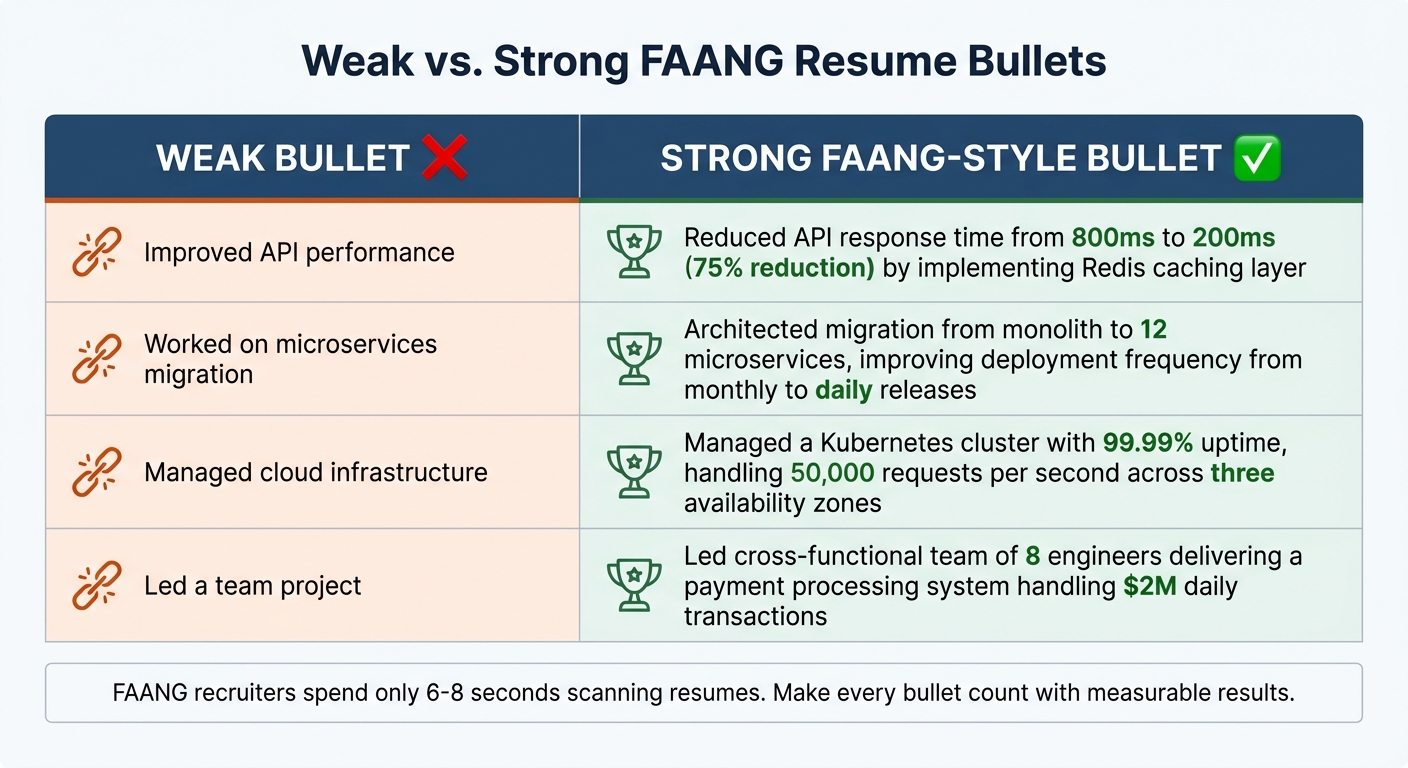
Weak vs Strong FAANG Resume Bullet Points Comparison
Did you know that FAANG recruiters typically spend just 6–8 seconds scanning a resume? With such limited time, every bullet point on your resume must highlight measurable results and technical expertise. Vague descriptions like "responsible for backend services" or "worked on microservices migration" won’t cut it - they're often dismissed by applicant tracking systems (ATS) and recruiters alike. To stand out, each bullet should clearly demonstrate the impact you've made.
The Action-Impact Formula
Once your resume layout is streamlined, the next step is crafting impactful bullet points. A proven method is using the Google XYZ Formula: "Accomplished [X] as measured by [Y], by doing [Z]." This structure forces you to specify what you achieved, how success was measured, and the technical approach you used. For example:
"Reduced API response time from 800ms to 200ms (75% reduction) by implementing a Redis caching layer."
This example shows technical expertise, quantifiable results, and the specific steps you took to achieve them.
To make your bullets even stronger, use action verbs like Architected, Optimized, Refactored, or Spearheaded. Avoid passive terms such as "helped" or "assisted", which fail to convey ownership and impact.
| Weak Bullet | Strong FAANG-Style Bullet |
|---|---|
| Improved API performance | Reduced API response time from 800ms to 200ms (75% reduction) by implementing Redis caching layer |
| Worked on microservices migration | Architected migration from monolith to 12 microservices, improving deployment frequency from monthly to daily releases |
| Managed cloud infrastructure | Managed a Kubernetes cluster with 99.99% uptime, handling 50,000 requests per second across three availability zones |
| Led a team project | Led cross-functional team of 8 engineers delivering a payment processing system handling $2M daily transactions |
Choosing Achievements That Match the Role
Once your bullets are well-structured, tailor them to match the job you're applying for. Highlight accomplishments that align with the job description and the company’s priorities. For instance, if the role emphasizes scalability, include metrics like "handled 50M daily requests" or "processed 10k transactions per second." If cost optimization is key, mention achievements such as "saved $2M annually in infrastructure costs by migrating from EC2 to Lambda."
Here’s an important tip: 76.4% of tech recruiters filter candidates based on specific skills. To ensure your resume passes these filters, use the exact terminology from the job posting. For example, if the listing mentions "React.js", don’t just say "React." Similarly, if it highlights "distributed systems", use that precise phrase. Resumes with quantified metrics are also 40% more likely to receive interview requests than those that only list responsibilities. Focus on results like performance improvements (e.g., latency reduction), business outcomes (e.g., revenue growth, cost savings), and engineering quality (e.g., test coverage, deployment frequency).
Demonstrating Career Progression
FAANG companies value not just what you’ve done but how you’ve grown over time. If you’ve been promoted, make it clear on your resume. For example, include a line like:
"Promoted from Software Engineer to Senior Software Engineer (March 2024)."
Even if you haven’t had a formal promotion, you can show growth by highlighting increased responsibilities. For instance, describe how you progressed from implementing individual features to owning entire systems, mentoring junior team members, or influencing architectural decisions across teams.
Here’s how to tailor your resume based on your experience level:
- Junior candidates (1–3 years): Focus on your learning curve and project outcomes.
- Mid-level engineers (3–5 years): Highlight independent contributions and ownership of features.
- Senior and staff engineers (5+ years): Emphasize technical leadership, system design, and organizational impact.
As Cody, a former Google recruiter, puts it:
"The top of the resume is prime real estate. Put the shiny bits up top to grab the recruiter's attention."
Customizing Your Resume for Each FAANG Company
When applying to FAANG companies, a generic resume just won't cut it. Each company has its own unique values and priorities, and tailoring your resume to match these is essential. To stand out, your resume must align with both the technical and cultural expectations of the company, while also passing ATS filters and impressing recruiters. Services like Scale.jobs can help strike this balance by combining ATS optimization with a human touch. While the overall structure and results-driven focus of your resume should remain consistent, the language, metrics, and examples must reflect what each company values most.
Google: Technical Depth and Problem-Solving
Google looks for candidates who embody "Googleyness", which includes traits like intellectual curiosity, adaptability, and problem-solving skills. They value depth over speed, so your resume should highlight complex technical challenges and innovative solutions. For example, instead of saying, "Improved database performance", opt for something like:
"Optimized distributed query engine to handle 500M+ daily queries across 12 data centers, reducing P99 latency from 450ms to 80ms."
If you've worked on projects involving distributed systems, algorithmic complexity, or large-scale data processing, make sure to include specific metrics to demonstrate your impact.
Meta: Product Impact and Data-Driven Results
Meta is all about rapid execution and measurable results. Your resume should emphasize speed, experimentation, and tangible outcomes. Use terms like "A/B testing", "iteration cycles", and "user growth" to frame your achievements. For instance:
"Launched checkout flow redesign in 3 weeks through 8 A/B experiments, increasing conversion rate from 12.3% to 15.8% and generating $4.2M in additional quarterly revenue."
Meta values decisions made quickly, even with incomplete data, so highlight instances where you prioritized impact over perfection.
Amazon: Leadership Principles and Scale
Amazon evaluates candidates based on its 16 Leadership Principles, with an emphasis on "Customer Obsession", "Ownership", "Bias for Action", and "Frugality." Your achievements should reflect these principles. For example:
- Customer Obsession: "Reduced checkout error rate from 2.1% to 0.3% by implementing real-time validation, preventing 45,000 failed orders monthly and boosting customer satisfaction scores by 18 points."
- Frugality: "Migrated image processing pipeline from EC2 to Lambda, cutting infrastructure costs from $180,000 to $42,000 annually while maintaining 99.95% uptime."
Amazon operates at an enormous scale, so include metrics like cost savings, request volumes, or customer impact wherever possible.
Apple: Innovation and Cross-Team Collaboration
Apple values attention to detail, craftsmanship, and seamless hardware-software integration. Your resume should highlight work that demonstrates precision, privacy-conscious design, and cross-functional collaboration. For example:
"Optimized video rendering pipeline to reduce battery consumption by 22% on iOS devices, extending playback time from 8.5 to 10.4 hours while maintaining 60fps performance across all iPhone models."
If you've collaborated with hardware teams, designers, or other disciplines, make sure to emphasize this, as Apple prizes teamwork across domains.
Netflix: Independent Decision-Making and Ownership

Netflix values autonomy and trust, expecting candidates to make impactful decisions with minimal supervision. Your resume should reflect independent problem-solving and ownership of key outcomes. For instance:
"Independently designed a CDN failover strategy for 15M concurrent streams, preventing $8M in potential revenue loss during a regional outage."
Avoid phrases like "assisted" or "supported." Instead, use terms like "owned", "architected", or "drove" to highlight your leadership and influence. Recruiters at Netflix look for evidence that you can make high-stakes decisions and shape strategies independently.
For those looking to refine their resumes further, platforms like Scale.jobs can help pinpoint and align with the unique cultural and technical expectations of FAANG companies, ensuring your application stands out.
Making Your Resume ATS-Compliant and Recruiter-Friendly
Creating a resume that works for both ATS software and human recruiters is no small feat. With 97.8% of Fortune 500 companies relying on ATS software and 76% of ATS rejections linked to formatting issues, it's clear that striking the right balance is crucial. A well-structured resume with clear language and strategically placed keywords not only satisfies ATS requirements but also appeals to recruiters.
Matching Keywords from Job Descriptions
Once your resume has a solid, ATS-friendly structure, the next step is to focus on keywords. Job descriptions are your best resource here. Companies like FAANG use specific terms intentionally, as their ATS platforms are designed to look for exact matches. For example, if the job posting mentions "React.js", avoid using variations like "React" or "ReactJS." Similarly, if "low-latency systems" is listed, don't substitute it with "high-performance systems." Candidates who match the job title in their resume headline are 3.5 times more likely to land an interview.
Pay attention to high-priority technical terms that often appear in FAANG job postings, such as distributed systems, scalability, microservices, CI/CD, API design, and cloud infrastructure (AWS, GCP, Azure). Integrate these naturally into your achievements using an action-impact formula. For instance: "Optimized distributed systems with Go and Kubernetes, cutting latency by 30% across 8 data centers." This method not only embeds keywords but also highlights your real-world accomplishments. Additionally, include full terms and abbreviations like "Continuous Integration/Continuous Deployment (CI/CD)" or "Search Engine Optimization (SEO)" to cover all bases.
Organize your technical skills into clear categories - such as Languages, Frameworks, Cloud/DevOps, and Databases - to make them easily searchable. Since 76.4% of recruiters filter candidates by skills within ATS systems, this organization can significantly impact your chances.
Avoiding Formatting That Breaks ATS
Many ATS failures happen because of formatting choices that, while visually appealing to humans, are unreadable by software. Avoid using photos, infographic-style elements, charts, logos, or graphics. Most ATS systems cannot interpret information embedded in images or graphics, meaning those details will be ignored entirely.
Stick to a single-column layout for simplicity. Ensure your contact information is placed within the body of the document, rather than in the header or footer, as many ATS systems skip these sections. Use standard section headers like "Professional Experience", "Education", and "Technical Skills" instead of creative titles like "My Journey" or "Where I've Been", which may confuse ATS algorithms.
When listing achievements, opt for standard round bullets rather than custom symbols, arrows, or unusual dashes, as older ATS systems might misinterpret them. Stick to web-safe fonts such as Arial, Calibri, or Garamond in 10-11pt size to ensure your resume is displayed consistently across platforms.
Choosing the Right File Format
The file format you choose can also affect how well your resume is parsed. Submitting your resume in .docx format is often the safest choice, as Microsoft Word files are widely recognized and reliably parsed by ATS systems. If you prefer to use PDF for visual consistency, make sure the text is selectable and not an image scan. Using a modern PDF generator that retains text layers is essential.
Before submitting, conduct a plain text test by pasting your resume into Notepad. This helps you see how the text appears without formatting. If it looks disorganized or incomplete, an ATS may struggle to process it as well. This quick check can save you from losing out on opportunities due to formatting errors.
For those looking for professional assistance, expert resume writing services can provide the technical adjustments and polish needed to make your resume stand out to both ATS systems and recruiters. Scale.jobs offers tailored solutions to help ensure your resume meets the high standards of FAANG applications and beyond.
Common Resume Mistakes to Avoid
Small, preventable mistakes can cost even the most qualified candidates valuable opportunities. With 87% of tech recruiters prioritizing ATS compatibility, resumes that use multi-column layouts, profile photos, or infographic-style skill bars often confuse these systems, leading to rejection before a recruiter even sees them. Add to that the fact that recruiters spend just 6 to 8 seconds scanning a resume initially, and early errors can quickly derail your chances.
Here’s how to avoid common missteps and ensure your resume resonates with FAANG recruiters.
Handling Employment Gaps
Employment gaps aren’t career-ending, but unexplained breaks can raise questions for human recruiters. Instead of ignoring these gaps, address them briefly and focus on how you stayed productive. For instance, if you worked on open-source projects, earned certifications, or developed side projects, include these in a dedicated "Projects" or "Professional Development" section. Use the same date format as your employment history to maintain consistency.
For example, if you took six months off in 2024 to care for a family member, you could include:
“Open Source Contributor, React Native Community (Mar–Sep 2024): Merged 12 pull requests improving accessibility features, adopted by 200+ production apps.”
This approach highlights your continued skill development and shows initiative. If you’ve worked with a job application service during a career transition, they can help refine these sections to maintain a smooth narrative while addressing potential recruiter concerns.
Removing Generic Task Descriptions
Generic descriptions like "worked on backend systems" or "assisted with database optimization" fail to showcase your impact. Recruiters want to see measurable results and evidence of technical decision-making. The XYZ formula is a great tool for this: "Accomplished [X] as measured by [Y], by doing [Z]."
Here’s a comparison:
- Weak: "Responsible for database optimization."
- Strong: "Reduced database query execution time from 2.3s to 340ms by implementing indexed views and query plan optimization, enabling real-time analytics for 5M+ users."
The second example clearly outlines the problem, the solution, and the outcome. Including metrics like percentages, time reductions, or user impact can double your chances of landing an interview.
Matching Content to Role Level
Your resume needs to reflect the responsibilities and achievements appropriate for your career stage. Junior candidates overstating their experience or senior professionals underselling their leadership can both hurt your chances. FAANG recruiters want resumes that match the role’s expectations.
- Junior roles: Highlight technical execution, foundational skills, and project contributions.
- Senior roles: Focus on leadership, system ownership, and strategic decision-making.
For example, mid-career professionals (5–10 years of experience) should show a clear progression. Instead of writing, "Built features using Python and Django", you might say:
“Led a team of 3 engineers to migrate legacy monolith to microservices architecture, reducing deployment time from 4 hours to 15 minutes and enabling weekly releases.”
This shift demonstrates growth from individual contributor to technical leader, which is exactly what recruiters at this level are looking for. Building ATS-friendly resumes can also improve callback rates by 40%, while including leadership examples can boost your ATS score by another 25%.
Common Resume Mistakes and Fixes
Here’s a quick guide to common resume mistakes and how to correct them:
| Resume Element | Mistake | Fix |
|---|---|---|
| Layout | Using multi-column formats, graphics, or photos | Stick to single-column, text-only layouts with standard fonts |
| Length | Exceeding 1 page for junior/mid-level roles | Limit to 1 page for candidates with less than 10 years of experience |
| Bullet Points | Listing responsibilities ("Responsible for...") | Focus on achievements ("Reduced latency by...") |
| Skills | Listing 20+ languages and tools | Highlight 8–12 core, relevant skills |
| Education | Keeping it at the top after 5+ years of experience | Move education below work experience after 5 years |
Conclusion: Preparing Your FAANG-Ready Resume
Crafting a resume for FAANG companies requires precision and strategy. Begin with a single-column, reverse-chronological layout to ensure compatibility with Applicant Tracking Systems (ATS). Unlike tools like Rezi.ai, which rely solely on automation, scale.jobs combines human expertise with technical optimization to refine every detail of your resume. Each bullet point should clearly outline your actions, the measurable results, and the impact you achieved. Place your most impactful accomplishments at the top of your most recent role to grab a recruiter’s attention during their quick scan.
Why Choose Scale.jobs Over Automated Competitors Like Rezi.ai
- Human expertise ensures nuanced adjustments that automated tools often overlook, especially those aligned with FAANG-specific expectations.
- Tailored customization for each FAANG company, reflecting their unique values and technical demands.
- ATS-optimized resumes with human oversight to eliminate formatting errors and boost visibility.
- One-time payment with dedicated WhatsApp support, avoiding recurring subscription fees.
- Transparency in revisions, with clear explanations of changes and their impact on your candidacy.
Align Your Resume with FAANG Company Values
Each FAANG company has distinct priorities, and tailoring your resume to reflect these is essential:
- Amazon looks for alignment with its Leadership Principles.
- Google emphasizes technical expertise and large-scale problem-solving.
- Meta values rapid execution and data-driven decision-making.
- Netflix prioritizes independent thinking and ownership.
Use keywords directly from the job description to optimize for ATS filters. For example, write "React.js" instead of "React" or "low-latency systems" instead of "high-performance systems." These small adjustments can significantly improve your resume’s visibility.
Avoid Common Resume Pitfalls
Common resume formatting mistakes can disqualify even the most qualified candidates. Stick to clean, single-column layouts and avoid graphics, tables, or multi-column designs. Save your resume as a .docx file for maximum ATS compatibility, and keep it to one page if you have fewer than 7–10 years of experience. If you're struggling to create a polished, ATS-friendly resume, consider working with a professional resume service that specializes in FAANG applications.
"The resume that wins is the one that shows, fast and convincingly, why you're the solution to a very specific problem." - Kathleen English, Balfour Beatty US
Final Tips for Success
To stand out, focus on quantifying your achievements, aligning them with the specific values of the company, and ensuring your resume is both ATS-friendly and engaging for recruiters. These strategies help you rise above candidates relying solely on automated tools.
Consider switching to scale.jobs if:
- Your resume keeps getting filtered out by ATS despite strong qualifications.
- You need personalized, hands-on support instead of generic templates.
- You want measurable improvements with clear explanations of changes.
- You prefer a one-time fee over ongoing subscriptions.
- You require company-specific customization that reflects FAANG’s unique values and expectations.
FAQs
How do I prove impact if I don’t have strong metrics?
If you don’t have solid metrics to showcase, shift the focus to qualitative aspects of your work. Emphasize the range of your responsibilities, the challenges tackled in your projects, or the overall impact your efforts had on the organization. For instance, you could describe how you enhanced a system’s reliability, streamlined processes to save time, or spearheaded an important initiative. Craft clear and compelling statements to highlight your contributions and demonstrate your value, even if exact numbers aren’t available.
How should I tailor the same resume for each FAANG company?
Customizing your resume for each company is a smart way to grab attention and improve your chances of landing an interview. Start by aligning your resume with the specific priorities of the company. Here’s how:
- Focus on Relevant Skills and Keywords: Carefully review the job description to identify key skills, projects, and keywords that the company values. Incorporate these into your resume to demonstrate you're a strong match for the role.
- Highlight Achievements with Impact: Adjust your bullet points to emphasize the problems you solved, the measurable impact of your work, and any technical expertise you brought to the table. For example, instead of saying “Managed a team of developers,” you could say, “Led a team of 5 developers to deliver a scalable application, improving system performance by 30%.”
- Reorder Sections Strategically: If the company prioritizes certain aspects like scalability or innovation (e.g., Google), make sure those sections are prominent on your resume. Tailoring the order of your sections can help recruiters quickly see your alignment with their needs.
- Ensure ATS Compatibility: Many companies use Applicant Tracking Systems (ATS) to screen resumes. Use clear formatting, avoid overly complex designs, and include relevant keywords to ensure your resume makes it through the initial screening.
By tailoring your resume this way, you not only align with recruiter preferences but also increase your chances of standing out during the review process. If you need help refining your resume, tools like an AI resume builder can simplify the process and ensure precision.
How can I quickly test if my resume will parse correctly in ATS?
To ensure your resume is compatible with Applicant Tracking Systems (ATS), consider using tools like Jobscan to simulate ATS software. These tools can help you evaluate formatting, keyword alignment, and overall compatibility. Stick to best practices by using a clean, single-column design, standard fonts, and clear section headings. Avoid intricate layouts like infographics or multi-column formats, as these can confuse the system. Incorporate keywords relevant to the job role to enhance how well your resume is parsed. Taking these steps can fine-tune your resume, increasing your chances of success when you apply for jobs.