
Is Sonara Hurting Your Job Search Without You Knowing?
Automated job apps can be generic, trigger ATS rejections, and lack proof of submission—see why automation may hurt your job hunt.

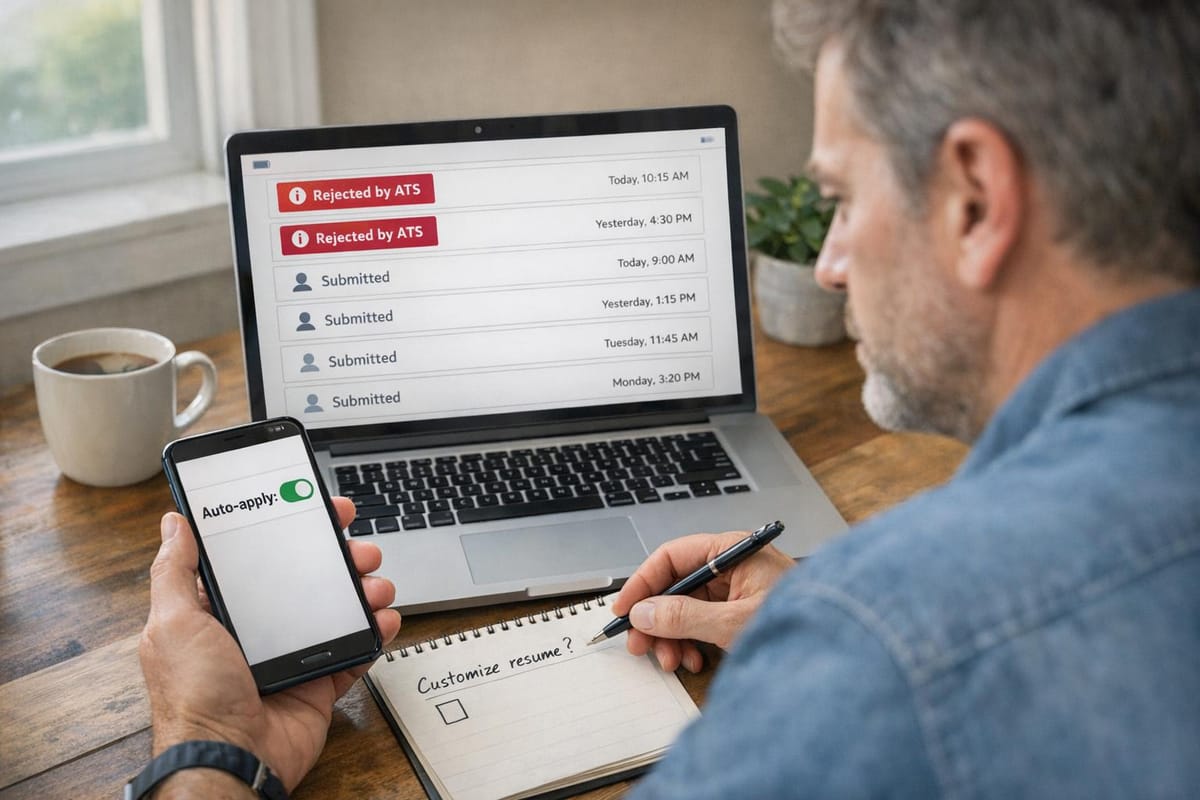
- Generic Applications: Automated submissions lack customization, reducing response rates to under 3%.
- ATS Rejections: Poor formatting and keyword mismatches lead to resumes being auto-rejected by Applicant Tracking Systems (ATS).
- Lack of Transparency: Users report no proof of application submissions, leaving them unsure if their resumes even reached employers.
For competitive or specialized roles, tools like Scale.jobs offer a better alternative. They provide human-verified, tailored applications and clear updates, ensuring your resume aligns with job requirements and reaches recruiters effectively.
Quick Comparison
| Feature | Sonara | Scale.jobs |
|---|---|---|
| Submission Method | Automated AI | Manual, human-verified |
| Personalization | None | Customized for each job |
| Transparency | Limited (no proof of submission) | Full proof with screenshots |
| Pricing | Subscription-based | Flat-fee, refundable credits |
If you're struggling to land interviews, reconsider relying solely on automation. Explore options like Scale.jobs for a more effective job application service.
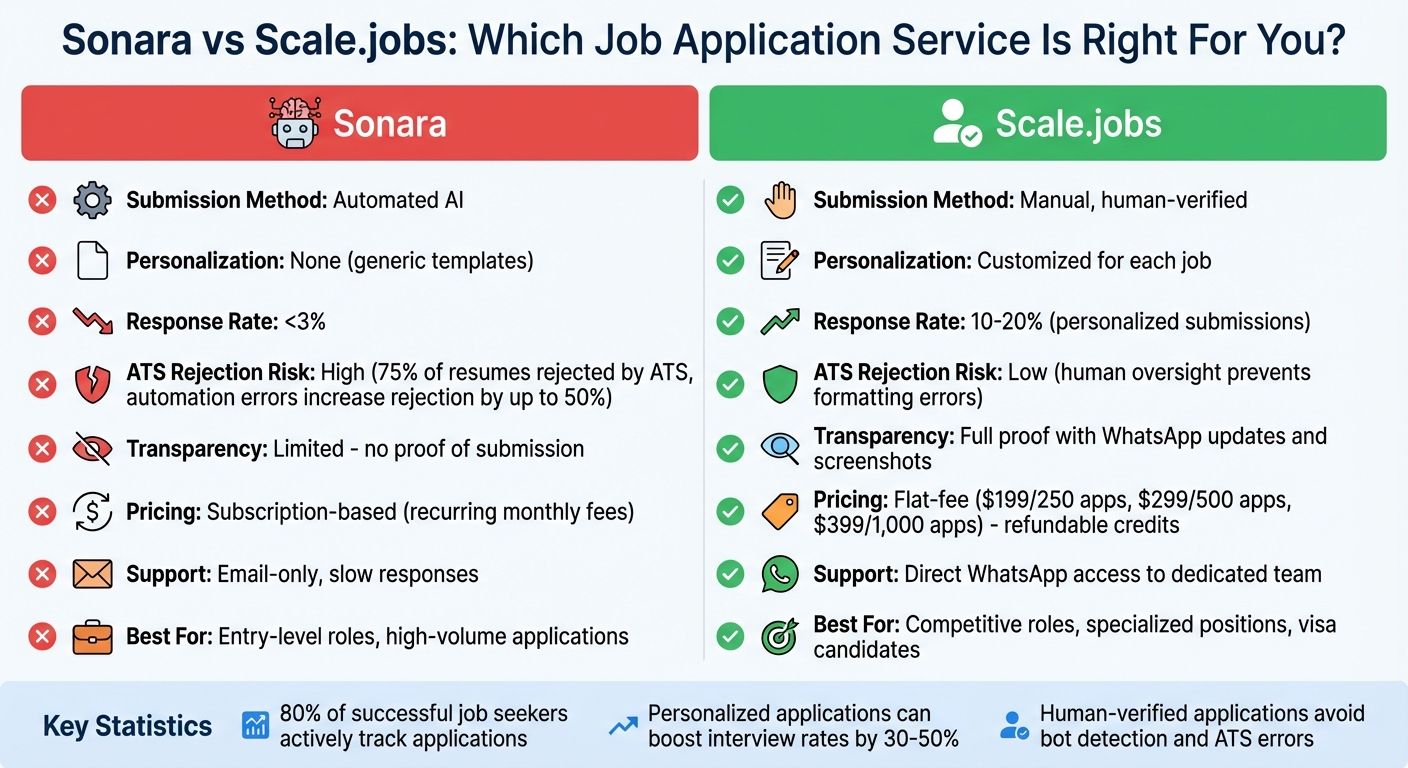
Sonara vs Scale.jobs Job Application Services Comparison
The real reason you shouldn’t pay AI bots to apply to jobs for you… 👀
sbb-itb-564272e
3 Ways Sonara Can Damage Your Job Search
Understanding the challenges associated with Sonara can help job seekers recognize why relying on automated applications might lead to fewer opportunities.
Generic Applications Get Overlooked
Sonara relies on automation to send out standardized applications, but this approach often backfires. The system uses templates that fail to adjust to specific job descriptions, meaning every employer receives the same generic resume and cover letter. These submissions lack tailored keywords and achievements that demonstrate genuine interest in a position.
Recruiters, who often sift through hundreds of applications, can easily spot these one-size-fits-all documents. As a result, generic applications typically yield response rates of less than 3%, compared to 10–20% for personalized submissions. This lack of customization not only reduces your chances of standing out but also creates problems when automated systems process your application.
Automation Errors Lead to ATS Rejections
Sonara’s automation process frequently runs into trouble with Applicant Tracking Systems (ATS), often leading to rejections before a human even reviews your application. Users have reported issues such as incorrect parsing of information, formatting mismatches, and problems with PDF conversions. For instance, one marketer discovered that resumes generated by Sonara were auto-rejected due to unreadable PDF formatting, confirmed through an ATS simulator.
Additionally, the polished but impersonal style of AI-generated resumes can be flagged by advanced ATS filters, which may detect overuse of keywords or patterns typical of automated tools. Considering that 75% of resumes are already rejected by ATS before reaching a recruiter, these technical missteps can further reduce your chances of landing an interview by up to 50%, even if you are otherwise qualified. Beyond these technical issues, Sonara also falls short in providing users with transparency about their applications.
Lack of Submission Proof or Visibility
While Sonara offers a dashboard that lists the jobs you’ve supposedly applied to, it doesn’t provide any tangible proof of submission, such as screenshots, confirmation emails, or employer receipts. This lack of transparency leaves users in the dark. For example, one G2 reviewer noted they applied to 500 jobs through Sonara but had no evidence to confirm whether the applications were actually submitted. This uncertainty makes it difficult to know whether to follow up or if duplicate applications were accidentally sent.
Without clear submission records, it’s nearly impossible to identify errors, track progress, or refine your job search strategy. Research shows that 80% of successful job seekers actively track their applications to improve their approach. Sonara’s opaque process can undermine trust and motivation, leaving users unsure if their lack of responses is due to their qualifications or if the applications never reached employers in the first place.
What Sonara Does Well (and What It Doesn't)
Building on the drawbacks discussed earlier, let's take a closer look at Sonara's strengths and where it falls short.
Fast, High-Volume Applications
One of Sonara's standout features is its speed. The platform scans through millions of job openings and submits applications at a pace that’s hard to match. For job seekers aiming to apply to as many roles as possible - especially in entry-level or high-turnover fields - Sonara delivers in terms of sheer volume. This can be particularly helpful for those looking to maximize their chances by applying to numerous positions quickly.
The automation takes care of repetitive tasks like filling out forms and uploading documents, saving users a considerable amount of time. If you're targeting jobs that don’t require highly tailored applications, Sonara’s efficiency can be a huge time-saver compared to manually submitting applications one by one.
However, this speed comes with a trade-off: a lack of personalization.
No Resume Customization or Human Review
Sonara's major weakness lies in its lack of tailored applications and human oversight. The platform relies solely on generic AI-generated templates, with no human intervention to refine or customize your documents. This means your application materials remain the same, regardless of the role or company.
This approach can be a significant disadvantage for those seeking mid-level or specialized roles, where hiring managers expect applications to reflect a clear understanding of the company and position. Unlike some resume writing services, which offer personalized, human-reviewed documents, Sonara’s automated process sends identical applications to vastly different employers - whether it’s a tech startup, a Fortune 500 company, or a nonprofit. This lack of customization can lead to lower response rates, especially for competitive roles.
The balance between quantity and quality is a key consideration when comparing Sonara to platforms like scale.jobs, which prioritize tailored applications for better results.
Why Scale.jobs Beats Sonara
When comparing Scale.jobs and Sonara, the edge lies in human oversight, tailored services, and clear communication. While Sonara relies heavily on automation, which can lead to ATS errors or missed opportunities, Scale.jobs takes a hands-on, personalized approach to job applications.
What Makes Scale.jobs Stand Out?
- Real human assistants manage every application manually.
- Tailored resumes and cover letters for each job.
- Flat-fee pricing with no hidden costs or subscriptions.
- Transparent updates through WhatsApp with proof of submission.
Here’s a closer look at why Scale.jobs outperforms Sonara in these critical areas.
Applications Submitted by Real People
At Scale.jobs, human assistants handle every step of the application process. They manually fill out forms, upload documents, and navigate employer portals. This eliminates the risks associated with automation, such as bot detection or applications getting stuck in "pending" status - issues that can plague tools like Sonara.
Human oversight also means assistants can tackle challenges that automation can’t, like handling two-factor authentication (2FA), email verifications, or complex application portals. With this hands-on approach, your applications actually make it to the recruiter’s desk instead of vanishing into the void.
Resumes and Cover Letters Customized for Each Role
Scale.jobs doesn’t take a one-size-fits-all approach. Instead, your assistant creates job-specific resumes and cover letters by analyzing the job description and aligning your materials with the employer’s needs. This improves your ATS scores and increases your chances of landing interviews.
This level of personalization mirrors the quality you’d get from a professional resume writing service, but it’s seamlessly integrated into the application process. Whether you’re targeting a startup or a Fortune 500 company, Scale.jobs ensures your documents are fine-tuned for the role.
Simple, Flat-Fee Pricing
Unlike Sonara’s subscription model, Scale.jobs uses a flat-fee structure. You pay a one-time fee based on the number of applications you need - starting at $199 for 250 applications and going up to $399 for 1,000 applications. There are no recurring charges, and any unused credits are refundable.
Sonara, on the other hand, charges monthly fees regardless of how many applications are submitted or their outcomes. For those on a budget or seeking cost predictability, Scale.jobs offers a more straightforward and budget-friendly option.
Real-Time Updates with Proof of Submission
Transparency is a cornerstone of Scale.jobs. You’ll receive WhatsApp updates with time-stamped screenshots for every application. Your assistant shares portal receipts, confirmation emails, and other proof-of-work documentation so you know exactly where your applications stand.
Sonara’s dashboard, by contrast, simply marks applications as "Sent" without providing detailed confirmation. This lack of transparency can leave job seekers in the dark about whether their applications even reached the employer.
| Feature | Sonara | Scale.jobs |
|---|---|---|
| Submission Method | Automated AI (risk of bot detection) | Human-verified manual submissions |
| Transparency | Basic dashboard tracking; no proof of receipt | WhatsApp updates with screenshots and receipts |
| Support | Email-only; slow responses | Direct WhatsApp access to a dedicated team |
| Verification | None; applications may get stuck | Proof-of-work documentation, including portal receipts |
Why Choose Scale.jobs?
Scale.jobs is the better choice if:
- You want manual oversight to avoid ATS errors and bot detection.
- You need proof of submission with screenshots and receipts.
- You prefer a flat-fee payment model without subscriptions.
- You value personalized resumes tailored to each job.
- You appreciate direct, real-time support via WhatsApp.
Take the time to evaluate these features and decide which platform aligns best with your job search goals. Whether you're applying for full-time jobs or exploring part-time jobs near me, Scale.jobs ensures your applications are handled with care and precision.
Who Should Use Sonara vs. Who Should Choose scale.jobs
Choosing between Sonara and scale.jobs depends on your specific job search needs and priorities. Here's a closer look at which tool aligns better with different scenarios.
When Sonara Makes Sense
Sonara is a better fit for job seekers who value speed and volume over precision. This makes it ideal for recent graduates or individuals applying to entry-level roles where casting a wide net is necessary. If you're targeting positions like customer service representative, sales associate, or administrative assistant - roles with similar job descriptions across companies - Sonara's automated system can help you cover a lot of ground quickly.
It’s also a practical choice for those with limited financial resources who need a no-cost solution to get started. However, the lack of customization and transparency in application tracking means it may not be the best option for those looking to stand out in a competitive job market. If your job search requires a more tailored and strategic approach, you might need to explore other alternatives.
When scale.jobs Is the Better Choice
For job seekers tackling competitive roles or specialized requirements, scale.jobs offers a more targeted and detail-oriented solution. This is especially true for mid-level and senior professionals in fields like tech, finance, consulting, or engineering, where manual resume reviews and human-led submissions can make a significant difference. For roles at top companies such as Google, Amazon, or JPMorgan Chase - where the competition is fierce - scale.jobs ensures your application avoids common pitfalls like ATS (Applicant Tracking System) errors and bot detection.
International candidates dealing with visa complexities (H1B, F1 CPT/OPT, TN, or O1) will also benefit from the precision and expertise offered by scale.jobs. Their assistants are trained to handle the intricate documentation and compliance requirements that automated tools might overlook, ensuring your visa status doesn’t hinder your job search.
If you’ve been recently laid off and need to focus on networking and interview preparation, scale.jobs can save you significant time by managing the bulk of your applications. With updates sent via WhatsApp, complete with timestamped screenshots, you’ll always know the exact status of your applications - no guesswork involved. This level of transparency and efficiency is invaluable for those juggling multiple priorities during their job hunt.
The flat-fee pricing model ($199 for 250 applications, $299 for 500, or $399 for 1,000) also makes scale.jobs a cost-effective choice for those who want a quality-focused approach. Any unused credits are refundable, ensuring you only pay for what you use. If speed and volume are your priorities, Sonara might be the way to go. But for competitive, high-stakes applications that require attention to detail, scale.jobs is the smarter option.
For more personalized support, consider exploring their resume writing services to further enhance your application process.
Decision Summary: Sonara vs. Scale.jobs
Note: While Sonara ceased operations in February 2024, its automation model still serves as a reference point for comparing job application tools.
When deciding between automation and manual customization, it boils down to your job search goals. If you're targeting over 100 entry-level positions - like roles in customer service, retail, or administrative work - automation can help you quickly apply to a large number of jobs with similar descriptions. However, for competitive positions at companies such as Amazon, Google, or JPMorgan Chase, or when dealing with visa complexities (H1B, F1 CPT/OPT), generic applications often fail to make it past applicant tracking systems (ATS). In these cases, tailored applications are crucial.
Track your success rate. Submitting hundreds of automated applications but receiving no callbacks is a sign that generic submissions are being filtered out. Scale.jobs takes a manual, personalized approach, which often results in higher response rates. Their human assistants fine-tune each application to align with ATS requirements, optimize keyword placement, and customize cover letters. This attention to detail can significantly improve your chances of landing interviews, making the cost per application less relevant compared to the overall conversion rate.
Automation tools may seem cost-effective initially, but expenses can add up during a prolonged 3–6-month job search. Scale.jobs offers flat-rate pricing - $199 for 250 applications, $299 for 500, and $399 for 1,000 - with refunds for unused credits. The real value lies in the results: if personalized applications boost your interview rate by 30–50%, the higher upfront cost is justified by quicker placements and better job matches.
To achieve the best outcomes, consider a mixed approach. Use Scale.jobs for high-stakes roles where customization is critical, and reserve automation for positions where standing out is less important. Scale.jobs also provides transparency through WhatsApp updates and screenshot confirmations for every submission. For even greater impact, their resume writing services can help refine your materials, ensuring you're presenting your strongest case to potential employers.
FAQs
How can I tell if my applications were actually submitted?
To ensure your job applications are successfully submitted, look for features like status updates, confirmation messages, or even take a screenshot as proof. Platforms such as Scale.jobs stand out by offering real-time updates and transparent tracking through workflows that include human oversight. This approach provides a more reliable way to confirm submissions. On the other hand, automated tools like Sonara.ai may experience higher failure rates and lack dependable confirmation mechanisms, making platforms with human involvement a better option for verifying your applications.
What’s the fastest way to check if my resume is getting rejected by ATS?
The fastest way to determine if your resume is being filtered out by an ATS (Applicant Tracking System) is by using an ATS testing tool or service. Platforms like Scale.jobs specialize in creating resumes that align with ATS requirements, blending professional insights with optimized formatting to boost your chances. For better accuracy, opt for a service that provides clear feedback and proof of their work. Alternatively, you can try free or paid ATS scanning tools to pinpoint any areas where your resume might fall short.
When should I stop using automation and switch to human-applied submissions?
If automated tools like Sonara.ai lead to disappointing outcomes - such as low response rates, high rejection rates from Applicant Tracking Systems (e.g., a 40% failure rate), or even spam flags - it might be time to consider a human-driven approach. This is particularly important for competitive roles where a personalized, ATS-friendly resume can make all the difference. Human-assisted services excel at crafting tailored applications, improving callback rates, and offering clearer insights into the process. When automation falls short, these services can provide the edge needed to achieve better results.