12 Industries Still Aggressively Sponsoring H1B in 2026
2026 H‑1B reforms and a $100K fee favor higher-wage roles and OPT candidates, reshaping sponsorship across 12 industries.


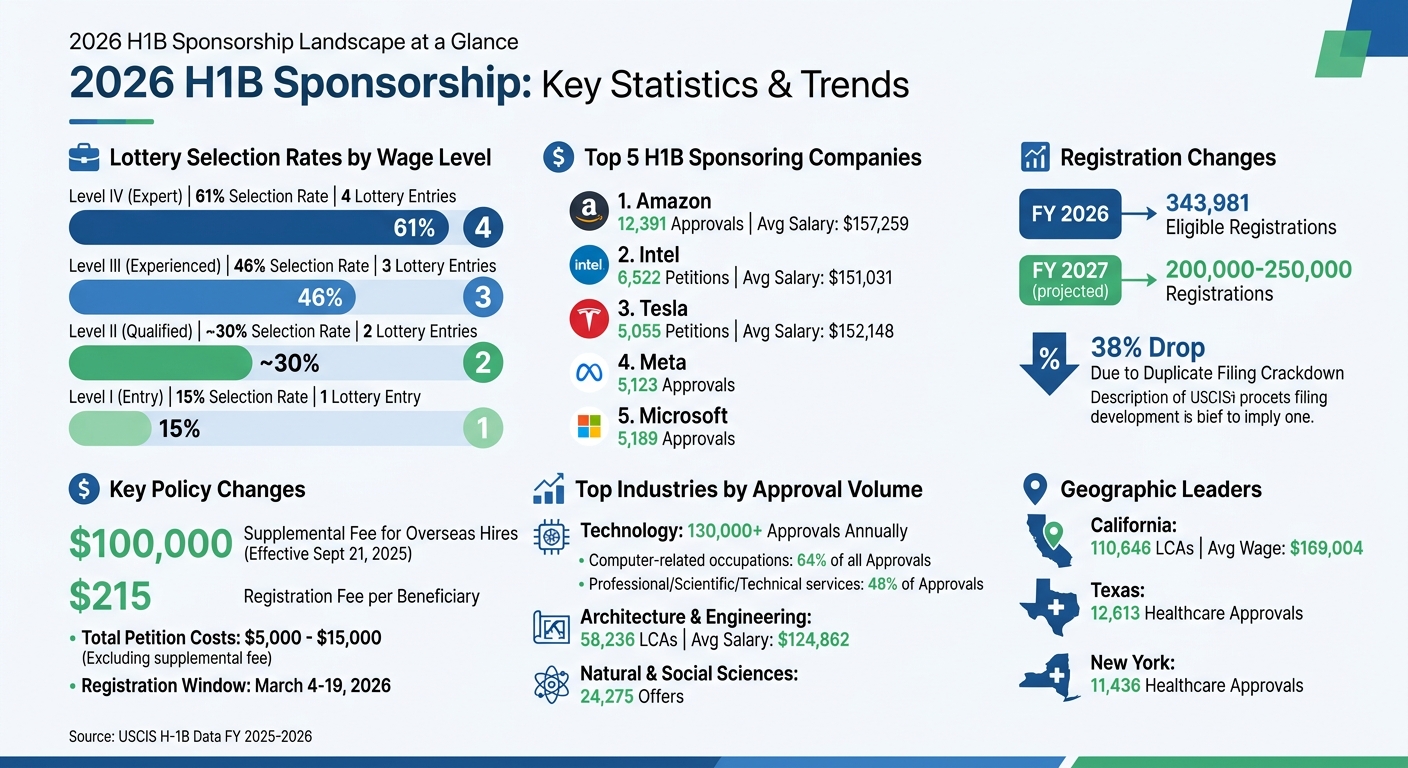
The H1B sponsorship landscape in 2026 has shifted significantly due to new regulations. The wage-weighted lottery system introduced by USCIS on February 27, 2026, prioritizes higher salary levels, with Level IV roles enjoying a 61% selection rate compared to just 15% for entry-level positions. Additionally, a $100,000 supplemental fee for overseas hires has led employers to focus on hiring F-1 OPT candidates already in the U.S.
Here’s a quick summary of the top industries actively sponsoring H1B visas and their key trends:
- Technology: Big Tech companies like Amazon, Google, and Microsoft lead with over 130,000 approvals annually. AI, machine learning, and semiconductor roles are in high demand.
- Finance: Firms such as JPMorgan Chase and Goldman Sachs are prioritizing tech-driven roles, with a focus on quantitative and AI expertise.
- Healthcare: Cap-exempt institutions like university hospitals provide year-round sponsorship opportunities, avoiding the lottery system.
- Semiconductors: Companies like Intel and NVIDIA are ramping up hiring, driven by the CHIPS Act.
- Consulting: Big Four firms and IT consultancies are focusing on mid-to-senior roles with higher salary levels.
Key Takeaways:
- Higher wages improve odds: Level III/IV roles have better chances in the lottery.
- Domestic hiring focus: F-1 OPT candidates are preferred due to cost savings from the supplemental fee exemption.
- Cap-exempt pathways: Research institutions and nonprofits offer alternative sponsorship routes.
For job seekers, strategic applications tailored to wage levels and industry trends are crucial. Platforms like scale.jobs provide human-assisted application services to align with these requirements, ensuring compliance with ATS and wage thresholds.
Explore how industries like technology, finance, healthcare, and more are navigating the new H1B landscape below.
H1B Visa Sponsorship Statistics 2026: Selection Rates and Top Industries
1. Technology
Key Companies Sponsoring H1B
Amazon continues to lead the way in H1B sponsorships, securing 12,391 approvals in FY 2025, reflecting an increase of 787 from the previous year. The Big Tech heavyweights - Amazon, Google, Microsoft, Apple, and Meta - collectively account for over 130,000 H1B approvals annually. Microsoft obtained 5,189 approvals, followed by Meta with 5,123, Apple with 4,202, and Google with 4,181. Cisco Systems sponsored 1,570 roles, primarily in network engineering and software development, while Nvidia filed 1,255 applications in California, offering an average salary of $226,005.
Outside of Big Tech, IT consulting firms such as Infosys, TCS, and Cognizant remain prominent sponsors, though their average salaries tend to lag behind the tech giants. Meanwhile, semiconductor companies like Intel and Qualcomm have ramped up sponsorship efforts, particularly for hardware and firmware engineers, in response to the CHIPS Act. Additionally, cutting-edge AI research labs, including OpenAI and Anthropic, are actively sponsoring roles, often filing at Level IV wage tiers to boost their chances in the lottery.
With these sponsorship figures in mind, let’s delve into the roles and skills that are currently in high demand in the tech industry.
In-Demand Roles and Skills
AI and machine learning positions are among the most sought-after, offering salaries between $180,000 and $310,000. Roles such as machine learning engineers, AI research scientists, and data scientists are particularly popular, with selection rates ranging from 46% to 61% for Level III/IV wages. Senior software engineers, earning a median salary of $175,000, also see strong sponsorship activity.
The semiconductor industry is experiencing a surge in demand for process engineers and hardware designers, driven by efforts to enhance domestic manufacturing capabilities. Meanwhile, full-stack developers, DevOps engineers, and site reliability engineers continue to secure sponsorships, though entry-level positions face tougher odds, with lottery success rates hovering around 15%.
Candidates applying in mid-sized cities like Austin or Raleigh may benefit from a strategic advantage. In these areas, a Level II salary can often meet Level IV wage criteria, significantly improving lottery odds.
H1B Sponsorship Trends in 2026
The introduction of a $100,000 supplemental fee for overseas hires, effective September 21, 2025, has shifted employer preferences. Companies now favor F-1 students on OPT already in the U.S., as they are exempt from this fee through "change of status" petitions. For tech professionals, navigating these complexities can be challenging, but using platforms like scale.jobs that blend human expertise with technology can make the process smoother.
H1B registrations for FY 2027 are projected to drop to 200,000–250,000, down from 343,981 in FY 2026, due to the new beneficiary-centric selection system. Geographic strategy has become increasingly important, with candidates targeting cities like Austin or Raleigh to take advantage of favorable wage classifications. For those looking to bypass the lottery altogether, cap-exempt opportunities at university research labs or nonprofit AI institutes provide an alternative pathway.
If you’re aiming to stand out in this competitive landscape, services like professional resume writing can help tailor your application to meet specific wage-level thresholds.
Tools and Strategies for Securing Sponsorship
Before applying, research a company’s sponsorship history using resources like the USCIS H‑1B Employer Data Hub or H1BGrader.com. Follow a daily job search system well in advance - ideally 6–9 months before the March registration window (March 4–19, 2026) - to allow time for internal approvals. When negotiating, aim to restructure equity or bonuses into base pay to elevate your wage level from II to III.
Focus on specific SOC codes that align with specialty occupations. For example, SOC code 15‑1221 (Computer and Information Research Scientists) is well-suited for AI research roles and offers competitive wage thresholds. While most H‑1B sponsors are smaller companies with just 1–5 approvals annually, they may face less competition than Big Tech. If the lottery doesn’t work out, consider cap-exempt employers like university AI labs or the Allen Institute for AI, which are not subject to the annual 85,000 cap.
Unlike automated tools like LazyApply, scale.jobs offers a human-assisted approach that ensures precise alignment with wage levels and provides transparency throughout the process.
sbb-itb-564272e
2. Finance and Banking
Key Companies Sponsoring H1B
In the finance sector, companies like JPMorgan Chase, Goldman Sachs, and Capital One dominate H1B sponsorships, with fintech firms such as Stripe, Robinhood, and Chime quickly gaining ground. While competitors like LazyApply focus on automated mass applications, scale.jobs offers a tailored approach that stands out with human oversight, ATS-optimized documents, a straightforward payment model, real-time WhatsApp support, and proof of submission for every application.
JPMorgan Chase leads the pack with 2,440 H1B approvals in FY 2025, showing a year-over-year increase of 721 petitions. Goldman Sachs and Morgan Stanley maintain their strong sponsorship records, particularly for analyst and associate roles. Among regional banks, Capital One sponsors 321+ visas, while asset management leaders like BlackRock (230+ approvals) and State Street Bank (157+ approvals) prioritize technology and quantitative expertise.
Fintech companies are also stepping up. Stripe, Robinhood, and Chime are actively hiring international talent for engineering and specialized finance roles. Visa Technology & Operations focuses on payments and fintech infrastructure, while Bloomberg LP targets data, finance, and technology professionals. Deutsche Bank (123+ approvals) and Barclays continue to sponsor roles in technology and risk management, reflecting the growing overlap between finance and tech.
What makes scale.jobs a better choice for finance applications:
- Human oversight: Applications are carefully tailored to meet wage-level thresholds and specific job requirements.
- ATS-optimized resumes: Documents are refined for finance-specific keywords and compliance with applicant tracking systems.
- One-time payment: A flat fee starting at $199 covers 250 applications - no recurring fees.
- Dedicated WhatsApp support: Stay connected with your assistant for real-time updates.
- Proof-of-work: Time-stamped screenshots validate every submission.
With these sponsorship trends in mind, let’s explore the roles and skills that make international candidates indispensable in finance.
In-Demand Roles and Skills
Quantitative researchers, financial analysts, and investment banking associates are among the most sponsored roles due to their classification as "specialty occupations." Other high-demand positions include risk analysts, compliance officers, and financial engineers, especially in best US states for H1B sponsorship like New York, North Carolina, Illinois, and California. Traditional banks are also increasingly sponsoring roles in AI, cloud computing, and machine learning to keep pace with fintech competitors.
Under the 2026 wage-weighted lottery system, higher-paying Level IV roles receive four lottery entries, offering a 61% selection rate, compared to just one entry (15% chance) for Level I roles. For instance, a Level II salary in New York City may qualify as Level IV in smaller markets, significantly improving lottery odds through strategic geographic targeting.
H1B Sponsorship Trends in 2026
The introduction of a $100,000 supplemental fee for overseas candidates has shifted employer preferences toward U.S.-based F-1 students on OPT, who are exempt from this fee through "change of status" petitions. Consequently, H1B registration volumes dropped 38% following USCIS's crackdown on duplicate applications, creating a more competitive yet fairer landscape for genuine applicants.
Finance companies are increasingly sponsoring tech-driven roles. Computer-related occupations, including fintech and high-frequency trading positions, account for 64% of all H1B approvals. Meanwhile, professional, scientific, and technical services - encompassing finance-related consulting - make up 48% of industry approvals. Most major finance firms align their hiring cycles with the March H1B registration window (March 4–19, 2026), primarily recruiting for full-time positions in the fall.
Scale.jobs capitalizes on these trends with a human-assisted approach that ensures precision and compliance, setting it apart from generic platforms.
Scale.jobs vs LazyApply: Why You Should Switch
Who might consider LazyApply:
LazyApply works best for candidates focused on high-volume, low-targeted applications across various industries, where speed outweighs precision. If you're applying to numerous entry-level positions without specific wage-level targeting, automated submissions may suffice.
Why scale.jobs is the smarter choice:
For candidates targeting specialized Level III/IV roles in finance, scale.jobs offers unmatched precision. With ATS-optimized resumes tailored to wage thresholds, manual application oversight to prevent errors, and transparent proof of submission, it’s the ideal platform for those seeking high-quality results.
Comparison Table:
| Feature | LazyApply | scale.jobs |
|---|---|---|
| Human Involvement | Automated bot submissions | Skilled assistants manually handle applications |
| Resume Customization Depth | Generic templates | Tailored, ATS-optimized for finance roles |
| ATS Handling | May trigger spam filters | Human verification ensures compliance |
| Application Execution Method | Automated form-filling | Manual submissions with quality checks |
| Transparency & Proof-of-Work | Limited tracking | Time-stamped screenshots for every application |
| Pricing Model | Recurring subscription | One-time payment starting at $199 |
Choose scale.jobs if:
- You’re targeting higher-level finance roles where precision is more critical than volume.
- You need resumes customized for specific wage thresholds and SOC codes.
- You want human oversight to avoid ATS rejections or application errors.
- You value transparency and proof of submission over automated processes.
- You prefer dedicated support throughout your job application journey.
Tools and Strategies for Securing Sponsorship
Before applying, check a company’s sponsorship history using the USCIS H-1B Employer Data Hub or DOL Disclosure Data. H1B holders are eligible for FINRA licenses (e.g., Series 7 and 63), so clarify this with employers concerned about regulatory requirements. Starting with OPT before transitioning to H1B can help you avoid the $100,000 supplemental fee.
Focus on Level III or IV roles to improve your lottery odds. These positions receive three or four lottery entries compared to just one for entry-level roles. Unlike generic tools like Rezi.ai or Jobscan.co, scale.jobs provides personalized refinements that align with higher wage-level thresholds. For candidates applying from outside the U.S., consider working with professional resume writers who understand how to position your experience effectively. Premium processing, costing $2,805, can reduce USCIS adjudication time to 15 business days, and employers often cover this expense.
Next, we’ll explore how scale.jobs outshines automated competitors in meeting the unique demands of the finance industry.
3. Healthcare
Key Companies Sponsoring H1B
In the healthcare sector, H1B sponsorship is split between cap-exempt institutions like Mayo Clinic and Johns Hopkins University and cap-subject corporations such as UnitedHealth Group and Pfizer. Cap-exempt employers, including universities, nonprofit research organizations, and government research entities, have a significant advantage - they can file H1B petitions year-round without being restricted by the lottery system. This makes them a popular choice for international professionals aiming to sidestep the competitive selection process.
UnitedHealth Group stands out as a major cap-subject sponsor, while academic medical centers dominate the cap-exempt space. Institutions like NYU Langone Health, Mount Sinai, Memorial Sloan Kettering, and NewYork-Presbyterian Hospital actively sponsor roles such as physicians, clinical researchers, and biostatisticians. Other notable names, including Massachusetts General Hospital and Johns Hopkins University, are well-known for their strong sponsorship records in research-focused roles. Additionally, pharmaceutical companies like Pfizer, Johnson & Johnson, and Bristol Myers Squibb continue to hire international talent for positions in drug development and clinical trials, although they must navigate the March registration window and the new wage-weighted lottery system.
While many platforms offer automated application services, scale.jobs' human-assisted approach stands out in the healthcare sector. This field requires precise alignment with wage levels and ATS compliance, which can significantly impact lottery outcomes. Moreover, the introduction of a $100,000 supplemental fee for overseas candidates has led employers to prioritize F-1 students on OPT, as they can change their status without incurring this additional cost, making domestic candidates more appealing.
In-Demand Roles and Skills
Key roles in the healthcare industry with high sponsorship demand include physicians, clinical scientists, biostatisticians, specialized therapists, and allied health professionals. Over the past year, natural and social science occupations, which include many healthcare research positions, accounted for 24,275 H1B offers. Under the 2026 wage-weighted lottery system, higher wage levels significantly improve selection odds. For instance, Level IV roles have a 61% selection rate compared to the 15% for Level I roles.
Geographic salary differences also play a strategic role. For example, a Level II salary in New York City might qualify as Level IV in a smaller metro area, enhancing the chances of selection. In 2026, healthcare employers in California led H1B approvals with 21,559, followed by Texas (12,613) and New York (11,436), reflecting the regional demand for specialized talent in the medical field. These nuances are shaping the sponsorship landscape as healthcare hiring evolves.
H1B Sponsorship Trends in 2026
The wage-based lottery system, implemented on February 27, 2026, has reshaped how healthcare employers approach hiring. Experts predict a drop in FY 2027 registrations to between 200,000 and 250,000, down from the 343,981 eligible registrations in FY 2026. This decline follows the USCIS's efforts to address duplicate filings. The registration fee remains $215 per beneficiary, with total employer petition costs ranging from $5,000 to $15,000.
Cap-exempt institutions remain the most reliable path to U.S. employment for international healthcare professionals. Unlike cap-subject employers that must compete in the March lottery, hospitals affiliated with universities and nonprofit research centers can hire year-round. This advantage has led many international candidates to focus on these organizations to avoid the uncertainty of the lottery. For those navigating this complex landscape, understanding these trends is crucial, especially when selecting the right tools and strategies for job applications.
Tools and Strategies for Securing Sponsorship
Choosing the right application strategy is critical for healthcare professionals seeking H1B sponsorship. This is where scale.jobs excels, offering a human-assisted approach that outperforms automated alternatives. Here are some key strategies:
- Verify sponsorship history: Use reliable USCIS resources to confirm an employer's sponsorship record.
- Target cap-exempt employers: These institutions allow you to bypass the lottery entirely, offering a more secure path to employment.
- Negotiate for higher wage levels: Positions at Level III or IV significantly improve lottery odds compared to entry-level roles.
- Leverage F-1/OPT status: If applicable, emphasize the cost savings for employers, as the supplemental fee does not apply to change-of-status petitions.
Timing is another critical factor. Secure offers and sponsorship commitments between September and February to prepare for the March registration window. For tailored applications and ATS optimization, working with professional resume writers who understand wage-level classifications can make a significant difference in your application outcomes.
Simplify.jobs vs scale.jobs: Why You Should Switch for Healthcare Applications
Simplify.jobs provides automated job applications with one-click submissions, but its generalized approach often falls short in the complex sponsorship landscape of healthcare. Here’s why scale.jobs is a better fit for healthcare professionals:
Why scale.jobs leads the way:
- Human oversight for wage-level accuracy: Skilled assistants ensure your applications align with Level III/IV wage thresholds, maximizing lottery odds - something automated tools can't guarantee.
- ATS-optimized resumes for healthcare: Applications are tailored with industry-specific keywords, SOC codes, and wage classifications to pass hospital and pharmaceutical ATS scoring algorithms.
- Transparent pricing: Starting at $199 for 250 applications with no recurring fees, compared to Simplify.jobs' monthly subscription model.
- Dedicated support: Real-time guidance via WhatsApp for strategic advice on cap-exempt vs. cap-subject applications.
- Proof-of-work: Time-stamped screenshots validate every submission, offering accountability that automated platforms lack.
Who should use Simplify.jobs: Ideal for candidates applying to high-volume, non-specialized entry-level positions across various industries.
Who should choose scale.jobs: Best for healthcare professionals targeting Level III/IV roles at academic medical centers, pharmaceutical companies, or research institutions where precision and compliance are crucial.
Comparison Table:
| Feature | Simplify.jobs | scale.jobs |
|---|---|---|
| Human Involvement | Automated one-click submissions | Skilled assistants manually handle applications |
| Resume Customization | Generic templates | ATS-optimized for healthcare roles |
| ATS Handling | May trigger spam filters | Human verification ensures compliance |
| Application Method | Automated form-filling | Manual submissions with quality checks |
| Transparency | Limited tracking | Time-stamped screenshots for every application |
| Pricing Model | Monthly subscription | One-time payment starting at $199 |
Why switch to scale.jobs?
- You're focused on specialized healthcare roles requiring precise wage-level positioning.
- You need resumes tailored for specific SOC codes and prevailing wage thresholds.
- You're applying to cap-exempt institutions where quality matters more than quantity.
- You value human oversight to avoid ATS rejections at major healthcare systems.
- You want transparency and proof of submission.
Compared to fully automated platforms, scale.jobs offers human-verified applications, ATS-optimized documents, and real-time support - essential tools for navigating the competitive H1B landscape in healthcare.
4. Semiconductors and Manufacturing
Key Companies Sponsoring H1B
The semiconductor and advanced manufacturing industries are at the forefront of H1B sponsorship in 2026, largely driven by the CHIPS Act, which aims to boost domestic production. Intel leads the hardware sector with 6,522 H1B petitions filed, offering an average salary of $151,031. NVIDIA follows with 3,244 petitions and an impressive average salary of $221,796. In the manufacturing space, Tesla filed 5,055 petitions with an average salary of $152,148, while Qualcomm Technologies (3,786 petitions, $165,709 average) and Applied Materials (901 petitions, $159,314 average) also stand out.
In addition to these major players, Tier 1 suppliers such as Bosch, Honeywell, and Raytheon are actively sponsoring H1B visas. Electric vehicle (EV) makers are also making their mark, with Rivian Automotive (1,256 petitions, $155,121 average) and Lucid USA (1,199 petitions, $170,177 average) increasing their sponsorship efforts. Traditional automotive giants like General Motors (1,538 petitions) and Ford (1,797 petitions) continue to bring in international talent.
The introduction of a $100,000 supplemental fee for new H1B applications targeting workers outside the U.S. has made candidates already in the country on F-1 OPT status more appealing to budget-conscious semiconductor and manufacturing firms.
Why scale.jobs Stands Out for Semiconductor Applications:
- Human Oversight for Accuracy: Skilled assistants ensure applications meet specific SOC code requirements (e.g., 17-2071 for Electrical Engineers) and align with wage-level thresholds critical for semiconductor roles.
- Tailored Resumes: Documents are optimized with industry-specific keywords like CAD software expertise, CHIPS Act relevance, and hardware design skills.
- Wage-Level Positioning: Applications are reviewed to frame salary qualifications effectively, improving chances for Level III/IV lottery selection.
- Proof of Submission: Time-stamped screenshots validate every application submitted to major semiconductor companies.
- One-Time Payment: $199 for 250 applications, compared to LazyApply's recurring subscription model.
Who Should Use LazyApply: Ideal for candidates prioritizing high-volume, generic applications across multiple industries where speed is more critical than precision.
Who Should Use scale.jobs: Best for professionals targeting specialized semiconductor roles, requiring human oversight, ATS-optimized applications, and precise wage-level alignment to boost lottery odds.
With these sponsorship trends in mind, the next section delves into the roles and skills in high demand within the semiconductor and manufacturing sectors.
In-Demand Roles and Skills
In FY 2025, architecture and engineering occupations ranked as the second-highest group for H1B sponsorship, with 58,236 labor condition applications filed at an average salary of $124,862. The semiconductor sector specifically shows high demand for Electronics Engineers and Electrical Engineers, with companies like Cypress Semiconductor achieving a 100% certification rate for 53 LCAs at an average salary of $166,459. Similarly, Samsung Electronics America secured 619 H1B approvals between 2020 and 2023, highlighting the ongoing need for specialized engineering expertise.
Proficiency in CAD and simulation software - such as SolidWorks, CATIA, and ANSYS - is a key advantage for candidates in manufacturing engineering roles. Under the wage-weighted lottery system, Level IV roles have a 61% selection rate compared to just 15% for Level I positions. Professionals targeting roles in the $95,000–$130,000+ range (Level III or IV) can significantly increase their lottery odds.
H1B Sponsorship Trends in 2026
Employers are increasingly focused on Level III and IV roles, which receive three to four times more lottery entries than entry-level positions. Experts predict that FY 2027 registrations will drop to between 200,000 and 250,000, compared to 343,981 eligible registrations in FY 2026, as USCIS works to eliminate duplicate filings. The registration fee remains $215 per beneficiary, with total employer petition costs ranging from $5,000 to $15,000, excluding the new supplemental fee. Traditional manufacturing companies like Caterpillar, John Deere, and GE are also ramping up H1B sponsorships for automation and software roles, reflecting the industry's modernization efforts.
Tools and Strategies for Securing Sponsorship
As seen in the technology and finance sectors, scale.jobs uses human expertise to tackle H1B challenges in semiconductor manufacturing. Precision tools and human oversight are especially important in this field, making scale.jobs a better choice than automated alternatives.
Candidates should check sponsorship histories through USCIS resources, aim for roles qualifying for Level III or IV wages, and use F-1 OPT status to highlight exemption from the $100,000 supplemental fee.
LazyApply vs scale.jobs: Comparison for Semiconductor Professionals
| Feature | LazyApply | scale.jobs |
|---|---|---|
| Human Involvement | Automated bot submissions | Skilled assistants manually handle applications |
| Resume Customization Depth | Generic templates | ATS-optimized for semiconductor roles with SOC code alignment |
| ATS Handling | May trigger spam filters | Human verification ensures compliance |
| Application Execution Method | Automated form-filling | Manual submissions with quality checks |
| Transparency & Proof-of-Work | Limited tracking | Time-stamped screenshots for every application |
| Pricing Model | Recurring subscription | One-time payment starting at $199 |
When to Choose scale.jobs:
- You’re targeting Level III/IV semiconductor engineering roles where wage positioning is crucial.
- You need resumes tailored to specific SOC codes and prevailing wage thresholds.
- You require human oversight to avoid ATS rejections at major chip manufacturers.
- You value detailed proof of submission over automated processes.
- You’re applying for CHIPS Act-funded positions that demand precise technical keyword alignment.
For those navigating the complexities of H1B applications in semiconductor and manufacturing roles, professional resume writing services from scale.jobs can provide the tailored support needed to stand out. With features like ATS-optimized documents, human oversight, and transparent submissions, scale.jobs offers a reliable path to success in this competitive field.
5. Aerospace and Defense
Key Companies Sponsoring H1B
The aerospace and defense industry continues to support H1B visa sponsorship in 2026, though it faces challenges related to security clearances and ITAR restrictions. Automated platforms like LazyApply may offer high-volume applications, but they often fall short in addressing the industry's specific compliance and wage-level requirements, which are critical for lottery success.
Major companies such as Boeing, Lockheed Martin, Raytheon Technologies, and Northrop Grumman remain key sponsors, focusing more on commercial aerospace roles than defense-specific programs. SpaceX is also heavily involved in sponsoring H1B visas, particularly for its launch services and commercial satellite operations.
Innovative firms in urban air mobility and drone technology are also stepping up their H1B sponsorship efforts. For instance, Joby Aero sponsored over 48 visas last year, targeting aerospace engineers and specialists in urban air mobility systems. Skydio sponsored more than 15 visas for drone systems and software engineering roles, while Dassault Falcon Jet and BETA Technologies focused on avionics and electric aviation, sponsoring 9+ and fewer than 5 visas, respectively. Wichita, Kansas, has emerged as a key hub for aerospace H1B jobs, driven by companies like Spirit AeroSystems and other aerospace manufacturing centers.
Entry-level aerospace engineers typically earn between $85,000 and $100,000 annually, while senior architects can command salaries up to $180,000. California leads in H1B visa applications, with 110,646 LCAs and an average wage of $169,004, followed by Texas and Washington with average wages of $123,752 and $161,523, respectively.
In-Demand Roles and Skills
Aerospace companies are in search of professionals for roles such as structural engineers, process engineers, systems architects, and project managers - positions that require expertise in integrating complex hardware and software systems. Preferred degrees include aeronautical engineering, mechanical engineering, systems engineering, and computer science. With a national shortage of over 500,000 skilled aerospace workers, having a well-thought-out application strategy is essential.
The wage-weighted H1B lottery system introduced in February 2026 has significantly impacted the selection process. Level IV roles now receive four lottery entries, offering a ~61% selection rate, compared to one entry (~15% selection rate) for Level I positions. Additionally, a $100,000 supplemental fee applies to H1B petitions for candidates outside the U.S., making F-1 students already in the country on OPT status more attractive to employers.
H1B Sponsorship Trends in 2026
Security clearance requirements remain a significant hurdle for H1B holders in the aerospace and defense industry. Most classified programs are restricted to "U.S. persons", which pushes international candidates toward commercial aerospace roles at companies like Boeing Commercial Airplanes or SpaceX. Approximately 90% of aerospace companies report fewer hiring errors by focusing on skills-based recruitment, emphasizing candidates' abilities over specific job titles or degrees.
"The search for the 'perfect' candidate has become a primary driver of program schedule slippage. When a critical role stays open... it is a direct threat to mission readiness."
Roughly 87% of aerospace and defense companies now use AI for screening resumes and scheduling interviews. However, about 30% plan to eliminate remote work by 2026, citing the need for collaborative engineering and secure environments. Meanwhile, startups in satellite technology and urban air mobility are becoming increasingly active H1B sponsors, often including equity in their compensation packages.
For aerospace professionals, platforms like scale.jobs offer tailored support that outperforms competitors like LazyApply by addressing the industry's unique needs with precision and compliance.
LazyApply vs scale.jobs: Why You Should Switch for Aerospace Applications
Why scale.jobs is better for aerospace professionals:
- Human oversight for ITAR compliance: Skilled assistants ensure applications meet export control requirements and align with commercial versus defense classifications - something automated tools can't manage.
- Wage-level accuracy: Applications are optimized for Level III/IV roles, improving lottery odds in an industry where salaries vary widely based on location and specialization.
- ATS-optimized resumes: Resumes are customized with aerospace-specific keywords (e.g., CAD software, FAA compliance) and proper SOC code alignment (e.g., 17-2011 for Aerospace Engineers).
- Transparency: Time-stamped screenshots validate every submission, offering accountability that automated platforms lack.
- Cost-effective pricing: A one-time payment of $199 for 250 applications, compared to LazyApply's recurring subscription model.
Who benefits from LazyApply:
LazyApply is suitable for candidates applying to high-volume, entry-level positions across various industries where speed is more important than precision or compliance.
Who should choose scale.jobs:
Aerospace professionals targeting Level III/IV roles in commercial aerospace, urban air mobility, or satellite technology firms will benefit most from scale.jobs. The platform excels in wage positioning, ITAR compliance, and ATS optimization.
Comparison Table:
| Feature | LazyApply | scale.jobs |
|---|---|---|
| Human Involvement | Automated bot submissions | Skilled assistants manually handle applications |
| Resume Customization | Generic templates | Tailored for aerospace roles with SOC code alignment |
| ATS Compliance | Risk of spam filters | Human-verified for compliance |
| Application Method | Automated form-filling | Manual submissions with quality checks |
| Transparency | Limited tracking | Time-stamped proof for every application |
| Pricing | Recurring subscription | One-time payment starting at $199 |
Switch to scale.jobs if:
- You're aiming for Level III/IV aerospace engineering roles, where wage positioning is crucial.
- You need resumes tailored to SOC codes and prevailing wage levels for commercial aerospace.
- ITAR compliance is a concern, and you want human oversight.
- You're applying to startups in urban air mobility or satellite technology that require precise keyword alignment.
- You value detailed proof of submission and dedicated support.
Tools and Strategies for Securing Sponsorship
To navigate aerospace H1B sponsorship challenges, use tools like scale.jobs to streamline your applications. Confirm ITAR restrictions early by asking recruiters directly about export control requirements. Focus on commercial divisions and non-classified programs to avoid delays related to security clearances.
If your degree is from outside the U.S., secure a NACES-approved evaluation before filing your petition, as many aerospace employers require this documentation upfront. For candidates targeting Level III or IV roles, consider using professional resume writing services to align your qualifications with prevailing wage levels and improve your application’s competitiveness.
Leverage resources like the USCIS H-1B Employer Data Hub to research a company's approval history or track H1B sponsoring companies before applying. If you're on F-1 OPT status, highlight your exemption from the $100,000 supplemental fee when approaching employers. Finally, begin the green card process by your third year of H1B status to ensure I-140 approval before needing a seven-year extension.
H-1B Visas News 2026 Major Policy Changes Fees and What You Must Know
6. Retail and Logistics
Retail and logistics play a pivotal role among the 12 industries actively sponsoring H1B visas in 2026. As companies increasingly emphasize technical and supply chain-focused roles, crafting a precise application strategy is vital. This is especially true when navigating the wage-weighted lottery system and ensuring compliance with ATS-friendly resumes and cover letters, both of which can significantly influence your chances of securing sponsorship.
Key Companies Sponsoring H1B
Amazon stands at the forefront of H1B sponsorship in the retail and logistics sector, filing 12,391 petitions in FY 2025. With an average salary of $157,259, Amazon's focus is on high-level technical and supply chain roles. Its sponsorship efforts span across multiple entities, including Amazon.com Services, Amazon Web Services (AWS), and Amazon Data Services, each submitting distinct Labor Condition Applications (LCAs).
Walmart Associates follows closely, with 2,390 H1B approvals in FY 2025. The company prioritizes corporate technology and supply chain roles over store-level positions. Other major players like Target, Costco, Home Depot, and eBay also sponsor H1B visas, concentrating on positions in data science, e-commerce infrastructure, and software engineering. Logistics companies such as FedEx focus on technical and data-driven roles supporting their global delivery networks. Additionally, employers are increasingly favoring F-1 students on OPT to avoid the $100,000 supplemental fee associated with overseas applicants.
In-Demand Roles and Skills
The demand for roles such as Software Engineers, Data Scientists, Machine Learning Specialists, Supply Chain Managers, Operations Managers, and Product Managers is on the rise. Employers seek expertise in areas like cloud computing (AWS/Azure), machine learning, data analytics, and supply chain management. Smaller retailers and e-commerce startups also sponsor H1B visas, often presenting less competition than larger corporations.
Under the wage-weighted lottery system introduced in February 2026, roles at Level IV have a 61% selection rate, compared to 15% for Level I roles. Meeting higher prevailing wage thresholds, influenced by local cost-of-living factors, can greatly improve your chances in the lottery.
H1B Sponsorship Trends in 2026
The H1B lottery selection rate reached 35.3% in FY 2026. Recent reforms by USCIS, aimed at curbing fraudulent filings, resulted in a 38% drop in registration volumes, creating a fairer selection process. Computer-related occupations, including many retail tech roles, accounted for 64% of all H1B approvals. Traditional retailers like Lowe's, Home Depot, and Target are now competing with tech firms to attract talent skilled in AI, machine learning, and cloud computing.
Geographic location plays a significant role in sponsorship success. Targeting Level III or IV roles at corporate headquarters in high-cost metropolitan areas can improve your odds. Many retailers are also focusing on domestic hiring to avoid the supplemental fee, making F-1 OPT candidates particularly appealing.
Next, learn how scale.jobs offers a more effective approach compared to LazyApply for retail and logistics applications.
LazyApply vs scale.jobs: Why You Should Switch for Retail & Logistics Applications
LazyApply provides automated mass applications, but its broad approach often misses the mark for retail tech roles, where precision in wage-level targeting and ATS compliance can make all the difference.
Why scale.jobs is better for retail and logistics professionals:
- Human oversight for accuracy: Skilled assistants ensure applications meet Level III/IV wage thresholds, enhancing lottery odds - something automated tools can’t provide.
- ATS-optimized resumes: Tailored documents include industry-specific keywords like "supply chain optimization" and "cloud computing", ensuring compatibility with corporate ATS systems at companies like Amazon, Walmart, and Target.
- Strategic targeting: For Amazon, applications are submitted separately to Amazon.com Services, AWS, and Amazon Data Services, accounting for distinct LCAs.
- Transparent pricing: A one-time fee of $199 for 250 applications, as opposed to LazyApply’s recurring subscription model.
- Dedicated support: Real-time assistance via WhatsApp helps with targeting corporate headquarters roles and highlighting F-1 OPT exemptions from supplemental fees.
- Proof-of-work: Time-stamped screenshots validate every submission, offering accountability that automated platforms lack.
LazyApply’s strength lies in speed, making it suitable for high-volume, entry-level applications across various industries where precision and wage-level targeting are less critical.
Who benefits from scale.jobs?
Retail and logistics professionals focusing on Level III/IV corporate tech roles at headquarters gain the most from scale.jobs. The platform excels in wage positioning, ATS optimization, and strategic multi-entity applications for companies like Amazon.
Comparison Table:
| Feature | LazyApply | scale.jobs |
|---|---|---|
| Human Involvement | Automated bot submissions | Skilled manual handling |
| Resume Customization Depth | Generic templates | ATS-optimized for retail tech roles |
| ATS Handling | May trigger spam filters | Human-verified compliance |
| Application Execution Method | Automated form-filling | Manual submissions with quality checks |
| Transparency & Proof-of-Work | Limited tracking | Time-stamped screenshots for every application |
| Pricing Model | Recurring subscription | One-time payment starting at $199 |
Switch to scale.jobs if:
- You’re targeting Level III/IV retail tech roles, where wage-level positioning can impact lottery outcomes.
- You need resumes tailored to specific SOC codes and prevailing wage thresholds for corporate headquarters positions.
- You’re applying to Amazon and require strategic submissions across multiple entities.
- You want human oversight to avoid ATS rejections at major retailers.
- You value detailed submission proof and dedicated support throughout your application process.
Tools and Strategies for Securing Sponsorship
Focus your applications on corporate roles at retail headquarters instead of store-level jobs. For Amazon, submit applications separately to Amazon.com Services, AWS, and Amazon Data Services, as each files distinct LCAs. If you’re on F-1 OPT, highlight your exemption from the $100,000 supplemental fee when engaging with recruiters.
Retailers rely heavily on ATS to filter resumes. Ensure your resume includes industry-specific keywords such as "supply chain optimization", "cloud computing", and "machine learning." For senior roles, consider using professional resume writing services to align your qualifications with prevailing wage levels and increase your competitiveness.
Leverage tools like the USCIS H-1B Employer Data Hub to research a company’s approval history and average salaries before applying. Target roles in higher prevailing wage tiers to improve your selection odds. Unlike automated platforms such as LazyApply, scale.jobs offers human-verified applications, ATS-optimized documents, and real-time support - key resources for navigating the competitive H1B landscape in retail and logistics.
7. Energy and Oil & Gas
The energy and oil & gas sector continues to be one of the leading sponsors of H1B visas in 2026, particularly in key regions like Texas, North Dakota, and the Gulf Coast. Unlike LazyApply's automated system, scale.jobs offers human-guided applications tailored to energy industry roles. To succeed in this field, understanding the sponsorship trends specific to energy companies is crucial. These firms focus heavily on specialized engineering and technical positions, with sponsorship extending to both petroleum and renewable energy companies.
Key Companies Sponsoring H1B
Major players such as General Electric, Honeywell, Caterpillar, and John Deere are consistent sponsors in the manufacturing and energy-adjacent sectors. Tesla and General Motors also sponsor H1B visas, particularly for energy technology roles. These companies typically prioritize corporate and research facility positions over field operations. Additionally, many firms are now favoring candidates already in the U.S. on F-1 OPT to avoid the $100,000 supplemental fee, which became mandatory for overseas hires requiring consular processing as of September 21, 2025.
In-Demand Roles and Skills
The most sponsored roles in this sector include petroleum engineers, process engineers, and industrial managers. Employers are looking for expertise in areas like reservoir modeling, drilling operations, production optimization, chemical processing, system safety, and efficiency auditing. With the growing integration of AI and machine learning into operations, software developers and data scientists are also in high demand. These roles often fall under Level III or IV wage categories, improving their odds in the wage-weighted lottery system. This shift has placed a sharper focus on experienced professionals within the sector.
H1B Sponsorship Trends in 2026
The wage-weighted lottery system introduced in February 2026 has significantly influenced sponsorship patterns in the energy sector. Selection rates for Level IV (Expert) roles are now estimated at 61%, while Level I (Entry) roles face a much lower chance at 15%. This has led energy companies to prioritize mid-to-senior-level professionals over entry-level candidates. Geographic location also plays a key role - a salary that qualifies as Level II in a high-cost city like San Francisco may qualify as Level IV in smaller energy hubs, effectively doubling the odds of selection. The supplemental fee for overseas candidates has further shifted the focus toward hiring individuals already in the U.S. on OPT or similar statuses.
Tools and Strategies for Securing Sponsorship
To succeed in securing sponsorship in the energy sector, a well-targeted application strategy is essential. Focus on roles that meet Wage Level III or IV criteria to maximize lottery chances. Use resources like the USCIS H-1B Employer Data Hub or MyVisaJobs.com to research a company’s sponsorship history before applying. If you're on F-1 OPT, highlight your exemption from the $100,000 supplemental fee during conversations with recruiters - this makes you a more attractive candidate. Direct your applications toward corporate headquarters and research facilities in energy hubs, as these locations are more likely to sponsor H1B visas. Ensure your resume includes industry-specific terms like "reservoir modeling", "drilling operations", and "production optimization" to navigate ATS screening systems effectively. For senior roles, consider leveraging ATS-friendly resume strategies to align your qualifications with wage-level requirements and strengthen your application.
LazyApply vs scale.jobs: Why You Should Switch for Energy Applications
Why scale.jobs stands out for energy professionals:
- Human oversight for wage-level accuracy: Skilled assistants ensure applications meet Level III/IV wage thresholds, improving lottery odds - something automated tools can't reliably achieve.
- ATS-optimized resumes for energy roles: Applications include industry-specific keywords like "reservoir modeling" and "production optimization" to pass ATS systems at major firms.
- Transparent pricing: A one-time payment of $199 for 250 applications, compared to LazyApply's recurring subscription fee.
- Dedicated support: Real-time advice via WhatsApp for targeting corporate roles and leveraging F-1 OPT exemptions.
- Proof-of-work: Time-stamped screenshots ensure accountability and transparency, which automated platforms lack.
Who benefits from LazyApply?
LazyApply works best for candidates applying to high-volume, entry-level roles across multiple industries where speed is more important than precision or wage-level considerations.
Who benefits from scale.jobs?
Energy professionals targeting Level III/IV roles at corporate headquarters, research facilities, or renewable energy firms will find scale.jobs invaluable. The platform excels in wage-level positioning, ATS optimization, and aligning resumes with industry-specific keywords.
Comparison Table:
| Feature | LazyApply | scale.jobs |
|---|---|---|
| Human Involvement | Automated bot submissions | Skilled assistants manage applications manually |
| Resume Customization Depth | Generic templates | ATS-optimized with industry-specific keywords |
| ATS Handling | May trigger spam filters | Human-verified for compliance |
| Application Execution Method | Automated form-filling | Manual submissions with quality checks |
| Transparency & Proof-of-Work | Limited tracking | Time-stamped screenshots for every application |
| Pricing Model | Recurring subscription | One-time payment starting at $199 |
Switch to scale.jobs if:
- You’re targeting Level III/IV engineering roles where wage-level positioning is key.
- You need resumes tailored to specific SOC codes and prevailing wage requirements.
- You’re applying to firms requiring precise technical keyword alignment.
- You value human oversight to avoid ATS rejections.
- You want detailed proof of submission and ongoing support during the application process.
8. Automotive and Engineering
The automotive and engineering industries remain major players in H1B sponsorship for 2026. This growth is fueled by advancements in electric vehicles, semiconductor manufacturing, and cutting-edge production technologies. For instance, General Motors submitted 574 petitions in FY 2025 - an increase of 106 from the previous year. Other prominent sponsors include Ford Motor Company, Boeing, Lockheed Martin, Raytheon Technologies, Honeywell, Caterpillar, and John Deere. In semiconductor and hardware engineering, Intel leads with 21,221 approvals, showcasing the influence of federal funding through the CHIPS and Science Act. Unlike LazyApply, which relies on bulk automated submissions, scale.jobs offers human-assisted, ATS-optimized applications that improve lottery chances by tailoring wage-level strategies and industry-specific details.
Key Companies Sponsoring H1B
Automotive and engineering companies focus their sponsorship efforts on headquarters, R&D centers, and advanced manufacturing facilities. General Motors and Ford prioritize roles in electric vehicle innovation, battery systems, and software integration. Aerospace and defense giants like Boeing, Lockheed Martin, and Raytheon Technologies sponsor engineers in areas such as systems design, avionics, and defense technologies. Meanwhile, industrial leaders like Caterpillar, Honeywell, and John Deere emphasize automation, robotics, and production optimization. The H-1B The $100,000 supplemental fee for overseas candidates00,000 fee for overseas candidates has made employers favor F-1 OPT holders already in the U.S., as they present a more cost-effective option.
In-Demand Roles and Skills
The range of engineering roles being sponsored has expanded significantly. Companies are now seeking professionals not only in mechanical engineering but also in electrical engineering, software development, systems engineering, and manufacturing. Expertise in areas like CAD/CAM design, finite element analysis, embedded systems, robotics, automation, battery technology, and semiconductor fabrication is particularly valued. Additionally, under the wage-weighted lottery system, senior roles at Level IV receive four times the lottery entries compared to Level I positions, significantly enhancing selection odds for experienced professionals. For a deeper dive into application strategies, explore how scale.jobs outperforms LazyApply in securing these competitive roles.
H1B Sponsorship Trends in 2026
Location plays a critical role in wage classification. For example, a salary considered Level II in San Francisco might qualify as Level IV in Austin, dramatically increasing selection odds. Sponsorship for advanced manufacturing and semiconductor roles is concentrated in states like Arizona, Texas, and Ohio due to industrial growth. Employers typically spend $5,000 to $15,000 per H1B petition, excluding supplemental fees, which further incentivizes hiring domestic candidates on OPT status. These trends highlight the value of platforms like scale.jobs, which optimize applications for these high-demand roles.
LazyApply vs scale.jobs: Why You Should Switch for Automotive & Engineering Applications
Why scale.jobs stands out for automotive and engineering professionals:
- Human oversight for wage-level precision: Skilled assistants ensure applications meet Level III/IV wage standards, boosting lottery chances - something automated platforms can't guarantee.
- ATS-optimized resumes tailored to engineering: Resumes are customized with industry-specific terms like "robotics", "embedded systems", and "semiconductor fabrication" to pass ATS filters at top firms.
- Transparent, one-time payment model: $199 covers 250 applications with no recurring fees, unlike LazyApply's subscription-based plans.
- Real-time support via WhatsApp: Get personalized guidance for targeting roles at corporate headquarters and leveraging F-1 OPT exemptions.
- Proof of submission: Time-stamped screenshots provide accountability, a feature missing in automated platforms.
Who benefits from LazyApply?
LazyApply is ideal for candidates pursuing high-volume, entry-level roles across various industries where speed takes precedence over precision.
Who should choose scale.jobs?
Automotive and engineering professionals targeting senior roles in R&D, corporate headquarters, or advanced manufacturing facilities should opt for scale.jobs. Its focus on wage-level positioning, ATS optimization, and technical keyword alignment makes it the better choice for these competitive applications.
Comparison Table:
| Feature | LazyApply | scale.jobs |
|---|---|---|
| Human Involvement | Automated submissions | Manual, expert-managed applications |
| Resume Customization Depth | Basic templates | Tailored with industry-specific terms |
| ATS Handling | Risk of rejection | Verified for ATS compliance |
| Application Method | Automated form-filling | Manual with quality checks |
| Transparency | Limited tracking | Time-stamped proof for every application |
| Pricing | Subscription-based | One-time fee starting at $199 |
Switch to scale.jobs if:
- You’re applying for Level III/IV roles where wage-level accuracy matters.
- You need resumes tailored to specific technical roles in automotive or aerospace industries.
- ATS optimization and human oversight are priorities to avoid rejections.
- You want proof of submission and ongoing support throughout the process.
Decision Summary:
Choose LazyApply for generic, high-volume applications across various fields. Opt for scale.jobs if you’re aiming for specialized roles in automotive and engineering, where attention to detail and precision can make all the difference.
Tools and Strategies for Securing Sponsorship
To improve your chances, target roles that align with Wage Level III or IV classifications. Use tools like the USCIS H-1B Employer Data Hub or MyVisaJobs.com to research a company’s sponsorship history before applying. If you’re on F-1 OPT, emphasize your exemption from the supplemental fee during recruiter discussions to highlight your cost advantage. It’s also crucial to apply early - secure offers by January or February to meet the March registration deadline. Focus your applications on R&D centers and corporate hubs in key regions, and ensure your resume includes terms like "CAD/CAM design", "robotics", and "semiconductor fabrication" to pass ATS filters. For senior-level roles, consider using professional resume services from scale.jobs to align your qualifications with Level III/IV requirements and enhance your application’s effectiveness.
9. Hospitality and Tourism
The hospitality and tourism industry is set to grow significantly by 2026, with over 30,000 new jobs expected to push total employment in direct hotel operations to around 2.2 million. This surge is fueled by the increasing popularity of "bleisure" travel - where business trips are combined with leisure - and the adoption of AI-driven guest services. Companies like Uber, the 20th largest H1B sponsor with 10,800 approvals, highlight the connection between transportation and tourism in this space. Employers often favor F-1 OPT holders since they are exempt from the $100,000 supplemental fee. While platforms like Simplify.jobs rely on automated tools that may trigger filtering systems, scale.jobs offers a personalized, human-assisted application process tailored to the unique demands of hospitality roles, which often require a blend of digital expertise and global awareness. This section explores how hospitality employers are adapting to these shifts and why scale.jobs stands out as a better choice for job seekers in this field.
Key Companies Sponsoring H1B
Large hotel chains, luxury resorts, and tech companies in the tourism sector dominate the H1B sponsorship landscape. Uber's 10,800 approvals emphasize the growing overlap between transportation and tourism. Employers are increasingly looking for candidates skilled in Property Management Systems (PMS), digital check-in technologies, and energy-efficient systems. Positions classified as Level IV, such as executive chefs, operations managers, and data scientists, have four times the lottery entries compared to Level I roles, making them particularly appealing. These opportunities are concentrated in major tourism hubs like New York, California, and Florida, where "bleisure" travel demand is strongest.
In-Demand Roles and Skills
The industry's demand for skilled professionals is evolving, with a focus on hybrid roles that combine traditional hospitality expertise with digital know-how. High-demand positions include executive chefs experienced in zero-waste management, operations managers proficient in PMS and digital systems, and data scientists specializing in guest analytics and AI personalization. By 2026, nearly 89% of hotels plan to implement AI tools like chatbots and voice-activated concierge services. Sustainability is also becoming a priority as hotels shift toward regenerative practices aimed at benefiting local communities. Candidates with experience in eco-friendly operations, energy-efficient systems, and AI-driven personalized guest services are particularly sought after.
H1B Sponsorship Trends in 2026
The hospitality sector is adapting its H1B sponsorship strategies to prioritize applicants with digital skills and operational expertise. Hotel guest spending is projected to reach $805 billion in 2026, a 1.7% increase from 2025, with industry wages and benefits totaling nearly $131 billion. This growth supports continued investment in H1B sponsorships, particularly for roles requiring a mix of technical and interpersonal skills. Beneficiary-centric reforms have reduced duplicate filings, with total eligible registrations for FY 2026 dropping by 26.9% to 343,981. Many hospitality professionals use J-1 training programs to gain U.S. experience before transitioning to H1B sponsorship. However, the short registration window from March 4 to March 19, 2026, calls for careful planning.
Simplify.jobs vs scale.jobs: Why You Should Switch for Hospitality Applications
Why scale.jobs is better for hospitality professionals:
- Human review to avoid ATS rejection: Applications are tailored by virtual assistants to highlight key skills like "guest analytics", "PMS proficiency", and "regenerative hospitality", reducing errors caused by automation.
- Real-time updates on WhatsApp: Timestamped notifications provide transparency, a feature missing from Simplify.jobs' basic dashboard, which is critical for competitive roles in major tourism hubs.
- Simple, one-time pricing: For $199, you get 250 applications, eliminating the need for recurring subscriptions.
- Better wage-level positioning: Human assistants optimize applications for Level III/IV roles, significantly increasing lottery odds compared to template-based methods.
- Targeted keyword integration: Resumes include industry-specific terms like "bleisure", "hyper-personalization", and "zero-waste operations" to pass ATS filters at leading hotel chains.
Who should use Simplify.jobs?
If you're applying for numerous entry-level roles across various industries and speed matters more than customization, Simplify.jobs might be a good fit.
Who should choose scale.jobs?
For hospitality professionals aiming for roles like executive chef, operations manager, or data scientist at prominent hotel chains or tourism companies, scale.jobs is the better choice. The platform’s focus on hybrid skills and sustainability expertise ensures your application stands out in competitive markets.
| Feature | Simplify.jobs | scale.jobs |
|---|---|---|
| Human Involvement | Automated browser extension | Manual virtual assistants |
| Resume Customization Depth | Template-based; limited tailoring | ATS-optimized; role-specific tailoring |
| ATS Handling | Higher risk of automated filtering | Human review minimizes ATS rejection |
| Application Method | Automated form-filling | Manual with quality checks |
| Transparency | Basic dashboard | WhatsApp updates and timestamped screenshots |
| Pricing Model | Subscription-based | One-time fee starting at $199 |
When to choose scale.jobs:
- If you're targeting Level III/IV roles where wage classification impacts lottery odds and need resumes emphasizing skills like "digital agility" and "regenerative hospitality."
- If you want submission proof and ongoing support during the March registration period.
- If ATS optimization and human oversight are more important than application volume for your job search.
Decision Summary:
Simplify.jobs works well for high-volume, generic applications across various fields. However, scale.jobs is ideal for specialized hospitality roles that demand technical expertise and global awareness, where human involvement can make a significant difference.
Tools and Strategies for Securing Sponsorship
To maximize your chances of securing an H1B sponsorship, focus on Level III or IV roles, as these positions have higher lottery selection odds. Use the USCIS H-1B Employer Data Hub to research a company's sponsorship history, ensuring they have a proven track record. If you're on F-1 OPT, highlight your exemption from the supplemental fee during recruiter conversations to showcase your cost advantage. Target applications in tourism hubs where "bleisure" travel is booming, and ensure your resume includes keywords like "PMS proficiency", "guest analytics", and "sustainability operations" to pass ATS filters. For senior roles that require a blend of technical and interpersonal skills, consider using professional resume services to align your qualifications with Level III/IV wage classifications and emphasize your readiness for the role.
10. Pharmaceuticals
The pharmaceutical industry, much like the tech and finance sectors, presents its own set of challenges and opportunities for H‑1B sponsorship. Companies like Amgen are leading the charge, with 910 petitions in 2026 and an average salary of $134,029. Eli Lilly follows closely with 754 petitions at $133,862. High-paying employers such as Genentech ($184,131 average salary) and Gilead Sciences ($174,970 average salary) highlight the sector's commitment to attracting global talent. Unlike automated platforms like LazyApply, scale.jobs combines human oversight with precision, ensuring pharmaceutical H‑1B applications meet exacting standards.
The wage-weighted lottery system now favors Level IV roles, with a 61% selection rate compared to 15% for entry-level positions. Many pharmaceutical research positions also fall under cap-exempt organizations like the Broad Institute or Dana‑Farber Cancer Institute, allowing them to bypass the lottery entirely. However, the supplemental fee for hiring overseas candidates remains a hurdle, prompting companies to prioritize those already in the U.S. under F‑1 OPT status.
Key Companies Sponsoring H‑1B
Pharmaceutical and biotech giants dominate H‑1B sponsorship. For example:
- Bristol‑Myers Squibb: 521 petitions, $153,060 average salary
- AbbVie: 469 petitions, $156,802 average salary
- Vertex Pharmaceuticals: 334 petitions, $154,084 average salary
Additionally, Contract Research Organizations (CROs) like IQVIA and Labcorp are consistent sponsors, offering accessible entry points. Medtronic submitted 733 petitions with an average salary of $124,220, while Thermo Fisher Scientific sponsored 294 positions at $146,605. These companies are concentrated in biotech hubs such as Boston, San Francisco, and Research Triangle Park, where local market conditions can influence wage levels for similar roles.
In‑Demand Roles and Skills
Pharmaceutical companies are increasingly seeking professionals with hybrid expertise - those who combine experimental biology with computational skills like Python, R, or genomics. Some of the most sought-after roles include:
- Biostatisticians
- Clinical Scientists
- Computational Biologists
- Specialists in AI-driven drug discovery
Entry-level research scientists in hubs like Boston or San Francisco typically earn between $80,000 and $110,000, while senior roles can command salaries exceeding $150,000. Candidates who can integrate wet-lab work with data science - designing experiments and analyzing genomic datasets - are especially valued. Physicians with research backgrounds are also in steady demand, particularly at university-affiliated hospitals offering cap-exempt positions. For those with foreign degrees, obtaining NACES-approved credential evaluations can help avoid delays, as outlined in this H1B cap checklist for international students.
H‑1B Sponsorship Trends in 2026
The wage-weighted lottery system has reshaped how pharmaceutical companies approach hiring. Employers now structure roles to qualify for Level III or IV classifications, which offer higher selection rates - 61% for Level IV and 46% for Level III. F‑1 OPT candidates have become increasingly attractive due to their exemption from the supplemental fee.
Cap-exempt employers, such as nonprofit research institutes and academic medical centers like the Mayo Clinic and Johns Hopkins University, provide a reliable alternative to the lottery. These organizations bypass both the lottery and supplemental fees, offering a smoother pathway for international talent. Interestingly, the Department of Labor certifies significantly more Labor Condition Applications (LCAs) than the number of available H‑1B visas, meaning companies often prepare multiple candidates for limited slots.
LazyApply vs scale.jobs: Why You Should Switch for Pharmaceutical Applications
Why scale.jobs is better suited for pharmaceutical professionals:
- Human-assisted application review: Skilled assistants ensure applications align with Level III/IV wage thresholds and meet specialty occupation criteria, unlike automated tools.
- ATS-optimized resumes: Documents are tailored with industry-specific keywords like "genomics", "clinical trials", and "bioinformatics" to navigate pharmaceutical ATS systems effectively.
- Transparent pricing: A one-time payment of $199 covers 250 applications, avoiding recurring fees tied to LazyApply.
- Real-time support: Dedicated WhatsApp assistance helps candidates target cap-exempt employers and leverage F‑1 OPT exemptions.
- Proof of work: Time-stamped screenshots provide transparency, ensuring accountability that automated platforms lack.
LazyApply's advantage lies in high-volume submissions across various industries, prioritizing speed over precision.
Who should use LazyApply?
LazyApply works well for candidates applying to numerous entry-level roles across multiple industries where generic applications are sufficient, and wage-level targeting isn’t critical.
Who should choose scale.jobs?
Pharmaceutical professionals aiming for Level III/IV research roles, especially at biotech companies, CROs, or cap-exempt institutions, will benefit most from scale.jobs. Its focus on wage positioning, ATS optimization, and strategic targeting ensures better alignment with industry demands.
Comparison Table:
| Feature | LazyApply | scale.jobs |
|---|---|---|
| Human Involvement | Automated bot submissions | Skilled manual applications |
| Resume Customization | Generic templates | Tailored for pharmaceutical roles |
| ATS Handling | May trigger spam filters | Human-verified compliance |
| Application Method | Automated form-filling | Manual with quality checks |
| Transparency | Limited tracking | Time-stamped screenshots |
| Pricing Model | Recurring subscription | One-time $199 payment |
Switch to scale.jobs if:
- You’re targeting Level III/IV pharmaceutical research roles where wage-level positioning impacts lottery chances.
- Your resume needs tailoring for hybrid roles combining wet-lab and computational skills.
- You’re an F‑1 OPT candidate looking to highlight supplemental fee exemptions.
- You’re applying to cap-exempt institutions and want to avoid ATS rejections.
- You value transparency and detailed application tracking.
Tools and Strategies for Securing Sponsorship
To maximize your chances in pharmaceuticals, focus on Level III or IV roles. Use resources like the USCIS H‑1B Employer Data Hub to verify a company's sponsorship history before applying. If you’re on F‑1 OPT, emphasize your supplemental fee exemption during recruiter discussions.
Cap-exempt employers, such as university-affiliated labs and nonprofit research organizations, offer an alternative to the lottery. Building skills in bioinformatics and data science (e.g., Python, R) can strengthen your case for specialty occupation roles and higher wage tiers. Senior roles often demand technical expertise paired with regulatory knowledge, so consider using professional resume services to highlight your hybrid skills effectively. With these strategies, pharmaceutical candidates can navigate the H‑1B process more confidently and improve their chances of success.
11. Aviation
The aviation industry, much like technology and finance, now emphasizes hiring for higher-paying roles that demand advanced technical and project management skills. Recent changes, including the wage-weighted lottery system and a $100,000 supplemental fee for new petitions filed for beneficiaries outside the U.S., have significantly influenced hiring strategies. For instance, American Airlines leads with 637 petitions, offering an average salary of $130,151. Rockwell Collins follows with 341 petitions averaging $143,804, while Delta Air Lines sponsored 308 positions, paying an average of $139,936. Meanwhile, aerospace giants such as Boeing, Raytheon Technologies, and Honeywell remain active sponsors, though specific petition numbers for 2026 were not disclosed.
Key Companies Sponsoring H‑1B
Aviation employers are now focusing on mid-to-senior level roles to increase their chances of success under the wage-weighted system. Here's a snapshot of some key players and their salary data:
| Aviation Company | H‑1B Petitions (2025‑2026) | Average Salary |
|---|---|---|
| American Airlines | 637 | $130,151 |
| Rockwell Collins | 341 | $143,804 |
| Delta Air Lines | 308 | $139,936 |
Defense contractors like Lockheed Martin and General Electric also remain steady in their sponsorship efforts. These companies often structure roles to meet Level III or IV wage classifications, which offer significantly higher selection rates - 46% and 61%, respectively - compared to just 15% for entry-level positions. Employers also favor candidates on F‑1 OPT, as this group avoids the $100,000 supplemental fee, reducing overall costs. Typical H‑1B petition costs range from $5,000 to $15,000, excluding the supplemental fee, making salary negotiations a critical factor.
In‑Demand Roles and Skills
Aviation employers are prioritizing professionals with expertise in aerospace engineering, structural engineering, and project management. The focus on higher wage levels means companies are targeting experienced professionals rather than recent graduates. Roles that combine technical skills with regulatory compliance expertise are particularly sought after, as they tend to command higher salaries and improve lottery odds.
Employers are also leveraging geographic salary optimization. For example, a Level II salary in an expensive city like Seattle could qualify as a Level IV wage in smaller aviation hubs like Wichita. This approach effectively doubles selection chances without increasing actual salary costs. The trend toward hiring mid-career professionals underscores the importance of tailoring applications to meet these criteria.
H‑1B Sponsorship Trends in 2026
The wage-weighted lottery has reshaped hiring in aviation. Level IV roles now receive four times the lottery entries compared to entry-level positions, giving experienced aerospace engineers and project managers a significant advantage. Some aviation-related research roles at universities or nonprofit organizations qualify as cap-exempt, allowing for year-round filing and bypassing the traditional March registration window. For FY 2027, the electronic registration period ran from March 4 to March 19, 2026, with results announced by March 31, 2026.
LazyApply vs Scale.jobs: Which Is Better for Aviation Applications?
Why scale.jobs stands out for aviation professionals:
- Human oversight for wage-level accuracy: Skilled assistants ensure applications meet Level III/IV wage thresholds, maximizing lottery odds - something automated platforms struggle to achieve.
- ATS-optimized resumes for aviation: Tailored resumes include industry-specific keywords like "aerospace engineering", "regulatory compliance", and "structural analysis", increasing the chances of passing ATS filters at major airlines and aerospace companies.
- Transparent pricing: A one-time payment of $199 for 250 applications, compared to LazyApply's recurring subscription fees.
- Dedicated WhatsApp support: Real-time assistance for targeting mid-to-senior aviation roles and leveraging F‑1 OPT exemptions from supplemental fees.
- Proof-of-work: Time-stamped screenshots validate every submission, offering accountability that automated platforms lack.
Who should use LazyApply:
LazyApply is ideal for candidates applying to high-volume, entry-level roles across multiple industries where speed is more important than precision or wage-level targeting.
Who should choose scale.jobs:
Aviation professionals aiming for Level III/IV roles at airlines, aerospace manufacturers, or defense contractors will benefit most from scale.jobs. The platform excels in aligning resumes with aviation-specific requirements, optimizing for wage-level classifications, and avoiding ATS rejections.
Comparison Table:
| Feature | LazyApply | scale.jobs |
|---|---|---|
| Human Involvement | Automated bot submissions | Skilled assistants manually handle applications |
| Resume Customization | Generic templates | ATS-optimized for aviation roles |
| ATS Handling | May trigger spam filters | Human-verified for compliance |
| Application Method | Automated form-filling | Manual submissions with quality checks |
| Transparency | Limited tracking | Time-stamped screenshots for every application |
| Pricing Model | Recurring subscription | One-time payment starting at $199 |
Switch to scale.jobs if:
- You need tailored, human-verified applications for mid-to-senior aviation roles.
- You aim to maximize lottery entries through precise wage-level positioning.
- You're applying to roles requiring technical expertise and regulatory compliance.
- You value accountability and real-time support during the application process.
Tools and Strategies for Securing Sponsorship
To increase your chances of securing H‑1B sponsorship in aviation, consider these strategies:
- Use the USCIS H‑1B Employer Data Hub to verify each employer's sponsorship history.
- Negotiate salaries to reach Level III or IV thresholds, which significantly improve lottery odds.
- Highlight F‑1 OPT exemptions from the $100,000 supplemental fee during recruiter discussions.
- Target applications between September and January to secure offers ahead of the March registration window.
Aviation roles often require detailed technical documentation and proven expertise in engineering and compliance. While LazyApply may suit high-volume applications, scale.jobs provides a more tailored approach with human oversight, ATS-optimized resumes, and real-time support. For senior-level roles, consider professional resume services to align your experience with higher wage classifications. Additionally, cap-exempt research roles at nonprofit aviation organizations can be a viable alternative, bypassing the lottery system altogether.
12. Consulting
After exploring industries like technology, finance, and healthcare, it’s time to dive into how consulting firms are leveraging H-1B sponsorship to attract top international talent.
The consulting industry is a major player in H-1B sponsorship, divided into three main categories: IT consulting firms (like Tata Consultancy Services and Cognizant), professional services giants such as the Big Four (Deloitte, PwC, EY, KPMG), and elite strategy firms like Boston Consulting Group (BCG) and McKinsey. The Big Four alone have secured over 50,000 H-1B approvals, while Tata Consultancy Services (TCS) led IT consulting with 5,509 approvals in FY 2025 - a 229% year-over-year increase. The wage-weighted lottery system has shifted hiring priorities toward mid-to-senior roles with Level III or IV wages. For instance, Boston Consulting Group filed 487 Labor Condition Applications (LCAs) with an average salary of $207,165, while Ernst & Young sponsored 1,764 positions with an average salary of $141,263.
Key Companies Sponsoring H-1B
Consulting firms are now tailoring roles to align with the wage-weighted system, focusing on higher-level positions to improve lottery odds. For example, Deloitte Consulting filed 3,209 LCAs with an average salary of $117,683 for advisory and technology roles. Cognizant sponsored 2,493 approvals at an average of $131,440, targeting digital transformation and IT consulting. Meanwhile, KPMG filed 755 LCAs averaging $126,087 for risk, compliance, and IT roles, and McKinsey & Company sponsored 308 positions at $124,374. The emphasis on Level III and IV roles is evident, with selection rates climbing from 15% at Level I to 61% at Level IV.
| Consulting Firm | FY 2025 Approvals/LCAs | Avg. Salary | Primary Roles |
|---|---|---|---|
| Tata Consultancy Services | 5,509 | $122,405 | IT Consulting, Development |
| Deloitte Consulting | 3,209 | $117,683 | Consulting, Advisory |
| Cognizant | 2,493 | $131,440 | IT Consulting, Digital |
| Infosys Limited | 2,004 | N/A | IT Services, Consulting |
| Ernst & Young (EY) | 1,764 | $141,263 | Audit, Tax, Advisory |
| KPMG | 755 | $126,087 | Risk, Compliance, IT |
| Boston Consulting Group | 487 | $207,165 | Strategy, Management |
| McKinsey & Company | 308 | $124,374 | Management Consulting |
In-Demand Roles and Skills
Consulting firms are prioritizing candidates with expertise in areas such as digital transformation, financial advisory, and strategic management. The focus on higher wage levels means they’re looking for professionals with several years of experience who qualify for Level III or IV wage classifications. For example, BCG and McKinsey strategy roles require strong analytical skills and often an MBA, while TCS and Cognizant value specialized knowledge in industry-specific technologies for IT consulting positions.
H-1B Sponsorship Trends in 2026
To adapt to higher prevailing wage thresholds, consulting firms are revising job descriptions and salary bands, which also boosts their odds in the H-1B lottery. Many firms are avoiding the $100,000 supplemental fee by targeting F-1 OPT candidates. The typical cost of filing an H-1B petition ranges from $5,000 to $15,000, excluding this fee. For year-round sponsorship without lottery constraints, firms can also explore cap-exempt options through university-affiliated research organizations or nonprofit entities.
SimplifyJobs vs scale.jobs: Which Delivers for Consulting Applications?
When it comes to consulting applications, precision is crucial. Here’s how scale.jobs stands apart from SimplifyJobs for candidates targeting this industry.
Why scale.jobs is better for consulting roles:
- Human verification for wage-level accuracy: Skilled assistants ensure applications meet Level III/IV wage criteria, maximizing lottery odds - something automated platforms can’t match.
- ATS-optimized resumes: Resumes are tailored for consulting roles with keywords like "digital transformation", "enterprise software", and "financial advisory", improving success rates at top firms.
- One-time payment model: A flat fee of $199 for 500 applications eliminates recurring subscription costs.
- Dedicated WhatsApp support: Real-time guidance helps with strategic targeting and navigating fee exemptions.
- Accountability: Time-stamped screenshots verify every application, offering transparency that automated tools lack.
When to use SimplifyJobs:
SimplifyJobs works best for candidates applying to high-volume, entry-level roles across various industries, where speed is more important than precision or tailored applications.
When to choose scale.jobs:
Consulting professionals targeting mid-to-senior roles at Big Four firms, IT consulting companies, or strategy consultancies will benefit most from scale.jobs. This platform focuses on aligning resumes with consulting-specific requirements, optimizing wage-level classifications, and avoiding ATS-related rejections.
| Feature | SimplifyJobs | scale.jobs |
|---|---|---|
| Human Involvement | Automated bot submissions | Skilled assistants manually handle applications |
| Resume Customization | Generic templates | ATS-optimized for consulting roles |
| ATS Handling | May trigger spam filters | Human-verified for compliance |
| Application Method | Automated form-filling | Manual submissions with quality checks |
| Transparency | Limited tracking | Time-stamped screenshots for every application |
| Pricing Model | Recurring subscription | One-time payment starting at $199 |
Switch to scale.jobs if:
- You need tailored, human-verified applications for mid-to-senior consulting roles.
- You aim to maximize lottery entries through precise wage-level positioning.
- You’re targeting Big Four, IT consulting, or strategy firms requiring industry-specific expertise.
- You value accountability and real-time support throughout the application process.
Decision Recap:
SimplifyJobs is ideal for high-volume, entry-level applications where speed matters. For mid-to-senior consulting roles requiring tailored applications and industry-specific resumes, scale.jobs is the better choice.
Tools and Strategies for Securing Sponsorship
To improve your chances of securing H-1B sponsorship in consulting:
- Use the USCIS H-1B Employer Data Hub to research employers with a history of sponsorship.
- Negotiate salaries to meet Level III or IV thresholds, enhancing your lottery odds.
- Highlight F-1 OPT exemptions to avoid the $100,000 supplemental fee when discussing opportunities with recruiters.
- Apply early - typically from September to December - to secure offers before the registration period.
- Leverage the DOL’s Online Wage Library to identify metro areas where your experience qualifies for higher wage levels, effectively doubling your lottery chances.
- For senior-level roles, consider professional resume writing services from scale.jobs or explore cap-exempt research roles at nonprofit consulting organizations.
Job Application Tools Comparison for H1B Seekers
When it comes to securing H-1B sponsorship, the right application strategy can make all the difference. With the new wage-weighted lottery system, roles at higher wage levels (Level IV) have a much better chance of selection - around 61%, compared to just 15% for Level I roles. This means that precision and strategy are crucial. Here's a breakdown of how scale.jobs stacks up against LazyApply and SimplifyJobs in industries like consulting, technology, and finance, where sponsorship is common.
LazyApply vs. scale.jobs: Automation or Accuracy?
LazyApply relies on browser extensions to auto-fill applications, which works for large-scale submissions but comes with risks, especially for roles requiring H-1B sponsorship. Automated submissions can trigger spam filters in Applicant Tracking Systems (ATS), which could hurt your chances. On the other hand, scale.jobs uses trained virtual assistants for manual submissions, ensuring compliance with ATS and tailoring resumes to specific wage-level requirements.
Why scale.jobs stands out:
- Trained assistants handle submissions manually, aligning with wage-level criteria.
- Resumes are tailored for ATS compatibility, reducing spam filter risks.
- Offers flat-fee bundles (e.g., $199 for 500 applications) with no recurring costs.
- Provides real-time support through WhatsApp and time-stamped proof of submissions.
While LazyApply offers lifetime access for a one-time fee, it’s better suited for high-volume, entry-level applications. Scale.jobs, with its focus on precision and transparency, is ideal when targeting roles with specific sponsorship requirements.
SimplifyJobs vs. scale.jobs: AI vs. Human Oversight
SimplifyJobs uses AI to generate resumes and auto-populate applications. While this speeds up the process, it lacks the human touch needed to fine-tune resumes for specific industries and wage levels. This can be critical, as wage thresholds vary by location and role. Scale.jobs, in contrast, provides human oversight to ensure resumes align with prevailing wage requirements and industry standards.
What makes scale.jobs a better choice:
- Human oversight ensures applications meet wage-level thresholds.
- Resumes are customized for location-specific wage requirements.
- Flat-fee bundles include refunds for unused credits, unlike SimplifyJobs’ monthly subscription.
- ATS compliance is verified by trained assistants, not algorithms.
- Real-time updates via WhatsApp keep you informed throughout the process.
SimplifyJobs works well for candidates who need quick submissions during peak registration periods. However, scale.jobs is better for those targeting employers with a proven history of H-1B sponsorship, as verified through tools like the USCIS H-1B Employer Data Hub.
| Feature | LazyApply | SimplifyJobs | scale.jobs |
|---|---|---|---|
| Human Involvement | None (browser automation) | AI-powered autofill | Trained virtual assistants |
| Resume Customization | Generic templates | AI-generated variations | Wage-level aligned |
| ATS Handling | High spam-filter risk | Moderate compatibility | Human-verified |
| Application Method | Automated browser extension | Automated form completion | Manual with quality checks |
| Transparency | Minimal tracking interface | Dashboard tracking | Time-stamped screenshots |
| Pricing Model | One-time fee | Monthly subscription | Flat-fee bundles (e.g., $99–$499) |
Choosing the Right Platform
LazyApply is best for candidates aiming to apply to a high volume of entry-level roles where speed is more important than precision. SimplifyJobs is a good option for early-career professionals who need quick, AI-driven assistance during busy application periods. However, scale.jobs is the top choice for professionals targeting roles with strict wage-level requirements and employers with a solid history of H-1B sponsorship.
Why Switch to scale.jobs?
- You're applying to companies with specific wage-level requirements.
- You want time-stamped proof of submissions and real-time support via WhatsApp.
- You prefer flat-fee bundles over recurring subscription costs.
- You need customized applications optimized for ATS compliance.
- You're focusing on established employers with strong sponsorship records.
Conclusion
Securing H‑1B sponsorship in 2026 requires a well-thought-out approach, prioritizing precision over sheer volume. Data reveals that Level IV roles have a 61% selection rate compared to just 15% for Level I positions, emphasizing the importance of a strategic application process. With 12 industries offering opportunities - from tech leaders like Amazon, which secured 47,477 H‑1B approvals, to cap-exempt employers such as universities and healthcare organizations - your focus should be on targeted pathways. Timing is everything: aim to submit applications between September and December to secure offers before the March registration window, and concentrate on applying to 15–20 top sponsors to boost your odds in the lottery.
In such a competitive, wage-weighted lottery system, the quality of your submissions is critical. The Department of Labor approves over three times the number of Labor Condition Applications than there are actual H‑1B visas available, making precision essential. Automated tools like LazyApply and SimplifyJobs can inadvertently trigger ATS spam filters, especially for wage-specific roles. On the other hand, platforms like scale.jobs use trained virtual assistants to manually submit applications, tailor resumes to meet prevailing wage requirements, and provide time-stamped proof of every submission via WhatsApp. With features like a one-time payment model, ATS-optimized documents, and transparent proof-of-work, scale.jobs stands out as the best choice for experienced professionals aiming for higher-level sponsorship roles.
For candidates balancing the challenges of job searching and visa requirements, combining professional resume writing services with human-powered application execution offers more dependable results than relying solely on AI-based platforms. Cap-exempt pathways, such as those offered by universities, nonprofit research institutions, and certain healthcare networks, provide year-round filing advantages, making them an excellent option for candidates on OPT or those seeking alternatives to the lottery system.
Ultimately, the method you choose to navigate the H‑1B process can make or break your chances. Whether you're targeting consulting firms in New York, semiconductor companies in Arizona, or aerospace contractors in California, ensuring your resume gets in front of hiring managers - not filtered out by ATS - is crucial. While tools like LazyApply and SimplifyJobs may suffice for high-volume, entry-level applications, scale.jobs delivers the precision and reliability needed for advanced sponsorship roles. Their flat-fee bundles ($99–$499), complete with unused-credit refunds and ATS-verified submissions, outperform subscription-based automation platforms.
To maximize your chances, focus on cap-exempt opportunities, research metro-specific wage levels using the DOL's Online Wage Library, and choose tools that prioritize compliance and accuracy over speed. Take action now to secure your H‑1B sponsorship and set yourself up for success.
FAQs
How can I tell if my role is Wage Level III or IV?
Wage Level III is generally assigned to positions that demand considerable responsibility, experience, and a specific skill set, often linked to senior or specialized roles. On the other hand, Wage Level IV is reserved for jobs that require advanced expertise, leadership capabilities, and a high degree of responsibility. To determine the appropriate wage level, carefully compare your job description with the Department of Labor’s criteria, paying close attention to the complexity of tasks, the level of decision-making involved, and the qualifications required. Positions with advanced responsibilities and specialized skills typically align with Wage Level IV, while those with more moderate demands fall under Level III.
What qualifies as a cap-exempt H-1B job?
Cap-exempt H-1B jobs are positions offered by specific employers such as universities, affiliated nonprofit organizations, nonprofit research institutions, or government research agencies. Unlike regular H-1B jobs, these roles are not limited by the annual cap of 85,000 visas. This means applications can be submitted at any time of the year, often with quicker processing times.
How can location improve my lottery odds?
Focusing on specific locations can significantly boost your chances of securing an H1B visa. States like California, Texas, New York, Washington, and New Jersey are known for offering a higher number of H1B sponsorships. These regions are home to thriving industries such as technology, healthcare, and finance, which are projected to continue growing in 2026. By targeting these states, you can tap into a larger pool of employers actively seeking to sponsor international talent while also benefiting from higher salary opportunities.