
Top 10 most reliable platforms for high-level jobs
Compare 10 platforms for C‑suite, VP, and director roles — features, pricing, and application methods to help you choose.


When searching for high-level roles like C-suite executives, VPs, and Directors, the right platform can significantly impact your success. Generic job boards often mix senior roles with lower-level positions, making it hard to find relevant opportunities. Specialized platforms like scale.jobs, The Ladders, and LinkedIn cater specifically to professionals targeting roles with salaries starting at $100,000 annually. Each platform has unique strengths, from human-assisted application services to curated job listings and recruiter networks.
Key Takeaways:
- scale.jobs: Offers human-powered application management, ATS-optimized resumes, and proof-of-work for $199 per 250 applications.
- The Ladders: Focuses on $100K+ roles with recruiter introductions but uses a subscription model.
- LinkedIn: Ideal for networking and direct recruiter access with premium features.
- Other options like FlexJobs, Glassdoor, and Indeed provide varying levels of support but often require self-management.
Choosing the right platform depends on your career goals, time availability, and need for personalized support. Below, we break down the pros and cons of each platform to help you decide.
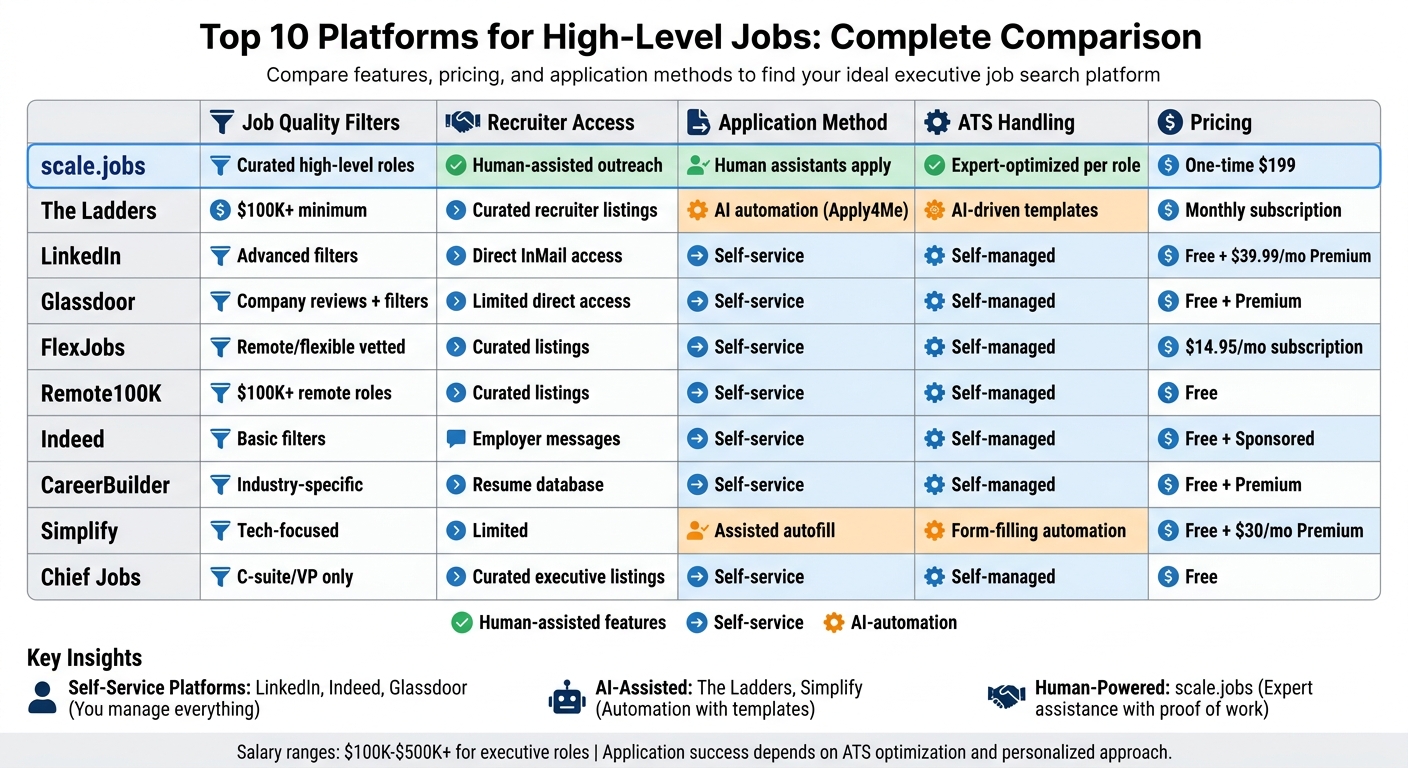
Top 10 Executive Job Platforms Comparison: Features, Pricing & Application Methods
The 2026 Job Search Playbook for Executives and Senior Leaders
sbb-itb-564272e
1. scale.jobs
While The Ladders emphasizes its recruiter networks, scale.jobs takes a different approach, offering a more personalized and efficient process that focuses on quality applications rather than sheer volume.
Job Quality and Salary Range
Scale.jobs caters specifically to high-level professionals by filtering for roles with salaries ranging from $100,000 to over $500,000 annually. This eliminates the clutter of mid-level listings often found on general job boards. With over 2 million postings aggregated monthly, its algorithms prioritize executive, VP, and Director-level positions based on seniority and pay. For instance, if you're aiming for a $280,000 VP of Engineering role, you won't waste time sifting through $60,000 analyst job listings. This targeted approach ensures that your job search remains efficient and focused on high-value opportunities.
Application Execution and ATS Handling
What sets scale.jobs apart is its human-powered application execution. Unlike automated tools, experienced virtual assistants handle the entire application process, including navigating corporate ATS portals that automation can’t effectively manage.
Key advantages of scale.jobs:
- Applications are managed by humans, avoiding ATS flags.
- Resumes and cover letters are tailored and ATS-optimized, with a 24-hour turnaround.
- Real-time updates via WhatsApp, complete with proof-of-work screenshots.
- Transparent, one-time payment starting at $199 for 250 applications.
- Time-stamped documentation showing exactly where your applications were submitted.
This hands-on approach not only ensures accuracy but also frees up your time to focus on networking and interview preparation.
Recruiter Networks and Direct Hiring Manager Access
Unlike The Ladders, which centers on recruiter introductions, scale.jobs shifts the focus to direct networking opportunities. By delegating repetitive tasks like account creation, form-filling, and submissions to dedicated assistants, you can dedicate more time - up to 20+ hours per week - to LinkedIn outreach, informational interviews, and building connections with hiring managers. Additionally, human-verified submissions reduce the chances of being filtered out by recruiters wary of generic, automated applications.
Who Might Prefer The Ladders:
- Executives looking for recruiter-mediated introductions.
- Professionals who value curated job matches provided by headhunters.
Who Should Choose scale.jobs:
- Job seekers who want full control over their application strategy.
- Candidates who value transparent, human-powered application processes.
- Those who prefer a one-time payment model over recurring subscriptions.
For those needing tailored resumes, scale.jobs also offers professional resume writing services, starting at $199. This package includes a professionally written resume and three job applications, maintaining the same hands-on execution approach.
Why Switch to scale.jobs:
- You want human oversight for every application.
- ATS-optimized resumes and cover letters are a priority.
- Transparent proof-of-work and real-time updates matter to you.
- You prefer a one-time payment model over subscriptions.
- You're done with automated tools that risk being flagged by ATS systems.
Scale.jobs offers a practical solution for professionals seeking a more personalized and efficient job application process. It’s a platform designed to save time and increase the likelihood of landing high-paying roles.
2. The Ladders
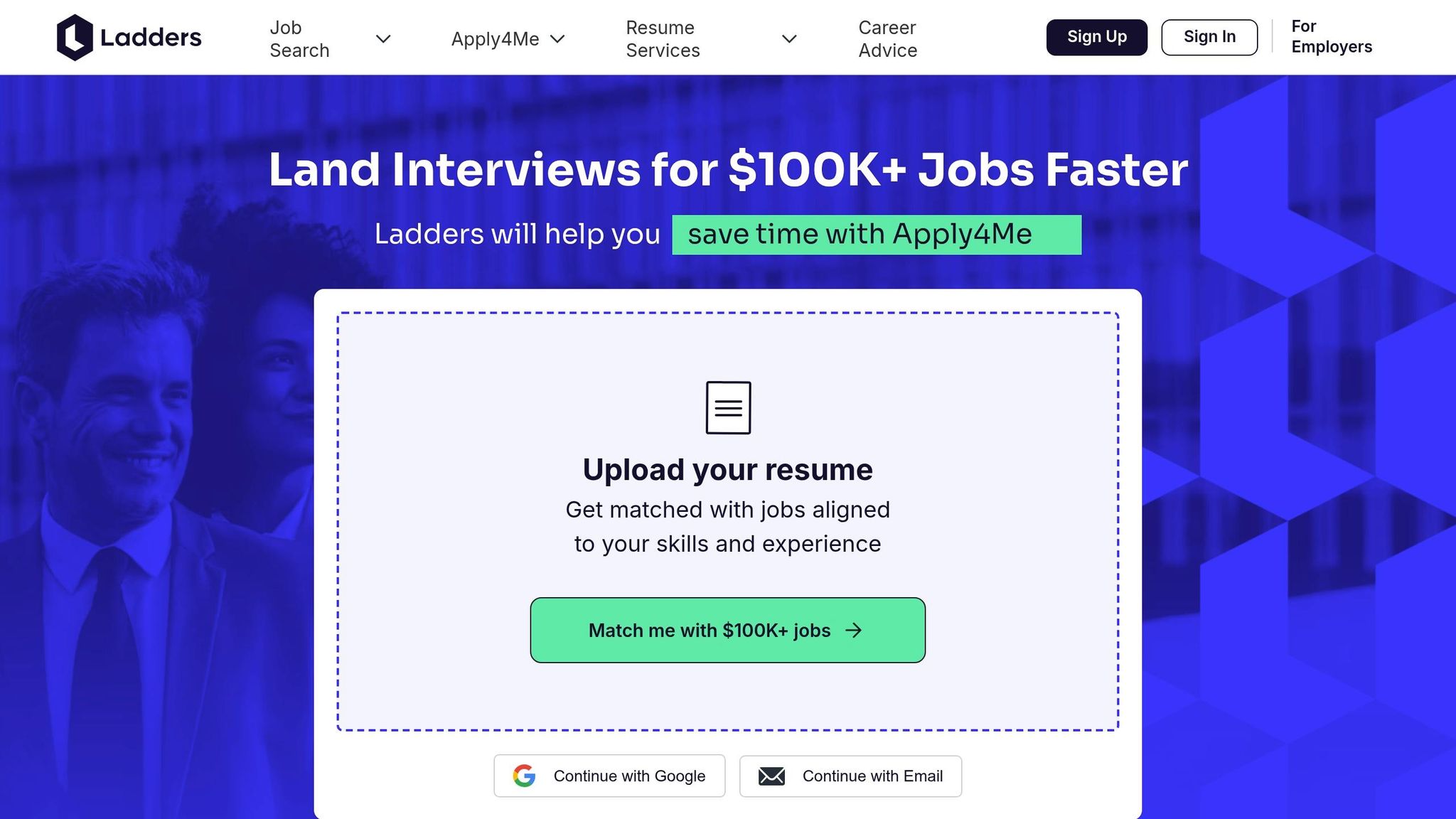
The Ladders is a niche job board that caters specifically to high-level roles with salaries ranging from $100,000 to $500,000 annually. Unlike broader platforms that mix various job levels, The Ladders narrows its focus to executive and senior-level positions, such as VP or Director roles, making it a go-to platform for professionals targeting top-tier opportunities. While The Ladders emphasizes recruiter-driven hiring and offers tools like a resume checker, scale.jobs sets itself apart by providing hands-on, human-guided support throughout the application process, offering a more personalized and transparent experience.
Job Listings and Salary Transparency
The Ladders ensures that every job listing meets a $100K+ salary benchmark, which helps filter out lower-paying roles. According to the platform, the median income of its users is $154,000, and 90% of its candidates hold at least a Bachelor's degree. Each job posting includes a clear salary range, giving applicants a better understanding of compensation expectations upfront.
Recruiter Connections and Cultural Fit Assessment
One of The Ladders' standout features is its Ladders Recruiter hub, which connects executive recruiters and corporate hiring teams with qualified candidates. The platform also includes the Third Page™, a detailed survey with over 125 questions designed to evaluate cultural fit, relocation preferences, and team compatibility.
Scott Hall, President of Hunter Technical Resources, shared: "Ladders has been a tremendous site that we have used for years. I spend more time on this site than any of the other services combined."
Additionally, The Ladders offers the Apply4Me service, which simplifies the application process for job seekers, saving an average of 18 minutes per application. Subscription plans range from $24.97 to $49.97 per month, with a lifetime access option priced at $1,499.
Application Tools and ATS Optimization
The Ladders provides a resume writing service that evaluates how well your resume performs with Applicant Tracking Systems (ATS) and human recruiters. It highlights formatting issues, such as tables or graphics, that could hinder ATS parsing and identifies missing keywords relevant to the job description. These features aim to enhance both automated and human review processes, offering a solid foundation for comparison with scale.jobs.
Why scale.jobs Stands Out Against The Ladders
- scale.jobs offers personalized human support with real-time updates via WhatsApp and proof-of-work documentation, contrasting with The Ladders' automated approach.
- Resumes crafted by scale.jobs are ATS-optimized and reviewed by experts, ensuring tailored applications for executive and senior roles with a 24-hour turnaround.
- Unlike The Ladders' subscription-based model, scale.jobs uses a one-time payment structure starting at $199, providing cost-effective, transparent services.
Who Should Use The Ladders:
Executives who prefer a recruiter-driven process and value features like cultural assessments through the Third Page™ and detailed salary transparency may find The Ladders a suitable option.
Who Should Choose scale.jobs:
Professionals looking for hands-on, human-guided support in resume customization and application execution, as well as transparent proof-of-work and ATS-optimized resumes without recurring fees, should consider scale.jobs.
Consider Switching to scale.jobs If:
- You prefer a one-time payment instead of monthly subscription fees.
- You want personalized assistance for resume optimization and job applications.
- Real-time support via WhatsApp is a priority for you.
- You value guaranteed ATS-optimized resumes with complete transparency in the application process.
3. LinkedIn

LinkedIn stands as a leading platform for executive job searches, boasting a network of over 546 million members and offering extensive opportunities in sectors like IT, finance, healthcare, and corporate leadership. Roles such as Senior Vice President (SVP) and Vice President (VP) are frequently listed, making it a go-to for high-level professionals. While LinkedIn provides powerful recruiter tools and detailed salary insights, scale.jobs takes a more personalized approach by offering human-assisted resume optimization and application support, which goes beyond LinkedIn's self-service model.
Job Quality and Salary Range
LinkedIn consistently features premium job opportunities across diverse industries. For instance, in the Software and IT Services sector, the median total compensation sits at approximately $104,700 for all levels. However, executive roles see a significant jump - Senior Vice Presidents in Finance or Sales often earn around $300,000, while top-tier medical professionals like Orthopedic Surgeons can reach median compensations of $450,000. For high-level technical roles, total compensation, including equity and bonuses, can climb to over $2 million.
LinkedIn’s salary tools provide detailed breakdowns, helping job seekers understand potential earnings and plan their career moves effectively.
Salary Data and Compensation Details
LinkedIn’s "Salary Insights" feature is a standout, offering compensation data directly on job listings. This data, sourced from employers or estimated using member inputs, breaks down pay into base salary, cash bonuses, and equity. For example, Restricted Stock Units (RSUs) for senior technical roles typically vest over four years, with 25% vesting annually.
"LinkedIn Recruiter and Job Posting tools integrate seamlessly with many ATS platforms, allowing you to source candidates, manage applications, and track recruitment metrics all in one place." - LinkedIn
These insights not only inform job seekers about their earning potential but also facilitate targeted outreach to recruiters, as explained below.
Recruiter Networks and Direct Hiring Manager Access
LinkedIn’s recruiter tools, such as InMail, make it easy to connect with hiring managers directly. Premium subscribers can message recruiters without prior connections, and many job postings include the name of the recruiter or hiring manager, enabling focused outreach. Features like the "Open to Work" signal allow executives to discreetly notify recruiters of their availability while keeping their search private from current employers. Additionally, LinkedIn Recruiter and Recruiter Lite enable hiring professionals to directly engage with passive candidates, bypassing traditional application filters.
Application Execution and ATS Handling
LinkedIn integrates seamlessly with Applicant Tracking Systems (ATS), simplifying the hiring process for recruiters. Using AI and Natural Language Processing, LinkedIn matches candidates to job postings based on context and synonyms, not just keywords. However, job seekers must ensure their resumes are formatted correctly - Word documents are often preferred - to avoid issues with ATS compatibility.
Why scale.jobs Outperforms LinkedIn for Application Success
While LinkedIn offers a wide array of tools, scale.jobs excels in several key areas:
- Tailored Resume Optimization: Unlike LinkedIn’s self-service model, scale.jobs provides human experts who customize resumes for each application, ensuring ATS compatibility.
- Real-Time Support: With WhatsApp-based support and proof-of-work documentation, scale.jobs offers transparency and guidance throughout the job search process.
- Cost-Efficient Pricing: Scale.jobs operates on a one-time payment model starting at $199, avoiding the recurring fees tied to LinkedIn Premium.
- Time-Saving Workflow: Human assistants handle the entire application process, from resume customization to submission, saving significant time compared to LinkedIn’s manual application process.
- Application Tracking: Every application is tracked and documented with timestamps, offering clarity and accountability.
Who Should Use LinkedIn:
LinkedIn is ideal for executives who want to leverage their professional network, engage directly with recruiters, and independently manage their applications while benefiting from comprehensive salary research tools.
Who Should Choose scale.jobs:
Professionals seeking expert assistance with ATS-optimized resumes, proof-of-work for applications, and transparent human-guided support without monthly fees should consider scale.jobs. Learn more about their Virtual Assistant for Job Applications.
Switch to scale.jobs If:
- You’re spending excessive time customizing resumes for LinkedIn applications but not securing interviews.
- You need expert-reviewed, ATS-optimized documents instead of relying on self-service tools.
- You value proof-of-work documentation showing how and when each application was submitted.
- You prefer a one-time payment model over LinkedIn Premium’s recurring fees.
- You want dedicated human support through WhatsApp to guide you throughout your job search journey.
4. Glassdoor
Glassdoor operates on a crowdsourced model, allowing employees to anonymously share salary details, benefits, and interview experiences. This makes it a useful resource for job seekers, especially those targeting executive roles like Chief Financial Officer (CFO) or Chief Technology Officer (CTO). It shines as a research tool for understanding a company’s leadership and internal culture before applying. However, scale.jobs offers a more hands-on approach, providing human assistants and ATS-optimized applications, going beyond Glassdoor’s self-service model. While Glassdoor is known for transparency through employee reviews, scale.jobs focuses on actionable services like tailored resume optimization and application submission.
Job Quality and Salary Range
Glassdoor’s salary data is based on anonymous employee submissions, meaning its accuracy depends on the number of data points available. For large companies with significant input, averages are more reliable, but smaller firms with fewer submissions can result in skewed figures. As Investopedia explains, "Salary is often the most guarded piece of information held by companies, but Glassdoor lifted the veil of secrecy by making it possible for users to report the amounts of money they earned." For executive-level positions, it’s wise to cross-check Glassdoor’s salary estimates with sources like Payscale or the Bureau of Labor Statistics (BLS) to confirm accuracy during negotiations. It’s also important to note that Glassdoor’s compensation data is unverified and may become outdated, as companies often adjust pay without updating the platform. When evaluating potential employers, pay attention to the CEO approval rating - a 73% approval is a common benchmark. Additionally, company ratings below 3.8 out of 5 are generally considered below average.
Recruiter Networks and Direct Hiring Manager Access
Glassdoor allows employers to post job openings and promote their brand to attract high-level talent, aligning with the trend of "brand approach" recruitment. However, it primarily serves as a research tool rather than a direct application platform. Unlike LinkedIn’s InMail or scale.jobs’ dedicated WhatsApp support, Glassdoor does not provide direct recruiter access or personalized outreach features. Applicants must independently apply through company websites or external platforms after conducting their research on Glassdoor. To understand where scale.jobs stands out, consider how each platform handles application execution and ATS optimization.
Application Execution and ATS Handling
Glassdoor does not manage the application process or optimize resumes for ATS systems, as it redirects users to external sites for submissions. This means job seekers are responsible for ensuring their resumes meet ATS requirements. On the other hand, scale.jobs offers hands-on support, ensuring every application is ATS-compliant and providing proof-of-work for submissions.
Key differences:
- Glassdoor relies on crowdsourced data for salaries; scale.jobs offers personalized, ATS-optimized resumes tailored to each application.
- Glassdoor redirects users to external sites for submissions; scale.jobs manages the entire application process, including documentation of submissions.
- Glassdoor is free for research purposes; scale.jobs charges a one-time fee starting at $199, offering comprehensive, human-guided support.
For those seeking more than just research data, scale.jobs provides a complete solution, from resume creation to application submission.
Who Should Use Glassdoor:
Executives and professionals who want to research company culture, leadership ratings, and salary benchmarks before independently applying should use Glassdoor’s crowdsourced insights.
Who Should Choose scale.jobs:
Individuals looking for expert-reviewed, ATS-optimized resumes, proof-of-work for applications, and dedicated human support through WhatsApp should consider scale.jobs.
Switch to scale.jobs If:
- You’ve gathered research on Glassdoor but need professional help with ATS-optimized resumes and applications.
- You want proof-of-work documentation for every application submitted.
- You prefer a one-time payment model over recurring subscription fees.
- You need personalized support from human assistants to handle the entire application process.
- You value transparent communication and WhatsApp support throughout your job search journey.
5. FlexJobs
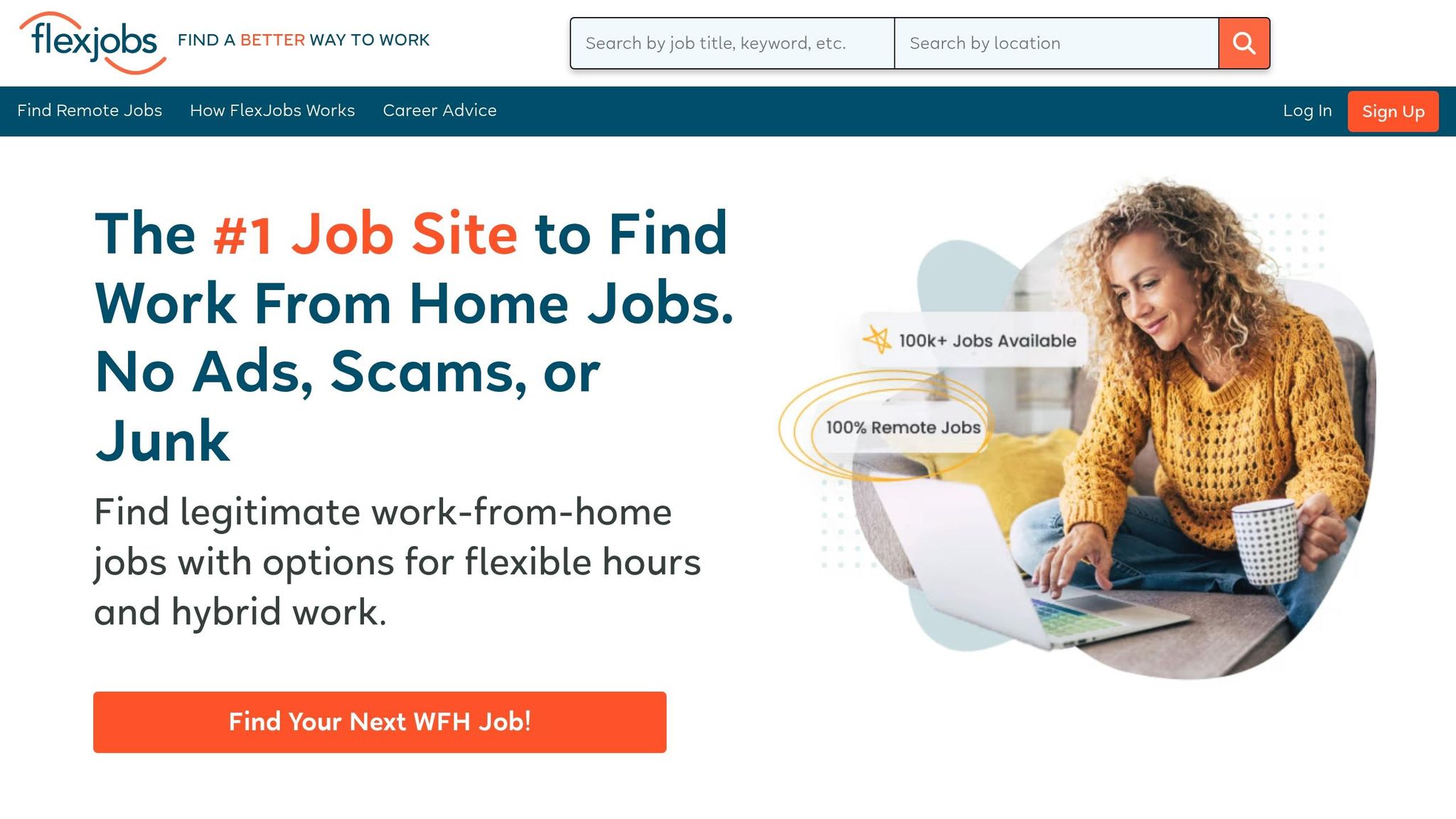
Before diving into FlexJobs, consider this: scale.jobs offers a hands-on application service that goes beyond basic resume tools. While FlexJobs focuses on remote, hybrid, and flexible job opportunities - primarily for high-level roles - it primarily acts as a curated job board. The platform manually screens job postings to filter out scams and low-quality listings, which sets it apart from generic aggregators. According to their data, 65% of their remote job postings cater to experienced professionals, with 29% targeting management and senior management roles. On the other hand, scale.jobs not only curates opportunities but also provides human-powered assistance to optimize and submit ATS-compliant applications. While FlexJobs connects you to vetted roles, scale.jobs completes the entire application process for you, ensuring a seamless experience.
Job Quality and Salary Range
FlexJobs collaborates with Payscale to offer salary insights for in-demand remote positions. For instance, in Q1 2026, average salaries for Senior Product Managers hit $136,763, Senior Data Engineers earned $135,328, and Senior Software Engineers made $132,223. Additionally, the platform adheres to pay transparency laws in states like California, New York, and Washington, ensuring salary ranges are included in job ads. This helps job seekers assess opportunities more effectively. Notably, FlexJobs recorded a 20% increase in remote job postings in Q1 2026 compared to Q4 2025, reflecting a growing market for flexible, high-paying roles.
Recruiter Networks and Direct Access
FlexJobs prioritizes job seekers by avoiding employer fees, ensuring that listings are curated without advertiser bias. However, it lacks direct recruiter access features, such as LinkedIn’s InMail. The platform boasts over 230,000 flexible job listings from more than 15,298 companies, including well-known names like Yelp, Lyft, and CVS Health. Their team dedicates over 200 hours daily to manually and AI-assisted job screening.
"The best executive hires are rarely on job boards. A firm’s network and outreach methodology matter more than their ATS."
While FlexJobs excels at vetting listings, it doesn’t provide outreach tools or direct recruiter connections. This is where scale.jobs shines, offering dedicated WhatsApp support and human assistants to manage networking and follow-ups.
Application Process and ATS Optimization
FlexJobs provides basic resume tools but requires users to apply independently through external company websites. It does not optimize resumes for ATS systems or provide proof-of-work for applications. In contrast, scale.jobs ensures every resume is tailored for ATS compatibility and offers detailed documentation for each submission.
Key Differences:
- FlexJobs focuses on curated, vetted job listings with salary transparency, while scale.jobs provides end-to-end application support, including customized, ATS-friendly resumes.
- FlexJobs operates on a subscription model, whereas scale.jobs offers a one-time payment starting at $199 for comprehensive application management and dedicated WhatsApp support.
- FlexJobs offers self-service tools for resumes, but scale.jobs assigns human assistants to handle resume customization and application execution.
Who Benefits Most?
FlexJobs Is Best For:
Professionals seeking remote or hybrid roles with reputable companies and who prefer to manage their job applications independently. The platform’s curated listings and salary insights make it a solid choice for those who value transparency.
scale.jobs Is Ideal For:
Executives and specialists who want expert help managing their applications, from ATS-optimized resumes to submission tracking. With personalized WhatsApp support and proof-of-work documentation, scale.jobs is perfect for those seeking a full-service approach.
Why Switch to scale.jobs?
- You’ve found promising roles on FlexJobs but need help creating ATS-compliant resumes and managing applications.
- You want detailed proof-of-work documentation showing when and where your applications were submitted.
- You prefer a one-time payment instead of recurring subscription fees.
- You need human support for follow-ups and communication during the job search.
- You value a tailored, guided experience throughout the process.
These factors make scale.jobs a more comprehensive solution compared to FlexJobs. Up next, we’ll review Remote100K and see how it compares to scale.jobs for executive-level job seekers.
6. Remote100K
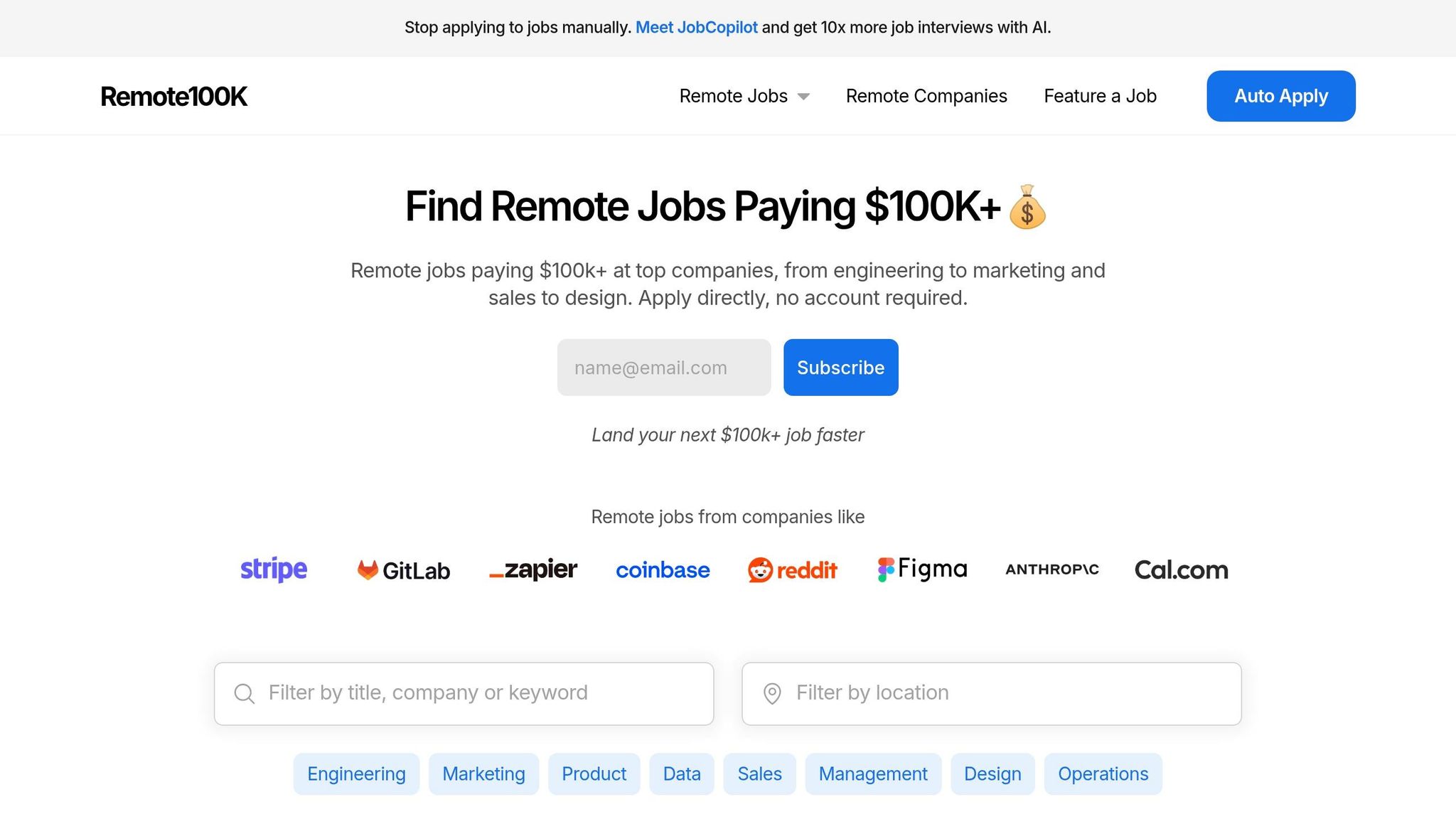
Remote100K specializes in curating high-paying remote job listings, specifically those with salaries starting at $100,000 and going up to $351,500. However, it lacks the full-service, human-assisted application management that scale.jobs offers. While scale.jobs provides tailored support for every step of the application process, including ATS-compliant resume creation and submission tracking, Remote100K operates as a self-directed job board. As of May 2026, the platform featured over 530 active listings, but users are responsible for managing their own applications, resumes, and follow-ups.
Job Quality and Salary Range
Remote100K focuses on verified remote positions with impressive salaries. For example, in May 2026, listings included:
- Principal AI Security Engineer at Life360: $239,500–$351,500
- Director of Partner Marketing at Cresta: $180,000–$220,000
- Senior Director at Eli Lilly and Company: $195,000–$314,600
- Sr Director Analyst at Gartner: $172,000–$202,500
While these listings highlight the platform's ability to connect professionals with lucrative opportunities, Remote100K stops short of assisting with the application process. This is where scale.jobs shines, offering a hands-on approach that includes resume customization, application tracking, and direct communication support.
Application Execution and ATS Handling
When it comes to applying, Remote100K redirects users to external career pages or ATS systems, leaving applicants to navigate the process alone. The platform does include JobCopilot, an automated tool designed to increase interview rates, but it lacks the human touch. Applicants are advised to apply through the portal while simultaneously reaching out to hiring managers with personalized messages - a strategy that requires significant effort and expertise.
By contrast, scale.jobs offers a seamless, end-to-end application experience. Their team creates ATS-optimized resumes, manages direct outreach, and provides proof of every submission. This human-centered approach ensures applications are not only submitted but also tailored to stand out, saving users time and increasing their chances of success.
Key Differences:
- Remote100K: A job board for six-figure remote roles with self-service application management. No resume optimization or recruiter access.
- scale.jobs: Comprehensive application management with ATS-compliant resumes, WhatsApp support, and proof-of-work documentation, all for a one-time fee starting at $199.
Who Should Use Remote100K?
Remote100K is ideal for professionals who are comfortable managing their own job search and have strong networking skills. If you prefer a straightforward, subscription-free platform for finding verified high-salary remote roles, Remote100K could be a good fit.
Who Should Choose scale.jobs?
If you need expert assistance with crafting ATS-friendly resumes, managing applications, and tracking submissions, scale.jobs is the better choice. It's perfect for executives and specialists who value personalized, human-guided support throughout their job search process.
Why Switch to scale.jobs?
Consider switching to scale.jobs if:
- You’ve found roles on Remote100K but need help creating tailored, ATS-optimized resumes.
- You want proof of when and where your applications were submitted.
- You prefer a one-time payment over juggling multiple subscriptions.
- You need human assistance for follow-ups and outreach to hiring managers.
- You value a guided, hands-on approach instead of relying solely on automation.
This comparison underscores why scale.jobs is the go-to platform for professionals seeking comprehensive job application support. Stay tuned as we explore how other platforms compare to scale.jobs’ all-inclusive approach.
7. Indeed
Indeed is one of the most widely recognized job boards globally, boasting over 225 million resumes and serving as a go-to platform for many active job seekers. Its appeal lies in its vast reach and free job postings, making it a hub for high-volume job searches. However, it operates as a self-service platform, meaning candidates are responsible for managing their applications, optimizing their resumes, and following up on their own. In contrast, scale.jobs offers a more guided approach, including human-assisted application processes, ATS-optimized resumes, and proof-of-work tracking, providing a more personalized experience.
Job Quality and Salary Range
Indeed organizes senior-level roles into categories like Executive/Senior Management (C-suite), Middle Management (e.g., Directors, Regional Managers), and First-level Management positions. For reference, the national average salaries for executive roles on Indeed include:
- Chief Financial Officer (CFO): $131,245
- Chief Marketing Officer (CMO): $125,515
- Chief Technology Officer (CTO): $116,875
While Indeed offers a broad range of opportunities, it is less focused than niche platforms catering specifically to executives. It primarily attracts active job seekers and relies on static filters and Boolean searches, which can make it harder to find nuanced, high-level profiles. This often results in job seekers needing to sift through a large volume of listings to find relevant matches, especially for senior roles.
Application Process and ATS Compatibility
One of Indeed's standout features is "Indeed Apply", which allows candidates to submit applications directly through the platform. This feature integrates with numerous ATS systems, increasing the likelihood of applications being reviewed. However, candidates must ensure their resumes are formatted in a simple, single-column layout without tables or graphics, as ATS systems convert resumes to plain text, which can distort complex designs.
The challenge lies in manually optimizing resumes for each job posting. Candidates need to match keywords from job descriptions precisely, avoid placing contact information in headers, and navigate other ATS pitfalls. Indeed does not offer personalized support for this process, leaving job seekers to handle it independently.
On the other hand, scale.jobs takes the guesswork out of the equation. Their team creates ATS-compatible resumes tailored to specific roles, manages the application process, and provides proof of submission. They also offer WhatsApp support to guide candidates every step of the way.
Why scale.jobs outperforms Indeed:
- Human assistance: Unlike Indeed’s self-service model, scale.jobs provides personalized support.
- ATS-optimized resumes: scale.jobs handles resume formatting and keyword alignment, while Indeed requires candidates to do this manually.
- Proof-of-work tracking: scale.jobs offers submission tracking and follow-ups, ensuring transparency.
- One-time payment: Starting at $199, scale.jobs provides a comprehensive service, whereas Indeed relies on a DIY approach.
- End-to-end support: From application execution to hiring manager outreach, scale.jobs covers it all, unlike Indeed’s automated system.
Recruiter Access and Hiring Manager Connectivity
Indeed offers tools like integrated messaging and a "Sourcing Assistant" for recruiters, using AI to match candidates with roles. With over 645 million job seeker profiles and more than 2 million virtual interviews conducted through its Hiring Events, Indeed’s reach is undeniable. Sponsored job postings are also 4.5 times more likely to result in a hire, though this primarily benefits employers.
For job seekers, connecting with recruiters depends on profile optimization and matching search criteria. Indeed does not provide dedicated support to help candidates reach decision-makers or craft personalized outreach. In contrast, scale.jobs offers human-powered assistance, including tailored communication strategies and follow-up management, all for a one-time fee starting at $199.
Who Should Use Each Platform
- Indeed: Ideal for professionals comfortable managing their own job search and navigating ATS systems, especially those seeking high-volume listings across various industries.
- scale.jobs: Perfect for executives and specialists who need expert help with ATS-optimized resumes, application tracking, and direct outreach to hiring managers, particularly for competitive roles.
When to Consider Switching to scale.jobs
- If you’ve identified roles on Indeed but struggle with ATS optimization or resume tailoring.
- If you want detailed proof of application submissions.
- If you need assistance with follow-ups and outreach to hiring managers.
- If you prefer a one-time payment model over managing the job search process yourself.
- If you value hands-on, personalized support over navigating job boards independently.
For job seekers looking for a more tailored and supported experience, scale.jobs offers a clear advantage over Indeed’s self-service approach.
8. CareerBuilder
CareerBuilder is a longstanding job board that offers a wide range of listings, from entry-level to executive roles. However, unlike scale.jobs, CareerBuilder operates on a self-service model, leaving candidates responsible for handling every aspect of their job applications. While it provides a large database of opportunities across various industries, it does not assist with resume optimization, application tracking, or follow-ups. In contrast, scale.jobs offers a hands-on approach, including ATS-optimized resumes, application management, and proof-of-work for each submission, making it particularly appealing for professionals targeting competitive, high-level positions.
Job Quality and Salary Range
CareerBuilder features opportunities across industries like IT, finance, and management, with some roles offering total compensation exceeding $500,000 annually. For instance:
- Enterprise tech sales roles: Base salaries around $120,000, with commissions bringing total earnings to over $420,000 annually.
- Flagship store managers: Compensation packages at major retailers like Walmart can reach $400,000, including bonuses and stock options.
- AI architects or principal engineers: Annual earnings can surpass $500,000 for top-tier professionals.
However, the platform's broad range of listings - from hourly jobs to C-suite positions - requires candidates to meticulously filter through postings to find senior-level roles. While CareerBuilder's "Quick Apply" feature simplifies applications with one-click submissions, it doesn’t extend to tailoring resumes or ensuring they meet ATS requirements for individual roles.
Application Execution and ATS Handling
CareerBuilder’s "Apply Path" feature integrates directly with employer ATS systems, reducing candidate drop-off rates by up to 90% and increasing application volumes for employers. While this ensures your data reaches the employer’s system, it also exposes candidates to potential "silent rejections" caused by formatting errors.
For example:
- Single-column resume layouts perform better, with a 7% higher success rate than double-column designs.
- Resumes with heavy graphics or non-standard formatting often fail ATS parsing, rendering them effectively blank.
Unfortunately, CareerBuilder does not assist candidates in navigating these pitfalls, leaving them to ensure their resumes are ATS-friendly. In contrast, scale.jobs takes on this challenge by crafting ATS-compatible resumes tailored to each role. Their service also includes application submissions, tracking, and WhatsApp support, offering a smoother and more reliable process compared to CareerBuilder’s DIY model.
Key advantages of scale.jobs over CareerBuilder:
- Tailored resumes: scale.jobs customizes each resume, while CareerBuilder relies on generic templates.
- Expert ATS handling: scale.jobs eliminates formatting issues that lead to silent rejections.
- Proof of submission: scale.jobs provides detailed tracking and follow-ups, unlike CareerBuilder’s opaque process.
- Direct hiring manager outreach: scale.jobs incorporates proactive strategies to connect with decision-makers.
- Comprehensive support: scale.jobs offers end-to-end assistance, including real-time WhatsApp support.
Recruiter Networks and Direct Hiring Manager Access
CareerBuilder enhances visibility by allowing candidates to upload resumes to a searchable database used by recruiters. While this can increase exposure, it is a passive approach that depends on recruiters finding your profile. The platform does not offer direct messaging or advocate for candidates with hiring managers. Additionally, while CareerBuilder tracks trending job titles in major cities like New York, Los Angeles, and Seattle, it does not assist with interview preparation or personalized outreach.
In contrast, scale.jobs actively supports candidates by managing application submissions, providing follow-up services, and offering strategies to directly engage hiring managers. This human-powered approach ensures every application is optimized and supported, setting it apart from CareerBuilder’s self-service model.
Comparison: CareerBuilder vs. scale.jobs
| Feature | CareerBuilder | scale.jobs |
|---|---|---|
| Human Involvement | Minimal | High |
| Resume Customization | Generic, self-managed | Professionally tailored |
| ATS Handling | Candidate-responsible | Expert-optimized |
| Application Execution | Self-managed | Managed with WhatsApp support |
| Transparency | None | Submission tracking provided |
| Pricing Model | Free/self-service | Starts at $199 |
Who Should Use CareerBuilder
CareerBuilder is ideal for individuals who are comfortable managing their job search independently, including navigating ATS requirements and filtering through a broad range of job listings.
Who Should Choose scale.jobs
Professionals targeting competitive roles who need expert assistance with ATS-optimized resumes, follow-ups, and direct hiring manager outreach will benefit from scale.jobs. It’s especially useful for those who prefer a guided, transparent application process.
Switch to scale.jobs If:
- You’ve found roles on CareerBuilder but struggle with resume formatting or tailoring for ATS systems.
- You want assurance that your applications are submitted and parsed correctly.
- You need help with follow-ups and connecting with hiring managers.
- You value proof of submission and expert-led application management over a do-it-yourself approach.
9. Simplify
Simplify is an automation-focused platform that processes over 200 million applications from more than 200,000 job listings. Unlike scale.jobs, which emphasizes personalized services by leveraging career professionals to craft resumes and manage applications, Simplify employs an "Autofill" browser extension. This tool automatically completes application forms across platforms like Workday, Greenhouse, and Lever. While this automation saves time by eliminating repetitive tasks, it may lack the precision and tailored focus offered by scale.jobs, especially in areas like resume customization and Applicant Tracking System (ATS) optimization.
Job Quality and Salary Range
Simplify caters to experienced professionals in fields such as finance, engineering, healthcare, IT, management, marketing, and sales. It also highlights high-stakes roles at "Unicorn" startups and Y Combinator-backed companies. Job listings span positions like Staff Engineers, Senior Product Managers, Principal Technical Program Managers, and even CEO roles. Additionally, Simplify provides salary insights to help users gauge market value, though it stops short of offering personalized negotiation assistance.
Grace H. shared how Simplify's timely notifications helped her secure a Google APM role efficiently. Similarly, Rio L., now an Analyst at Deloitte, remarked:
"Simplify has saved me hours of time getting through the most tedious parts of the job search process, helping me to discover more opportunities quickly."
These testimonials highlight the platform's focus on speed and scale, which may appeal to candidates looking for volume but might not be ideal for those seeking highly customized applications, particularly for executive-level roles.
Key advantages of scale.jobs over Simplify:
- Tailored Resumes: scale.jobs creates resumes customized for specific roles, while Simplify relies on autofill templates that might not address unique job requirements.
- ATS Optimization: scale.jobs ensures resumes are formatted and keyword-aligned to pass ATS screening, while Simplify's AI resume builder offers scoring without human review.
- Submission Proof: scale.jobs provides timestamped screenshots and real-time updates, whereas Simplify’s job tracker only logs submissions.
- Pricing: scale.jobs charges a one-time fee starting at $199, while Simplify operates on a freemium model with premium features available through a subscription.
- Hiring Manager Outreach: scale.jobs includes proactive outreach strategies, while Simplify’s Networking Copilot requires candidates to manage outreach independently.
While Simplify speeds up the application process, ensuring resumes pass ATS filters and align with hiring expectations is equally critical.
Application Execution and ATS Handling
Simplify's Copilot extension simplifies application processes with one-click autofill across over 100 job boards and ATS portals. Its AI resume builder evaluates resumes for ATS compatibility, identifies missing keywords, and suggests ways to tailor resumes to specific job descriptions. However, this automated system lacks the human touch needed to catch subtle formatting issues or ensure alignment with hiring manager expectations beyond keyword matching.
The platform claims a 25% higher response rate, but this figure doesn’t distinguish between automated rejections and genuine interview opportunities. Simplify excels in enabling candidates to submit a large volume of applications quickly, but this speed-focused approach may not be as effective for roles requiring detailed, tailored applications. While automation reduces time spent on form filling, direct recruiter outreach remains a critical step.
Recruiter Networks and Direct Hiring Manager Access
Simplify also functions as a hiring marketplace, where recruiters can post exclusive jobs and search for candidates. Its "Networking Copilot" feature helps users identify hiring managers and draft outreach emails, but candidates are responsible for executing the outreach themselves. Additionally, Simplify’s job tracker allows users to record recruiter interactions and manage application relationships, but it lacks the hands-on support provided by scale.jobs, such as dedicated WhatsApp assistance and follow-up management.
Over 40% of Simplify’s 300,000+ candidates come from top 50 universities, and applicants are reportedly four times more likely to engage with recruiters compared to other platforms. However, the more comprehensive support offered by scale.jobs provides a distinct advantage for candidates seeking a hands-on, transparent experience.
| Feature | Simplify | scale.jobs |
|---|---|---|
| Human Involvement | Minimal (AI-driven) | High (career professionals) |
| Resume Customization | AI-suggested keywords | Professionally tailored per role |
| ATS Handling | Automated scoring | Expert-optimized formatting |
| Application Execution | Self-managed autofill | Managed with proof of submission |
| Transparency | Job tracker (self-recorded) | Timestamped screenshots |
| Pricing Model | Free + Simplify+ subscription | One-time payment from $199 |
Who Should Use Simplify
Simplify is ideal for early- to mid-career professionals who prioritize applying to a high volume of jobs and are comfortable managing their own outreach, resume adjustments, and follow-ups. It’s especially useful for candidates targeting startup roles where speed is a priority and who are confident in evaluating AI-generated suggestions independently. However, for those aiming for executive positions, Simplify’s automation-first approach might not provide the level of customization and support needed.
Who Should Choose scale.jobs
Professionals targeting competitive senior or executive roles will benefit from scale.jobs. The platform’s expert-crafted resumes, detailed ATS optimization, and verifiable proof of submission make it a better option for those who value personalized support and transparent tracking. It’s particularly suited for candidates seeking a more hands-on approach to applications and follow-ups.
Switch to scale.jobs If:
- You’ve applied to numerous jobs through Simplify but aren’t receiving interview callbacks for higher-level roles.
- You want assurance that your resume is optimized by a human expert, not just AI analytics.
- You need verifiable proof of submission and real-time updates, rather than managing your own tracking.
- You prefer a one-time payment model over recurring subscription fees.
- You require assistance with follow-ups and hiring manager outreach beyond automated templates.
Decision Summary: Simplify is best for those who value speed and volume in their job search, while scale.jobs is the go-to choice for candidates seeking personalized, human-driven application strategies and thorough ATS compliance. Choose the platform that aligns with your career goals and the level of support you need.
10. Chief Jobs
Chief Jobs is a specialized platform designed for C-suite executives, Vice Presidents, and senior management professionals looking for high-paying roles, often with six-figure salaries. Unlike scale.jobs, which offers a full-service model, Chief Jobs operates as a self-service job board. This means candidates handle their own resume submissions and applications. While it exclusively lists executive-level positions like CEO, COO, CFO, and specialized director roles, it lacks the personalized resume optimization and proof of submission services that scale.jobs provides. Let’s see how Chief Jobs compares to scale.jobs' more hands-on, transparent approach.
Job Quality and Salary Range
Chief Jobs focuses on positions with substantial compensation. For instance, the median salary for Chief Executives in 2024 was $206,420, with the top 25% earning $239,200 or more. Executive salaries generally range from $187,000 to $333,000 annually, with average total cash compensation reaching $249,000. Location plays a big role in pay - New Jersey boasts an average CEO salary of $465,040, while San Jose, California offers up to $507,680, reflecting the region's higher living costs. Compensation packages often go beyond base pay, including bonuses, profit sharing, stock options, and wellness programs.
Jon Kaplan of TDS Global Services highlights:
In today's competitive job market, many businesses also offer other types of compensation that go beyond base pay for corporate executives, including stock options, equity in the company, and even performance-based bonuses.
Key Advantages of scale.jobs Over Chief Jobs
- Professional Resume Crafting: scale.jobs creates ATS-optimized resumes tailored for each role, while Chief Jobs leaves this task to candidates.
- Application Management: scale.jobs handles the entire application process and provides timestamped proof of submission; Chief Jobs requires candidates to apply independently.
- Post-Application Support: scale.jobs offers WhatsApp assistance and outreach to hiring managers, which Chief Jobs does not.
- Transparent Pricing: scale.jobs charges a one-time fee starting at $199, while Chief Jobs is a free platform but lacks application services.
- ATS Optimization: scale.jobs ensures resumes are formatted and keyword-aligned for ATS systems, a feature not available with Chief Jobs.
Application Execution and ATS Handling
Chief Jobs provides a database of executive-level job listings but does not assist with the application process or ATS optimization. Candidates must independently tailor their resumes, navigate application systems, and track submissions. This can be a challenge for roles where certifications, leadership experience, and location significantly impact pay. In contrast, scale.jobs offers a managed approach, including proof of submission and real-time updates, ensuring transparency and reducing the risk of missed opportunities.
| Feature | Chief Jobs | scale.jobs |
|---|---|---|
| Human Involvement | None (self-service) | High (career professionals) |
| Resume Customization | Self-managed | Professionally tailored per role |
| ATS Handling | No assistance | Expert-optimized formatting |
| Application Execution | Self-applied | Managed with proof of submission |
| Transparency/Proof-of-Work | No tracking provided | Timestamped screenshots |
| Pricing Model | Free job board | One-time payment from $199 |
Who Should Use Chief Jobs
Chief Jobs appeals to executives who are confident in their ability to craft compelling resumes, navigate complex application systems, and manage their job search independently. It’s a good fit for those who primarily use job boards for research or networking rather than actively applying. If you're an executive with a strong personal network and prefer a no-cost platform, Chief Jobs might suit your needs.
Who Should Choose scale.jobs
For executives aiming for competitive C-suite or VP roles, scale.jobs offers a level of support that can make all the difference. If you've struggled with ATS systems or want assurance that your applications are submitted correctly and professionally managed, scale.jobs is the better choice. It’s ideal for busy professionals who value expert-crafted resumes, transparent tracking, and dedicated support throughout the application process.
Switch to scale.jobs If:
- You're not getting responses despite having strong qualifications.
- You need help ensuring your resume passes ATS filters for high-level positions.
- You want verifiable proof that your applications were submitted accurately and on time.
- You prefer a comprehensive application management service over handling everything yourself.
- You value follow-up support, including outreach to hiring managers.
Decision Summary: Chief Jobs is a practical option for self-reliant executives who prefer a free, no-frills job board. However, for those who want expert oversight, ATS-optimized resumes, and verifiable application tracking, scale.jobs is the superior choice. Your decision should depend on whether you prioritize professional support or prefer a hands-on, self-service approach.
Platform Comparison Table
This table provides a clear summary of the key features across various job platforms, helping you decide which one aligns best with your career goals. Whether you're targeting executive roles or specialized positions, factors like job quality filters, recruiter access, and application methods can significantly influence your job search experience.
Platforms like LinkedIn and Indeed give you full control but demand a significant time commitment. Meanwhile, options like scale.jobs offer human-assisted vs automated job applications to streamline the process, and subscription-based platforms such as The Ladders use AI to automate applications, though they may lack the same personal touch.
Here's a side-by-side comparison of these platforms across essential factors like job quality, recruiter access, salary visibility, and pricing:
| Platform | Job Quality Filters | Recruiter Access | Salary Transparency | Application Method | ATS Handling | Pricing Structure |
|---|---|---|---|---|---|---|
| scale.jobs | Curated high-level roles | Human-assisted outreach | Role-specific ranges | Human assistants apply | Expert-optimized per role | One-time fee from $199 |
| The Ladders | $100K+ salary minimum | Curated recruiter listings | Pre-screened salaries | AI automation (Apply4Me) | AI-driven templates | Monthly/Annual subscription |
| Advanced filters available | Direct InMail access | Varies by employer | Self-service | Self-managed | Free + Premium ($39.99/mo) | |
| Glassdoor | Company reviews + filters | Limited direct access | Crowdsourced estimates | Self-service | Self-managed | Free + Premium features |
| FlexJobs | Remote/flexible vetted roles | Curated listings | Disclosed upfront | Self-service | Self-managed | Subscription ($14.95/mo) |
| Remote100K | $100K+ remote roles | Curated listings | Salary ranges shown | Self-service | Self-managed | Free job board |
| Indeed | Basic filters available | Employer messages | Inconsistent disclosure | Self-service | Self-managed | Free + Sponsored listings |
| CareerBuilder | Industry-specific filters | Resume database access | Varies by posting | Self-service | Self-managed | Free + Premium features |
| Simplify | Tech-focused roles | Limited | Varies by employer | Assisted autofill with human review | Form-filling automation | Free + Premium ($30/mo) |
| Chief Jobs | C-suite/VP roles only | Curated executive listings | $187K–$507K ranges | Self-service | Self-managed | Free job board |
For those seeking assurance their applications are submitted correctly and want to avoid getting stuck in the ATS (Applicant Tracking System) void, scale.jobs offers unique advantages like timestamped proof of submission and dedicated WhatsApp support. While subscription-based models might appear cost-effective for short-term use, a one-time fee approach can often be more economical over a typical 3–6 month job search.
If you're looking for professional support to optimize your job search, consider exploring platforms like scale.jobs or using a job search virtual assistant to save time and improve your chances of landing your next role.
Conclusion
Finding the right platform for high-level job searches often depends on how much control you want versus how much time you’re willing to dedicate. Platforms like LinkedIn and Indeed offer broad access but demand significant effort to manage applications - especially for roles paying $100K or more. On the other hand, niche job boards focus on high-paying positions but still require manual submissions, which can be tedious.
When deciding between self-service platforms and human-powered job application services, consider your career goals and how efficiently you want to navigate the process. As Meredith Bowen, Executive Partner at Walker Bowen Talent Partners, points out:
"The more strategic you can be, the greater the likelihood you're going to get responses."
For those aiming at executive or specialized roles, prioritizing quality over quantity often yields better results. This is where platforms like Scale.jobs stand out. They provide ATS-optimized resumes, real-time WhatsApp updates with timestamped proof of submissions, and a flat fee starting at $199 for 250 applications. This model avoids recurring subscriptions and ensures trained assistants handle the heavy lifting.
If you prefer managing your job search with AI tools, platforms like Simplify with its autofill features or The Ladders' Apply4Me option ($49.97/month) might suit your needs. Alternatively, if you need help refining your materials before applying, professional resume writing services can prepare you for executive-level opportunities.
While LinkedIn, Indeed, and Simplify are valid choices, Scale.jobs offers a unique blend of transparency, human oversight, and cost-effective pricing. It’s an excellent choice for professionals targeting $100K+ roles who value timestamped proof of submissions and want to focus on networking and interview preparation. On the other hand, self-service platforms are ideal if you’re early in your search, prefer browsing at your own pace, or want to test the waters before committing to a more active strategy. With job scams on the rise and wage growth for job changes slowing, selecting the right platform has never been more important.
FAQs
Which platform is best if I’m targeting $100K+ executive roles?
Scale.jobs stands out as a preferred option for securing $100K+ executive roles, thanks to its human-assisted approach, ATS-optimized applications, and ability to handle a high volume of submissions. This combination significantly increases your chances in these competitive job markets. Unlike subscription-based services such as The Ladders or Ivy Exec, Scale.jobs provides customized support, clear proof of work, and a straightforward flat one-time payment structure. For those navigating high-stakes executive job searches, Scale.jobs offers a streamlined, personalized application process with real-time updates to keep you informed every step of the way.
How can I avoid being filtered out by ATS systems?
To ensure your resume makes it through ATS systems, focus on keywords, formatting, and structure:
- Align your resume with the job description by using exact keywords (e.g., "project management" instead of synonyms).
- Stick to a simple, clean design with standard fonts and clear section headings.
- Save your resume as a .docx or PDF file and avoid using tables, graphics, or unusual formatting.
- Spell out acronyms and customize your resume for each job application to increase its chances of being ATS-friendly.
For additional help, consider using an AI resume builder to streamline the process and ensure compatibility.
Should I use a managed application service or apply myself?
When deciding whether to use a managed application service or handle applications on your own, it often comes down to your career goals, available time, and the level of support you need to boost your chances. Managed services like Scale.jobs are perfect for those aiming for mid-to-senior roles. They save time by optimizing your resume for ATS (Applicant Tracking Systems) and offer clear, organized application tracking. On the other hand, applying on your own might be a better fit if you have the time to customize each application and want complete control, especially when targeting entry-level or less competitive positions.