
7 features every great job search platform needs
Seven essential features for job search platforms: ATS-ready tools, human-reviewed submissions, AI customization, tracking, and flat pricing.


Searching for jobs can feel overwhelming, especially when dealing with repetitive data entry, ATS rejections, and vague application processes. The best platforms simplify this by combining automation with human expertise, ensuring your applications are seen and optimized for success. Here’s what sets top platforms apart, along with essential job search tips for modern candidates:
- Advanced Filtering: Precise job searches by location, skills, and salary.
- ATS-Optimized Tools: Real-time resume feedback to pass automated filters.
- AI + Human Customization: Avoid bot detection with tailored applications.
- Human-Powered Submissions: Manual oversight for accurate and credible submissions.
- Application Tracking: Centralized dashboards to manage your job pipeline.
- Integrated Toolkit: Combine resume building, job boards, and interview prep in one place.
- Transparent Pricing: Flat fees with no hidden costs or recurring subscriptions.
Platforms like Scale.jobs excel by blending automation with personal assistance, offering features like ATS-compliant resume checks, real-time updates, and proof-of-submission screenshots. This approach helps job seekers stand out in competitive markets while avoiding wasted effort on poorly optimized tools.
Quick Comparison
| Feature | Scale.jobs | LazyApply | Simplify | Teal HQ |
|---|---|---|---|---|
| Advanced Filtering | Yes (location, skills) | Basic filters | Curated suggestions | Job tracking only |
| ATS Resume Optimization | Human + AI | Basic templates | Autofill only | AI suggestions |
| Application Submission | Human-reviewed | Automated only | Autofill | No submission |
| Tracking & Updates | Real-time proof | Basic dashboard | Limited tracking | Comprehensive |
| Pricing | Flat fee | Subscription | Free + Premium | Free + Premium |
For job seekers looking for tailored, ATS-friendly applications and transparent pricing, Scale.jobs offers a clear advantage. Whether you’re applying for full-time jobs or exploring part-time jobs near me, these features can save time and improve your chances of success.
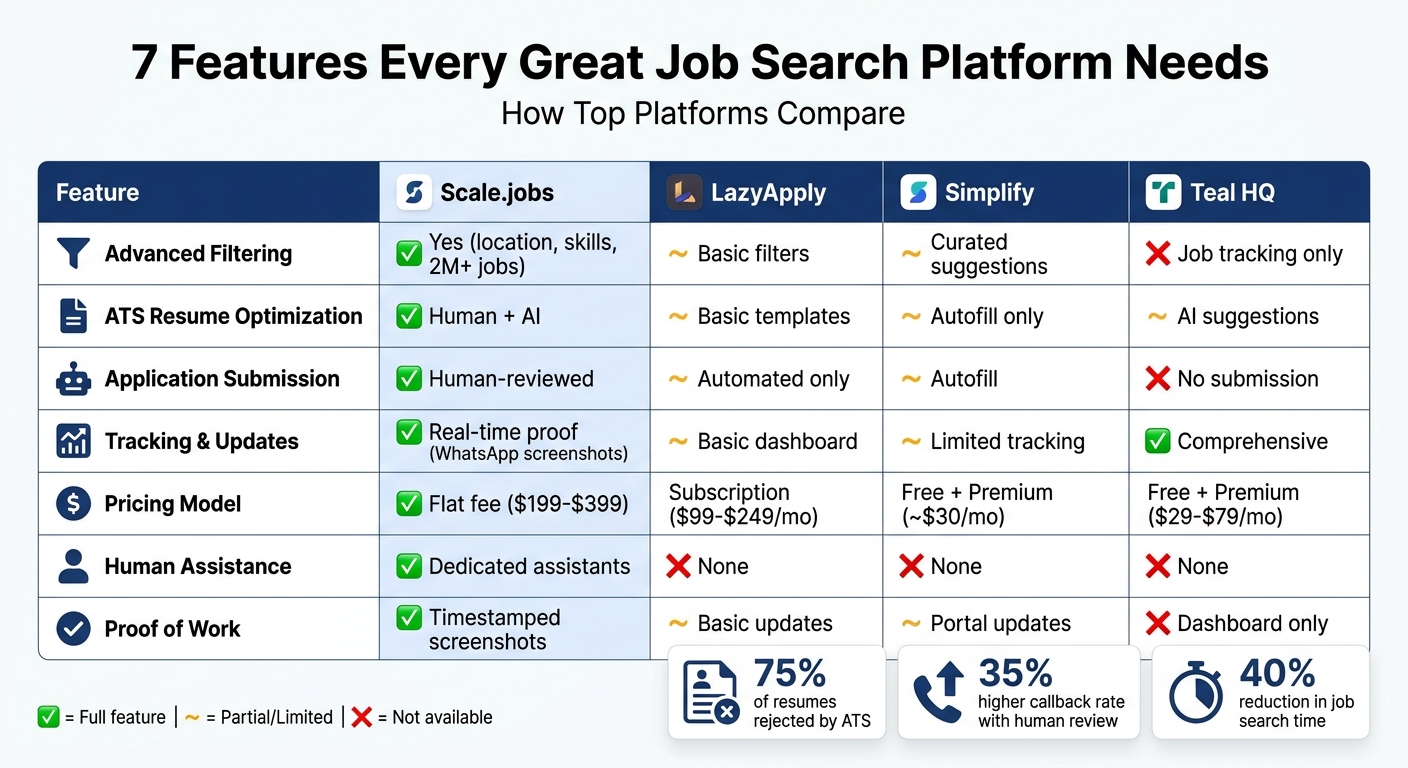
Job Search Platform Features Comparison: Scale.jobs vs Competitors
Best Job Search Websites in the World
sbb-itb-564272e
1. Advanced Filtering and Location-Based Search
Sifting through endless irrelevant job postings can feel like a full-time job in itself. That’s where geographic targeting comes in, helping you focus on opportunities that match your commute preferences or verified remote positions. With precise location filters, you can zero in on jobs in a specific neighborhood, within a 25-mile radius, or exclusively remote roles - saving you time and energy.
Modern platforms go beyond just city names. They allow for area-specific, skill-specific, and knowledge-specific searches that refine results in real time. For example, you could search for "Senior Product Manager" in "San Francisco" while including "Remote" as an option, and even add salary range filters to weed out positions that don’t meet your expectations. This level of precision ensures that your search results are tailored to your specific needs.
Unlike platforms like LazyApply and FindMyProfession that rely solely on algorithms, scale.jobs offers a unique combination of automation and human expertise. Their job board provides access to over 2 million monthly postings with advanced filters for location and employment type. But what sets them apart is the human touch: a dedicated assistant reviews each posting to eliminate ghost jobs and recruiter spam, ensuring that every alert and application is worth your time.
This approach is especially valuable if you’re managing a full-time job or dealing with visa requirements. With location-specific alerts sent via email or text, you’re notified immediately of roles that genuinely align with your preferences, avoiding the frustration of unsuitable listings. And if you’re considering whether to handle applications yourself or use professional resume writing services, starting with accurate filtering ensures your efforts are directed toward roles you’d genuinely accept.
2. ATS-Optimized Resume Tools and Compliance Checking
Did you know that 75% of resumes never make it past an ATS (Applicant Tracking System)? That means three out of four candidates are filtered out before a recruiter even sees their application. Often, these rejections happen because of formatting issues or missing keywords. With 99% of Fortune 500 companies using ATS platforms like iCIMS, Greenhouse, Lever, and Taleo, crafting a resume that aligns with these systems is no longer optional - it's essential.
A quality job search platform should provide real-time feedback on formatting and keyword gaps to help you navigate these systems effectively. Tools such as Jobscan ($49.95/month) and Teal ($29/month) analyze your resume against specific job descriptions, pinpointing missing hard and soft skills, as well as industry-specific terms. They also identify formatting issues that disrupt ATS parsing, such as tables, graphics, text boxes, or multi-column layouts. Many of these tools offer an instant "match rate", allowing you to aim for 75% to 80% compatibility without overloading your resume with keywords.
That said, automation has its limits. scale.jobs takes a more comprehensive approach by combining a free ATS Resume Checker with personalized, human-powered customization. While platforms like Resume Worded (rated 4.8/5 on Trustpilot) and Rezi ($29/month or $149 lifetime) are excellent for keyword matching, they may fall short in tailoring your achievements and skills to align with specific job roles. In contrast, scale.jobs pairs automated feedback with a dedicated assistant who delivers custom, ATS-optimized resumes and cover letters within 24 hours. This ensures not only that your resume is ATS-friendly but also that it highlights your accomplishments in the right context for the role you're aiming for.
Formatting matters more than you might think. A staggering 88% of employers report that their ATS systems reject qualified candidates due to formatting issues. Additionally, job seekers who tailor their resumes to specific job descriptions are 40% more likely to land an interview. If you're weighing the choice between do-it-yourself optimization tools and professional assistance, consider that professional resume writing services can take the guesswork out of the process. These services ensure your documents are ready to pass both ATS filters and human scrutiny on the first try.
The difference is clear when it comes to results. Fully automated tools like TheLadders' "Apply4Me" often rely on generic templates that can trigger ATS rejections. On the other hand, scale.jobs' hybrid approach - blending automation with human insight - delivers resumes that are polished, personalized, and ready to stand out in a crowded job market. For recruiters trained to spot mass-applied resumes, this attention to detail can make all the difference.
3. AI Customization That Avoids Bot Detection
When it comes to avoiding bot detection, blending AI technology with human input is key. While AI can significantly cut down on the time it takes to tailor applications - reducing a 60-minute process to under 5 minutes - fully automated systems often miss the mark. A 2024 Jobscan study revealed that 75% of resumes created through full automation were rejected before reaching a human recruiter. Why? Applicant Tracking Systems (ATS) and recruiters use tools to identify bot-like patterns, such as repetitive phrasing, overly structured sentences, and artificial keyword stuffing.
The difference between being flagged and standing out lies in the human touch. Platforms that incorporate human oversight into their AI processes are setting themselves apart. For example, Teal HQ and Jobscan, with respective ratings of 4.6/5 on Capterra and 4.7/5 on G2, offer AI tools that generate draft applications but require users to review and adjust them. AI might suggest swapping "managed team" for "led cross-functional team of 5 in AWS migrations", but it’s your unique input that ensures the final product reflects your true experience. This hybrid method has shown to reduce rejection rates by 40%, as human edits introduce the natural variations that help evade detection. According to LinkedIn's 2025 Workforce Report, job seekers who used AI-assisted tools with human review experienced a 35% higher callback rate compared to those applying manually. In contrast, fully automated applications saw a 12% drop in callbacks due to being flagged and rejected.
Recruiters are increasingly adept at spotting automated applications. A 2024 SHRM survey found that 62% of recruiters can identify these applications due to repetitive phrasing and unnatural language. However, hybrid AI-human approaches reduce detection rates to just 12%. As career expert Jenny Foss explained in a 2025 Forbes article:
"Pure AI reads robotic - hybrids win because they sound like you."
Some platforms prioritize quantity over quality, such as LazyApply, which boasts the ability to send out over 100 applications daily. However, this approach often leads to rejection rates of 70–90% due to blacklisting and pattern detection. This highlights the importance of platforms like scale.jobs, which combine AI tools with human expertise.
Unlike competitors such as Rezi.ai, which offers ATS compatibility scoring but still requires users to manually edit their applications, scale.jobs takes it a step further. By pairing free AI tools like the ATS Resume Checker and Cover Letter Generator with trained human assistants, scale.jobs ensures every resume and cover letter is fully customized and ATS-friendly. The result? Applications that not only pass automated filters but also impress human recruiters. With scale.jobs, job seekers benefit from the speed of AI and the authenticity of human input, ensuring their applications avoid bot detection and stand out where it matters most.
4. Human-Powered Application Submission with Proof of Work
Automated tools often stumble when faced with advanced security measures. Many job portals use sophisticated detection systems, like _GRECAPTCHA and Cloudflare's __cf_bm cookies, to identify and block bots. Human assistants, however, sidestep these barriers by manually navigating company-specific career portals and niche job boards that are designed to thwart automated submissions. This manual approach not only bypasses CAPTCHA challenges but also ensures that your applications maintain a professional and credible impression with recruiters, avoiding the pitfalls of mass-automated submissions. Manual intervention also addresses common errors that automated systems might overlook.
For instance, automated platforms frequently misinterpret broken form fields - such as incorrect date inputs or misaligned dropdown menus - leading to parsing errors that can disqualify your application outright. Human-powered platforms, on the other hand, address these issues in real time, adjusting entries to meet each form's unique requirements and ensuring your documents are submitted accurately and professionally.
At Scale.jobs, trained human assistants provide not just manual submissions but also transparent proof-of-work. Every application is verified through timestamped WhatsApp screenshots, documenting submission details. These assistants also review job descriptions to tailor your resume and cover letter, steering clear of generic templates that could trigger spam filters. This level of personalization stands in stark contrast to TheLadders.com's AI-powered Apply4Me service, which offers only basic status updates without visual confirmation of submissions.
Pricing models further highlight these differences. Scale.jobs operates on a one-time fee structure - $199 for 250 applications, $299 for 500, or $399 for 1,000 applications - with the option to have two dedicated human assistants for higher-tier plans. This personalized service is especially valuable for job seekers facing visa challenges or aiming for highly competitive roles. In comparison, TheLadders uses a subscription model, limiting users to 50 applications per month with minimal human oversight, which may not adequately address the nuanced requirements of senior-level positions.
For a seamless job search experience, consider pairing this service with our professional resume writing services to refine your documents before they’re customized for specific roles.
5. Application Tracking and Pipeline Management
When you're applying to multiple roles, keeping track of everything manually - using spreadsheets or scattered emails - can quickly become overwhelming. A centralized dashboard streamlines this process by logging every application, tracking responses, and suggesting next steps. This ensures you don’t miss deadlines or accidentally apply to the same job twice. Platforms like Simplify provide job tracking and autofill tools, helping you maintain a clear record of your applications. Some tools, like those with "ATS Sync", even align your activity with company career pages to avoid duplicate submissions.
Tracking your progress is just as important as submitting applications, making this feature a key part of any effective job search platform.
Modern tools now offer AI-driven guidance to analyze your profile and suggest prioritized actions during critical hiring periods. For instance, Upwork’s Uma assistant and Wizehire’s Scout guide users on what to do and when to do it. Competitors like ZipRecruiter, Monster, LinkedIn Premium Career, and Ladders Premium offer features such as one-tap applications, instant alerts, and basic AI guidance. However, many of these platforms lack the real-time, detailed updates provided by scale.jobs.
While Simplify, ZipRecruiter, and Monster include basic tracking capabilities, they don’t offer the depth of real-time updates that scale.jobs provides. Scale.jobs enhances tracking with real-time WhatsApp updates and timestamped proof-of-work screenshots, offering unparalleled transparency.
Why Scale.jobs Stands Out for Tracking
- Real-time WhatsApp updates with proof-of-work screenshots
- Transparent submission details, including the specific resume and cover letter versions used
- One-time payment for full dashboard access - no recurring fees
Instead of relying on generic email notifications, Scale.jobs gives you visual confirmation for every submission. This is especially helpful for high-volume applicants, such as those dealing with visa challenges or navigating competitive industries, where distinguishing human-assisted applications from automated pipelines is critical. Pricing is straightforward: $199 for 250 applications, $299 for 500, or $399 for 1,000 applications, all with full access to the tracking dashboard.
For job seekers juggling diverse industries or multiple locations, pairing a powerful tracking system with professionally written resumes ensures your documents are tailored and optimized for each role. Centralized dashboards also reveal response trends and analytics, helping you refine your job search strategy.
As Wizehire aptly states:
"A job board is a sourcing channel. A hiring platform is a hiring system."
The difference is clear: Are you passively submitting applications, or are you actively managing a well-organized pipeline with tools that keep you accountable and ready to act when opportunities arise?
The next section will provide a detailed comparison of these tracking features and more.
6. Integrated Toolkit Beyond Basic Job Boards
An integrated toolkit goes beyond just tracking applications or managing pipelines - it brings all the essential job search tools into a single, cohesive system. Instead of juggling multiple subscriptions for services like resume creation, salary research, interview preparation, and portfolio hosting, these platforms streamline everything into one place. This saves both time and money. For example, Teal offers free job tracking with AI-driven skill matching, LinkedIn combines networking with tools like salary estimators and company culture insights, and Glassdoor adds value with verified employee reviews and company-specific interview question databases.
These all-in-one platforms don’t merely simplify your workflow - they also enhance efficiency and reduce costs when compared to standalone tools. Take Scale.jobs, for instance. It offers a comprehensive toolkit at no recurring cost, including an ATS-compliant resume builder, access to over 2 million monthly job postings, an application tracker, salary and interview predictors, and even a portfolio generator.
Why Scale.jobs Stands Out Compared to Teal and LinkedIn
- Human-powered resume building: Scale.jobs provides ATS-compliant resumes crafted by experts, with real-time updates via WhatsApp.
- Centralized job board: With over 2 million monthly listings, there’s no need to search across multiple platforms.
- Integrated salary and interview predictors: These tools eliminate the need for additional subscriptions.
- Transparent, one-time payment model: Proof-of-work screenshots ensure clarity and trust.
- Dedicated human assistants: Applications are customized and submitted by trained professionals, not just software.
Scale.jobs also offers a free tier, which includes two AI-tailored resumes per day, a cover letter, and interview responses. For those needing more, the AI Assistant Pro upgrade is available for $9/month, offering unlimited customization. Additionally, professional resume writing services and human-powered job application submissions provide a hybrid approach that combines automation with personal expertise. Real-time WhatsApp updates and proof-of-work screenshots ensure transparency and keep you informed throughout the process.
Sam Wright, Head of Career Strategy at Huntr.co, highlights the importance of thinking beyond the obvious platforms:
"The data tells a massive story: the sites where everyone looks might not be the sites that get you hired."
By consolidating tools like salary insights, networking contacts, and application histories into one place, integrated systems like Scale.jobs minimize the distractions and inefficiencies that come with managing multiple platforms. While some competitors focus on niche features, such as visa sponsorship filters or LinkedIn optimization, Scale.jobs merges all these functions into a single, unified platform.
Who Benefits Most?
- Competitors like Teal and LinkedIn: Best for job seekers who prefer specialized tools and want the flexibility to choose individual services.
- Scale.jobs: Ideal for those who value personalized, human-powered assistance, seamless tracking, and a cost-effective, one-time payment model.
For anyone overwhelmed by managing multiple subscriptions and platforms, this consolidated approach offers a more straightforward and efficient way to focus on landing interviews and securing opportunities.
7. Clear Pricing and One-Time Payment Options
Subscription fees can quickly add up when you're navigating a job search. For instance, LinkedIn Premium costs around $39.99 per month, Ladders charges between $24.97 and $49.99 monthly, and Upwork Freelancer Plus costs $19.99 per month, with an added service fee of 0% to 15% on every contract. Over several months, these recurring charges can snowball, especially with limited refund options if you land a job sooner than expected.
One-time payment models, like the one offered by Scale.jobs, provide a different approach. Their pricing is straightforward: $199 for 250 applications, $299 for 500, or $399 for 1,000 applications. Plus, they offer pro-rata refunds for unused credits. Compare this to some reverse recruiting services that charge $1,500 per month and tack on a 10% success fee based on your first-year salary, potentially totaling $14,000 for an average of 863 applications per hire.
Why Scale.jobs Stands Out on Pricing and Value
- Flat-fee pricing with pro-rata refunds for unused credits
- No recurring fees or hidden charges - pay once, not monthly
- Proof-of-work verification through WhatsApp screenshots
- Human-powered customization included in every package
- Predictable ROI per application, avoiding subscription pitfalls
Beyond the upfront costs, hidden fees can make job searches even more challenging. For example, Indeed's pay-per-performance model requires setting daily budgets that fluctuate based on applicant volume, making overall spending unpredictable. Other platforms might charge per job post or require payments to access candidate contact details. Even "free" platforms often come with hidden trade-offs, such as sharing sensitive personal data - like gender, ethnicity, or disability status - for access to job listings. Alarming research shows that 21% of job postings on major sites like Glassdoor might be ghost jobs, and LinkedIn may host as many as 1.7 million of these phantom listings.
Scale.jobs’ transparent pricing model, combined with its human oversight and ATS-optimized services, ensures you get clear value. Flat-fee options allow for upfront budgeting, tracking ROI per application, and avoiding the hassle of monthly renewals. Before committing to any service, it’s wise to check refund policies, confirm success-based fees, and see whether unused credits carry over or expire. For services like professional resume writing, a one-time investment can elevate your job search without tying you to recurring payments.
While platforms like LinkedIn Premium or The Ladders may appeal to those accustomed to subscription models, Scale.jobs caters to job seekers who value upfront pricing and personalized human support.
Alex Shinkarovsky, a reverse recruiting agency founder, captured the frustration many job seekers feel:
"It's fundamentally broken."
When platforms prioritize volume over results and charge regardless of outcomes, the financial burden falls on job seekers. Transparent pricing, refund policies, and proof-of-work documentation shift the dynamic, putting control back in your hands.
Below is a comparison highlighting the transparency, human support, and pricing benefits that set Scale.jobs apart.
Comparison Table
The table below outlines how Scale.jobs stacks up against its competitors, showcasing its combination of personalized service, ATS-friendly tools, and transparent pricing.
| Feature | Scale.jobs | LazyApply | Simplify | LoopCV | Teal HQ |
|---|---|---|---|---|---|
| Advanced Filtering & Location Search | Custom filters for location and salary; 2M+ job postings monthly | Basic filters with generic results | Curated recommendations; autofill for common portals | Profile-based matching with location and keyword filters | Job tracking and organization; depends on external job boards |
| ATS-Optimized Resume Tools | Free ATS-compliant resume builder; unlimited AI-crafted resumes (Pro plan); actionable feedback | Generic templates; minimal ATS optimization | Basic autofill for resumes; lacks ATS checker | Profile-based resume generation; limited customization | ATS-friendly builder with keyword optimization suggestions |
| Automation vs. Human Involvement | Human-reviewed submissions enhanced by AI | Fully automated submissions with no human review | AI-driven autofill; no manual review | Automated application loop; no manual verification | AI-driven suggestions; no human application support |
| Application Tracking & Pipeline Management | Built-in tracker for applications and interviews; WhatsApp updates with time-stamped proof | Simple dashboard with no real-time proof | Tracking via integrated portals; no direct proof | Automated tracking with email summaries | Comprehensive tracker with pipeline stages and notes |
| Integrated Toolkit Beyond Job Boards | Career toolkit: resume builder, interview prep, salary insights, networking tools | Limited to automation; no additional tools | Basic tracking and autofill; lacks advanced tools | Resume generation and automation; no interview or salary tools | Toolkit includes resume builder, cover letter templates, tracker, and coaching resources |
| Pricing Structure | Flat fee: $199 (250 apps), $299 (500 apps), $399 (1,000 apps); pro-rata refunds for unused credits | Subscription: $99–$249/month; no refunds | Free tier; premium plans around $30/month | €29–€79/month; no flat-fee option | Free tier; premium plans $29–$79/month; no flat-fee option |
| Proof-of-Work Transparency | WhatsApp proof with time-stamped screenshots | Basic updates; no real-time proof | Portal updates; no direct proof | Email alerts only; lacks real-time proof | Dashboard tracking; no proof-of-work screenshots |
| Customization Depth | Human-crafted resumes and cover letters; AI tools for unlimited DIY variations | Automated templates; minimal customization | Autofill with saved profile data; limited tailoring | Profile-based automation; generic submissions | AI-suggested edits; user finalizes customization |
Competitors like LazyApply and LoopCV focus heavily on automated job applications, which may lead to generic submissions and the risk of bot-detection flags. Simplify offers convenience for early-career professionals but lacks the detailed customization needed for competitive roles. Teal HQ shines in tracking and resume-building but doesn’t handle application submissions.
Scale.jobs, on the other hand, blends human expertise with AI tools, offering tailored applications, ATS-optimized documents, and real-time proof of work. Its flat-fee pricing model avoids the pitfalls of recurring subscriptions and ensures transparency. For those seeking expert assistance beyond do-it-yourself tools, professional resume writing combined with human-powered applications can provide a distinct advantage in competitive job markets.
This comparison highlights how Scale.jobs stands out in practical job search scenarios, offering a balanced mix of automation and human involvement tailored to job seekers' needs.
Conclusion
The seven features discussed above play a crucial role in determining whether a job search platform becomes your time-saver or a source of frustration. According to LinkedIn's 2025 Workforce Report, platforms offering advanced filtering and ATS-optimized tools can increase response rates by 35% and reduce job search time by 40%. These numbers highlight why the execution of these features is so important. For instance, faster interview turnarounds - like 28 days instead of 42 - often depend on whether your platform ensures compliance checks, bypasses bot detection, and provides proof of submission.
Your choice should depend on your career stage, budget, and the level of support you need. Entry-level candidates might prefer platforms offering free filtering and ATS tools for under $50 per month. Mid-level professionals aiming for competitive positions could benefit from AI-driven customization and tracking tools, typically ranging from $100 to $300 as a one-time cost. On the other hand, executives or visa-dependent job seekers often require human-assisted submissions with clear workflows, which generally cost between $200 and $500. These tailored services are especially crucial as automated platforms are increasingly flagged for bot-like applications, as noted in SHRM's 2026 trends report.
"The best platforms don't just list jobs - they engineer success through tailored features." - Josh Bersin, HR Analyst, 2026 Forbes Interview
When choosing a platform, consider your personal workflow and support needs. Test free trials and monitor your application-to-callback ratio before committing. For those sending over 50 applications per month and needing precise ATS compliance with human verification, pairing professional resume writing with human-powered submissions can remove much of the uncertainty.
Who Should Use Competitor Platforms
- LazyApply or LoopCV: Best for job seekers focused on high-volume automation at a low cost, even if it means generic applications and a higher risk of bot detection.
- Teal HQ: Ideal for professionals who prefer managing their own applications but need tools for tracking, resume optimization, and pipeline organization.
- Simplify: A good fit for early-career candidates targeting tech roles where autofill features outweigh the need for deep customization.
Who Should Choose scale.jobs
scale.jobs is tailored for mid-to-senior professionals, visa-dependent applicants, and those pursuing competitive roles where ATS compliance, personalized customization, and submission transparency are essential.
Consider Switching to scale.jobs if…
- You’ve submitted over 100 applications with few callbacks and suspect ATS or bot-detection issues.
- You need submission confirmation with visual proof, such as WhatsApp screenshots.
- Your applications require tailored resumes that go beyond standard templates.
- You prefer flat-fee pricing without recurring subscriptions or hidden fees.
- You need dedicated human assistants to navigate complex portals and CAPTCHA challenges.
Decision Summary
Choose competitor platforms if you’re comfortable with DIY tools, prefer low monthly costs, and can handle high application volumes with minimal customization. Opt for scale.jobs if you need human-assisted, ATS-optimized applications with real-time proof of submission, transparent flat-fee pricing starting at $199 for 250 applications, and guaranteed quality for competitive roles. With features like advanced filters across over 2 million monthly postings, unlimited AI-crafted resumes, human-reviewed submissions, and built-in tracking, scale.jobs eliminates the risks of bot detection and recurring subscriptions, offering a more reliable path to success.
FAQs
How do I know if my resume will pass an ATS?
To determine if your resume can make it through an ATS (Applicant Tracking System), consider using ATS resume scanners. These tools analyze critical elements like relevant keywords, proper formatting, and overall compliance with ATS requirements. They offer practical suggestions to help you optimize your resume for automated screening. Popular options include Jobscan, Resume Worded, MyPerfectResume, and Enhancv.
When should I use human-assisted applications instead of automation?
When your job search demands personalized and polished submissions, human-assisted applications are the way to go. These services shine in crafting tailored resumes and cover letters designed to work seamlessly with applicant tracking systems (ATS), significantly improving your chances of callbacks. They steer clear of cookie-cutter templates, making them an excellent choice for competitive roles, visa sponsorship opportunities, or professionals in the middle of their careers looking to stand out.
On the other hand, automated tools are more suitable for situations where speed takes precedence over customization. For instance, if you're applying to a large number of entry-level positions, automation can help you manage the volume efficiently without the need for extensive personalization.
What proof should I look for to confirm my job applications were submitted?
To make sure your applications have been successfully submitted, keep time-stamped screenshots or maintain organized records of confirmation pages and completed forms. Platforms like Scale.jobs offer detailed, annotated proof of submission, ensuring that every step is properly documented. This approach minimizes misunderstandings, verifies submissions, and adds a layer of accountability to your job search efforts.