
JobCopilot vs LazyApply vs Scale.jobs: The Comparison Nobody Did
Compare automated vs human-assisted job application services—features, pricing, ATS handling, and callback rates to choose high-volume tools or tailored submissions.


When searching for the best job application service, three platforms often come up: JobCopilot, LazyApply, and Scale.jobs. Each offers unique approaches to automating or assisting with job applications, but their effectiveness varies based on your needs. Here's a quick summary:
- JobCopilot: AI-driven automation for high-volume applications (up to 50/day). Best for entry-level roles but lacks personalization, with callback rates below 2%.
- LazyApply: A browser extension for bulk "Easy Apply" submissions on job boards like LinkedIn. Affordable one-time pricing but risks low-quality submissions and potential account flags.
- Scale.jobs: Human-powered assistance with tailored applications, ATS compliance, and a 47% callback rate. Ideal for mid-to-senior roles or strategic job searches, with a flat fee starting at $199 for 250 applications.
Key Takeaway: If you value speed and volume, JobCopilot or LazyApply might work. For quality, personalization, and better callback rates, Scale.jobs is a standout choice.
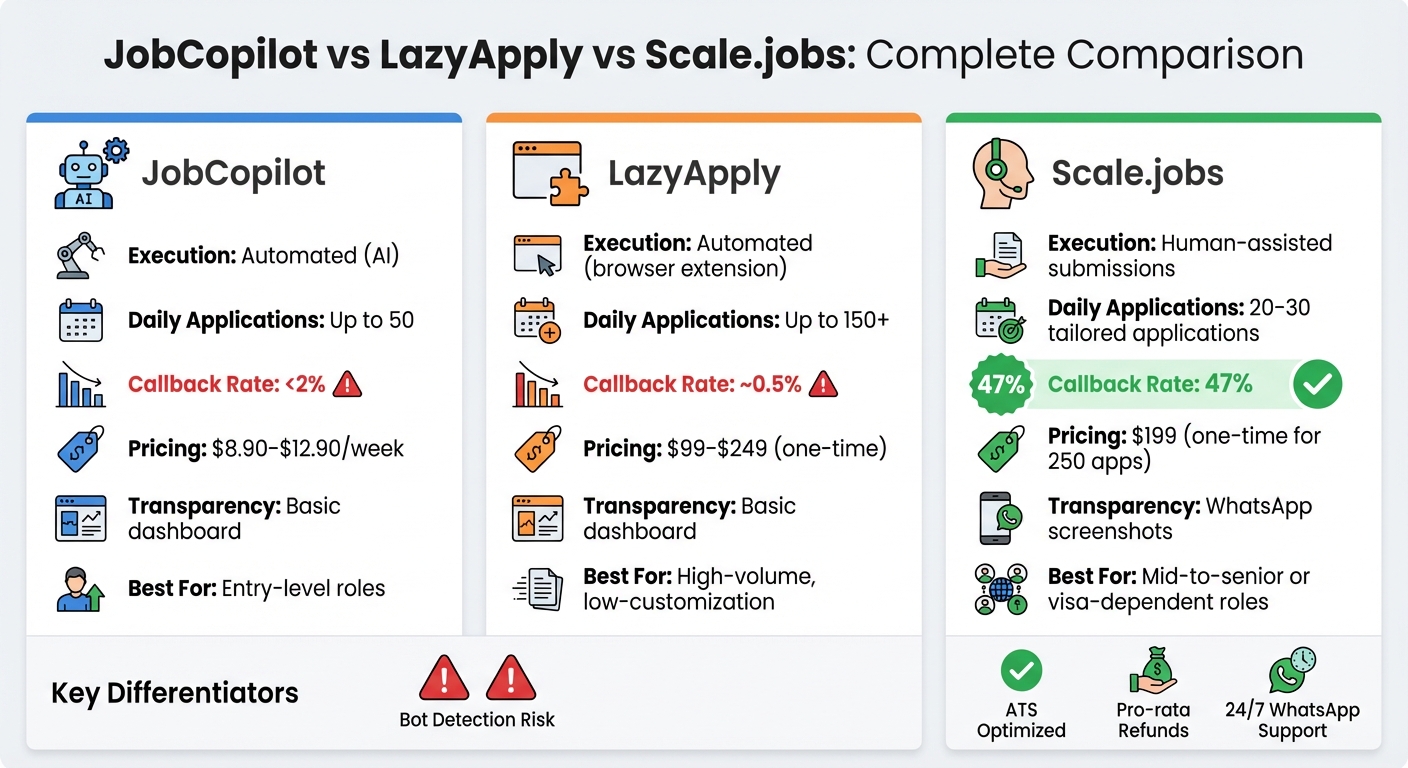
JobCopilot vs LazyApply vs Scale.jobs: Features, Pricing & Callback Rates Comparison
Quick Comparison
| Feature | JobCopilot | LazyApply | Scale.jobs |
|---|---|---|---|
| Execution | Automated (AI) | Automated (browser extension) | Human-assisted submissions |
| Daily Applications | Up to 50 | Up to 150+ | 20–30 tailored applications |
| Callback Rate | <2% | ~0.5% | 47% |
| Pricing | $8.90–$12.90/week | $99–$249 (one-time) | $199 (one-time fee for 250 apps) |
| Transparency | Basic dashboard | Basic dashboard | WhatsApp screenshots |
| Best For | Entry-level roles | High-volume, low-customization | Mid-to-senior or visa-dependent roles |
For those targeting full-time jobs, part-time jobs near me, or specialized roles, platforms like Scale.jobs provide tailored support and higher success rates. Below, we break down each platform's strengths and weaknesses to help you choose the right job search platforms for your needs.
JobCopilot: What It Offers
JobCopilot takes a different approach compared to more traditional, human-powered services by using automation to handle job applications efficiently and at scale. The platform scans over 300,000 career pages every two hours, matching opportunities to your profile and preferences. Unlike many services that rely on third-party job boards, JobCopilot submits applications directly to official company websites. This reduces the risk of encountering fake job postings or duplicate listings, ensuring a more reliable application process.
Depending on your plan, JobCopilot can submit up to 50 applications daily. It uses AI to manage both the submission process and document customization, tailoring your resume and cover letter to each job. Additionally, the platform includes a Job Application Tracker, which keeps all your submissions organized in one place. This tracker logs job descriptions, company details, and application statuses, offering a clear overview of your progress. Users can fine-tune the platform’s matching criteria, deciding whether to focus on jobs that meet most of their requirements or to cast a wider net for more opportunities. For those who prefer more control, there's an option to save jobs for manual review instead of auto-applying.
Beyond job applications, JobCopilot provides AI-powered mock interviews and salary negotiation tools, helping users prepare for later stages of the hiring process.
These core features form the foundation of JobCopilot, with more details outlined below.
JobCopilot Features
JobCopilot simplifies the application process by allowing users to upload their resumes, set preferences (such as location, role type, and seniority), and let the AI handle the rest. The platform customizes documents and manages applications based on your chosen settings. Its matching controls let you decide whether to prioritize quality matches or aim for higher application volumes. To keep you informed, email notifications provide updates on new submissions.
The platform offers two subscription plans:
- Premium plan ($8.90/week): Allows up to 20 applications per day with one AI copilot.
- Elite plan ($12.90/week): Increases the limit to 50 applications per day, includes three AI copilots, and grants access to interview preparation tools.
Both plans include AI resume builders and access to the application tracker. For those considering professional resume writing services, JobCopilot’s AI templates present a quicker and more affordable alternative. However, users targeting competitive mid-to-senior roles may notice a lack of the personal touch that human-written resumes provide.
Where JobCopilot Performs Well
JobCopilot excels in situations where speed and verified job targeting are more critical than deep personalization. By focusing on official company career pages, it avoids the pitfalls of aggregator platforms, such as outdated or misleading job postings. The platform’s straightforward setup makes it user-friendly, especially for those new to automation tools or applying to high-volume entry-level positions where generic applications are acceptable.
For users who want to avoid irrelevant applications, the matching controls are particularly useful. By setting the AI to apply only when 80-90% of job requirements align, users can ensure higher-quality submissions, though this may reduce the number of daily applications. On the other hand, recent graduates or job seekers in less competitive fields may benefit from JobCopilot's high-volume capabilities, which keep applications moving without requiring constant manual input.
LazyApply: What It Offers
LazyApply is a browser extension built to streamline job applications across multiple platforms simultaneously. Unlike JobCopilot, which focuses on direct-to-company applications, LazyApply targets "Easy Apply" roles on popular sites like LinkedIn, Indeed, ZipRecruiter, Glassdoor, Monster, and SimplyHired. Its primary focus is on maximizing the volume of applications rather than tailoring them for specific roles.
One of LazyApply's standout features is its lifetime pricing model. Instead of monthly or annual subscriptions, users pay a one-time fee ranging from $99 to $249, depending on how many applications they want to submit daily. The Basic Plan, priced at $99, allows up to 150 applications per day, while the Unlimited Plan, at $249, removes daily limits and supports up to 10 different resume profiles. Additionally, the platform offers AI tools for tasks like screening responses, creating cover letters, and optimizing resumes. An analytics dashboard is included to track daily submissions, but the emphasis remains on speed over customization.
LazyApply Features
LazyApply automates the job application process by scanning job boards for "Easy Apply" opportunities and filling out forms using pre-saved information. It handles repetitive tasks such as entering contact details, work history, and educational background, submitting applications with minimal user input. Users can specify preferences like job titles, locations, and experience levels, but its matching algorithm lacks the sophistication of platforms that provide professional resume writing or personalized reviews.
Where LazyApply Performs Well
LazyApply is particularly effective for high-volume, entry-level job searches where the goal is to apply broadly rather than focus on tailored applications. This makes it a helpful tool for recent graduates or career changers exploring a variety of industries. Its ability to submit hundreds of applications quickly is a major advantage for roles that don't require extensive screening. Additionally, the lifetime pricing model can save money for those engaged in long-term job searches.
The platform's integration with major job boards offers access to a wide range of opportunities without the need to visit each site individually. However, this high-volume strategy has its downsides. For instance, one case study showed a success rate of just 0.5%, translating to 20 interviews from 5,000 applications. Moreover, data from Indeed suggests that applicants submitting high volumes of applications are 39% less likely to receive positive responses from employers.
Another concern is account safety. Automated tools like LazyApply can trigger warnings on platforms like LinkedIn and Indeed, which have strict policies against such behavior. Users have reported being flagged for fraudulent activity, and the tool often struggles with challenges like captchas or more complex ATS systems such as Greenhouse or Lever. While LazyApply is excellent for automating high-volume submissions, platforms like Scale.jobs provide a more personalized, human-assisted alternative that addresses these issues effectively.
Scale.jobs: What It Offers
Scale.jobs combines the expertise of human virtual assistants with advanced AI tools to handle job applications manually. This approach ensures smooth navigation through Applicant Tracking Systems (ATS) like Workday, Taleo, Greenhouse, and Lever, avoiding the pitfalls of bot-detection systems. By blending human oversight with technology, Scale.jobs tackles a common issue faced by automated platforms: triggering security alerts or failing to adapt to the nuances of complex ATS systems.
The platform operates on a one-time payment structure, eliminating the hassle of recurring fees. Pricing starts at $199 for 250 applications managed by a dedicated assistant, and goes up to $1,099 for the Ultimate Bundle. This top-tier package includes 1,000 applications, two assistants, a personal recruiter, resume review, and a LinkedIn profile makeover. Another standout feature is the refund policy for unused application credits, which sets Scale.jobs apart from competitors like JobCopilot and LazyApply.
Scale.jobs Features
Scale.jobs’ hybrid model offers a range of features that elevate it above fully automated services:
- Customized Applications: Every job application is tailored with a unique resume and cover letter created within 24 hours. Human assistants review job postings, optimize materials for ATS compatibility, and manually complete application forms. This hands-on approach avoids generic submissions that automated systems often produce and ensures applications pass through ATS filters effectively.
- Proof of Work: Users receive real-time updates via WhatsApp, complete with time-stamped screenshots of each application. These updates confirm submission details, timestamps, and any screening responses, providing full transparency.
- Free Tools: The platform includes helpful resources like an ATS Score Checker, Cover Letter Generator, Job Application Tracker, Salary Predictor, and Interview Question Predictor, enhancing the job search process.
For those needing additional support, professional resume writing services are available. These services ensure your resume is polished and optimized before assistants begin tailoring it for specific roles.
Where Scale.jobs Performs Well
Scale.jobs shines in situations where quality takes precedence over quantity. The platform boasts an impressive 47% callback rate, a significant improvement over the sub-2% rates typical of automated tools like JobCopilot and LazyApply. This success stems from the human oversight that ensures applications are carefully crafted and strategically submitted.
The service also excels in handling multi-portal compatibility. Unlike browser extensions prone to technical glitches, Scale.jobs’ human assistants manually navigate corporate career pages, niche job boards, and complex ATS portals. This approach avoids common issues like captcha errors, form-filling mistakes, and account flags that automated tools often encounter.
For professionals targeting mid-to-senior roles, visa-dependent candidates managing H1B or TN requirements, or anyone conducting a strategic job search across 100–500 well-chosen positions, Scale.jobs offers a reliable and effective solution. By prioritizing precision and adaptability, the platform delivers outcomes that high-volume automation tools simply cannot match.
JobCopilot vs Scale.jobs: Direct Comparison
When it comes to job application services, the distinction between JobCopilot and Scale.jobs lies in their approach. JobCopilot operates with fully automated AI, submitting up to 50 applications daily using AI-generated templates with keyword insertion - no human involvement. On the other hand, Scale.jobs employs trained virtual assistants who manually complete each application, tailoring resumes and cover letters to meet the specific requirements of each job posting. This human-driven method can significantly enhance ATS compatibility and improve callback rates.
Their pricing models also reflect these differences. JobCopilot charges a weekly subscription starting at $8.90, which amounts to approximately $463 annually. Meanwhile, Scale.jobs offers a one-time fee starting at $199 for 250 applications, with no recurring charges and the option for pro-rata refunds on unused credits. For job seekers focusing on targeted campaigns over a few months, this flat-fee structure can often be more budget-friendly than a continuous subscription.
Transparency is another key differentiator. JobCopilot provides a basic dashboard to track application numbers, while Scale.jobs sends time-stamped WhatsApp screenshots for every application. These updates ensure users have complete visibility into where and when their applications are submitted.
5 Reasons Scale.jobs Outperforms JobCopilot
1. Human Execution Avoids Bot-Detection Issues.
Automated submissions from JobCopilot often trigger spam filters and ATS red flags, which can lower the chances of applications being reviewed. Scale.jobs' manual process avoids these risks, contributing to a reported 47% callback rate, far surpassing JobCopilot's underwhelming sub-2% performance.
2. Tailored Documents for ATS Success.
JobCopilot relies on AI-generated templates that may include awkward phrasing or irrelevant keyword matches. Scale.jobs, however, creates job-specific resumes and cover letters, ensuring they align with the job posting while maintaining natural language. This attention to detail is particularly important for mid-to-senior-level roles.
3. Flat-Fee Pricing Offers Flexibility.
JobCopilot's weekly subscription continues regardless of whether you're actively using the service, which can lead to unnecessary costs. Scale.jobs' one-time payment model allows you to pay only for the applications you need and pause the campaign when interviews start rolling in. Additionally, their refund policy for unused credits adds a layer of financial security that subscription-based models lack.
4. Real-Time WhatsApp Support.
JobCopilot relies on slower email-based support, which can be frustrating for users. Scale.jobs provides dedicated WhatsApp support, allowing users to communicate directly with the assistants managing their applications. This real-time interaction makes it easier to adjust strategies, pause campaigns, or resolve issues quickly.
5. Proof-of-Work Screenshots for Transparency.
Instead of a simple application count on a dashboard, Scale.jobs provides time-stamped screenshots of each submission. This level of transparency helps users track their applications, confirm submission statuses, and evaluate which postings are yielding responses.
Who Should Use JobCopilot vs Scale.jobs
JobCopilot is best suited for job seekers prioritizing quantity over quality, particularly those targeting entry-level positions. Its automated, high-volume approach is ideal for those willing to trade lower response rates for a flexible subscription model.
Scale.jobs, on the other hand, is designed for individuals who value quality and precision in their job applications. It's especially advantageous for professionals pursuing mid-to-senior roles, visa-dependent candidates, or those conducting strategic job searches. With its focus on ATS-friendly submissions, transparent proof-of-work, and real-time support, Scale.jobs' 47% callback rate is a compelling choice for anyone aiming for better interview outcomes.
Next, take a look at how Scale.jobs compares to LazyApply for optimizing your job search strategy.
LazyApply vs Scale.jobs: Direct Comparison
LazyApply functions through a Chrome extension that fills out job application forms automatically using standard templates. However, without human oversight, this process can lead to errors and overly generic submissions. On the other hand, Scale.jobs employs trained virtual assistants to manually tailor each resume and cover letter to the specific requirements of a job, ensuring they meet applicant tracking system (ATS) criteria and avoid bot-detection. This human-led approach, combined with ATS-optimized documents and real-time WhatsApp support, significantly improves the quality of applications.
The pricing models of these platforms also highlight their differences. LazyApply offers a one-time payment or lifetime subscription, while Scale.jobs charges a flat fee starting at $199 for 250 applications. Scale.jobs also provides pro-rata refunds for unused credits, offering financial flexibility - especially for users who quickly secure interviews. This refund option contrasts with the fixed nature of lifetime subscriptions.
Transparency is another area where these platforms diverge. LazyApply provides a basic dashboard showing the number of applications submitted but does not give users insight into what was sent or how their materials were represented. Scale.jobs, however, offers time-stamped WhatsApp screenshots for each application, allowing users to verify submissions and track responses in real time.
Below are five key reasons why Scale.jobs surpasses LazyApply in critical aspects.
5 Reasons Scale.jobs Outperforms LazyApply
-
Human Execution Minimizes Bot-Flagging
LazyApply’s automated system can trigger spam filters in ATS platforms, reducing the chances of your application being processed. By contrast, Scale.jobs’ manual submission approach avoids these issues, increasing the likelihood of your application reaching hiring managers. -
Tailored Applications Instead of Generic Templates
LazyApply relies on standard templates that may not align with specific job requirements. Scale.jobs customizes every document, adjusting the language, highlighting relevant skills, and aligning closely with the job description to make applications stand out. -
Error-Free Submissions Through Human Oversight
Automated systems like LazyApply can make mistakes, such as submitting incorrect job titles or incomplete information. Scale.jobs’ human-assisted quality control ensures that errors are caught and corrected, which is especially vital for visa-dependent roles or positions in regulated industries. -
Real-Time Support and Strategy Adjustments
LazyApply offers limited support, while Scale.jobs provides direct WhatsApp access to its assistants. This allows users to make on-the-fly adjustments to their job search strategy, pause campaigns, or shift focus to different industries as needed. -
Detailed Proof-of-Work for Every Submission
Instead of simply displaying the number of applications submitted, Scale.jobs provides time-stamped screenshots for each application. This transparency helps users verify their submissions, assess response rates, and maintain accurate records for professional or regulatory purposes.
These factors make Scale.jobs a better choice for job seekers who value precision, customization, and transparency.
Who Should Use LazyApply vs Scale.jobs
LazyApply is a good fit for those who prioritize applying to a high volume of jobs over detailed customization. It is best suited for entry-level candidates or individuals comfortable with a hands-off, automated approach, even if it means a lower likelihood of receiving responses.
Scale.jobs, on the other hand, is ideal for professionals who need tailored and high-quality applications. It caters to mid-to-senior-level candidates, those seeking competitive roles, career changers, and visa-dependent job seekers. If you're also considering a professional resume overhaul, Scale.jobs’ human-led approach can help you achieve faster and more effective results.
For those looking to elevate their job search strategy with precision and professionalism, Scale.jobs offers a more comprehensive solution. Whether you're targeting full-time jobs, exploring options for part-time jobs near me, or seeking tailored guidance with a job search virtual assistant, Scale.jobs ensures your applications are handled with care and expertise.
Feature Comparison: JobCopilot vs LazyApply vs Scale.jobs
Here's a closer look at how JobCopilot, LazyApply, and Scale.jobs stack up in terms of features and how these differences influence your job application outcomes.
| Feature | JobCopilot | LazyApply | Scale.jobs |
|---|---|---|---|
| Human Involvement | Fully AI-driven | AI-based automation | High involvement with dedicated human virtual assistants (VAs) |
| Resume Customization | AI-generated templates | Generic AI templates | Tailored, job-specific resumes crafted manually |
| ATS Handling | Limited AI optimization | Standardized formatting | Verified for ATS compliance by humans |
| Application Method | Automated bot submissions | Browser extension automation | Manual submissions by trained professionals |
| Transparency & Proof | Basic dashboard | Basic dashboard | Time-stamped WhatsApp screenshots for every application |
| Pricing Model | Weekly subscription ($8.90–$12.90/week) | One-time or annual fee ($99–$999) | Flat one-time fee ($199–$1,099) |
| Support Type | Automated tools only | Email support | 24/7 human support via WhatsApp |
| Refund Policy | None | 30-day guarantee (no credit refunds) | Pro-rata refunds for unused credits |
As seen above, Scale.jobs stands out by combining human expertise with technology. Unlike fully automated platforms, it uses trained virtual assistants to submit applications manually, ensuring accuracy and avoiding common pitfalls like incomplete forms or spam triggers. Additionally, Scale.jobs provides time-stamped WhatsApp proof for every submission, a level of transparency unmatched by JobCopilot and LazyApply, which only offer basic dashboards.
Cost and Pricing Considerations
JobCopilot’s weekly subscription can quickly add up, potentially exceeding $50 per month if your job search extends over time. LazyApply, while offering a one-time or annual fee, locks you into a fully automated system with no flexibility for personalized adjustments. On the other hand, Scale.jobs charges a flat fee and even refunds unused credits if you secure a job sooner than expected, making it a more outcome-oriented option.
Execution Methods: Bots vs. Humans
The method of execution is a critical differentiator. JobCopilot and LazyApply rely entirely on automation, such as bots and browser extensions. While convenient, these methods can lead to errors or even trigger spam filters, reducing the effectiveness of your applications. Scale.jobs, in contrast, employs human assistants to handle each application manually, ensuring everything is done correctly. This approach significantly reduces the risk of errors and increases your chances of landing interviews.
For those seeking to enhance their job search beyond automation, pairing human-assisted application services with resume writing services can improve your overall success rate. A professionally crafted resume, combined with precise manual application submissions, can make a noticeable difference in how you're perceived by potential employers.
Transparency and Proof of Work
Transparency is another area where Scale.jobs excels. With time-stamped WhatsApp screenshots for every application, you know exactly what was submitted and when. In contrast, JobCopilot and LazyApply only provide basic dashboards that show submission numbers without revealing the details of what was sent or how your materials were presented.
In the next section, we’ll dive into specific scenarios where switching to Scale.jobs could be the game-changer for your job search.
When to Switch to Scale.jobs
As highlighted in comparisons with JobCopilot and LazyApply, automated job application platforms often come with limitations. If you’ve been sending out dozens of applications without hearing back, the problem might not be your qualifications but how these tools handle your submissions. Automated systems are prone to triggering spam filters or submitting incomplete applications, which means your resume may never even reach a recruiter’s desk. Scale.jobs tackles this issue by employing trained virtual assistants to manually submit each application, ensuring accuracy and compatibility with ATS (Applicant Tracking System) requirements.
Another frustration with competitors is their recurring subscription model. Platforms like JobCopilot and LazyApply require ongoing payments, which can quickly add up - especially if you land a job before using all your credits. Scale.jobs, on the other hand, offers a one-time flat fee, starting at $199 for 250 applications, with a pro-rata refund for unused credits. This pay-as-you-go approach ensures you’re only investing in results, while also prioritizing application quality and ATS compliance.
Frequent ATS rejections are another common hurdle. If your applications are regularly filtered out before reaching a recruiter, you're missing valuable opportunities. Scale.jobs minimizes this risk by having human assistants verify your resume’s ATS compatibility and tailor it for each job description, giving your application a better chance of making it through the system.
Transparency is another area where competitors fall short. While some platforms offer dashboards to track submission counts, they rarely provide details about what was sent or how it was formatted. Scale.jobs goes further by delivering submission proofs, giving you full visibility into each application and its outcome.
For job seekers who value consistent human oversight, Scale.jobs stands apart from JobCopilot’s automated approach and LazyApply’s high-volume strategy. Pair this service with professional resume writing to ensure your materials are polished and ready for submission. This combination of expertly crafted resumes and manually optimized applications significantly improves your chances of landing interviews. If quality, budget-consciousness, and transparency matter in your job search, switching to Scale.jobs could be the game-changer you need.
Which Platform to Choose: Quick Decision Guide
Selecting between JobCopilot, LazyApply, and Scale.jobs boils down to your career goals, desired level of control, and whether you value quantity or precision in your job applications. Here's a breakdown to help you align each platform with your job search priorities.
Opt for JobCopilot if you're an entry-level job seeker or pursuing roles in high-turnover industries where speed is more critical than customization. JobCopilot pulls opportunities directly from verified company career pages, reducing the risk of fake postings. Its weekly subscription model suits short-term, high-volume job hunts, but the costs can add up for longer campaigns. Keep in mind, it lacks the personalized touch and ATS-optimized applications needed for more competitive roles.
Go with LazyApply if you're working with a tight budget and prefer a broad-volume application strategy. The platform’s lifetime fee option is appealing for those seeking unlimited applications without recurring costs. However, its reliance on generic templates increases the risk of ATS rejections, making it better suited for less competitive industries. Personalized support and detailed submission tracking are not part of the package.
Choose Scale.jobs if you're targeting mid-to-senior roles, need help navigating visa sponsorships (e.g., H‑1B, F‑1), or are managing complex application requirements. The platform stands out with:
- Dedicated human assistants who manually handle ATS-optimized applications
- A one-time payment model ($199 for 250 applications) with no recurring fees
- Transparent, time-stamped WhatsApp proofs for every submission
- Real-time support to adjust strategies as your search progresses
For job seekers aiming for competitive roles, career shifts, or positions requiring tailored cover letters, pairing Scale.jobs with their professional resume writing service can further enhance your application materials.
| Priority | Recommended Platform | Why |
|---|---|---|
| Budget/Speed | JobCopilot or LazyApply | Affordable, high-volume applications |
| Quality/ATS Compliance | Scale.jobs | Manual submissions by human assistants |
| Transparency | Scale.jobs | Proof-of-work with WhatsApp time-stamped screenshots |
| Entry-Level Roles | LazyApply | Lifetime pricing for volume-focused applications |
| Mid-Senior/Complex Needs | Scale.jobs | Tailored applications, visa support, customization |
When to Switch to Scale.jobs
Consider making the move to Scale.jobs if:
- You're experiencing instant rejections or bot-detection warnings from platforms like Workday, Greenhouse, or LinkedIn
- Your target roles require tailored resumes and cover letters to address specific needs like employment gaps or career pivots
- You need proof-of-work for every application, verified via WhatsApp screenshots
- Your job search involves navigating visa sponsorships or answering detailed screening questions that automated tools can't handle
- You prefer a one-time payment structure with pro-rata refunds for unused credits, avoiding ongoing subscription fees
Decision Summary
- JobCopilot: Best for short-term, high-volume applications in entry-level roles where speed and verified job postings matter more than customization.
- LazyApply: A budget-friendly option for job seekers prioritizing quantity over quality in less competitive industries.
- Scale.jobs: Ideal for mid-to-senior level professionals, candidates requiring visa support, or anyone focused on quality, ATS compliance, and transparent application tracking over sheer volume.
New Offer: 5 Free Applications from Scale.jobs
Scale.jobs is now offering a risk-free way to experience their service with 5 free job applications - no upfront payment required. Unlike competitors such as JobCopilot and LazyApply, which ask for payment before you can start (LazyApply, for instance, charges at least $99), Scale.jobs lets you try their service without any financial commitment.
What’s included in this offer? The same features that make Scale.jobs stand out:
- A human-powered approach, where a dedicated assistant handles your applications.
- Proof of submission via WhatsApp screenshots, ensuring transparency.
- A 15-minute consultation to get started - no credit card or hidden fees involved.
| Feature | Scale.jobs Free Offer | JobCopilot | LazyApply |
|---|---|---|---|
| Upfront Cost | Free for 5 applications | Paid upfront | $99 minimum |
| Human Involvement | Yes (dedicated assistant) | No | No |
| Proof of Work | WhatsApp screenshots | Dashboard metrics only | Dashboard metrics only |
| Customization | Tailored per job | Generic templates | Generic templates |
This free trial highlights the advantages of Scale.jobs’ human-powered process compared to automated job search tools. Your dedicated assistant doesn’t just submit your applications - they navigate Applicant Tracking Systems (ATS), answer screening questions, and tailor submissions to specific job postings. These are areas where automated systems, like those used by JobCopilot and LazyApply, can fall short.
On top of the free applications, Scale.jobs has earned a stellar 4.8–4.9 rating across major review platforms. Users frequently praise the personalized support they receive from their assigned assistants. To make the most of your trial, you might also consider pairing it with their professional resume writing service. This ensures your resume is optimized for ATS from the start, giving you a stronger chance of landing interviews. Scale.jobs’ commitment to transparency and tailored service truly sets it apart from other platforms.
FAQs
How should I choose between high-volume automation and tailored applications?
When deciding which approach to take in your job search, it’s essential to align your strategy with your goals. Tools designed for high-volume automation are all about speed, allowing you to send out a large number of generic applications quickly. This can work well for entry-level positions or roles with high turnover rates, though the response rates may be lower.
On the other hand, tailored applications crafted by human assistants focus on creating personalized, ATS-friendly documents. This approach is better suited for senior-level, specialized, or highly competitive roles where a customized application can make a stronger impression.
For the most effective results, you might consider a hybrid approach. By combining the efficiency of automation with the precision and personal touch of human oversight, you can strike a balance that maximizes both reach and impact.
What does “callback rate” mean, and how should I interpret it?
Callback rate refers to the proportion of job applications that get a response or callback from employers, indicating their interest or engagement. If your callback rate is low, typically around 1–3%, it may suggest that your applications are too generic or not tailored to the roles you're pursuing. On the other hand, a higher callback rate, such as 25–30%, usually demonstrates a stronger alignment with the job requirements and a more targeted approach. Applications that are personalized and carefully managed by individuals tend to perform better than those relying on automated or generic submissions.
How can I tell if my applications are being submitted correctly?
To make sure your applications are submitted accurately, focus on platforms that offer clear confirmation and tracking features. For instance, Scale.jobs employs human assistants to prepare and submit applications, providing real-time updates along with proof of submission. On the other hand, automated tools like LazyApply might not include detailed confirmation, which can leave you uncertain about the application status. Prioritize platforms with submission tracking or proof of application to ensure everything is handled properly.