
Top 5 Job application tools that actually save your time
Compare five job-application tools that speed up submissions, optimize resumes for ATS, and track applications.


Applying for jobs can be exhausting - especially when dealing with repetitive tasks, ATS filters, and low response rates. This article reviews five tools that simplify the process: scale.jobs, LazyApply, Simplify, Teal, and Jobscan. Each tool addresses specific challenges, from automating submissions to optimizing resumes for ATS systems. Below is a quick breakdown of how these tools can help:
- scale.jobs: Combines AI and human assistance to handle applications, customize resumes, and provide proof of submission - all for a one-time fee.
- LazyApply: Automates form-filling for high-volume applications but lacks customization and ATS optimization.
- Simplify: Autofills applications across ATS platforms but requires manual submission.
- Teal: Organizes job searches with tracking tools and resume version control.
- Jobscan: Optimizes resumes for ATS compatibility but requires significant manual effort.
scale.jobs stands out by offering a hands-off, human-led service that ensures tailored, ATS-friendly applications. It’s ideal for job seekers applying to many roles or those short on time. Below, we’ll compare these auto job applier tools by exploring their features, pricing, and best use cases to help you decide which suits your needs.
This Tool solves Job Applications (100s in ONE Shot)!!
sbb-itb-564272e
1. scale.jobs
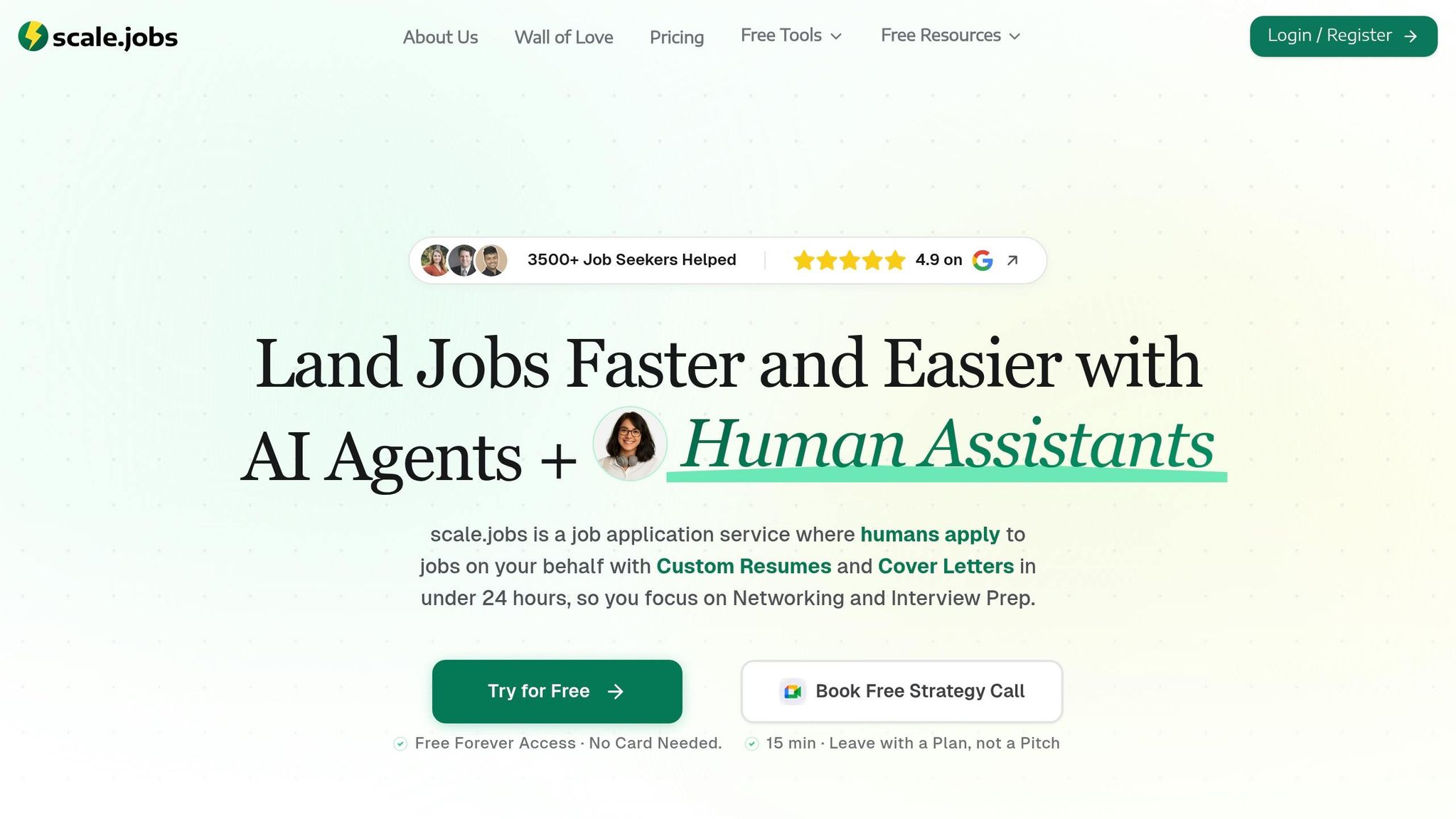
scale.jobs operates on a straightforward principle: finding a job shouldn't consume your entire day. Unlike tools such as LazyApply or Jobscan, scale.jobs combines speed and efficiency with human oversight, addressing common shortcomings of purely automated platforms.
The platform offers three distinct tiers to cater to different needs:
- Free Software + AI Tier: This tier provides access to a job board featuring over 2 million monthly postings, an ATS-friendly resume builder, application tracking tools, and a limited number of daily AI-generated resumes and cover letters tailored to specific roles.
- AI Assistant Pro ($9/month): At an introductory price, this level unlocks unlimited AI-generated resumes, cover letters, and even responses to application and interview questions.
- Human Assistant Plans: These plans are where scale.jobs truly stands out. Human assistants carefully vet roles and handle applications to ensure precise matches, saving you time and effort. This approach addresses the limitations of platforms that rely solely on automation.
The proof-of-work model is a defining feature of the human-assisted tiers. Every application is supported by time-stamped screenshots, a live dashboard, and real-time updates via WhatsApp, giving you full visibility into the process. Human assistants also pre-screen roles to filter out mismatches in salary, seniority, or location - something automated tools often miss. This blend of automation and human precision sets scale.jobs apart.
The Human Assistant plans are priced as a flat one-time fee rather than a recurring subscription:
- Basic Plan ($199): Covers 250 applications with one assistant.
- Standard Plan ($299): Covers 500 applications with two assistants.
- Best Value Plan ($399): Covers 1,000 applications with two assistants.
These plans aim to eliminate the inefficiencies of ATS systems and reduce repetitive tasks. Additional services, such as resume writing and LinkedIn profile optimization, can further enhance your job search package.
Why scale.jobs Stands Out
- Human-assisted applications with complete transparency through proof-of-work.
- ATS-optimized resumes to improve your chances of success.
- Flat, one-time pricing - no recurring subscriptions.
- Real-time updates via WhatsApp to ensure you're always informed.
scale.jobs is especially useful for job seekers applying to multiple similar roles, like software engineers targeting backend or full-stack positions. Users report drastically reducing their application time - often to zero - while maintaining or even increasing their interview opportunities. Some users have achieved over 300 targeted applications in a single month, demonstrating the platform's efficiency.
For those looking to streamline their job search without sacrificing quality, scale.jobs offers a practical and time-saving solution.
2. LazyApply
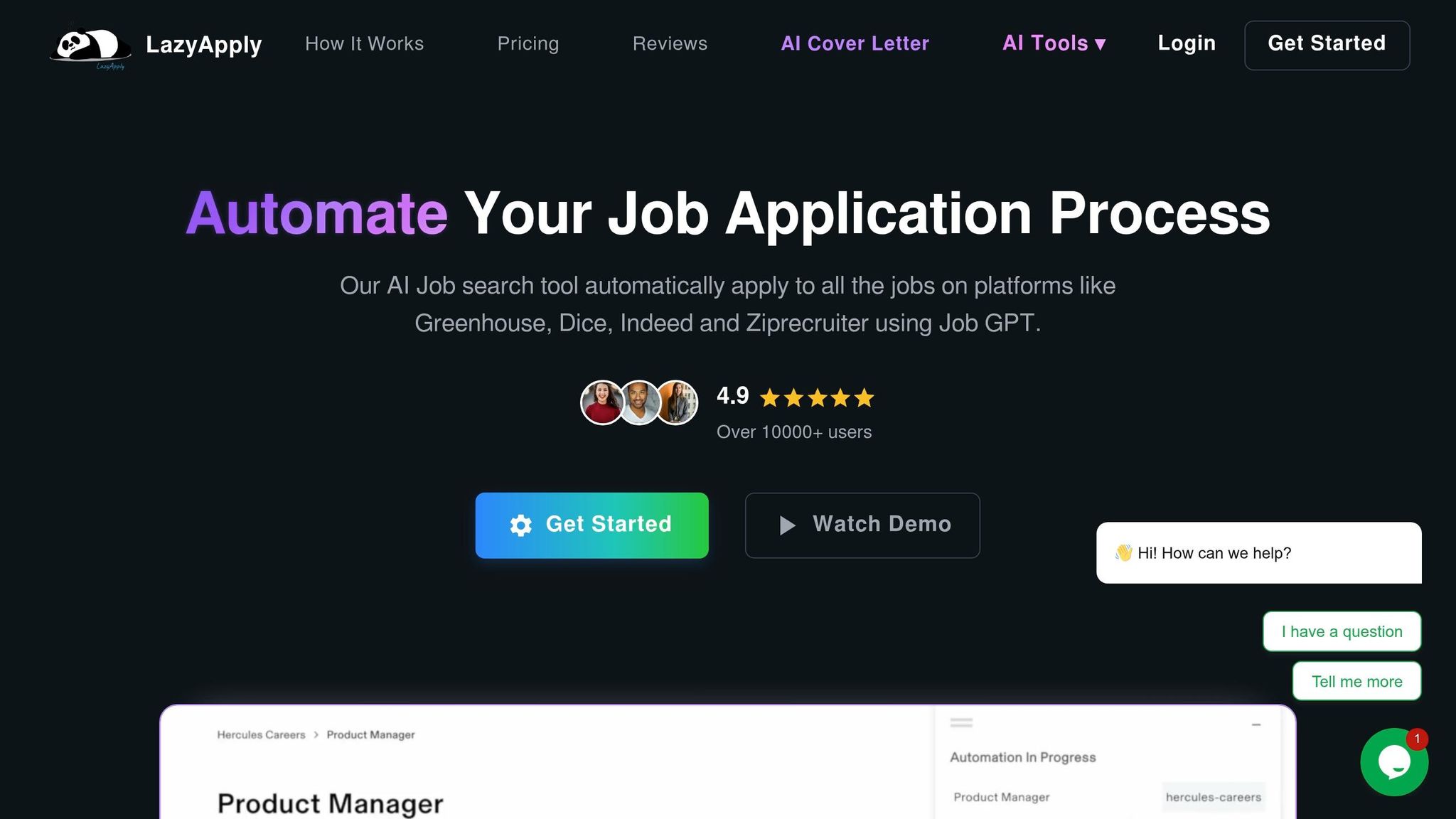
LazyApply is a Chrome extension designed to automate the process of filling out job applications on platforms like LinkedIn, Indeed, ZipRecruiter, and Dice. If you're someone who has already perfected your resume and simply wants to avoid the repetitive task of entering the same information repeatedly, LazyApply takes care of that for you.
However, there’s a significant downside: LazyApply uses a single, static resume for every application. There’s no option to tailor your application to specific roles, which can be a major drawback. In contrast, Scale.jobs provides tailored, human-assisted vs. automated job applications that are customized for each job. LazyApply’s bulk approach allows users to upload their profile and submit up to 1,500 applications per day on its highest-tier plan. While this may sound impressive, it’s worth noting that as automated applications become more common - predicted to make up 25% of job applications by 2028 - Applicant Tracking Systems (ATS) will likely become even more stringent in filtering out generic submissions.
"LazyApply suits someone who wants pure form-filling automation and has already solved the resume and interview problems elsewhere." - AIApply
There are also practical risks to consider. Platforms like LinkedIn and Indeed have terms of service that restrict certain types of third-party automation. Heavy usage of LazyApply could lead to account restrictions. Additionally, the refund policy is quite restrictive - you’re only eligible for a 30-day money-back guarantee if fewer than 100 applications were submitted and you can prove the software malfunctioned. The updated privacy policy (as of January 2024) allows for sharing personal data with advertisers and marketing partners, which may raise concerns for some users.
LazyApply’s pricing starts at $99 per year for the Basic plan, which limits users to 15 applications per day. The Ultimate plan, priced at $999 per year, allows up to 1,500 applications per day. Despite the high volume, none of the plans include human review, ATS optimization, or role-specific customization. This makes LazyApply less effective for targeted job searches, which is where Scale.jobs outshines it.
Why scale.jobs outperforms LazyApply:
- Human-Assisted Applications: Scale.jobs provides tailored, role-specific applications compared to LazyApply’s generic, static resume submissions.
- ATS Optimization: Every document is optimized to pass ATS filters, increasing the chances of landing interviews.
- Real-Time Updates: Scale.jobs offers transparent proof-of-work with real-time updates via WhatsApp, ensuring accountability.
- One-Time Pricing: Unlike LazyApply’s recurring subscription model, Scale.jobs offers a one-time payment option with personalized support.
Who benefits from LazyApply?
LazyApply is best for job seekers who already have a polished resume, understand the risks associated with mass applications, and need a simple tool to automate repetitive form-filling across job boards.
Who should choose scale.jobs instead?
If you’re looking for tailored resumes, ATS-friendly applications, human-vetted job matches, or proof of submission accuracy, Scale.jobs offers a more comprehensive solution. It integrates all these features into a seamless workflow, making it ideal for those who want a targeted and effective job search strategy.
Continue to the next section for a detailed comparison of features between LazyApply and Scale.jobs.
3. Simplify
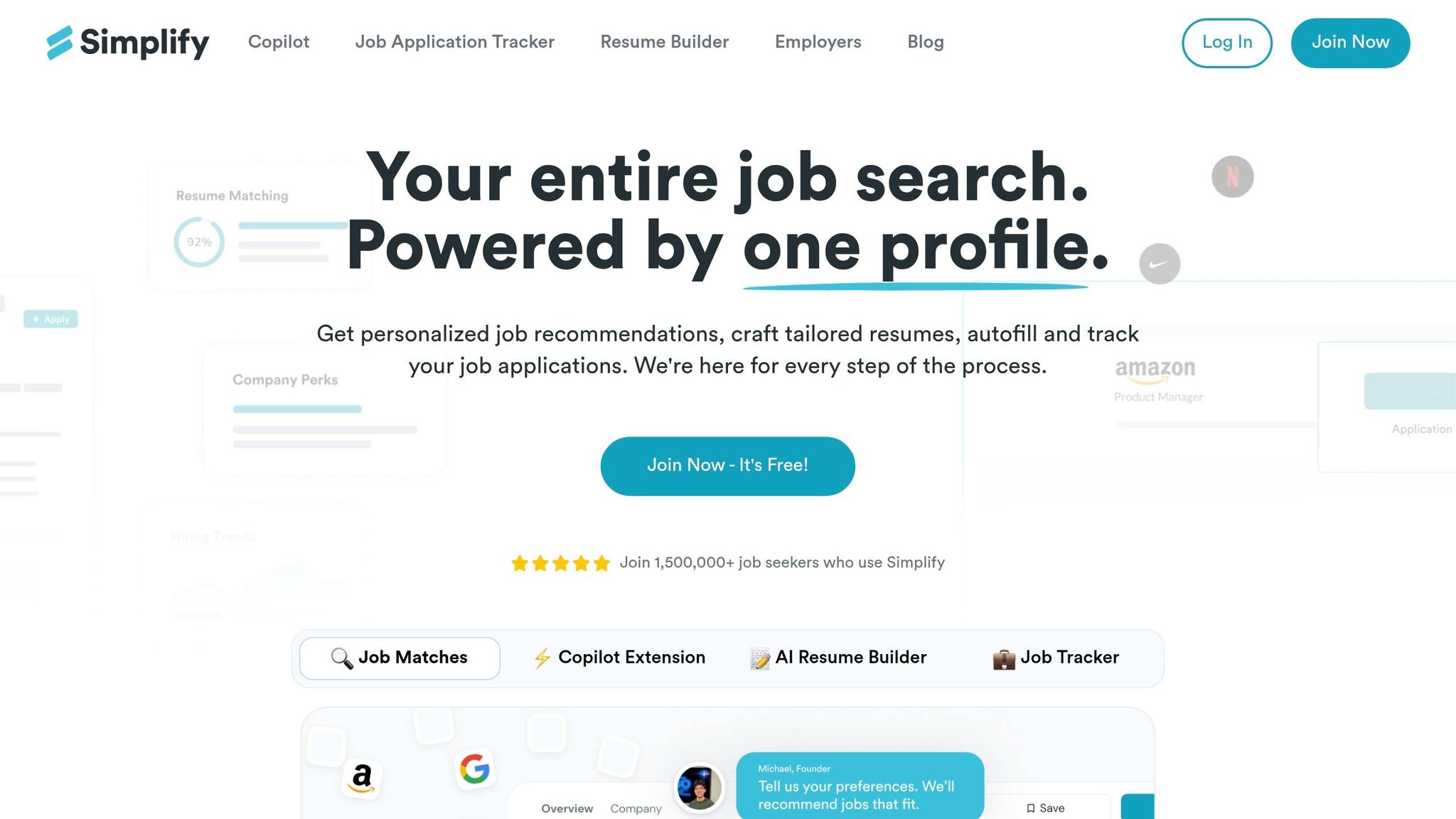
Simplify is a Chrome extension boasting over 1,500,000 users, designed to autofill job applications across more than 100 Applicant Tracking Systems (ATS), including Workday, Greenhouse, Lever, and iCIMS. During testing, Simplify reduced the average time spent on a Workday application from 22 minutes to just 8 minutes, making it a time-saver for those applying to multiple roles.
However, there’s an important catch: Simplify helps with autofilling, but it doesn’t auto-submit applications. You still need to review each page and manually click "Submit." As one reviewer put it:
"Simplify Jobs doesn't auto-apply. It auto-fills. You're still the one clicking Submit - every single time." - Remote Job Assistant Blog
The free tier provides unlimited autofill and a job tracker, a feature many users find especially helpful. For those seeking additional tools, the paid Simplify+ tier costs $19.99 per week or $39.99 per month and includes AI-powered resume and cover letter creation. However, it lacks a free trial and a clear refund policy. Some users have expressed concerns about the AI-generated documents, as highlighted in this review:
"AI is absolutely terrible at making resumes that would pass a human reader." - Stephen Nemo, Verified Reviewer, Trustpilot
On the other hand, scale.jobs offers a completely different experience. Instead of leaving the submission process in your hands, scale.jobs assigns human assistants to oversee the entire application process. From crafting ATS-optimized, job-specific resumes and cover letters to providing real-time updates via WhatsApp, scale.jobs ensures a seamless experience - all for a one-time fee, avoiding recurring charges.
Why scale.jobs stands out compared to Simplify:
- Hands-off process: Unlike Simplify, scale.jobs takes care of submitting applications for you.
- Tailored applications: Documents are customized for each job, rather than using a generic autofill template.
- Human expertise: Resumes and cover letters are reviewed by professionals, ensuring they meet ATS standards and avoid common AI errors.
- Ready-to-submit documents: Human-reviewed materials eliminate the need for extensive edits or corrections.
- Clear updates: Receive real-time proof of submission via WhatsApp, so you know exactly when and where your applications are sent.
- One-time payment: Say goodbye to weekly or monthly subscription fees.
These features make scale.jobs an appealing choice for those seeking a more comprehensive and efficient application process - something Simplify doesn’t fully provide.
Who should consider Simplify?
Simplify’s free tier is a practical option for job seekers who want to save time on repetitive tasks but don’t mind managing the submission process themselves. It’s particularly useful for roles on platforms like Workday and Greenhouse.
Who benefits more from scale.jobs?
If you’re spending countless hours submitting applications and need a more personalized and hands-off approach, scale.jobs is the better fit. This is especially true for those aiming for competitive roles, where a generic autofill solution might not cut it. Check out our comparison table next to see how scale.jobs measures up against other tools.
4. Teal
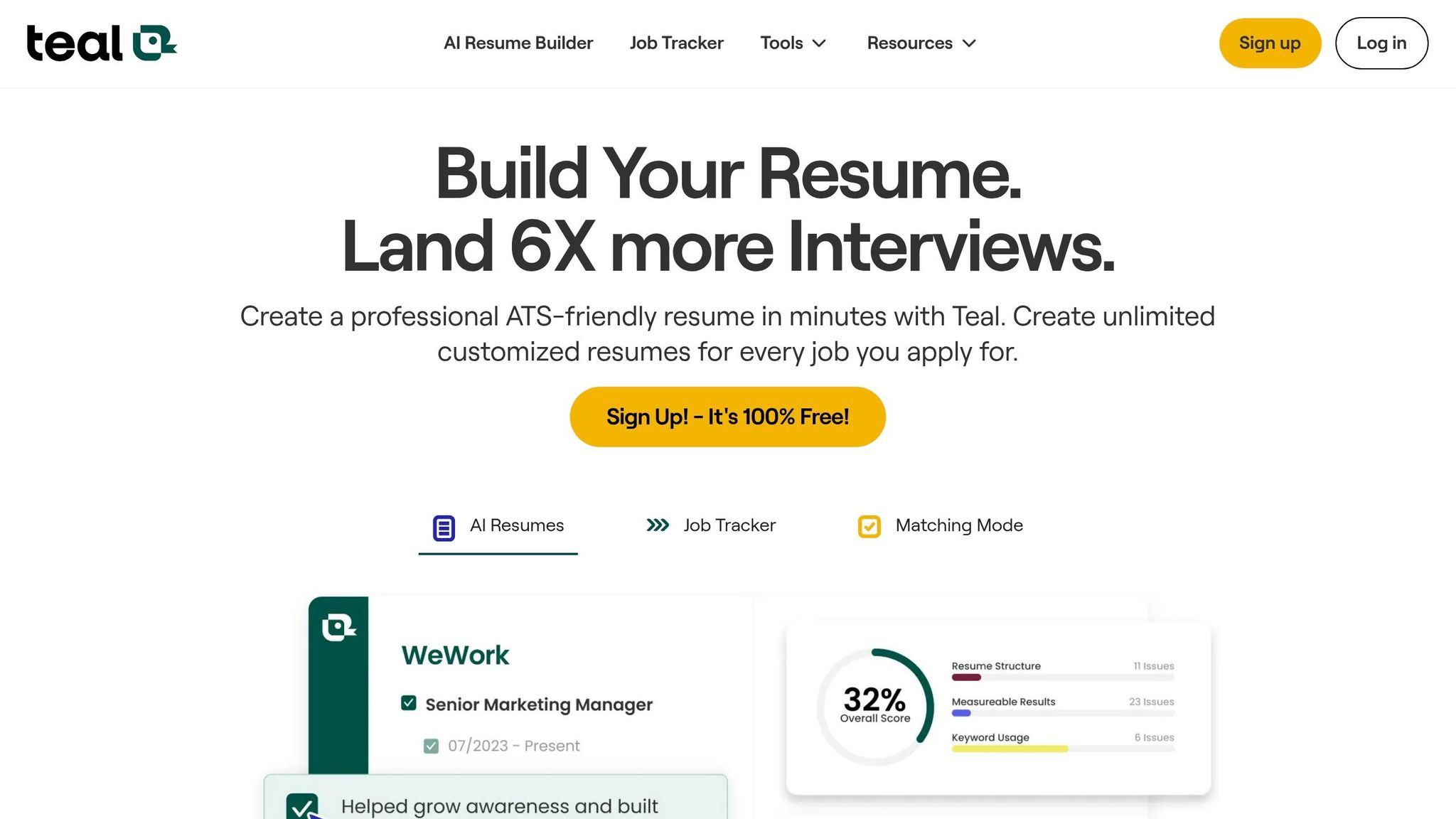
Teal operates as a comprehensive job-search hub, combining tools for tracking applications, building resumes, and analyzing job descriptions (JDs) into one platform. Its standout feature is a Chrome extension that extracts JD details directly from platforms like LinkedIn, Indeed, and Greenhouse. This data is then organized into a card-based tracker, which logs the JD, the resume version submitted, and the application date.
"The application tracker is the best in this category. Each application is a card with the JD, the resume version you sent, the date, and follow-up state." - The AI Career Lab Team
The version control feature is another highlight. It allows users to save multiple resume versions, link each to specific applications, and even compare them to identify which phrasing led to interviews. Priced at $9–$29/month for its Pro tier, Teal offers a budget-friendly option compared to many competitors.
However, some features come with limitations. The AI rewriting tool often generates generic language - overusing terms like "leverage" and "robust" - which newer ATS systems may flag. Similarly, the Match Score provides a basic keyword overlap percentage rather than a nuanced semantic analysis. This makes it less effective for modern ATS systems like Greenhouse, Lever, or Ashby, which prioritize contextual understanding over simple keyword matching.
In contrast, scale.jobs goes beyond tracking by offering end-to-end application management with human oversight. Unlike Teal, scale.jobs ensures each application features ATS-optimized, role-specific documents crafted by professionals. It also provides real-time WhatsApp updates to confirm every submission, all for a one-time fee rather than a recurring subscription.
Why scale.jobs Wins vs. Teal
- Human-assisted applications ensure tailored, ATS-friendly documents, avoiding the pitfalls of keyword-stuffed templates.
- A one-time payment covers complete tracking and submission, eliminating ongoing monthly costs.
- Real-time WhatsApp updates provide transparency and proof for every application.
- Semantic resume customization for each role replaces Teal's less reliable Match Score.
- Human review avoids the formulaic language patterns that AI tools often produce and ATS systems flag.
Who Should Use Teal?
Teal is a good choice for job seekers managing a high-volume search across numerous roles who need a structured way to stay organized. Its tracking and version control features are particularly helpful. However, users should approach the AI tools with caution - skip the AI writing feature and use the Match Score as a general reference, not a definitive metric.
Who Should Choose scale.jobs?
For job seekers who need more than just organization, scale.jobs offers a complete solution. It’s ideal for those who want assistance with the entire application process, including creating tailored documents for each role and receiving proof of every submission. Scale.jobs is designed for people focused on results, not just better tracking.
Switch to scale.jobs if…
- You need full application management, not just tracking and organization.
- Customized resumes and cover letters for each role are essential to your job search.
- Verified proof of submission matters more than self-managed records.
- You prefer a one-time payment over ongoing subscription fees.
- You’re applying for competitive roles where generic keyword matching won’t cut it.
5. Jobscan
Following our review of Teal, let's take a closer look at Jobscan and how it compares.
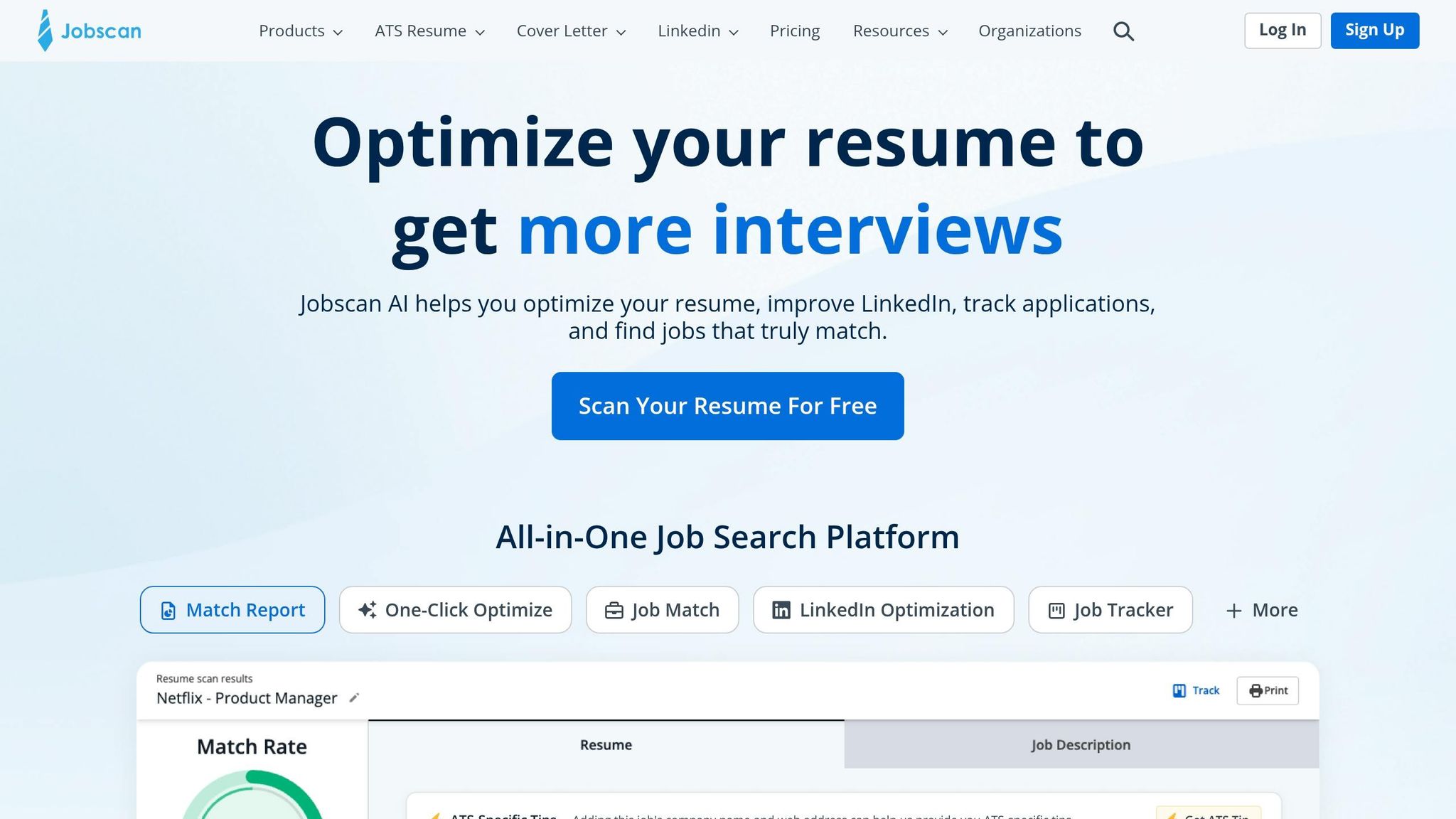
Jobscan is all about making your resume ATS-friendly before it even reaches a human recruiter. This platform reverse-engineers the algorithms of leading ATS systems like Taleo, iCIMS, Lever, and Greenhouse. Instead of offering generic advice, it provides platform-specific tips to optimize your resume. Here's how it works: you paste a job description, upload your resume, and Jobscan generates a "Match Rate" score. This score evaluates your hard skills, soft skills, job titles, and industry-specific keywords. It also flags formatting issues - like tables, images, or multi-column layouts - that might confuse ATS parsers.
One standout feature is the LinkedIn optimizer, which evaluates your LinkedIn profile against target job descriptions. According to Jobscan, users who follow these recommendations are 1.5x more likely to secure an interview. For those eyeing roles at Fortune 500 companies - where nearly all use ATS filters as a first step - Jobscan's tailored insights can provide a critical edge over basic keyword matching tools.
That said, Jobscan's process takes time. Each resume can demand 22–26 minutes to optimize, which can be a challenge for users applying to multiple roles. Another concern, as Ishtiaque Hossain of ResumeHog points out:
"Jobscan optimizes for ATS scores, not for the human recruiter who spends six seconds skimming your resume after it clears the filter."
In other words, a high Match Rate doesn't always translate to a compelling resume for recruiters. While the One-Click Optimize feature (powered by GPT-4) speeds things up, the AI-generated results often require human editing to sound natural. At $49.95/month for the full plan, Jobscan offers a lot of insights, but you're still doing much of the work yourself.
Scale.jobs offers a different solution. Instead of guiding you through optimization, it handles the entire process. Human assistants customize your resume for specific roles and ATS platforms, submit applications within 12–24 hours, and even send proof-of-work screenshots via WhatsApp. While Jobscan teaches you how to optimize, scale.jobs takes care of the heavy lifting for you.
Why scale.jobs Wins vs. Jobscan
- No time spent per application. Jobscan's 22–26 minute process per resume isn't practical for high-volume applications. Scale.jobs eliminates this step, submitting applications quickly while ensuring resumes are effective for both ATS systems and recruiters.
- Proof of submission. Scale.jobs provides screenshot confirmations for every application, whereas Jobscan only offers optimization reports.
- Cost-effective pricing. Scale.jobs charges a flat fee for application bundles (e.g., $199 for 250 applications), unlike Jobscan's recurring $49.95/month subscription, making it more budget-friendly for those applying to many roles.
- Comprehensive service. While Jobscan stops at optimization, scale.jobs handles everything - optimization, customization, and submission.
Who Should Use Jobscan?
Jobscan is a great choice for DIY job seekers applying to a smaller number of roles - around 5 to 10 per week - who want to understand why their resumes may not be passing ATS filters. It’s particularly helpful for those targeting Fortune 500 companies, where knowing the specifics of an ATS can give you an edge. Users often appreciate the platform’s educational value, as it teaches them to think like an ATS.
Who Should Choose scale.jobs?
Scale.jobs is perfect for those managing high-volume job searches - 50 or more applications per month - or anyone spending over 10 hours weekly on manual applications. It’s also ideal if you want verified proof that your applications have been submitted, not just optimized. For those who prefer to focus their time on interview prep rather than the application process, scale.jobs offers a hands-off approach with human assistants, ATS-optimized documents, and WhatsApp proof-of-work.
Switch to scale.jobs if…
- You’re applying to 50 or more roles each month and can’t afford the time spent on individual resume optimization.
- You value confirmation that your applications were submitted, not just optimized.
- You need resumes that work for both ATS systems and recruiters, without compromising on either.
- You prefer a one-time payment over a recurring monthly subscription.
Next, check out our comparison table to see how Jobscan stacks up against scale.jobs and other platforms.
Comparison Table
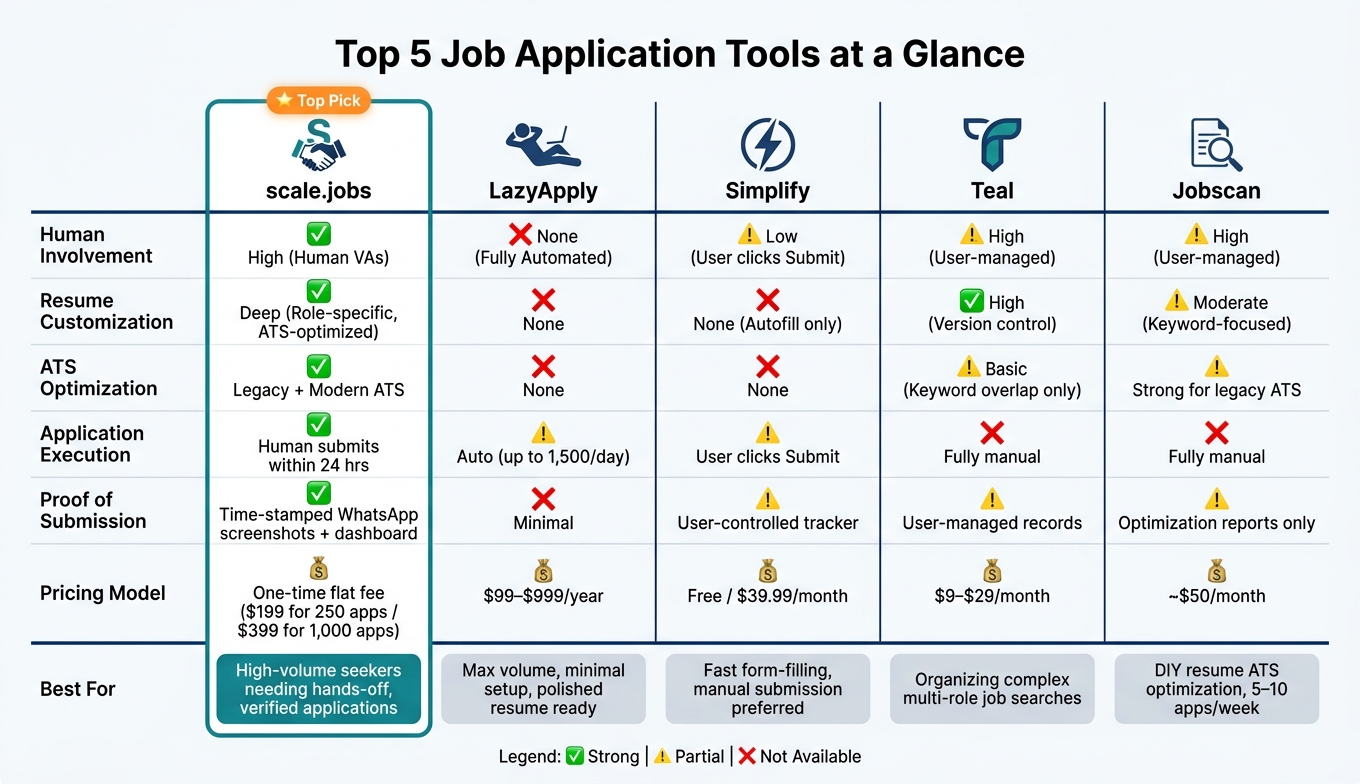
Top 5 Job Application Tools Compared: Features, Pricing & Best Use Cases
Here's a detailed look at how five job application tools stack up against each other based on critical factors:
| Criteria | scale.jobs | LazyApply | Simplify | Teal | Jobscan |
|---|---|---|---|---|---|
| Human Involvement | High - trained human VAs personally handle every application | None - fully automated | Low - users review and click submit | High - users manage every step manually | High - users manually refine resumes based on detailed reports |
| Resume Customization Depth | Deep - ATS-optimized, role-specific resumes and cover letters for each job | None - no document tailoring | None - auto-form fills only | High - version-controlled resumes with side-by-side comparisons | Moderate - keyword-focused edits based on job descriptions |
| ATS Handling | Works with both legacy (Workday, Taleo) and modern ATS (Greenhouse, Lever) | No ATS optimization | No ATS optimization | Basic keyword overlap scoring (limited for modern ATS) | Strong for legacy ATS; less effective on modern systems |
| Application Execution | Human assistants submit applications on any portal within 24 hours | Automated Chrome extension - up to 1,500/day | Browser extension - users click submit | Manual - users submit each application | Focuses on resume optimization; manual application submission required |
| Transparency & Proof of Work | Time-stamped screenshots via WhatsApp plus an application dashboard | Minimal submission transparency | High - user-controlled tracker | High - users oversee every step | High - detailed optimization reports, but no submission tracking |
| Pricing Model | Flat one-time fee ($199 for 250 apps; $399 for 1,000 apps) | One-time fee (~$99–$249) or $179/year | Free | $9–$29/month (Pro tier) | ~$50/month |
Key Takeaways
- LazyApply is a budget-friendly option for submitting a high volume of applications quickly, but it lacks customization and oversight.
- Simplify offers convenience but skips ATS optimization and requires users to manually handle submissions.
- Teal excels in tracking and resume management, making it ideal for complex job searches, though its ATS scoring isn’t as effective for modern systems.
- Jobscan provides in-depth ATS analysis but demands significant manual effort for each application.
- scale.jobs stands out by combining human-assisted submissions, tailored ATS-friendly resumes, transparent proof-of-work via WhatsApp, and a straightforward flat fee.
Your choice ultimately depends on what’s holding you back - whether it’s tracking, resume optimization, or the actual submission process. This breakdown provides a strong foundation for selecting the tool that best meets your needs.
Conclusion
Jobscan, Teal, Simplify, and LazyApply each serve a distinct purpose in the job application process, while Scale.jobs stands out by automating applications with human oversight. Here's how they align with different needs: Jobscan fine-tunes resumes to pass ATS filters, Teal helps organize your job search pipeline, Simplify accelerates form-filling on tech-focused job boards, and LazyApply prioritizes high-volume applications with minimal effort.
Despite these tools' strengths, the biggest challenge for many U.S. job seekers remains the repetitive and time-consuming process of submitting applications. Most spend hours after work entering the same information into platforms like Workday, Taleo, and Greenhouse. Scale.jobs tackles this issue directly by having human virtual assistants submit applications within 24 hours, using ATS-optimized resumes. Submissions are verified through time-stamped WhatsApp screenshots, all for a one-time fee.
For anyone applying to 50 to 200+ roles monthly, balancing a full-time job, or dealing with the urgency of a layoff, Scale.jobs is a practical solution. Additionally, for those needing professionally crafted application materials, Scale.jobs' resume writing and career services ensure consistency across your documents and submissions.
The most effective approach often involves combining tools based on your specific needs: Jobscan for refining your resume, Teal for tracking and managing your search, and Scale.jobs for handling high-volume applications. Together, they cover the essential steps of optimization, organization, and execution.
Decision Summary:
- Use Jobscan if you’re targeting specific roles and want to refine your resume for ATS compatibility yourself.
- Use Teal if you need to manage a complex job search with multiple opportunities and require tracking tools.
- Use Simplify if you’re looking for quicker form-filling on portals like Workday or Greenhouse but prefer to submit applications manually.
- Use LazyApply if you have a polished resume, are comfortable with the risks of automated submissions, and want maximum volume with minimal setup.
- Choose Scale.jobs if you’re applying at scale, need proof of submissions, prefer ATS-optimized documents tailored to each role, and value a one-time payment over ongoing subscriptions.
FAQs
How do I choose the right tool for my application volume?
When deciding on a tool, consider how it handles multiple applications and whether you prefer automation or human involvement. If you’re managing a high volume of applications (50+ per week), platforms like Scale.jobs offer human-assisted services that ensure ATS-compliant, personalized applications. On the other hand, fully automated tools such as LazyApply or LoopCV work well for smaller volumes (5–10 applications per week), providing quicker but less tailored submissions. Align your specific needs with the tool’s capabilities to achieve the best outcomes.
Will these tools work with Workday and Greenhouse portals?
These tools often lack direct integrations with platforms like Workday or Greenhouse. However, certain options, such as KarKo AI, offer compatibility with applicant tracking systems (ATS) by using features like document parsing and upload. In some cases, automation extensions or third-party connectors can help simplify the process further.
What’s the safest way to avoid ATS or account issues when automating?
To steer clear of issues with Applicant Tracking Systems (ATS) or account flags when automating job applications, it's essential to use tools that blend human oversight with ATS-friendly resume adjustments. Approaches that incorporate human assistants to tailor and submit applications can significantly lower the chances of rejection or account restrictions often triggered by fully automated systems. Focusing on creating ATS-optimized resumes while avoiding excessive automation without proper supervision is critical for staying compliant and sidestepping platform-related problems.