
The Job Application Checklist That Gets 3x More Callbacks
Tailor resumes, cover letters, portfolios, and follow-ups to pass ATS filters and triple your callback rate.


Struggling to land interviews? The key isn’t sending more applications - it’s sending smarter ones. This guide outlines a step-by-step checklist to help you craft tailored job applications that pass Applicant Tracking Systems (ATS) and grab the attention of hiring managers. By focusing on personalization, measurable achievements, and strategic follow-ups, you can triple your callback rate.
Key Takeaways:
- Target the Right Jobs: Apply only to roles where you meet at least 70% of the qualifications.
- Customize Every Resume: Use job-specific keywords and quantify your achievements.
- Write Tailored Cover Letters: Align your skills with the job description and show genuine interest.
- Prepare Work Samples: Showcase results-driven examples relevant to the role.
- Submit Thoughtfully: Avoid mass applications; focus on timing and precision.
- Follow Up Strategically: Send personalized follow-ups to reinforce your interest.
Platforms like Scale.jobs can simplify this process with ATS-compliant tools and human-assisted services. Whether you’re handling applications yourself or seeking professional help, this checklist ensures your efforts are focused and effective. Let’s dive into the details.
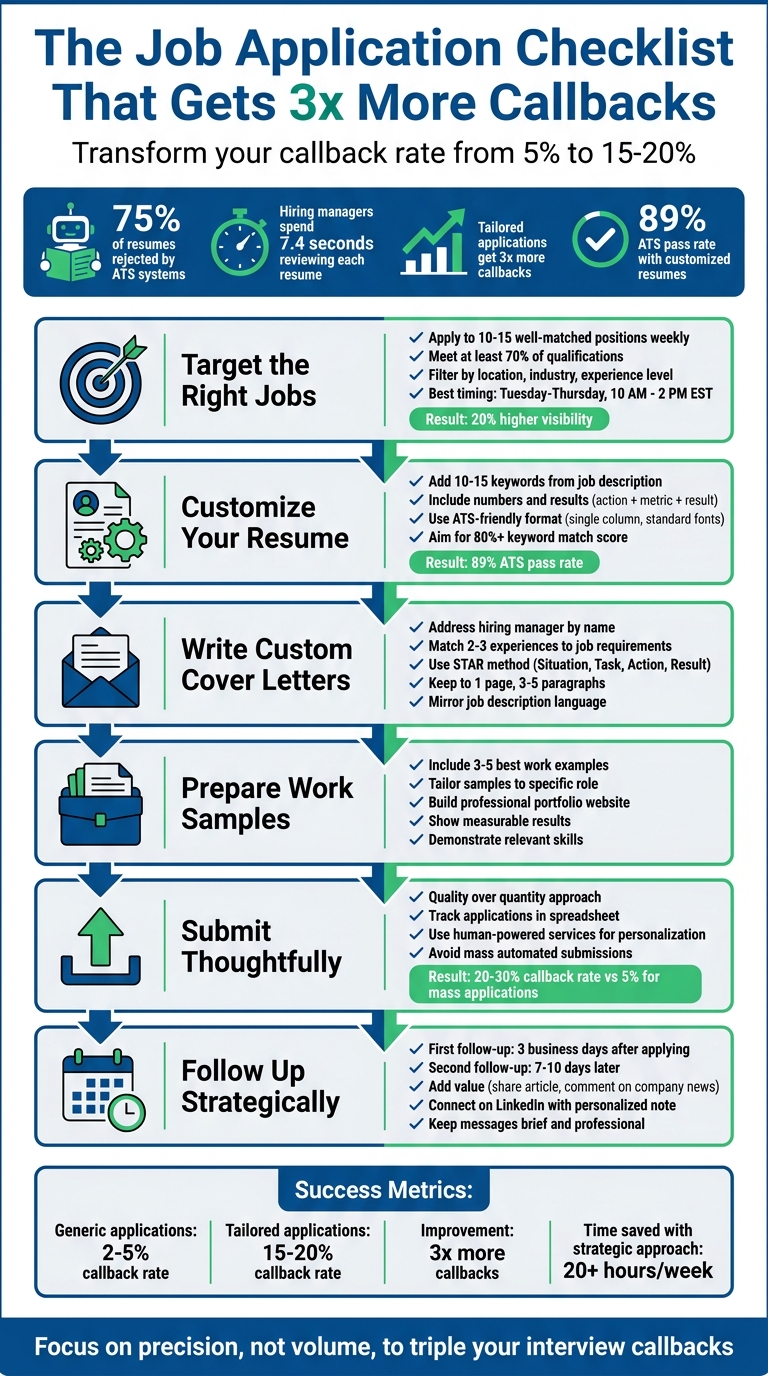
6-Step Job Application Checklist to Triple Your Callback Rate
Step 1: Find and Target the Right Jobs
Define Your Job Search Criteria
Applying to every job you come across can waste both time and energy, often leading to fewer callbacks. Instead, focus your efforts by narrowing down opportunities based on location, industry, experience level, and company size. For example, if you're interested in remote software engineering roles at mid-sized tech companies, skip over on-site positions at Fortune 500 giants or early-stage startups.
A helpful guideline is the 70% rule: apply only if you meet at least 70% of the job's listed qualifications. This shows employers you’re capable of handling the core responsibilities while leaving room to grow on the job. For instance, if a job description lists ten requirements and you meet seven, you’re in a strong position. Anything less than this often results in automatic rejections or wasted effort on roles where you may not be a good fit. Unlike platforms like LazyApply, which automate bulk applications without much targeting, Scale.jobs focuses on personalized strategies to match your strengths with the right roles.
Once you’ve clearly defined your criteria, the next step is to use specialized job boards to streamline your search process.
Use Job Boards to Speed Up Your Search
Job boards are a great way to bring all available opportunities into one place, saving you from hopping between LinkedIn, Indeed, and individual company websites. While tools like LazyApply can quickly gather postings, Scale.jobs stands out by offering advanced filtering and a more personalized experience. The Scale.jobs job board indexes over 2 million postings, allowing you to filter by salary, remote possibilities, and posting dates, so you can zero in on jobs that meet your criteria. It even lets you track which roles you’ve already reviewed, helping you avoid duplicate applications.
For job seekers considering automation tools like LazyApply, Scale.jobs goes a step further with features like a dedicated outcome manager and tailored resume services. Through its Job Guarantee Program, Scale.jobs assigns a dedicated manager who identifies suitable roles, customizes your resume for each one, and submits applications on your behalf. This program guarantees a first interview within 30 days and continues the campaign until you secure an offer within 120 days.
To make the most of specialized job boards, start by listing your must-haves - such as minimum salary, visa sponsorship, or specific skills - and nice-to-haves, like flexible hours or equity options. This ensures you stay focused on roles that align with your career goals. By sticking to a targeted approach, you’ll save time and stand out from candidates using purely automated tools like LazyApply.
sbb-itb-564272e
How to Get A Call Back After Submitting A Job/Internship Application
Step 2: Customize Your Resume for Each Application
Using the same resume for every job application is a common mistake that can cost you opportunities. Up to 75% of resumes are rejected by ATS systems due to missing keywords or incompatible formats, and hiring managers spend an average of just 7.4 seconds reviewing each resume. To increase your chances of landing an interview, tailoring your resume for each job is absolutely essential.
Customizing your resume goes beyond simply changing the job title. It involves aligning your language with the job description, quantifying your achievements, and ensuring your format is ATS-friendly. Resumes tailored to specific roles are more likely to pass ATS filters - 89% of the time, in fact - and result in three times more callbacks. Let’s break down how to fine-tune your resume for maximum impact.
Add Keywords from the Job Description
ATS software is designed to scan resumes for specific keywords that match the job posting. If the listing emphasizes skills like "Python", "Agile", or "project management", and your resume doesn’t include those terms, it may never reach a hiring manager’s desk.
To avoid this, carefully review the job description and identify 10-15 frequently mentioned keywords - these might include skills, tools, or action verbs. Incorporate them naturally into your resume’s summary and experience sections. For instance, if the job mentions "SEO optimization" and "content strategy", you could write:
- Summary: "Experienced marketer skilled in SEO optimization and content strategy."
- Experience: "Led SEO optimization for 20+ campaigns, increasing traffic by 40% through data-driven content strategy."
If you’re unsure how well your resume aligns with a job posting, tools like Jobscan can help you measure compatibility. Aim for a match score of 80% or higher. Alternatively, platforms like Scale.jobs offer an AI Assistant Pro that can generate tailored resumes in seconds, pulling keywords directly from job descriptions and formatting them for ATS compliance. Once you’ve nailed the keywords, focus on showcasing measurable achievements.
Include Numbers and Results
Hiring managers are less interested in your responsibilities and more focused on the results you’ve achieved. Replace vague descriptions like "managed a team" with specific, quantifiable outcomes such as "led a 12-person team to achieve 25% revenue growth in Q3 2024."
Every bullet point in your experience section should follow this formula: action verb + metric + result. For example:
- A software engineer might write: "Developed 5 microservices, reducing deployment time by 50% (from 4 hours to 2)."
- A sales professional could say: "Closed $500,000 in deals, surpassing quota by 120%."
- An HR manager might highlight: "Implemented onboarding for 150 hires, improving retention by 25%."
Numbers make your achievements tangible. For instance, a marketing professional who tailored their resume with keywords like "SEO optimization" and "content strategy" from a job posting also added a metric: "grew organic traffic by 150% year-over-year." This adjustment boosted their callback rate from 10% to 45% across 50 applications. Including metrics not only demonstrates your impact but also helps ATS systems rank your resume higher.
Use ATS-Friendly Resume Formats
Even a well-tailored resume packed with keywords and metrics can get rejected if it’s formatted incorrectly. ATS systems, especially those used by 99% of Fortune 500 companies like Taleo and Workday, struggle with complex layouts, images, and unusual fonts.
To ensure your resume is ATS-compliant, stick to these guidelines:
- Use a single-column layout.
- Choose standard fonts like Arial or Calibri (10–12 pt).
- Clearly label sections with headings like "Experience" and "Skills."
- Save your resume as a .docx file or a text-based PDF.
Templates from Scale.jobs are specifically designed to meet ATS requirements while remaining visually appealing to hiring managers. These templates feature single-column layouts, keyword-optimized sections, and bullet points that highlight measurable achievements. Unlike some competitors, such as LazyApply, Scale.jobs prioritizes formatting details to ensure your resume passes ATS filters.
If you need additional help, professional resume writing services can create ATS-friendly resumes tailored to your target roles. For example, Scale.jobs’ Basic package ($199) includes a professionally written resume, a 45-minute Zoom consultation, and three job applications submitted on your behalf - offering both expertly crafted documents and hands-on support to increase your chances of success.
Step 3: Write a Custom Cover Letter for Each Role
Crafting a tailored cover letter can be the key to landing an interview. It shows you've done your homework and highlights how you specifically align with the role.
Unlike your resume, which summarizes your qualifications, a cover letter dives deeper into your story - why you're drawn to the company, why you're transitioning careers (if applicable), or how your background makes you the perfect match. This personal touch helps establish a connection with the hiring manager and sets you apart from generic applications.
Address the Hiring Manager by Name
Skip the generic "To Whom It May Concern." Instead, take the time to find the hiring manager's name. This extra effort shows attention to detail and genuine interest. You can often find this information on LinkedIn, the company’s "About" page, or even in recent press releases.
If the job posting includes a reference code (e.g., "Ref: MKT-2026-04"), include it in your introduction. It helps HR track your application more efficiently. Use appropriate titles in your greeting, like "Dear Ms. Rodriguez" or "Hi Sarah", depending on the company's tone - formal or casual.
Match Your Experience to the Job Requirements
After a personalized greeting, focus on aligning your experience with the job description. Your cover letter isn’t a rehash of your resume. Instead, pick 2–3 specific examples from your past roles that directly address the job's key responsibilities. The STAR method (Situation, Task, Action, Result) is a great way to present these examples with clarity and impact.
For example, if the job emphasizes "cross-functional collaboration" and "data-driven decision-making", you could write:
"At TechCorp, I led a cross-functional team of engineers and designers to revamp our checkout process. By analyzing user data, we identified key friction points and implemented A/B tests that improved conversion rates by 15% within three months."
This approach not only demonstrates your qualifications but also provides measurable results, making your case more compelling.
"The cover letter should show that you match what the company is looking for, and the company matches what you want in an employer." – Madeline Mann, Creator of Self Made Millennial
To decide which skills to highlight, pay attention to the action verbs in the job description, such as "analyze", "coordinate", or "manage." Reflecting this language in your cover letter reinforces how well your experience aligns with the employer's needs.
Use AI Tools to Save Time
Writing personalized cover letters for every application can be daunting. This is where AI tools like Scale.jobs' AI Cover Letter Generator come in handy. These tools quickly draft tailored cover letters by analyzing job postings and matching them with your experience.
Scale.jobs offers a free plan that generates one cover letter per day. For $9/month (launch offer), the AI Assistant Pro plan provides unlimited drafts. Unlike generic templates, Scale.jobs combines AI efficiency with human review to maintain a natural and professional tone. You can also explore their professional resume writing services, which include custom cover letters as part of ATS-optimized packages starting at $199.
Keep your final cover letter concise - ideally one page, with 3–5 paragraphs in a 10–12 point font. If you lack direct experience, emphasize transferable skills like leadership, problem-solving, or project management. A well-written cover letter, paired with a tailored resume, boosts your chances of passing ATS filters and getting a callback.
Step 4: Prepare Work Samples and Portfolio
Work samples can set you apart in a competitive job market. While many candidates may share similar qualifications, a well-curated portfolio demonstrates your ability to deliver results. It’s not just about claiming you can do the job - it’s about showing evidence of your skills in action.
Work samples provide hiring managers with a clear picture of your expertise and how you meet the role's demands. For creative roles like design, writing, or marketing, a portfolio is often non-negotiable. In fields like finance or operations, showcasing examples such as data analysis reports, process improvement plans, or case studies can make your application more compelling than just a resume and cover letter. A polished online portfolio is an excellent way to present these examples effectively.
Build a Portfolio Website
Creating a professional portfolio website doesn’t have to be overwhelming or expensive. Tools like Scale.jobs' portfolio generator allow you to build an elegant site without needing coding skills or paying for costly design services. This ensures your work samples are displayed in a clean and professional format that works seamlessly across devices.
Keep your portfolio straightforward. Include 3–5 of your best work samples, a concise bio, and clear contact details. Even if you’re not applying for a tech role, having an online portfolio demonstrates your ability to adapt to digital tools, which can give you an edge. This approach not only showcases your work but also highlights your technical competence - something platforms like LazyApply don’t offer with their services.
Include Relevant Work Examples
Tailoring your work samples to the job you’re applying for is crucial. Generic examples won’t leave a strong impression. Instead, focus on projects that align with the specific requirements of the role. For instance, if you’re pursuing a content marketing role that emphasizes "SEO-driven blog posts", include published articles that show measurable results, like improved rankings or traffic growth. Similarly, if you’re applying for a data analyst position, highlight dashboards or reports that demonstrate your ability to interpret and present data effectively.
Be selective with what you include. Research suggests that adding irrelevant or lower-level roles to your application can reduce callback rates for senior positions. Ensure your portfolio reflects the level and scope of the job you’re targeting. If you don’t have direct work experience - perhaps you’re a recent graduate or changing careers - consider creating spec projects, volunteer work, or case studies that showcase transferable skills.
For a polished presentation of your work samples, consider using Scale.jobs' resume writing services. Their packages, starting at $199, include portfolio guidance to help you select and format examples for maximum impact. A targeted portfolio doesn’t just prove your capabilities - it positions you as a strong candidate ready for the next step in your application journey.
Step 5: Submit Applications the Right Way
When it comes to job applications, quality beats quantity every time. Research shows that tailored applications have a callback rate of 15–20%, while generic submissions hover around a meager 2–5%. The key difference lies in how well your materials align with the specific job and demonstrate genuine interest.
While tools like LazyApply and Sonara.ai promise speed, they often compromise on personalization and compatibility with Applicant Tracking Systems (ATS). Scale.jobs takes a different approach, combining human oversight, ATS-optimized documents, and proof-of-work transparency to ensure your applications make it to the right people.
Avoid Applying to Every Job You See
Sending out 50+ applications a week with the same resume is a recipe for rejection. ATS systems filter out applications lacking role-specific keywords, and hiring managers easily spot generic or error-filled submissions. This approach often signals a lack of genuine interest.
Instead, focus on roles where you meet at least 80% of the qualifications. A more targeted strategy - applying to 10–15 well-matched positions weekly - can significantly improve your response rates. To stay organized, keep a spreadsheet with columns for job title, company name, application date, and follow-up status.
Timing also matters. Submit your applications between Tuesday and Thursday, ideally from 10:00 AM to 2:00 PM EST. This timeframe increases visibility by 20% compared to Monday mornings or late Fridays when inboxes are either flooded or winding down.
Why Scale.jobs Stands Out
Here’s why Scale.jobs outperforms automated tools like LazyApply and Sonara.ai:
- Human oversight: Trained virtual assistants manually review and customize each application.
- Tailored resumes: Submissions are aligned with specific job requirements, avoiding generic mass applications.
- Higher ATS success rates: Real browser submissions bypass ATS filters that block automated applications.
- Transparent tracking: Time-stamped WhatsApp screenshots provide proof of submission.
- Flexible payment options: One-time payments for 100–250 applications eliminate recurring subscription fees.
This hands-on approach ensures your applications are seen and taken seriously by hiring managers.
Consider Human-Powered Application Services
Automated tools like LazyApply and Sonara.ai can submit hundreds of applications quickly, but nearly 90% of those submissions are blocked by ATS systems designed to detect automation. Platforms like Workday and Taleo actively filter out bot-driven applications.
Unlike these tools, Scale.jobs combines human expertise with ATS-optimized documents to elevate your chances of success. Their virtual assistants manually customize your resume and cover letter, ensuring each submission matches the job requirements. Applications are submitted through real browsers, offering authenticity that bots can’t replicate. Plus, you’ll get time-stamped WhatsApp screenshots for full transparency.
With Scale.jobs, users report callback rates of 20–30%, compared to just 5% for mass submissions. Packages start at $99 for 100 applications, while the $149 Standard plan includes 250 applications, two assistants, and custom cover letters.
Who Should Use LazyApply or Sonara.ai
Automated tools may be a good fit if you:
- Need to submit over 100 applications weekly with minimal customization.
- Are applying for entry-level roles with less competition.
- Have a tight budget and prefer low-cost monthly subscriptions.
- Are okay with lower callback rates in exchange for faster submissions.
Who Should Choose Scale.jobs
Scale.jobs is ideal for job seekers who:
- Want personalized applications tailored to each role.
- Need transparency with proof-of-work tracking.
- Are applying for competitive positions where ATS compliance is critical.
- Prefer human oversight to avoid bot detection and ATS rejections.
- Value higher callback rates (20–30%) over sheer application volume.
When to Switch to Scale.jobs
Consider switching to Scale.jobs if:
- Your callback rate is below 10%, even after sending dozens of applications weekly.
- You’re facing ATS rejections from platforms like Workday or Taleo.
- You require transparency, ensuring your applications are submitted correctly.
- You’re targeting mid-to-senior roles, where personalization and ATS optimization are crucial.
- You want to save time, freeing up 20+ hours a week for networking and interview preparation.
For more comprehensive support, check out Scale.jobs’ professional services, starting at $199. These services can help you maximize your callback rates. Up next, we’ll dive deeper into how Scale.jobs compares to LazyApply and other competitors in Step 6.
Step 6: Follow Up After Applying
Once you've submitted your tailored application, the next step is to follow up effectively. This not only confirms your application was received but also reinforces your interest in the role. A well-timed follow-up can set you apart, showing initiative and ensuring your materials don't get lost in the shuffle. Studies indicate that candidates who follow up multiple times over a few weeks are more likely to grab the attention of hiring managers.
The secret lies in timing and personalization. Avoid generic messages like "just checking in", as they often go unnoticed. Instead, craft follow-ups that reflect your knowledge of the company or reference specific projects. Keep your messages short and direct, with a clear subject line that includes the job title and your name.
Send a Brief Follow-Up Email
Start with your first follow-up three business days after submitting your application. Use this message to confirm receipt and restate your enthusiasm for the role. Keep it concise - no more than two or three sentences. Address the hiring manager by name if possible, and avoid vague questions like "Have you reviewed my application?"
If you don’t hear back within 7–10 days, send another follow-up. This time, instead of simply asking for an update, add value by sharing something relevant. For example, you could mention an industry article, comment on a recent company milestone, or provide a fresh perspective on a challenge the company is facing. This approach showcases your insight and genuine interest.
If you have another job offer on the table, it’s appropriate to politely inquire about the timeline for a decision. This helps you manage your options professionally without seeming overly aggressive. Thoughtful follow-ups like these can make your application stand out in a sea of automated submissions.
Connect on LinkedIn
LinkedIn is another great tool for building connections with recruiters or hiring managers. A warm introduction can make all the difference, especially if you have a mutual contact. When sending a connection request, include a brief, personalized note. For example, you might write, "My former colleague Sarah Johnson suggested I reach out to you." This adds a personal touch and increases the likelihood of your request being accepted.
If you were referred by someone, mention their name in your subject line or message (e.g., "Referral from [Name]"). Keep your LinkedIn message short and focused on building rapport rather than directly asking for a job. Highlighting something specific about their work or a recent company achievement shows you've done your homework.
Limit your LinkedIn outreach to one connection request and one follow-up message. Bombarding someone with multiple messages across platforms can come across as desperate rather than enthusiastic. Instead, space out your communication over a few weeks, varying the content to keep it fresh and engaging.
Conclusion: Get More Callbacks with This Checklist
Scale.jobs offers a standout approach to job applications by combining human expertise with ATS-friendly tools, setting it apart from options like LazyApply and Sonara.ai. This blend ensures your applications are not only personalized but also strategically crafted to avoid common pitfalls that many job seekers face.
Landing more callbacks isn’t just about effort; it’s about precision. By following a structured checklist - defining your goals, tailoring your resume, crafting unique cover letters, preparing relevant work samples, submitting thoughtfully, and following up - you can address the most common application challenges head-on. In fact, job seekers who adopt such a method often see their callback rates improve from 5% to an impressive 15–20%. This transformation comes from verifying every step rather than relying on luck.
The key to success lies in customization and accuracy. A well-crafted application tailored to a specific job, combined with proactive follow-ups, significantly increases your chances of standing out. For instance, resumes with quantifiable achievements and meaningful LinkedIn connections often outperform generic, mass-submitted applications.
Scale.jobs takes this process to the next level by providing tools and services designed to enhance your application strategy:
- Human oversight ensures genuine, personalized applications.
- ATS-friendly documentation boosts your chances of passing initial screenings.
- Transparent, one-time payment plans eliminate recurring costs.
- Real-time WhatsApp updates keep you informed with proof-of-work screenshots.
- Dedicated outcome managers focus on personalizing your applications at scale.
For those starting out, Scale.jobs offers a free toolkit featuring ATS-proof resume templates, AI-powered cover letter tools, and keyword extraction features to streamline key steps. If you need more hands-on support, their human-powered services provide virtual assistants who tailor resumes, write custom cover letters, and manually submit applications - ensuring every detail aligns with the job description while avoiding automation flags.
Whether your focus is on a handful of targeted roles or managing hundreds of applications, Scale.jobs’ flat-fee pricing ensures affordability without compromising quality. Plus, real-time updates and time-stamped proofs keep you in the loop. For additional support, you can explore services like professionally written resumes or LinkedIn enhancements to attract recruiters and highlight your accomplishments.
Start with the free tools to make an immediate impact on your applications. When you’re ready to save time and boost your callback rates, Scale.jobs’ human assistant packages offer expert execution - helping you focus on networking and interview preparation while tripling your results.
FAQs
How do I tell if my resume will pass an ATS?
To ensure your resume can pass an ATS (Applicant Tracking System), try using dedicated ATS resume checkers. These tools evaluate elements like keyword usage, formatting, and overall structure. Platforms such as Resume Worded and Enhancv provide insights into your resume's compatibility with ATS and suggest areas for improvement. For a more thorough approach, you might explore services like Scale.jobs, which combine AI technology with human expertise to fine-tune your resume and boost its chances of getting through ATS filters.
What if I don’t have measurable metrics for my achievements?
If you don’t have specific metrics to showcase, concentrate on the qualitative aspects of your work. Describe your skills, responsibilities, and contributions in detail, focusing on areas like problem-solving, leadership, teamwork, or key projects you’ve been part of. Even without hard numbers, presenting a clear and engaging story about the value you bring can catch a recruiter’s attention and make your resume stand out.
How long should I wait before following up after applying?
It's a good idea to wait at least two weeks before following up on a job application. This timeframe allows employers adequate time to review all submissions and ensures you don’t come across as impatient or overly eager. Reaching out at the right moment shows professionalism and respect for their hiring process.