
7 Factors to Evaluate Career Growth in Job Offers
Assess mentorship, training, promotions, company stability, reviews, networking, and work-life balance to judge a job offer's growth potential.


Evaluating career growth in job offers is crucial for long-term success. Beyond salary and benefits, focus on mentorship, skill development, and internal mobility. Companies with structured programs and clear promotion paths show commitment to employee growth, while financial stability ensures sustainability. Understanding these factors can help you make informed decisions and align your goals with the right opportunity.
Key Takeaways:
- Mentorship & Coaching: Look for structured guidance and leadership development programs.
- Skill Development: Ask about training opportunities and certifications.
- Promotion Paths: Inquire about internal mobility and examples of employee advancement.
- Company Stability: Assess financial health and growth potential.
- Performance Reviews: Ensure clear feedback systems and recognition practices.
- Networking Opportunities: Check for cross-functional projects and leadership visibility.
- Work-Life Balance: Evaluate policies that prevent burnout and support well-being.
Use tools like Scale.jobs to track applications, optimize resumes, and compare job offers effectively. Making informed choices now can set the foundation for a thriving career.
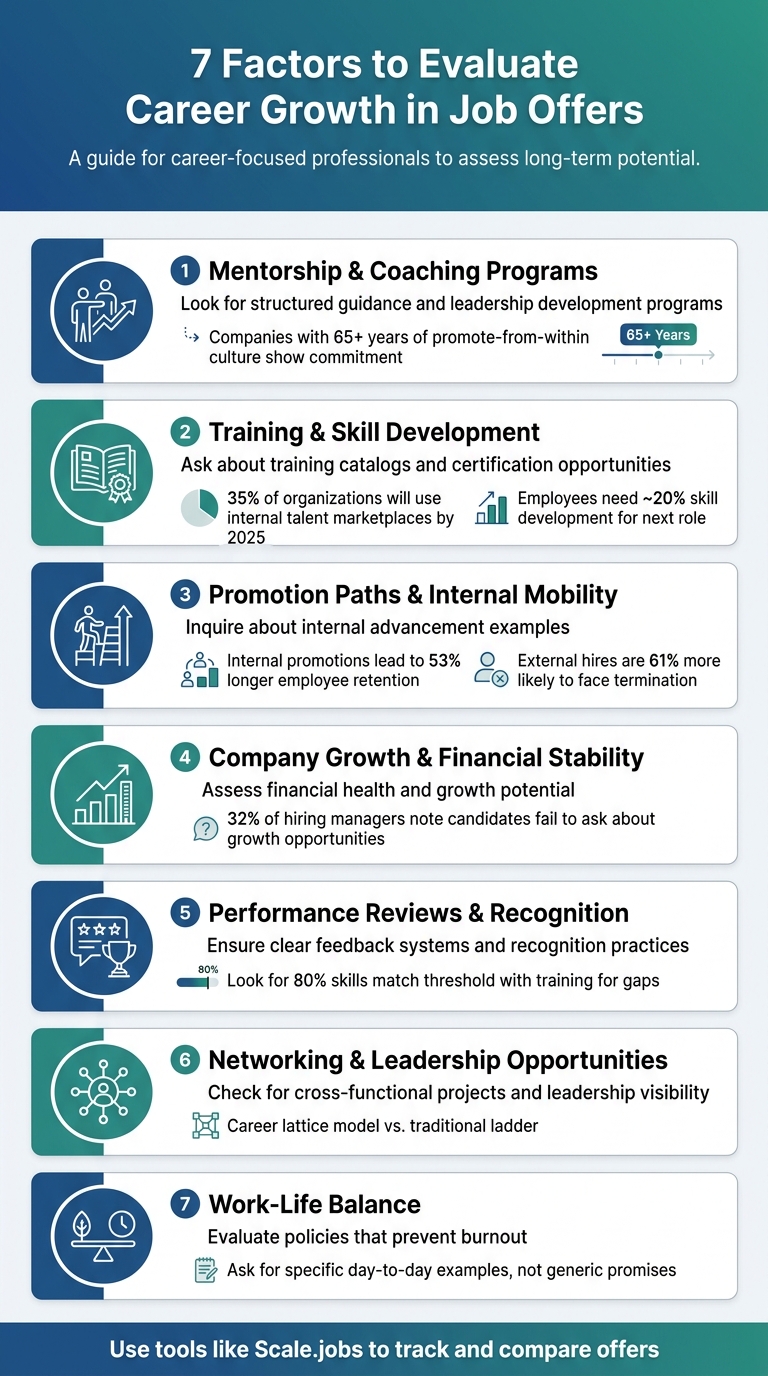
7 Key Factors to Evaluate Career Growth in Job Offers
1. Mentorship and Coaching Programs
Opportunities for Professional Development
When considering a job offer, it's worth asking about the company's mentorship programs. Specific, structured programs are far more effective than vague assurances like "open door policies." Companies that genuinely value employee growth tend to offer well-defined development opportunities.
For example, in February 2026, Blueprint Medicines (a Sanofi company) introduced workshops such as Influential Communication and Skillful Conflict. They also rolled out specialized programs for situational leadership and career planning tailored to underrepresented groups. Similarly, Spectrum partnered with the U.S. Department of Labor to create a nationally recognized Apprentice Program. This program allowed field technicians with less than 18 months of experience to advance through a certified broadband technician track.
These structured initiatives go beyond surface-level promises, showcasing a company's dedication to developing its workforce and retaining talent.
Company's Investment in Employee Growth
The way a company invests in mentorship can reveal its priorities - whether it values long-term employee retention or simply views its workforce as replaceable. For instance, Enterprise Mobility has upheld a "promote-from-within" culture for over 65 years, offering its 90,000 global employees the chance to shift roles and grow without leaving the organization. This stands in stark contrast to industries like customer service, where the U.S. Bureau of Labor Statistics predicts 380,000 annual job openings, often due to high turnover and unclear career paths.
"Our people make our business thrive... they're met along the way with unlimited possibilities and a support system to flourish, grow and advance." - Enterprise Mobility
Pay attention to companies that provide targeted coaching programs, such as those for first-time managers, women's leadership, or transitions from technical roles to managerial positions. These offerings demonstrate whether an organization is committed to helping employees grow or expects them to navigate their careers on their own.
Beyond mentorship and coaching, a company's approach to leadership development is a key factor in fostering sustainable career growth.
Support for Long-Term Career Sustainability
Effective mentorship goes beyond correcting day-to-day tasks - it focuses on developing leadership skills and fostering growth over time. Companies that prioritize coaching as part of their culture are more likely to support leadership evolution. Hitachi Energy, for example, emphasizes "lifelong learning" as a core principle, providing support for employees across various stages of their careers rather than limiting assistance to onboarding.
You should also consider whether the organization encourages employees to explore roles across different departments. Companies that allow technicians, engineers, or customer service representatives to collaborate across functions show a true commitment to career sustainability. This kind of integrated approach to mentorship not only enhances individual growth but also strengthens the overall organization, creating a solid foundation for long-term success.
sbb-itb-564272e
2. Training and Skill Development Programs
Opportunities for Professional Development
Effective training programs play a key role in career advancement, especially when paired with strong mentorship. The difference between a meaningful program and a vague promise lies in the details. When considering a job offer, don’t settle for generic assurances - ask for specifics, like a training catalog or free AI job search tools that can help you identify companies with robust development programs. Companies that prioritize employee growth often provide structured workshops, certification courses, and access to internal learning platforms that lead to measurable outcomes, such as industry-recognized credentials.
Take Spectrum, for example. They offer a nationally recognized Apprentice Program in collaboration with the U.S. Department of Labor. This program helps field technicians with less than 18 months of experience progress through a certified broadband technician track, earning certifications that enhance their career prospects - even beyond their current employer. Programs like these, which focus on certification-backed training, pave the way for long-term career growth and skill development.
Company's Investment in Employee Growth
The structure of a company’s training initiatives can reveal whether they see employees as valuable, long-term contributors or just short-term resources. Beyond standard courses, some forward-thinking companies are adopting internal talent marketplaces. These platforms, projected to be used by 35% of organizations by 2025, connect employees to project-based work and skill-building opportunities across departments, fostering diverse skill sets.
Organizations that encourage lateral moves and career lattice models stand out. Instead of sticking to rigid vertical paths, these companies allow employees to explore horizontal opportunities, helping them acquire a wider range of skills. This approach is particularly useful for addressing specific skill gaps - often around 20% of required competencies - before pursuing promotions or internal transfers.
"Successful individuals are constantly attending seminars, taking classes, attaining training, and otherwise learning new skills that will keep them marketable in their careers. Successful people are lifelong learners." - University of Minnesota School of Public Health
Be cautious of "quiet hiring" practices, where companies assign additional responsibilities without offering formal promotions or necessary training. If a role involves expanded duties, ask what training or development resources are in place to support those changes. Companies that genuinely value growth will provide clear paths for advancement, not just extra tasks.
Support for Long-Term Career Sustainability
Much like mentorship programs, robust training systems reflect a company’s commitment to preparing employees for future challenges. Look for training that aligns with emerging industry trends and technologies, not just current job demands. Employers investing in areas like AI or renewable energy demonstrate a forward-thinking approach, ensuring their workforce is equipped for the future.
When interviewing, consider asking whether the company uses AI-powered skill matching platforms, such as Gloat, to pair employees with internal projects suited to their abilities. Also, inquire about policies that prevent "talent hoarding", where managers might block team members from exploring new opportunities within the organization. Companies that embrace employee-driven mobility give you the freedom to shape your career path, rather than waiting for managerial approval.
If you’re looking at roles in fast-evolving sectors like AI or renewable energy, confirm that the training offered builds skills that are both transferable and sustainable. Ask about support for external certifications, tuition assistance, or encouragement to pursue further education. These factors not only boost your value within the company but also prepare you for broader opportunities in the job market.
3. Promotion Paths and Internal Mobility
Opportunities for Professional Development
When considering a new role, it’s essential to understand the potential for career growth. One effective way to gauge this is by asking the hiring manager: "Can you share an example of someone who started in this role and advanced within the company?" This question helps you move past vague assurances and reveals whether the organization actively promotes from within. If they struggle to provide a clear example, it might indicate limited opportunities for internal advancement.
Look for companies with formal policies, such as requiring internal job postings before external recruitment or using a skills match threshold (around 80%) for internal transfers. These systems ensure that internal candidates have a fair chance to advance. During interviews, ask about specific progression tracks for your role. For technical or specialized roles, inquire about apprentice programs or certifications that can help you grow. These details provide clarity on how the company supports immediate and long-term professional development.
Company's Investment in Employee Growth
A company’s approach to internal mobility speaks volumes about its commitment to employee growth. Data shows that internal promotions and external hires often lead to different levels of stability, with internal candidates staying 53% longer. On the other hand, external hires are 61% more likely to face termination. These statistics highlight the importance of a workplace that prioritizes internal career progression.
To evaluate this, ask whether the company allows employees to explore other internal opportunities without restrictions. A good question to pose is: "How do you handle team members who express interest in moving to other departments?" Organizations that genuinely value growth often have policies preventing managers from blocking such moves. Restrictive policies can hinder your ability to advance, so it’s worth digging into how the company handles internal transitions.
Support for Long-Term Career Sustainability
Sustainable career growth isn’t just about climbing the ladder - it’s also about broadening your skill set. Companies that encourage internal mobility often support both vertical promotions and lateral transitions to diversify skills. Check if the organization uses tools like AI-driven platforms to match employees with cross-departmental projects. These systems can help you gain new experiences without waiting for a formal promotion.
Additionally, ask about training budgets dedicated to helping employees close skill gaps before transitioning to new roles. Research shows that employees typically need to develop about 20% of the required competencies for their next position. Companies that allocate resources for this demonstrate a commitment to your growth. It’s also helpful to ask about salary transparency for future roles - knowing the financial trajectory can make long-term planning much more manageable.
4. Company Growth and Financial Stability
Opportunities for Professional Development
A company's financial health plays a critical role in shaping your career development. Beyond mentorship and training, financial stability often determines whether a company can invest in resources that foster your professional growth. If a company is thriving, it’s more likely to adopt cutting-edge tools like AI and data science, which can accelerate your career trajectory. On the other hand, stagnation or restructuring might signal limited opportunities for advancement. Reviewing recent growth trends can help you understand whether the organization is on an upward trajectory or facing challenges.
Stable companies often emphasize internal hiring, as it keeps recruitment costs manageable while offering employees genuine opportunities to climb the ladder. Asking specific questions during interviews, like, "What does success look like in this role during the first 90 days?" can reveal how the company measures performance and whether it provides clear pathways for career advancement.
Company's Investment in Employee Growth
When evaluating a potential employer, it’s essential to ask questions about their commitment to professional development. For example, inquire, "How does the company support professional growth and learning?" Look for detailed answers that mention allocated budgets or structured programs rather than generic statements. Interestingly, 32% of hiring managers note that candidates who fail to ask about growth opportunities make a common interview mistake. It’s a missed chance to assess whether the company prioritizes employee development.
Financially unstable companies often struggle to provide meaningful growth opportunities, which can lead to "skill stagnation" - a lack of exposure to new ideas or techniques. In contrast, financially secure and growing companies are more likely to maintain strong development budgets, even during challenging times. To dig deeper, consider asking, "Can you share an example of someone who started in this role and advanced within the company?" A vague or evasive answer might signal a lack of real investment in employee growth.
Support for Long-Term Career Sustainability
Companies that are both financially stable and growth-oriented tend to have higher employee retention rates, highlighting the connection between financial health and long-term career sustainability. When assessing an organization, it’s important to evaluate not just its current financial standing but also its growth trajectory. Firms that actively invest in their employees’ development create environments where careers can thrive over the long haul.
If you’re comparing multiple job offers, it can be challenging to determine which company offers the best growth potential. Services like professional resume and career services can help you analyze a company’s financial stability and growth prospects, ensuring your career goals align with the right opportunity.
A combination of financial health and a genuine commitment to employee development sets the stage for meaningful career growth. These factors often translate into structured performance reviews, recognition systems, and long-term opportunities that help you achieve your professional aspirations.
5. Performance Reviews and Recognition Systems
Opportunities for Professional Development
The way a company conducts performance reviews can reveal how seriously it takes your professional growth. A structured review process not only defines success - especially during the critical first 90 days - but also clarifies how your manager assesses progress and sets expectations. Teams that prioritize formal feedback often create an environment for career growth, while those that lack structure can leave employees guessing about their performance.
When interviewing, consider asking: "How do you measure performance and provide feedback?" A thoughtful response that includes specific review cycles, metrics, or frameworks suggests the company values development. On the other hand, vague answers like "We check in regularly" might indicate a lack of organization. A well-defined review system also supports broader recognition practices that celebrate consistent progress.
Company's Investment in Employee Growth
Recognition systems that extend beyond annual evaluations highlight a company's dedication to its employees' long-term growth. For example, internal talent marketplaces - such as Unilever's "Flex Experiences" program - leverage AI to connect employees with project-based work and new roles within the organization, helping them avoid skill stagnation. Similarly, Amdocs removes managerial barriers, allowing employees to explore internal opportunities freely, which prevents "talent hoarding" and promotes career mobility.
Seagate Technology provides a compelling example: when employees meet 80% of the skills required for a new role, the company offers formal training to bridge the remaining gap. This proactive approach to internal growth showcases a commitment to employee development. Conversely, watch out for signs of "quiet hiring", where additional responsibilities are assigned without corresponding promotions or raises - this can be a red flag for limited growth opportunities. Ensure the company has a clear schedule for pay and performance reviews to avoid career stagnation. When paired with consistent performance evaluations, these systems lay the groundwork for meaningful career advancement.
Support for Long-Term Career Sustainability
Frequent and formal career development discussions between managers and employees are vital for long-term growth. These conversations, supported by transparent progress tracking and detailed job specifications, ensure that recognition is based on measurable achievements rather than subjective opinions.
Ask for examples of how employees have advanced within the company. Performance reviews, when combined with structured mentorship programs and targeted training, create a solid foundation for career progression. Tools like Scale.jobs can further enhance these systems by offering tailored feedback and transparent tracking optimized for applicant tracking systems (ATS) scoring algorithms.
Companies that integrate structured feedback, transparent recognition practices, and clear promotion pathways provide employees with a roadmap for sustained career growth.
6. Networking and Leadership Opportunities
Opportunities for Professional Development
After establishing a foundation through mentorship and training, the next step in career growth is networking. Building connections across departments can significantly influence your career path, often just as much as technical expertise. Internal networking helps you gain visibility with leadership, understand organizational dynamics, and position yourself for future opportunities. When interviewing for a role, ask about cross-functional projects that encourage collaboration with other teams. These projects not only expand your network but also highlight your contributions to a broader audience.
Some companies now use AI-powered internal talent platforms to connect employees with temporary or project-based roles across departments. These systems break down traditional barriers, allowing employees to take on new challenges without needing a formal promotion. If you're evaluating a job offer, ask for examples of employees who have successfully transitioned into leadership roles through such initiatives. If the responses are vague or lack concrete examples, it might indicate that structured mobility opportunities are limited. Networking through these platforms can be a stepping stone for further career advancement, as seen in companies that prioritize employee mobility.
Company's Investment in Employee Growth
Modern career progression has shifted from the traditional ladder model to a career lattice, emphasizing diverse growth opportunities. Companies that prioritize networking often support horizontal moves, enabling employees to develop a wide range of skills. Look for organizations with structured coaching or sponsorship programs where leaders actively advocate for your career progression, rather than relying solely on informal mentorship.
However, some managers may resist cross-departmental moves, potentially limiting growth for top performers. To counter this, many forward-thinking companies have adopted employee-led mobility models. These models empower employees to explore internal roles without requiring their current manager's approval. When considering a job offer, ask about the internal transfer process and whether employees have the autonomy to pursue new roles independently.
Support for Long-Term Career Sustainability
Strong networking, combined with mentoring and training, accelerates your ability to integrate into a company. Research shows that internal hires often adapt to new teams more quickly than external hires, who may take up to two years to fully integrate. Building internal relationships not only speeds up this process but also supports long-term career growth. When exploring leadership development programs, find out if the company offers targeted training to help internal candidates bridge skill gaps. For example, some companies use an 80% skills match threshold for internal transfers and provide additional training to address any gaps.
During interviews, take a broader view by asking leaders how the role you're considering fits into the company’s overall strategy. This approach can uncover opportunities for gaining visibility and demonstrate the organization’s commitment to cross-functional collaboration. If you're balancing networking with job applications, consider using tools like scale.jobs to optimize your resume for ATS and simplify the application process. This can free up valuable time to focus on building meaningful connections.
7. Work-Life Balance and Burnout Prevention
Opportunities for Professional Development
Balancing career growth with personal well-being is essential for long-term success. When considering job offers, it's important to dig deeper than broad claims about work-life balance. Ask questions like, "What does work-life balance look like on a day-to-day basis?" This approach encourages hiring managers to provide real-life examples rather than rehearsed answers. Look for specifics such as meeting-free days, flexible working hours, or clear on-call policies. Companies that genuinely value sustainable growth often focus on a career lattice - offering lateral moves to develop new skills without the constant pressure of climbing the corporate ladder.
Be cautious of warning signs like silent role expansion, where extra tasks are added without promotions or pay adjustments. Instead, seek organizations with structured internal mobility programs, such as internal talent marketplaces or project-based platforms, which align with your long-term goals without creating unnecessary stress. Poor work-life balance can hinder professional growth, so it’s critical to evaluate these elements in any potential role.
Company's Investment in Employee Growth
Flexible work-hour policies and clear paths for internal mobility are key to combining professional growth with personal well-being. One significant concern is talent hoarding, where managers prevent employees from exploring internal opportunities to maintain team performance. During interviews, ask for a specific example of an employee who started in the role and advanced within the company. If the hiring manager struggles to provide an example, it could signal that growth opportunities are more theoretical than practical. Companies that genuinely care about employee development often implement formal processes that allow employees to pursue internal roles independently, bypassing the need for direct managerial approval.
Support for Long-Term Career Sustainability
Take the time to review contracts for clear work-hour expectations and vacation policies. During interviews, ask how managers handle conflicts and evaluate performance to gauge whether the workplace culture supports growth or fosters burnout. Tools like scale.jobs can help you create an ATS-optimized resume while ensuring you thoroughly assess each opportunity.
Data shows that internal hires tend to stay with companies 53% longer than external hires, who face a 61% higher risk of termination. These statistics highlight the value of internal mobility and sustainable growth practices in fostering long-term employee retention. Companies that prioritize work-life balance through actionable policies create environments where you can advance your career without compromising your health. This thoughtful approach helps you make well-informed decisions as you weigh your options.
Should I Accept This Job Offer? 🤔 Career Coach Explains | Indeed
Feature Comparison: scale.jobs vs. Competitors
When weighing job application tools, it's important to consider factors like human involvement, ATS (Applicant Tracking System) optimization, and pricing clarity. These aspects directly influence how effectively a platform supports your career goals and long-term job search success.
scale.jobs stands out by combining manual application submissions with a straightforward flat-fee pricing model. Trained assistants handle applications manually, minimizing the risks of bot detection often associated with fully automated platforms like LazyApply. Users receive real-time updates via WhatsApp along with timestamped screenshots as proof of submission - this level of transparency is rarely seen among competitors. Pricing begins at $199 for 250 applications, and any unused credits are refunded if you land a job. On the other hand, Find My Profession offers personalized services like resume writing and career coaching but operates on a per-project basis rather than providing bundled application services. Jobscan focuses on algorithm-driven ATS scanning without human feedback, with its free tier limiting users to just five scans per month - an issue for those with an active job search. Meanwhile, LazyApply emphasizes automated "one-click" applications but lacks personalized oversight or tailored document adjustments. These differences can guide you in selecting a platform that aligns with your specific job search needs.
| Feature | scale.jobs | Jobscan | LazyApply | Find My Profession |
|---|---|---|---|---|
| Human Assistants | Yes (Manual submissions) | No | No | Yes (Coaching/Writing) |
| Application Method | Manual (Human) | DIY (User) | Automated (Bot) | DIY (User) |
| Pricing Model | Flat-fee / Bundles | Subscription | Subscription | Per-service |
| Transparency | WhatsApp updates, screenshots | None | None | Project-based |
| ATS Optimization | Yes | Yes | Yes | Yes |
The table above highlights the major differences, but let’s explore real-world scenarios to help you decide which service fits your strategy.
"One of the most significant limitations of Jobscan is the lack of personalized, human review... The advice you receive is algorithm-based, meaning it may miss context, tone, or industry-specific conventions that only a human could catch."
For mid-level to senior roles, where searches often extend beyond three months, a flat-fee pricing structure can save you from subscription fatigue. If you're looking for more than just application help - such as LinkedIn profile optimization, interview preparation, or professional resume writing services - scale.jobs offers all-inclusive packages. For instance, the $1,099 Ultimate Bundle includes 1,000 applications, assistance from two human agents, recruiter support, and a LinkedIn makeover.
Who Should Use Competitor Tools
- Jobscan: Ideal for those who prefer a DIY approach and only need resume scanning without application management.
- LazyApply: Best for applicants targeting high-volume, entry-level roles where speed outweighs the need for personalization.
- Find My Profession: Suitable for job seekers who want one-time professional services like coaching or resume writing but prefer to handle applications independently.
Who Should Choose scale.jobs
scale.jobs is perfect for job seekers navigating highly competitive markets, requiring proof of application submissions, or needing to bypass ATS bot filters through manual processes. It’s especially beneficial for those balancing career advancement with visa sponsorship concerns (e.g., H-1B, F-1 OPT, TN) or recovering from layoffs. The platform’s human-managed approach ensures a level of customization and oversight that automated tools simply can’t match.
Decision Summary
- Opt for Jobscan if you want to manage resume optimization on your own.
- Select LazyApply for high-volume, automated applications when speed is your top priority.
- Go with Find My Profession if you need one-time coaching or resume writing services.
- Choose scale.jobs for manual application execution, transparent updates, flat-fee pricing, and comprehensive support, including ATS-optimized documents and real-time communication.
Conclusion
Evaluating job offers is more than just a decision; it’s a thoughtful process that can shape the trajectory of your career. By considering the seven factors outlined earlier, you can identify whether an employer is genuinely committed to your growth or simply looking to fill a vacancy.
Key Factors to Consider:
- Mentorship and Coaching Programs: Look for structured guidance that fosters personal and professional growth.
- Training and Skill Development Programs: Opportunities for continuous learning can keep your skills sharp and relevant.
- Promotion Paths and Internal Mobility: Clear avenues for advancement are essential for long-term career growth.
- Company Growth and Financial Stability: A stable organization can offer sustained opportunities.
- Performance Reviews and Recognition Systems: Constructive feedback and acknowledgment of your efforts matter.
- Networking and Leadership Opportunities: Access to leadership roles and professional networks can expand your horizons.
- Work-Life Balance and Burnout Prevention: A supportive environment ensures sustainable productivity and well-being.
These elements not only help you gauge whether an employer prioritizes your development but also highlight the importance of tools like scale.jobs in simplifying the decision-making process.
How Scale.jobs Can Help
scale.jobs makes job searching more efficient by automating repetitive tasks and saving you over 20 hours a week with human-assisted services. Their free Job Applications Tracker allows you to compare offers based on factors like mentorship opportunities and promotion timelines. Additionally, the AI Assistant Pro, available for $9/month during its launch, creates tailored resumes to help you stand out in applicant tracking systems (ATS).
For those navigating layoffs, visa challenges, or competitive industries, scale.jobs offers flat-fee pricing starting at $199 for 250 applications. Unlike fully automated tools, scale.jobs provides real-time WhatsApp updates and proof-of-work screenshots, ensuring transparency and reliability.
You can also use their free Resume ATS Checker and Salary Predictor to evaluate a company’s training programs and promotion cycles against industry benchmarks. These tools turn vague promises into measurable insights, helping you make informed decisions.
Final Thoughts
- Choose scale.jobs if: You value personalized support, human-led management, and real-time updates.
- Consider fully automated tools if: You prefer a high-volume, tech-driven approach and are comfortable with less personalized oversight.
Start with scale.jobs' free tier to track your applications and refine your resume. When you're ready for a more hands-on experience, their human-assisted services can streamline your job search and position you for success.
FAQs
What questions should I ask to confirm real mentorship and training?
To assess the mentorship and training opportunities in a job offer, it's important to dig into the details of how these programs are structured and supported. Here are some key questions to consider:
- What kind of training or professional development opportunities are available? Understanding the scope of these offerings can help you gauge how the company invests in employee growth.
- Is the mentorship program formal or informal? Additionally, ask about the frequency of mentorship sessions to understand how consistent and structured the support will be.
- How are mentors or trainers paired with employees? This can reveal whether the matching process is thoughtful and tailored to your needs and goals.
- How does the company evaluate the success of its mentorship and training programs? Knowing how outcomes are measured will give you insight into the program's effectiveness and alignment with company goals.
- Do these programs connect to clear career advancement opportunities? This will help you determine if participating in these initiatives can directly impact your professional growth within the company.
Asking these questions will provide clarity on how the company supports learning and career development, ensuring you make an informed decision about the role.
How can I verify promotion paths and internal mobility before accepting?
Before saying yes to a job offer, take time to evaluate how the company supports career growth. Look into their promotion criteria, the skills they value, and the pathways they offer for advancement. During interviews, bring up questions about internal promotions - ask about policies, typical timelines, and any programs they have for career development. It's also smart to research how often they promote from within and their track record with internal hiring. This deeper dive will give you a better picture of your potential to grow within the organization.
What are the biggest red flags for burnout or 'quiet hiring' in a new role?
Burnout and "quiet hiring" often show up through warning signs like overwhelming workloads without clear limits, vague career progression opportunities, and an expectation to always be available. Be cautious if you notice unclear promotion processes, pressure to work beyond regular hours, or being asked to take on additional tasks without acknowledgment or fair compensation. To gauge a company's transparency and support, ask direct questions about workload expectations, growth opportunities, and workplace policies.