Top Candidate Approved Job Search Strategy in 2026
Practical 2026 job search tactics: ATS-friendly resumes, targeted roles, human-assisted applications, networking, and work samples.


In 2026, job searching has evolved drastically due to stricter Applicant Tracking Systems (ATS), the rise of AI-generated applications, and a growing reliance on networking. Bulk applications and generic templates are no longer effective. Instead, job seekers need personalized applications, targeted roles, and stronger networking efforts to stand out.
Key takeaways:
- AI screening tools dominate: Applications need to be ATS-friendly with tailored keywords and formatting.
- Networking leads to 80% of quality hires: Direct outreach to decision-makers and referrals are crucial.
- Personalization is key: Customized resumes and cover letters significantly boost interview chances.
- Human-assisted tools outperform automation: Services like scale.jobs offer tailored applications with higher response rates (15–20%) compared to automated platforms like LazyApply (1–2%).
This guide outlines actionable steps to refine your job search, from optimizing applications to leveraging networking and work samples for better results.
How to Build a Focused Job Search Plan for 2026
Pick Your Target Roles
To stand out in 2026's competitive job market, narrow your focus to 2–3 specific roles instead of applying to every opening you come across. According to the LinkedIn Workforce Report from 2025, job seekers who concentrate on targeted roles and companies are three times more likely to land interviews compared to those using a broad, unfocused approach. This strategy allows you to craft tailored applications that resonate with hiring managers.
Begin by conducting a skills audit. List your technical skills (like software proficiency, programming languages, or AI tools), soft skills (such as communication or leadership), and industry-specific expertise. For each skill, assess your proficiency and include examples of how you've applied it successfully. Then, compare this list against job descriptions for roles that interest you. This will help you identify positions that align with your strengths.
Next, create a positioning statement - a concise 2–3 sentence summary that highlights your unique qualifications. For instance: "I'm a data analyst with over five years of experience leveraging AI-driven insights to optimize marketing campaigns, consistently boosting ROI by 23% on average." This statement will serve as the foundation for customizing your resume, cover letters, and networking conversations. Employers in 2026 value skills like AI literacy, remote collaboration, and measurable achievements, so ensure your statement reflects these priorities.
To stay organized, categorize your target roles into three tiers:
- Ideal roles: Perfectly aligned with your current skills and experience.
- Stretch roles: Positions requiring 3–6 months of additional skill development.
- Foundation roles: Jobs that fully utilize your existing expertise.
Record these tiers in a simple spreadsheet to keep track of your progress and avoid applying for roles where you’re either overqualified or underprepared. Once your target roles are set, shift your attention to identifying companies and decision-makers that align with your career goals.
Identify Companies and Decision-Makers
Focus your efforts on 10–12 target companies that align with your career aspirations. Look for factors such as company size, growth potential, remote work policies, and alignment with your skill set. Use tools like LinkedIn, Crunchbase, and company websites to gather insights about each organization, including recent news, funding updates, leadership changes, and hiring trends. This research will help you craft personalized outreach messages and determine if the company is a good fit for your goals.
For each company, identify and map the key decision-makers in your target department. Start by exploring the company’s LinkedIn page to understand its structure. Then, use LinkedIn's filters and Boolean search techniques - such as "(hiring manager OR recruiter) AND [company name]" - to pinpoint hiring managers, department heads, and team members who influence hiring decisions. Note each contact’s role, tenure, and relevant background details in your spreadsheet.
Building relationships with decision-makers is crucial since 70% of jobs are filled through networking rather than public postings, as highlighted by Harvard Business Review's 2024 research. Direct outreach can help you bypass applicant tracking systems (ATS) entirely. In fact, Glassdoor Insights reported that 40% of tech hires in 2025 were the result of networking and direct engagement with hiring managers.
If this process feels overwhelming or you want to ensure your materials are polished, consider working with a job application service that specializes in crafting resumes, cover letters, and outreach strategies tailored for the 2026 job market. These services can save you time and help you connect more effectively with decision-makers.
To measure your progress, track key metrics like:
- Application-to-interview conversion rate: Aim for 5–10%.
- Networking conversations per week: Target 3–5 meaningful interactions.
- Time-to-first-interview: Strive to secure your first interview within 2–4 weeks.
Review your performance weekly to identify areas for improvement and refine your job search strategy as needed. This structured approach will keep you focused and increase your chances of landing the right role.
sbb-itb-564272e
How to Prepare Applications for ATS and Human Reviewers
ATS Requirements: The Technical Basics
Did you know that about 75% of resumes get rejected by Applicant Tracking Systems (ATS) due to formatting issues or missing keywords? With most Fortune 500 companies relying on ATS tools like iCIMS, Workday, and Greenhouse, understanding how these systems work can make or break your application.
Start with an ATS resume format that works: stick to standard fonts like Arial, Calibri, or Times New Roman in sizes 10–12, and use a single-column layout with left-aligned text. Avoid adding tables, images, graphics, text boxes, or placing contact details in headers or footers - ATS systems often can't process these elements correctly. Save your resume in the format specified in the job posting, typically a .docx or PDF. Use clear section headers such as "Work Experience", "Education", and "Skills" to make parsing easier for the system.
Keywords are your golden ticket. Pull 5–10 key terms directly from the job description - these could include specific certifications, software tools, or industry jargon - and incorporate them exactly as written. To increase your chances, aim for an 80–90% keyword match. Tools like Jobscan (offering 5 free scans per month) and ResumeWorded (unlimited basic scans) can help identify gaps and suggest improvements.
Before submitting, test your resume's formatting by pasting it into a plain text editor like Notepad. If the formatting looks messy or text appears jumbled, ATS systems may struggle to read it. Common pitfalls include using columns (ATS reads left-to-right), inconsistent date formats (stick to something like "January 2024 – May 2026"), or embedding special characters. Fixing these issues ensures your resume gets a fair shot at passing the ATS filter.
Once your resume is ATS-ready, it’s time to focus on tailoring it for specific roles.
How to Customize Resumes and Cover Letters for Each Job
Even with an ATS-optimized resume, customization is critical to standing out in today’s competitive job market. A generic application won’t cut it. Plan to spend 15–20 minutes tailoring your resume and cover letter for each role. This effort can dramatically improve your chances of landing an interview.
Start by analyzing the job posting. Copy the description into a word cloud generator to identify frequently mentioned skills and requirements. Compare these against your own experience and adjust your resume to highlight the most relevant points.
Reorganize your experience section to emphasize accomplishments that align with the job’s priorities. For instance, if the posting focuses on "cross-functional team leadership", highlight projects where you led diverse teams. Use the same language as the job posting when describing your achievements - if it mentions "budget oversight", write "Managed $2.5M annual budget" instead of using vague terms.
Numbers grab attention. Quantify your accomplishments wherever possible. For example, mention revenue increases ("boosted sales by $1.2M"), efficiency improvements ("cut processing time by 40%"), or team sizes ("led a team of 15 across three departments"). With recruiters spending just 7.4 seconds on average reviewing each resume, these metrics can make a strong first impression.
For cover letters, keep them concise - ideally under 250 words. Open with a tailored introduction that mentions the job title and company name. Address 2–3 key qualifications from the job description, and explain how your experience meets these needs using specific examples. While some ATS systems do scan cover letters for keywords, focus on writing naturally and engagingly. If the job posting doesn’t explicitly require a cover letter, weigh whether it’s worth the effort, as many applications treat them as optional.
If customizing every application feels overwhelming, consider using a professional resume writing service or a job search virtual assistant. These services can create master templates and tailored versions for each role, saving you time while ensuring your applications meet both ATS and recruiter expectations. It’s an investment that can pay off by increasing your response rates and reducing the stress of job hunting.
Mastering Your Job Search in 2024: 5 Essential Strategies and Insider Tips
Human-Assisted vs. Automated Applications: Which Delivers Results?
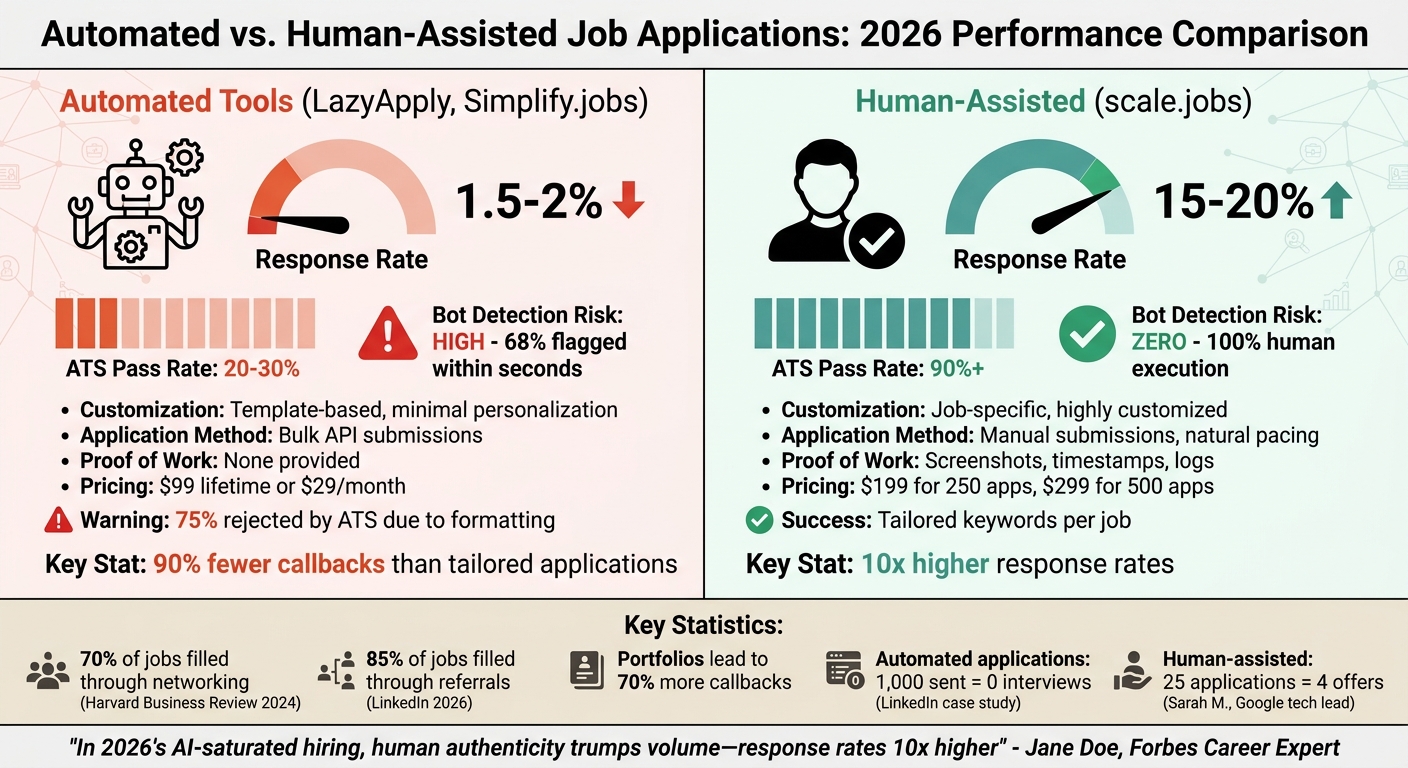
Automated vs Human-Assisted Job Application Tools Comparison 2026
Why Fully Automated Applications Don't Work
Automated tools like LazyApply claim to send hundreds of applications in a short period, but the results are often disappointing. A 2026 Jobvite study revealed that automated applications receive 90% fewer callbacks than tailored ones, with response rates falling below 2%. The issue lies in modern ATS platforms like Workday and Greenhouse, which use bot-detection systems to flag automation. These systems analyze patterns like rapid submissions, uniform typing speeds, and repetitive IP addresses. A Scale.jobs case study showed that 68% of automated applications are flagged almost instantly, often leading to account blacklists lasting 30–90 days.
Another major drawback of automation is its inability to adapt to job-specific requirements. Generic templates fail to incorporate critical keywords from job descriptions, resulting in ATS rejection rates of over 75%, as noted by LinkedIn in 2025. For instance, in software engineering positions, automated tools often overlook action verbs like "optimized" or "architected", which are crucial for passing ATS filters. One user shared on LinkedIn that after submitting over 1,000 applications through LazyApply, they received zero interview requests. This highlights that in a competitive job market, quality far outweighs quantity. These shortcomings underscore the need for a more personalized, human-driven approach.
How scale.jobs' Human-Assisted Applications Work
Unlike fully automated tools, scale.jobs takes a more thoughtful approach by assigning a US-based specialist to customize each application. After you submit your resume and target roles, a trained virtual assistant carefully reviews your background and tailors your application using keywords specific to the job posting. Each submission, taking 5–15 minutes, mimics human behavior to avoid triggering bot-detection systems.
This process prioritizes transparency and accuracy. You receive real-time screenshots that show exactly which fields were filled, when the application was submitted, and what documents were attached. Detailed logs and timestamps provide a clear record of each submission. If an application is rejected, you’ll know why - whether it’s due to a missing certification or a formatting issue - allowing you to adjust your approach. According to 2026 user testimonials, this method delivers 15–20% response rates, a significant improvement over the 1.5% average for automated tools.
Sarah M., a former Google tech lead, shared her experience on LinkedIn:
"Scale.jobs got me 4 offers from 25 applications; automation wasted 500 attempts."
This human-focused strategy adapts to any application portal, from standard ATS systems to niche job boards. Assistants can upload portfolios, answer detailed questions about your experience, and even attach links to relevant work like GitHub projects. For those juggling a busy schedule, this job application service saves over 20 hours per week while ensuring the kind of personalization that leads to real results.
Comparison Table: Automation vs. Human Assistance
| Criteria | Automated Tools (LazyApply, Simplify.jobs) | Human-Assisted (scale.jobs) |
|---|---|---|
| ATS Handling | 20–30% pass rate; generic keyword parsing | 90%+ pass rate; tailored keywords |
| Customization Depth | Template-based, minimal personalization | Job-specific, highly customized |
| Application Method | Bulk API submissions, bot-like patterns | Manual submissions, natural pacing |
| Proof-of-Work | None; no visibility into submissions | Screenshots, timestamps, logs |
| Pricing Model | $99 lifetime (LazyApply) or $29/month | $199 for 250 apps, $299 for 500 apps |
| Bot Detection Risk | High; 68% flagged within seconds | Zero; 100% human execution |
| Response Rate | 1.5–2% average | 15–20% average |
Career expert Jane Doe, a Forbes contributor, has observed:
"In 2026's AI-saturated hiring, human authenticity trumps volume - response rates 10x higher,"
based on her experience coaching over 1,000 clients. The data repeatedly shows that tailored, high-quality applications are the key to landing interviews in today’s job market.
scale.jobs vs. Competitors: Why Human-Powered Applications Win
scale.jobs vs. LazyApply: Bulk Automation vs. Quality Execution
When comparing scale.jobs to LazyApply, the difference boils down to execution quality. LazyApply focuses on high-volume automation, offering to send hundreds of applications daily for $99/month. The platform uses a single resume to auto-fill job forms, appealing to those who want to apply quickly and in bulk. However, this approach often results in low callback rates of 1–2%, as applications lack the customization needed to stand out. While LazyApply can process over 100 applications in a few hours, it sacrifices personalization and is more likely to trigger ATS filters.
scale.jobs takes a more focused approach, relying on trained human assistants to craft each application by hand. They customize resumes with job-specific keywords, create tailored cover letters, and submit applications at a natural pace to avoid detection by ATS systems. While LazyApply might send 500 applications a week, scale.jobs focuses on delivering 20–30 high-quality submissions, leading to callback rates of 15–20%. This personalized execution results in applications that resonate with hiring managers.
The pricing reflects these differences. LazyApply charges a flat $99/month for unlimited applications, while scale.jobs offers one-time bundles ranging from $199 for 250 applications to $399 for 1,000. Additionally, scale.jobs provides real-time updates via WhatsApp and proof-of-work screenshots, ensuring transparency in the application process.
| Feature | LazyApply | scale.jobs |
|---|---|---|
| Application Method | Bulk automation | Manual, human-executed |
| Customization | Minimal; one resume for all jobs | Tailored for each job |
| Callback Rate | 1–2% | 15–20% |
| Proof of Work | None | Screenshots, timestamps, logs |
| Pricing | $99/month | $199–$399 bundles |
Who should use LazyApply
Ideal for candidates who want to test the job market quickly and don’t mind lower callback rates or generic applications.
Who should choose scale.jobs
Best for professionals aiming for personalized applications that meet ATS requirements and want detailed proof of submission.
Switch to scale.jobs if
You’ve sent hundreds of automated applications without results, are applying for competitive roles, or want to avoid ATS flags from bot-like submissions.
scale.jobs vs. Simplify.jobs: Job Aggregation vs. Full-Service Job Search
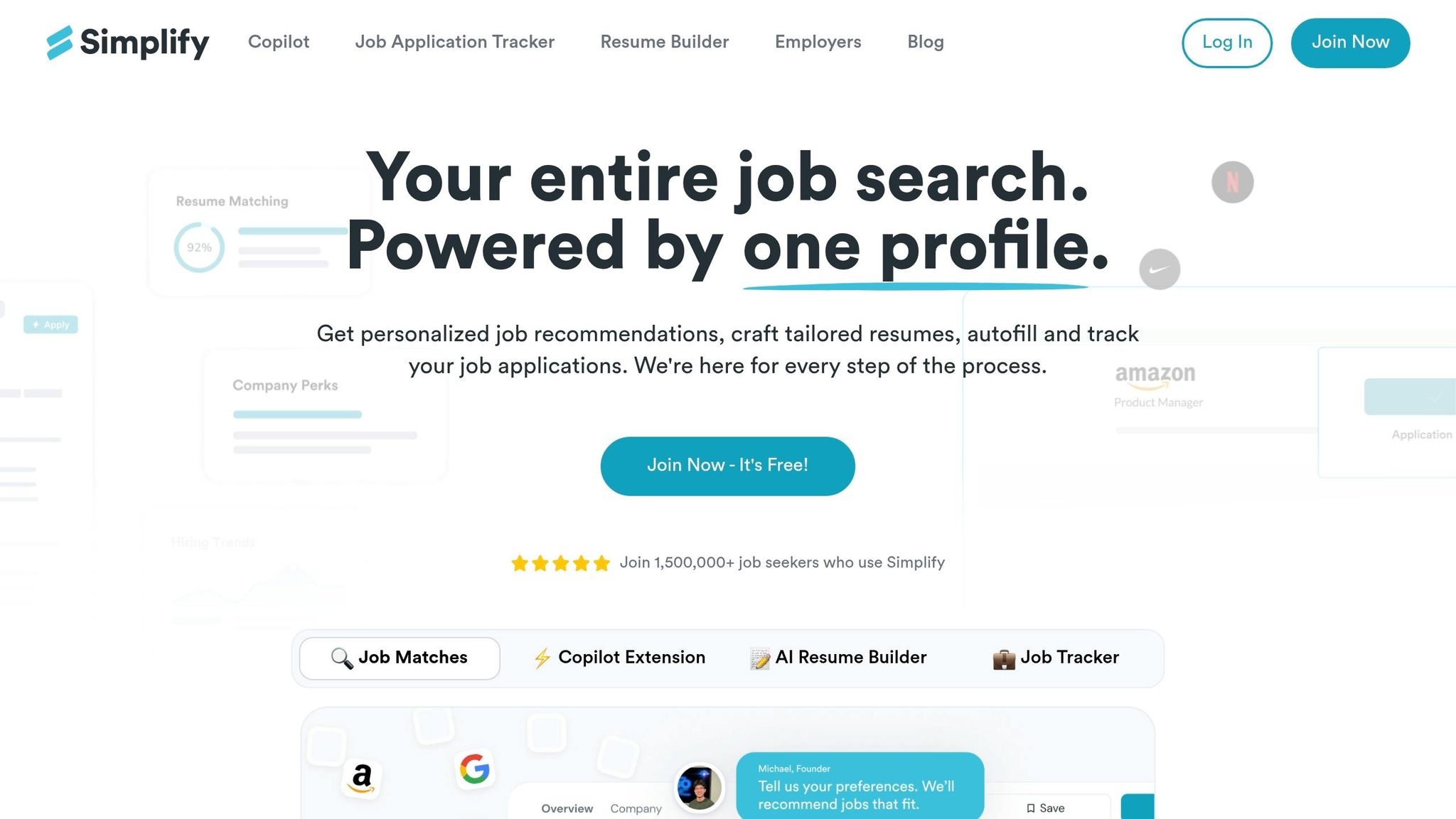
Simplify.jobs simplifies job discovery by aggregating listings from various job boards into one platform. It offers features like one-click applications and tracking tools, making it a good choice for candidates who want a centralized hub to organize their search. For $29/month, users get access to advanced filters and unlimited tracking. However, Simplify.jobs doesn’t provide any customization or submission assistance, relying entirely on the user’s existing resume.
The limitations of this approach become evident when personalization is required. For instance, a 2026 case study highlighted a software engineer who applied to 200 jobs via Simplify.jobs without securing a single interview. After switching to scale.jobs, the same candidate received 12 interviews from just 30 applications in two weeks. The difference? scale.jobs manages the entire process, from tailoring resumes to submitting applications and even following up with hiring managers.
scale.jobs doesn’t just help you find jobs - it handles the entire application process. Trained assistants research each company, customize your materials, and submit applications across various platforms, including niche job boards. You also receive detailed reports on targeted jobs, resume adjustments, and submission timelines. With one-time pricing between $199 and $399, scale.jobs eliminates the need for recurring subscriptions, making it a comprehensive solution for busy professionals.
| Aspect | Simplify.jobs | scale.jobs |
|---|---|---|
| Job Discovery | Aggregates multiple boards | Fully integrated service |
| Resume Customization | None | Tailored per job |
| Application Submission | User-managed | Handled by human assistants |
| Follow-Up Support | Not included | Managed by assistants |
| Pricing Model | $29/month | $199–$399 one-time bundles |
| Best For | Self-managed job search | Full-service application support |
Who should use Simplify.jobs
Best for candidates who prefer to manage their own applications and need a tool to streamline job discovery.
Who should choose scale.jobs
Perfect for professionals with limited time or those seeking expert help with every aspect of their job search.
Switch to scale.jobs if
You’re overwhelmed by managing applications across platforms, aren’t getting interviews despite applying, or need comprehensive support.
scale.jobs vs. Jobscan: Resume Optimization vs. Complete Job Search Solutions
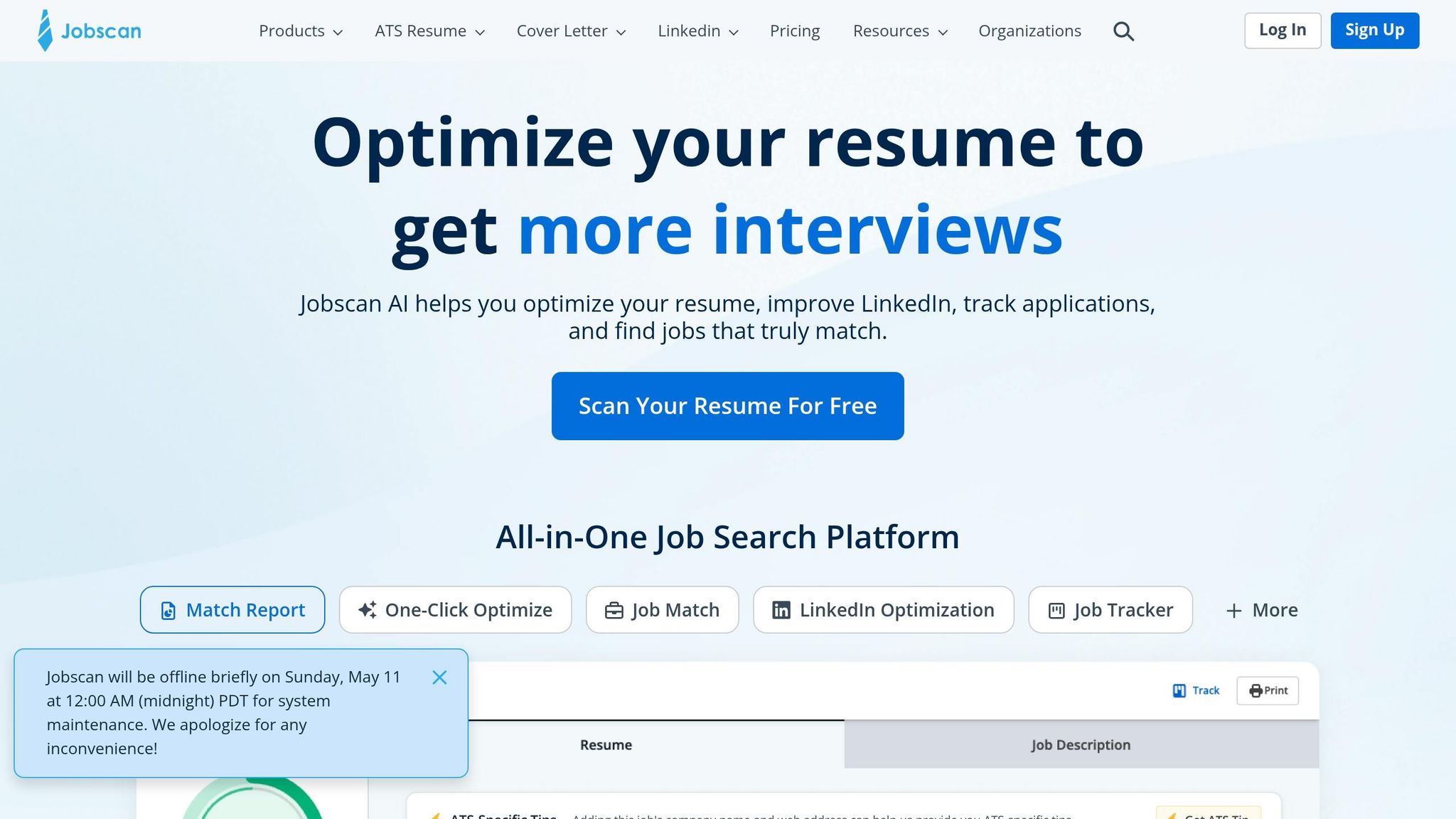
Jobscan focuses on resume optimization, using ATS scanning to analyze keyword alignment and provide a score from 0–100. It’s an excellent tool for improving your resume’s chances of passing ATS filters, with studies showing a 60% improvement in pass rates. For $49.95/month, Jobscan offers unlimited scans and is ideal for candidates who want to refine their resumes before applying. However, it doesn’t assist with application submissions, cover letters, or follow-ups.
scale.jobs incorporates ATS optimization into a complete job search solution. Beyond reviewing your resume, trained assistants rewrite it for each job, ensuring it includes role-specific keywords and proper formatting. They also manage the entire application process, from answering application questions to uploading work samples. This comprehensive service covers every step, unlike Jobscan’s focus on resume scanning alone.
In terms of pricing, Jobscan charges $49.95/month for unlimited scans, while scale.jobs offers one-time bundles ranging from $199 to $399. These bundles include resume optimization, customization, and submission support for 250–1,000 applications. For those starting from scratch, scale.jobs also provides professional resume writing services, ensuring a solid foundation for your job search.
| Capability | Jobscan | scale.jobs |
|---|---|---|
| ATS Optimization | Keyword scanning | Included with applications |
| Resume Customization | Suggestions only | Full rewrite per job |
| Application Submission | Not included | Managed by assistants |
| Cover Letter Writing | Not included | Custom per job |
| Follow-Up Management | Not included | Included |
| Pricing | $49.95/month | $199–$399 one-time |
Who should use Jobscan
Great for candidates who want to optimize their resumes independently and are comfortable managing the rest of the application process.
Who should choose scale.jobs
Ideal for those who want end-to-end support, from resume optimization to application submission and follow-up.
Switch to scale.jobs if
You’ve optimized your resume but aren’t landing interviews, don’t have the time to manage applications, or want a single service to handle your job search.
Why Networking and Work Samples Matter in 2026 Job Searches
Networking: The Overlooked Job Search Method
While a polished resume and carefully crafted applications are essential, networking and work samples have become two of the most impactful tools for job seekers in 2026.
In fact, 85% of jobs are now filled through referrals. With many roles attracting over 500 applications on platforms like LinkedIn, networking offers a way to stand out and bypass applicant tracking systems (ATS). According to LinkedIn, candidates referred by someone within the company are 4x more likely to be hired compared to those applying without a connection.
To make the most of LinkedIn, focus on optimizing your profile with up-to-date keywords like "AI ethics specialist" and highlight measurable achievements, such as "Improved efficiency by 30% using machine learning models." Sharing content weekly, particularly case studies, can also showcase your expertise. When targeting companies, identify second-degree connections and send personalized InMails. For example, a message like, "I saw your post on scalable AI - my project at XYZ achieved similar results", has been shown to generate 25% response rates, according to industry experts.
Informational interviews remain another effective strategy. Reach out via email and request short, 15-minute conversations: "As someone who admires your work as a [role], I’d appreciate 15 minutes to learn about your journey at [company]." Prepare thoughtful questions, such as "What skills are hiring managers prioritizing in 2026?" and focus on active listening. Before ending the call, ask, "Who else should I speak with?" Following up with a thank-you note and a LinkedIn connection request can turn 40% of these conversations into referrals, according to career coaches.
Direct outreach to decision-makers is also worth considering. Tools like Hunter.io can help you find email addresses, or you can explore company WhatsApp links. Keep your outreach concise and relevant: "Hi [Name], I noticed your Q3 report mentioned [issue]. In my role at [past company], I addressed similar challenges and improved ROI by 25%. Would you be open to discussing this further?" Aim to send about 50 messages per week, which typically results in a 10–15% response rate. Platforms like scale.jobs can complement this strategy by providing optimized materials and managing the application process for you.
While effective networking is crucial, showcasing tangible work samples can further strengthen your case as a standout candidate.
Work Samples: How to Show Your Value
Work samples serve as proof of your abilities, often leading to higher callback rates. In 2026, hiring managers report that portfolios showcasing tangible results lead to 70% more callbacks compared to resumes alone. With the average job receiving 700 applications, presenting a one-page case study - such as "Reduced churn by 40% through A/B testing" - can help you rise above the competition and even bypass ATS filters.
To create impactful work samples, design a one-page case study that outlines the problem, your solution (in bullet points), and quantifiable results. Enhance it with a before-and-after chart for clarity. Tools like Canva can help you create an ATS-friendly PDF, which you can hyperlink directly within your resume. Hosting these samples on platforms like GitHub or Notion makes sharing simple. For instance, a software engineer might include a code snippet, deployment link, and a note like "Deployed to 10,000 users with 99.9% uptime."
Tailored portfolios can make an even bigger impression. Tech professionals might showcase GitHub repositories with live demos, such as an "ML model predicting hires with 92% accuracy." Marketing candidates can create Notion pages highlighting campaign results, like "Generated $500,000 in leads through TikTok AI ads." Sales professionals might use Loom videos to present mock pitches, such as a "Closed $200,000 deal simulation." Surveys indicate that candidates using tailored portfolios see offer rates increase by 50%.
Combining networking with strong work samples can significantly speed up the hiring process. Top candidates report landing jobs three times faster by leveraging this approach. For example, following up a LinkedIn conversation with a targeted case study can lead to an interview as soon as the next day. Platforms like scale.jobs further enhance these efforts by enabling candidates to attach work samples to human-assisted applications, referencing direct outreach to decision-makers. This results in a 60% success rate from referrals, compared to just 20% with automated tools.
Together, networking and work samples create a powerful strategy for navigating the competitive 2026 job market, helping you stand out and secure opportunities faster.
Decision Guide: Picking the Right Job Search Tools for 2026
When to Choose scale.jobs
Let’s break down when scale.jobs might be the ideal choice for your job search. Unlike fully automated platforms that risk triggering ATS flags, scale.jobs employs trained human assistants to manually customize and submit each application. They provide full proof-of-work transparency, including screenshots, timestamps, and detailed logs that you can verify in real time.
This service is a great fit for candidates who want to shift their focus from repetitive tasks, like filling out forms, to more strategic activities like networking and preparing for interviews. With scale.jobs, you get a 24-hour turnaround for custom resumes and cover letters, along with real-time updates via WhatsApp, complete with time-stamped screenshots. The flat-fee pricing model eliminates recurring subscriptions or hidden charges, offering a straightforward and dependable option.
If you’re looking for additional services, such as professionally crafted resumes or LinkedIn profile optimization, scale.jobs offers bundled solutions. For instance, their Entire Toolkit Bundle costs $399 and includes a professionally written resume, LinkedIn makeover, a cover letter, and 25 human-assisted job applications. This package combines high-quality materials with hassle-free application management.
Comparison Table: Tools and Features
| scale.jobs | LazyApply | Simplify.jobs | Jobscan | |
|---|---|---|---|---|
| Human Involvement | High (trained VAs handle every form) | None (fully automated) | Low (aggregation only) | None (self-service analysis) |
| Resume Customization | Full tailoring per job with human review | Template-based automation | Basic keyword insertion | Optimization suggestions only |
| ATS Handling | Hand-entered to avoid bot flags | High risk of auto-decline | Depends on job board | Analysis tool, not submission |
| Application Method | Manual submission with screenshots | Bulk automation | User applies via aggregated links | No application service |
| Transparency | WhatsApp updates with verified proof-of-work (screenshots, timestamps, submission logs) | Dashboard only | Job alerts only | Match score reports |
| Pricing Model | One-time flat fee ($199–$1,099) | $99–$249/month subscription | Free with premium features | $49.95–$89.95/month |
For candidates who prefer a DIY approach, Jobscan is a smart choice. It helps you analyze your resume against specific job descriptions to boost your match score, making it ideal for those who want to understand how ATS systems evaluate applications. If your priority is centralized job discovery, Simplify.jobs offers an easy way to browse multiple job boards while leaving the application process in your hands. Meanwhile, LazyApply is suitable for high-volume, lower-priority roles where personalization isn’t a major concern, though the risks of automated submissions should be noted.
This comparison underscores scale.jobs' emphasis on human involvement and personalized execution, offering a clear advantage for candidates seeking a more tailored approach.
Final Thoughts: Taking Control of Your Job Search in 2026
The job market in 2026 will reward candidates who combine well-executed applications with strategic networking efforts. As we’ve outlined, platforms like scale.jobs stand out by addressing the limitations of automated tools through their human-verified submissions and dedicated WhatsApp updates.
Whether you decide on scale.jobs for a comprehensive, hands-on service, Jobscan for resume optimization, or a mix of tools, the focus should always be on solutions that improve callback rates and minimize ghosting. Platforms with transparency and human oversight can help you avoid the pitfalls of automated rejections. In this competitive environment, choose tools that give you control, clarity, and the flexibility to adjust your strategy as the job market evolves. For those ready to take the next step, consider a job search virtual assistant to streamline your efforts and enhance your results.
FAQs
How can I choose 2–3 target roles without limiting my options?
When exploring career opportunities, start by identifying broad industries or fields that align with your interests. This keeps your options open and allows you to discover various roles within those areas. Once you have a general direction, narrow your focus by considering roles that match your skills, experience, and long-term goals. Avoid setting overly rigid criteria, as this could limit your possibilities.
To stay organized, create a shortlist of 3–5 related roles that appeal to you. Tailor your resume for each of these positions to highlight the most relevant qualifications. This method strikes a balance between staying focused and remaining adaptable, ensuring you're prepared to seize new opportunities as they arise.
What’s the fastest way to find and contact real hiring decision-makers?
The quickest way to reach hiring decision-makers in 2026 involves blending AI-powered tools with human-guided outreach. Services like Scale.jobs leverage virtual assistants to craft customized, ATS-compliant applications while delivering personalized messages through email or LinkedIn. This focused strategy, paired with real-time updates via platforms like WhatsApp, offers a more efficient and impactful alternative to generic, automated job applications.
How can I prove I’m not using bots when applying at scale?
In 2026, showing genuine effort in your job applications is more important than ever, and platforms like Scale.jobs make this easier. By combining human assistance with technology, they ensure your applications are manually reviewed and tailored to be ATS-friendly. Plus, they provide proof of submission, giving recruiters confidence that you're putting in real effort.
One standout feature is their real-time WhatsApp updates, which confirm a human touch throughout the process. Unlike fully automated tools, this approach highlights transparency and reassures recruiters that your applications aren't generated by bots.