Job Search Taking Too Long? Fix This 10 Things First
Speed up your job hunt: target specific roles, use ATS-friendly resumes, network, secure referrals, and fix presentation gaps.


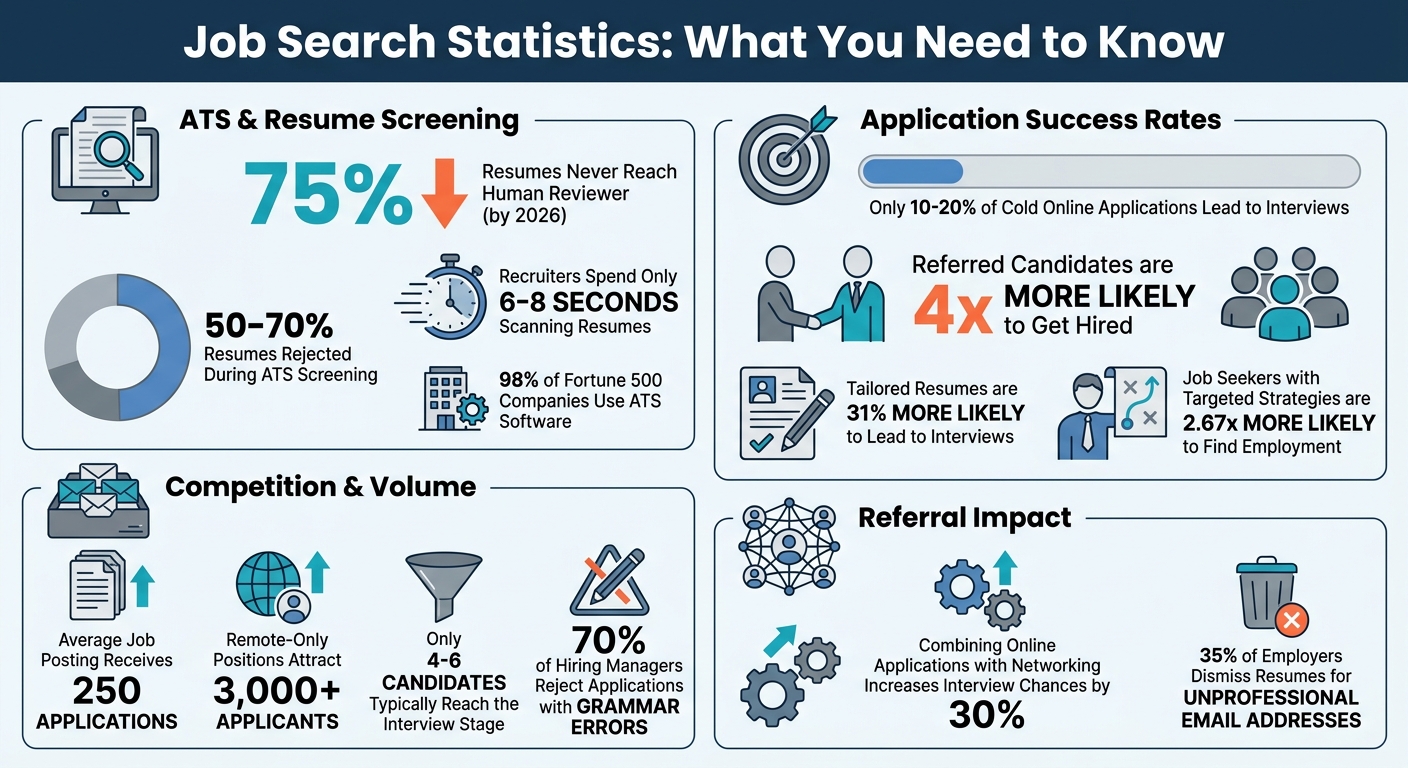
If you're not getting callbacks or interviews, the problem may not be your qualifications but how you're presenting them. By 2026, 75% of resumes never reach a human reviewer, and recruiters spend just 6–8 seconds scanning resumes. This means even well-qualified candidates can be overlooked due to avoidable mistakes.
Here’s how to improve your chances:
- Focus on specific roles: Target 1–2 roles instead of applying broadly. Tailor your resume to match the language and skills in job descriptions.
- Optimize for ATS: Avoid complex formatting and ensure your resume includes keywords that match the job listing.
- Customize each application: Generic resumes rarely succeed. Use a "master resume" to create tailored versions for each job.
- Stick to a schedule: Apply consistently, not sporadically, and dedicate time for networking and follow-ups.
- Leverage referrals: Referred candidates are 4x more likely to get hired. Build connections within your target companies.
- Expand beyond remote jobs: Remote roles attract thousands of applicants. Consider hybrid or in-office positions for less competition.
- Adjust quickly: If 20–30 applications yield no results, reassess your strategy within 2–3 weeks.
- Address gaps: Explain employment gaps briefly and focus on measurable achievements in your resume.
- Avoid over-relying on automation: Automation tools can fail ATS tests. Combine automation with human review for better results.
For tailored support, tools like scale.jobs combine human expertise with ATS optimization to help you stand out. Whether you need help customizing resumes, optimizing LinkedIn, or managing applications, these services can save time and improve results.
Key takeaway: A focused, consistent approach with ATS-friendly resumes and networking can transform your job search. Start improving today by tailoring your applications and leveraging tools or services that align with your goals.
Job Search Statistics: ATS Rejection Rates and Application Success Factors
9 Practical Tips When Your Job Search is Taking Longer Than Expected
sbb-itb-564272e
1. Applying to Too Many Different Roles Instead of Focusing on 1–2 Targets
It might seem like a good idea to apply for as many jobs as possible, but scattering your efforts across vastly different roles - like marketing manager one day, project coordinator the next, and business analyst the day after - can backfire. This approach often results in a resume that feels unfocused, with generic skills that don’t clearly align with any one job. For recruiters and ATS (Applicant Tracking System) algorithms, this lack of clarity can make it difficult to see you as the right fit for the role.
When recruiters scan resumes, they’re not digging deep into your experience; they’re looking for patterns and keywords that match the job description. If your resume tries to cover too many bases, it risks being overlooked entirely.
"Recruiters aren't interpreting your background, they're scanning for familiar patterns." - TieTalent Blog
Instead, narrowing your focus to one or two specific roles can make all the difference. Research backs this up - job seekers who adopt a targeted, goal-oriented strategy are 2.67 times more likely to find employment than those who apply broadly without a clear plan. This focused approach allows you to identify gaps in your skills, use the exact language from job descriptions, and present yourself as a confident, qualified candidate rather than a wildcard.
Start by tailoring your resume to reflect the specific requirements and language of your chosen roles. Review your past experience and highlight achievements that align with the priorities of your target jobs. For example, if you're aiming for a project management role, emphasize skills like "stakeholder management" or "budget forecasting" that are commonly mentioned in job postings. Use strong, active verbs like "led", "developed", or "executed" to show ownership of your accomplishments. If you’re unsure how to refine your resume for a particular role, consider using a professional resume service that can help you optimize it for ATS systems and specific industries.
This kind of strategic focus not only improves your chances with recruiters but also ensures that your application aligns with what hiring managers are looking for. Once you’ve honed your targeting, the next step is making sure your resume is formatted to pass ATS screenings and stand out to human reviewers.
2. Submitting Resumes That Fail ATS Screening
When your resume fails an ATS (Applicant Tracking System) scan, it never even gets to a recruiter. Considering that 50% to 70% of resumes are rejected during this automated process, ensuring your resume is ATS-friendly is critical to your job search. ATS software scans resumes to extract essential details like contact information, work experience, and skills. However, overly complex designs or unconventional formatting can interfere with this process.
To improve your resume's chances, avoid multi-column layouts, tables, text boxes, or placing contact details in headers or footers, as ATS systems often struggle to read these elements. Similarly, using creative section titles - such as "Where I've Been" instead of "Work Experience" - can confuse the system, preventing proper categorization of your information. Visual components like logos, skill-level bars, or icons can also cause errors, as ATS software cannot interpret images.
"We once had a brilliant candidate apply through our portal. Her resume came through as a series of broken characters and scrambled sections. She had used a two-column template. We nearly missed her entirely." - HR Advisor, Impacteers
To check if your resume is ATS-compatible, try pasting it into a plain text (.txt) file. If the text appears disorganized or jumbled, it's a sign you need to simplify the formatting. Stick to a single-column layout, use standard fonts like Arial or Calibri, and label sections clearly with titles such as Summary, Work Experience, Education, Skills, and Certifications. Save your resume as a .docx file for maximum compatibility unless the job posting specifically requests a PDF.
Keyword precision matters. Modern ATS systems use Natural Language Processing to assess not just the presence of keywords but also their context. For instance, if a job description mentions "stakeholder management", ensure you use that exact phrase rather than a similar term like "client relations." Tailoring your resume to match the job description's language can make all the difference. If you're unsure how to balance ATS optimization with creating a resume that appeals to human recruiters, consider using a professional resume service. These services can help craft a document that aligns with ATS requirements while showcasing your qualifications effectively.
In the next section, we'll discuss how using the same resume for every job application can hurt your chances of landing an interview.
3. Using the Same Resume for Every Application
Sending out the same resume for every job application can seriously derail your job search. Generic resumes tend to perform poorly in Applicant Tracking Systems (ATS), which are designed to rank candidates based on how well their resumes align with the specific job description. A one-size-fits-all approach often results in your resume being overlooked by these systems. This is why creating a tailored resume is so important to navigate these filters effectively.
But it's not just about the algorithms. On average, large companies receive around 250 applications for a single job posting, yet only 4–6 candidates typically move on to the interview stage. Hiring managers, who spend just 6–7 seconds scanning each resume during an initial review, are quick to discard resumes that don't immediately signal a strong fit for the role.
"I cannot tell you how many times I have seen a strong candidate fall through the cracks because their resume was not optimized for our systems. It is not about the person - it is about the document." - Senior HR Manager, Fortune 500 Tech Company
Customizing your resume doesn’t mean starting from scratch every time. Instead, start with a "master resume" - a comprehensive document that includes all your skills, projects, and achievements, typically spanning 4–5 pages. From this, create a targeted 1–2 page version for each job application. Spend 10–15 minutes tailoring it by selecting the most relevant experiences and using the exact language from the job description. For example, if a job posting emphasizes "stakeholder management", use that phrase instead of a similar term like "client relations." Similarly, if "Project Management" is a key requirement, make sure it appears prominently in your professional summary, skills section, and at least one bullet point under your work experience. This approach not only aligns your resume with ATS requirements but also significantly increases your chances of landing an interview.
It's also important to distinguish between tailoring for specific roles and general optimization. For platforms like LinkedIn or networking purposes, use broad industry keywords that appeal to recruiters across various companies. However, when applying for a specific job, go the extra mile: customize your professional summary, rearrange bullet points to prioritize the most relevant achievements, and ensure that 60–80% of the high-priority keywords from the job listing are included. Research shows that tailored resumes are up to 31% more likely to lead to an interview.
If you’re applying to multiple jobs each week and feel overwhelmed by the time it takes to tailor every resume, consider using a professional resume writing service. These services specialize in creating ATS-friendly, role-specific resumes, saving you time while improving your chances of success.
4. Applying Inconsistently Without a Weekly Schedule
Inconsistent application habits can seriously disrupt your job search. If you apply sporadically - three jobs one week, none the next, then five all at once - you’re likely to experience long periods of silence from employers. This lack of response can shake your confidence, even when the issue lies in your approach, not your qualifications.
Without a clear weekly plan, it’s easy to overlook essential steps like aligning your LinkedIn profile with your resume or catching grammar mistakes - errors that lead 70% of hiring managers to reject applications immediately.
"For those job seekers who are fully unemployed and actively seeking gainful employment, your number one job is conducting a full-time job search - meaning you should be investing at least 40 hours a week into networking, applications, and interview preparation." - Alex Harrington, Author and Certified Career Services Provider
To stay on track, create a consistent weekly routine. Dedicate specific time slots to different tasks. For example:
- Spend Monday and Wednesday mornings finding new job postings. Save the listings and step away from the job boards.
- Use Tuesday and Thursday to submit personalized, high-quality applications. Carefully read each job description, tailor your resume with relevant keywords, and take 10–15 minutes to customize your professional summary.
- Reserve Fridays for follow-ups and networking on LinkedIn.
This "batching" method minimizes the mental strain of switching between tasks and ensures you’re submitting 2–3 well-thought-out applications each week, rather than rushing through generic submissions.
If keeping this level of organization feels daunting, especially while juggling other responsibilities, tools like scale.jobs resume writing services can help. They ensure your applications are tailored, ATS-friendly, and consistent, so you can focus on other aspects of your job search.
5. Relying Only on Online Applications Without Networking
Did you know that only about 10%–20% of cold online applications make it to the interview stage? Meanwhile, referrals continue to dominate as the leading source of hires across industries. Relying exclusively on job boards means competing against hundreds of AI-enhanced resumes, with recruiters often giving your application just six seconds of attention.
This highlights the importance of standing out.
"In a market defined by automation, human connection remains the most powerful way to stand out." - Rodney Apple, Founder, SCM Talent Group
Volume alone won't help. When hiring managers sift through cold applications, they often have to piece together your career story, especially if there are employment gaps or career changes. Using a personal branding guide can help you frame these transitions effectively. Unfortunately, this guessing game rarely works in your favor. A referral, on the other hand, removes this uncertainty. It tells the hiring team that you're a reliable candidate who can fit into the role seamlessly, something that's tough to convey through a resume alone.
To navigate these hurdles, consider adopting a more proactive approach. Use job boards like LinkedIn and Indeed not just for applying, but as tools to gather insights. Spot companies actively hiring for your desired role, then focus on building connections within those organizations. Reach out to peers or professionals slightly ahead in your career field - they often have more sway with hiring managers than higher-level executives. Instead of asking for a job outright, aim to establish meaningful conversations. Combining online applications with strategic networking can boost your chances of landing an interview by up to 30%.
This approach works hand-in-hand with other strategies to accelerate your job search. If juggling targeted networking, resume customization, and application tracking feels like too much, consider outsourcing some tasks. For instance, professional resume writing services can craft ATS-friendly documents, freeing you to focus on building the relationships that lead to job offers.
6. Submitting Applications Without Referrals or Direct Outreach
Did you know that referred candidates are four times more likely to get hired than those who apply through traditional job boards? Despite this, many job seekers stick to the "submit and wait" method, missing out on a powerful way to get their resume in front of an actual decision-maker. Just as optimizing your resume for ATS is essential, leveraging referrals can be a game-changer in ensuring your application gets reviewed by a human.
Referrals come with built-in credibility, instantly giving you an edge. Companies often offer referral bonuses to employees, highlighting how much they value this process for finding strong candidates who are more likely to succeed in the role long-term.
To make the referral process smoother, craft a "forwardable note." This is a concise, 3-4 sentence summary of your experience and interest in the position. Your contact can easily share it with their recruiter. Attach your tailored resume and portfolio links to the same message, and include a polite, low-pressure closing line. Kareem Abukhadra, Founder of Joinrelentless.com, advises adding what he calls the "easy out":
"No pressure if you're not comfortable with that. I totally understand."
When seeking referrals, focus on peers who are one level above you in your field. They often have more influence with hiring managers and are more likely to respond to outreach. Use LinkedIn to identify potential connections at your target companies. Start by engaging with their posts or commenting thoughtfully on their work before transitioning to a referral request.
Timing matters, too. If someone agrees to help, follow the 24-hour rule: send your materials within a day to keep the momentum going. Once your application progresses, close the loop by updating your referrer on the outcome, whether it’s an interview, an offer, or another step in the process. This courtesy not only shows gratitude but also strengthens your professional relationship.
If juggling tailored resumes, forwardable notes, and follow-ups feels like too much, you might benefit from professional resume writing services. These services often include LinkedIn optimization and application support, making it easier for your contacts to advocate for you. With the right tools in place, warm introductions can quickly turn into interview invitations.
Next, we'll discuss how expanding your job search beyond remote-only roles can further speed up the process.
7. Limiting Your Search to Remote-Only Positions
Remote work has undeniable appeal, but narrowing your job hunt exclusively to "Work From Anywhere" roles can significantly slow your progress. These positions often attract an overwhelming number of applicants - sometimes exceeding 3,000 per posting - compared to around 250 for a typical job opening. Competing with thousands of candidates makes it harder for even a well-crafted resume to stand out. Unlike platforms that rely solely on bulk applications, Scale.jobs uses expert-driven strategies to fine-tune your resume for Applicant Tracking Systems (ATS), giving you an edge in these highly competitive markets.
Here’s why this matters: 98% of Fortune 500 companies use ATS to sift through applications, and a staggering 75% of qualified candidates are filtered out before a human ever reviews their resume. As NidoDesigns, a Lifestyle Writer and Editor, aptly put it:
"The remote job market is brutal. Every 'Work From Anywhere' listing gets 3,000+ applicants, and LinkedIn 'Easy Apply' feels like shouting into a void."
Expanding your search to include hybrid or in-office roles opens doors to opportunities with less intense competition. This doesn’t mean giving up on flexibility - it’s about increasing your chances of success by targeting positions where your application can genuinely shine. Many ATS systems screen candidates based on location eligibility, so if you’re open to relocation or hybrid work, make that clear on your resume. Scale.jobs ensures your resume highlights this information to improve both ATS compatibility and recruiter interest. With recruiters spending just 6–7 seconds scanning each resume, unclear location details can lead to automatic rejection.
For less saturated options, explore niche job boards like FlexJobs or Fair Remote, or focus on hybrid opportunities at companies known for flexible work policies. If tailoring your resume for ATS and location clarity feels like a daunting task, consider using professional resume writing services to create targeted versions without starting from scratch. Broadening your search not only increases your chances but also lays the groundwork for a smarter, more effective job application strategy. Up next, we’ll discuss why delaying adjustments to your approach could cost you more than just time.
8. Waiting Months to Adjust Your Strategy
Sticking with a strategy that isn’t working can cost you weeks of progress. If you’ve submitted 20–30 applications without seeing results, it’s time to make adjustments - not months down the line, but within the next 2–3 weeks. Recruiters typically sort resumes into three categories: immediate reject (50–70%), maybe (20–30%), and interview (10–20%). Every week spent on ineffective tactics adds up to lost opportunities.
If your applications aren’t leading to callbacks, there’s likely a core issue - whether it’s how well your resume aligns with ATS requirements, the keywords you’re using, or how you’re showcasing your experience. Waiting too long to address these problems only means missed chances that could have been avoided with quicker intervention.
Here’s how to spot and address issues early, ideally every 2–3 weeks:
- Are you landing interviews? If not, test your resume’s ATS compatibility. Copy it into a plain-text (.txt) file to see if headings disappear or bullet points get jumbled. If they do, simplify your formatting.
- Does your LinkedIn profile match your resume? Even small discrepancies in job titles or dates can raise red flags with recruiters.
- Audit your contact information. Believe it or not, unprofessional email addresses (e.g., "partycat99@hotmail.com") can lead to immediate rejection. Studies show that 35% of employers dismiss resumes for this reason alone.
This quick feedback loop is essential for refining your job search strategy. If 30 applications haven’t resulted in a single phone screen, it’s time to seek professional help. Small mistakes, like formatting errors can derail your efforts. Consider working with resume writing experts who specialize in ATS-optimized resumes. Scale.jobs combines human expertise with precise ATS optimization to revamp your resume, ensuring it’s tailored for every role you apply to.
The difference between a drawn-out, three-month job search and a swift, three-week one often comes down to this: recognizing what’s not working and fixing it promptly. Regularly review your metrics, test your resume’s ATS readability, and refine your keyword strategy. Every week you delay is another missed opportunity to land your next role.
9. Ignoring Resume Gaps and Weak Job Positioning
Unexplained gaps in your work history or unclear descriptions of past roles can seriously hinder your job search. Recruiters typically spend just 6–7 seconds reviewing each resume, and when they encounter gaps without context or vague phrases like "assisted with" or "helped coordinate", they often move on. In fact, about 50–70% of resumes are rejected during this initial scan because uncertainty is seen as a risk.
The key is not to hide gaps or exaggerate your experience but to provide clear, professional context directly within your resume. For example, briefly explain a gap with a note like "Position eliminated during consolidation", and ensure your work history aligns with your LinkedIn profile to avoid raising red flags. This transparency reduces doubts for recruiters. Additionally, applicant tracking systems (ATS) often flag inconsistent dates, which can harm your credibility.
Another common issue is weak resume positioning. If your resume reads like a list of tasks instead of showcasing results, you may come across as a passive contributor rather than someone who delivers outcomes. Replace vague phrases like "assisted with" with action-oriented verbs such as "led" or "implemented" to immediately highlight your contributions. Whenever possible, include measurable results - statements like "Reduced quarterly operating expenses by 15%" are far more impactful than generic descriptions like "Managed budget." If you're transitioning to a new industry, avoid company-specific jargon and use language that clearly communicates your value in a broader business context.
"If you don't provide context, recruiters will create their own narrative, and it rarely works in your favor." – TieTalent
If you're struggling to get callbacks, professional help can make a difference. Services like those offered by scale.jobs specialize in creating human-assisted, ATS-optimized resumes that not only pass software filters but also grab attention during the crucial 6-second recruiter scan. These services can transform unclear or weak resume positioning into a compelling argument for why you're the right candidate. Optimizing how you address gaps and improving your positioning strengthens your chances of standing out, especially when compared to competitors like LazyApply and Simplify.jobs.
Up next, we'll dive into the challenges of automation and how scale.jobs combines technology with the human touch to deliver better results.
10. Using Only Automation Tools Without Human Review
Automated job application tools are often marketed as time-savers, but relying entirely on them can lead to missed opportunities. Studies indicate that 75% of resumes are filtered by ATS (Applicant Tracking System) software, and automation without human oversight frequently results in errors that hurt your chances.
One major issue involves formatting. Automation tools often strip away complex formatting, which can lead to merged columns, jumbled sections, or misplaced content. A common mistake is placing contact details in headers or footers - areas that many ATS platforms ignore - leaving recruiters without critical information like your phone number or email address.
Another problem is how modern ATS software detects automated behavior. Overloading your resume with keywords or using generic summaries can trigger spam filters, making your application less appealing. Additionally, inconsistencies between your resume and LinkedIn profile can create doubts. A Senior HR Manager at a Fortune 500 tech company shared this insight:
"I cannot tell you how many times I have seen a genuinely strong candidate fall through the cracks because their resume was not optimized for our systems. It is not about the person - it is about the document."
Automation tools also tend to produce resumes filled with vague statements instead of highlighting specific, measurable achievements. Without human review, these generic phrases fail to make an impact on hiring managers.
To avoid these pitfalls, it’s crucial to combine the speed of automation with the accuracy of human review. For example, while tools like LazyApply focus solely on automation, platforms like Scale.jobs integrate expert human oversight to ensure ATS compatibility. Use automation for tasks like generating drafts or identifying relevant keywords, but always follow up with a manual review. Here are a few tips:
- Test your resume in plain text format to check for layout issues.
- Ensure that all essential details, such as contact information, are visible.
- Replace generic phrases with specific accomplishments backed by metrics.
By blending automation with careful human review, you can create resumes that not only pass ATS filters but also grab the attention of recruiters during their quick 6–7 second scans.
Ultimately, the difference between an automated resume and one refined with human input can determine whether you get a callback or are overlooked. Up next, we’ll compare how different platforms handle the balance between automation and human expertise.
Platform Comparison: scale.jobs vs LazyApply vs Simplify.jobs
When it comes to creating applications that stand out and overcome ATS (Applicant Tracking System) hurdles, these platforms take different approaches. Here's how scale.jobs, LazyApply, and Simplify.jobs stack up against each other.
LazyApply emphasizes quantity over quality, offering a browser extension to submit hundreds of applications across platforms like LinkedIn and Indeed with minimal effort. Lifetime access costs range from $99 (Basic) to $249 (Unlimited), making it appealing for those who prioritize volume. However, this method often leads to generic applications that fail to align with specific job descriptions - a critical issue, as 99% of applications are rejected during ATS screening.
Why scale.jobs Outperforms LazyApply
- Personalized Resumes: Human assistants tailor each resume to the job's requirements, avoiding cookie-cutter templates.
- ATS Optimization: Applications are manually reviewed, with proof-of-work screenshots to confirm formatting accuracy.
- Real-Time Support: WhatsApp updates provide transparency that automated tools can't match.
- One-Time Pricing: Costs range from $199 to $1,099, offering human-reviewed submissions instead of relying solely on algorithms.
- Error-Free Details: Ensures contact information and other key elements are correctly placed, reducing rejection risks.
Simplify.jobs strikes a balance between automation and user control. Its browser extension automates data entry while requiring users to manually trigger applications. The core tool is free, with premium features available for $10–$20 per month. While it offers more control than LazyApply, it lacks the deep customization and human review needed to optimize applications for ATS and recruiters.
Why scale.jobs Outperforms Simplify.jobs
- End-to-End Service: Trained virtual assistants handle the entire application process, unlike Simplify.jobs' user-driven approach.
- Expert Customization: Resumes and cover letters are tailored to each job, ensuring ATS compatibility.
- Fast Turnaround: Custom documents are delivered within 24 hours.
- Proof-of-Work: Time-stamped screenshots provide accountability, unlike browser extensions.
- Comprehensive Packages: Services include resume writing, LinkedIn optimization, and strategic job search guidance.
scale.jobs offers a managed service where trained human assistants handle every application manually. Starting at $199 for 250 applications, the platform combines AI tools with human oversight to create ATS-friendly, customized submissions. Features include real-time WhatsApp updates, proof-of-work screenshots, and a 24-hour turnaround for tailored resumes and cover letters.
Why scale.jobs Stands Out
- Human Oversight: Resumes are crafted to pass both ATS filters and the recruiter’s initial scan.
- Industry-Specific Language: Experience is translated into terms that match job descriptions.
- Flat-Fee Pricing: Avoid recurring costs with one-time payment bundles.
- Transparent Communication: WhatsApp updates keep users informed throughout the process.
- Accountability: Proof-of-work screenshots ensure applications are submitted correctly.
The table below highlights key differences between the platforms:
| Feature | scale.jobs | LazyApply | Simplify.jobs |
|---|---|---|---|
| Human Involvement | High (trained VAs review each application) | Low (algorithm-only) | Medium (user-driven with auto-fill) |
| Resume Customization | High (tailored by experts per job) | Low (generic templates) | Medium (user-adjusted) |
| ATS Handling | Manual optimization with proof-of-work | Basic keyword matching | Field-mapping accuracy |
| Application Method | Managed outreach by human assistants | Automated bot/script | Browser extension auto-fill |
| Transparency | Live WhatsApp chat + screenshots | Limited tracking | Application dashboard |
| Pricing Model | Flat-fee bundles ($199–$1,099) | Lifetime access ($99–$249) | Free core; $10–$20/month premium |
Who Should Use LazyApply
LazyApply is ideal for job seekers who prioritize volume over customization:
- Applicants aiming for 100+ entry-level positions where generic resumes suffice.
- Users who are okay with lower callback rates to save time.
- Candidates in less competitive industries where ATS optimization is less critical.
- Individuals testing the job market without urgency to secure interviews.
Who Should Use Simplify.jobs
Simplify.jobs works well for those who want a mix of speed and control:
- Job seekers managing their own applications but looking to save time on data entry.
- Candidates with strong resumes that require minimal adjustments.
- Users applying to 10–20 jobs per week who can manually fine-tune submissions.
- Budget-conscious individuals comfortable with DIY customization.
Who Should Choose scale.jobs
scale.jobs is the go-to option when precision, accountability, and customization matter most:
- Professionals targeting competitive roles requiring tailored applications.
- Job seekers who’ve applied to 30+ jobs without results and need expert guidance.
- Candidates with gaps, career changes, or complex histories needing strategic positioning.
- Users who value transparency and proof of application submission.
- Those willing to make a one-time investment for comprehensive support.
When to Switch to scale.jobs
You might want to switch to scale.jobs if:
- Automated tools have failed to yield interviews after 30+ applications.
- Your resume has formatting issues, gaps, or needs expert adjustments for career transitions.
- You’re applying for competitive roles where ATS optimization is critical.
- You need real-time updates and proof-of-work transparency.
- You prefer one-time payment over recurring subscriptions while receiving human-powered assistance.
Decision Summary
- Choose LazyApply for high-volume, generic applications aimed at entry-level roles with lower callback expectations.
- Choose Simplify.jobs if you want to save time on data entry while managing your own applications and have a strong resume.
- Choose scale.jobs for competitive roles, ATS-friendly applications, and expert human oversight. Its combination of trained VAs, proof-of-work transparency, and tailored resumes can make the difference between landing interviews or being overlooked.
Conclusion
Shifting from a scattershot approach to a focused job search strategy can completely change your results. By avoiding mass applications, tailoring your resume for ATS systems, and highlighting measurable accomplishments, you increase your chances of standing out to recruiters. This shift in mindset sets the stage for a more effective and efficient job search.
The difference between a long, drawn-out search and landing a role quickly often boils down to how well you execute. Reflecting the language of potential employers, networking with purpose, and sticking to a consistent application routine transforms your efforts into a targeted campaign. As Dr.Job Blog aptly puts it:
"The real goal is not to game the system. It is to make your resume readable, relevant, and aligned with the role you want."
Speed is critical in today’s job market. If you've sent out dozens of applications without hearing back, the issue likely isn’t your qualifications - it’s how they’re presented. Take action now to refine your materials. Use strong, active verbs and include specific metrics to make your resume more compelling and aligned with the roles you’re aiming for.
For roles that combine ATS screening with human review, consider the benefits of working with professional resume writers. These experts can address career gaps, simplify technical jargon, and ensure your online profiles are consistent with your resume. With scale.jobs, you gain access to both human expertise and proven ATS optimization strategies, transforming your applications into high-impact submissions. Whether you choose to go with DIY methods or managed services, the key lies in creating tailored applications that resonate with both algorithms and recruiters.
Start improving your job search today with these steps:
- Use a professional email address that reflects your name.
- Ensure your LinkedIn profile aligns with your resume.
- Test your resume by viewing it in plain text format.
- Track which versions of your resume lead to callbacks.
- Monitor your application-to-interview ratio on a weekly basis.
In a competitive job market, clarity, consistency, and relevance are your greatest allies. By focusing on the basics and fine-tuning your approach, you can significantly shorten your job search timeline. Partnering with scale.jobs gives you the tools and expertise to make each application count, ensuring a smoother and more transparent path to your next role.
FAQs
How do I know if my resume is ATS-readable?
To make sure your resume is ready for an ATS (Applicant Tracking System), focus on using relevant keywords that match the job description, maintain straightforward formatting, and ensure the layout is clean and easy to read. Steer clear of intricate graphics, uncommon fonts, or overly decorative designs, as these can confuse the system. By aligning your resume with the specific requirements of the job and prioritizing clarity, you improve your chances of getting past the initial screening stage.
How many applications should I send before changing my strategy?
When it comes to job applications, there isn’t a magic number that guarantees success. Instead, prioritize quality over quantity. Aim to apply for 10–20 positions that genuinely match your skills and interests, rather than scattering applications without a clear focus. If you’re submitting numerous applications but not hearing back, it may be time to tweak your strategy. Consider revising your resume, adjusting the keywords you use, or narrowing your targeting. Services like a job search virtual assistant or an AI resume builder can provide tailored support to improve your chances of landing interviews.
What’s the fastest way to get referrals at target companies?
The fastest way to secure referrals is by leveraging employee referral platforms and sharpening your networking skills. Platforms designed for referrals can link you directly with employees at leading companies, streamlining the process. At the same time, tools like LinkedIn and professional groups provide an opportunity to cultivate authentic connections. Prioritize engaging with current employees, actively contribute to industry conversations, and seek referrals from contacts you trust. These strategies can greatly increase your odds of securing interviews.