
Do ATS Scores Actually Matter? Real Job Search Data
ATS scores are diagnostic — parsing, keywords, and human review, not the percentage, determine interview chances.


ATS scores matter less than you think. While tools like Jobscan estimate how well your resume matches a job description, recruiters never see these scores. Instead, Applicant Tracking Systems (ATS) act as searchable databases, helping recruiters filter applications based on keywords, location, and qualifications.
Here’s what you need to know:
- ATS scores are diagnostic tools. They help identify gaps in your resume but don’t directly impact hiring decisions.
- Formatting and keywords matter. Resumes must be machine-readable and contain relevant terms to pass ATS filters.
- Human review is key. Overloading your resume with keywords can hurt its appeal during a recruiter’s 7.4-second scan.
- Automation isn’t always effective. Tools like LazyApply may cause rejections due to bot-detection or missed eligibility questions.
For better results, a balanced approach is essential - combine ATS-friendly formatting with tailored, human-centered content. Services like scale.jobs ensure your applications perform well across all stages, from ATS parsing to recruiter review. Whether you're applying for full-time jobs or part-time jobs near me, understanding these nuances can save time and increase your chances of landing interviews.
What the Data Shows About ATS Scores
How ATS Scores Are Calculated
The "ATS score" provided by tools like Jobscan or Resume Worded is not something recruiters actually see. Instead, it serves as a diagnostic tool that estimates how well your resume aligns with a specific job description. These tools analyze factors like keyword density, formatting compatibility, and how your experience matches the job's requirements. The process involves converting your resume into plain text, comparing it to the job description, and generating a percentage match.
Recruiters, however, don't rely on this score. How recruiters filter resumes using ATS involves using their company's platform - platforms like Workday, which is used by over 37% of Fortune 500 companies - to search for specific keywords, job titles, certifications, or skills. Your resume either appears in their filtered search results or it doesn’t. For example, a resume with a 70% keyword match will rank higher than one with a 40% match, even if the latter candidate is more qualified. While these scores can help identify gaps in your resume, they are not the ultimate hiring criteria.
Do High Scores Lead to More Interviews?
Understanding how ATS scores are calculated is one thing, but how do they influence your chances of landing an interview? Generally, a diagnostic score between 75% and 85% is ideal. Going beyond 90% can lead to keyword stuffing, which makes your resume appear robotic and unappealing during a recruiter’s quick scan. On the other hand, scores below 60% often point to major issues, such as poor formatting or missing critical qualifications.
The reality is that only 4–6 out of every 250 resumes submitted for a job end up leading to an interview. The filtering process happens in stages. First, candidates are screened out by knockout questions related to work authorization, location, or specific certifications - regardless of their ATS score. Then, recruiters use search filters to find resumes with the right keywords. Finally, they spend just a few seconds scanning the top section of each resume. While a high match score can get you noticed, it’s your headline, summary, and key accomplishments that ultimately determine whether you move forward.
When Humans Override ATS Rankings
Although ATS systems primarily function as searchable databases, recruiters often bypass these rankings in certain situations. For instance, if a hiring manager receives a referral, that candidate’s resume often skips the ATS process entirely. Internal applicants also tend to take priority over external ones, regardless of keyword matches. In smaller companies - where only 20% use ATS compared to 70% of larger organizations - human review plays a bigger role from the outset.
Interestingly, 48% of hiring managers now use AI tools to screen resumes. These tools are becoming better at evaluating context and relevance rather than just keyword repetition. For example, a resume that repeatedly mentions "project management" is less compelling than one that specifies achievements, such as "Led a team of 12 to deliver a $2.3M product launch three weeks ahead of schedule." This is where services like resume writing professionals can help by blending ATS optimization with engaging storytelling.
Ultimately, 94% of recruiters agree that ATS improves their hiring process. However, the system is most effective when your resume performs well across three layers: the Parse Layer (formatting), the Match Layer (keywords), and the Human Layer (compelling content). Focusing on just one of these areas leaves you vulnerable in the others. This balanced approach underscores why combining ATS-friendly techniques with human expertise - like the methods used by scale.jobs - can deliver better outcomes. Understanding how this dual filtering process works also provides a foundation for comparing scale.jobs with tools like Jobscan and LazyApply.
sbb-itb-564272e
What Is ATS Score & How Is It Calculated? (Resume ATS Explained)
Jobscan vs scale.jobs: Which Handles ATS Better?
When it comes to navigating Applicant Tracking Systems (ATS), it’s not just about hitting the right scores - it’s about turning those scores into actual interviews. Jobscan and scale.jobs approach ATS optimization from two very different angles. Jobscan offers a self-service diagnostic tool that analyzes keywords and match rates instantly. Meanwhile, scale.jobs takes a hands-on approach, managing your applications from start to finish, ensuring they’re both ATS-friendly and recruiter-ready.
What Jobscan Does Well
Jobscan is a solid choice for job seekers who prefer a DIY approach. By uploading your resume and job description, you get a percentage match that highlights keyword gaps, formatting issues, and areas to improve. For those aiming to understand how their resume stacks up against a specific job post, this instant feedback can be quite helpful. Generally, aiming for a 75–85% match rate is enough to navigate ATS filters without overloading on keywords.
One standout feature is its ability to detect formatting problems. If your resume uses tables, text boxes, or columns, Jobscan flags these elements, which can drop parsing accuracy significantly. This is especially important since poorly formatted resumes often get rejected before a recruiter even sees them. However, while Jobscan provides valuable diagnostics, it stops short of handling the actual application process - something scale.jobs excels at.
5 Reasons scale.jobs Outperforms Jobscan
1. Comprehensive optimization for all layers of review.
Jobscan focuses on ATS keywords and formatting but doesn’t address the "Human Layer" - the part that resonates with recruiters during their brief scan. scale.jobs goes beyond machines by crafting persuasive, achievement-oriented resumes that appeal to both ATS systems and human reviewers.
2. Manual application submissions to avoid bot-flagging.
While Jobscan provides keyword analysis, you’re left to submit applications manually or through automated tools, which can trigger red flags in some ATS systems. scale.jobs’ team of virtual assistants meticulously fills out each application by hand, ensuring compatibility with diverse platforms, including niche job boards and unique company portals.
3. Proof-of-work updates for peace of mind.
Jobscan offers match-rate dashboards, but it doesn’t confirm whether your applications are submitted correctly. scale.jobs provides time-stamped screenshots via WhatsApp for every application submitted, offering complete transparency and eliminating any guesswork.
4. Flat-fee pricing for budget clarity.
Jobscan operates on a recurring subscription model, which can add up over time. In contrast, scale.jobs offers flat-fee bundles - starting at $199 for 250 applications - making it easier to budget without worrying about ongoing charges.
5. Rapid turnaround for tailored documents.
Jobscan identifies what needs fixing, but you’re responsible for rewriting your resume and cover letter for each job. scale.jobs delivers customized resumes and cover letters within 24 hours, ensuring every application is optimized for ATS and recruiter review alike.
Feature Comparison: Jobscan vs scale.jobs
Here’s a quick breakdown of how the two services stack up:
| Feature | Jobscan | scale.jobs |
|---|---|---|
| Human Involvement | None (self-service) | Virtual assistants and resume writers handle everything |
| Resume Customization | Keyword suggestions; user rewrites | Fully customized resumes and cover letters for each job |
| ATS Optimization | Focuses on keywords and formatting | Optimized for keywords, formatting, and recruiter appeal |
| Application Submission | User submits manually | Applications submitted by hand to all platforms |
| Transparency | Match-rate dashboard | Proof-of-work screenshots via WhatsApp |
| Pricing Model | Subscription-based | One-time flat-fee bundles |
For job seekers making career pivots, addressing gaps, or targeting highly specific roles, Jobscan’s automated feedback might not be enough. scale.jobs combines ATS expertise with a human touch, ensuring your applications are not only technically sound but also compelling to recruiters. If you're serious about landing interviews, the tailored approach of scale.jobs may be the better choice.
LazyApply vs scale.jobs: Automation vs Human Application
When comparing LazyApply to scale.jobs, it’s clear that automation alone doesn’t guarantee interviews. These two platforms take entirely different approaches: LazyApply focuses on high-volume automation, while scale.jobs emphasizes detailed, human-driven precision. The real question is whether speed or accuracy matters more when trying to get past applicant tracking systems (ATS) and into a recruiter’s hands.
What LazyApply Does Well
LazyApply is all about efficiency, allowing users to submit over 50 applications daily with minimal effort. This approach works well for entry-level roles where customization isn’t a top priority. For instance, fields like retail and customer service often have uniform job descriptions, making LazyApply’s template-based system a practical option.
Its low-cost subscription plans (typically under $100) make it accessible for those on a tight budget. Additionally, the platform offers a basic dashboard to help you track where your resume has been sent, which can simplify your job search process.
However, when it comes to roles requiring attention to detail, scale.jobs offers a clear edge.
5 Reasons scale.jobs Outperforms LazyApply
1. Manual submissions avoid bot-detection issues.
Many ATS platforms, such as Workday, can flag automated submissions from tools like LazyApply, leading to instant rejections. scale.jobs avoids this by having virtual assistants manually complete each application, ensuring compatibility without triggering anti-bot systems.
2. Knockout questions are answered accurately.
Automated tools often mishandle eligibility questions - like those about location, certifications, or work authorization - resulting in immediate disqualification. scale.jobs ensures these critical questions are answered correctly, reducing unnecessary rejections.
3. Resumes are formatted for ATS compatibility.
LazyApply uses a one-size-fits-all resume approach, which can lead to parsing errors in ATS systems, especially if the resume includes tables or graphics. scale.jobs provides ATS-optimized resumes tailored to each role, ensuring they remain structured and readable.
4. Applications cater to recruiter preferences.
Recruiters spend an average of 7.4 seconds scanning resumes. scale.jobs creates resumes that not only pass ATS filters but also engage recruiters with clear, achievement-focused content - something generic templates often fail to do.
5. Proof-of-work ensures transparency.
While LazyApply offers submission logs, they don’t confirm whether applications were completed correctly or flagged as spam. scale.jobs provides time-stamped screenshots for every submission, offering unmatched transparency.
Feature Comparison: LazyApply vs scale.jobs
| Feature | LazyApply | scale.jobs |
|---|---|---|
| Human Involvement | Fully automated | Dedicated virtual assistants |
| Resume Customization | Generic templates | Job-specific resumes and cover letters |
| ATS Compatibility | Risk of bot-flagging | Human-verified submissions |
| Application Method | Chrome extension | Manual submission |
| Transparency | Basic dashboard | Time-stamped proof-of-work screenshots |
| Pricing Model | Subscription-based ($99–$249) | Flat-fee ($199–$399) |
Who Should Use LazyApply
LazyApply is a good fit for:
- Entry-level job seekers targeting high-volume, standardized roles like retail or customer service.
- Those who don’t require much customization and want to apply quickly.
- Job seekers with limited budgets who prioritize quantity over quality.
- Individuals applying to roles with nearly identical job descriptions across companies.
- Candidates comfortable with lower response rates in exchange for speed.
Who Should Choose scale.jobs
scale.jobs is better suited for:
- Mid-to-senior professionals who need tailored applications for specialized roles.
- Career changers wanting resumes that highlight transferable skills.
- International candidates requiring visa sponsorship (e.g., H-1B or F-1 OPT), where eligibility questions are critical.
- Job seekers targeting competitive positions with low interview rates (e.g., 4–6 out of 250 applicants).
- Professionals needing ATS-optimized resumes that also appeal to human recruiters.
- Anyone frustrated by auto-rejections or low response rates from automated tools.
- Candidates applying to niche or highly specialized industries.
Switch to scale.jobs if…
- Your applications are getting auto-rejected. This often means automated tools are being flagged or knockout questions are being mishandled.
- You’re applying for roles requiring specific qualifications. Manual handling ensures eligibility filters are correctly addressed.
- You need tailored resumes for competitive positions. Generic templates won’t cut it for roles attracting hundreds of applicants.
- You’ve encountered formatting issues with your resume. Human verification ensures your resume uploads correctly across platforms.
- You want proof of submission accuracy. Time-stamped screenshots provide the transparency that automated systems lack.
For professionals seeking more than just volume, scale.jobs offers the attention to detail required to stand out. With nearly half of hiring managers using AI to screen resumes and corporate openings attracting hundreds of applicants, the difference between a generic submission and a tailored approach can be the deciding factor. If you’re serious about landing interviews and avoiding auto-rejections, scale.jobs combines human expertise with ATS-friendly strategies to ensure your applications succeed at every stage.
Case Studies: ATS Scores and Actual Outcomes
Data from hiring processes reveals that ATS (Applicant Tracking System) scores offer limited insight - they are diagnostic tools rather than definitive measures of a candidate's potential. What truly matters is meeting the job's key requirements and catching a recruiter’s attention during their brief 7.4-second scan. Tools like Jobscan provide match percentages to help job seekers refine their resumes, but remember, these scores are not what recruiters see. They are merely guides to help improve alignment with job postings.
Take a typical corporate job posting as an example: it might receive around 250 applications, yet only 4 to 6 candidates are invited to interview. Success often hinges on three critical areas of optimization:
- Parse: Ensuring that the text can be extracted cleanly by the ATS.
- Match: Using the right keywords in the right places.
- Human: Creating a resume that persuades hiring managers.
Interestingly, a candidate with a 75–85% match rate who uses the "Action + Skill + Scope + Result" formula in their achievements often performs better than someone with a 95% match achieved through keyword stuffing. This highlights the importance of balancing keywords with meaningful content that demonstrates impact.
The Hidden Danger of Formatting Issues
Formatting problems can significantly hurt your chances, even if you’re highly qualified. Resumes that use tables, text boxes, or multi-column layouts often score poorly - falling into the 0–49% range - because ATS systems struggle to parse them correctly. A simple way to test your resume is to paste it into Notepad. If the order of the text looks scrambled, it’s a sign that formatting issues could be affecting your ATS score. Fixing these errors can move your resume into the "strong match" category (75–84%), where most successful applicants reside.
"ATS score = 'How well does my resume mirror this posting?' Not: 'How good is my career?'" – JobShinobi
The Role of Human Judgment in Hiring
While ATS systems focus on technical matches, recruiters pay close attention to factors like recognizable employers, clear career progression, and job titles that align with the role. These are elements that automated tools often miss. This is why professional resume services emphasize embedding keywords naturally within achievement statements rather than simply listing them. A well-crafted resume needs to pass both machine filters and human scrutiny.
With nearly half of hiring managers (48%) now using AI to screen resumes, there’s less room for error. This is where platforms like scale.jobs stand out by combining ATS optimization with human review, ensuring your resume is both technically sound and compelling to recruiters.
Knockout Questions: A Common Pitfall
Even a high ATS match rate won’t save a candidate who fails knockout questions. For instance, answering "No" to critical criteria like work authorization or location eligibility can lead to immediate rejection. Human oversight is crucial in addressing these filters accurately, giving candidates a better chance in today’s competitive job market.
When to Switch to scale.jobs
Submitting job applications can feel like a full-time job in itself. If you’re spending 3–4 hours a day applying but still not landing interviews - even with high ATS scores - it’s time to rethink your approach. Tools like Jobscan might show a strong ATS match, but those scores don’t always align with how recruiters filter candidates. When high scores don’t lead to callbacks, you could be facing indirect rejection. This happens when your application gets lost among hundreds of others or fails due to knockout questions that automated tools can’t address.
Immediate rejections - those that happen within minutes or hours - often signal issues like missing certifications, location restrictions, or work authorization requirements. These are knockout barriers that automated tools overlook. Here’s where human oversight becomes critical. scale.jobs assistants carefully review each job portal’s requirements before submitting your application. They also provide time-stamped proof-of-work screenshots, ensuring transparency and accuracy for every submission.
If your resume formatting isn’t translating well across employer systems, that’s another sign to make the switch. A resume that scores well on diagnostic tools might still scramble in ATS systems like Workday, which is used by over 37% of Fortune 500 companies. Multi-column layouts or tables can cause parsing errors. A simple way to check? Copy your resume into Notepad - if the layout breaks, formatting issues exist. scale.jobs offers ATS-optimized resumes within 24 hours, tailoring the format for systems like Workday, Greenhouse, or even niche job boards.
Switching to scale.jobs also makes sense if you need verifiable application history. Unlike bulk automation tools like LazyApply, scale.jobs provides an exportable tracker that documents every submission. This feature is especially useful for tracking progress and gauging your return on investment. Plus, with WhatsApp updates and a real-time application dashboard, you’ll always know where you stand - features that automated tools simply don’t offer.
For those who prioritize results over generic solutions, combining professional resume services with human-assisted applications can significantly improve your job search strategy. With a one-time payment model ranging from $199 to $399 for 250–1,000 applications, you avoid recurring fees while ensuring real people handle the details. This frees up your time to focus on networking and preparing for interviews. When technical fixes fall short, having human expertise can make all the difference.
Which Service to Choose
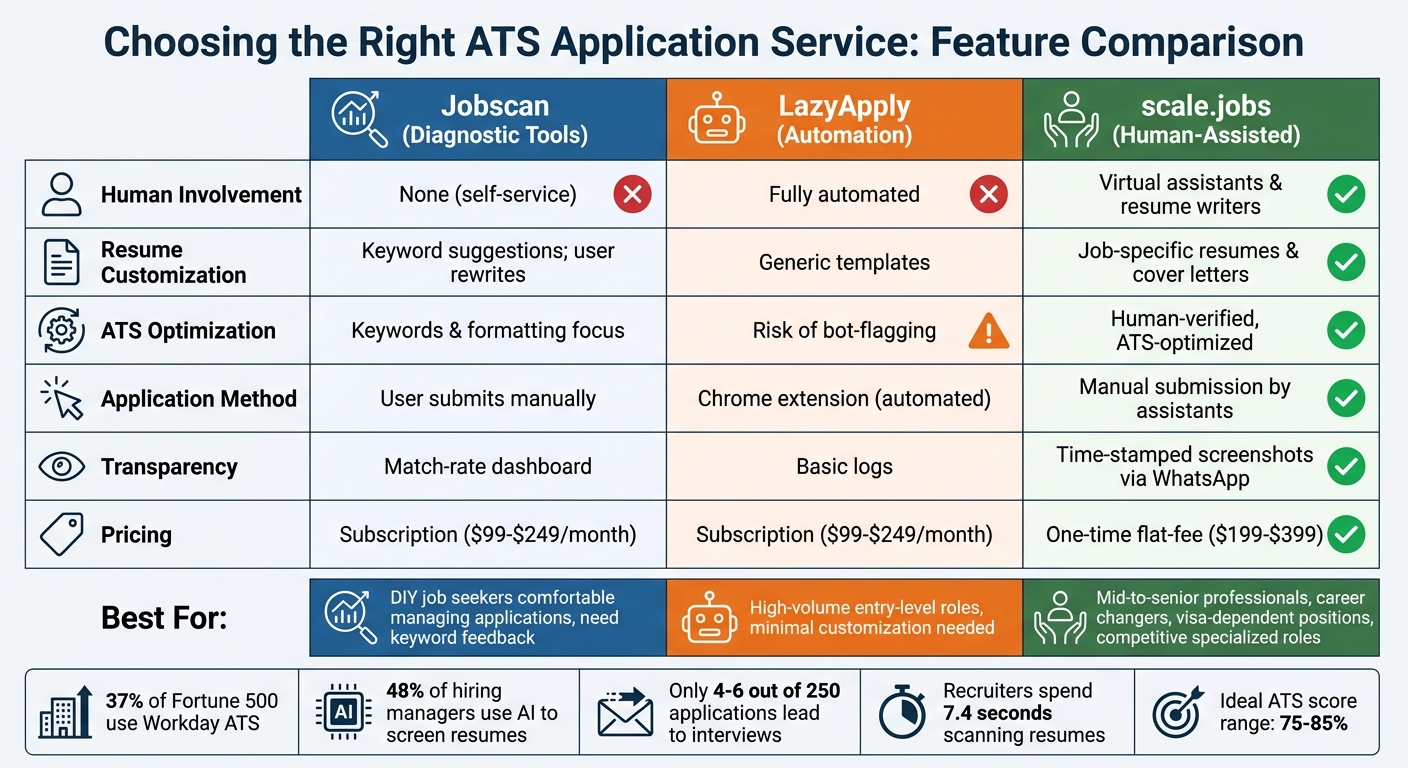
Jobscan vs LazyApply vs scale.jobs: ATS Application Services Comparison
Deciding between diagnostic tools and hands-on services can feel overwhelming, especially when you're navigating the complexities of ATS scoring and human oversight. Here's a breakdown to help you make the right choice.
ATS scores are particularly important when you're applying to large companies, like Fortune 500 employers, where nearly 98.4% rely on ATS systems to manage applications. If you're targeting these organizations, tools like Jobscan can help pinpoint keyword gaps and formatting issues before you hit "submit." Ideally, your ATS score should range between 75% and 85% - high enough to include essential keywords but still readable for recruiters. Striving for a perfect 100% can backfire, as it often leads to keyword stuffing, which makes your resume seem robotic. This is a problem, given that 48% of hiring managers use AI to pre-screen resumes.
However, a high ATS score doesn’t always guarantee interviews. When strong match rates fail to yield results, the issue often lies in the "Human Layer" - how well your resume communicates your value and answers the recruiter’s key question: Can this person excel in this role? Tools like Jobscan and LazyApply can't address knockout questions about work eligibility, certifications, or location. Nor can they ensure that your resume parses correctly in platforms like Workday, which is used by over 37% of Fortune 500 companies. That’s where human input becomes essential. Here’s how to decide which option suits your needs.
Who Should Use Diagnostic and Automation Tools?
- Jobscan (or similar diagnostic tools): These are perfect for job seekers who prefer a hands-on approach. If you’re comfortable managing your own applications and tweaking your resume based on feedback, these tools act as a "spellcheck" for keyword alignment and formatting.
- LazyApply: Ideal for candidates applying to a high volume of roles with minimal customization. This tool is best suited for entry-level positions where detailed proof-of-work isn’t required.
Who Should Choose scale.jobs?
- scale.jobs: This service is perfect for those who feel stuck spending hours on applications without results. If you need a reliable submission history or want to free up time for networking and interview prep, scale.jobs offers a more thorough approach. By combining professional resume optimization with human-assisted submissions, it tackles all three layers of the application process: formatting (Parse), keyword alignment (Match), and recruiter appeal (Human).
For those dealing with visa requirements, certification-heavy industries, or niche job boards, human oversight ensures that critical details don’t get overlooked. scale.jobs assistants handle portal-specific requirements, ensuring your application meets all criteria. They also provide time-stamped proof-of-work screenshots, giving you transparency and peace of mind. With a one-time payment starting at $199 for 250 applications, you avoid recurring subscription fees while benefiting from hands-on expertise.
Comparison Table: Diagnostic & Automation Tools vs scale.jobs
| Feature | Jobscan / LazyApply | scale.jobs |
|---|---|---|
| Human Involvement | None (self-service or automated) | Virtual assistants and resume writers |
| Resume Customization Depth | Keyword suggestions; generic templates | Job-specific resumes and cover letters |
| ATS Handling | Diagnostic feedback; risk of bot-flagging | Human-verified, ATS-optimized submissions |
| Application Execution Method | User submits or Chrome extension | Manual submission by assistants |
| Transparency and Proof of Work | Match-rate dashboard or basic logs | Time-stamped screenshots via WhatsApp |
| Pricing Model | Subscription-based ($99–$249/month) | One-time flat-fee ($199–$399) |
Switch to scale.jobs if…
- You’re spending 3–4 hours daily with no results. If your high application volume isn’t leading to callbacks, human oversight can help identify what’s missing.
- You need verifiable submission history. Time-stamped proof-of-work screenshots offer transparency that automated tools can’t provide.
- Eligibility questions are causing frequent rejections. Human assistants ensure that work authorization, location, and certification requirements are addressed correctly.
- Your resume struggles with ATS formatting. Professional formatting ensures your resume parses correctly in systems like Workday or Greenhouse.
- You’re aiming for competitive, specialized roles. Tailored applications that meet both ATS and recruiter expectations can give you an edge in highly competitive fields.
Decision Summary
If you’re comfortable managing your own applications and need quick feedback on keyword alignment, diagnostic tools like Jobscan are a good fit. For high-volume, entry-level roles where customization isn’t critical, automation tools like LazyApply can save time. On the other hand, if you’re targeting mid-to-senior roles, making a career transition, or dealing with visa-dependent positions, scale.jobs provides the precision and customization needed to stand out. With human-assisted applications, you can address formatting challenges, knockout questions, and recruiter expectations effectively, giving you a better chance of landing interviews.
FAQs
What’s the fastest way to tell if my resume will parse correctly in an ATS?
To quickly determine if your resume will pass through an ATS (Applicant Tracking System) without issues, consider using an ATS checker. These tools identify formatting problems, evaluate keyword alignment, and even provide a match score for your resume. If you don’t have access to such a tool, you can manually ensure ATS compatibility by sticking to standard fonts, avoiding the use of headers or footers, and saving your resume in formats like .docx or PDF. These simple adjustments can significantly improve your chances of getting noticed by the system when you apply for jobs.
How do I add keywords without making my resume look like keyword stuffing?
When incorporating keywords into your resume, aim for a natural and seamless integration. Highlight the essential skills and tools mentioned in the job description by strategically placing them in your summary, experience, and skills sections. To avoid redundancy, use synonyms and variations where appropriate. Focus on maintaining a balance - prioritize clarity and professionalism over cramming in keywords. Both ATS systems and recruiters appreciate resumes that are easy to read and well-organized, rather than ones overloaded with repetitive terms.
If I’m still getting rejected fast, what should I check besides my ATS match score?
If you keep facing rejections despite having a high ATS match score, it might be time to look at potential formatting issues. Elements like headers, footers, or non-standard fonts can sometimes confuse ATS systems, making your resume harder to process. Make sure keywords are seamlessly woven into your resume and are directly relevant to the job you're targeting.
Also, take a step back and evaluate your resume’s overall clarity. Are your skills and accomplishments easy to spot at a glance? If not, consider reworking the layout or phrasing to make them stand out. Additionally, ensure you're applying for positions that align with your experience and qualifications. Pair your applications with customized cover letters and make an effort to network - it can often open doors that an application alone might not.
For added support, tools like an AI resume builder or an AI cover letter builder can help refine your documents and increase your chances of success. Don't forget to double-check everything before hitting submit!