
How to Apply to Fortune 500 Jobs the Right Way
Learn ATS-friendly resume tips, tailored cover letters, and measurable-results strategies to improve your chances at Fortune 500 companies.

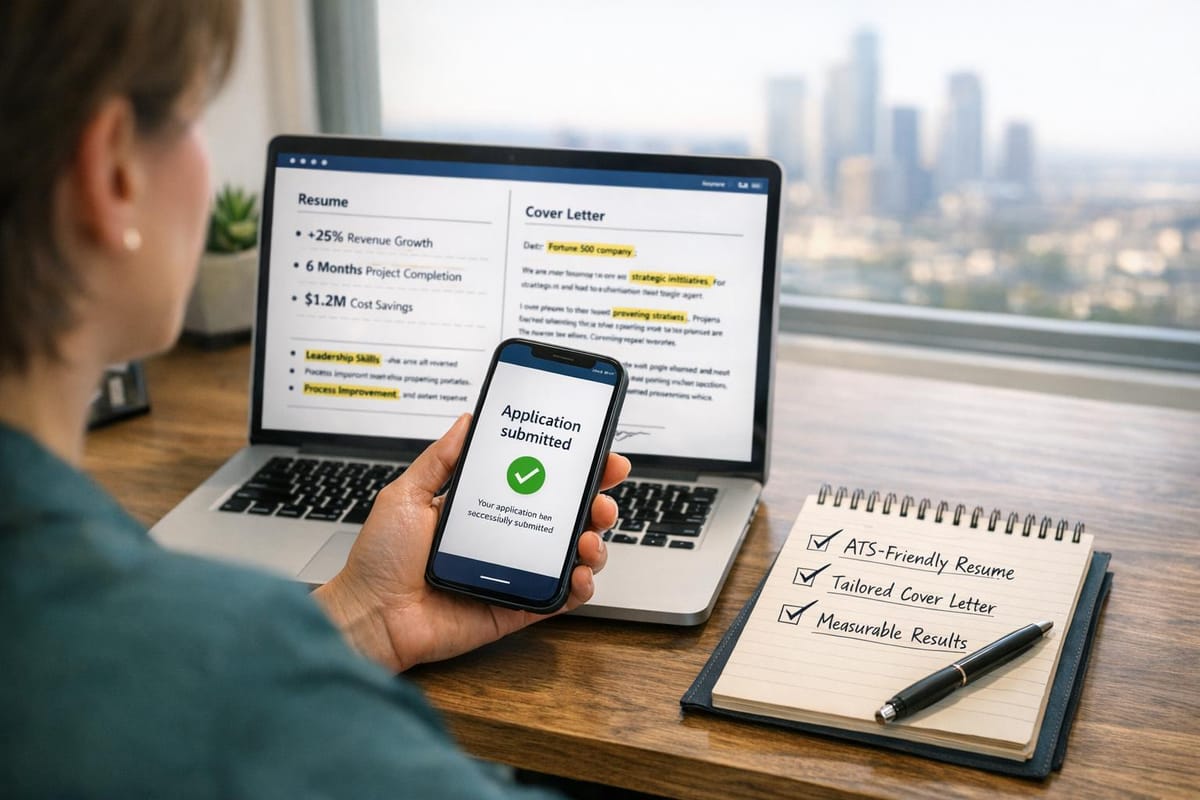
Applying to Fortune 500 companies requires a different strategy than smaller firms. These organizations use advanced applicant tracking systems (ATS) and structured hiring processes to manage high volumes of applications. To stand out in 2026, focus on creating ATS-friendly resumes, tailoring cover letters to specific roles, and showcasing measurable achievements.
Key Takeaways:
- ATS Optimization: Use clean formatting, .docx or text-based PDFs, and match keywords from job descriptions.
- Customized Applications: Tailor resumes and cover letters to each role, emphasizing quantifiable results.
- Avoid Common Mistakes: Spelling errors, generic applications, and poor mobile formatting often lead to rejections.
- Highlight Metrics: Use specific numbers to demonstrate your impact, e.g., "Increased revenue by $125,000 in six months."
- Use Tools Wisely: Platforms like scale.jobs offer personalized, human-assisted application services, ensuring ATS compliance and reducing errors.
Navigating Fortune 500 hiring processes demands precision and preparation. By following these steps, you can improve your chances of landing your next role.
How Fortune 500 Companies Screen Candidates
What Sets Fortune 500 Hiring Apart
Fortune 500 companies handle an overwhelming number of job applications, which has transformed how they evaluate candidates. Unlike smaller businesses, where a hiring manager might personally go through each resume, these large corporations rely on advanced, multi-step screening systems. These systems blend software automation with human judgment to manage the sheer volume of applications efficiently.
Their hiring processes are highly structured, combining cutting-edge technology with skilled recruiters. Applications are assessed against strict, data-focused criteria, requiring candidates to meet both technical qualifications and qualitative benchmarks. A significant part of this system hinges on the use of applicant tracking systems (ATS), which play a crucial role in the early stages of screening.
How ATS Software Filters Your Resume
Applicant tracking systems (ATS) are the gatekeepers of Fortune 500 hiring. These systems analyze resumes for specific qualifications before they even reach a human reviewer. Research shows that 76.4% of recruiters prioritize filtering by skills, followed by education (59.7%) and job titles (55.3%). ATS software scans for exact keywords, certifications, and relevant experience, so the way you format and phrase your resume can make or break your chances.
To avoid ATS errors, stick to a clean, single-column layout with clear section headers like "Work Experience" and "Education." Fancy designs or complex formatting can confuse the system, leading to missed information. Additionally, ATS ranks candidates by keyword relevance. For example, if a job description emphasizes "project management", but your resume uses "led projects" instead, the system might rank your application lower - even if the two phrases mean the same thing. Matching the language of the job posting and aiming for 80-90% keyword alignment can significantly improve your chances.
Why Most Fortune 500 Applications Get Rejected
Even after passing ATS screening, many resumes are rejected during the human review stage. On average, recruiters spend just 2.1 to 7 seconds scanning a resume initially. In the competitive job market of 2025-2026, 89% of resumes are rejected due to avoidable errors. Common mistakes include spelling and grammar issues - cited by 84% of hiring managers as grounds for immediate disqualification - unprofessional email addresses, and resumes that fail to highlight measurable achievements.
Quantifiable achievements are particularly important. A vague statement like "managed social media accounts" doesn’t stand out, but something like "increased Instagram engagement by 340% over six months, driving $125,000 in attributed revenue" leaves a stronger impression. In fact, 79% of hiring managers prefer resumes that clearly demonstrate impact through numbers and results.
Another often-overlooked factor is mobile formatting. With 73% of recruiters reviewing resumes on mobile devices, poorly formatted resumes that don’t display well on smaller screens are frequently ignored. Additionally, generic applications that fail to address the specific role or company are quickly dismissed. For job seekers, deciding whether to customize applications themselves or use services like an AI resume builder or job application service often depends on their time and familiarity with these requirements. Both approaches can help ensure your application meets the rigorous standards of Fortune 500 companies.
How to Build Applications That Pass ATS and Impress Recruiters
Building an ATS-Compliant Resume
The way your resume is formatted can make or break its chances of getting through an Applicant Tracking System (ATS). With 99% of Fortune 500 companies using ATS software and 75% of qualified candidates being rejected due to formatting issues, it's clear that getting this right is crucial. In fact, improving your resume's ATS compatibility can boost your screening success by up to 60%.
To start, always submit your resume as a .docx or text-based PDF. Avoid formats like image-based PDFs, Google Docs links, or JPGs, which ATS software often cannot process. Stick to standard fonts like Arial, Calibri, or Times New Roman, and ensure your margins are between 0.5–1.0 inch. Avoid adding photos, logos, charts, progress bars, or any visual elements such as tables or text boxes - ATS scanners tend to ignore or misread these.
"ATS formatting is not about making your resume look fancy - it's about making sure your qualifications can be accurately read and understood by both systems and humans." - Elite Resumes
Another critical aspect is using the right keywords. Pay close attention to the job description, and use the exact terms listed. For instance, if the job posting mentions "Project Management", don’t rephrase it as "Managing Projects." Incorporate these keywords naturally into your professional summary, work experience, and skills sections. However, avoid overloading your resume with keywords in an unnatural way - this can work against you.
Once your resume is ATS-ready, shift your focus to crafting a cover letter that aligns with the job requirements.
Writing Cover Letters That Match Job Requirements
For roles at Fortune 500 companies, a tailored cover letter is essential. Begin by identifying the key qualifications in the job posting, such as specific skills, certifications, or experience requirements. Use these as a framework for your cover letter, dedicating each paragraph to one or more of these qualifications while providing concrete examples from your background.
For instance, if the job requires SQL expertise, don’t just state that you have the skill. Instead, provide a specific example like:
"I used SQL to create automated reporting dashboards, cutting monthly reporting time from 40 hours to 6 hours and saving the finance team $18,000 annually in labor costs."
Take the time to research the company’s current goals. Look at recent press releases, LinkedIn updates from executives, or financial reports. For example, if a company is expanding into e-commerce, highlight your experience with digital transformation projects that align with their strategy. This level of detail requires effort - around 20–30 minutes per application - but it’s worth it. If time is tight, consider using a job application service or a virtual assistants for job seekers to help streamline the process.
Keep your cover letter concise, limiting it to three or four short paragraphs. Recruiters spend an average of just 6 seconds reviewing resumes, and even less on cover letters. Lead with your most impressive accomplishment in the opening paragraph, then weave in additional qualifications throughout.
Finally, measurable achievements can make your application stand out even more.
Adding Measurable Results and Work Examples
Numbers bring your accomplishments to life. Instead of listing generic responsibilities, quantify your impact to demonstrate your value. For example, rather than saying, "Managed social media accounts", you could write:
"Increased Instagram engagement by 340% in six months, generating $125,000 in attributed revenue."
A helpful structure for presenting achievements is the Context-Action-Result (CAR) format. Here’s how it works:
- Context: Describe the situation or challenge.
- Action: Explain what you did to address it.
- Result: Highlight the measurable outcome.
For example:
"When customer churn reached 23% in Q2 2024 (Context), I redesigned the onboarding email sequence and implemented a 30-day check-in call program (Action), reducing churn to 11% by Q4 2024 and retaining $2.3 million in annual recurring revenue (Result)."
Focus on metrics that resonate with Fortune 500 companies, such as revenue growth, cost savings, efficiency improvements, or customer satisfaction scores. If you increased sales, specify the percentage or dollar amount. If you optimized a process, quantify the time saved or errors reduced. For leadership roles, mention the size of the team or projects you managed.
Even if you don’t have access to exact numbers, provide reasonable estimates with context. For example, "trained approximately 50 new hires across three departments" is far more impactful than "trained many employees." For roles that are harder to quantify, such as administrative positions, focus on scope and frequency. For instance, "coordinated travel logistics for 15 executives across 200+ trips annually, maintaining a 98% on-time booking rate."
The Resume Secrets That Got Me Job Offers At Google & Fortune 500s
scale.jobs vs LazyApply vs Jobscan: Which Tool Actually Works?
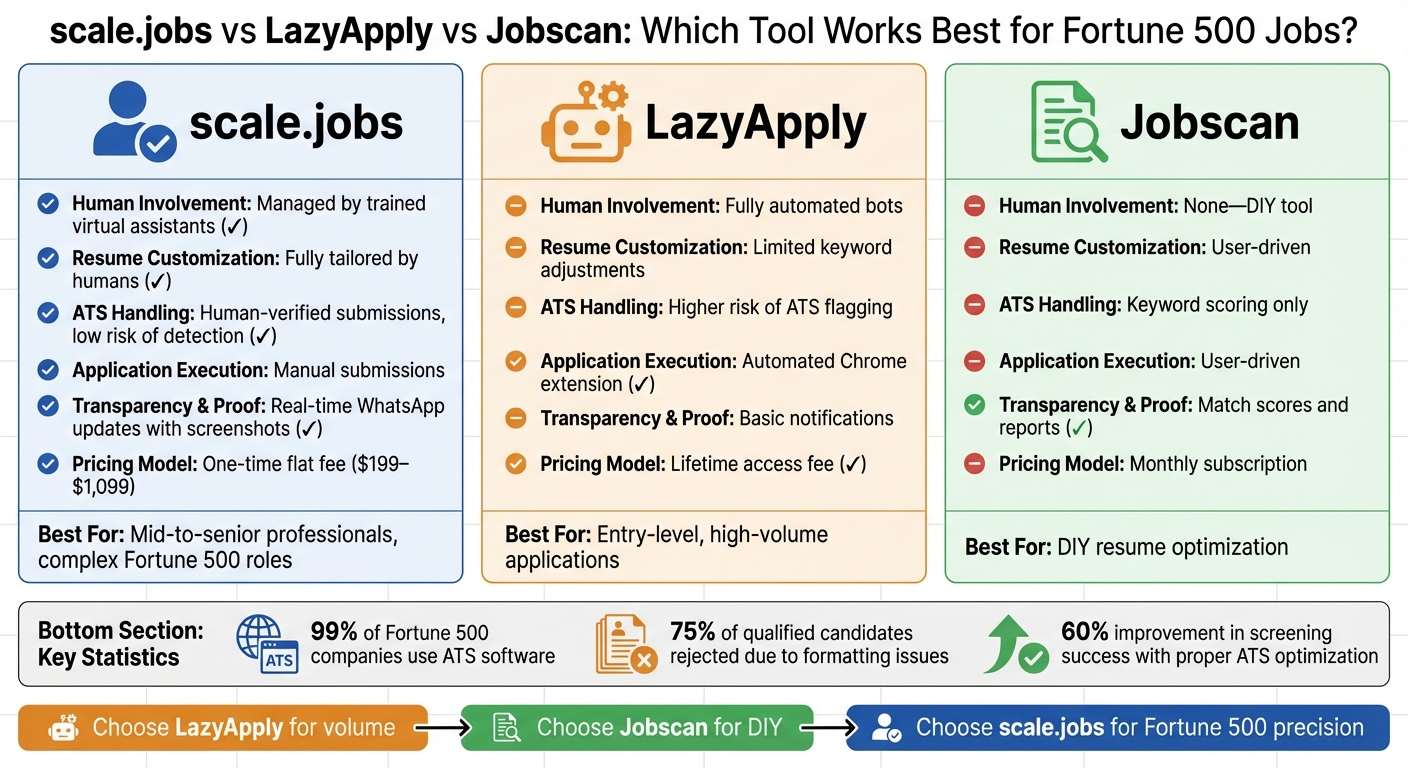
scale.jobs vs LazyApply vs Jobscan Feature Comparison for Fortune 500 Applications
When aiming for roles at Fortune 500 companies, the tool you choose can make or break whether your application gets noticed. LazyApply automates submissions using browser-based tools, Jobscan provides a do-it-yourself approach for resume optimization, and scale.jobs relies on trained human assistants to handle applications manually and with precision.
Why scale.jobs Stands Out Against LazyApply
- Human-assisted submissions avoid triggering ATS flags caused by automation.
- Trained professionals tailor ATS-friendly resumes and cover letters for each role.
- Offers a one-time flat fee with no recurring subscriptions.
- Provides real-time updates via WhatsApp, including time-stamped proof of submissions.
- Applications are manually submitted during business hours to mimic authentic candidate behavior.
Why scale.jobs Excels Over Jobscan
- Goes beyond resume optimization by managing the entire application process.
- Human assistants handle complex screening questions and navigate intricate portals.
- Provides proof of submissions with screenshots, not just keyword match scores.
- Saves hours of manual work after resume adjustments.
- Charges a one-time fee, avoiding monthly subscription costs.
Given the challenges of navigating ATS systems, scale.jobs offers a tailored, human-driven approach that sets it apart from LazyApply and Jobscan.
Feature Comparison: scale.jobs vs LazyApply vs Jobscan
| Feature | scale.jobs | LazyApply | Jobscan |
|---|---|---|---|
| Human Involvement | Managed by trained virtual assistants | Fully automated bots | None - DIY tool |
| Resume Customization | Fully tailored by humans | Limited keyword adjustments | User-driven |
| ATS Handling | Human-verified submissions, low risk of detection | Higher risk of ATS flagging | Keyword scoring only |
| Application Execution | Manual submissions | Automated Chrome extension | User-driven |
| Transparency & Proof | Real-time WhatsApp updates with screenshots | Basic notifications | Match scores and reports |
| Pricing Model | One-time flat fee ($199–$1,099) | Lifetime access fee | Monthly subscription |
Breaking Down the Differences
LazyApply focuses on high-volume applications through browser automation, which can work for smaller companies. However, Fortune 500 ATS systems often detect automation patterns - like identical formatting and clustered timestamps - which may result in flagged or rejected applications.
Jobscan offers excellent tools for resume analysis, helping users align their resumes with job descriptions. While helpful for those who prefer a hands-on approach, it doesn’t handle the time-intensive task of submitting applications, leaving users to manage this manually.
scale.jobs takes a comprehensive approach by assigning human assistants to manage applications end-to-end. These assistants log into portals, read job postings, customize resumes and cover letters, answer screening questions thoughtfully, and submit applications during standard business hours. Users receive real-time updates, including screenshots, ensuring full transparency. With a one-time payment model, scale.jobs eliminates the hassle of recurring fees, and unused credits are refundable.
Why scale.jobs Relies on Human Expertise Over Bots
Fortune 500 companies use sophisticated ATS systems to detect automated submissions. Bots applying to multiple roles in quick succession can trigger red flags due to repetitive timestamps and patterns, leading to rejections or even broader account issues.
Human assistants at scale.jobs ensure applications are submitted in a way that mimics genuine candidate behavior. They carefully interpret job postings, tailor materials, and complete submissions manually, reducing the risk of detection while maximizing alignment with job requirements.
Who Should Use Each Platform
LazyApply is suitable for entry-level positions where speed matters more than customization, and companies have less stringent ATS systems.
Jobscan is ideal for those who want to refine their resumes and understand ATS compatibility but are prepared to handle the actual application process manually.
scale.jobs is the go-to option for professionals targeting mid-to-senior level Fortune 500 roles. It’s particularly valuable for roles with complex requirements or extensive screening questions, allowing users to focus their time on networking and interview preparation.
Who Benefits Most from scale.jobs
- Mid-to-senior professionals applying to competitive roles at Fortune 500 companies.
- Career changers needing tailored applications to align with new industries or functions.
- Busy executives who want to save time while ensuring their applications are professionally managed.
- Job seekers frustrated by automation who have faced ATS flags or low response rates.
- Candidates dealing with complex application portals requiring detailed answers and multi-step processes.
For those who need additional support, such as resume writing services and real-life examples, scale.jobs offers a transparent and dedicated approach to managing the entire application process.
Decision Summary
- LazyApply: Best for high-volume, entry-level applications where automation is sufficient, and ATS systems are less strict.
- Jobscan: Ideal for users who want to optimize their resumes and handle submissions manually.
- scale.jobs: Perfect for applicants targeting competitive mid-to-senior roles, requiring personalized applications and full transparency.
When to Switch to scale.jobs
- If your current tool hasn’t yielded responses after 50+ applications.
- If you’ve experienced issues with flagged applications due to automation.
- If manual applications are consuming too much of your time.
- If you encounter portals that don’t support browser extensions.
- If you want verifiable proof that your applications are submitted correctly, with customized materials.
Step-by-Step: Applying to Fortune 500 Jobs
Research Companies and Customize Each Application
Start by identifying top-performing companies in your industry using Fortune 1000 groupings. In 2024, 51% of Fortune 500 companies expanded their workforce, while 40% reduced headcount, making it essential to focus on employers actively hiring rather than downsizing [1].
Dive into 10-K filings and annual reports to evaluate financial health and hiring trends. Although Fortune 500 companies collectively generated $18.8 trillion in revenue and $1.7 trillion in profits in 2024, many also faced workforce reductions [1]. Target companies with consistent growth and solid financial performance to improve your chances.
Once you've pinpointed your target companies, carefully analyze job descriptions. Tailor your resume and cover letter by mirroring key terms, such as replacing "client relations" with "stakeholder management" if that’s the language used. Highlight measurable achievements that address the specific challenges mentioned in the job listing. For instance, if the role emphasizes process improvement, include quantifiable examples of how you streamlined operations in a previous position.
With your research complete and materials customized, you can use advanced tools to enhance your application process.
Use Tools to Speed Up ATS Optimization
Customizing applications for multiple roles can be overwhelming, but tools like scale.jobs' AI resume builder simplify the process. This tool creates ATS-friendly resumes tailored to specific job postings, while human assistants manage the submission process, including portal logins, answering screening questions, and uploading documents. Unlike fully automated systems, scale.jobs combines AI precision with human oversight, reducing the risk of ATS rejection.
Additionally, human assistants provide time-stamped screenshots of completed applications, so you know exactly when and how your materials were submitted. If you need further refinement, resume writing services can help you craft polished, job-specific resumes and cover letters before submissions.
Track Applications and Follow Up
After submitting your applications, tracking and follow-ups are key to staying organized and increasing your chances of landing interviews. Use a centralized tracker to monitor important details like company name, role, date applied (MM/DD/YYYY), salary, location, visa requirements, application source, and current status (e.g., Applied, Interview, Offer). For international candidates, include columns for work authorizations like H1B or F1 CPT to filter out non-sponsoring employers.
Review your progress weekly by analyzing metrics such as response rates, time-to-response trends, and interview conversion rates. Submitting more than 50 applications without an interview could signal the need to revise your resume or keyword strategy.
Send personalized follow-up messages 1–2 weeks after applying and 3–5 days after an interview. Avoid generic templates - address hiring managers directly for better engagement. Real-time WhatsApp notifications from scale.jobs ensure you can quickly respond to recruiter inquiries or interview invitations, helping you stay on top of opportunities.
Conclusion
Landing a role with a Fortune 500 company demands precision and a tailored approach. With 98% of these companies relying on ATS systems to filter resumes before they reach human eyes, your application must not only pass these filters but also clearly present your skills and value. By focusing on ATS-friendly formats, personalized cover letters, and quantifiable achievements, you position yourself to meet the high standards these companies expect. The strategies we’ve discussed - ATS-compliant formatting, tailored cover letters, measurable accomplishments, proof-of-work examples, targeted research, and strategic follow-ups - shift your efforts from a broad, unfocused approach to a deliberate campaign targeting 12–20 companies where you can make a real impact.
Interestingly, while application volumes have doubled, two-thirds of recruiters report challenges in finding qualified candidates. This indicates that most applications fail to effectively communicate readiness. With 72% of employers now prioritizing skills over traditional credentials, it’s more important than ever to craft applications that strike the right balance between ATS optimization and human appeal. Automated tools often fall short, flagging generic submissions, whereas personalized applications created with human insight have a much better chance of standing out.
This is where a service like scale.jobs becomes invaluable. Unlike fully automated solutions, scale.jobs combines ATS-optimized resumes with manual, human-assisted submissions. Their process includes real-time WhatsApp updates, proof-of-work screenshots, and manual handling of screening questions - all for a one-time flat fee. If your materials need a refresh before submission, their resume writing services can help align your documents with Fortune 500 expectations.
With these strategies in hand, the next step is straightforward: Sign up with scale.jobs, specify your target Fortune 500 roles, and let their human assistants manage the process - customizing resumes, navigating application portals, and tracking your progress with transparency. Free up your time for networking and interview preparation - critical steps that turn applications into job offers. In a hiring landscape where nearly 60% of recruiters use AI to uncover overlooked talent, human precision ensures you rise above the competition.
FAQs
How can I tell if my resume is actually ATS-readable?
To ensure your resume is compatible with applicant tracking systems (ATS), you can use tools like Jobscan or Rezi. These platforms analyze key aspects such as keyword usage, formatting, and overall section structure. By testing your resume with these tools, you can refine it to improve your chances of making it past ATS filters and getting noticed by hiring managers.
What’s the fastest way to tailor keywords without rewriting my whole resume?
The fastest way to adjust keywords on your resume without starting from scratch is by using AI-driven tools. These tools can analyze job descriptions and seamlessly add relevant keywords to your current resume. For instance, platforms like Scale.jobs use a combination of AI and human expertise to fine-tune resumes, making them ATS-compatible and tailored to specific roles - all within just 24 hours. This approach saves time and effort while keeping your resume aligned with job requirements.
How do I quantify impact when I don’t have access to exact numbers?
When precise numbers aren't accessible, focus on showcasing achievements through qualitative insights, backed by trends or estimates. For instance, you could highlight outcomes like improved response rates, a noticeable rise in callbacks, or a boost in interview opportunities. Drawing from similar cases can also be helpful; for example, personalized job applications have been shown to increase callback rates by up to 47%. Using such data points effectively illustrates the potential impact of your efforts.