
Why Resume Templates Look Good but Perform Poorly in ATS Systems
Visually striking resume templates often fail ATS parsing. Use single-column layouts, standard headers, and DOCX to preserve skills and work history.


In the race to land a job, an eye-catching resume might seem like the key to standing out. However, most visually appealing resume templates fail to perform well in Applicant Tracking Systems (ATS) - software used by employers to screen candidates. Resumes with columns, graphics, or unconventional layouts often confuse these systems, leading to critical information being misread or skipped entirely.
Key takeaways:
- ATS scans resumes for structured data like skills, experience, and contact info.
- Templates with columns, tables, or graphics can result in parsing errors.
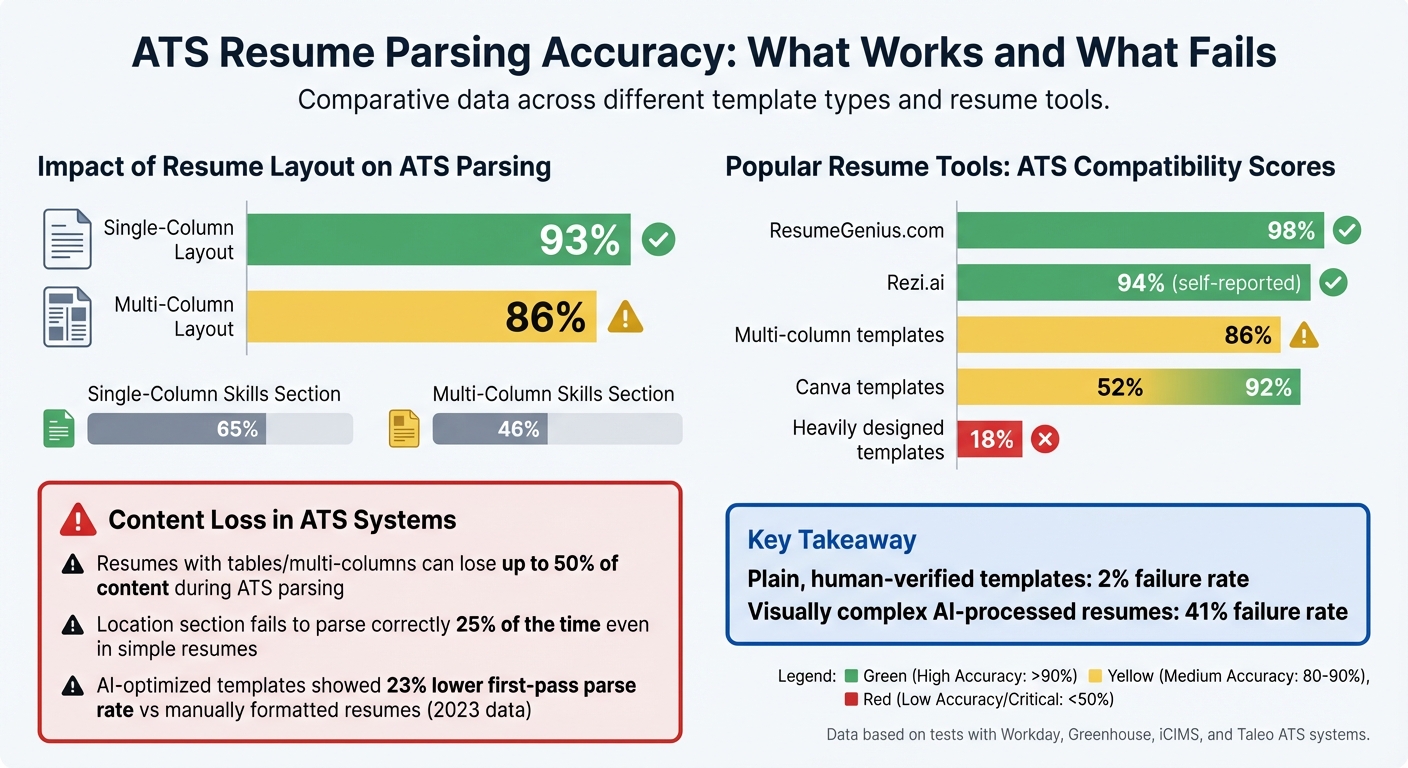
- Single-column layouts with standard headers achieve higher ATS compatibility (up to 93% accuracy).
- Tools like Canva and some Word templates often score poorly in ATS tests, with parsing accuracy as low as 36%.
If you're struggling to get interview callbacks, your resume's design and formatting might be the issue. Below, we’ll explore how ATS works, common resume pitfalls, and solutions like professional resume services to improve your chances.
ATS Resume Parsing Accuracy: Template Types and Tools Comparison
Common Resume Template Problems
Formatting Mistakes That Break ATS Parsing
A frequent issue job seekers face is selecting templates with multi-column layouts. Research indicates that single-column resumes achieve about 93% parsing accuracy, while multi-column designs drop to 86%. This decline also affects the accuracy of the Skills section, which falls from 65% to 46%. These layouts often confuse Applicant Tracking Systems (ATS) by forcing them to read content out of order, leading to scrambled work history or missing sections.
Another common pitfall is the use of tables and text boxes. For example, if contact details are placed in headers or tables are used to format job information, the ATS might skip over this content entirely. Similarly, graphics, icons, and images can disrupt the scanning process, causing errors. Even seemingly simple design elements like skill bars or star ratings can result in misinterpretation of nearby text. Tests show that resumes with heavy visual elements are much less ATS-friendly than plain-text designs.
Astley Cervania, Career Writer and Editor at Rezi, highlights, "Many modern resume scanners don't work as reliably as they should... critical sections like work history, education, or even contact details can vanish when parsed."
Additionally, non-standard section headers can confuse ATS software. For instance, using creative labels like "My Journey" instead of "Work Experience" or "What I Bring" instead of "Skills" may result in the system miscategorizing or ignoring these sections. Similarly, unconventional date formats - such as using em dashes ( - ) instead of hyphens (-) or writing "January 2024" instead of "01/2024" - can disrupt how employment history is processed. To avoid these technical pitfalls, consider using a professional resume writing service to create an ATS-friendly document that also appeals to human recruiters.
ATS Problems in Jobscan.co, Rezi.ai, and ResumeGenius.com
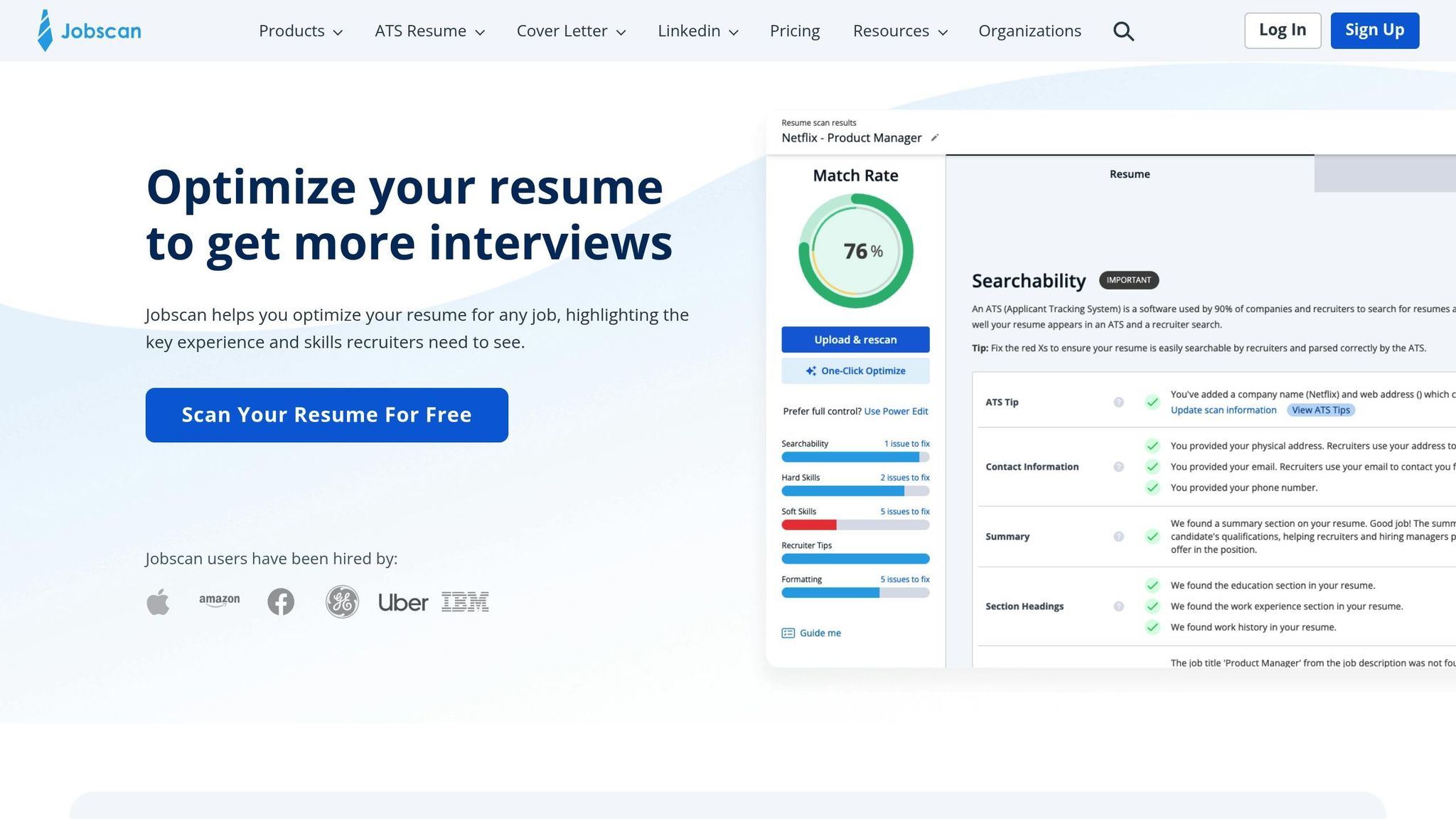
These formatting challenges can also affect the performance of popular resume tools.
Jobscan.co focuses on analyzing resumes rather than building templates. While it identifies issues like missing keywords or formatting errors, it doesn't fix them. This means users often pair Jobscan with templates from other sources, which may include problematic layouts like tables or multi-columns. Unfortunately, these structural flaws can cause resumes to lose up to 50% of their content during ATS parsing, as seen in tests with tools like Workday. Platforms like scale.jobs address this issue by providing resumes that are reviewed by humans to ensure structural and ATS compatibility from the start.
Rezi.ai promotes itself as ATS-friendly, claiming a score of 94 out of 100 in its own tests. However, actual results depend on the specific ATS used by employers. While Rezi uses AI to generate content, some templates may appear too generic to human recruiters. Moreover, older ATS systems may still struggle with data loss when parsing these resumes. scale.jobs bridges this gap by combining ATS optimization with human expertise to tailor resumes for both machine and human readability.
Luc Lemerez, Lead Developer, notes: "PDFs, the universal resume format, were built for printing, not structured data, and ATS stumble without it."
ResumeGenius.com performs well in controlled tests, achieving about 98% parsing accuracy, making it one of the more reliable tools. However, it comes with a subscription fee of around $29 per month. Users have reported that even its "ATS-optimized" templates can fail when exported as PDFs containing embedded graphics or complex formatting. Additionally, its adaptive formatting may add visual elements that confuse older ATS systems like iCIMS or Taleo. Platforms like scale.jobs offer a more affordable, one-time payment option with human oversight to ensure compatibility across all ATS platforms.
Canva templates, while visually appealing, consistently rank lowest in ATS compatibility. Parsing accuracy for these templates ranges between 52% and 92%, with many failing to have their Skills section recognized. In one test, a heavily designed template from a similar visual-first platform scored just 18% parsing accuracy when processed through systems like Workday, emphasizing that these tools prioritize aesthetics over machine readability.
scale.jobs vs Competitors: ATS-Optimized Resumes with Human Review
Jobscan.co vs scale.jobs: Why Human Review Matters More Than Automated Scanning
Jobscan.co evaluates resumes by comparing them to job descriptions, assigning a match score based on keyword alignment. However, it stops short of resolving the deeper issues in your resume. Users are left to manually implement changes, often relying on templates that may not be ATS-friendly, unlike a high-quality AI resume builder designed for modern standards. In fact, in 2023, resumes optimized by third-party AI tools showed a 23% lower first-pass parse rate compared to manually formatted resumes.
scale.jobs, on the other hand, takes a hands-on approach. Instead of just providing a score, their human assistants create resumes from scratch, adhering to single-column formats and standardized section headers that ATS systems can easily process. Beyond resume optimization, scale.jobs manages the entire application process, submitting your resume to 30 jobs daily and providing daily WhatsApp updates with time-stamped screenshots for full transparency.
| Feature | Jobscan.co | scale.jobs |
|---|---|---|
| Primary Function | DIY ATS keyword matching & scoring | Human-led resume optimization & job applications |
| Process | Automated algorithm comparison | Human assistants review and customize content |
| Execution | User must manually apply to jobs | Service applies to 30 jobs/day on user's behalf |
| Proof of Work | Score report only | Daily updates and transparent application tracking |
| Pricing Model | Monthly subscription | One-time payment per campaign |
This comparison underscores why scale.jobs stands out with its human-driven approach and transparent job application process. Next, let’s see how Rezi.ai compares.
Rezi.ai vs scale.jobs: Human Expertise vs AI Templates
Rezi.ai, like Jobscan.co, relies heavily on automation. It generates resume content using AI and boasts an ATS score of 94 out of 100 in its own evaluations. However, AI-generated resumes often include hidden formatting issues, such as non-standard characters, which can disrupt ATS parsing. These errors are challenging to detect and can lower your chances of success.
scale.jobs avoids such pitfalls entirely by employing human assistants to manually format resumes, ensuring compliance with ATS standards. This eliminates risks associated with hidden characters or unconventional headers. Additionally, scale.jobs takes care of the entire job application process, submitting your resume to 30 jobs per day, so you don’t have to.
| Feature | Rezi.ai | scale.jobs |
|---|---|---|
| Resume Creation | AI-generated based on templates | Human-crafted for specific job targets |
| ATS Strategy | Proprietary "ATS-friendly" AI templates | Manual adherence to parsing standards (no AI artifacts) |
| Support | Self-service AI builder | Human assistants with direct WhatsApp communication |
| Application Handling | User applies manually | Human-assisted daily applications (30/day) |
| Pricing Model | Monthly subscription | One-time payment with unused-credit refunds |
By combining human expertise with ATS optimization and full application management, scale.jobs offers a comprehensive solution that AI-based tools like Rezi.ai simply can’t match.
ResumeGenius.com vs scale.jobs: Custom Resumes Outperform Pre-Made Templates
ResumeGenius.com provides pre-made templates that achieve around 98% parsing accuracy in controlled tests, making it a strong contender among template providers. However, these templates come with limitations. Priced at $29 per month, they often include embedded graphics or multi-column layouts that may fail on older ATS systems like iCIMS or Taleo.
scale.jobs eliminates these risks by creating custom, single-column resumes tailored to each client. This ensures that contact information isn’t hidden in headers and that section labels follow ATS-friendly terminology. Moreover, scale.jobs provides proof of work by sharing daily screenshots of job applications, showing exactly when and where your resume was submitted - a level of accountability that DIY template tools can’t offer.
| Feature | ResumeGenius.com | scale.jobs |
|---|---|---|
| Template Style | Visual, often multi-column templates | Clean, single-column, ATS-optimized layouts |
| Customization | User-edited pre-made templates | Personalized resumes built by human experts |
| Parsing Risk | High risk of formatting breaks in ATS | Low risk; built specifically for machine readability |
| Service Scope | Document creation only | Full-cycle: Resume, Cover Letter, and Applications |
| Pricing Model | $29/month subscription | One-time payment ($199–$1,099 based on volume) |
These comparisons highlight how scale.jobs delivers a more reliable and personalized service, combining human expertise, ATS optimization, and full application management to address the shortcomings of both AI-generated and template-based solutions. By focusing on transparency and precision, scale.jobs ensures resumes are not only ATS-compliant but also appealing to hiring managers.
Who Should Use Each Tool?
Who Should Use Jobscan.co, Rezi.ai, and ResumeGenius.com?
For job seekers who are mindful of costs and have the time to manage their applications manually, tools like Jobscan.co, Rezi.ai, and ResumeGenius.com can be helpful. These platforms are best suited for those applying to 5–10 jobs weekly without a pressing need for immediate results. They provide feedback to improve keyword alignment but require users to handle resume optimization, application submissions, and any formatting challenges on their own.
- Jobscan.co is ideal for candidates seeking a quick keyword audit. It provides match scores to guide alignment but doesn’t guarantee results.
- Rezi.ai works well for users comfortable with AI-generated content and templates designed for better parsing. However, studies suggest automated templates may only retain about 50% of resume data in systems like Workday.
- ResumeGenius.com is a good fit for those who prefer template-based resumes and need a fast, do-it-yourself solution. This approach is often a cost-effective choice for early-career professionals or those exploring various career options without urgency.
Why scale.jobs is a better alternative:
- Human expertise ensures ATS compatibility: Avoids formatting errors that AI tools might introduce.
- Comprehensive application management: Handles resume creation, customization, and submissions for 30+ jobs daily.
- No subscriptions: Offers a one-time payment structure with refunds for unused credits.
- Real-time proof of work: Daily WhatsApp updates with screenshots showing submission details.
- Faster turnaround: Custom resumes delivered within 24 hours, streamlining the process.
These differences are crucial because even a small formatting issue can disrupt an ATS scan. scale.jobs overcomes these challenges with its fully managed service, providing a reliable alternative to DIY tools.
Who Should Choose scale.jobs?
scale.jobs caters to professionals who need to avoid the setbacks of ATS rejections, such as those facing financial strain after layoffs, career changers entering new industries, or immigrants working within tight visa timelines.
Why scale.jobs stands out:
- Saves over 20 hours weekly: Eliminates the time spent on formatting and filling out application forms.
- Fast resume turnaround: Delivers professionally written, ATS-optimized resumes within 24 hours.
- Daily updates for accountability: Time-stamped WhatsApp screenshots ensure transparency.
- Handles 30+ applications daily: Achieves a scale that manual efforts can’t match.
- Human oversight ensures compatibility: Works across corporate ATS systems and niche job boards, reducing the risk of errors flagged by bots.
With pricing ranging from $199 to $1,099 depending on the number of applications, scale.jobs avoids subscription fees while maximizing your chances of landing interviews.
Switch to scale.jobs if...
- You need to apply to more than 30 jobs daily: DIY tools can’t handle this volume without compromising quality.
- Your resume struggles with ATS scans: Human experts catch issues that automated tools might miss.
- You’re under time constraints: Whether due to layoffs, visa deadlines, or career gaps, there’s no time for trial-and-error.
- You want proof of work: Transparent updates provide evidence of proper application submissions.
- Your time is worth more than $10/hour: Reclaiming 20+ hours weekly makes the one-time cost worthwhile.
Switch to scale.jobs If...
Your Current Templates Get Rejected by ATS
Even if your resume performs well on automated scanners, it might still fail to land you interviews due to parsing errors that many DIY tools overlook. Research highlights that even simple single-column resumes fail to parse the "Location" section correctly 25% of the time. For resumes with double-column layouts, the skills section parsing success drops to just 46%. ATS systems often misinterpret or scramble data when handling multi-column designs, text boxes, or unconventional headers. These issues may not be flagged by automated tools but can prevent your resume from even being considered by recruiters.
Take Sarah, a cybersecurity analyst, as an example. In 2023, she applied to 84 positions over 10 weeks using a popular AI resume tool. Unfortunately, this tool embedded her work history as a PNG-in-Word file and used headers like "Career Narrative." The result? Zero interviews. After switching to a single-column, manually formatted resume with standard headings, Sarah secured 7 interviews in just 12 days. Her recruiter later confirmed the original resume was marked "unparseable" by the ATS.
scale.jobs solves these issues with human-verified formatting. Every resume undergoes a manual review to ensure crucial details - employment dates, contact info, and skills - parse correctly in systems like Workday and Greenhouse. This meticulous approach reduces the failure rate to just 2% for plain, human-verified templates, compared to a 41% failure rate for visually complex resumes processed by AI tools. These parsing problems directly affect your chances of landing interviews, especially when relying on DIY solutions.
DIY Tools Aren't Getting You Interviews
Automated tools may provide match scores, but recruiters don't hire based on scores - they hire based on resumes that show measurable achievements. Many resumes fall short because they either overuse keywords or fail to include impactful, results-driven bullet points that demonstrate value, such as revenue growth or time savings.
scale.jobs takes a tailored approach, creating resumes that go beyond generic keyword optimization. Trained virtual assistants craft job-specific resumes within 24 hours, ensuring each bullet point highlights tangible outcomes that align with the job description. This method ensures resumes not only pass ATS checks but also resonate with human reviewers. With the ability to manage 30+ applications daily per client, scale.jobs achieves a balance of volume and quality that is difficult to replicate manually.
A quick test: paste your resume into a plain-text editor. If sections are jumbled or missing, it’s likely to fail ATS parsing. Services like resume writing services offered by scale.jobs restructure resumes to ensure data remains intact across all systems.
You Need Proof of Work and Transparency
One of the biggest frustrations with automated tools is the lack of transparency in the submission process. Without clear confirmation, you may never know if your resume actually reached the employer. This can waste both time and money, especially when applications fail due to errors in submission portals or incomplete uploads.
scale.jobs addresses this issue by providing real-time WhatsApp updates with time-stamped screenshots. These updates show which jobs were applied to, when, and with which documents. This level of transparency ensures you’re always informed, solving one of the key problems with automated application platforms: the inability to track and improve the process. Plus, their flat-fee pricing model ($199–$1,099 based on application volume) includes refunds for unused credits, avoiding the hassle of recurring subscriptions common with DIY tools.
If you're targeting mid-to-large U.S. employers where ATS systems act as critical recruiter databases, data accuracy is far more important than having a visually striking resume. A creative design that fails to populate correctly in a recruiter’s database essentially renders your application invisible. scale.jobs ensures your profile is complete and accessible by maintaining two versions when necessary - one optimized for ATS parsing and another styled for direct networking opportunities.
Your Resume Is Getting REJECTED by ATS (Here’s How to FIX IT) + FREE TEMPLATE INSIDE!
Decision Summary: Choosing Between Visual Appeal and ATS Performance
When deciding between a visually appealing resume and one optimized for ATS (Applicant Tracking Systems), the trade-off is clear. Visually intricate resumes often score between 52% and 92% on ATS systems, while straightforward, single-column layouts reviewed by humans consistently achieve parsing accuracy of 95% or higher. Tools like Jobscan.co and Rezi.ai provide automated scoring and AI-driven optimizations, but they require users to manually tweak formatting - a process that isn’t always straightforward. On the other hand, platforms like ResumeGenius.com offer attractive templates, though independent testing reveals that many "ATS-friendly" claims are unreliable. Some highly designed templates score as low as 18% in real-world ATS performance tests.
scale.jobs stands out by offering:
- Human-assisted resume formatting to eliminate errors
- ATS-optimized, single-column layouts
- Transparent proof-of-work via WhatsApp with time-stamped screenshots
- One-time flat-fee pricing
- Custom resumes delivered within 24 hours
This meticulous, human-driven process ensures better ATS parsing, highlighting scale.jobs's commitment to quality.
Why scale.jobs Excels in ATS Optimization
Unlike visually complex resumes that rely solely on automated tools, scale.jobs pairs human expertise with ATS-specific formatting. Every resume is manually reviewed to ensure critical details like contact information, dates, and skills are accurately parsed by systems such as Workday, Greenhouse, and Lever. This hands-on approach significantly reduces parsing errors. Additionally, scale.jobs assistants can manage up to 30 applications per day, completing forms manually to avoid triggering bot detection systems.
Comparing Pricing Models
The pricing structure also sets scale.jobs apart. DIY tools like Jobscan.co and Rezi.ai charge $19–$29 per month for limited self-service features, requiring users to handle formatting and submission themselves. In contrast, scale.jobs offers flat-fee campaigns starting at $199 for up to 250 applications. These campaigns include custom resumes, tailored cover letters, and real-time updates via WhatsApp, complete with time-stamped screenshots for transparency.
Choosing the Right Service for Your Needs
Ultimately, the choice depends on your priorities. If you value a visually striking resume for networking or direct outreach, ResumeGenius.com may meet your needs. Jobscan.co and Rezi.ai are better suited for those who prefer manual control and instant feedback on keyword optimization. However, if you're targeting mid-to-large U.S. employers where ATS systems play a critical role in screening candidates, data accuracy and parsing reliability are far more important than aesthetic design. In such cases, scale.jobs offers a superior solution by ensuring error-free, ATS-compliant submissions.
As Luc Lemerez, Lead Developer at Rezi, explains: "PDFs, the universal resume format, were built for printing, not structured data, and ATS stumble without it."
scale.jobs addresses this issue by creating separate resume versions when necessary and managing the entire application process. This allows you to focus on resume writing services that genuinely increase your chances of landing interviews. By combining human expertise with ATS-compliant formatting, scale.jobs ensures every application not only meets parsing requirements but also appeals to recruiters reviewing your information.
FAQs
How can I tell if my resume will parse correctly in an ATS?
To ensure your resume is ATS-friendly, consider using ATS resume scanners or conducting compatibility tests. These tools help pinpoint formatting problems and missing keywords. Stick to a straightforward, single-column format, and choose standard fonts like Arial or Calibri. Avoid using graphics, multi-column layouts, or headers and footers, as these can confuse the system. Additionally, manually check your resume for consistent formatting and relevant keywords. Before submitting, run it through an ATS tool to confirm it meets compatibility standards.
Should I submit my resume as a PDF or Word file?
When it comes to submitting your resume, using a Word file (DOCX) is often the safer choice for compatibility with Applicant Tracking Systems (ATS). Most ATS software is designed to read and process DOCX files more accurately. While PDFs may look polished, they can occasionally create parsing problems if they aren't formatted correctly. To improve your chances, make sure your resume is structured to meet ATS-friendly standards, no matter which file type you choose.
What formatting elements are most likely to break ATS parsing?
Formatting elements that can interfere with ATS parsing include multi-column layouts, graphics, text boxes, headers and footers, decorative elements, and complex table structures. These design features often confuse ATS software, which may result in critical details being missed or improperly processed.