
Why Most Job Applications Fail and How to Fix Yours
Why most job applications get rejected — from ATS parsing and generic resumes to missing keywords — plus practical fixes: ATS-friendly formatting, tailored keywords, and better cover letters.


Most job applications fail due to avoidable mistakes like generic resumes, poor formatting, or missing keywords. With 75% of resumes filtered out by Applicant Tracking Systems (ATS) and recruiters spending just 7 seconds per review, it's critical to tailor your application for each role. Common issues include:
- Generic resumes and cover letters: Tailored applications are three times more likely to secure interviews.
- ATS-unfriendly formatting: Overly creative designs or improper layouts can render your resume unreadable.
- Keyword mismatches: 62% of resumes are rejected for not aligning with job descriptions.
- Skipping cover letters: A strong cover letter can set you apart.
- Complex application processes: Tedious forms often deter even qualified candidates.
Solutions
- Use a clean, ATS-friendly resume format with standard fonts and clear headings.
- Customize your resume and cover letter for each job using keywords from the job description.
- Highlight measurable achievements instead of generic duties.
- Seek feedback or use tools like AI resume builders or job application services for improvement.
- Consider platforms like Scale.jobs, which offers human-managed application assistance, ensuring ATS compliance and tailored submissions.
Don't let small mistakes hold you back. By addressing these issues, you can significantly improve your chances of landing interviews for both full-time jobs and part-time jobs near you.
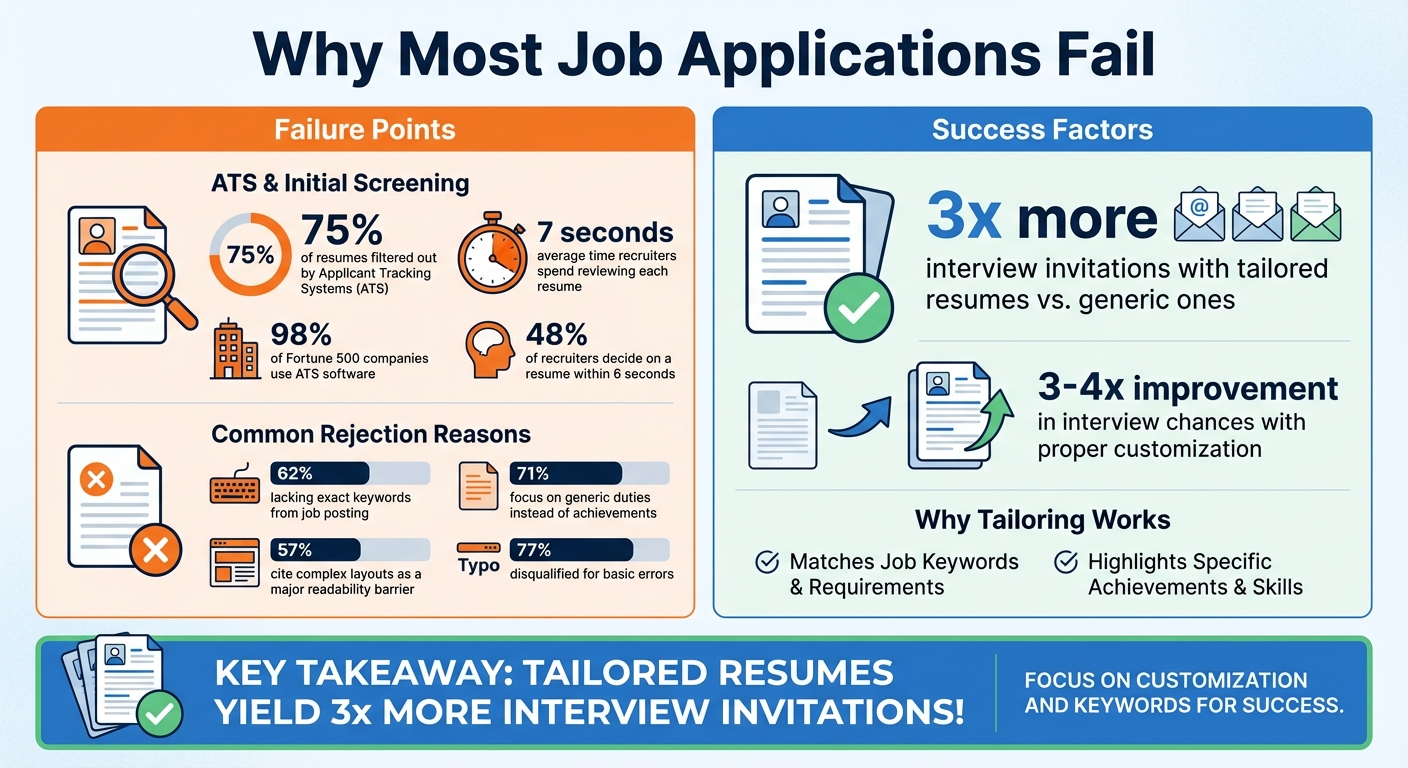
Why Job Applications Fail: Key Statistics and Success Rates
The #1 Mistake KILLING Your Job Search | How To Fix It FAST!
If you're struggling to keep up with the volume of applications, consider using job search automation to streamline your efforts.
Why Most Job Applications Get Rejected
Understanding why job applications often fail can help you avoid common pitfalls. Many rejections stem from avoidable mistakes, and addressing these issues can significantly improve your chances. Below are five frequent errors that can cost applicants valuable opportunities.
1. Using the Same Resume and Cover Letter for Every Job
A one-size-fits-all resume rarely works. 71% of resumes fail because they focus on generic job duties instead of highlighting specific achievements that align with the role. Employers want to see how your experience connects directly to their needs.
The data is clear: tailored resumes lead to three times more interview invitations compared to generic ones. Applicant Tracking Systems (ATS) play a big role here. These systems prioritize keyword matches from the job description. For instance, if the job posting mentions "project management" and your resume says "managed projects", the ATS might not recognize it as a match. This mismatch often means your application won't even reach a recruiter, no matter how qualified you are.
Beyond content, the way your resume is formatted can also make or break your chances.
2. Resumes That Applicant Tracking Systems Can't Read
Formatting mistakes are a surprisingly common reason for rejection. 98% of Fortune 500 companies rely on ATS software, and overly creative designs - like using tables, columns, or graphics - can render your resume unreadable.
"ATS systems are ruthlessly utilitarian. If they can't read it, it doesn't exist." - Stephen Greet, Co-founder, BeamJobs
Common technical issues include ATS systems ignoring headers and footers, which can make your contact information disappear. Similarly, image-based PDFs can't be processed at all. 57% of hiring managers cite complex layouts as a major barrier to readability. Even unconventional section titles like "My Journey" instead of "Experience" can confuse the software, preventing it from organizing your information properly.
The next hurdle comes from how closely your application aligns with the job description.
3. Failing to Match Your Application to the Job Description
62% of resumes are rejected because they lack the exact keywords from the job posting. ATS software doesn't interpret or guess - it looks for precise matches. For example, if the job posting lists "client relations" but your resume says "customer service", the system might not recognize your experience as relevant.
This issue extends beyond keywords. Employers want to see that you understand their specific needs. If a job emphasizes "strategic planning" and your resume highlights "goal setting", you might lose out, even if the skills overlap. ATS algorithms typically surface only the top 20-30% of applications, so failing to match the language in the job description can keep you from advancing to the next stage.
And while resumes are critical, cover letters also play a key role in making a strong impression.
4. Weak or Missing Cover Letters
Skipping the cover letter or submitting a generic one can hurt your chances. With 48% of recruiters deciding on a resume within six seconds, a well-written cover letter can make you stand out. Unfortunately, many applicants either forgo the cover letter entirely or submit one that lacks effort, which contributes to 77% of candidates being disqualified for basic errors.
Lastly, the application process itself can discourage even the most qualified candidates.
5. Giving Up on Long Application Forms
Overly complex application systems drive many candidates to quit before finishing. When companies ask you to re-enter information already on your resume or complete lengthy questionnaires, the process can feel unnecessarily tedious.
This creates an unintended problem: the candidates who persist through these forms aren’t always the most qualified - they’re just the most determined. If you’re struggling with these time-consuming processes, tools like professional resume writing services can help. Delegating the application work allows you to focus your energy on interview preparation instead of battling with clunky forms.
How to Fix Your Job Applications
Tired of sending out applications without hearing back? These straightforward adjustments can make a big difference. With just a little effort, you can improve your chances of landing interviews.
1. Format Your Resume for ATS Software
Applicant Tracking Systems (ATS) can be picky about formatting. To avoid getting filtered out, stick to a clean, single-column layout with standard fonts like Arial, Calibri, or Times New Roman (10–12pt). Skip the fancy graphics, icons, or tables - they often confuse the system. Use clear section headers like "Work Experience", "Education", and "Skills" to help the software sort through your details.
Incorporate keywords directly from the job description, but make sure they fit naturally. For instance, if the job mentions "client relations", use that phrase instead of a synonym like "customer service." Additionally, if your job title is unique to your company (e.g., "Customer Happiness Hero"), replace it with a more recognizable industry title like "Customer Success Specialist" to ensure it aligns with recruiter searches.
Always save your resume as a PDF. This keeps your formatting intact and ensures your text remains searchable.
2. Customize Each Application for the Specific Job
Tailoring your application doesn’t mean starting from scratch every time. Focus your efforts on the most visible and impactful sections: your professional summary, skills, and the top 2–3 bullet points of your most recent roles. This 80/20 approach helps you make a big impact with minimal effort.
For instance, tweak your summary to match the job's key requirements and reframe your achievements with measurable results. Instead of saying, "Managed customer accounts", try, "Developed microservices using Python, cutting API response time by 35%."
Before hitting submit, perform a quick 7-second glance test. Can someone immediately identify your role, top skills, and key achievements within the first few lines? If not, refine it further.
3. Get Feedback on Your Resume and Cover Letter
It’s easy to overlook issues in your own work, so getting an outside perspective can be invaluable. Free tools like Resumly can scan your resume for ATS compatibility, flagging missing keywords or formatting issues. That said, automated tools can only go so far - they won’t tell you if your achievements are compelling or if your cover letter aligns with the job’s needs.
Professional resume writing services, like Scale.jobs, take it a step further. They can refine both your content and formatting to ensure your documents not only pass ATS scans but also stand out to human recruiters. These services can help you shift from listing tasks to highlighting accomplishments, making your application more impactful.
4. Save Time with Application Assistance
Customizing applications and filling out lengthy forms can be a huge time drain. That’s where application assistance services come in. These services handle the repetitive tasks - like tailoring your resume, completing forms, and even matching your documents to job descriptions - so you can focus on more strategic activities like networking and interview prep.
Some services use AI tools to automate the process, while others, like Scale.jobs, assign real people to manage your applications. This human touch ensures each submission is carefully reviewed and fine-tuned for quality.
5. Start with Templates but Make Them Your Own
Templates are a great starting point, especially if you’re unsure about formatting. Choose an ATS-friendly design and then personalize it to reflect your unique achievements. Replace placeholder text with specific accomplishments, using numbers and metrics to quantify your impact.
For example, if a job prioritizes technical skills, move that section higher on your resume. If leadership experience is key, highlight your management roles first. Templates save time, but your personal touch is what makes your application stand out. Focus on showcasing the value you bring to the table, and you’ll be on your way to landing interviews.
Why Scale.jobs Works Better Than Other Job Application Services
Scale.jobs addresses the common challenges of job applications with a unique approach that sets it apart from competitors like Jobscan and LazyApply. Instead of relying solely on automation or leaving users to handle the complexities, Scale.jobs combines expert human support with strategies designed to meet applicant tracking system (ATS) standards. This combination not only avoids the usual pitfalls but also simplifies the entire process.
1. Real People Manage Your Applications
One of the standout features of Scale.jobs is the use of trained assistants who manually complete each application. These professionals customize every submission to align with the specific requirements of the job, ensuring a polished and personalized touch. Automated systems often fail to meet recruiter expectations, but with Scale.jobs, your applications are handled by real people who maintain the quality needed to make an impression.
2. ATS-Ready Documents Every Time
Most resumes are screened by ATS software before they ever reach a recruiter, and many are rejected due to formatting issues or missing keywords. Scale.jobs ensures every resume and cover letter is ATS-compliant by using a one-column design, standard fonts, and carefully chosen keywords. Unlike tools like Jobscan that only point out problems, Scale.jobs fixes them for you, saving time and improving your chances.
3. Simple, One-Time Pricing
Instead of locking you into monthly subscriptions, Scale.jobs offers a flat-fee pricing model. You pay just once for a set number of applications - $199 for 250, $299 for 500, or $399 for 1,000. If you secure a job before using all your credits, Scale.jobs refunds the unused portion. This straightforward pricing eliminates hidden fees and recurring charges, making it a cost-effective solution.
4. Real-Time Updates via WhatsApp
Forget waiting for vague email updates or constantly checking dashboards. Scale.jobs keeps you informed through real-time WhatsApp updates. Your assistant provides proof of completed applications, including screenshots and confirmation of submissions. This transparency removes any doubt about whether your applications have been sent.
5. Free Tools to Support Your Job Search
Beyond application assistance, Scale.jobs offers a range of free tools to streamline your job search. These include an AI resume builder with actionable tips, a cover letter generator, a job application tracker, a salary predictor, an interview question predictor, and even a portfolio website generator. These tools help you stay organized and prepared at every stage of the hiring process.
Conclusion
Job applications often fail because of avoidable errors. Issues like generic resumes, unclear formatting, and missing keywords can significantly lower your chances of success. Even when your resume gets past an ATS (Applicant Tracking System), recruiters typically spend only 6–7 seconds reviewing it. Considering that 98% of Fortune 500 companies rely on ATS to filter candidates, small mistakes can cost you crucial opportunities.
Thankfully, the solutions are simple. Stick to a clean, single-column layout using standard fonts and clear headings that ATS tools can easily process. Align your resume language with the job description, use measurable achievements to showcase your impact, and customize each application to the specific role. These small but effective changes can improve your interview chances by 3 to 4 times compared to sending out generic resumes.
However, tailoring every application takes time and effort. This is where scale.jobs steps in to simplify the process. Their team of real assistants handles tasks like filling out application forms, customizing resumes for each job, and ensuring ATS compatibility. With clear, one-time pricing and real-time updates via WhatsApp, you gain transparency and results without worrying about recurring fees.
Don’t let minor mistakes hold you back from landing your dream job. Professional resume writing services paired with expert application support can make all the difference. Often, the gap between being overlooked and securing interviews comes down to fixing these critical details - and having the right tools and support to stay consistent. Take control of your job search today with personalized assistance from scale.jobs.
FAQs
How do I make my resume compatible with ATS systems?
To make your resume compatible with Applicant Tracking Systems (ATS), focus on keeping it simple, well-structured, and loaded with relevant keywords. ATS software scans resumes for specific details, so a well-optimized resume increases your chances of catching a recruiter's eye.
- Stick to a clean format: Use standard headings like Work Experience, Skills, and Education. Avoid using graphics, tables, or non-standard fonts, as these can interfere with how ATS software reads your resume.
- Use job-specific keywords: Pull keywords directly from the job description and incorporate them naturally, particularly in your skills and experience sections. This helps the ATS align your resume with the role's requirements.
- Save in ATS-friendly formats: Opt for a Word document (.docx) or a plain text file. While PDFs are common, complex formatting in them can sometimes cause parsing issues.
These simple tweaks can help your resume make it past ATS filters and into the hands of hiring managers.
What are the advantages of using Scale.jobs for your job applications?
Using Scale.jobs can significantly improve your chances of landing interviews by providing resumes tailored to pass ATS (Applicant Tracking Systems) and grab recruiters' attention. Unlike one-size-fits-all services, Scale.jobs offers customized support from experienced professionals, ensuring your resume and cover letter are packed with relevant keywords and formatted to match the specific role you're aiming for.
With their one-time payment system, you won’t have to worry about ongoing subscription fees. They also offer dedicated WhatsApp support, providing step-by-step guidance throughout the process. Additionally, their proof-of-work feature shows exactly how your application has been optimized, giving you peace of mind about the quality of the service. Scale.jobs is a smart option for job seekers who want to stand out in today’s competitive job market.
Why should I tailor my resume and cover letter for every job application?
Customizing your resume and cover letter for each job application is essential because it highlights the skills and experiences that align most closely with the role. Many companies rely on Applicant Tracking Systems (ATS) to screen applications, and tailoring your documents with keywords specific to the job description increases your chances of making it through this initial filter.
Beyond ATS, personalized applications demonstrate to hiring managers that you’ve invested time in understanding their needs. This attention to detail not only underscores your qualifications but also shows why you’re a strong candidate for the position. In a competitive job market, this added effort can set you apart from other applicants.