What to Say When Recruiters Ask for Experience You Don’t Have
Focus on transferable skills, quantify your results, and show fast learning using CAR or Past‑Present‑Future answers to overcome experience gaps.


When recruiters ask about experience you don’t have, they’re often looking for proof that you can handle the role’s responsibilities despite the gap. The key is to shift the focus from what’s missing to what you bring. Highlight transferable skills, measurable achievements, and your ability to learn quickly. For example, if you haven’t used a specific tool, emphasize similar tools you’ve mastered and provide examples of how you’ve delivered results.
To prepare:
- Map transferable skills: Connect past experiences (volunteer work, internships, freelance projects) to the job requirements.
- Quantify achievements: Use numbers to showcase results, like “reduced costs by 15%” or “increased efficiency by 20%.”
- Address gaps confidently: Briefly acknowledge the gap, then pivot to your strengths and readiness.
- Use frameworks: Apply methods like Past-Present-Future or Context-Action-Result to structure your responses.
- Upskill quickly: Take certifications or courses for missing skills before interviews.
For example, if a job requires Salesforce experience, you could say: “I haven’t used Salesforce, but I’ve worked extensively with HubSpot, managing a pipeline of 150 leads and increasing conversion rates by 22%. I’ve also started a Salesforce certification to deepen my knowledge.”
Interview Tips: What to say when you have zero experience
What Recruiters Are Really Looking For
When recruiters inquire about your experience, they're not just ticking off items on a checklist. They’re searching for evidence that you can handle the responsibilities of the role - even if your previous titles don’t perfectly match. For example, when they ask, "Have you worked with Salesforce?" or "Can you describe your project management experience?" they’re essentially asking: Can you deliver results, and how can you prove it?
Beyond technical expertise, recruiters evaluate something often called "real-world readiness." This means they’re looking for your ability to take initiative, apply knowledge in practical settings, and navigate challenges when things don’t go as planned. Alba Hornero, Co-founder and Employability Expert at CandyCV, explains it well:
"Your job isn't to be 'original.' Your job is to make it easy for them to think: Okay, no experience, but I want to talk to this person."
This emphasis on practical skills opens the door to showcasing transferable abilities, even if your background doesn’t align perfectly with the job description.
Recruiters also value demonstrated problem-solving, coordination, and communication skills that are backed by real-world examples - not just buzzwords on a resume. If you lack experience with a specific tool or skill, focus on transferable abilities that address the same core need. For instance, if you haven’t used a particular analytics platform, highlight how you quickly learned a comparable tool and delivered measurable results to show your adaptability.
For help presenting non-traditional experience effectively, consider working with professional resume writers who can transform unconventional skills into compelling achievements. You can also use frameworks like the Situation-Challenge-Action-Result (SCAR) method to clearly articulate your potential. Up next, we’ll explore how to turn these insights into actionable strategies.
How to Show Transferable Skills
Finding Skills That Overlap
Think beyond traditional work experience - include university projects, internships, volunteer work, freelance gigs, or even personal projects. The goal is to connect these experiences to the skills the job requires.
Start by carefully reading the job description. Pinpoint key skills such as communication, leadership, or technical expertise. Then, map out your own experiences that demonstrate similar abilities, even if they come from different settings. For instance, if you managed the budget for your university club and the job involves financial oversight, that’s a clear match. Or, if you organized volunteers for a nonprofit event and the role involves project management, you’ve already showcased those skills.
Dean Kulaweera, a tech recruiter, advises focusing on transferable tools and frameworks. If you lack experience with a specific tool, highlight your expertise with a similar one. He suggests framing it like this:
"I don't have experience with XYZ, but I’ve worked extensively with ABC, which is quite similar. Based on my understanding, both share features like [list similarities]."
This demonstrates your ability to grasp the underlying concepts and adapt quickly. With this mindset, you can confidently present your transferable skills to recruiters.
What to Say to Redirect the Conversation
When addressing a skill gap, acknowledge it briefly and shift the focus to your strengths. Jessica Hernandez, President and CEO of Great Resumes Fast, suggests saying:
"While I don’t have direct experience in XYZ, I’m a fast learner and confident I can handle XYZ successfully and exceed your expectations."
Follow this with a specific example to back up your claim. For instance: "I haven’t worked with Salesforce, but I used HubSpot to manage a pipeline of over 150 leads, increasing conversion rates by 22% in six months. Since both platforms share similar CRM functionalities, I’m confident I can bring the same results here."
Avoid vague statements like "I’m good at problem-solving." Instead, provide a concrete example, such as: "I identified a bottleneck in our order processing system and implemented a new workflow that cut fulfillment time by 30%."
Emphasize Past Results and Learning Speed
Recruiters prioritize results over a perfectly linear career path. If you don’t have direct experience in a particular area, focus on your accomplishments and your ability to learn quickly. This approach reassures hiring managers that you're not only capable but also ready to contribute immediately. By highlighting outcomes and transferable skills, you can make a strong case for your candidacy.
Use Numbers to Back Up Your Claims
Concrete numbers make your achievements stand out. Instead of vague statements like "I learn new systems quickly", try something specific: "I became my team's go-to expert on Salesforce within two weeks of joining." Numbers and details make your claims more credible and impactful.
Whenever possible, quantify your accomplishments. For instance, if you led a project, mention the size of the team or the scope of the work. If you improved a process, include metrics like a percentage increase in efficiency. For example: "Increased customer retention by 25% over one year." These measurable results give recruiters a clear picture of your impact, even if your experience doesn’t align perfectly with the job description.
According to Resume-Example.com, employers often value impact, adaptability, and growth potential over rigid experience requirements. A 20% boost in efficiency through effective project management can outweigh a lack of industry-specific experience. If you meet 70–80% of the job requirements, most employers are flexible about the "years of experience" listed in the posting.
Demonstrating a track record of learning quickly and delivering results further strengthens your case.
Show You Can Adapt and Learn
Beyond showcasing measurable results, emphasizing your ability to adapt and learn quickly can set you apart. Just as numbers validate past successes, examples of rapid skill acquisition highlight your potential for future growth.
Share examples of times you mastered something new in a short timeframe. For instance, completing a Google Analytics certification in three weeks or teaching yourself Python to automate a task demonstrates initiative and drive. These examples show that your willingness to learn can outweigh years of experience.
Certifications and coursework can also bolster your case. For example: "I had no prior experience with AWS when I started my last role, but I earned an AWS Solutions Architect certification within two months. Using that knowledge, I migrated our infrastructure and reduced hosting costs by 18%." This type of story not only illustrates your adaptability but also underscores your ability to deliver tangible results.
Kathleen Davis, Deputy Editor at Fast Company, explains it well:
"You just need to expand your definition of 'experience.'"
Freelance work, volunteer roles, academic projects, or leadership positions in clubs or sports can all count as valuable experience. The key is to connect these experiences to measurable outcomes that align with the job you’re targeting.
Structure Your Answers: Past-Present-Future
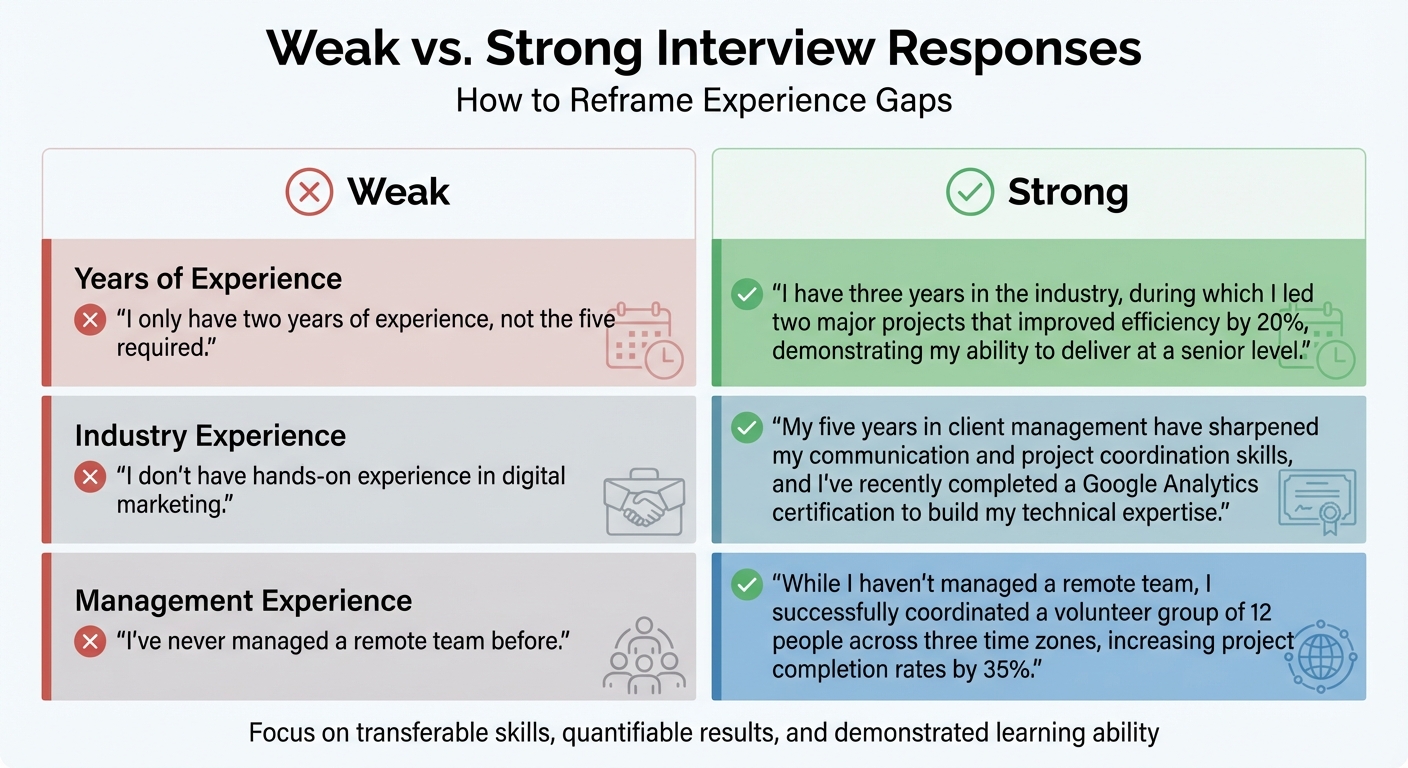
How to Answer Interview Questions About Missing Experience: Weak vs Strong Responses
Using a Past-Present-Future framework allows you to confidently address any gaps in your experience while emphasizing your strengths and future contributions. This approach helps shift the focus from what you may lack to what you bring to the table.
Start by highlighting your past achievements, focusing on transferable skills and measurable results. Then, move to your present readiness - what you're doing right now to prepare for the role, such as earning certifications or gaining relevant experience. Finally, discuss the future, articulating how you’ll apply your skills to address the employer’s needs and challenges.
This method works because it creates a positive narrative centered on growth, initiative, and how your goals align with the company’s objectives. Avoid being defensive; instead, let your story reflect your potential and readiness to contribute.
Now, let’s explore how the CAR method can help you craft compelling stories about your past achievements.
The Context-Action-Result Method
When discussing your past experience, the Context-Action-Result (CAR) method can help transform job responsibilities into impactful achievement stories. Break it down like this:
- Context: Describe the situation or challenge you faced.
- Action: Explain the specific steps you took to address it.
- Result: Highlight the measurable outcome of your efforts.
For example, instead of saying, "I managed a team", you could say:
"When our department faced a 30% increase in customer complaints (Context), I reorganized our response workflow and trained five team members on new protocols (Action). Within three months, we reduced complaint resolution time by 40% and improved our satisfaction rating from 3.2 to 4.5 stars (Result)."
This method works even if your experience is from a different industry. For instance, someone transitioning from retail to project coordination might frame their story like this:
"In my retail role, I had no experience with budget forecasting (Context). I took a two-week online course in financial planning and built a quarterly budget model for our store (Action). This helped us reduce inventory waste by 15% and stay under budget for eight consecutive months (Result)."
As noted by HirePilot, recruiters typically spend just six seconds scanning resumes. By leading with quantifiable results - percentages, dollar amounts, or timeframes - you immediately demonstrate value and credibility.
This approach complements the Past-Present-Future structure, ensuring your answers emphasize both readiness and measurable impact.
Sample Answers for Different Situations
Here are examples of how to apply these strategies to common recruiter concerns:
For a tool you haven’t used:
"I haven’t worked with Salesforce, but in my last role, I had zero experience with HubSpot when I started. Within two weeks, I became the team’s go-to resource for troubleshooting and trained three new hires on the platform. I’m currently completing a Salesforce Trailhead certification and have finished four modules. I’m confident I can quickly master your CRM and start contributing to your sales pipeline within the first month."
For switching industries:
"My background is in hospitality, not healthcare, but I spent five years managing high-pressure client relationships where attention to detail was critical. I reduced customer complaints by 25% in one year by implementing a new feedback system. Over the past six months, I’ve been volunteering at a local clinic to understand healthcare workflows, and I recently completed a medical terminology course. I’m eager to bring my client management skills to improve patient satisfaction at your facility."
For fewer years of experience than required:
"I have three years in the industry rather than the five listed in the job posting, but during that time, I led two major efficiency projects that improved team output by 20% and saved the company $50,000 annually. I’ve also been writing a LinkedIn newsletter on industry trends, gaining 2,000 followers in the past year, which keeps me up-to-date on best practices. I’m ready to bring this results-driven approach to your senior team and deliver measurable improvements immediately."
For employment gaps, a slight variation - "Reason-Activity-Readiness" - works well. Briefly explain why you stepped away, discuss what you did during that time, and express your readiness to return:
"I took 18 months off to care for a family member. During that time, I completed three professional certifications and freelanced on two projects that sharpened my data analysis skills. I’m now fully available and excited to apply these updated skills to your team."
"Gaps are an opportunity to learn, so describe your growth opportunities and improvement to put a proactive, positive spin on your history."
The key is to focus less on the gap itself and more on what you gained during that time. Recruiters are far more interested in your current skills and future potential than in a perfectly linear career path.
Prepare Before the Interview
Once you’ve structured your responses and highlighted measurable achievements on your resume, it’s time to focus on preparing for the interview itself. Recruiters often skim resumes quickly, so demonstrating that you’re ready and capable is crucial. Start by identifying the key job requirements and addressing any skill gaps.
Begin with the job description. Pinpoint the technical skills, soft skills, and keywords that the employer emphasizes. Then, map these requirements to your past experiences - whether from academic projects, volunteering, part-time jobs, or personal endeavors. If you meet about 70–80% of the qualifications, you’re in a good position. From there, work on closing the remaining gaps.
For any missing skills, consider quick certifications to strengthen your qualifications. For instance, Google Analytics works well for marketing roles, while CompTIA certifications are great for IT positions. Additionally, building a digital portfolio - whether through a personal website or LinkedIn posts - can showcase your initiative and skills. If you’re unsure how to highlight these updates on your resume, you might explore services like professional resume writers to create an ATS-friendly document.
Lastly, rehearse your interview responses. Practice speaking out loud to ensure your delivery feels natural and confident. While tools like ChatGPT or Claude can help you brainstorm phrasing, always tailor the responses to reflect your personality - authenticity matters.
Learn Required Skills Before You Interview
If the role requires tools or platforms you’re unfamiliar with, take the time to learn them before the interview. Resources like LinkedIn Learning can help you quickly fill these gaps.
For example, imagine the job requires expertise in Salesforce, but your experience is limited to HubSpot. Completing a Salesforce Trailhead certification before the interview allows you to confidently say, “I’ve completed four Salesforce modules and understand the core CRM workflows,” instead of admitting you’re unfamiliar with the tool. Similarly, becoming comfortable with collaboration tools like Slack, Zoom, or Teams, as well as project management platforms like Asana or Jira, can set you apart.
Short-term projects are another way to gain practical experience. Consider building a website for a local non-profit, managing a friend’s social media campaign, or taking on freelance gigs through platforms like Upwork or Fiverr. Take inspiration from stories like Hunter Casillas, who joined the Praxis program at 18 with no professional skills. By creating a personal website and publishing an article on Vox, he landed two full-time job offers and built a standout portfolio.
Certifications can also boost your credibility. Depending on your target role, you might look into credentials like Microsoft Office Specialist (MOS), Lean Six Sigma Yellow Belt, AAT for accounting, or AWS and CompTIA for technical roles. These certifications not only validate your abilities but also show recruiters that you’re proactive about addressing skill gaps.
Make sure your preparation reflects current trends. Use an updated email address, list the digital tools you’ve mastered, and mention familiarity with tools like ChatGPT, Notion AI, or Grammarly to demonstrate your adaptability to emerging technologies.
Once your skills are updated, shift your attention to crafting clear, impactful verbal responses.
Practice Better Responses
When addressing experience gaps in an interview, avoid sounding defensive or vague. Instead, focus on reframing the conversation to highlight your transferable skills, quick learning, and measurable accomplishments.
Here’s how precise language can make a difference:
| Weak Response | Stronger Response |
|---|---|
| "I only have two years of experience, not the five required." | "I have three years in the industry, during which I led two major projects that improved efficiency by 20%, demonstrating my ability to deliver at a senior level." |
| "I don't have hands-on experience in digital marketing." | "My five years in client management have sharpened my communication and project coordination skills, and I’ve recently completed a Google Analytics certification to build my technical expertise." |
| "I've never managed a remote team before." | "While I haven’t managed a remote team, I successfully coordinated a volunteer group of 12 people across three time zones, increasing project completion rates by 35%." |
Notice how the stronger responses directly connect your background to the job’s needs. Whether you’re transitioning between industries or roles, clearly explain how your unique experiences and ability to learn quickly can benefit the employer.
To refine your delivery, practice reading your responses aloud or record yourself. This helps ensure you sound confident and personable rather than overly scripted. It’s important that your answers reflect your own voice and experiences, not generic phrasing.
Additionally, prepare stories that demonstrate your adaptability. For example, think of a time when you quickly learned a new tool or process. Sharing such examples can reassure employers that you’re ready to tackle challenges, even without direct experience. By preparing in this way, you’ll turn potential gaps into strengths that enhance your overall narrative.
Conclusion
Focus on what you bring to the table rather than dwelling on what you might lack. By now, you’ve learned how to highlight transferable skills, back up your achievements with measurable results, and connect your past experiences to future contributions.
Preparation is your secret weapon. When you provide specific numbers to support your claims and demonstrate how quickly you can adapt, you give recruiters solid proof of your potential. As Kathleen Davis, Deputy Editor at Fast Company, wisely says:
"You just need to expand your definition of 'experience.'"
Make it clear how your background meets the employer's needs. Use statements that bridge your skills to their requirements, quantify your accomplishments, and practice your delivery until it feels confident and natural. If you’re unsure how to showcase your strengths, consider working with professional resume writers who can craft a resume that highlights your skills effectively.
Take these strategies into your next interview. This builds on the earlier advice about leveraging transferable skills and showcasing measurable results.
Go into interviews with the understanding that your ability to adapt and apply your skills creatively can often matter more than years of direct experience. With thoughtful preparation and clear communication, you can turn perceived gaps into compelling reasons why you’re the perfect fit for the job.
FAQs
How can I showcase transferable skills when I lack direct experience?
To present your transferable skills effectively, focus on how your previous experiences, even those unrelated to the role, have prepared you with abilities relevant to the job. Key skills like communication, problem-solving, teamwork, or adaptability are often highly valued. Support these with clear examples from past roles, projects, or situations.
For example, you might describe a time when you managed a demanding project, successfully collaborated with others, or navigated tight deadlines. Using the STAR method - Situation, Task, Action, Result - can help you structure your story. Clearly outline the context, your responsibilities, the steps you took, and the positive outcomes. Highlighting accomplishments in this way demonstrates how these skills will contribute to your success in the new position. This strategy also helps you address any gaps in direct experience while showcasing your readiness and capability.
How can I quickly gain the skills needed for a new job?
To quickly build the skills needed for a new job, start by focusing on transferable skills you already possess. Abilities like communication, problem-solving, or leadership can often be adapted to fit a wide range of roles. Be sure to clearly connect these skills to the requirements of the position you’re aiming for.
You can also enhance your qualifications by taking online courses, earning certifications, or completing tutorials that target specific technical or industry-related knowledge. Platforms like Coursera, LinkedIn Learning, or even YouTube can be excellent resources for quick, targeted learning.
Another effective way to gain practical experience is through internships, freelance work, or volunteering. These opportunities not only help you develop hands-on skills but also demonstrate your eagerness to grow and contribute. When applying for jobs, emphasize relevant accomplishments from past work, academic projects, or personal endeavors to show that you’re prepared to step into the role.
By taking a proactive approach and crafting a clear plan for learning, you can position yourself as a strong candidate, even if you’re transitioning into a new field.
How can I address gaps in experience when applying for a job?
To tackle experience gaps with confidence, focus on showcasing transferable skills, key accomplishments, and efforts to improve yourself. Pull examples from volunteer work, internships, personal projects, or educational experiences that align with the job's needs. These examples can highlight your ability to adapt and excel in the role.
Make it clear that you're eager to learn and committed to personal and professional growth. Customize your resume and cover letter for each job, emphasizing skills and achievements that align with the role. By presenting gaps as moments of growth and learning, you can position yourself as a driven and capable candidate.