
What to Do When You Are Applying for Jobs but Hearing Nothing Back
Improve response rates by optimizing your resume for ATS, tailoring applications, networking, and following up strategically to land more interviews.


If your job applications are going unanswered, it's likely due to one or more fixable issues. Common reasons include resumes not passing Applicant Tracking Systems (ATS), generic applications that fail to catch a recruiter’s attention, or relying too heavily on online job boards instead of networking. With 70-78% of jobs filled through referrals and internal connections, focusing on networking and tailoring your applications can significantly improve your chances.
Here’s how to address these challenges:
- Optimize your resume for ATS: Use simple formatting, match keywords from job descriptions, and save your file in .docx format.
- Customize applications: Tailor your resume and cover letter for each role to highlight relevant achievements.
- Leverage your network: Connect with industry professionals, attend events, and use LinkedIn to build relationships and uncover hidden opportunities.
- Follow up strategically: Send professional follow-up emails 1-2 weeks after applying to show continued interest.
- Track and adjust: Monitor your job search progress, seek feedback, and fill skill gaps with certifications or courses.
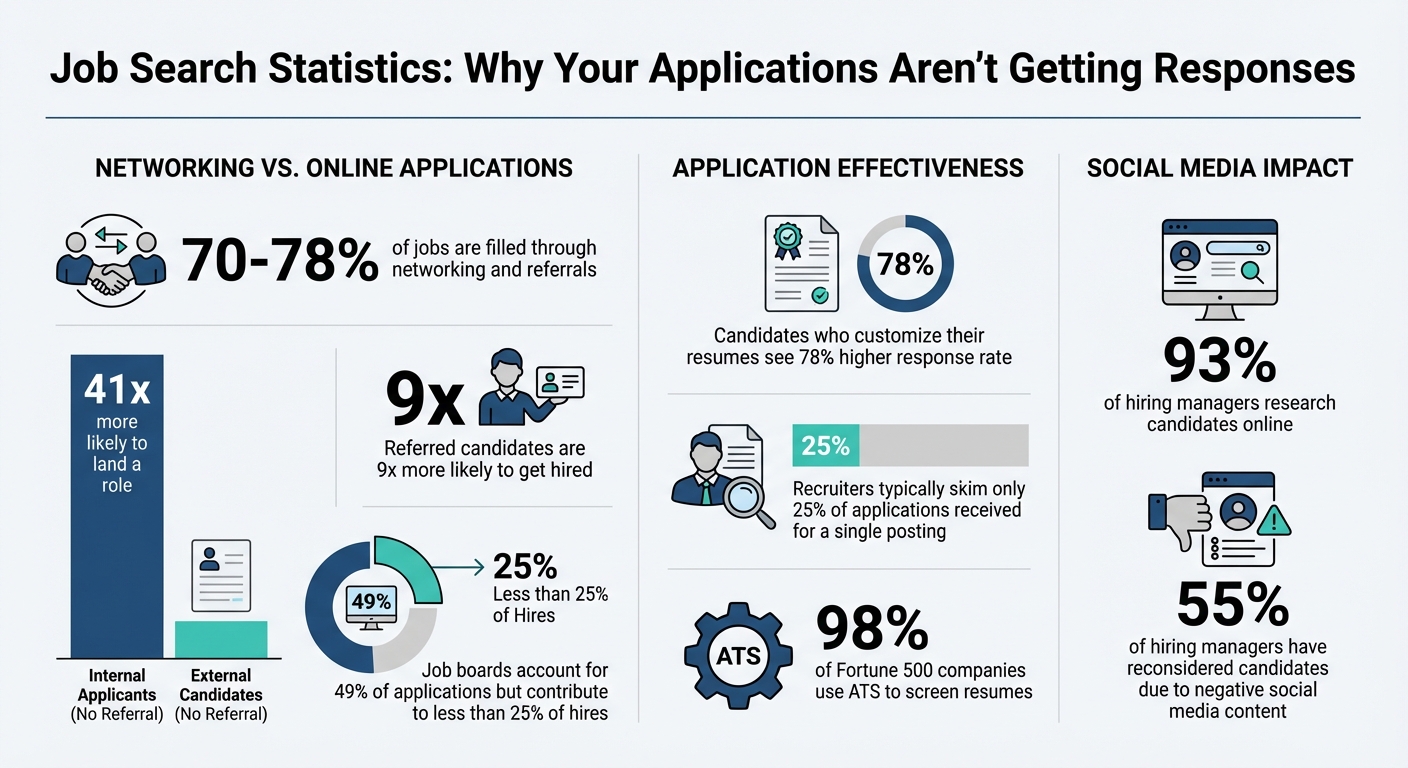
Job Search Statistics: Why Your Applications Aren't Getting Responses
Why You Never Hear Back After Applying (And How to Fix It!)
1. Why Your Job Applications Are Being Ignored
If your job applications seem to vanish without a trace, you're not alone. The problem often isn't your qualifications but how you're presenting them and where you're directing your efforts.
1.1 Your Resume Isn't Getting Past ATS Software
Applicant Tracking Systems (ATS) are often the first hurdle your resume must clear, and they can be ruthless. These systems are designed to filter resumes based on specific criteria, but they struggle with anything beyond basic formatting. If you've used complex layouts or unusual fonts, the ATS might jumble your information or render it unreadable.
One common issue is keyword mismatch. ATS software looks for exact matches to job description terms. For example, if a job posting specifies "Licensed Social Worker" but your resume only says "LSW", the system might not recognize it as a match. Missing these keywords can result in your application being ranked lower or even discarded.
"If I'm looking at an entry-level [accounting] position and seeing someone who is a dentist or a VP... it's totally fair for the ATS to discard those." – Yolanda M. Owens, Founder, CareerSensei Consulting
Even creative touches like unique section headings - think "My Journey" instead of "Work Experience" - can confuse the system, making it difficult for your information to be categorized correctly. Additionally, placing content in headers or footers can cause it to be dropped entirely. File format matters too: while PDFs are common, some older systems handle .docx files better, and image files like JPG or PNG are completely unreadable.
These challenges highlight the need for a well-optimized, ATS-friendly resume.
1.2 You're Sending Generic Applications
Recruiters can quickly spot generic applications, and they don't waste time on them. With hundreds or even thousands of applications to review, they prioritize those tailored to the specific role.
The numbers back this up: candidates who customize their resumes for each job see a 78% higher response rate compared to those who send generic ones. Yet, despite job boards accounting for 49% of applications, they contribute to less than 25% of hires. Recruiters typically skim only 25% of the applications they receive for a single posting.
"This 'throw it at the wall and see if it sticks' approach is wasting valuable time you could be using in a more productive way... You're more likely to get a response spending time on 2 relevant applications a day than an irrelevant 100." – Joe Morrison, Team Lead of In-house Recruiters, EMJ
Applying to every open position at a company can signal a lack of focus. Recruiters may interpret this as a lack of genuine interest or understanding of the role. Without specific accomplishments or tailored messaging that addresses a company's needs, your application risks blending into the crowd, especially in the flood of resumes received shortly after a job is posted.
1.3 You're Not Using Your Network
Solely relying on online job boards is one of the least effective ways to find a job. While you're clicking "Apply", most positions - between 70% and 78% - are being filled through networking and referrals. The numbers are striking: internal applicants are 41 times more likely to land a role than external candidates without a referral, and referred candidates are 9 times more likely to get hired.
"Do not just apply and hope to get a callback. I promise you are being buried. We are living in a new age." – Kyle Minton, Recruiter
The "spray and pray" method - applying to as many jobs as possible with one-click applications - often backfires, burying your resume under a pile of others. Recruiters are increasingly using LinkedIn filters to prioritize candidates who show interest by following their company, as it demonstrates motivation. Without personal connections, you're left to compete in an ATS lottery with slim chances of being noticed. Meanwhile, networking opens doors to the hidden job market - roles filled before they're even posted - and ensures your application gets immediate attention rather than sitting in a database.
Recognizing these common pitfalls is the first step toward improving your job application strategy. The next section will guide you on how to make your applications stand out.
2. How to Fix Your Job Application Process
If your job applications are going unnoticed, it might be time to rethink your approach. Making a few key adjustments can significantly improve your chances of standing out and landing interviews.
2.1 Create ATS-Compatible Resumes
Many resumes are filtered out by Applicant Tracking Systems (ATS) before a recruiter even sees them. To ensure your resume makes it through, you need to format it specifically for these systems.
- Stick to a single-column layout. Avoid multi-column designs, as they can confuse ATS software and result in scrambled or missing information.
- Use standard section headers. Stick to familiar labels like "Work Experience", "Education", and "Skills" to help ATS software categorize your information correctly.
- Match keywords directly. If a job listing mentions "React.js", use that exact term instead of just "React." Include both full terms and abbreviations for certifications, such as "Licensed Social Worker (LSW)."
- Save your resume as a .docx file. This format is the most widely accepted by ATS platforms. Avoid using image-based formats like JPG or PNG.
- Remove design elements. Tables, text boxes, headers, footers, and graphics can disrupt ATS parsing. Keep everything simple and place your contact details directly in the main body.
- Quantify your achievements. Use numbers to highlight your impact, such as "Boosted sales by 27%" or "Cut payroll processing time by 20%, saving $15,000 per quarter." Resumes with measurable results are more likely to catch attention.
- Test your resume with a .txt file. Save your resume as plain text to ensure it appears in the correct order without any formatting issues.
"ATS optimization is the process of formatting, structuring, and keyword-optimizing your resume so that Applicant Tracking Systems can correctly read, parse, and rank your application. Think of it like SEO for your resume." – ResumeAdapter
2.2 Write Custom Cover Letters for Each Job
A tailored cover letter can set you apart from other applicants by showing genuine interest in the role and the company.
- Address it to a specific person. If possible, find the hiring manager's name on LinkedIn or the company's website. If not, use "Dear Hiring Manager."
- Mention recent company news. Referencing a recent product launch, funding round, or award demonstrates your interest and research.
- Highlight accomplishments, not duties. Focus on results, such as "Streamlined onboarding, reducing setup time from 3 days to 8 hours and boosting customer satisfaction by 34%."
- Mirror the job description's language. Use the exact terms from the posting, like "cross-functional collaboration", to align your experience with their needs.
- Keep it concise. Limit your cover letter to one page, as recruiters spend only a few seconds scanning each application.
2.3 Use Tools to Improve Your Applications
Optimizing your resume and cover letter is just the first step. Leveraging specialized tools can streamline the application process and increase your chances of success.
- Free ATS analyzers like Jobscan, Resume Worded, and Wozber help identify missing keywords and suggest improvements by comparing your resume to job descriptions.
- Paid optimization tools offer more in-depth analysis. Jobscan's premium plans range from $49.95/month to $89.95 for three months, while Resume Worded Pro costs $19–$49/month. These services also provide LinkedIn profile optimization.
- Human-powered services like Scale.jobs combine technology with personalized assistance. For a one-time fee ($199–$399 for 250–1,000 applications), Scale.jobs offers:
- Custom resumes tailored for each job.
- Manual application submissions to avoid bot detection.
- Proof-of-work with time-stamped screenshots and updates via WhatsApp.
- A 24-hour turnaround for personalized materials.
- Free tools like an ATS checker, cover letter generator, application tracker, and salary predictor.
- AI Assistant Pro for $9/month (introductory price, normally $19/month), which provides unlimited AI-generated resumes and cover letters with human oversight.
Jobscan vs Scale.jobs: While Jobscan is great for keyword matching, its subscription costs can add up, and you still need to tailor applications manually. Scale.jobs, on the other hand, offers a hands-free, human-assisted approach with transparent pricing.
- Avoid automated application bots. Services like LazyApply and Sonara.ai can submit hundreds of applications automatically, but many companies now detect and reject these submissions. Human-powered services like Scale.jobs ensure your applications are submitted manually, reducing the risk of rejection.
If you're applying to only a handful of jobs each week, free tools and manual customization might be enough. However, if you're targeting 50+ positions weekly, a human-powered service can save you 20+ hours, freeing up time for networking and interview prep.
3. How to Network Your Way to Job Opportunities
Did you know that between 70% and 78% of jobs are filled through networking and referrals? Despite this, many job seekers still rely heavily on online applications. By building connections within your industry, you can skip the Applicant Tracking Systems (ATS) and tap into the "hidden job market" - those roles that are filled through referrals before they’re ever advertised.
Hiring managers often view referred candidates as a safer choice since they come with a recommendation from someone they trust. This personal endorsement can help you stand out from the crowd and move to the top of the candidate list.
"It's much more likely that you will land your next job through someone in your network than just through an online listing, so it's essential to leverage this invaluable resource." – Jaclyn Westlake, Career Coach
Networking doesn’t just open doors - it also gives you insider knowledge about company dynamics, upcoming opportunities, and what hiring managers prioritize. Armed with this information, you can fine-tune your applications or even position yourself for roles that haven’t been announced yet. Start by reconnecting with your current network, then expand it strategically.
3.1 Contact People in Your Industry
Your first step is reaching out to trusted contacts - former colleagues, classmates, friends, and even family. These "warm" connections are often your best leads. Be clear about your goals by specifying your target industry, companies, and roles.
When reaching out, craft a focused and actionable message. For instance:
"I'm currently exploring product management roles at SaaS companies such as Salesforce, HubSpot, or Zendesk. Do you know anyone in those organizations who might be open to a quick conversation?"
This gives your contact a clear idea of how they can assist.
Don’t hesitate to ask for direct introductions. Instead of a vague "let me know if you hear of something", request a specific connection to someone at your target company or a referral for a role you've identified.
Another effective approach is setting up informational interviews. These short, 15–20 minute conversations aren’t about asking for a job - they’re an opportunity to learn. Ask about the person’s career path, their experiences at the company, or challenges their team is tackling. This builds relationships and equips you with valuable insights for tailoring your applications.
When reaching out to former colleagues or classmates, referencing a shared experience can make your message more personal and engaging. For example: "We worked together on the Q3 product launch at TechCorp" or "We were both in Professor Smith's marketing strategy class."
3.2 Use LinkedIn to Connect with Recruiters
LinkedIn is more than just a social platform - it’s a critical tool for job seekers. With 93% of hiring managers researching candidates online, an incomplete or outdated profile could mean missed opportunities.
Start by optimizing your LinkedIn profile. Use a professional headshot with a clean background, customize your profile URL (e.g., linkedin.com/in/yourname), and craft a headline that highlights your expertise. For example, instead of "Marketing Manager", try "B2B Marketing Manager specializing in SaaS customer acquisition and retention."
Engage with recruiters and hiring managers by following their posts, commenting thoughtfully, and sharing relevant industry content. This consistent interaction keeps you visible and showcases your expertise. When you later apply for a role, your name will already be familiar.
When sending connection requests, always personalize your message. Mention a specific post they shared, a mutual connection, or a shared interest. Personalized requests are far more likely to be accepted than generic ones.
After submitting a job application, consider sending a follow-up message to the recruiter or hiring manager on LinkedIn. For example:
"I just applied for the Senior Analyst role and wanted to reach out directly. I'm especially excited about [specific company initiative]. Please let me know if there’s any additional information I can provide."
This small gesture can make a big difference in getting your application noticed.
Lastly, clean up your social media presence. Set personal accounts like Facebook and Instagram to private, and ensure your public profiles reflect a professional image. Remember, 55% of hiring managers have reconsidered candidates due to negative content on social media.
By combining these digital efforts with in-person networking, you’ll strengthen your overall job search strategy.
3.3 Attend Job Fairs and Industry Events
Networking events - whether in-person or virtual - offer direct access to hiring managers and recruiters, an advantage that online applications simply can’t match. Job fairs, industry conferences, professional meetups, and webinars provide opportunities to make an impression that could lead to interviews.
Do your homework before attending. Many events publish a list of participating companies and attendees. Identify your top targets, research their current openings, and prepare thoughtful questions about their teams or challenges. This preparation ensures your conversations are meaningful, not generic.
At in-person events, bring multiple copies of your resume but hand them out selectively - after meaningful conversations. For virtual events, ensure your LinkedIn profile is polished and ready to share, and consider having a digital portfolio if it’s relevant to your field.
Follow up promptly - ideally within 24 hours of meeting someone. Send a concise email or LinkedIn message referencing a specific detail from your conversation, such as:
"It was great speaking with you about your team’s approach to customer onboarding. I’d love to continue the conversation."
This keeps you fresh in their memory and reinforces the connection.
For those who find networking overwhelming, Scale.jobs offers LinkedIn Makeover services as part of their Human Assistant plans. Their team handles profile optimization and provides tailored networking advice, freeing you to focus on building relationships. Paired with their human-powered job application service, this ensures your efforts stay organized and effective.
4. When and How to Follow Up on Applications
Once you've polished your application and leveraged networking opportunities, the next step is following up. A well-timed follow-up can strengthen your candidacy by showing genuine enthusiasm, keeping you on the hiring manager's radar, and potentially reviving interest if your application was initially overlooked. However, it's all about timing and tone - reaching out too soon may seem impatient, while waiting too long could mean missing your chance.
The general rule is to wait one to two weeks after submitting your application. For roles with urgent timelines or set deadlines, consider following up 3–5 business days after the closing date. This approach respects the hiring process while ensuring you're not forgotten.
"Generally, the ideal time to follow up is around two weeks after submitting your application." – FED Group
Recruiters often juggle 15–20 roles and sift through hundreds of applications for each position. When following up, keep your message short and professional. Avoid vague phrases like "just checking in." Instead, reaffirm your interest in the role and highlight a specific skill or achievement that underscores your fit for the position.
Below, you'll find tips for crafting effective follow-up emails and knowing when to step back.
4.1 Write Professional Follow-Up Emails
Your follow-up email should strike the right balance between professionalism and enthusiasm. Start with a clear subject line, such as "Following Up: Marketing Manager Application – [Your Name]." In the email body, remind the hiring manager of the role you applied for and when, while expressing your continued interest.
To stand out, add value by mentioning a relevant accomplishment or project. For instance: "Since submitting my application, I've earned a Google Analytics 4 certification, which aligns with your team's focus on data-driven marketing." This approach demonstrates initiative and keeps your application fresh in their mind.
For optimal results, send your email between 9:00 AM and 11:00 AM on a Tuesday, Wednesday, or Thursday - times when hiring managers are most likely to check their inboxes. Avoid Mondays and Fridays, as these are typically spent catching up or winding down.
Here’s a simple email template you can tailor to your needs:
Subject: Following Up: [Job Title] Application – [Your Name]
Body:
Hi [Hiring Manager's Name],
I hope this message finds you well. I applied for the [Job Title] role on [date] and wanted to follow up to express my continued interest. I’m particularly drawn to [specific company initiative or project], and I believe my experience in [relevant skill or achievement] would enable me to contribute effectively.
If there’s any additional information I can provide, I’d be happy to share. I’d also welcome the chance to discuss how I can support your team.
Thank you for your time and consideration.
Best regards,
[Your Name]
[LinkedIn Profile URL]
[Phone Number]
Before hitting send, proofread your email carefully. Even minor errors can undermine your professionalism.
4.2 Know When to Stop Following Up
After sending your initial follow-up, it’s essential to know when to step back. If you don’t receive a response, wait 4–14 days before sending a second, brief follow-up. Most experts suggest limiting yourself to two follow-up attempts. Beyond that, it’s best to focus on other opportunities.
"If you haven't heard back after a week: Follow up... Still nothing? Wait another 4–5 days and follow up once more. After that, move on - you've done your part." – Jennifer Bookspan, Career Coach
Keep in mind, silence doesn’t always mean rejection. Internal factors like budget constraints, shifting priorities, or internal hires can delay decisions. However, repeatedly following up beyond two attempts can come across as overly persistent and might hurt your chances for future roles at the company.
Pay attention to job descriptions. If a listing explicitly states "no phone calls" or "no further contact", respect those instructions. Ignoring them can signal a lack of attention to detail and may disqualify you immediately.
If you do receive a rejection, consider sending a brief, polite response thanking them for their time. You can also ask for feedback or express interest in staying connected for future roles. This leaves a positive impression and keeps the door open for potential opportunities down the line.
| Scenario | Wait Time |
|---|---|
| Standard Job Application | 1 to 2 weeks |
| Urgent Hiring/Immediate Start | 3 to 5 business days |
| Application with a Closing Date | 3 to 5 business days after the deadline |
| Second Follow-up Attempt | 4 to 14 days after the first follow-up |
| Post-Interview Thank You | Within 24 hours |
Stay organized by tracking your applications. Use tools like Scale.jobs' free Job Applications Tracker to log details such as company name, job title, contact person, and submission date. This helps you time your follow-ups appropriately and ensures nothing slips through the cracks. If managing follow-ups feels daunting, Scale.jobs’ Human Assistant plans can simplify the process. Their virtual assistants handle tracking, follow-ups, and even send updates via WhatsApp, so you can focus on landing your next role.
5. Review and Adjust Your Job Search Strategy
If you've been sending out numerous applications without hearing back, it’s time to pause and reassess. The issue usually lies in one of two areas: either your resume and cover letter fail to make an impression, or your interview performance isn’t sealing the deal. Pinpointing where things are breaking down allows you to channel your efforts into meaningful improvements.
Start by tracking your progress. How many applications have you submitted in the past two weeks? How many responses or interviews have they generated? For example, if you’ve sent 50 applications and received no responses, your resume might lack essential keywords or proper formatting for Applicant Tracking Systems (ATS). On the other hand, if you’re securing interviews but not job offers, it’s likely time to refine how you present yourself during interviews.
"If you're not getting the response you want in your job search - but have no idea what you're doing wrong - it's time to go back to the basics." – Lea McLeod, Career Consultant and Coach
With over 98% of Fortune 500 companies using ATS to screen resumes, optimizing your materials is critical. Avoid listing generic job duties, which can make your resume forgettable. Instead, focus on measurable achievements. For example, swap "processed transactions" with "increased transaction accuracy by 15%."
Tools like Scale.jobs’ free Resume ATS Checker can provide instant feedback on your resume’s compatibility with ATS software. For a deeper review, consider Scale.jobs’ Human Assistant plans, which offer expert resume reviews and LinkedIn updates. Unlike automated tools, these plans provide personalized advice, addressing subtle issues like weak phrasing or poorly structured content.
5.1 Get Feedback on Your Resume and Cover Letter
Improving your application materials starts with meaningful feedback.
The best feedback comes from people with hiring experience. While friends and family might say your resume looks "fine", they often lack the expertise to identify what’s truly holding you back.
"Nearly always, those [resume and cover letter] are the problem. The people who told them that they were fine were wrong - they didn't have the experience or the insight to know what would make a really great resume or letter." – Alison Green, Author and Hiring Expert
Reach out to mentors, former managers, or industry professionals who have reviewed resumes before. Ask for specific, actionable suggestions, such as “add metrics to your accomplishments” or “rewrite your summary to be more targeted.” If you’ve made it to the interview stage but didn’t get the job, politely request feedback from the hiring manager. While not all will reply, those who do can offer valuable insights into areas you need to improve.
Pay close attention to the top third of your resume, as this is the first section recruiters see on ATS previews or mobile devices. Highlight your most compelling achievements here to grab attention immediately. If you’re unsure how to make these changes, tools like Scale.jobs’ ATS Checker or Human Assistant plans can help align your resume with job requirements and highlight your strengths effectively.
5.2 Fill Gaps in Your Skills and Experience
If feedback reveals missing qualifications, it’s time to address those gaps. Review job descriptions for roles you’re interested in and look for recurring requirements. For example, if multiple postings ask for certifications like Google Analytics 4 or project management credentials, these are clear indicators of skills you need to acquire.
Online platforms offer affordable, short-term courses that can help you upskill quickly. For instance, earning a Google Analytics 4 certification (which takes about 10–15 hours) can enhance your credibility for marketing roles. Similarly, a Certified Associate in Project Management (CAPM) credential can strengthen your profile for project management positions.
When you’ve gained new skills, don’t just list them on your resume - show how they’re relevant. Mention certifications in your cover letter and explain how they align with the role you’re applying for. For example: "I recently earned my Google Analytics 4 certification to enhance my data-driven marketing approach, which matches your team’s focus on performance metrics." This demonstrates initiative and makes your application stand out.
To prioritize effectively, use keyword analysis tools or Scale.jobs’ AI Assistant Pro to identify the most in-demand skills for your target roles. This ensures your efforts are aligned with what employers are actively seeking.
5.3 Stay Motivated During Your Job Search
Revisiting your strategy isn’t just about improving your applications - it’s also about staying energized throughout the process.
Job searching can feel draining, especially when results aren’t immediate. To stay motivated, focus on what you can control. Set weekly goals, such as submitting five tailored applications, reaching out to three new LinkedIn connections, or completing an online course. Tracking these actions helps you feel productive, even if offers take time to materialize.
Keep a simple spreadsheet or use Scale.jobs’ free Job Applications Tracker to log details like job titles, submission dates, and follow-ups. This helps you identify trends, such as which types of roles generate the most responses, and ensures you don’t miss opportunities. Plus, seeing your progress over time can be a morale booster.
Adopt the "9/10 applications only" rule: only apply for jobs you’re genuinely excited about - those you’d rate as a 9 or 10 on a 10-point scale. This approach ensures you focus on crafting high-quality, tailored applications rather than mass-applying to roles you’re not invested in.
Lastly, take care of your mental health. Set boundaries for your search, such as avoiding job applications after 6:00 PM, and celebrate small wins, like landing an interview. If the process feels overwhelming, Scale.jobs’ Human Assistant plans can handle time-consuming tasks like tailoring resumes and tracking submissions, freeing up your energy for networking and interview prep.
Conclusion: Take Action on Your Job Search Today
If your applications are met with silence, it’s not a reflection of your abilities - it’s likely a sign that your job search strategy could use some fine-tuning. You now have actionable steps: tailor your resume for ATS compatibility, apply selectively using the "9-out-of-10" rule, and prioritize networking over solely relying on job boards. By making these changes, you can turn those silent responses into interview invitations.
Start with an honest assessment. If you’ve submitted 50 or more applications without landing an interview, it’s possible your resume isn’t making it past ATS filters. Use Scale.jobs' free Resume ATS Checker to pinpoint keyword gaps or formatting issues. If interviews aren’t converting into offers, focus on sharpening your responses with the STAR method and seek constructive feedback from interviewers.
Create a focused 30-day action plan to put these strategies into motion. Dedicate Days 1–3 to refining your resume and running it through an ATS checker. From Days 4–10, apply to 5–10 roles that align closely with your skills and experience. For the rest of the month, aim to connect with 10 new professionals on LinkedIn each week. With most major companies using ATS and recruiters spending just seconds on each resume, every application must be customized. Scale.jobs offers tools to help you quickly craft tailored applications and keep track of submissions.
Success often hinges on taking consistent, deliberate action. Whether you prefer using DIY tools or Scale.jobs' personalized services, the steps you take today can push your application to the top of the pile. Explore the options Scale.jobs provides and take control of your job search. Your next opportunity is waiting - it just needs to reach the right hands.
FAQs
How can I make my resume stand out to applicant tracking systems (ATS)?
To help your resume pass ATS filters, concentrate on making it rich in keywords, cleanly formatted, and customized for the job description. Incorporate specific terms from the job posting naturally throughout your resume. Stick to a straightforward layout with standard headings like "Work Experience" and "Skills." Avoid using graphics, tables, or non-standard fonts, as these can confuse ATS systems.
Rather than listing job duties, emphasize measurable accomplishments to showcase your impact - this aligns better with what ATS systems and recruiters look for. Tailor your resume for each job application by including keywords and skills that match the role, boosting your chances of standing out.
What are the best networking strategies to boost your job search?
Networking can be a game-changer in your job search. The key is to focus on building authentic connections within your desired industry or at companies you're targeting. Instead of sending random connection requests, aim to engage meaningfully. Attend industry meetups, become active in professional organizations, or join discussions on LinkedIn by sharing thoughtful comments and insights.
A particularly effective strategy is informational interviewing. This involves reaching out to professionals to learn about their roles, career paths, or companies. Not only does this expand your network, but it also helps you gather valuable knowledge to fine-tune your applications and demonstrate genuine interest in your chosen field. Additionally, don’t overlook your current network - friends, family, and alumni can often point you toward opportunities you might not find elsewhere.
By putting in consistent effort and prioritizing real connections, you’ll increase your visibility and credibility, making it more likely that potential employers will consider you for referrals or reach out with opportunities.
When should you follow up on a job application?
The best time to follow up on a job application is generally one to two weeks after submitting it. This gives the employer enough time to review applications and possibly begin initial screenings. Reaching out during this timeframe demonstrates your interest and professionalism without appearing overly eager.
If you don’t hear back after this period, sending a brief and polite follow-up email can help keep your application on their radar. Following up too quickly might seem impatient, while waiting too long could give the impression that you’re not invested. Timing your follow-up within this window strikes a good balance and may improve your chances of receiving a response.