
Top 10 Checklist for USAJOBS Applications
Federal job success hinges on precise resumes, required documents, and tailored applications—miss any and you're disqualified.

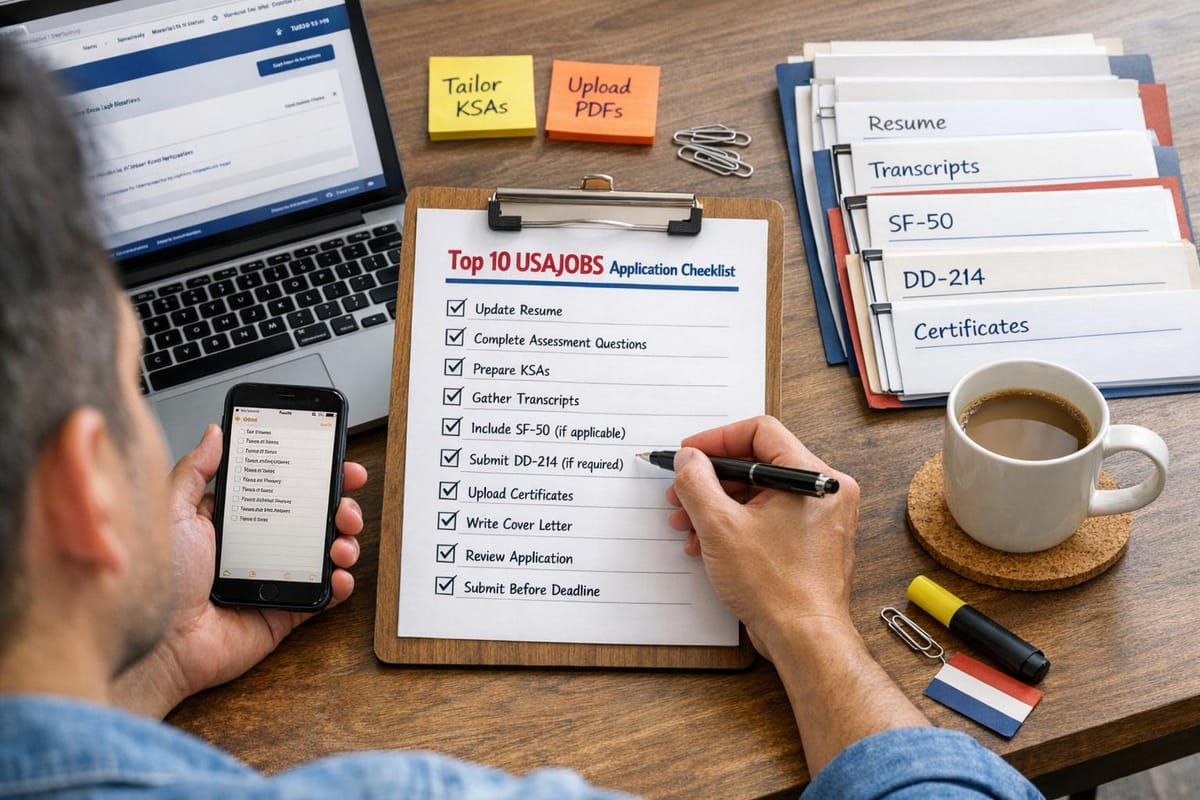
Applying for federal jobs through USAJOBS requires precision and attention to detail. Unlike private-sector applications, federal job applications demand specific documents, detailed formatting, and strict adherence to guidelines. Missing key information or failing to meet requirements can result in disqualification.
Here’s a quick breakdown of the process:
- Verify Eligibility: Ensure you're part of the group allowed to apply (e.g., U.S. citizens, veterans, federal employees).
- Federal-Format Resume: Limit resumes to two pages, include job-specific details like hours worked per week, GS grades, and use ATS-friendly formatting.
- Required Documents: Submit all necessary items, such as transcripts, SF-50s, DD-214s, or certifications.
- Tailor Applications: Match your resume and cover letter to the job announcement's language and qualifications.
- Submit and Track: Double-check accuracy, confirm submission, and monitor application status in your USAJOBS dashboard.
Federal hiring processes can take months, so preparation and organization are key. Platforms like Scale.jobs can simplify the process by offering tools like resume optimization, tailored applications, and tracking assistance.
Keep reading for a detailed step-by-step guide to ensure your federal application stands out.
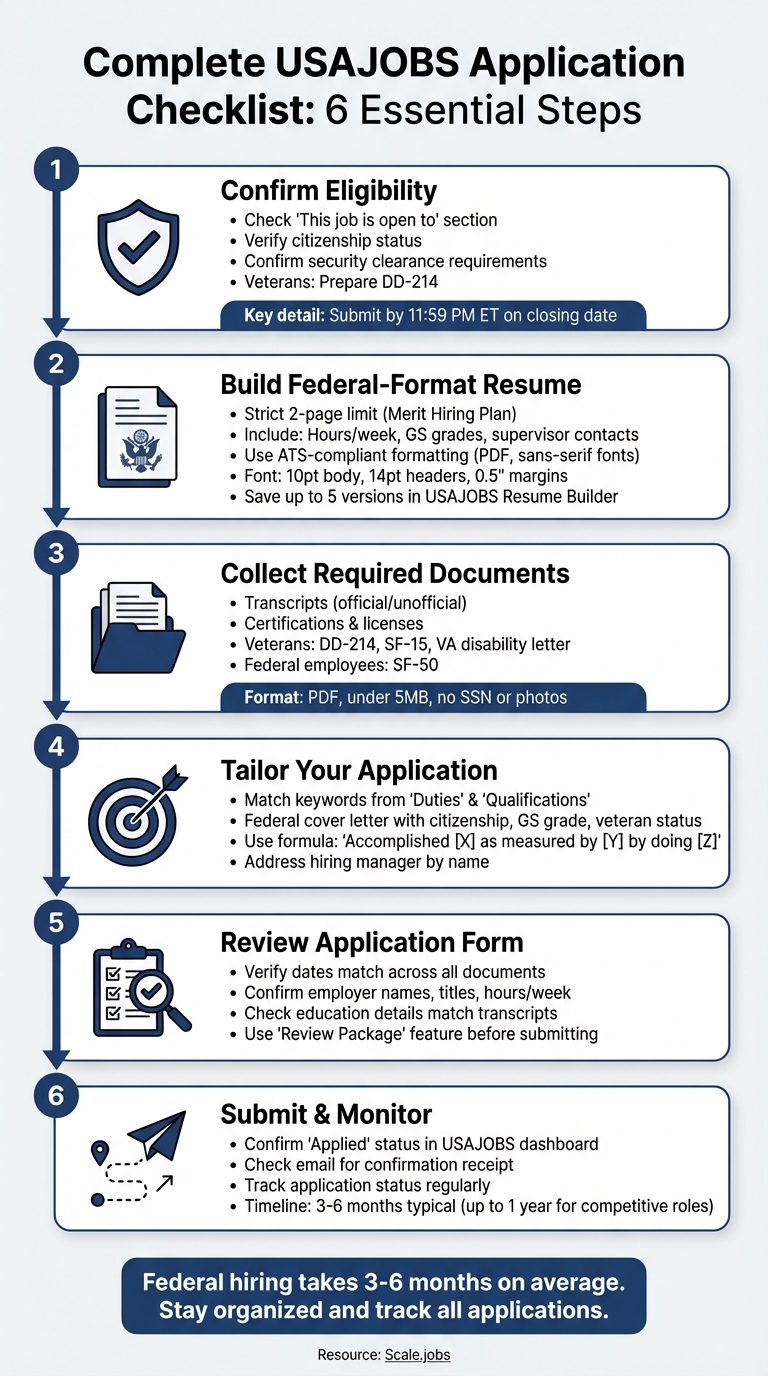
USAJOBS Federal Application Process: 6-Step Checklist
USAJOBS: Federal Application and Hiring Process
1. Confirm You Meet Eligibility Requirements
Before diving into resume updates, make sure you meet the eligibility criteria. Federal job postings differentiate between eligibility (whether you're part of the group allowed to apply) and qualifications (whether you're capable of doing the job). Check the "This job is open to" section at the top of the announcement. It specifies who can apply - U.S. citizens, current federal employees, veterans, Peace Corps volunteers, or other designated groups. If your status isn’t included, your application won’t be reviewed, no matter how impressive your experience is. Once confirmed, move on to checking federal employment requirements.
Check Federal Employment Requirements
Federal positions require a background investigation, and many roles also demand specific security clearance levels. You’ll need to confirm your citizenship status, and for positions like law enforcement, age requirements may apply. Veterans hoping to claim preference must submit documents like a DD-214 or VA disability letter, while individuals with disabilities may qualify for Schedule A hiring authority - requiring a letter from a medical professional. Additionally, the Declaration for Federal Employment (OF-306) form is used to verify basic federal service requirements and can be requested at various stages of the hiring process.
"The job offer is final when the agency successfully completes the background investigation and any additional security checks." - USAJOBS
Avoid including Social Security Numbers, photos, or classified information in your application. Current or former federal employees should ensure their SF-50 is up to date. For positions requiring transcripts, reach out to your registrar early to avoid last-minute delays.
Match Your Qualifications to the Job Posting
Carefully review the "Requirements" and "Duties" sections of the job announcement. These sections outline the Specialized Experience the role demands, and your resume must clearly show you’ve performed those tasks. Federal agencies often use occupational questionnaires to sort applicants into "Minimally qualified" or "Highest qualified" categories before a recruiter even looks at your documents. If the job specifies experience with a tool like MS Project, ensure you use that exact term in your resume.
"In your resume, use language as close as possible to the language in the 'Duties' and 'Qualifications Required' sections of the job announcement." - National Labor Relations Board
If managing multiple federal applications feels overwhelming, professional resume writing services can help ensure your documents meet federal standards. This includes adding essential details like GS grade levels and hours worked per week. Remember, applications must be submitted by 11:59 pm Eastern Time on the closing date. Some postings may close earlier if they reach their application cap, so don’t wait until the last minute.
2. Build a Federal-Format Resume
Once your eligibility is confirmed, the next step is crafting a resume that aligns with federal guidelines. Federal resumes are not the same as the typical one-page resumes used in the corporate world. These resumes are strictly limited to two pages, in line with the Merit Hiring Plan. USAJOBS enforces this rule, so resumes exceeding this limit cannot be uploaded or built on the platform. Within those two pages, you’ll need to include details that aren’t typically required for corporate resumes, such as exact hours worked per week, supervisor contact information, federal pay grades, and your GPA.
"Federal agencies only accept resumes up to two pages in length to comply with the Merit Hiring Plan." - USAJOBS
A properly formatted federal resume is essential for passing pre-screening systems and catching the attention of hiring managers. For instance, clearly stating that you worked a 40-hour week avoids confusion. If you’ve held a GS-0343-11 position, make sure to include the full occupational series and grade. Don’t skip the GPA field, and consider listing three to four relevant courses in the "Relevant Coursework" section to further strengthen your application.
Add Federal-Specific Information
Your federal resume should start with the basics: include the employer’s name, your job title, the start and end dates (month and year), and the exact number of hours worked per week. For previous federal roles, it’s important to specify the pay plan, occupational series, and grade level (e.g., GS-0343-11). When describing your accomplishments, use this recommended formula: "Accomplished [X] as measured by [Y], by doing [Z]."
If you’re a veteran claiming preference, have your DD-214 ready to verify the dates and discharge status listed on your resume. Similarly, current or former federal employees should ensure their SF-50 is up-to-date and accessible. Once you’ve included these federal-specific details, make sure your resume format is compatible with Applicant Tracking Systems (ATS) to avoid being filtered out.
Use ATS-Compliant Formatting
Since federal systems rely on ATS to screen resumes, using an ATS-friendly format is non-negotiable. Save your resume as a PDF to preserve formatting, though Word files (DOC or DOCX) are also acceptable. Stick to sans-serif fonts like Lato, Calibri, or Arial, set margins to 0.5 inches, and use a 10-point font for body text with 14-point font for section titles.
The USAJOBS Resume Builder is a reliable tool to ensure all required fields are included, and it allows you to store up to five versions of your resume within your profile. If you prefer uploading a custom resume, drafting it in Microsoft Word can help you avoid errors and session timeouts. For those juggling multiple applications or complex federal requirements, professional resume services can assist in creating a polished, compliant document that meets the two-page limit. After finalizing your resume, don’t forget to click "Make Searchable" on USAJOBS to allow agency recruiters to find your profile, even if you haven’t applied to a specific position yet.
3. Collect All Required Documents
When applying through USAJOBS, the announcement will outline the documents you need to submit. Some are non-negotiable, while others depend on your background. Missing a required document can immediately disqualify your application, so it's crucial to carefully review the list. Make sure your transcripts, certifications, and, if applicable, military documents meet the specified criteria.
In addition to your two-page resume, transcripts are often necessary to confirm your educational qualifications, especially if the job requires a specific degree. You can request these from your school's registrar office - either official or unofficial copies are generally acceptable for the initial application, though official versions may be needed later. Ensure your transcripts clearly display the school name, degree type, GPA, and completion date. If you're applying under special hiring authorities like Schedule A, you'll also need a letter from a licensed medical professional or vocational rehabilitation specialist.
Prepare Transcripts and Certifications
Organize your transcripts and certifications as separate PDF files. Transcripts should include all essential details like the school name, degree type, GPA, and completion date. For certifications, upload scans of professional licenses, such as a driver's license, bar membership, or industry-specific credentials. Be sure to exclude sensitive information such as Social Security Numbers. Save these documents in the USAJOBS "Documents" tab for quick access when attaching them to applications. For positions requiring technical expertise or executive-level qualifications, you might also need to prepare writing samples or responses to Executive Core Qualifications (ECQs).
Include Military Service Documents
If you're a veteran claiming preference, you'll need to provide a DD-214 (Certificate of Release or Discharge from Active Duty) or a Statement of Service if you're still on active duty. To claim a 10-point preference, include an SF-15 (Application for 10-point Veterans' Preference) along with a VA disability letter issued on official Department of Veterans Affairs letterhead, showing your combined service-connected disability rating. Military spouses claiming preference should submit a marriage certificate and Permanent Change of Station (PCS) orders. If you need copies of your DD-214 or medical records, you can request them for free through the National Archives Veterans' Records Service. To streamline the process, consider using a professional application service to help format and organize these materials according to federal standards, allowing you to focus on networking and preparing for interviews.
4. Tailor Your Application to Each Position
Once you've prepared your resume and supporting documents, the next step is to customize your application for each job. It's essential to align your materials with the specific details outlined in the job announcement. Pay close attention to the "Duties" and "Qualifications" sections, as these provide the exact language hiring managers expect to see in your resume and cover letter. For example, if the job posting mentions "MS Project", ensure that term is explicitly included in your materials.
Write a Job-Specific Cover Letter
Federal cover letters have a unique structure and format. Start with a federal-specific header that includes vital details like your citizenship status, highest GS grade (if applicable), veteran's preference, and availability (e.g., "Permanent, Full Time"). Structure your letter in three concise parts:
- Key Achievement: Highlight a significant accomplishment.
- Proof of Skills: Use the formula "Accomplished [X] as measured by [Y] by doing [Z]" to demonstrate your impact. For instance, instead of saying, "I managed document storage", you could write, "Processed 300+ compliance documents per month, reducing retrieval time by 30% through implementation of a new tracking system."
- Call-to-Action: End with a clear and professional closing.
Whenever possible, address the hiring manager by name instead of using general terms like "Hiring Team." Federal agencies enforce strict guidelines, including a two-page resume limit under the Merit Hiring Plan, making the cover letter an essential tool to elaborate on skills or goals that don't fit in the resume. Use 1.5 line spacing and one-inch margins to ensure the document is easy to read.
"Your federal cover letter can't be covert; it needs to turn heads." - Tom Gerencer, CPRW
Every part of your application, from the resume to the cover letter, should reflect the specific language and qualifications outlined in the job announcement.
Generate Customized Application Materials
To stand out, incorporate exact keywords from the "Qualifications", "Specialized Experience", and "KSA" (Knowledge, Skills, and Abilities) sections of the job posting. For example, if the job requires "experience coordinating multi-agency projects", your resume should include a phrase like "coordinated multi-agency projects", supported by measurable outcomes.
If you're managing multiple applications or need help aligning with federal standards, tools like Scale.jobs' AI Assistant Pro can simplify the process. For just $9/month, this service generates tailored resumes and cover letters that match federal job announcement keywords while ensuring ATS compliance. Additionally, their Human Assistant service offers personalized support from trained reverse recruiters who customize your applications according to OPM standards and even submit them on your behalf. You'll also receive time-stamped proof-of-work screenshots via WhatsApp, making the process seamless and efficient.
5. Fill Out and Review the Application Form
With your resume and supporting documents tailored to the job, it’s time to carefully complete your USAJOBS application form. Federal agencies evaluate applications strictly based on the information provided, so every field must be filled out accurately and consistently.
Ensure Information Matches Across Documents
Double-check every detail in your work history. For each job, confirm that the employer’s name, job title, start and end dates (month and year), and hours worked per week are consistent across your resume, application form, and any supporting documents like the SF-50. If you’re a current or former federal employee, ensure your pay plan, series, and grade are identical in all materials. Even small discrepancies in dates or titles can lead to disqualification or a "not qualified" status.
Education details are equally important. Cross-reference your application with your transcripts to verify school names, degree types, completion dates, and GPAs. If you’re a veteran, make sure the dates on your DD-214 match those listed in your work history. Also, ensure that your contact information - your full name, email, and phone number - is consistent across your USAJOBS profile, resume, and application form. Once everything aligns, do a final review for accuracy before submitting.
Check for Errors Before Submitting
Before you hit submit, take advantage of the "Review Package" step in the USAJOBS application process. This is your chance to catch typos, missing details, or formatting issues. Avoid including personal details like Social Security Numbers, photos, or demographic information, as these can result in immediate disqualification.
Make sure to include the hours per week for each job listed, as HR specialists use this information to determine whether you meet the experience requirements. Uploaded documents should be in PDF format, under 5 MB, and free of encryption or digital signatures that could prevent access.
After submitting, check your USAJOBS profile to confirm the status reads "Applied" and that the correct submission date is displayed. Save a PDF of your confirmation receipt for your records. If you’re juggling multiple federal applications or want an expert review, consider using professional resume services to catch any inconsistencies that might cost you the job opportunity.
6. Submit and Monitor Your Application
Confirm Your Submission Went Through
Once you've submitted your application, it's crucial to confirm that it was successfully received. Check your email for a confirmation message - this should arrive within a few hours. If you don't see one, log into your USAJOBS dashboard, navigate to the "Applications" section, and ensure that your status reads "Applied" with the correct submission date. To stay updated, use the "Track This Application" link in your profile. If the status doesn't change after some time, double-check that all required fields and documents were completed and uploaded correctly. With confirmation in hand, you're ready to focus on keeping track of deadlines and any updates.
Track Application Status and Deadlines
Keeping an eye on your application's progress is essential, especially given how lengthy federal hiring processes can be. Relying on manual tracking for multiple submissions can quickly become overwhelming. Tools like the Job Applications Tracker available at scale.jobs simplify this by consolidating all your federal applications into one dashboard. This tool not only provides real-time status updates and reminders about deadlines but also allows you to add notes for each submission. It's particularly helpful for jobs with application caps, as some postings might close earlier than anticipated.
Make it a habit to check your USAJOBS dashboard for updates. After an application window closes, hiring agencies typically review submissions and sort candidates into categories like minimally qualified or highest qualified. If you're among the top candidates, the agency will reach out directly to schedule an interview. Be prepared for this process to take weeks - or even months - depending on the volume of applicants.
Conclusion: Submit a Complete Federal Application
Once you've clicked "Apply", make sure to complete any agency-specific questions or questionnaires. Double-check that your USAJOBS profile shows "applied" with a submission date. If this status isn’t visible, it means the hiring agency hasn’t received your application, so it’s critical to verify this step.
Do a quick review of your application - can a hiring manager immediately identify your top qualifications in just 15 seconds? Reflect on the federal resume standards discussed earlier. Confirm that your resume meets the required format: no longer than two pages, under 5MB in PDF format, and free of Social Security Numbers, photos, or encrypted files. Additionally, ensure that all fields match federal requirements, as missing details could lead to disqualification.
Consider having a peer review your application to catch any errors or unclear points. Avoid using acronyms or jargon that might not be universally understood. Submit your application at least 24 hours before the 11:59 PM Eastern Time deadline to avoid technical issues. Keep in mind that some job postings may close early if they reach the application limit.
If you’re juggling multiple federal applications, tools like the free Job Applications Tracker can help you stay organized by consolidating deadlines and tracking updates. For those needing tailored, ATS-ready resumes, scale.jobs offers AI-assisted tools to populate federal-specific sections or even human-powered services where trained virtual assistants manage the entire process, including real-time updates and proof-of-work screenshots.
Lastly, revisit the "Required Documents" section in the job announcement to ensure all necessary items - such as transcripts, certifications, or military service documents - are attached. With everything in place, you’ll be ready to navigate a hiring process that often takes 3–6 months, though some competitive roles may take up to a year.
FAQs
What most commonly disqualifies a USAJOBS application?
When applying through USAJOBS, many applications are disqualified due to common mistakes like not following instructions, omitting required documents, or submitting incomplete or incorrectly formatted resumes. To avoid this, make sure your resume directly addresses the qualifications outlined in the job announcement. Additionally, double-check that all necessary materials are included before submitting your application. Attention to detail can make all the difference.
How do I prove 'specialized experience' on a federal resume?
To demonstrate specialized experience on a federal resume, it's crucial to provide detailed and specific descriptions of your past work. Highlight the complexity of your tasks, the scope of your responsibilities, and how they align with the job you're applying for. Include concrete examples of your accomplishments and duties, along with the following details for each position:
- Start and end dates (formatted as month/year)
- Hours worked per week
- Relevance to the job qualifications listed in the announcement
By tailoring your resume to directly address the requirements outlined in the job posting, you increase your chances of meeting the qualifications and standing out to hiring managers.
Why doesn’t my USAJOBS status say “Applied” after submission?
When you submit an application on USAJOBS, the "Applied" status might not show up right away. This delay happens because updates rely on the agency's processing system. It may take a few hours for your submission to reflect as "Applied." Additionally, some agencies may take longer to update the application status, meaning it might not change until they have fully processed your application.