
Upwork or Fiverr? The 2026 Pay Reality No One Talks About
Compare Upwork, Fiverr, and Scale.jobs on fees, earnings, and use cases to decide whether freelance gigs or a full-time job service fits your goals.


In 2026, freelancers face a critical decision: Upwork or Fiverr? Both platforms are popular, but their fee structures, client types, and earning potential differ significantly. Upwork is ideal for long-term, high-budget projects, with service fees ranging from 0% to 15%, while Fiverr focuses on quick, fixed-price gigs, charging a flat 20% commission. For those seeking full-time jobs, Scale.jobs offers a flat-fee service to simplify job applications with an AI resume builder, making it a better choice for career transitions.
Key Takeaways:
- Upwork: Best for ongoing, high-value contracts. Fees are lower for high-demand skills, but proposal costs (Connects) add up.
- Fiverr: Great for task-based work, but the 20% commission can cut into earnings, especially on smaller gigs.
- Scale.jobs: Focused on full-time job seekers, offering human-assisted application services with no recurring fees or commissions.
Choosing the right platform depends on your goals: freelance flexibility or full-time stability. This often requires optimizing for ATS to ensure your profile reaches human recruiters. Below, we break down how each platform works, their strengths, and the trade-offs to consider.
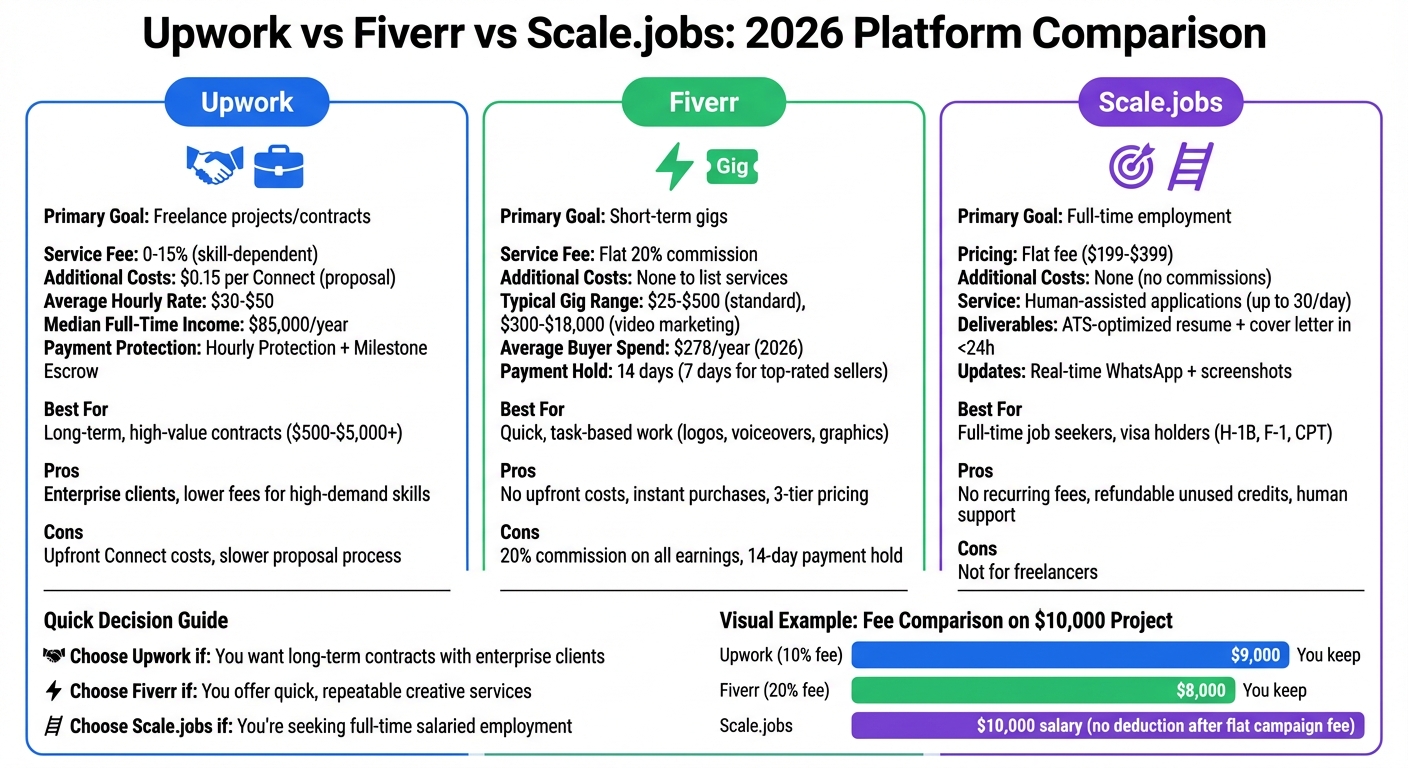
Upwork vs Fiverr vs Scale.jobs 2026 Comparison: Fees, Features, and Best Use Cases
Fiverr vs Upwork (2026) Detailed Comparison - Which Is Better For Freelancers?
Upwork in 2026: What You'll Earn and What You'll Pay
Upwork's service fees now range between 0% and 15%, depending on the demand for your skill set. For instance, software developers specializing in areas like AI data annotation or blockchain may enjoy a 0% fee, while most freelancers typically pay around 10% on marketplace contracts. These fees are set when a project begins and remain consistent throughout.
Freelancers also need to purchase Connects to submit proposals, with each Connect costing $0.15. For those bidding on 20 projects a week, the cost adds up to about $3.00 per week - or roughly $156 annually.
The platform supports over 10,000 skill sets spanning more than 12 major categories, attracting clients with significant project budgets. Freelancers are generally hired within three days and report earning between $30 and $50 per hour on average. Full-time freelancers on Upwork often achieve a median income of $85,000, which surpasses the earnings of many traditional employees.
What Upwork Does Well
Upwork stands out for its ability to connect freelancers with enterprise-level clients looking for long-term, complex projects. Its proposal-and-interview model allows professionals - ranging from software developers to marketing experts and consultants - to negotiate project details, including scope, timeline, and pricing, before committing.
For example, on a $10,000 project, Upwork’s 10% fee leaves freelancers with $9,000. This is a better deal compared to Fiverr, which charges a flat 20% fee. Additionally, Upwork ensures secure payments through its Hourly Payment Protection feature for hourly projects and milestone-based escrow for fixed-price work.
"Upwork has a wider breadth of high-paying clients than any other freelance platform I've tried." - Evan Fisher, Pitch Deck Expert
For those seeking additional perks, the Freelancer Plus subscription, priced at $19.95 per month, provides 100 Connects and access to Uma, an AI assistant designed to create tailored proposals and analyze job postings. Activating the Availability Badge can boost job invites by as much as 70%, while Boosted Proposals have been shown to double hiring chances.
While Upwork offers excellent opportunities for client connections and secure payment systems, the platform isn't without its drawbacks.
Where Upwork Falls Short
The Connects system introduces a financial hurdle by requiring freelancers to pay for each proposal. This can be particularly challenging for entry-level freelancers, who may quickly run out of Connects and face upfront costs before securing their first client. Additionally, Upwork’s proposal process - where clients post jobs, review proposals, conduct interviews, and negotiate terms - can feel slow compared to Fiverr’s streamlined gig model. For freelancers who prefer faster turnaround times, Upwork’s relationship-focused approach might not be ideal.
For those seeking full-time opportunities, platforms like scale.jobs may be a better fit. Scale.jobs offers tools like ATS-optimized resumes and AI-powered resume tools, making it a strong option for freelancers looking to transition into more stable, long-term roles. These considerations are important when comparing Upwork to competitors like Fiverr and scale.jobs.
Next, we’ll dive into how Fiverr’s strengths and weaknesses measure up against Upwork’s offerings - and explore where scale.jobs fits into the mix.
Fiverr in 2026: What You'll Earn and What You'll Pay
Fiverr operates on a gig-based model, setting it apart from platforms like Upwork that rely on a proposal system. Instead of bidding on jobs, freelancers create fixed-price services - called "Gigs" - that include clear deliverables and turnaround times. Buyers can browse these offerings, click to purchase, and proceed without interviews or negotiations.
The platform charges a flat 20% commission on all transactions. For instance, if you sell a $500 gig, you'll take home $400, while a $1,000 gig leaves you with $800. On an annual income of $60,000, this commission translates to approximately $12,000 in platform fees.
Recent data indicates that the average Fiverr buyer spends about $278 per year, with projections showing an increase to $318 by Q2 2025. Standard gigs typically fall between $25 and $500, while specialized categories - such as video marketing - can command anywhere from $300 to $18,000 per project. For beginners, hourly rates hover around $10–$25, whereas seasoned professionals in high-demand niches can earn $75–$200 or more per hour.
Fiverr Pro, a premium tier for vetted, experienced sellers, allows freelancers to charge higher rates. Revenue from Pro services has reportedly grown by 45% recently. However, most Fiverr projects remain centered on quick, transactional tasks like logo design, voiceovers, social media graphics, and short-form copywriting.
What Fiverr Does Well
Fiverr shines when it comes to speed and simplicity. Buyers can instantly purchase services, enabling freelancers to start earning without the hassle of writing proposals or waiting for client feedback. Additionally, there’s no upfront cost to list services, making Fiverr a great choice for beginners exploring the freelance market.
The platform also offers a three-tier pricing system - Basic, Standard, and Premium - allowing freelancers to cater to various budgets. For example, a graphic designer might price a simple logo at $50, a standard package with revisions at $150, and a premium brand identity kit at $400. This structure can help increase the average order value and attract a broader range of clients.
"Fiverr is excellent for quick, task-based work and agencies that want predictable gig-style buying." - An Jay, SmashingApps
Fiverr also offers the "Seller Plus" subscription, costing $15 to $49 per month, which provides advanced analytics and a "Request to Order" feature to screen projects before accepting them. Top-rated sellers benefit from faster payment clearance, receiving funds within seven days rather than the standard 14-day hold.
Where Fiverr Falls Short
The 20% commission can feel steep, especially for lower-value gigs. For instance, a $25 gig only leaves the freelancer with $20 after fees. To make a sustainable full-time income on Fiverr, freelancers often need to complete a high volume of gigs or consistently land higher-paying projects, which can be challenging in competitive categories.
Scaling beyond one-off tasks is another limitation. Fiverr’s model is tailored for quick, transactional work, making it harder to build lasting client relationships or negotiate larger, ongoing projects. For freelancers looking to transition into more stable, full-time roles, Fiverr may fall short compared to platforms like scale.jobs, which provide tools like ATS-optimized resumes and personalized job application assistance.
Additionally, the standard 14-day payment holding period can create cash flow challenges for freelancers who depend on steady income. While Fiverr is ideal for side gigs or building a portfolio, it may not be the best fit for those seeking enterprise-level projects or consistent monthly earnings.
| Project Value | Platform Fee (20%) | Freelancer Take-Home |
|---|---|---|
| $100 | $20 | $80 |
| $500 | $100 | $400 |
| $1,000 | $200 | $800 |
| $5,000 | $1,000 | $4,000 |
Next, we’ll explore how scale.jobs combines human expertise and advanced tools to elevate your job search experience.
Why Scale.jobs Beats Upwork and Fiverr for Job Seekers
Platforms like Upwork and Fiverr cater primarily to freelancers aiming for project-based gigs, not job seekers pursuing full-time roles. If you're looking to secure a salaried position, navigate Applicant Tracking Systems (ATS), or compete in the corporate job market, these platforms fall short. Scale.jobs, however, focuses on a different mission: helping individuals land permanent employment rather than piecing together freelance work.
On Upwork, you pay for "Connects" to bid on freelance projects. On Fiverr, you're dependent on buyers purchasing your gig packages. Neither platform assists with submitting job applications, customizing resumes for ATS compliance, or ensuring your materials reach hiring managers. For someone juggling interviews, visa deadlines, or needing to send out 50+ tailored applications per week, this lack of support can cost both time and opportunities.
What Makes Scale.jobs Stand Out
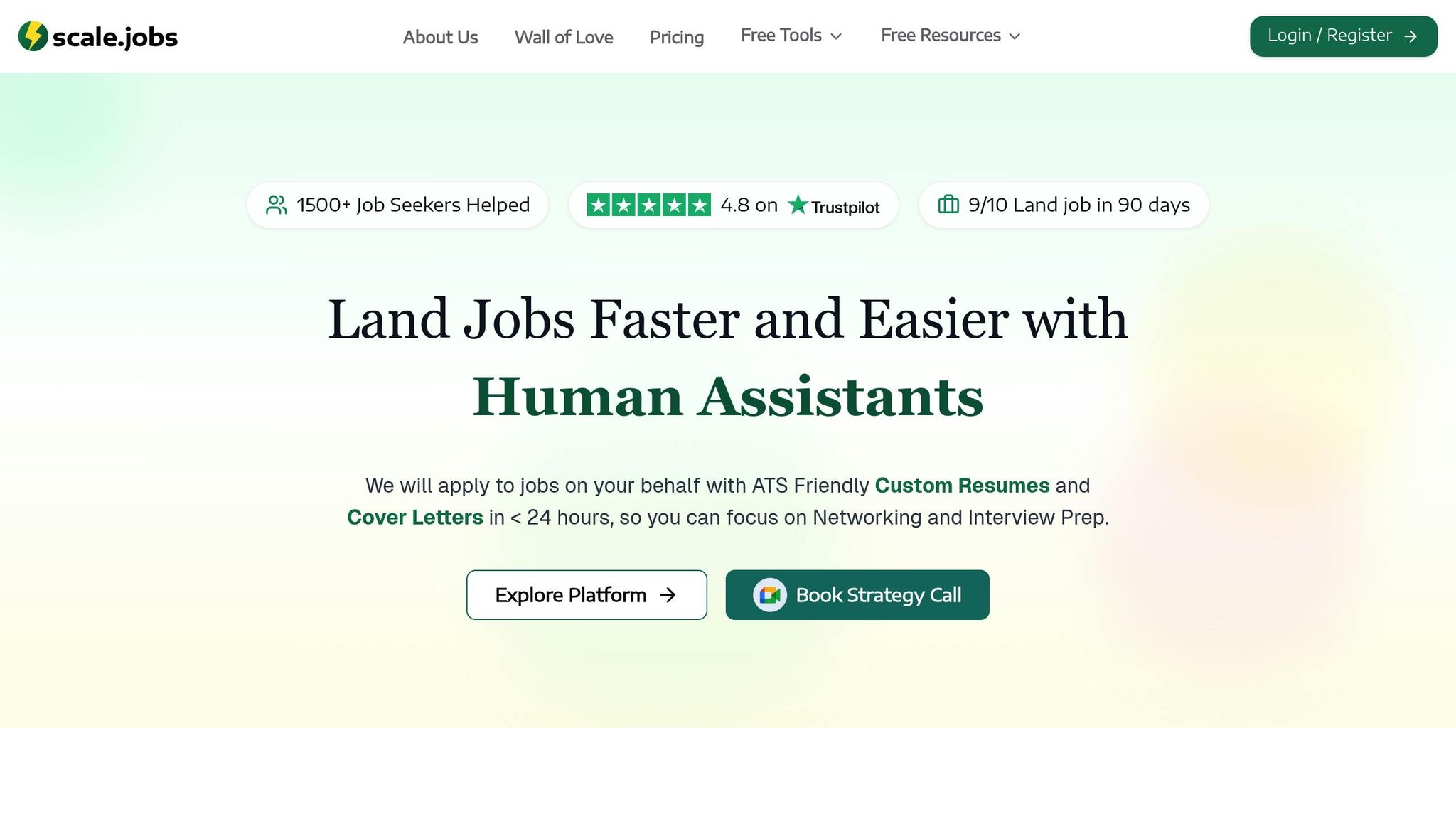
Scale.jobs combines trained human assistants with ATS-friendly tools to simplify the entire application process. A dedicated virtual assistant personally submits applications through corporate portals, LinkedIn, and niche job boards, ensuring accuracy and a personalized approach. Within 24 hours, you receive a tailored resume and cover letter, formatted specifically for ATS compatibility.
Transparency is a key feature. You’ll get real-time WhatsApp updates and time-stamped screenshots showing exactly when and where each application was submitted. This level of detail surpasses Upwork’s desktop time tracker (limited to hourly contracts) and Fiverr’s basic order status notifications. Additionally, Scale.jobs offers flexibility: if you purchase 100 applications but only use 80, the unused credits are refunded - a feature missing from commission-based models.
The pricing is straightforward with no recurring fees or hidden costs. Flat-rate packages start at $199 for 250 applications, $299 for 500, and $399 for 1,000 applications. Unlike Fiverr’s 20% commission or Upwork’s 0–15% service fees plus bidding costs, Scale.jobs charges a one-time fee. For example, a job seeker landing a $90,000 role pays nothing beyond the upfront campaign fee - no deductions from future income or ongoing subscriptions.
"Choosing the wrong platform can cost you thousands of dollars annually... in the sneaky 20% commissions, withdrawal fees, and 'processing charges'." – Jobbers.io
For individuals like immigrants handling H-1B transfers, recent graduates facing ATS rejections, or professionals recovering from layoffs, Scale.jobs is a game-changer. It saves 20+ hours per week, freeing up time for networking and interview preparation. With its human-driven application service, it delivers measurable results that platforms designed for gig workers simply cannot provide.
Upwork vs Fiverr vs Scale.jobs: Feature Comparison
| Feature | Upwork | Fiverr | Scale.jobs |
|---|---|---|---|
| Primary Goal | Freelance projects/contracts | Short-term "Gigs" | Full-time employment |
| Human Involvement | Self-managed bidding | Self-managed listings | Dedicated human assistants |
| Resume/Profile | Static profile/portfolio | Static gig descriptions | ATS-optimized & customized in < 24h |
| Application Method | Proposals (costs "Connects") | Buyers purchase Gigs | Assistants submit to ATS/Job boards |
| Transparency | Desktop time tracker | Order status updates | WhatsApp updates & screenshots |
| Pricing Model | 0–15% commission + fees | 20% commission + fees | Flat-fee (no commissions) |
| Refund Policy | Dispute resolution | Dispute resolution | Refundable unused credits |
This table highlights the differences clearly: while Upwork and Fiverr are excellent for connecting freelancers with short-term projects, Scale.jobs is purpose-built for securing full-time roles through hands-on application management and ATS expertise. If you're serious about landing a permanent position, Scale.jobs offers the tools and support you need.
Which Platform Fits Your Situation
Choosing between Upwork, Fiverr, or Scale.jobs depends on whether you're aiming for freelance opportunities or a full-time career. Each platform caters to different goals, and selecting the wrong one could mean unnecessary fees or wasted effort. Here's a breakdown to help you decide which platform aligns with your needs.
When to Use Upwork
Upwork is designed for professionals seeking long-term contracts with enterprise clients. If you're ready to dedicate 1–2 hours daily to submitting proposals for projects ranging from $500 to over $5,000, this platform is a strong choice. With over 145,000 clients offering budgets above $5,000, Upwork is ideal for building lasting client relationships.
To succeed, focus on enhancing your Job Success Score and aim for "Expert-Vetted" status to unlock access to high-budget enterprise clients. The platform also supports contract-to-hire opportunities, allowing freelancers to test the waters with a company before committing to full-time employment. Keep in mind that Upwork charges a service fee of 5% to 15%, depending on the demand for your skills.
"Upwork is good for those who want to work on bigger or more long-term projects... Fiverr is better for creatives who like one-time projects." – Taylor Cameron, Freelance Writer
When to Use Fiverr
Fiverr works best for creatives who prefer quick, fixed-price projects. If your goal is to earn through volume rather than a few high-value contracts, Fiverr's marketplace allows clients to browse and purchase services directly. Success on Fiverr often depends on creating niche offerings - specific gigs like "Twitch overlays for gaming streamers" tend to perform better than broad services like "graphic design."
While Fiverr Pro enables higher rates, the platform's foundation is built on high transaction volume. Be prepared for a flat 20% commission on all your earnings, which aligns with the fee structure discussed earlier.
"Upwork suits complex, ongoing projects with higher budgets. Fiverr suits productized services with fixed deliverables." – Glen Meade, Side Hustle Expert
When to Use Scale.jobs
If you're seeking full-time employment rather than freelance gigs, Scale.jobs is a standout option. Unlike platforms focused on gig work, Scale.jobs simplifies the process of applying for full-time roles. This is particularly valuable if you're juggling a current job, managing visa deadlines (like H-1B, F-1, or CPT), or recovering from a layoff.
Scale.jobs handles tailored job applications across corporate ATS portals, LinkedIn, and niche job boards, freeing up your time for networking and interview preparation. Services include ATS-optimized resumes and cover letters delivered within 24 hours, along with real-time WhatsApp updates featuring time-stamped screenshots. Packages start at $199 for 250 applications, making it a practical choice for professionals facing repeated ATS rejections or struggling to find time for job applications. If stability through a salaried role is your priority, Scale.jobs offers a streamlined path to achieving that goal.
For additional support, tools like an AI resume builder or AI cover letter builder can further refine your application materials, boosting your chances of landing interviews.
Decision Summary: Upwork, Fiverr, or Scale.jobs in 2026
When deciding between Upwork, Fiverr, and Scale.jobs, it all comes down to your career goals: are you looking for freelance project work or a full-time position? Upwork and Fiverr cater to freelancers offering project-based services, while Scale.jobs focuses on professionals seeking full-time salaried roles.
If you're a developer, consultant, or specialist aiming to establish long-term client relationships and earn $30–$50 per hour on complex projects, Upwork's proposal-driven system might be the right fit. The platform charges fees ranging from 0% to 15%, depending on the demand for your skills. On the other hand, Fiverr is tailored for creative professionals offering quick, repeatable services like logo design or video editing. With Fiverr, clients can directly purchase from your gig listings, but the platform takes 20% of every transaction.
"On a $60,000 annual income, you could be paying anywhere from $0 to $12,000 in platform fees depending on where you work." – Jobbers.io
For those ready to leave freelance work behind and secure a stable W-2 role, Scale.jobs offers a unique service. Its human assistants manage ATS-optimized applications across corporate portals, LinkedIn, and niche job boards, submitting up to 30 applications daily. Starting at a flat fee of $199, you get real-time WhatsApp updates, proof-of-work screenshots, and no recurring commissions. This service is particularly helpful for professionals navigating visa deadlines, recovering from layoffs, or balancing a current job while job searching. If you need help fine-tuning your resume or cover letter, consider their resume writing services to ensure your documents meet ATS requirements.
Why Scale.jobs Stands Out:
- No ongoing commissions: Pay a flat fee without deductions from future earnings.
- Human-assisted applications: Tailored, ATS-optimized submissions and personalized cover letters.
- Real-time updates: WhatsApp notifications and time-stamped proof-of-work screenshots.
- Specialized support: Ideal for visa-related deadlines (H-1B, F-1, CPT) and career transitions.
- Refundable credits: Only pay for applications that are actually submitted.
Who Should Use Upwork or Fiverr:
These platforms are best suited for freelancers seeking project-based work, flexible pricing, and the chance to build a portfolio through short-term or ongoing contracts.
Who Should Choose Scale.jobs:
This service is ideal for professionals aiming for full-time roles, especially those who need assistance with human-led job applications, ATS expertise, and transparent pricing without recurring fees. If you're managing a career transition or visa deadlines, Scale.jobs can streamline the process and save you time.
FAQs
Which platform leaves me with more take-home pay at my typical project size?
Upwork applies a service fee ranging from 5% to 10%, depending on the total earnings from a client. This tiered system can make it more economical for freelancers working on larger or ongoing projects. On the other hand, Fiverr imposes a flat 20% commission on every transaction, which can be a heavier burden, particularly for smaller gigs. Alternatives like Scale.jobs, which offer a flat-fee structure combined with personalized, human-powered assistance, provide freelancers with opportunities to land higher-paying jobs while cutting down on the time spent searching. This approach can lead to a better overall income for freelancers.
How many proposals can I send on Upwork before Connects become costly?
Submitting about 20 proposals on Upwork, each requiring 8 Connects, can add up to roughly $24 in Connect fees. On top of this, you'll also face the platform's service fees, which can take a noticeable chunk out of your earnings. It's important to account for these expenses when shaping your freelance approach to ensure you're maximizing profitability.
When should I choose scale.jobs instead of freelancing platforms?
If you're focused on securing full-time jobs rather than freelance opportunities, Scale.jobs is a better choice compared to platforms like Upwork or Fiverr. Scale.jobs offers a more tailored experience with human-powered application management, including ATS-optimized resumes, customized cover letters, and real-time progress updates. This makes it especially helpful for those facing unique challenges, such as navigating visa requirements, recent graduates entering the workforce, or professionals transitioning after a layoff. For steady, long-term employment, freelancing platforms may not be the best fit. Instead, consider a platform like Scale.jobs for a more personalized and goal-oriented job search experience.