
A Step by Step Job Search Plan That Actually Works
A practical 5-step job search plan: set goals, craft ATS-friendly resumes, use smart tools, network with recruiters, and prepare strong interviews.


- Set clear career goals: Define your target roles, skills, and priorities to focus your efforts.
- Optimize your resume and cover letter: Use tools like ATS scanners to tailor applications for each job.
- Leverage smart tools for automating your job search: Platforms like Teal or scale.jobs streamline applications, saving hours of manual work.
- Build your network: Connect with recruiters and tap into the hidden job market, where most opportunities lie.
- Prepare for interviews: Research thoroughly, practice answers using the STAR method, and follow up with personalized thank-you notes.
This guide simplifies the process, ensuring you focus on quality over quantity. Whether you're seeking full-time jobs, part-time jobs near you, or remote opportunities, these steps will help you stand out and secure the right role efficiently.
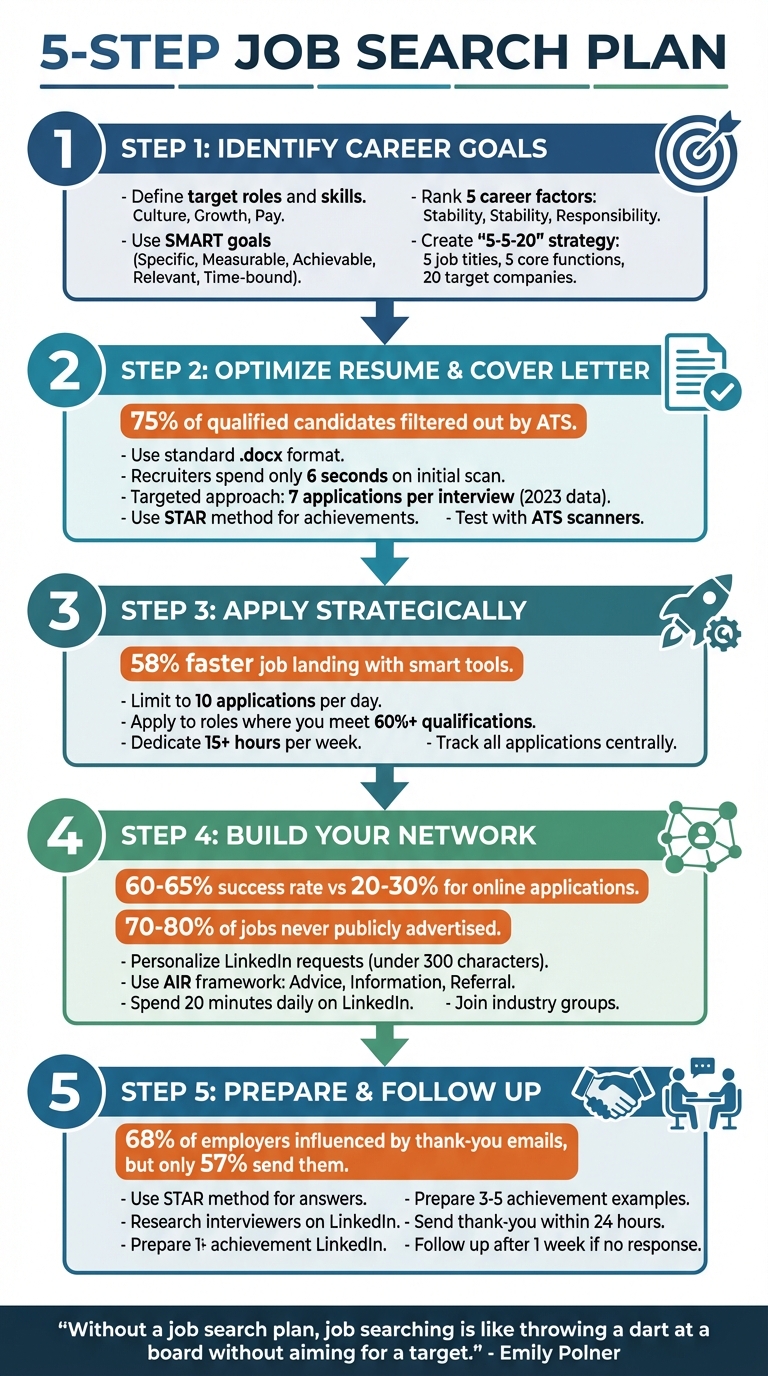
5-Step Job Search Plan: From Goal Setting to Interview Success
4 SMART Job Search Tips to Finally STOP the Rejections!
Implementing job search automation can further streamline this process.
Step 1: Identify Your Career Goals and Target Roles
Start by defining your career goals and the roles you want to pursue. Skipping this step can waste time and lead to applying for positions that don’t align with your skills or interests. Emily Polner, a freelance writer with expertise in career advice, sums it up perfectly:
"Without a job search plan, job searching is like throwing a dart at a board without aiming for a target."
To avoid this, take the time to clarify your career direction. Reflect on your past experiences to identify tasks you enjoyed and those you’d prefer to avoid. Then, rank five key career factors - Company Culture, Opportunity for Growth, Pay and Benefits, Stability, and Level of Responsibility - to determine what matters most to you. The goal isn’t to find the “perfect” job but to focus on opportunities that align with your priorities.
Here’s how you can create a clear career path and identify roles that match your strengths.
Understanding your hard skills (technical expertise, certifications) and soft skills (like communication or leadership) is equally important. Tools like O*NET Online can help you match your skill set with what employers are looking for. This process, often called a gap analysis, can also highlight whether you need additional training or just a more targeted resume. Laying this groundwork will make it easier to craft ATS-friendly resumes later on.
Set Measurable Short- and Long-Term Goals
Clear goals lead to clear outcomes. Instead of vague ambitions like “I want a better job,” use SMART goals (Specific, Measurable, Achievable, Relevant, Time-bound). For instance, a specific goal could be: “Land a Marketing Manager position in the SaaS industry within 90 days.” Break this into smaller weekly tasks, such as “Contact two professionals in the industry for informational interviews by Friday,” to stay on track.
After assessing your skills, set both short-term and long-term goals that are actionable and measurable.
Create a List of Job Titles and Target Companies
Develop a "5-5-20" strategy: Identify five job titles, five core functions, and 20 target companies. Use standard job titles like “Digital Marketing Specialist” rather than quirky ones like “Marketing Ninja” to ensure your resume aligns with recruiter searches. Platforms such as LinkedIn, Indeed, or niche boards like Dice (for tech jobs) and RemoteOK.io (for remote work) can help you evaluate whether the responsibilities of these roles align with your interests.
When researching companies, dig deeper than their careers page. Look at employee reviews on Glassdoor, explore recent funding news, and read their mission statements to gauge their values and workplace culture.
Lastly, define your non-negotiables - things like minimum salary, preferred location (or willingness to work remotely), and visa sponsorship requirements. Informational interviews with professionals already working in your desired roles can provide valuable insights into their career paths and day-to-day responsibilities, helping you fine-tune your list of target companies.
Step 2: Create ATS-Optimized Resumes and Cover Letters
Your resume needs to impress both the ATS and human recruiters. Many large employers rely on ATS (Applicant Tracking Systems), and a staggering 75% of qualified candidates are filtered out before a human even reviews their application. The upside? Modern ATS platforms now evaluate context alongside keywords, meaning a well-tailored resume has a much better shot.
Alba Hornero, Co-founder and Employability Expert at CandyCV, sums it up perfectly:
"A resume has to do two jobs at once: it has to pass the algorithmic screen and the human one."
Striking this balance involves technical precision and human appeal. Use a standard .docx format with clear headers to ensure the ATS reads your document correctly. Since recruiters typically spend just 6 seconds on an initial scan, place your most critical information - like your professional summary and key skills - front and center.
Customize Your Resume and Cover Letter for Each Job
Tailoring your application is non-negotiable if you want to stand out. In 2023, job seekers who took a targeted approach averaged just seven applications per interview. One effective trick is to paste the job description into a free word-cloud tool to identify frequently used terms. Incorporate these keywords into your professional summary, skills section, and achievement bullet points.
When listing accomplishments, use the STAR method (Situation, Task, Action, Result) and include measurable results. Instead of writing "Managed social media accounts", aim for something like: "Boosted Instagram engagement by 43% in 6 months through a user-generated content campaign that led to 2,500+ shares." Be sure to include both full terms and acronyms (e.g., "Search Engine Optimization (SEO)").
For your cover letter, create a base template that you can adapt for each role. Update the introduction and highlight specific skills relevant to the job. If you have fewer than 10 years of experience, keep your resume to one page; two pages are acceptable for more seasoned professionals. Limit yourself to ten applications per day to ensure each one is thoughtfully tailored, and focus on roles where you meet at least 60% of the qualifications.
Once your documents are customized, test their effectiveness with an ATS scanner.
Scan Your Documents with ATS Feedback Tools
Before submitting, run your resume through an ATS scanner to catch any errors or keyword gaps. Tools like Resume Worded offer free features such as "Score My Resume" and "Targeted Resume" for keyword optimization. Similarly, Jobscan provides match-rate scoring against specific job descriptions, while the Teal Chrome Extension - rated 4.9/5 stars by over 140,000 users - combines keyword matching and job tracking in one platform.
For a more advanced option, scale.jobs' AI Assistant Pro offers one-click tailoring along with human-assisted manual submissions. At $9/month (launch pricing, $19/month otherwise), it generates unlimited AI-optimized resumes and cover letters for each application. Unlike fully automated tools that risk triggering bot flags, scale.jobs pairs AI with human assistants who manually submit applications across a variety of platforms, from corporate ATS systems to niche job boards. The service includes real-time WhatsApp updates, proof-of-work screenshots, and a 24-hour turnaround for custom documents. Their flat-fee pricing model - starting at $199 for 250 applications - eliminates recurring subscriptions, and unused credits are refundable. This level of transparency and value stands out compared to subscription-based competitors like Jobscan (premium required) and Teal ($13 per week for advanced features).
| Tool | Primary ATS Feature | Pricing Model |
|---|---|---|
| scale.jobs | AI Assistant Pro for one-click tailoring + Human VAs for manual submission | Free tier / $9–$19 monthly / Flat-fee bundles ($199–$1,099) |
| Jobscan | Match rate scoring against job descriptions | Free scans / Premium subscription |
| Teal | Keyword matching and job tracking | Free tier / $13 per week |
| Resume Worded | AI-driven resume scoring and error checking | Free tools available |
Finally, proofread your documents using Grammarly or ask a trusted friend for feedback. A polished professional summary that highlights your hard skills while adding a personal touch - like a unique hobby or achievement - can help you connect with recruiters once your resume clears the ATS.
Step 3: Apply to More Jobs Using Smart Tools and Workflows
Maximizing your job applications is about working efficiently while keeping quality intact. Once you've polished your resume and cover letter, the next step is to simplify your application process using smart tools. According to 2023 data, focused job seekers secured one interview for every seven targeted applications. A structured workflow helps you maintain quality submissions without overwhelming yourself.
Use Job Boards and AI-Powered Application Tools
The right tools can save you time while ensuring personalized applications. For instance, Teal's Chrome Extension allows you to save job listings from over 40 boards - such as LinkedIn, Indeed, and Glassdoor - with a single click. Its "Super Search" feature scans multiple boards simultaneously, reducing the need to constantly switch tabs. Users of Teal report landing jobs 58% faster.
For AI-driven job matching, Jobright acts as a "Career Copilot", offering personalized job recommendations, instant resume customization, and referral identification. With 1.25 million users, Jobright claims to triple interview rates while saving 80% of the time typically spent on job searches. Kenny Mendes, Chief People Officer at Grammarly, highlights its impact:
"Most job seekers still rely on decades-old tools. Jobright.ai's AI guidance modernizes the whole search and gets you to interviews faster - a true game-changer."
scale.jobs stands out by combining AI with human assistance. Its AI Assistant Pro (priced at $9/month during launch, later $19/month) generates tailored resumes and cover letters in one click. Meanwhile, its Human Assistant service ensures manual application submissions by trained virtual assistants - up to 30 applications daily. This approach avoids bot-detection issues common with fully automated tools like LazyApply or Sonara.ai. Key features include:
- Real-time WhatsApp updates with proof-of-work screenshots
- Custom documents delivered within 24 hours
- Flat-fee pricing starting at $199 for 250 applications
- No recurring subscriptions, with refundable unused credits
- Transparent tracking verified by humans for every application
Unlike subscription-based platforms like Teal ($13/week for premium) or tools that require ongoing payments, scale.jobs provides flexibility and transparency, addressing frustrations about paying for unused services.
| Tool | Primary Strength | Pricing Model |
|---|---|---|
| scale.jobs | Human VAs for manual submissions + AI tailoring | Free tier / $9–$19 monthly / Flat-fee bundles ($199–$1,099) |
| Teal | Super Search across 40+ boards + Chrome Extension tracking | Free tier / $13 per week for premium |
| Jobright | AI matching + referral discovery + instant resume tailoring | Free (basic features) |
| Plancv | Neural semantic matching + recruiter analytics | Free tier / $12/month (billed annually) |
Focus on roles where you meet at least 60% of the qualifications to keep your response rate high. Limit yourself to 10 direct applications per day to stay efficient and ensure each submission is thoughtfully tailored. After applying, keeping track of your submissions is crucial.
Track Every Application in One Place
A centralized tracker helps you stay organized and avoid duplicate submissions. Ditch scattered spreadsheets in favor of platforms that automatically log submission dates, save job descriptions (important since employers often remove postings), and set follow-up reminders. Teal’s dashboard integrates seamlessly with its Chrome Extension, while scale.jobs offers human-verified tracking, complete with WhatsApp notifications and proof-of-work screenshots for every submission.
For each application, document essential details like the submission date, job link, remote/hybrid status, hiring manager contact info, and salary ranges. As Teal HQ emphasizes:
"What gets measured gets managed - and that means fewer missed opportunities and more interviews."
Aim to dedicate at least 15 hours per week to your job search to maintain momentum. By batching tasks and using tools like "Super Search" to bookmark roles for later, you can handle a higher volume of applications without losing the precision needed to get past Applicant Tracking Systems (ATS) and secure interviews.
Step 4: Build Your Professional Network and Connect with Recruiters
Once you've streamlined your application process, the next step is to focus on building a professional network to uncover hidden job opportunities. Networking often proves far more effective than online applications, with a 60–65% success rate compared to just 20–30% for applying through job boards. In fact, research shows that 70% to 80% of job openings are never publicly advertised - they’re filled through referrals and personal connections before a listing even goes live. Leslie Warner, Assistant Director of Alumni Career Services at Tufts University, sums it up perfectly:
"People hire people, not resumes."
While automation tools can help with certain tasks, meaningful connections require a personal touch. Recruiters often receive 10 to 50 connection requests daily, so generic messages are easily overlooked. Instead, focus on quality over quantity by researching each recruiter’s background to ensure they align with your industry and career goals. Personalize every LinkedIn connection request with a short note (under 300 characters). Mention a shared connection, reference a post they’ve shared, or highlight why their work resonates with you. When reaching out to hiring managers, use the "AIR" framework: ask for Advice, Information, or a Referral. This approach fosters trust and shows genuine interest before making any direct job inquiries.
Once you've embraced the importance of networking, the next logical step is to polish your LinkedIn profile to leave a lasting impression.
Update Your LinkedIn Profile with Keywords and Details
Your LinkedIn headline should go beyond listing your job title - it should showcase your unique strengths and achievements. For example, instead of "Marketing Manager", try something like "Enterprise Sales Executive | SaaS | $2M+ Quota Achiever" to highlight your expertise and results. Use a professional photo and ensure your profile aligns with your resume. Enable the "Open to Work" option, making it visible only to recruiters to maintain discretion. Dedicate 20 minutes daily to LinkedIn activities like commenting on posts, replying to messages, and starting conversations. These small efforts can significantly expand your network.
Reach Out to Recruiters and Join Industry Groups
Once your LinkedIn profile is optimized, it’s time to take action. Connect with both internal recruiters (those working within specific companies) and external recruiters (headhunters who work across multiple organizations). Tailor your approach for each type. Internal recruiters often focus on culture fit and current openings, while external recruiters can offer broader opportunities across industries. Before reaching out, review their posts and craft a personalized message using the RAQ method: Recognize their expertise, Appreciate their insights, and ask a thoughtful Question.
Additionally, join LinkedIn Groups relevant to your field. These communities allow you to demonstrate your knowledge and engage with recruiters who often monitor group discussions. After any interaction - whether it’s an informational interview or a brief exchange - always send a thank-you message within 24 hours. If you don’t hear back, follow up politely after a week to keep the conversation alive.
scale.jobs can make networking even more manageable by handling time-consuming application tasks for you. With their Human Assistant service, you can focus on building relationships with recruiters and attending industry events while they manage the application process. The platform provides real-time WhatsApp updates along with proof-of-work screenshots, ensuring you stay informed about your applications and can confidently reference them during networking conversations. Their flat-fee bundles come with refund options for unused credits, giving you the flexibility to allocate resources toward professional events or LinkedIn Premium if needed.
Here’s why scale.jobs stands out compared to competitors like Jobscan:
- Saves over 20 hours each week by offloading repetitive tasks
- Keeps you updated with real-time WhatsApp notifications and proof-of-work screenshots
- Offers flat-fee pricing starting at $199 for 250 applications, with refunds for unused credits
- Focuses on personalized, human-driven applications to help you stand out in a crowded market
Step 5: Prepare for Interviews and Follow Up Properly
Getting an interview means your resume did its job. Now it’s time to prove you’re the right fit. Every interview is a chance to stand out, and preparation is the key to turning that opportunity into an offer. Start by aligning your experience with the job description. For each responsibility listed, think of a specific example from your past that shows you have the skills they’re looking for. Research your interviewers on LinkedIn to understand their background and interests, and tailor your approach to connect with them. Go beyond just skimming the company’s "About Us" page - look into recent news, funding updates, or strategic shifts to understand what challenges they’re facing. This groundwork will help you refine your answers and make a strong impression during the interview.
Practice Answers to Common Interview Questions
Use the STAR method (Situation, Task, Action, Result) to structure your responses. This approach helps you stay focused and clearly communicate your achievements. For instance, if asked, "Tell me about a time you solved a difficult problem", spend more time on the steps you took to solve it rather than the problem itself. Prepare 3–5 concise examples that showcase your skills in areas like leadership, conflict resolution, or problem-solving. Be ready for classic questions like "Tell me about yourself", "Why do you want this job?" and "What’s your greatest weakness?" Practice summarizing your experience in a way that connects directly to the role you’re applying for.
Come prepared with three thoughtful questions about the team, company strategy, or growth opportunities. This shows you’ve done your homework and are genuinely interested in the role.
Once you’ve nailed your interview responses, don’t let the momentum drop - follow up promptly.
Send Thank-You Messages Within 24 Hours
Within 24 hours, send a personalized thank-you email that references a specific part of your conversation. Did you know 68% of employers say a thank-you email influences their decision, yet only 57% of candidates actually send one? Stand out by referencing something specific - like a project the interviewer mentioned, a company milestone, or an aspect of the role that excites you. This shows you were engaged and are genuinely interested in the opportunity.
If the interviewer doesn’t provide a decision timeline, follow up with a short, professional email after one week. Keep it brief - two or three sentences are enough. Use this as a chance to reiterate your interest and provide any additional information they may have requested.
scale.jobs makes staying organized during the interview process simple. Their dashboard tracks all your applications, so you know exactly which companies to prepare for. With their Human Assistant service for $199 (covering 250 applications), you’ll get real-time WhatsApp updates and proof-of-work screenshots for every submission. This transparency ensures you’re always informed about where you stand. Unlike competitors like Teal Premium, which costs about $13 per week ($52/month) for tools like interview practice, scale.jobs focuses on securing more interviews and keeps your application history well-documented. This way, you can confidently discuss your applications during recruiter conversations.
These steps round out your job search strategy, helping you approach each phase with clarity and confidence.
Conclusion: Start Your Job Search Plan Today
A well-structured plan can significantly speed up your job search. We've just walked through five key steps that separate successful job seekers from those who struggle: defining your target roles, creating ATS-friendly application materials, applying with intention, expanding your network, and preparing thoroughly for interviews. Each step builds on the one before it, and skipping even one could slow your progress. Together, these strategies form a focused, results-driven approach to landing your next role.
Now is the time to take action. Define the roles you're aiming for, fine-tune your resume with an ATS checker, apply with purpose, build connections on LinkedIn, and perfect your interview skills.
When it comes to integrating these strategies, scale.jobs offers a streamlined solution. Their platform combines a free job board, an ATS-compliant resume builder, and an application tracker - all in one place. For added convenience, their Human Assistant service ($199 for 250 applications) manages the submission process manually, complete with live WhatsApp updates and proof-of-work screenshots, saving you over 20 hours a week.
Why scale.jobs outshines Teal Premium:
- Transparent, one-time pricing
- Human-managed applications with live updates via WhatsApp
- A comprehensive platform that includes a job board, resume builder, and application tracker
"Without a strategic job search plan, job searching is like throwing a dart at a board without aiming for a target." - Emily Polner, Freelance Writer
FAQs
How do I tailor my resume for specific job applications?
To make your resume stand out for a specific job, it's all about customization. Start by thoroughly analyzing the job description to pinpoint the key skills, responsibilities, and terms the employer highlights. Seamlessly weave these keywords into your resume to ensure it aligns with Applicant Tracking Systems (ATS) and catches the recruiter's eye.
Focus on showcasing work experiences and achievements that directly align with the role. Whenever possible, use numbers or measurable results to illustrate your contributions. For instance, instead of saying you "led a team", you could say you "managed a team of 10, increasing project efficiency by 20%." This approach helps demonstrate your impact in a concrete way.
Take it a step further by researching the company to familiarize yourself with its values and industry-specific language. This allows you to adjust your resume's tone and content to better resonate with the company's culture. Keeping a master resume with all your experiences is also a smart move - it makes creating tailored versions for each job quicker and more efficient.
Customizing your resume for every application boosts your chances of grabbing recruiters' attention and landing interviews.
What are the best ways to network and find unadvertised job opportunities?
To tap into hidden job opportunities, focus on creating authentic connections within your field. Attend industry events, participate in specialized groups, and engage with recruiters and professionals on platforms like LinkedIn. Take the initiative to reach out, schedule informational interviews, and have purposeful conversations to broaden your network.
Keep track of your networking activities and follow-ups to stay consistent and ensure no potential opportunity slips through the cracks. At the same time, optimize your resume using ATS-friendly formats and include role-specific keywords to enhance its chances of passing applicant tracking systems. By combining thoughtful networking with tailored applications, you can open doors to roles that might not be publicly advertised.
How can I use ATS-friendly tools to improve my chances of getting noticed by recruiters?
Using tools designed for ATS (Applicant Tracking Systems) can make a big difference in ensuring your resume gets through the automated screening systems many employers use. These tools focus on analyzing your resume for relevant keywords, qualifications, and formatting that align with the job description, making your application more likely to stand out.
To improve your chances, customize your resume for each position by incorporating specific keywords and phrases directly from the job posting. Stick to simple formatting, use standard section titles (like Work Experience or Education), and submit your resume in Word format, as ATS systems often process these files more effectively. Additionally, using tools like resume scanners can highlight areas for improvement, such as missing keywords or formatting issues, helping you fine-tune your application.
By applying these ATS-friendly strategies, you increase the odds of your resume making it past the initial screening and into the hands of recruiters, bringing you one step closer to landing interviews.