11 step by step guide for interview preparation in 2026
An 11-step plan that ensures deep company research, ATS-optimized applications, and confidence in AI-driven virtual interviews.


In 2026, preparing for interviews has become more detailed due to the integration of AI tools and changes in hiring trends. Virtual interviews are now standard, and recruiters focus on measurable outcomes and genuine expertise rather than rehearsed answers. Here's a quick overview of the key steps:
- Research Deeply: Go beyond company websites. Use earnings reports, LinkedIn insights, and employee reviews to understand the company’s goals and challenges.
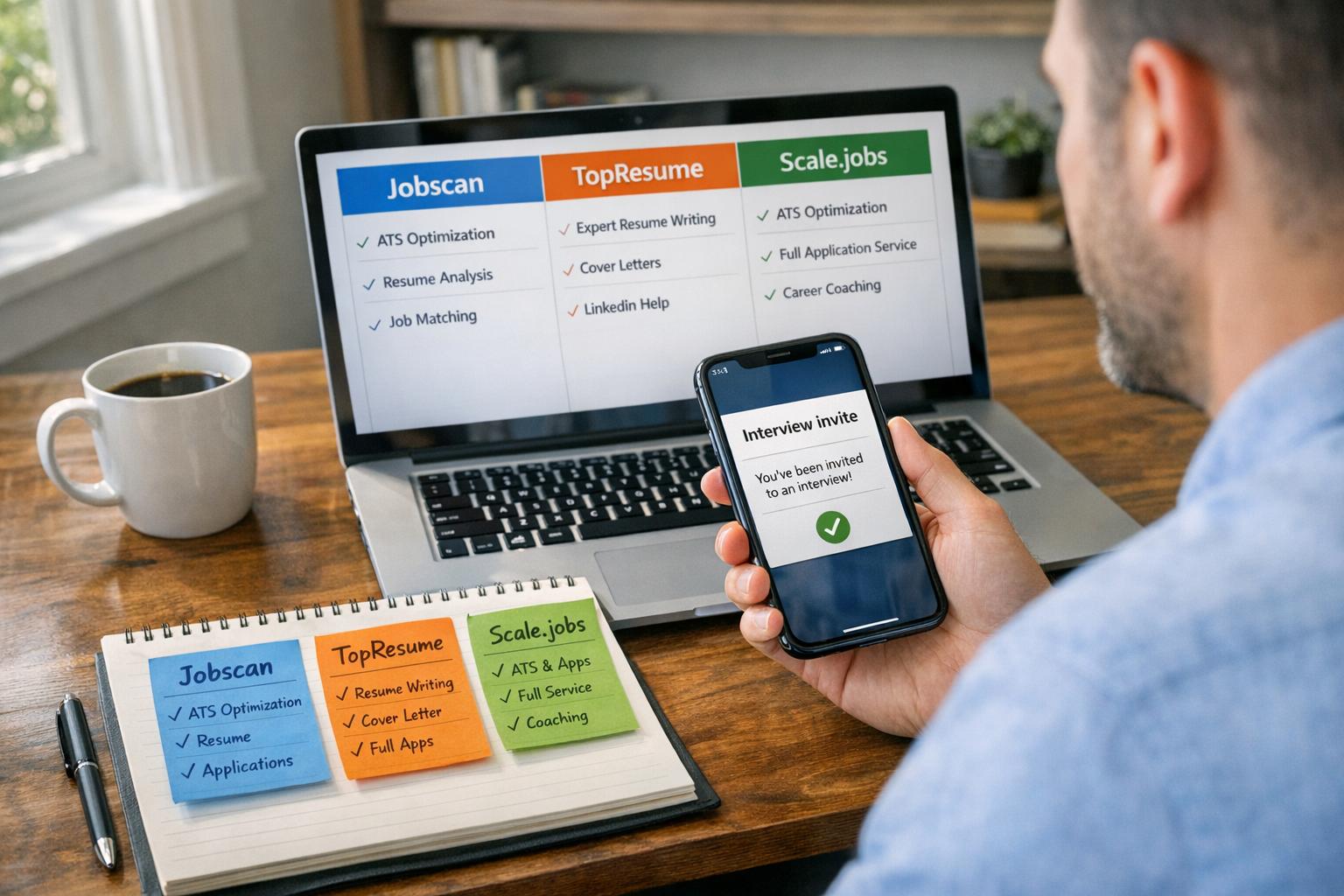
- Tailor Your Resume: Ensure it’s ATS-friendly and aligned with job descriptions. Use tools like Jobscan or professional services for optimization.
- Practice Behavioral Questions: Structure answers using the STAR method (Situation, Task, Action, Result) and back claims with specific results.
- Prepare for AI Evaluations: Use AI platforms to refine answers but balance with human feedback for soft skills.
- Optimize Your Virtual Setup: Ensure proper lighting, audio, and a distraction-free environment during video interviews.
- Mock Interviews: Combine AI and human-led mock sessions to improve delivery and confidence.
- Align with Company Values: Connect your experiences to the company’s mission and challenges.
These steps ensure you’re prepared for modern hiring processes, where preparation and adaptability are key. For those overwhelmed by job applications, platforms like Scale.jobs offer personalized job application services and tools to save time and improve success rates.
11-Step Interview Preparation Guide for 2026
JOB INTERVIEW QUESTIONS & ANSWERS 2026 | How to PASS Any Job Interview!
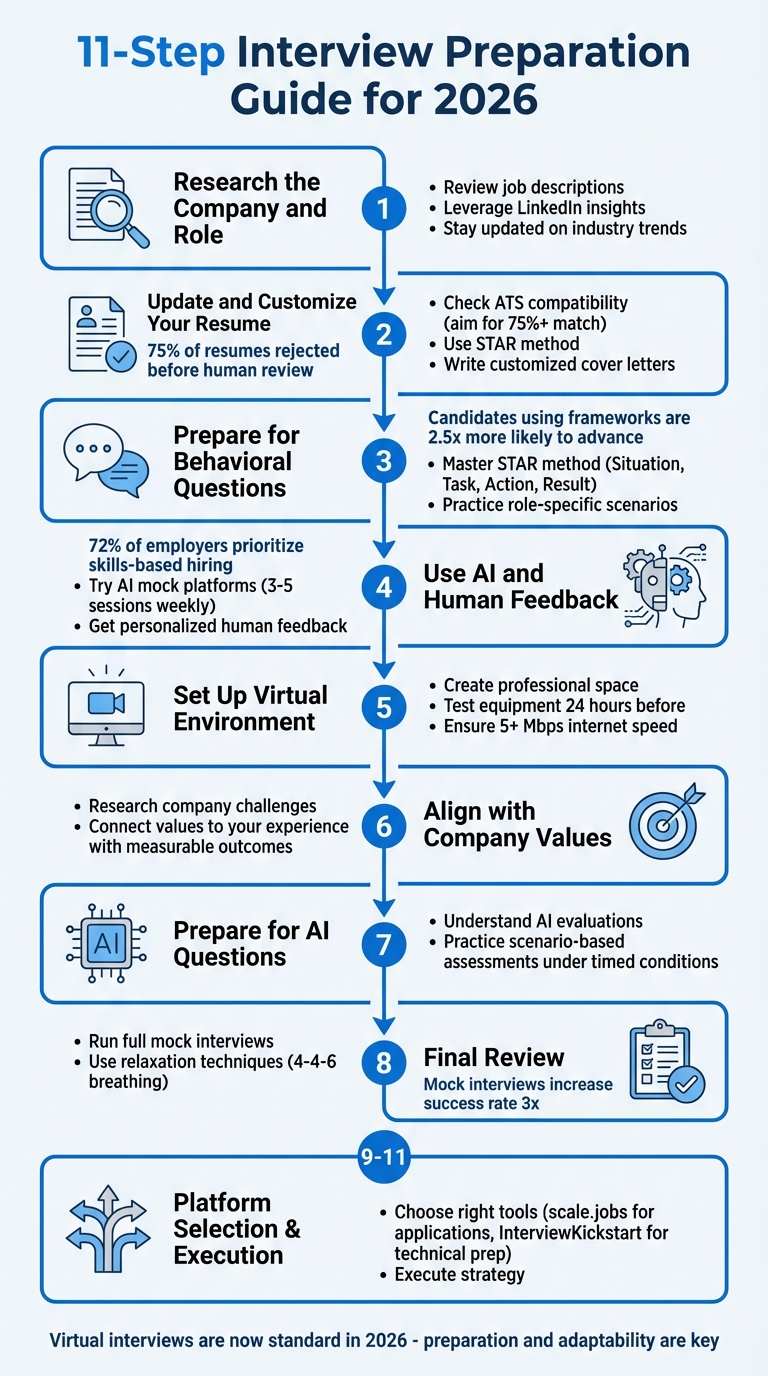
Step 1: Research the Company and Role
In 2026, research goes far beyond skimming the "About Us" page. Employers now look for candidates who can reference specific company initiatives, recent milestones, and strategic goals. The effort you put into understanding the company can set you apart - whether it’s analyzing earnings calls or diving into detailed reports.
Review Job Descriptions and Company Websites
Start with the job posting. Pinpoint the top 3–5 key requirements and align them with insights from the company’s official website. For publicly traded companies, the "Investor Relations" section is a treasure trove of information. Look at 10K and 10Q reports to grasp their financial status and future plans. Earnings call transcripts are especially useful, as they reveal leadership’s priorities and the language they use to discuss their goals.
For a broader perspective, use search queries like "[Company Name] employee reviews OR complaints" to uncover candid feedback. To go even deeper, explore business databases such as Nexis Uni, ABI/INFORM, or Business Source Complete for comprehensive analysis.
Leverage LinkedIn and Employee Insights
LinkedIn is an invaluable tool for understanding the company’s culture and hiring patterns. Use it to explore the career paths of individuals currently working in your desired role. Visit the company’s LinkedIn page and click on the "People" tab to identify trends in employees’ previous roles and commonly highlighted skills. This can reveal hiring preferences and skillsets that might not be explicitly mentioned in the job description.
Platforms like Glassdoor can provide salary benchmarks and even specific interview questions shared by past candidates. Additionally, tools like "Insider Connections" on LinkedIn can help you find referral opportunities or connect with current employees for direct insights. If you’re fine-tuning your application, consider using professional services like an AI resume builder with human review to ensure your materials are tailored and ATS-friendly.
Stay Updated on Industry Trends
Keeping up with industry developments is crucial in 2026. For example, salary transparency laws are becoming more widespread, making compensation discussions a standard part of the hiring process. AI-assisted interviews are also common, with recruiters paying attention to non-verbal cues like body language and response cadence to ensure authenticity.
In tech roles, front-end system design has gained importance - not just for back-end engineers. Researching the company’s recent product launches, mentorship initiatives, or strategic changes can provide valuable talking points. Mentioning these specifics in your application or interview demonstrates that you’re not only informed but genuinely interested in contributing to their goals.
This kind of deep research lays the groundwork for tailoring your resume and interview strategy. Tools like Scale.jobs excel in helping you refine these aspects, providing a clear edge over competitors like InterviewKickstart. Use these insights to build a strong foundation for success in the next steps of your job search.
Step 2: Update and Customize Your Resume and Cover Letter
Using the insights from your research, it's time to tailor your resume and cover letter to show how your skills and experience align with the company's specific needs. With most companies relying on Applicant Tracking Systems (ATS) and behavioral metrics, your application must meet two crucial goals: pass automated screening and stand out to a human recruiter. Considering that 99% of Fortune 500 companies use ATS and 75% of resumes are rejected before a recruiter even sees them, personalization is no longer a choice - it's a must.
Check ATS Compatibility with Tools
Start by testing your resume with an ATS-friendly tool to identify formatting and keyword issues. Platforms like Jobscan analyze your resume against job descriptions, providing a match score based on skills, job titles, and education. Users have reported a 50% increase in interview chances and three times more callbacks after optimizing their resumes. Jobscan offers 5 free scans per month, making it a great starting point.
Another option, Kickresume, evaluates design, structure, and content through 20+ checks. With a 4.6/5 Trustpilot rating from over 3,600 users, it’s a reliable choice. For a quicker analysis, Hireflow provides an ATS score and keyword gap analysis in just 30 seconds, with no login required. Aim for at least a 75% match rate - while 100% is ideal, 75% is often enough to pass ATS filters without overloading your resume with keywords.
If you’re looking for a platform that combines ATS optimization with human oversight, scale.jobs offers both. This ensures your resume is not only error-free and ATS-friendly but also persuasive enough to capture a recruiter’s attention.
To avoid common ATS pitfalls, follow these tips:
- Use .docx formats unless a PDF is specifically requested.
- Avoid tables, columns, graphics, headers, and footers.
- Stick to traditional section titles like "Work Experience" instead of more creative alternatives like "Career Highlights."
These adjustments can significantly improve your chances of making it past the initial screening.
Use the STAR Method to Highlight Achievements
Generic job descriptions won’t cut it. Recruiters are looking for specific, measurable results presented in a structured way. The STAR method - Situation, Task, Action, and Result - helps you frame your accomplishments effectively. For example, instead of writing "Managed a team", try: "Led a 12-person engineering team to deliver a product feature 3 weeks ahead of schedule, reducing customer churn by 18%." This level of detail not only shows your impact but also gives interviewers concrete examples to discuss.
If you’re unsure how to frame your achievements, AI-powered resume tools can analyze your content and suggest role-specific improvements. These tools help transform generic work histories into tailored, impactful narratives that align with the job description. Focus on quantifiable outcomes - such as revenue growth, time savings, or efficiency improvements - and use the STAR framework to make your resume both ATS-friendly and compelling to human reviewers.
Once your resume is polished, use these examples to craft a cover letter that directly addresses the company’s needs.
Write Customized Cover Letters for Each Role
A strong cover letter should directly address the company’s challenges and the role’s requirements. Use the research you gathered in Step 1 to reference specific details, such as recent product launches or strategic initiatives, and explain how your experience aligns. For example, if the company is expanding into new markets, mention your expertise in market entry strategies and how it supports their goals.
You don’t need to start from scratch every time. Create a flexible template with 3–4 core paragraphs that you can adjust for each role. Use the same keywords from the job description that you optimized in your resume to maintain consistency. Tools like SkillSyncer (available for about $11.62/month on a quarterly plan) can help identify job-specific skills to include in your cover letter.
For more comprehensive support, consider scale.jobs for expert resume and cover letter services. Their offerings include:
- Personalized adjustments by human assistants
- ATS-optimized documents tailored for specific roles
- A one-time payment covering all job search needs
- Real-time revisions via dedicated WhatsApp support
Step 3: Prepare for Behavioral and Role-Specific Questions
Once your resume and cover letter are polished, it’s time to focus on proving your qualifications during the interview. Employers today expect candidates to back up their claims with specific, measurable examples. Research shows that structured responses significantly increase your chances of progressing. For instance, LinkedIn data highlights that candidates using frameworks are 2.5 times more likely to advance, and a 2025 SHRM study found that 68% of hiring managers prefer structured answers, a number that rises to 75% in tech roles, where AI screening tools value quantifiable results.
Use the STAR Method for Behavioral Questions
The STAR Method - Situation, Task, Action, Result - is an effective way to structure responses to questions like "Describe a challenge you overcame" or "Tell me about a time you showed leadership." Start by setting the scene (Situation), describe your responsibility (Task), outline your actions (Action), and end with measurable results (Result). For example, saying, "I led a project that cut turnaround time by 30%" clearly conveys your impact.
For open-ended prompts like "Tell me about yourself", you can adapt the STAR method. Start with a brief overview of your current role and expertise, highlight a major achievement using the Action and Result steps, and tie it back to the job you’re applying for. Keep your response under 2 minutes and practice delivering it out loud to ensure clarity and confidence.
Be prepared for modern prompts like "Describe a project where you used AI tools to overcome obstacles", which allow you to demonstrate both technical proficiency and problem-solving skills. Practicing concise, 2–3 minute answers to behavioral questions such as "Give an example of when you failed and what you learned" or "Describe a time you managed a workplace conflict" will help you stay sharp. Use AI tools for practice but balance them with feedback from peers or professionals. If you’re seeking expert advice to refine your responses, consider professional resume and interview coaching services for tailored guidance.
Once you’ve nailed your behavioral answers, shift your attention to preparing for role-specific challenges.
Practice Role-Specific Scenarios
In addition to behavioral questions, employers often test your ability to handle challenges specific to your role. For software engineers, this might involve solving technical problems like "Design a scalable system for real-time data processing" or "Debug a distributed system failure." Platforms like LeetCode offer over 2,000 problems, many tagged by company and difficulty level. For example, Google often includes dynamic programming questions. Aim to solve 5–10 problems daily, review optimal solutions, and practice under timed conditions to prepare for algorithm-heavy tasks.
For non-technical roles, the focus shifts to industry-specific challenges. Marketing professionals might be asked, "How would you launch a product using AI-driven personalization while navigating privacy regulations?" Sales candidates, on the other hand, may need to address objections like "How would you handle a client’s pricing concerns in a competitive market?" Stay informed on industry trends by reviewing resources like Glassdoor, company earnings reports, and Gartner research. Identify key challenges - such as AI ethics in technology or sustainability in consumer goods - and prepare 3–5 STAR responses that connect your experience to these themes.
Platforms like Pramp and Interviewing.io provide peer-to-peer practice and AI-driven simulations for both behavioral and role-specific scenarios. Keep a journal to track your progress, noting which questions you handle well and where there’s room for improvement. Regularly refine your answers based on feedback, and tailor them to reflect current trends like hybrid work challenges or AI integration. By preparing methodically, you’ll feel confident tackling both standard interview questions and unexpected, job-specific scenarios.
Step 4: Use AI and Human Feedback for Mock Interviews
Once you've prepared your STAR responses and role-specific scenarios, it's time to put them to the test. Mock interviews, conducted with both AI tools and human reviewers, can simulate real-world conditions, helping you refine your answers, identify weaknesses, and build confidence. This combination of feedback ensures you're ready to handle the pressure of an actual interview. Unlike InterviewKickstart, Scale.jobs provides a blend of real-time AI analysis and personalized human feedback, giving you a well-rounded preparation strategy. With 72% of employers in 2026 prioritizing skills-based hiring over traditional credentials, your ability to communicate your experience effectively is more critical than ever.
Try AI-Powered Mock Interview Platforms
AI-driven platforms are a great way to practice answering common interview questions and sample answers. Tools like Scale.jobs AI Interview Responses analyze your answers instantly, flagging areas for improvement such as overuse of filler words, vague phrasing, or a lack of measurable results. These platforms are particularly effective for behavioral questions, such as "Describe a time you led a team" or "How do you handle tight deadlines?" By conducting 3–5 mock sessions each week, you can refine your responses, experiment with different approaches, and ensure your delivery feels natural and confident.
For technical roles, AI tools can simulate coding challenges or system design questions, providing valuable practice for standard prompts. However, while AI excels at identifying structural or technical flaws, it falls short in evaluating soft skills like communication style or quick thinking. Use AI tools to strengthen your fundamentals, but complement this with human feedback to fine-tune the nuances that automated systems might overlook.
Obtain Detailed, Personalized Advice from Human Reviewers
AI tools may be fast, but human feedback is unmatched in depth and nuance. A career coach or mentor can provide insights that go beyond what AI can detect, such as whether your tone feels genuine, if you're over-explaining, or if your body language detracts from your message. As career coach Kelsie Marks explains:
"The goal of career coaching is to provide you with actionable tools, resources, and strategies... Give motivation, accountability, and feedback."
Scale.jobs Human Assistants connect you with trained professionals who review your mock interview recordings and offer tailored advice on your content, delivery, and presentation. Here’s how Scale.jobs stands out compared to competitors like InterviewKickstart:
- Expert feedback from professionals familiar with modern hiring trends, ensuring your responses align with what employers value today.
- Actionable suggestions to improve clarity and eliminate overly rehearsed answers.
- Quick, focused coaching sessions via WhatsApp, offering real-time guidance and support.
- A one-time payment model with transparent results, avoiding the subscription-based models used by other services.
- Integration of ATS optimization with human expertise, ensuring your application materials and interview responses work cohesively.
For example, a Scale.jobs reviewer might recommend condensing a lengthy 3-minute answer into a sharp 90-second pitch that highlights your most relevant achievements. You can also schedule 15-minute "coffee chats" with professionals in your target industry to rehearse your pitch and receive immediate feedback. While InterviewKickstart leans heavily on AI tools, Scale.jobs combines this with human expertise for a balanced and effective approach. For more comprehensive support, consider professional resume and interview coaching services that include one-on-one strategy sessions and regular check-ins to keep you motivated during your job search.
Step 5: Set Up Your Virtual Interview Environment
Your virtual interview setup plays a crucial role in how hiring managers perceive your professionalism and attention to detail. While refining your answers is essential, the environment you present during the interview is equally important. A cluttered background, poor lighting, or unreliable audio are common virtual interview mistakes to avoid that can leave a negative impression. On the other hand, a polished setup conveys that you're organized and take the opportunity seriously. With virtual interviews becoming the norm for first-round and technical screenings in 2026, your environment can make or break your presentation. Natalie Lemons, Founder and President of Resilience Group, LLC, puts it well:
"Communication is rarely evaluated in isolation. Instead, it functions as a proxy for broader professional capabilities."
A clean, well-prepared space reflects your organizational skills and respect for the interviewer's time.
Create a Professional Interview Space
Start by selecting a quiet, distraction-free spot with a neutral or simple background. Avoid sitting with a window directly behind you, as it can create harsh backlighting. Instead, position yourself facing a window or use a desk lamp at eye level to achieve balanced, flattering lighting. If your home environment is noisy or unpredictable, consider alternatives like a coworking space or a private room in a library.
Your internet connection is another critical factor. Ensure it supports at least 5 Mbps upload and download speeds to avoid lag or interruptions. Run a quick speed test on platforms like Fast.com or Speedtest.net. If your connection seems unstable, switch to a wired Ethernet cable for better reliability. To minimize digital distractions, close unnecessary browser tabs and apps. Tools like a dedicated job inbox from Scale.jobs can keep recruiter communications organized and separate from personal emails, reducing stress on interview day.
Once you've optimized your space, it's time to focus on your equipment and attire.
Test Equipment and Attire Before the Interview
Conduct a full equipment check 24 hours before the interview. Record a short video to verify your camera's framing, lighting, and microphone quality. Speak at your normal interview volume to ensure your voice is clear and free from background noise. If you’re using headphones, opt for a wired pair with a built-in microphone to avoid potential Bluetooth issues.
Dress professionally from head to toe, even if only your upper half will be visible on screen. Wearing full business attire can boost your confidence and prevent awkward moments if you need to stand up unexpectedly. Stick to solid, neutral colors like navy, gray, or white, as busy patterns or bright colors can appear distorted on video. For those looking for extra guidance, professional resume and interview coaching services can provide tailored strategies to enhance both your preparation and virtual presence. Just as Scale.jobs simplifies your application process with tools like WhatsApp support, a well-thought-out virtual setup underscores your professionalism and readiness.
Step 6: Align Your Answers with Company Values
After making targeted resume changes and practicing your responses, the next step is aligning your answers with the company's core values. Avoid generic responses - they lack focus. Instead, connect your past experiences to the company’s mission and current challenges. Candidates who demonstrate this connection show they’re not only qualified but also ready to address specific needs. This approach is especially relevant as companies increasingly use AI-driven tools to evaluate cultural fit alongside technical skills. Speaking the company’s language and addressing their priorities can set you apart from those who rely on cookie-cutter answers.
Research Company Challenges and Goals
Dive into resources like press releases, quarterly reports, LinkedIn updates, and Glassdoor reviews to uncover the company’s challenges and goals. Look for details about expansion plans, product launches, or market hurdles. For instance, if reviews mention inefficiencies in decision-making, prepare examples of how you’ve streamlined processes in your previous roles. Tools like Jobright's AI Job Match can also help you identify how your qualifications align with the role, providing a solid foundation for your interview preparation.
By automating repetitive application tasks or delegating them to human assistants, you can free up time to focus on deeper research. Use this time to connect with current employees on LinkedIn or attend industry events to gather insights not readily available online. Additionally, setting up a dedicated job search inbox can help you organize recruiter communications and track feedback about company needs. This preparation ensures you’re equipped with relevant details to demonstrate how your achievements directly address the company’s challenges.
Connect Company Values to Your Experience
Once you’ve identified the company’s priorities, tailor your examples to reflect their values. For example, if the company emphasizes innovation, share a story about a time you introduced a new tool or process. If collaboration is a core value, discuss a cross-functional project you led. Replace vague statements with measurable outcomes that align with their goals. For instance, if customer retention is a focus, explain how you improved retention rates by a specific percentage instead of simply saying you “worked with customers.”
Leverage expert tools to refine your language and align it with the company’s terminology. If you’re unsure how to position your experience effectively, consider using professional resume and interview coaching services to develop a tailored strategy. Just as Scale.jobs uses human assistants to personalize applications, aligning your interview responses requires thoughtful customization. The key is to show that you’ve done your homework and are ready to contribute to solving the company’s challenges. For those seeking additional support, Scale.jobs offers a streamlined process, including WhatsApp assistance, to help you articulate responses that resonate with employers.
Step 7: Prepare for AI and Scenario-Based Questions
Building on the mock interview practice from Step 4, this step zeroes in on mastering AI-driven and scenario-based questions, which are becoming a staple in modern hiring processes. These types of interviews often simulate real-world challenges, testing your problem-solving skills and adaptability in situations you might encounter on the job.
Understand How AI Evaluations Work
AI-powered interview platforms, like Jobright with its "AI Job Match" feature, are designed to assess how well your responses align with the job's key requirements. These systems evaluate the clarity of your reasoning, your ability to communicate effectively, and whether your answers demonstrate the skills and competencies employers are seeking.
To prepare, research the specific AI tools used by the companies you're targeting. Many platforms provide practice modes or sample questions, which can help you familiarize yourself with their process. Treat these AI assessments as a skill you can refine through practice and feedback. Regular, focused preparation will help you approach these evaluations with confidence.
Once you’re comfortable with AI-driven assessments, shift your focus to scenario-based questions to further enhance your readiness.
Practice Scenario-Based Assessments
Scenario-based questions challenge you to respond to hypothetical situations that are relevant to your prospective role. For instance, a product manager might need to address conflicting stakeholder demands, while a software engineer could face an unexpected technical problem. These exercises test your ability to prioritize, weigh trade-offs, and make sound decisions, offering insight into how you might handle future challenges.
To prepare, research scenarios common in your field and practice responding to them under timed conditions. Start by identifying the main problem, exploring potential solutions, and then explaining your approach clearly and logically. For technical roles, platforms like LeetCode or HackerRank provide timed exercises that simulate real-world challenges. Business professionals can benefit from working through case studies to hone their decision-making skills. Practicing under pressure not only improves your ability to organize your thoughts but also builds confidence for the actual interview.
Step 8: Do a Final Review and Build Confidence
Once you've tackled AI-driven and scenario-based questions, it's time to pull everything together and head into your interview feeling calm and self-assured. This step is all about reducing any last-minute jitters and ensuring you're mentally ready to shine.
Run Full Mock Interviews
Set up a complete mock interview to replicate the actual experience. This means preparing your interview space, dressing professionally, and answering questions without interruptions or second chances. Studies suggest that candidates who engage in mock interviews are three times more likely to succeed in real interviews[1]. You can practice with a friend who can throw in unexpected questions or explore platforms that provide realistic interview simulations.
The goal here is to make the entire process - from your initial greeting to your closing remarks - feel second nature. When you walk into the actual interview, nothing should feel unfamiliar or catch you off guard.
Use Relaxation Techniques
Even with solid preparation, feeling nervous before an interview is completely normal. To manage this, try simple breathing exercises right before the interview. A proven method involves inhaling for 4 counts, holding your breath for 4 counts, and exhaling for 6 counts. Repeat this sequence 3–5 times to help your body relax and your mind focus.
Another powerful tool is positive visualization. Take a few moments to imagine yourself confidently answering questions and receiving encouraging feedback from the interviewer. Pair this with positive self-talk, reminding yourself of your achievements and strengths. Remember, no one expects perfection - what truly matters is how you recover from unexpected challenges. Practicing good posture and maintaining steady eye contact during your mock sessions can also reinforce your confidence and help you project it during the real thing.
Is InterviewKickstart Worth It? Reviews & Alternatives
For senior tech professionals aiming for FAANG+ roles, InterviewKickstart has built a reputation for its rigorous technical training programs. The platform provides specialized courses for 18 different tech roles, featuring 15 to 21 mock interviews and instruction from highly experienced mentors. It boasts a 4.81/5 rating on SwitchUp, based on 53 reviews, with users frequently praising its in-depth curriculum and knowledgeable instructors.
That said, InterviewKickstart is focused solely on interview preparation. While it equips you to tackle system design and coding challenges, it doesn’t assist with finding job openings, tailoring resumes, or managing the extensive application process. This is where scale.jobs stands out - by taking over the time-consuming task of job applications through human-led processes, ensuring ATS compatibility and personalized submissions that automated tools often miss.
While InterviewKickstart is excellent for boosting your technical skills, scale.jobs addresses the often-overlooked challenge of job application execution. Here’s why scale.jobs can be a better option for managing your job search:
Why scale.jobs excels in application execution:
- Human assistants handle every application manually, bypassing automated tools that may trigger bot flags.
- ATS-optimized resumes tailored to each job posting, delivered within 24 hours.
- Transparent pricing, ranging from $199 (for 250 applications) to $1,099 (for 1,000 applications with full support), compared to InterviewKickstart’s tuition fees of $4,900–$9,600.
- Real-time updates via WhatsApp, complete with time-stamped screenshots for proof of work.
- Compatibility with all job portals, from corporate ATS systems to niche job boards.
While InterviewKickstart focuses on technical skill-building, scale.jobs prioritizes streamlining the job search process, saving you hours of repetitive work.
Strengths and Drawbacks of InterviewKickstart
InterviewKickstart is ideal for sharpening your technical expertise. With intensive programs lasting 11–15 weeks, it has helped over 13,500 tech professionals land roles, with some achieving offers as high as $1.267 million. The curriculum is tailored for roles like Backend Engineer, Machine Learning Engineer, Engineering Manager, and Technical Program Manager. However, the platform has its challenges - some users have reported "missed meetings" and inconsistent communication, and the high tuition cost requires a significant upfront investment.
How scale.jobs Differs
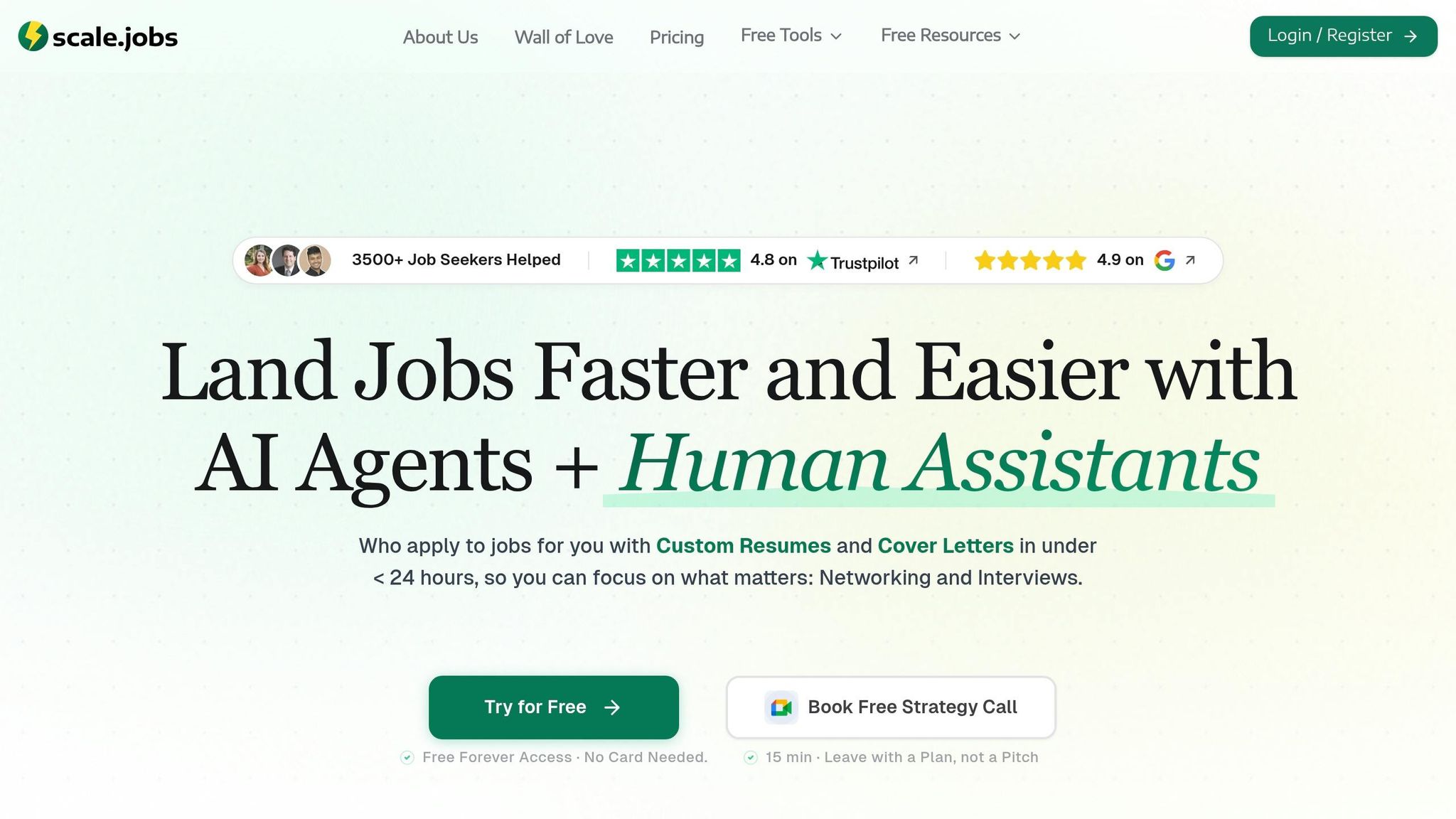
In contrast, scale.jobs assumes you already possess the necessary skills and focuses on getting your resume in front of hiring managers. As noted by the Jobright Editorial Team:
Scale.jobs is worth considering if time savings matter more than cost and you prefer human-led applications.
The platform doesn’t teach coding or conduct mock interviews, but it can save you over 20 hours per week by automating application tasks. Additional tools, like an ATS score checker, cover letter generator, and job tracker, complement your job search efforts, making it a practical addition to your interview prep strategy. For those needing extra help with resumes, professional resume writing services are also available.
The choice between the two platforms boils down to your needs: InterviewKickstart is a training program to master technical interviews, while scale.jobs is a productivity tool to efficiently manage job applications. Below, a comparison table highlights their key differences.
Comparison Table: Features and Focus
| Feature | InterviewKickstart | scale.jobs |
|---|---|---|
| Primary Goal | Mastering technical interviews | Automating job applications |
| Human Involvement | Instructors and mentors | Human assistants for applications |
| Resume Support | Not included | ATS-optimized, tailored per job |
| ATS Compatibility | Not applicable | Built-in ATS checker and manual submissions |
| Application Process | Self-managed | Fully handled by human assistants |
| Transparency | Feedback on mock interviews | Real-time updates with proof of work |
| Pricing | $4,900–$9,600 (tuition-based) | $199–$1,099 (one-time payment) |
| Duration | 11–15 weeks | Ongoing support |
| Target Audience | Senior tech professionals | Job seekers needing application help |
| Job Board Access | Not included | 2M+ US-based job postings monthly |
Who Should Consider InterviewKickstart?
Choose InterviewKickstart if you’re an experienced engineer or data professional looking to refine your technical skills for high-stakes interviews. It’s particularly suited for those targeting Backend, Machine Learning, or TPM roles at top-tier companies. The program’s structured practice in system design, algorithms, and behavioral interviews can be a game-changer for those who already have a solid foundation but need to elevate their expertise. With AI Engineers earning $150,000–$180,000 and Software Developers averaging $120,000+ by 2026, the tuition cost can pay off if you secure a FAANG+ offer. Some programs even offer a conditional 50% refund if job placement goals aren’t met.
However, InterviewKickstart is not a job search tool. If your primary obstacle is time rather than technical skills, you’ll need additional resources to manage applications and networking.
Who Should Opt for scale.jobs?
Choose scale.jobs if your main challenge is the volume and complexity of job applications. This platform is designed for job seekers who value human oversight over fully automated systems and want a transparent, efficient solution for managing applications. It’s especially helpful for recent grads, professionals re-entering the workforce, and those in transition who need to apply to hundreds of roles without sacrificing quality. With pricing starting at $199, it’s a cost-effective way to save time and focus on networking or interview preparation.
However, scale.jobs is not a training platform. It won’t teach you coding or conduct mock interviews, so pairing it with learning resources or coaching may be necessary if you’re not fully prepared for the interview stage. Additionally, its job board is limited to U.S.-based roles, which could be a drawback for international candidates. Still, for those confident in their skills but overwhelmed by the application process, scale.jobs offers a straightforward and reliable solution.
Switch to scale.jobs If
When you're deep into interview preparation, picking the right application tool becomes a crucial step in streamlining your job search.
You Need Human Help with Applications
Spending over 20 hours a week filling out application forms, uploading documents, and answering repetitive questions? Scale.jobs can save you that time. The platform assigns trained human assistants to manually handle each application. They ensure your resume is tailored to the job description and that all fields are completed accurately.
This is especially helpful when applying to hundreds of positions across different platforms. Corporate ATS systems like Workday and Greenhouse vary in layout, and niche job boards often require specific formatting. Human assistants navigate these complexities seamlessly, avoiding the errors AI tools might make when facing unexpected form fields or security checks. Plus, you’ll receive personalized application materials within 24 hours, along with real-time WhatsApp updates and time-stamped submission screenshots.
You Want Proof of Work and Transparency
Scale.jobs stands out with its dedicated application dashboard, offering full visibility into your job search. Rather than generic "application sent" emails, you’ll receive screenshots of completed forms, confirmation pages, and recruiter communications. This level of detail ensures you can track every submission with confidence.
Additionally, the platform provides a dedicated job inbox to separate recruiter messages from your personal email. This feature keeps your job search organized and prevents critical communications from being lost in spam folders. If you're juggling multiple applications, this setup ensures you stay on top of every opportunity.
You Need Complete Job Search Tools
Scale.jobs goes beyond application management with a free toolkit that includes an ATS score checker, cover letter generator, job application tracker, salary predictor, and interview question predictor and AI tools. These tools simplify and centralize your job search process.
For those needing extra help, you can access professional resume writing services starting at $199. This package includes a 45-minute consultation and three job applications managed by human assistants. The platform’s one-time payment model - ranging from $199 for 250 applications to $1,099 for 1,000 applications with full support - eliminates recurring subscription fees. This structure is ideal for job seekers focusing on an intensive search within a specific timeframe.
These features make scale.jobs a strong choice for job seekers who need hands-on support and comprehensive tools to optimize their search process.
Decision Summary: Choosing Your Interview Prep Platform
After evaluating the features and approaches of various platforms, here's a streamlined guide to help you select the best interview prep solution for your needs.
In 2026, preparing for interviews requires a well-planned strategy integrated with your overall job search efforts. The platform you choose should complement your approach to managing job applications, whether you value the precision of human assistance or the efficiency of AI tools.
Choose scale.jobs if you're applying to a large number of positions and want human experts to manage the repetitive process of filling out applications, allowing you to concentrate on interview preparation. Key features include:
- Human-led application submissions, avoiding automated processes that might trigger bot detection.
- Custom ATS-optimized resumes tailored for each job, delivered in just 24 hours.
- One-time payment plans ranging from $199 to $1,099, avoiding recurring subscription costs.
- Real-time updates via WhatsApp, complete with time-stamped screenshots for transparency.
- Dedicated job inbox to keep recruiter communications separate from personal emails.
This option is ideal for job seekers prioritizing precision over volume, particularly for roles in the U.S. that involve complex ATS systems like Workday or Greenhouse.
Choose InterviewKickstart if you're targeting technical roles at FAANG companies and need in-depth coaching on algorithms and system design. Their live, instructor-led sessions are tailored to specific roles but do not include help with application submissions or ATS-optimized resumes.
Choose Jobright if you prefer high-volume applications across the U.S. and Canada, supported by AI-driven job matching. Their "Insider Connections" feature can help identify referral opportunities, and their Chrome extension simplifies the form-filling process. However, you won't benefit from human verification to prevent bot detection or detailed proof-of-work updates like those provided by scale.jobs.
Comparison Table: Interview Prep Platforms
| Feature | scale.jobs | InterviewKickstart | Jobright |
|---|---|---|---|
| Human Involvement | Trained assistants handle all applications | Live instructors for mock interviews | AI-driven matching only |
| Resume Customization Depth | Tailored per job, ATS-optimized | Not included | Basic AI customization |
| ATS Handling | Manual submission with verification | Not applicable | Automated form-filling |
| Application Execution | Human-managed, portal-by-portal | Self-managed | AI Chrome extension |
| Transparency/Proof of Work | Screenshots + WhatsApp updates | Mock interview feedback | Application status tracking |
| Pricing Model | One-time ($199–$1,099) | Tuition-based ($4,900–$9,600) | Freemium + subscription |
Making Your Decision
The best platform for you depends on where you're spending the bulk of your time:
- If managing applications is taking up more than 20 hours per week, consider using professional resume writing services alongside human-led application management. This lets you focus on networking and interview practice, which are key to landing offers.
- If your application process is already efficient but you need targeted interview coaching, platforms like InterviewKickstart can provide specialized preparation. You can also use an interview question generator to practice common prompts for your specific role.
- For the majority of job seekers in 2026, combining human-assisted application management with AI-supported interview prep offers the most effective approach.
Use this summary to align your job search strategy with the platform that best supports your specific goals and needs.
FAQs
How can I prepare for AI-scored interviews without sounding scripted?
To make your responses feel natural and engaging, focus on preparing 3–5 key anecdotes that showcase your strengths, such as leadership, problem-solving, or resilience. These stories should be versatile enough to adapt to different questions while still sounding fresh and genuine.
Using a structured approach to improvisation can help you stay on topic without sounding overly rehearsed. AI tools can also be incredibly useful here - they can analyze your tone and flag responses that might come across as too scripted. This feedback allows you to adjust your delivery, ensuring your answers feel personal and tailored, even if you've prepared them in advance. Balancing preparation with flexibility is the key to sounding both polished and authentic.
What’s the fastest way to tailor my resume for ATS without keyword stuffing?
To make your resume ATS-friendly without overloading it with keywords, focus on weaving key skills and relevant terms naturally throughout the document. Aim to include them 2–3 times in areas like the summary, core skills section, and work experience descriptions. This approach keeps your resume clear and avoids triggering spam filters. If you're unsure, AI resume analyzers can simplify the process, helping you optimize your resume for ATS while maintaining a clean and professional tone.
What should I do if my virtual interview setup fails mid-call?
If your virtual interview setup encounters a hiccup mid-call, it’s important to stay calm and act swiftly. Start by checking your internet connection and device functionality - sometimes a quick restart can resolve the issue. Let your interviewer know about the problem right away, briefly explaining what happened and asking if you can reschedule or pick up where you left off. If you have access to a backup device or an alternative internet source, try reconnecting through those. Before jumping back into the interview, double-check your camera, microphone, and connection to make sure everything is functioning smoothly.