
STEM OPT Extension: How to Maximize Every Week of Your Job Search
A 24-week, week-by-week plan to optimize your STEM OPT job search, stay SEVP-compliant, track unemployment days, and ace interviews.


Navigating the job search under the STEM OPT extension can be challenging due to strict timelines, unemployment limits, and visa-specific requirements. This guide breaks down actionable steps to maximize your job search efforts and stay compliant with U.S. immigration rules. Key takeaways:
- 150-Day Unemployment Cap: Exceeding this limit can jeopardize your F-1 status.
- Employer Requirements: Work only for E-Verify-enrolled employers with a valid Form I-983.
- Structured Weekly Plan: From preparing documents to networking and interview prep, this guide provides a step-by-step framework.
- Compliance: Track your SEVP updates, I-983 changes, and unemployment days carefully.
Learn how tools like Scale.jobs, LazyApply, and Simplify.jobs compare, and find the best approach to secure full-time jobs while maintaining your visa status.
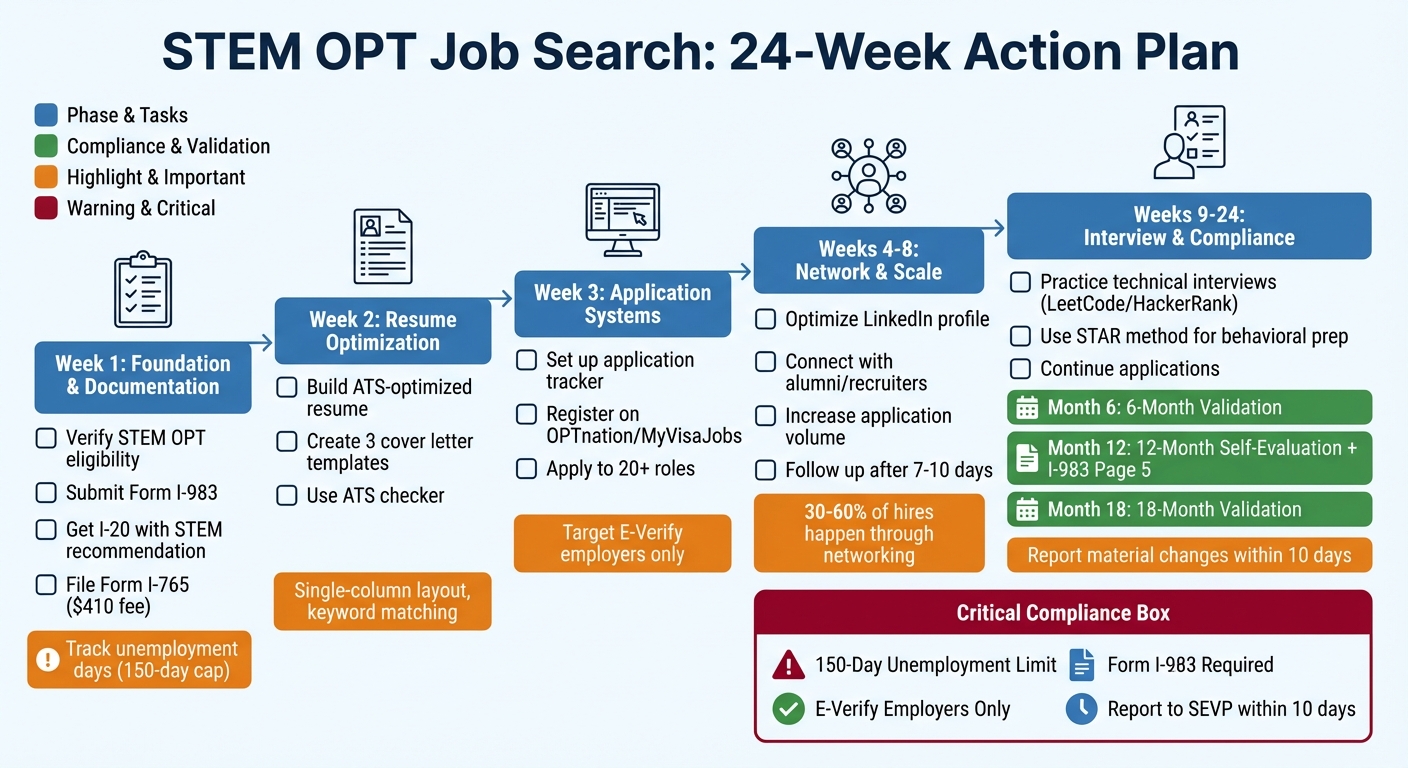
24-Week STEM OPT Job Search Timeline with Key Milestones and Compliance Requirements
Week 1: Verify STEM OPT Eligibility and Gather Required Documents
Check Your STEM OPT Eligibility Requirements
Before submitting anything to USCIS, make sure you meet all the STEM OPT requirements. First, confirm that your employer is enrolled in E-Verify and has a valid Employer Identification Number (EIN). You'll need their E-Verify Company Identification Number to complete Form I-765, so reach out to your HR department for this information as soon as possible. Your job must be paid, at least 20 hours per week, and directly tied to your STEM degree. If you're working with a staffing agency, ensure they maintain a direct employer-employee relationship and provide hands-on training.
Keep an eye on your unemployment days. If you’ve already used 90 days during standard OPT, you’ll only have 60 days left during the STEM extension. Use a spreadsheet or calendar to track this carefully since exceeding the limit could result in the termination of your F-1 status and SEVIS record. Finally, confirm that your degree is listed on the STEM Designated Degree Program List maintained by the Department of Homeland Security. Staying organized and proactive here is key to maintaining your F-1 status while continuing your job search. If you have already graduated but don't have a job, focusing on these compliance steps is the first move toward securing your future.
Prepare Required Forms and Documentation
Start by submitting Form I-983 (Training Plan) to your Designated School Official (DSO). This form needs input from both you and your employer. Your employer is responsible for completing Sections 3 through 6, which include information like their NAICS code (you can find this on the U.S. Census website), compensation details, and a detailed training plan in Section 5. The training plan should outline your learning objectives and explain how your supervisor will monitor your progress. According to the Study in the States website, "DHS requires that the STEM OPT student and employer work together to complete the Form I-983."
Once your DSO approves the I-983, they’ll issue a new Form I-20 with a STEM recommendation. Only after receiving this updated I-20 should you file your application with USCIS. Submit Form I-765 within 60 days of your DSO’s SEVIS update, but no more than 90 days before your current OPT expires. The filing fee is $410.00, though it’s a good idea to double-check the current rates on the USCIS website. Along with Form I-765, include copies of all prior I-20s, your I-94 arrival record, your F-1 visa, your passport photo page, your STEM degree or transcript, and two passport-style photos. If you need faster processing, you can file Form I-907 for premium processing, which guarantees a decision within 30 business days.
If you’re unsure about completing these forms or coordinating with your employer, consider using professional documentation services that specialize in visa compliance. Mistakes on Form I-983 or I-765 can lead to significant delays, so accuracy is crucial in this initial week.
Once you’ve confirmed your eligibility and prepared your documents, you’ll be ready to focus on creating ATS-optimized resumes in Week 2.
Week 2: Build ATS-Optimized Resumes and Cover Letters
Apply ATS-Compliant Formatting and Keywords
To ensure your resume gets through both the Applicant Tracking System (ATS) and the hiring manager’s review, stick to a clean, simple format. Use a single-column layout with easy-to-read fonts like Arial or Calibri. Avoid using tables, text boxes, or graphics, as these can confuse ATS software and lead to your resume being rejected. Use clear headings such as Education, Experience, and Skills to help the system correctly interpret your information.
Incorporate keywords directly from the job posting into your resume. For example, if you see terms like "Python", "data analysis", or "Agile methodology", include those phrases exactly as written. Quantify your achievements wherever possible (e.g., "GPA: 3.8" or "improved process efficiency by 35%") to make your qualifications clear. For STEM OPT candidates, it’s particularly important to highlight technical skills and measurable accomplishments that demonstrate your role qualifies as a "specialty occupation" under H-1B guidelines.
When it comes to cover letters, create three templates tailored to specific industries, with placeholders for easy customization. This approach saves time while allowing you to personalize each letter for individual job applications. Before submitting, use scale.jobs’ free ATS checker to spot missing keywords or formatting issues, ensuring your documents are ready to impress.
Once your resume and cover letter are polished, you’ll be ready to tackle Week 3, where you’ll set up an application tracking system.
LazyApply vs scale.jobs: Resume Customization Comparison
When it comes to resume customization, LazyApply and scale.jobs take very different approaches. LazyApply automates the application process, which can be convenient but risky, especially for STEM OPT candidates. Automated systems often mishandle visa-specific questions like "Will you require sponsorship?" resulting in errors that could lead to rejections. For example, incorrect responses about your current OPT status or H-1B sponsorship needs might raise red flags for employers.
On the other hand, scale.jobs uses a human-in-the-loop approach, where experienced career professionals manually tailor your resume and cover letter for each job. This includes addressing visa-specific details like authorization dates and sponsorship requirements, ensuring accurate and professional communication. They also provide proof of submission with time-stamped screenshots sent via WhatsApp, so you can track your applications with confidence.
| Feature | LazyApply (Automated) | scale.jobs (Human-Powered) |
|---|---|---|
| Resume Customization | Generic keyword matching | Expert-tailored, including visa-specific details |
| Visa Question Handling | Automated responses; higher risk of errors | Manual, accurate answers tailored to OPT/STEM status |
| Bot Detection Risk | Higher; more likely to be flagged by employer systems | Lower; manual entry avoids automated triggers |
| Proof of Work | Application count only | Time-stamped screenshots via WhatsApp |
| Pricing Model | Recurring monthly fee (~$49–$99/month) | One-time fee ($199–$399 for 250–1,000 applications) |
When to choose LazyApply: If you’re applying for a large number of internships or entry-level roles where speed is more important than precision, LazyApply might work for you.
When to choose scale.jobs: If you’re a STEM OPT candidate with strict unemployment limits, scale.jobs is a better fit. Their tailored approach ensures your visa status is communicated clearly, helping you avoid wasted applications. For additional support, consider their professional resume writing services, which specialize in STEM OPT and H-1B transitions. Errors in visa-related details can quickly drain your limited application opportunities, so precision is key.
These comparisons can help you decide which service best aligns with your job search strategy. With your ATS-optimized documents ready, you’re set to move on to Week 3, where you’ll explore job boards and create a system to track your applications effectively.
Week 3: Use Job Boards and Track Your Applications
Best Job Boards for STEM OPT Candidates
After refining your documents and resumes, Week 3 shifts the focus to finding compliant employers and keeping track of your applications.
While general platforms like Indeed and LinkedIn might feature jobs that don’t sponsor visas, specialized platforms can save you time. For instance, OPTnation is tailored for OPT and STEM OPT candidates, listing E-Verify employers and roles like software developer, data scientist, or engineer. This ensures you’re targeting positions that meet compliance requirements.
For a deeper dive into sponsorship history, MyVisaJobs.com and H1BVisaJobs.com are excellent tools. These platforms provide insights into companies that have previously filed H-1B petitions, helping you identify potential H-1B sponsors. Major tech companies such as Google, Amazon, and Microsoft, along with firms in the Big Four, frequently hire international STEM graduates. On LinkedIn, optimize your profile by marking it as "Open to Work" and specifying STEM-related roles. Use keywords like "E-Verify", "OPT-friendly", or "STEM OPT" to filter positions aligned with I-983 criteria, which require paid roles of at least 20 hours per week directly tied to your degree.
Additionally, scale.jobs offers a job board with filters for cap-exempt employers, including universities, nonprofits, and research institutions. These organizations bypass the H-1B lottery cap, saving you time and effort by focusing on visa-friendly opportunities. With these platforms in mind, you’re ready to move on to tracking your applications effectively.
Simplify.jobs vs scale.jobs: Application Tracking and Submission
When it comes to managing and submitting applications, both Simplify.jobs and scale.jobs offer distinct advantages, but they cater to different needs.
Simplify.jobs relies on AI for one-click submissions across multiple job boards. While this system is fast, it may not handle visa-related details, like E-Verify or OPT start dates, with the precision required for STEM OPT candidates. This can lead to errors and even trigger employer bot-detection systems.
On the other hand, scale.jobs uses human assistants to manually complete each application. This approach ensures accurate communication of visa-specific details. They also provide proof of submission by sending time-stamped screenshots via WhatsApp, giving you confidence in the process.
| Feature | Simplify.jobs (AI-Driven) | scale.jobs (Human-Powered) |
|---|---|---|
| Submission Method | Automated AI auto-fill | Manual entry by human assistants |
| Visa Question Handling | Generic/Automated (risk of errors) | Accurate, tailored responses by humans |
| Bot-Detection Risk | High | Low |
| Resume Customization | Generic matching | Tailored to each job posting |
| Application Speed | Instant batch submissions | 12–24 hour turnaround per application |
| Proof of Work | Limited/dashboard only | Time-stamped screenshots via WhatsApp |
| Pricing Model | Monthly subscription (~$29.99/month) | Flat fee ($199–$499 for 250–1,000 applications) |
When Simplify.jobs Works Best: If you’re applying to a high volume of entry-level roles or internships and need speed, Simplify.jobs may fit the bill.
Why Choose scale.jobs: For STEM OPT candidates, where compliance and accuracy are critical, scale.jobs offers a safer option. Their human-assisted approach minimizes errors and provides documentation that can be invaluable during immigration audits. If you’re looking to further refine your application materials, consider their resume writing services for ATS-friendly resumes tailored to STEM OPT and H-1B pathways.
Once you've chosen your preferred tool, it’s time to establish a reliable tracking system for your applications.
Set Up Your Application Tracking System
Accurate tracking is vital for STEM OPT candidates due to strict regulations. A simple tracker, such as a Google Sheet, can help you stay organized. Include columns for Job Title, Company, Application Date (MM/DD/YYYY), Sponsorship (Yes/No), Status, and Follow-Up Date. Update this sheet regularly to keep everything in order.
scale.jobs simplifies this process with built-in tracking features. Their real-time WhatsApp updates and downloadable CSV logs, complete with time-stamped screenshots, make compliance easier to manage.
For example, on the first day of Week 3, aim to apply to 20 roles using platforms like OPTnation or scale.jobs. Record each submission in your tracker (e.g., "Applied: 03/15/2026, Amazon Data Scientist"). By the end of the week, follow up on your applications through LinkedIn or email with a message like: "I wanted to confirm receipt of my application for [role] and express my enthusiasm for contributing my STEM expertise."
Finally, ensure you report any employment updates to the SEVP Portal within 10 days to maintain compliance. With an organized tracking system in place, you’ll be ready to ramp up your efforts in the weeks ahead.
Weeks 4–8: Expand Your Network and Increase Application Volume
Use LinkedIn for Professional Networking
By Week 4, your job search infrastructure should be ready, and it’s time to focus on networking and leveraging referrals - 30–60% of hires happen through networking.
Start by fine-tuning your LinkedIn profile. Use a professional photo and update your headline to reflect your status and goals, such as "Software Engineer | STEM OPT | Open to Work." Your summary should emphasize your degree, technical expertise, and work authorization timeline. Activate the "Open to Work" badge to signal your availability to recruiters.
Next, grow your network thoughtfully. Connect with alumni from your university who are working at companies you’re targeting. Mention your shared alma mater in your connection request and ask for a brief informational interview. When reaching out to recruiters, be upfront about your OPT eligibility. For example, you could say, "I’m authorized to work for 12–36 months under STEM OPT." For peers or industry professionals, engage with their LinkedIn posts by leaving meaningful comments before sending a connection request - this approach helps establish a connection and improves acceptance rates.
| Outreach Type | Best Practice | Goal |
|---|---|---|
| Alumni | Reference shared university; request advice | Gain referrals or secure informational interviews |
| Recruiter | Clearly state OPT eligibility | Clarify work authorization; secure screening calls |
| Peer | Interact with posts before connecting | Build lasting professional relationships |
If you’re unsure how to optimize your LinkedIn profile, scale.jobs offers a LinkedIn makeover service to enhance your visibility. Their team tailors your profile to align with STEM OPT and H-1B pathways, making it easier for recruiters to find you.
While networking boosts your chances of being noticed, managing applications effectively is equally important for increasing your success rate.
TealHQ vs scale.jobs: Networking and Application Volume
As your application volume increases during Weeks 4–8, selecting the right tool to manage your job search can save you time and effort. TealHQ and scale.jobs offer solutions tailored to different needs, but they operate very differently.
TealHQ provides a self-service platform with job tracking dashboards, resume templates, and keyword suggestions. It’s a good choice for those who want to stay organized but are willing to handle the application process manually. However, for STEM OPT candidates, this could mean spending over 20 hours per week filling out forms, addressing visa-related questions, and customizing resumes.
scale.jobs, in contrast, assigns human assistants to manage the entire application process. They take care of filling out forms, answering visa-related questions like E-Verify status or OPT start dates, and tailoring your resume and cover letter for each job. You’ll receive time-stamped submission screenshots via WhatsApp, giving you peace of mind and ensuring compliance.
| Feature | TealHQ | scale.jobs |
|---|---|---|
| Primary Function | Job tracking and organization | Full-service application management |
| Execution | User applies manually | Human assistants handle submissions |
| Visa Handling | Managed by user | Expert responses tailored to visa requirements |
| Resume Customization | Templates and keyword tips | Custom resumes for every application |
| Proof of Work | Self-tracked | Time-stamped screenshots via WhatsApp |
| Effort Level | High (manual submissions) | Low (assistants manage tasks) |
| Pricing Model | $9/month or $79/year | $199–$399 flat fee |
Who Should Use TealHQ: Ideal for those who prefer full control and are willing to invest time in every application.
Who Should Choose scale.jobs: Perfect for candidates who value time savings, compliance accuracy, and human-assisted precision. For STEM OPT applicants, scale.jobs offers a clear edge with its tailored approach.
Follow Up on STEM OPT Job Applications
Once you’ve ramped up your applications and networking efforts, following up becomes crucial. During Weeks 4–8, aim to follow up on applications you submitted 7–10 days earlier.
Here’s a simple email template you can use:
"Hi [Recruiter Name],
I applied for the [Job Title] position on [Date] and wanted to express my continued interest. I’m authorized to work under STEM OPT for 12–36 months and would love to discuss how my background in [specific skill] aligns with your team’s needs. Thank you for your time."
Send one concise, professional follow-up email per application. Keep track of your follow-ups to avoid sending multiple emails to the same recruiter.
scale.jobs simplifies this process by offering real-time WhatsApp updates and downloadable CSV logs, making it easy to stay organized. This level of detail not only keeps you on track but also ensures compliance with SEVP reporting requirements while maintaining effective communication with potential employers.
Weeks 9–24: Prepare for Interviews and Stay Compliant
Interview Preparation Tools and Practice Methods
Once interview requests start rolling in, it's time to focus on preparation - but don’t let up on sending out applications. Even with interviews lined up, keeping your pipeline active increases your chances of landing the right opportunity.
For technical interviews, dedicate 1–2 hours each day to practicing coding challenges on platforms like LeetCode or HackerRank. These tools help sharpen problem-solving skills and prepare you for the types of questions often asked in technical roles. For behavioral interviews, use the STAR method (Situation, Task, Action, Result) to structure your answers. Prepare 5–7 examples that showcase your skills, teamwork, and ability to tackle challenges effectively.
Scale.jobs offers AI-powered tools that streamline interview preparation. Their platform generates customized responses based on your job description, analyzing common interview questions and tailoring answers to meet employer expectations. Unlike fully automated tools such as Simplify.jobs, Scale.jobs combines AI insights with human oversight, ensuring your responses align with STEM OPT requirements and role-specific needs. This saves time and ensures your answers are polished and relevant.
Practicing mock interviews can also be invaluable. Record sessions with peers or mentors to identify areas for improvement, such as filler words, pacing, or body language. When discussing your STEM OPT status, clearly explain that it provides up to 36 months of work authorization, which can reassure employers unfamiliar with the program.
While honing your interview skills, remember to stay compliant with all reporting requirements for your STEM OPT status.
Track I-983 and SEVP Portal Updates
Staying compliant with STEM OPT reporting is non-negotiable. Missing a deadline can jeopardize your immigration status, so set up calendar alerts to keep track of important dates.
| Report Type | Due Date | Requirement |
|---|---|---|
| 6-Month Validation | 6 months after STEM EAD start | Confirm name, address, and employer info |
| 12-Month Self-Evaluation | 12 months after STEM EAD start | Complete Page 5 of Form I-983 (Evaluation on Student Progress) |
| 18-Month Validation | 18 months after STEM EAD start | Confirm name, address, and employer info |
| Final Self-Evaluation | At the end of employment or STEM period | Complete Page 5 of Form I-983 (Final Evaluation) |
If there’s a "material change" to your I-983 training plan - like a new employer EIN, reduced work hours, or changes to your compensation - you must report it within 10 days. Similarly, report any address changes to SEVIS within the same timeframe.
To track your 150-day unemployment limit, keep a simple spreadsheet logging any unemployment days. Use the same document to record your 6-, 12-, and 18-month validation deadlines, ensuring you never miss a compliance milestone.
Scale.jobs simplifies compliance by offering audit-ready screenshots via WhatsApp updates. These updates serve as proof of your job search efforts, which can be crucial during SEVP audits or status reviews. For added support in managing your job search while staying compliant, check out their resume writing services. These services include application tracking and real-time updates, helping you stay on top of both your job hunt and reporting obligations.
Decision Summary: Choosing the Right Tools for Your STEM OPT Job Search
Navigating the job search as a STEM OPT candidate comes with unique challenges - visa questions, proving "specialty occupation" qualifications, and ensuring compliance with immigration regulations. The right job search tool can make a huge difference, not just in securing a role but also in protecting your immigration status.
Here’s a breakdown of popular tools:
LazyApply and Simplify.jobs are designed for U.S. citizens focused on sending out a large number of applications quickly and affordably. Meanwhile, TealHQ and Rezi.ai cater to those willing to dedicate significant time each day to submitting applications manually, with occasional help for resume formatting or tracking. However, these tools may fall short when dealing with visa-related questions or employer portals that flag bot activity.
Scale.jobs, on the other hand, offers a more personalized approach. It assigns trained human assistants to manage your applications manually. This includes creating tailored, ATS-optimized resumes within 24 hours, answering visa-related questions accurately, and providing proof of work with time-stamped screenshots via WhatsApp. With a one-time flat fee ranging from $199 to $1,099, depending on the number of applications, Scale.jobs also frees up over 20 hours per week, allowing you to focus on networking and interview preparation.
| Feature | LazyApply / Simplify.jobs | TealHQ / Rezi.ai | scale.jobs |
|---|---|---|---|
| Human Involvement | None (fully automated) | Self-service with templates | Human assistants handle all submissions |
| Resume Customization Depth | Generic keyword matching | Templates with user edits | Tailored to each job posting within 24 hours |
| ATS Handling | Basic keyword insertion | User-managed optimization | Expert ATS compliance for every application |
| Application Execution Method | Automated batch submissions | Manual user submissions | Human-powered manual entry |
| Transparency & Proof of Work | Application count only | Self-tracked | Time-stamped screenshots via WhatsApp |
| Pricing Model | $29–$99/month recurring | $9–$79/month or annual | $199–$1,099 one-time flat fee |
When to Consider Switching to Scale.jobs
Based on the table above, here are some scenarios where Scale.jobs could be the better choice:
1. You’ve encountered bot-detection warnings.
Automated tools can trigger ATS systems to flag repetitive submissions, wasting precious time during your unemployment period.
2. You can’t risk application errors.
Answering visa-related questions incorrectly, such as "Will you now or in the future require sponsorship?" can jeopardize your status. Human oversight ensures accuracy.
3. You need custom resumes for every application.
Unlike generic templates, Scale.jobs creates resumes tailored to each job posting, meeting the rigorous standards of H-1B "specialty occupations."
4. You require proof of work for SEVP compliance.
Time-stamped screenshots provide clear documentation of your application timeline, which is essential for audits or status reviews.
5. You prefer a one-time fee over recurring subscriptions.
Scale.jobs eliminates the hassle of monthly payments, aligning costs with real, measurable outcomes.
Who Should Use LazyApply, Simplify.jobs, TealHQ, or Rezi.ai?
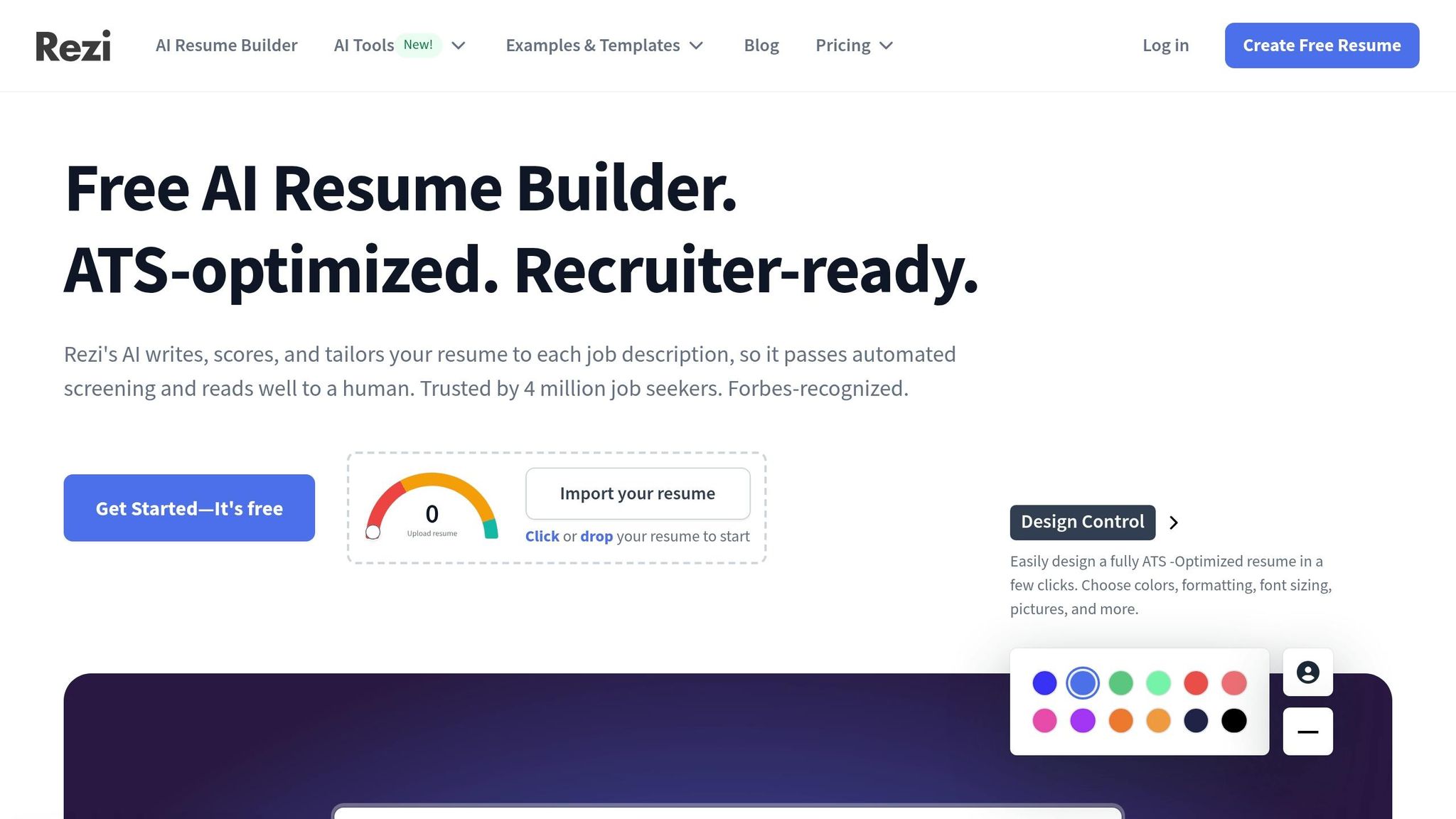
LazyApply or Simplify.jobs are ideal for U.S. citizens or green card holders applying to high-volume entry-level roles. These tools prioritize speed and affordability over precision and compliance.
TealHQ or Rezi.ai work well for those who can spend 3+ hours daily on manual submissions, prefer hands-on control, and want organizational tools or templates for managing their job search.
Why Scale.jobs Stands Out for STEM OPT Candidates
For STEM OPT candidates, compliance and precision are non-negotiable. Automated tools often struggle with multi-step employer portals and complex visa-related questions. Human assistants, like those at Scale.jobs, manually handle these intricacies, ensuring every application reflects your qualifications and work authorization status accurately.
Additionally, Scale.jobs provides real-time updates through WhatsApp, letting you track your applications with full transparency. The flat fee structure eliminates the unpredictability of monthly subscriptions, letting you focus on networking, interview prep, and meeting I-983 requirements.
"Your job search should be measured by outcomes (interviews, conversations, opportunities), not outputs (number of applications sent)." - Jessica Hernandez, President & CEO, Great Resumes Fast
For STEM OPT candidates, choosing tools that prioritize quality and compliance over quantity is critical. Scale.jobs delivers on those priorities, making it a strong choice for those navigating these unique challenges.
FAQs
How do I track my 150 unemployment days accurately?
To keep track of your 150 unemployment days during OPT, begin counting from the start date listed on your approved OPT/EAD card. These 90 days of unemployment are cumulative, meaning they add up over the entire OPT period. Exceeding this limit could jeopardize your F-1 visa status. Tools such as TrackMyOPT can make this process easier by monitoring your unemployment days, employment records, and reporting duties, ensuring you remain compliant with visa regulations.
What counts as a “material change” on Form I-983?
A "material change" on Form I-983 refers to any major updates to the original training plan that affect the student's training objectives, employer details, or employment conditions. Such changes must be reported to your Designated School Official (DSO). Examples include alterations in job responsibilities, changes to the work location, or modifications to employer information.
What should I say when an application asks about sponsorship?
When asked about sponsorship during a job application or interview, it's crucial to be upfront and clear. For instance, you might say something like, "I will need employer sponsorship to continue working beyond my OPT period." Being transparent helps ensure compliance with visa regulations and allows employers to understand your situation from the start. This honesty also helps set realistic expectations, paving the way for a smoother hiring process.