
SQL Certifications: Are They Worth It?
Assess whether SQL certifications are worth the investment: costs, renewal, ideal roles, and how to pair them with hands-on projects to boost job prospects.


SQL certifications can help you stand out in competitive job markets, especially in database administration, finance, and government roles. They validate your SQL skills, improve ATS (Applicant Tracking System) visibility, and may lead to salary increases (10–18% in some cases). However, their value depends on your career goals. Certifications are more critical for roles requiring specific tools like Oracle, AWS, or Azure but carry less weight in fields like data science, where portfolios and hands-on experience are prioritized.
Key Takeaways:
- Best For: Beginners, career switchers, or roles in regulated industries.
- Costs: Range from $99 to $300, with renewal fees for many certifications.
- Limitations: Limited impact on AI/data science hiring; hands-on experience often outweighs certifications.
- Complement: pair certifications with practical projects (e.g., GitHub portfolios) and tailored job application assistance to maximize job prospects.
Quick Comparison Table:
| Certification | Cost | Renewal Period | Audience | Industry Focus |
|---|---|---|---|---|
| Oracle Database SQL Certified Associate | $245 | 18–24 months | DBAs, Data Engineers | Finance, Government |
| Google Cloud Database Engineer | $200 | 2 years | Cloud Engineers, Analysts | Cloud Analytics |
| AWS Data Analytics – Specialty | $300 | 3 years | Analytics Engineers | Cloud-Native Roles |
| Microsoft Azure DBA Associate (DP-300) | $165 | Periodic | DBAs, Engineers | Hybrid Cloud |
| IBM Certified DB2 Associate | $200 | N/A | Entry-Level DBAs | Enterprise Systems |
Certifications can open doors but should be paired with practical experience to provide a comprehensive skill set.
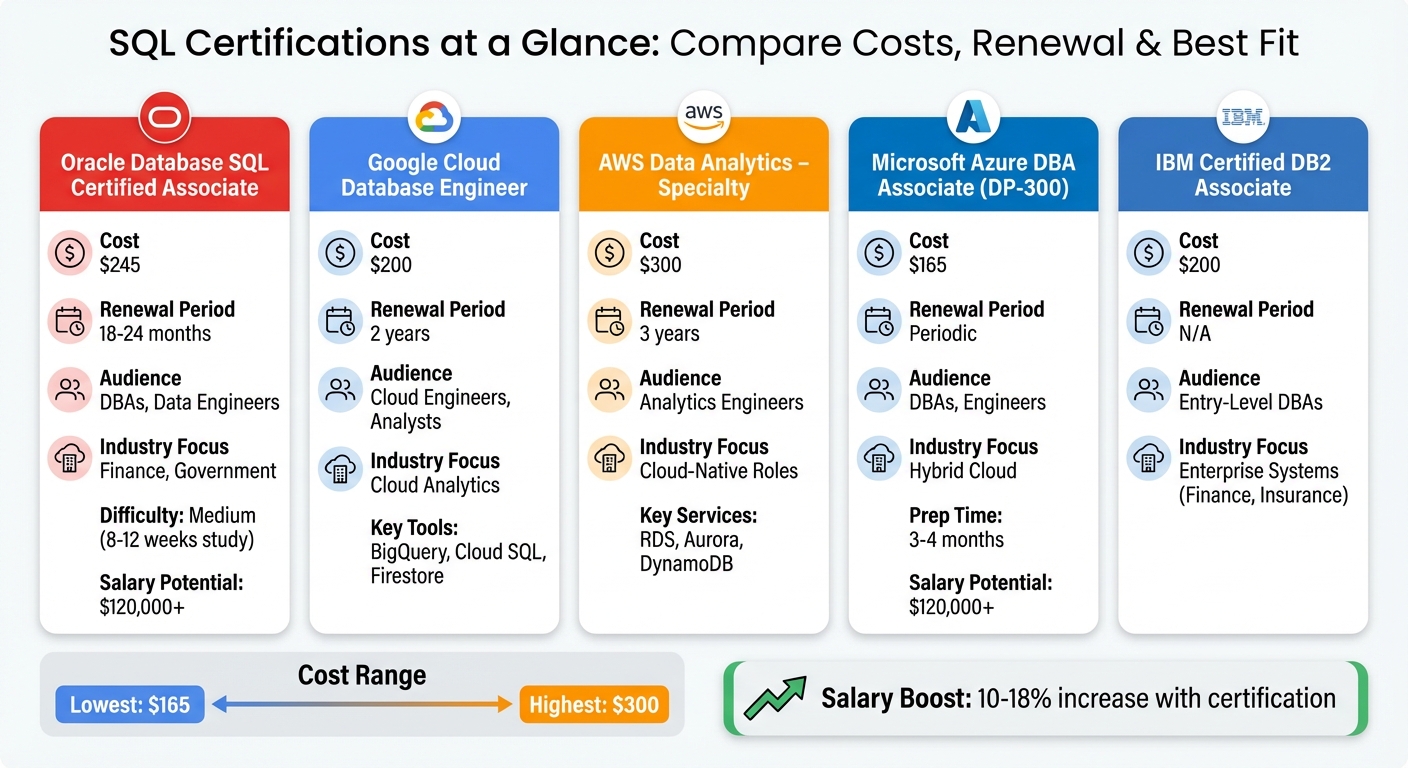
SQL Certification Comparison: Costs, Renewal Periods, and Industry Focus
7 BEST SQL Certifications For Data Analysts
1. Oracle Database SQL Certified Associate
The Oracle Database SQL Certified Associate (Exam 1Z0-071) is a sought-after credential for professionals working with Oracle's database systems. It verifies your expertise in SQL concepts, data modeling, table operations, and Oracle's database architecture - essential skills in enterprise environments that rely on Oracle technology.
Cost
The exam costs $245, and Oracle University offers optional 16-hour online training courses. If you'd like to dive deeper, training paths are available for up to $4,995.
Exam Duration
You'll face 78 multiple-choice questions in 120 minutes, with a passing score set at 63%. The exam focuses on Oracle-specific knowledge, including unique syntax and edge cases that differentiate Oracle from other database systems.
Expiration
This certification typically needs to be renewed every 18–24 months to align with updates to Oracle Database versions. This ensures professionals stay current with evolving technology.
Best For
This certification is ideal for Database Administrators and Data Engineers working in sectors like finance and government, where Oracle infrastructure is widely used. According to Dice Staff:
Oracle's certification is highly respected, particularly in large enterprise IT environments that heavily utilize Oracle Database technology.
Dataquest also highlights its importance:
getting an Oracle Database SQL certification may be required
for certain roles. Professionals in these positions often earn salaries exceeding $120,000 annually, making this certification a solid investment.
Industry Recognition
The Oracle Database SQL Certified Associate is considered to have a medium difficulty level, typically requiring 8–12 weeks of dedicated study. While data science roles may place more value on practical portfolios, database administration roles in Oracle-reliant organizations often list this certification as mandatory or highly desirable.
Once certified, platforms like scale.jobs can help you maximize the value of your credential. They specialize in creating ATS-optimized resumes that highlight your certification and practical experience, ensuring your application passes automated systems and grabs the attention of hiring managers.
What makes scale.jobs stand out:
- Personalized job application support from human assistants.
- ATS-optimized resumes to improve success rates with automated systems.
- A one-time flat fee, avoiding recurring subscription costs.
- Dedicated WhatsApp support for timely updates.
- Transparent proof-of-work to build trust with employers.
2. Google Professional Cloud Database Engineer
The Google Professional Cloud Database Engineer certification highlights your ability to design, manage, and fine-tune database solutions within Google Cloud. As more organizations embrace cloud-based data systems, this credential has become a valuable asset for professionals involved in enterprise analytics.
Cost
The exam costs $200, which falls within the typical range of $100–$300 for certifications.
Exam Overview and Expiration
This certification evaluates your expertise in areas like database design, migration strategies, security protocols, and performance optimization. You’ll work with tools such as Cloud SQL, Cloud Spanner, Firestore, and BigQuery. Once earned, the certification remains valid for two years, ensuring that professionals maintain up-to-date knowledge in the rapidly evolving cloud technology landscape.
Best For
This certification is particularly beneficial for Data Engineers, Cloud Database Administrators, and Analytics Professionals working with Google Cloud infrastructure. It provides a strong foundation in cloud data services, distributed databases, and modern SQL dialects - skills that are essential in hybrid and cloud-first environments.
Organizations using BigQuery for large-scale analytics, including companies in tech, retail, and media, actively seek professionals with this certification. It demonstrates expertise in managing distributed database systems, making it a sought-after qualification for those working with cutting-edge analytics platforms.
Industry Recognition
Google Cloud certifications are highly regarded, especially among organizations that rely on Google's data tools. BigQuery’s extensive use in analytics underscores the relevance of this credential. To enhance your learning, consider engaging in hands-on projects with tools like Google Cloud SQL and BigQuery, which can showcase your practical skills and deepen your understanding.
Much like Oracle's certification, this credential emphasizes real-world cloud experience, making it a standout qualification in the job market. After earning your certification, platforms like scale.jobs can help you leverage your technical expertise by connecting you with opportunities tailored to cloud-focused roles.
Why scale.jobs is worth considering:
- Personalized application support from real people
- Resumes optimized with an AI builder for applicant tracking systems (ATS)
- Transparent, one-time fee with updates via WhatsApp
- Proof-of-work credentials to showcase your expertise
3. AWS Certified Data Analytics – Specialty
The AWS Certified Data Analytics – Specialty certification is designed for professionals who have hands-on experience with AWS data analytics tools. It validates your skills in areas like data warehousing, ETL processes, and overall proficiency in AWS analytics services.
Cost
The exam costs $300, which is higher than certifications like Snowflake ($175) and Databricks ($200). This pricing reflects AWS's prominent position in the market and the extensive range of skills covered in the certification.
The certification is valid for three years, meaning you'll need to renew it periodically to keep your credentials up to date.
Expiration
As with most AWS certifications, this credential must be renewed every three years. This ensures that certified professionals stay updated with AWS's evolving analytics tools and services.
Best For
This certification is a great fit for analytics engineers and data scientists who are shifting to cloud-based analytics. It’s also a strong choice for professionals moving from traditional database roles to cloud-native environments.
Industry Recognition
AWS certifications are highly regarded in the industry, especially among companies that rely on services like RDS, Aurora, and DynamoDB. Many consulting firms even require a certain number of AWS-certified employees to maintain their AWS Partner status, which can open doors to new career opportunities.
This certification demonstrates your expertise in cloud-native architectures, distributed systems, and modern analytics, making it a valuable asset for roles that demand these skills. To showcase your AWS certification effectively, consider using platforms like scale.jobs for ATS-friendly resumes, personalized support, and transparent proof of your expertise.
4. Microsoft Certified: Azure Database Administrator Associate
The Microsoft Certified: Azure Database Administrator Associate (DP-300) is the modern successor to the retired MCSA SQL Server certifications. This shift reflects Microsoft's focus on blending Azure cloud services with traditional SQL Server management, aligning with the growing demand for hybrid database solutions.
Cost
The DP-300 exam is priced at $165 per attempt, placing it in the mid-range for certification costs. This fee reflects the technical depth of the exam and its emphasis on practical, hands-on skills.
Preparing for the DP-300 typically takes three to four months, as it covers a mix of on-premises SQL Server environments and Azure-specific tools like elastic pools and managed instances. Microsoft provides free learning paths through Microsoft Learn, offering a cost-effective way to access comprehensive study materials. This makes the certification accessible while maintaining a strong focus on technical rigor.
Expiration
The certification requires periodic renewal to stay current with Azure's continuously evolving database services and features.
Best For
This certification is tailored for database administrators managing SQL environments migrating to Azure. It's especially relevant for professionals working with hybrid architectures as organizations transition to cloud-based infrastructures. The exam assesses key skills such as securing data environments, optimizing performance, configuring high availability, and implementing disaster recovery solutions.
"The Azure certification is the newest and most relevant certification related to Microsoft SQL Server." - Dataquest
Candidates need more than basic database knowledge; hands-on experience with Azure SQL Database, managed instances, and cloud-native features is essential to excel.
Industry Recognition
The DP-300 has become a key benchmark for professionals in the Microsoft ecosystem. It’s a sought-after credential for roles involving Azure infrastructure or SQL Server environments and serves as a vital keyword for passing applicant tracking systems (ATS). Positions like Data Engineer or Database Administrator often list this certification as a requirement, with salaries in these roles frequently exceeding $120,000 annually.
For consultants or those aiming for roles at Microsoft partner organizations, the DP-300 provides a distinct advantage. Companies hiring for cloud architect or modern data platform roles often prioritize candidates with Azure certifications, given the increasing reliance on cloud-based solutions.
To maximize the impact of your DP-300 credential, pairing it with practical experience is crucial. Platforms like scale.jobs can help you showcase your certification effectively:
- ATS-optimized resumes that highlight your qualifications
- Personalized application support through human assistance
- Flat, one-time fee with no recurring costs
- Real-time updates via WhatsApp for seamless communication
- Proof-of-work tools to demonstrate your expertise clearly
This certification not only validates your technical skills but also positions you as a strong candidate in a competitive job market.
5. IBM Certified Database Associate – DB2
The IBM Certified Database Associate – DB2 certification highlights your foundational skills in IBM DB2, with a focus on SQL expertise, database security, transaction isolation, and working with SQL and XML data. It shows your ability to write Data Definition Language (DDL) statements, connect to DB2 servers, and grasp application design principles within IBM's framework.
Cost
The exam fee is $200 per attempt. To prepare effectively, consider gaining hands-on experience or enrolling in training programs tailored to DB2's unique features and administrative tasks.
Best For
This certification is ideal for entry-level database administrators and developers who work with IBM DB2. It's especially relevant for professionals in industries like finance and insurance, where DB2 is widely used for its reputation in maintaining data quality and system dependability. Prior experience with DB2 administration is highly recommended for candidates.
The exam focuses on the unique aspects of IBM DB2's features and architecture, making it distinct from general SQL certifications.
Industry Recognition
IBM certifications are well-regarded among enterprise organizations that prioritize secure and reliable systems. Holding this certification can give you a competitive edge in the job market. Certified SQL professionals often see salary boosts of over 10%. To further enhance your career prospects, showcase your IBM DB2 certification on platforms like scale.jobs with ATS-friendly resumes and verified proof-of-work, helping you stand out in a crowded field.
Pros and Cons of SQL Certifications
Expanding on the earlier discussion about individual SQL certifications, let’s dive into the broader benefits and challenges these credentials bring to the table.
SQL certifications can be a great way to validate your technical skills, especially for self-taught developers or those transitioning into tech careers. They also play a significant role in making your resume stand out, particularly with Applicant Tracking Systems (ATS). Certifications like "Oracle Certified Associate" can act as keywords that help your resume pass automated filters used in industries like government, banking, and defense.
In terms of earnings, certifications can translate into a pay bump of 10–18% in fields where credentials hold weight. They can also be useful during performance reviews, giving you leverage to negotiate raises or promotions. On top of that, certifications provide structured learning paths - from basic SQL queries to advanced topics like optimization and window functions - offering guidance when self-study becomes overwhelming.
However, there are some drawbacks to consider. Many hiring managers, especially in AI or data science, prioritize portfolios over certifications. As Dataquest aptly points out:
The people who hire data analysts, data scientists and AI/ML engineers typically don't care about certifications. Having a SQL certificate on your resume isn't likely to impact their decision one way or the other.
Another issue lies in the nature of the exams. They often emphasize theoretical edge cases rather than practical problem-solving. For example, Oracle’s certification exams are known for focusing on obscure syntax and error codes that are rarely encountered in real-world scenarios. Preparing for these exams can demand a significant time investment - typically 3–6 months of dedicated study.
Additionally, recurring renewal fees can diminish the long-term value of certifications. High-level certifications, like those from Oracle, expire every 18–24 months, while Snowflake charges $88 for recertification every two years. The fragmented nature of the SQL certification market also complicates their value; there’s no universal standard, making it harder for employers to assess their significance. For instance, the pass rate for challenging exams like dbt Analytics Engineering is just 65%, underscoring their difficulty.
Here’s a quick comparison of key factors across different types of SQL certifications:
| Factor | Vendor-Specific (Oracle, Microsoft, AWS) | Platform-Agnostic (Google, CompTIA) |
|---|---|---|
| Cost | $99–$300 per exam | $39–$49/month subscription |
| Time Investment | 2–6 months preparation | 1–6 months (varies by depth) |
| Expiration | 18 months–3 years | Often does not expire |
| Best For | DBAs, Cloud Engineers, Enterprise roles | Data Analysts, Career Switchers, Beginners |
| Employer Recognition | Highly valued in specific ecosystems (Finance/Gov) | Signals foundational knowledge and discipline |
| Practical Focus | Deep technical details of specific tools | Universal SQL principles and data analysis |
Both vendor-specific and platform-agnostic certifications have their strengths, but the choice ultimately depends on your career goals and the roles you’re targeting. While certifications can be a stepping stone, it’s important to weigh their costs and relevance against other ways to demonstrate your skills, like building a strong portfolio or completing real-world projects.
When SQL Certifications Make Sense
SQL certifications can be a game-changer, but they’re not for everyone. They’re especially useful for recent graduates or those transitioning from non-technical careers, as they demonstrate more than just basic SQL knowledge. Certifications show you’re ready to tackle advanced tasks like optimization and window functions, setting you apart in a competitive job market.
As Henry Ameseder, COO and Co-founder of Mimo, explains:
In government, banking, and defense sectors especially, certifications function as hard requirements programmed into recruiting systems.
This highlights their importance in industries with strict hiring standards. Many organizations use applicant tracking systems (ATS) to filter resumes, making certifications like "Oracle Certified Associate" essential in regulated fields. For example, government agencies, financial institutions, and defense contractors often require specific credentials. Similarly, consultancy firms need certified employees to maintain partnerships with major vendors like Microsoft, Snowflake, or Oracle.
If you’re aiming for a Database Administrator (DBA) role, platform-specific certifications are often non-negotiable. Companies running Oracle, Azure, or AWS in their environments expect proof that you can handle those systems. Beyond job requirements, certifications can also boost your earning potential. Certified SQL professionals often see salary increases of over 10%, with some reporting raises as high as 18%. However, while certifications are critical in regulated industries, other fields may prioritize hands-on skills over formal credentials.
For roles in data science or AI, certifications typically carry less weight. Recruiters in these fields often focus on practical experience and real-world projects. In fact, a study analyzing 200 pages of interview transcripts with 15 data science recruiters found no mention of certifications, even though SQL remains one of the most in-demand skills. Professionals with more than five years of experience usually rely on portfolios of completed projects to showcase their abilities. Free resources like SQLZoo, LeetCode SQL, and Microsoft Learn modules also provide excellent opportunities to refine your skills without the expense of certification exams.
Ultimately, certifications are most effective when combined with practical experience. Pairing formal credentials with a portfolio of two or three projects - such as cleaning messy datasets, building dashboards, or solving real business challenges - offers a well-rounded validation of your expertise.
Conclusion
SQL certifications can be a worthwhile investment when they align with your career goals and industry demands. For beginners or those transitioning into tech, certifications provide a structured learning path and help establish credibility, especially when competing with candidates who have more experience. If you're aiming for roles in sectors like government, banking, or defense, certifications often act as essential filters in applicant tracking systems (ATS), helping you move past the initial screening process.
For mid-level professionals, advanced certifications can enhance your credentials and strengthen your position during salary negotiations. As Henry Ameseder, COO and Co-founder of Mimo, explains:
Certifications don't generate salary premiums, but they generate opportunity. They're binary filters: without them, your resume gets rejected. With them, the interview process begins.
Consultants also see value in certifications, as many firms require a certain number of certified employees to maintain partnerships with key vendors.
In fields like data science and AI, portfolios tend to carry more weight than certifications, but SQL skills remain crucial. To stand out, certifications should be paired with practical experience - whether that's optimizing queries, creating dashboards, or solving real business challenges. Combining certifications with hands-on projects and effective job search strategies can make your profile much stronger.
Platforms like scale.jobs simplify the application process by offering ATS-friendly resumes, human support, and proof-of-work tools, ensuring your certifications have the biggest impact.
While pursuing SQL certifications can be a smart move, their true value comes when paired with practical experience and strategic job search tools. This combination will help you maximize your career opportunities and return on investment.
FAQs
Do SQL certifications help you negotiate a higher salary?
Getting SQL certified can give your paycheck a noticeable lift, especially when it’s time to negotiate your salary. Certified professionals often enjoy a 10–25% pay bump, with many landing roles that pay $120,000 or more per year in data-focused careers.
These certifications serve as proof of your skills, helping you stand out as a top contender for lucrative roles in areas like data analysis, database management, and business intelligence.
Do you need an SQL certification for a data science job?
No, having an SQL certification isn’t a requirement for data science roles. Employers are generally more interested in your ability to use SQL effectively in practical situations than in whether you hold a formal certification. That said, if you’re just starting out or making a career switch, earning an SQL certification can be a great way to showcase your skills and give your resume an edge.
If you’re in the middle of a job search, platforms like scale.jobs can be a great resource. They offer tools like an AI-driven resume builder and personalized job applications to help you highlight your abilities and stand out to potential employers.
Do SQL certifications need to be renewed, and if so, how often?
Most SQL certifications don’t come with strict renewal requirements, but it’s a good idea to confirm the details with the organization that issued your certification. While some credentials are valid for life, others may require you to update or retest periodically to keep up with evolving technologies and practices. Keeping up with these updates helps ensure your certification stays relevant and valuable in today’s job market.