The Sonara Red Flag That Scale.jobs Solved From Day One
Human-verified job applications outperform mass automation, improving ATS pass rates and providing clear proof-of-work.

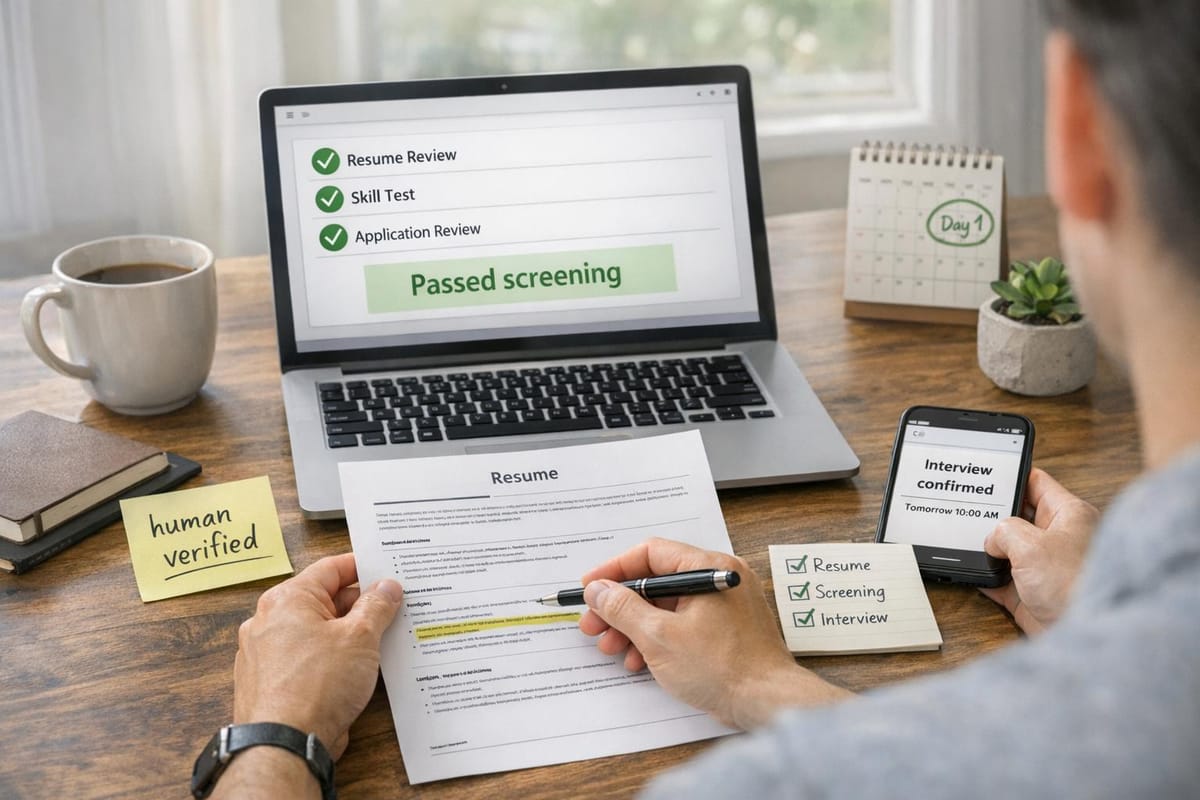
When applying for jobs, one of the biggest frustrations is ensuring your applications actually reach recruiters. Sonara.ai and Scale.jobs tackle this problem differently. Sonara.ai uses automation to submit hundreds of applications daily but struggles with a 40% failure rate due to ATS (Applicant Tracking System) filters. In contrast, Scale.jobs combines human oversight with AI tools to ensure accurate, tailored submissions, boasting a 90% ATS success rate and faster job placements.
Sonara.ai is suitable for high-volume, low-cost job applications but often results in missed opportunities due to automation errors. Scale.jobs, while pricier, focuses on quality and transparency, offering personalized service, real-time tracking, and higher callback rates.
Here’s what you need to know to decide which platform is right for your job search:
- Sonara.ai: Fully automated, budget-friendly, but prone to errors and ATS rejections.
- Scale.jobs: Human-verified applications, tailored resumes, and higher success rates, ideal for competitive industries.
If you want reliable, human-driven application submissions that maximize your chances of landing interviews, Scale.jobs may be the better choice.
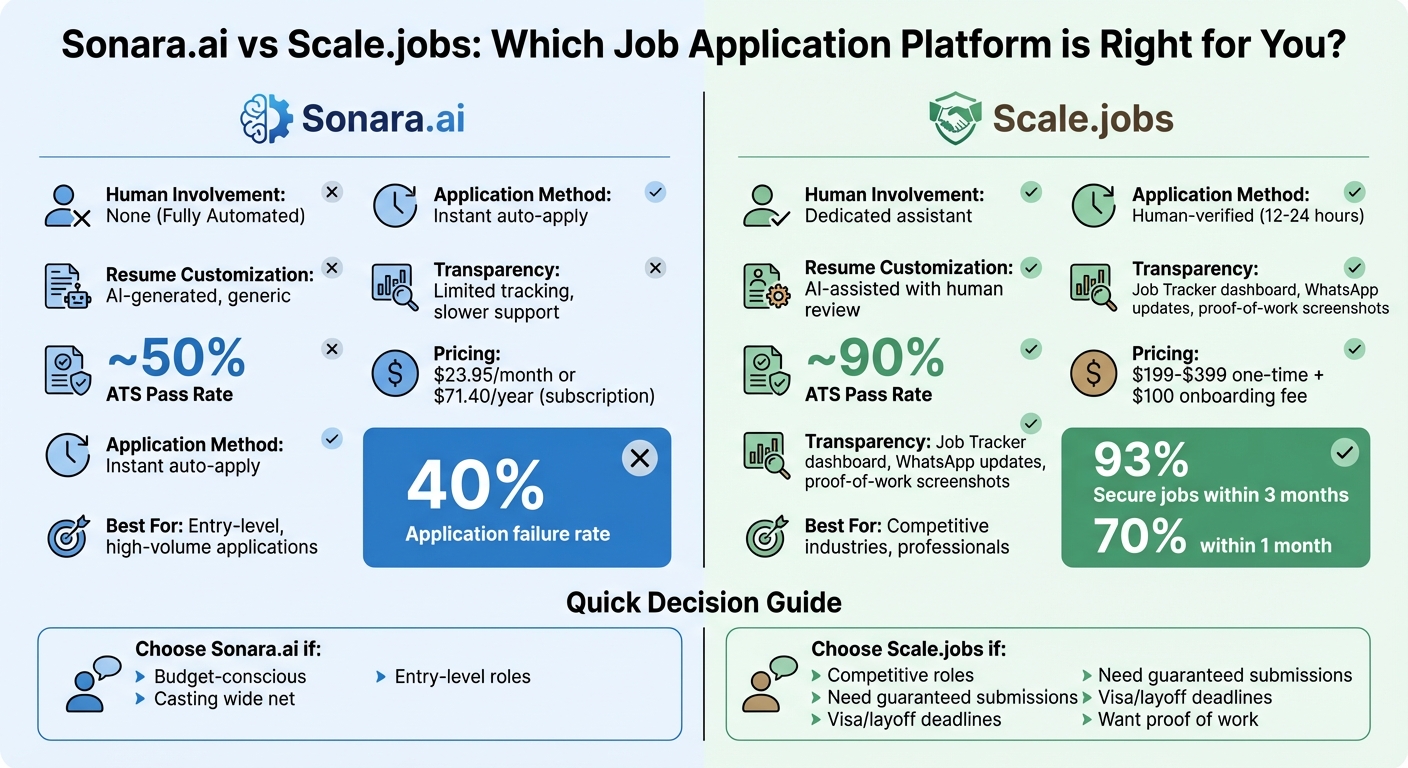
Sonara.ai vs Scale.jobs: Feature Comparison for Job Seekers
1. Sonara.ai
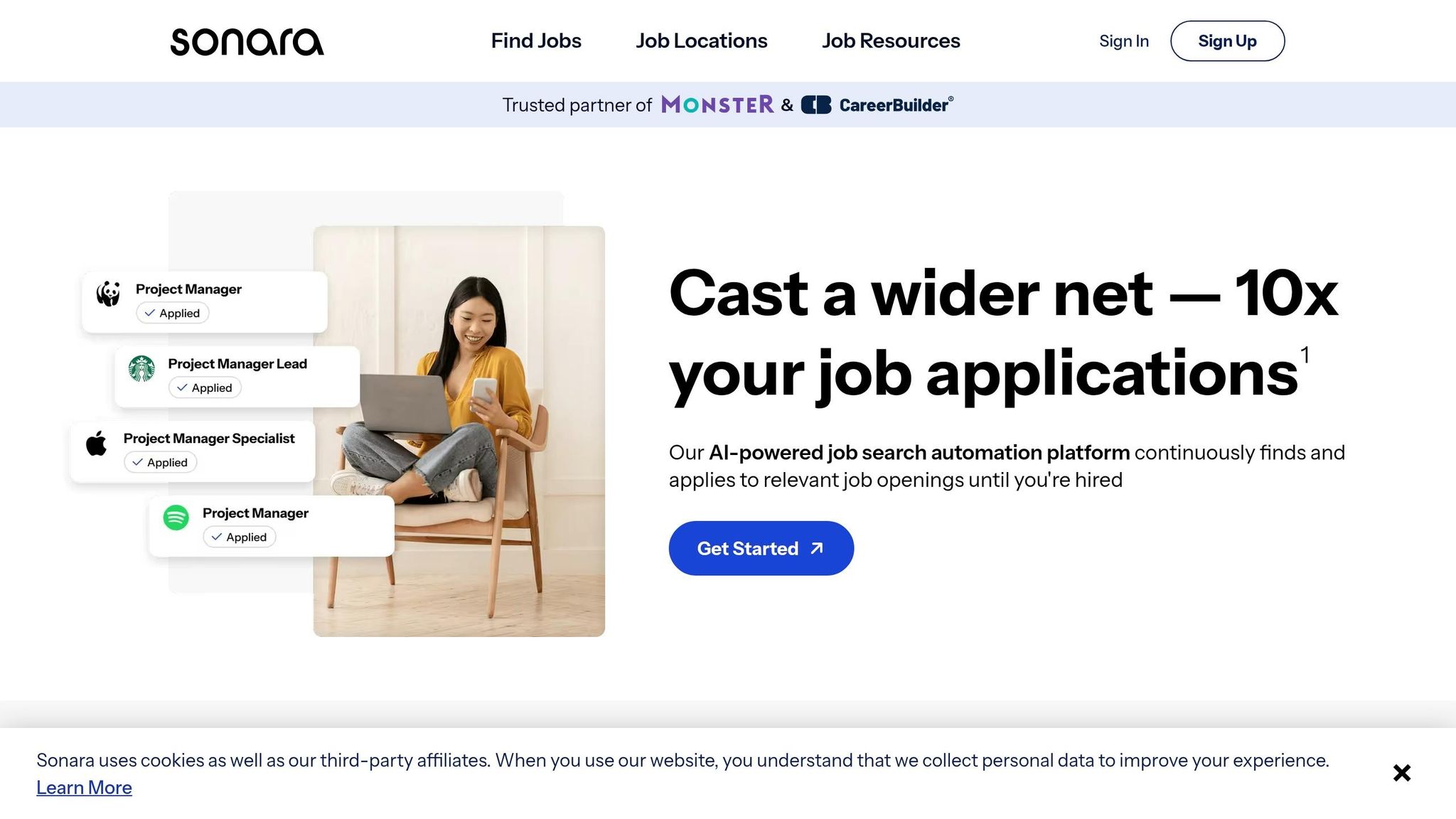
Before diving into how Scale.jobs compares, let’s take a closer look at some of the challenges users face with Sonara.ai.
Human Involvement
Sonara.ai relies entirely on automation, handling mass job applications without any human oversight. While the platform uses AI to pull data from your profile and fill out job applications, there’s no team ensuring submissions are accurate or tailored to specific positions. This automation speeds up the process but introduces significant drawbacks.
For instance, without human verification, applications often fail basic requirements like email validation or pre-screening questions. Many users report that 40% of their applications remain stuck in a "pending" status, never making it to employers. If technical glitches - such as broken filters or failed submissions - arise, there’s no human support to resolve these issues, leaving users in the dark.
ATS Optimization
Sonara claims its AI adjusts resumes and cover letters to align with job descriptions. However, feedback suggests these documents often come across as generic and lack the depth needed to pass ATS (Applicant Tracking System) filters effectively. Recruiters can easily spot low-effort, AI-generated submissions, which hurts your chances of standing out.
The platform’s focus on quantity over quality compounds the issue. Since users can’t manually edit or customize their materials, they’re left with limited control over how their applications are presented. This "black box" approach makes it harder to track progress or ensure applications are tailored for success.
Transparency
Transparency is another area where Sonara struggles. Many users experience the frustrating "pending job queue" problem, where applications sit in limbo with no confirmation of submission. Issues like email verification failures and broken job filters only add to the confusion, making it unclear whether applications are even reaching employers.
Customer support has also been criticized for being slow and unhelpful in addressing these technical problems. With no clear updates or reliable assistance, users are left uncertain about their application outcomes. The absence of human oversight only amplifies these concerns.
Pricing Model
Sonara’s pricing starts with a $2.95 trial for 14 days or up to 10 applications, after which it renews at $23.95 per month. Alternatively, users can opt for an annual plan at $71.40, which offers unlimited applications. While the pricing might seem competitive compared to professional services, the reported 40% failure rate significantly reduces its value. A large portion of your subscription fee could be wasted on applications that never even reach employers.
These challenges highlight the importance of a more reliable, human-driven approach - something Scale.jobs aims to deliver. Let’s explore how it stacks up.
2. Scale.jobs
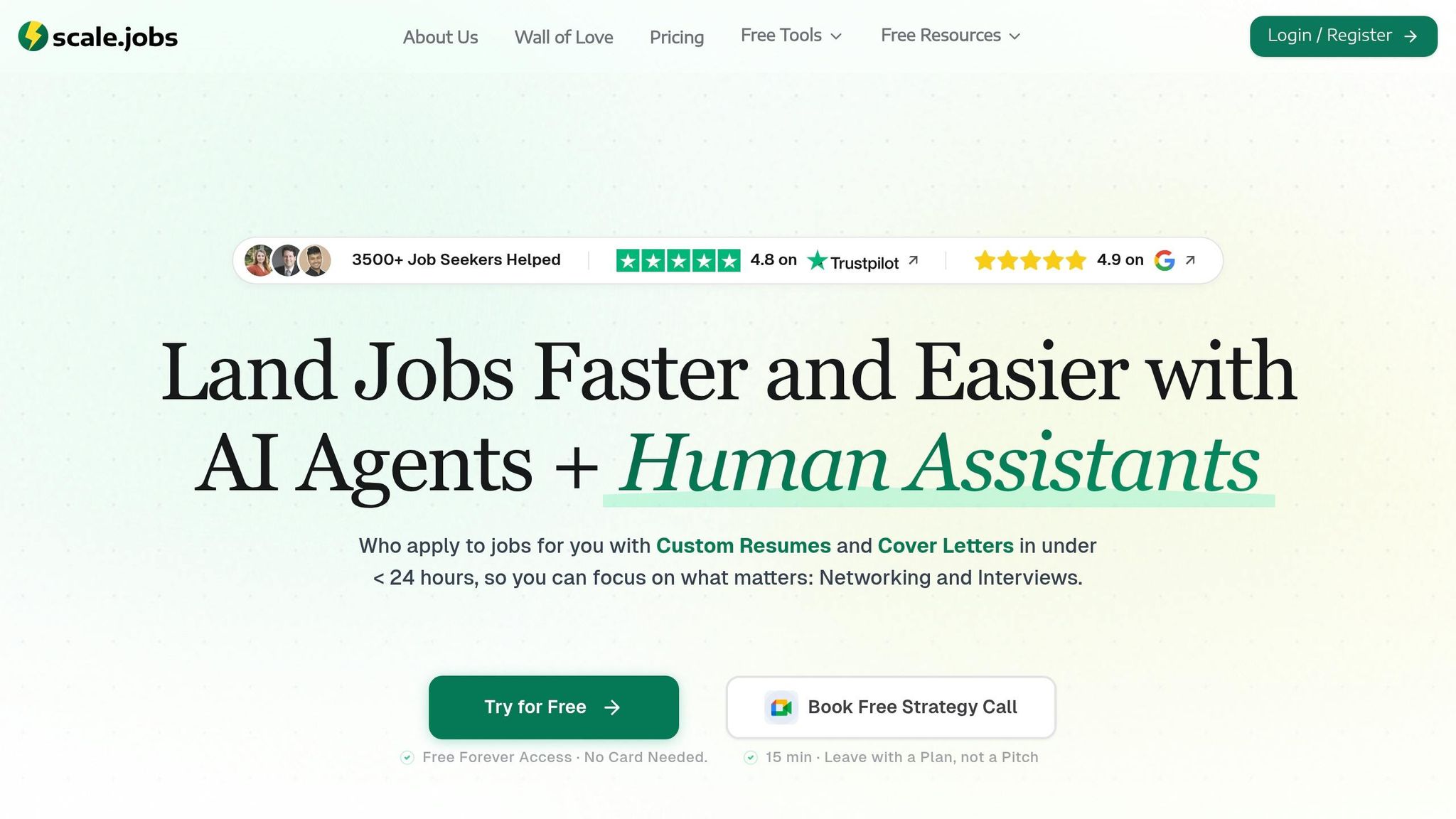
Scale.jobs takes a different approach compared to Sonara.ai by blending automation with human expertise. This hybrid process addresses the reliability issues seen in fully automated systems, such as Sonara's reported 40% application failure rate.
Human Involvement
At the heart of Scale.jobs is a dedicated assistant who personally oversees your applications. After a quick onboarding call, you're paired with a virtual assistant who manages tasks like sourcing roles and completing application forms. This human touch minimizes issues like email verification errors and broken filters, which can disrupt automated systems.
The platform ensures applications are submitted within 12–24 hours of approval. Unlike automated tools that may trigger security flags, human assistants navigate complex forms and website protections without being mistaken for bots. According to Scale.jobs, 47% of placements come from human-reviewed applications, and 93% of users secure jobs within three months, showcasing the effectiveness of their human-centered approach.
ATS Optimization
Scale.jobs leverages AI to craft tailored resumes and cover letters for each job application. However, before submission, these documents are reviewed by a human to ensure they accurately reflect your experience and qualifications. The platform also provides tools to analyze your resume against job descriptions, offering match scores and actionable feedback for improving ATS compatibility. Their resume builder includes templates optimized for major systems like Taleo and Workday.
This additional human review step sets Scale.jobs apart from Sonara. While AI handles the initial customization, the human oversight ensures the final documents align perfectly with your skills and the job requirements.
Transparency
Transparency is a cornerstone of Scale.jobs. The platform offers a Job Tracker dashboard, where you can track each application from start to finish. Unlike Sonara's more opaque system, Scale.jobs provides real-time updates via WhatsApp and even shares proof-of-work screenshots showing when and how applications were submitted. Each job listing includes detailed metrics, such as an 87% skill match, giving you clear insights into your progress.
Scale.jobs is upfront about its operations, including the use of offshore associates (mainly in India) working at $4/hr to keep costs manageable. They also clearly label AI-generated documents as "AI Custom Resumes", ensuring users understand the role of automation in the process. This level of openness contrasts sharply with Sonara's slower support and less transparent application tracking.
Pricing Model
Scale.jobs uses a one-time payment structure, avoiding the recurring subscription fees common with services like Sonara. Campaign bundles are priced at $199 for 250 applications, $299 for 500 applications, and $399 for 1,000 applications, with a one-time $100 onboarding fee that covers your setup call and assistant assignment. They also offer pro-rated refunds for unused credits once you secure a job.
For those looking to explore the platform risk-free, Scale.jobs provides a free tier that includes access to job boards, tracking tools, and limited AI features. This pay-as-you-go model ensures you only invest in work that’s actually completed, making it a cost-effective alternative to subscription-based services.
Strengths and Weaknesses
Sonara.ai emphasizes speed and volume in job applications, while Scale.jobs focuses on delivering reliable, human-verified submissions.
Sonara's standout feature is its ability to quickly scan and apply to thousands of job postings daily, reducing manual effort by up to 80%. This makes it a good choice for those who want to apply to as many positions as possible in a short time. However, this speed comes with trade-offs. The platform's auto-generated resumes and cover letters often lack the level of customization needed to stand out, leading to an ATS rejection rate of roughly 40%–50%. Additionally, technical issues can further affect its effectiveness, particularly in highly competitive industries.
Scale.jobs takes a different approach, prioritizing quality and accuracy. With a 90% ATS pass rate, it significantly outperforms Sonara in ensuring applications get through initial screening systems. A dedicated assistant works with users to create tailored applications, avoiding common errors and ensuring attention to detail. The platform operates on a one-time payment model, with campaign bundles priced between $199 and $399, plus a $100 onboarding fee. This setup emphasizes reliability and transparency, offering features like proof-of-work screenshots and real-time updates via WhatsApp.
To better understand the differences, here’s a side-by-side comparison:
| Feature | Sonara.ai | Scale.jobs |
|---|---|---|
| Human Involvement | None - fully automated | Dedicated assistant for personalized service |
| Resume Customization | AI-generated, generic | AI-assisted with human review for precision |
| ATS Pass Rate | ~50% | ~90% |
| Application Method | Instant auto-apply | Human-verified submissions within 12–24 hours |
| Transparency | Limited tracking, slower support | Job Tracker dashboard, WhatsApp updates, proof-of-work screenshots |
| Pricing Model | Subscription-based | One-time bundles: $199–$399 + $100 onboarding fee |
For job seekers who are tired of automated tools that fail to meet expectations, Scale.jobs offers a more thorough and reliable alternative. Its combination of expert-level resume customization and human-assisted application management leads to higher success rates. Notably, 70% of Scale.jobs users reportedly secure jobs within one month, highlighting the platform's focus on ATS optimization and reliable submissions.
Your decision ultimately depends on what matters most to you. If speed and volume are your top priorities, Sonara.ai might be worth considering despite its higher rejection rates. On the other hand, if you’re looking for guaranteed submissions, tailored applications, and clear proof that your efforts are reaching hiring managers, Scale.jobs could be the better choice.
Which Platform Should You Choose?
Sonara.ai's automated application system often struggles with ATS filters, while Scale.jobs' human oversight effectively addresses this issue. To help you decide, here's a breakdown of which platform suits different needs.
Who Should Use Sonara.ai
Sonara.ai is a good fit if you're an entry-level candidate aiming to apply across multiple industries without needing much customization. Its fully automated system is a cost-effective choice for those casting a wide net, especially in fields where high-volume applications are common. However, keep in mind that occasional submission errors may require monitoring.
Who Should Choose Scale.jobs
Scale.jobs is ideal for candidates targeting competitive roles in industries like tech, finance, or consulting, where ATS optimization is crucial. It's particularly helpful for international job seekers with visa deadlines, busy professionals juggling full-time jobs, or anyone who has faced challenges with automated tools. For example, a data scientist using Scale.jobs' personalized approach could see significantly higher callback rates compared to generic, high-volume submissions.
Comparison Table
Here's a quick look at how the two platforms differ:
| Feature | Sonara.ai | Scale.jobs |
|---|---|---|
| Human Involvement | Fully automated | Dedicated assistant for personalized service |
| Resume Customization Depth | Generic AI-generated resumes | AI-assisted with human review for precision |
| ATS Handling | ~50% pass rate | ~90% pass rate |
| Application Execution Method | Instant auto-apply | Human-verified submissions within 12–24 hours |
| Transparency/Proof of Work | Limited tracking and slower support | Job Tracker dashboard, WhatsApp updates, proof-of-work screenshots |
| Pricing Model | $23.95/month or $71.40/year | One-time bundles: $199–$399 + $100 onboarding fee |
Switch to Scale.jobs If…
- Your applications are stuck in pending queues without confirmation of submission.
- You're getting low response rates despite submitting numerous applications.
- You need proof that your applications are reaching hiring managers.
- You're spending too much time on repetitive form-filling instead of preparing for interviews.
- You're facing immediate layoff or visa deadlines and need guaranteed submissions within 12–24 hours.
Decision Summary
Timing is key. If you're in a time crunch due to a layoff or visa deadline, Scale.jobs' human-verified system can reduce your job search timeline from an average of five months to just 1–3 months. On the other hand, if you have more time to explore opportunities and are okay with monitoring for automation glitches, Sonara.ai offers a more budget-friendly option upfront.
FAQs
How can I verify my applications were actually submitted?
Scale.jobs prioritizes transparency by offering real-time, timestamped proof for every job application submitted. Once an application is sent, you'll receive WhatsApp notifications along with screenshots as verification. To keep everything organized, the platform also provides a detailed dashboard featuring proof-of-work documentation, including email confirmations and portal receipts. This ensures you can easily track and confirm that your applications have been successfully submitted.
What should I do if my applications keep getting stuck as “pending”?
If your job applications are stuck in "pending" status, it might be because of how automated systems or applicant tracking systems (ATS) process submissions. Platforms like Scale.jobs take a human-assisted approach, creating ATS-friendly applications that can minimize delays or rejections. By opting for a more tailored, human-focused method, you can improve your chances of smoother progress. Additionally, using tools that provide real-time updates and reminders can make it easier to follow up promptly, keeping your applications on track. For additional support, consider leveraging a job application service or a virtual assistant for job seekers to streamline the process.
How do I know my resume is ATS-friendly before applying?
To make your resume compatible with ATS (Applicant Tracking Systems), focus on including relevant keywords, maintaining a clean layout, and tailoring the content to match the specific role. While automated tools may assist in this process, Scale.jobs offers human-crafted resumes designed to meet ATS requirements, giving you a better shot at passing these filters. Choosing services that provide submission proof and formatting checks can also ensure your resume is fully optimized before sending out applications.