The Smart Way to Track H1B Sponsoring Companies in 2026
Use MyVisaJobs, H1BGrader, LinkedIn and human-led application services to find high-wage H‑1B sponsors and boost your wage-weighted lottery odds in 2026.


Tracking H1B sponsoring companies in 2026 is crucial for navigating the updated wage-weighted lottery system. This system, effective February 27, 2026, gives applicants with higher wage levels better odds, making employer salary data more important than ever. With only 85,000 visas available annually, targeting companies with a proven sponsorship history is key to improving your chances.
Here’s how you can efficiently identify and apply to H1B sponsors:
- Use Data-Driven Platforms: Explore tools like MyVisaJobs, H1BGrader, and the USCIS Employer Data Hub to analyze sponsorship trends, salary benchmarks, and approval rates.
- Leverage Real-Time Alerts: Platforms like LinkedIn help you stay updated on job postings from active sponsors.
- Focus on High-Wage Employers: Companies like Microsoft and Meta have consistently filed high-paying LCAs, boosting applicant odds under the new system.
- Consider Cap-Exempt Employers: Universities and nonprofits bypass the lottery, offering year-round sponsorship opportunities.
Combining research tools with application services like Scale.jobs can streamline your job search. Scale.jobs offers tailored, human-led application submissions to ensure your resume stands out and meets ATS requirements. With the FY 2027 lottery opening on March 4, 2026, now is the time to finalize your strategy.
How to find H-1B sponsored job in the USA in 1 month
Best Platforms for Finding H1B Sponsoring Companies
When it comes to researching H1B sponsors in 2026, three platforms stand out: MyVisaJobs, H1BGrader, and LinkedIn. Each offers unique tools to simplify the process. MyVisaJobs provides insights into the entire hiring process, from initial planning to green card sponsorship. H1BGrader focuses on approval rates and salary data, while LinkedIn delivers job alerts in real-time. Unlike these platforms, Scale.jobs offers a hands-on, human-driven approach, including ATS-friendly documents and personalized support via WhatsApp. Below, we’ll break down how these platforms, including Scale.jobs, can help streamline your search for H1B sponsorship opportunities.
How to Use MyVisaJobs for Sponsor Research
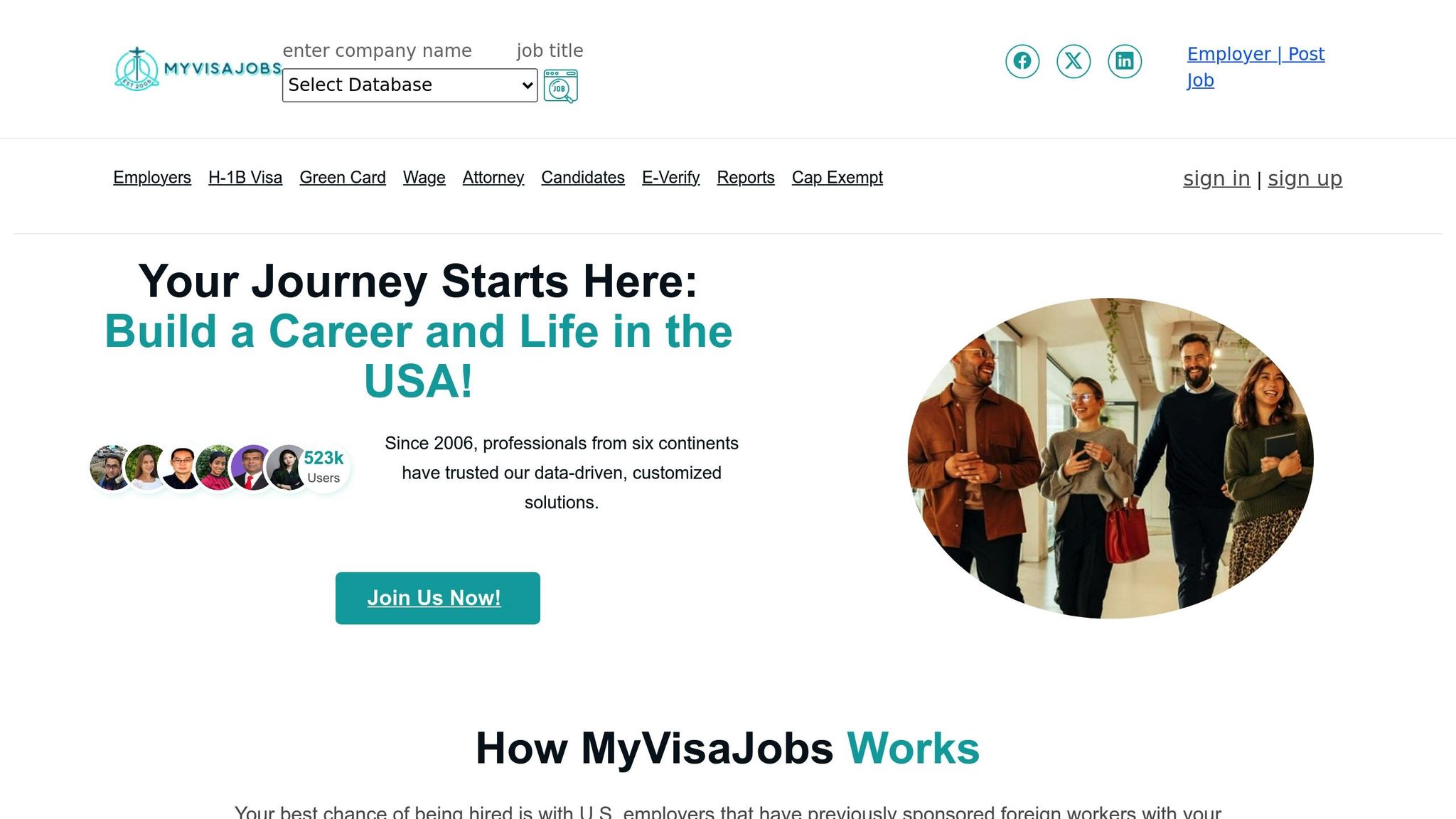
MyVisaJobs is a powerful tool for tracking H1B sponsorship activity. It monitors Prevailing Wage Determinations (PWD), Labor Condition Applications (LCA), and PERM filings, giving you a clear view of companies planning to hire, actively recruiting, or sponsoring green cards. For example, smaller employers like Roku stand out with competitive wages, averaging $331,521 across 120 filings, making them attractive for those aiming to maximize their chances under the wage-weighted lottery system.
The platform’s advanced search filters let you refine results by industry, job title, or city. If you’re targeting a specific location, remember that moving outside the same Metropolitan Statistical Area (MSA) will require a new LCA. MyVisaJobs also features an E-Verified Database, which confirms whether an employer has a consistent history of sponsoring foreign workers. For those looking to strengthen their applications for H1B-sponsoring companies, consider using a professional resume service. Scale.jobs takes this a step further by integrating these insights with personalized support to enhance your job search strategy.
How to Use H1BGrader for Approval Rates and Salary Data
H1BGrader excels in providing detailed data on approval rates and salaries, making it easier to compare employers. For instance, the Company Comparison Tool allows you to evaluate Google’s approval rates and average salaries alongside Facebook’s, offering valuable insights for informed decision-making. This is particularly important because the Department of Labor certifies significantly more LCAs than USCIS ultimately approves.
The platform also features an H1B Lottery Odds Calculator to estimate your chances of selection based on your wage level. Additionally, its Chrome extension flags potential sponsors as you browse job listings. Reviewing an employer’s LCA status can also give you a sense of their legal team’s reliability before accepting an offer. While H1BGrader focuses on approval metrics and salary data, LinkedIn complements it by offering instant job alerts, ensuring you don’t miss out on opportunities.
How to Set Up LinkedIn Alerts for H1B Jobs
LinkedIn adds a real-time element to your H1B sponsor research. By using Advanced Search filters, you can search for jobs with keywords like “H1B sponsorship,” “visa sponsorship,” or “OPT to H1B.” Setting up Job Alerts for specific roles, companies, or locations ensures you’re notified as soon as new positions become available.
For example, if ByteDance filed 1,388 LCAs in FY 2025 with an average salary of $220,361, you can create a LinkedIn alert tailored to ByteDance openings in your field. This approach ensures you focus on employers with a proven history of sponsorship rather than wasting time on companies that rarely sponsor.
Combining LinkedIn’s real-time alerts with early-stage data from PWD filings on MyVisaJobs can give you a competitive edge. If a company shows up in Stage 1 (PWD) reports, setting up an alert ensures you’re ready to apply as soon as the position is advertised. To further enhance your strategy, Scale.jobs merges these tools with personalized assistance, offering a comprehensive solution for navigating the H1B sponsorship process.
How to Monitor H1B Sponsorship Trends
How to Query the USCIS H1B Employer Data Hub
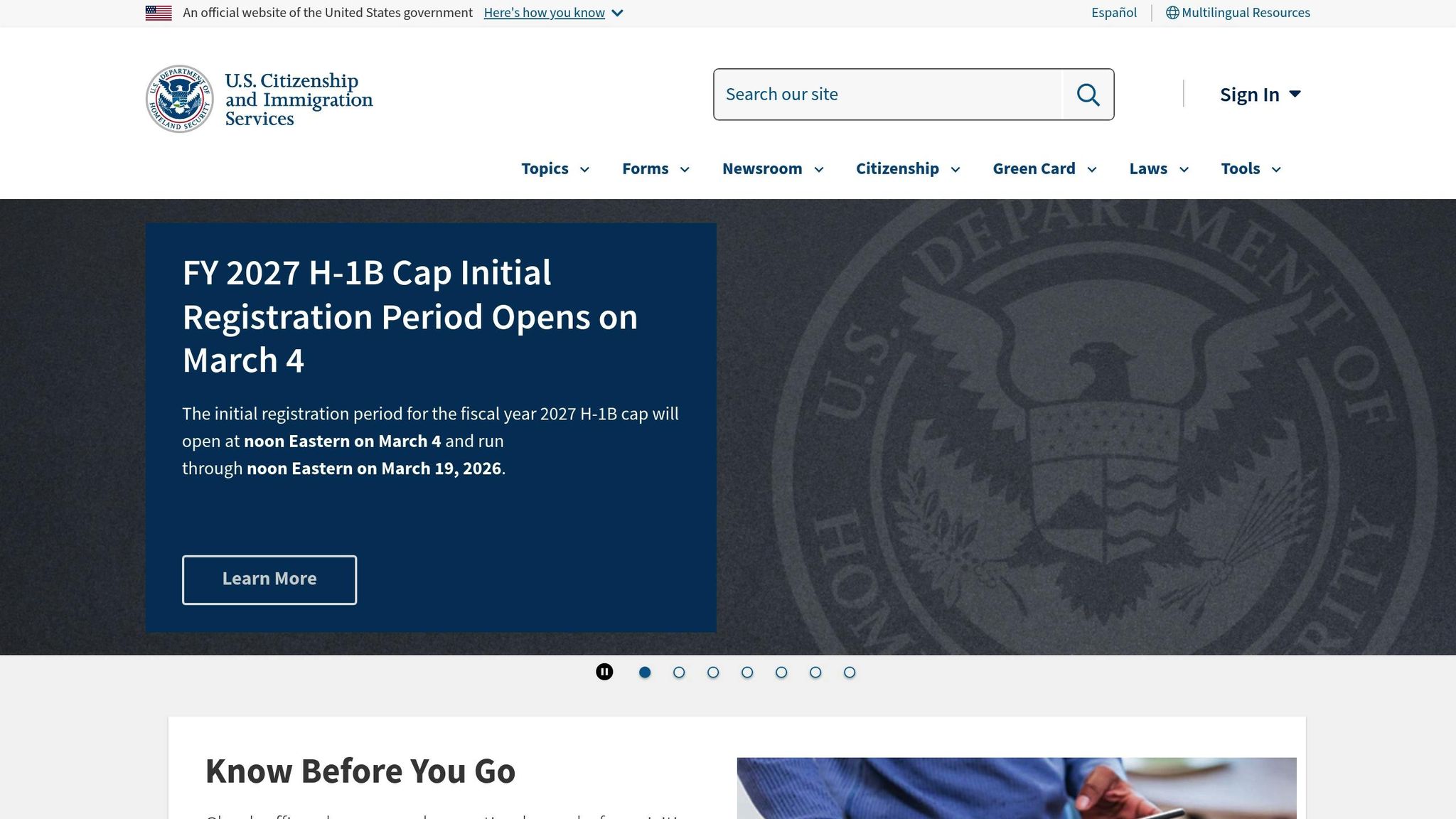
The USCIS H-1B Employer Data Hub provides access to official petition data from fiscal year 2009 through the first quarter of fiscal year 2026. This resource allows you to explore various sponsorship activities, including New Employment (initial H-1B petitions), Continuation (extensions), Change of Employer (transfers), and Amended Petitions. If you're aiming to identify companies actively hiring new H-1B workers, focus on the New Employment Approvals category.
The data is updated quarterly, with October–December information typically released in April. For a broad analysis, you can download annual Excel or CSV files to compare trends across multiple years. Use the Crosstab View feature to filter data by state, employer, or NAICS code. For instance, filtering by NAICS code 51 can help you identify trends in the tech sector. Once you've customized your dataset, export it for further analysis.
However, keep in mind a few limitations. The hub only reflects the USCIS's initial decision on a petition, so any subsequent appeals or revocations won't be included. Additionally, the city, state, and ZIP code listed correspond to the employer's mailing address, which may not match the actual work location.
This data serves as a solid foundation for conducting more detailed analyses using external tools.
How to Analyze Job Market Trends with MyVisaJobs and H1BGrader
To complement government data, third-party platforms like MyVisaJobs and H1BGrader offer more detailed insights into job market trends. For instance, MyVisaJobs provides access to Prevailing Wage Determinations (PWD), which can signal hiring plans 3–6 months before jobs are posted. It also tracks Labor Condition Applications (LCA) for current recruitment activities and PERM filings, which indicate long-term hiring stability. Companies with a high volume of PERM filings are likely investing in permanent roles rather than relying on temporary staffing.
For example, FY 2025 data reveals that Microsoft filed 9,362 LCAs with an average salary of $172,325, while Meta filed 6,627 LCAs with an average salary of $205,401. These figures can help you benchmark employers for stability and salary competitiveness. H1BGrader's Company Comparison Tool allows you to directly compare employers based on approval rates and salary data. Always check the "Data Refresh Status" on these platforms to ensure you're working with the latest information.
When analyzing opportunities, focus on specific work cities and states rather than just the employer's headquarters location. If you're juggling multiple sponsorship opportunities and need help tailoring your application strategy, consider using a professional resume service familiar with H-1B employer expectations. With the FY 2027 H-1B lottery scheduled to open on March 4, 2026, late February is the ideal time to finalize your employer research and application plans.
MyVisaJobs vs scale.jobs: Which Should You Choose?
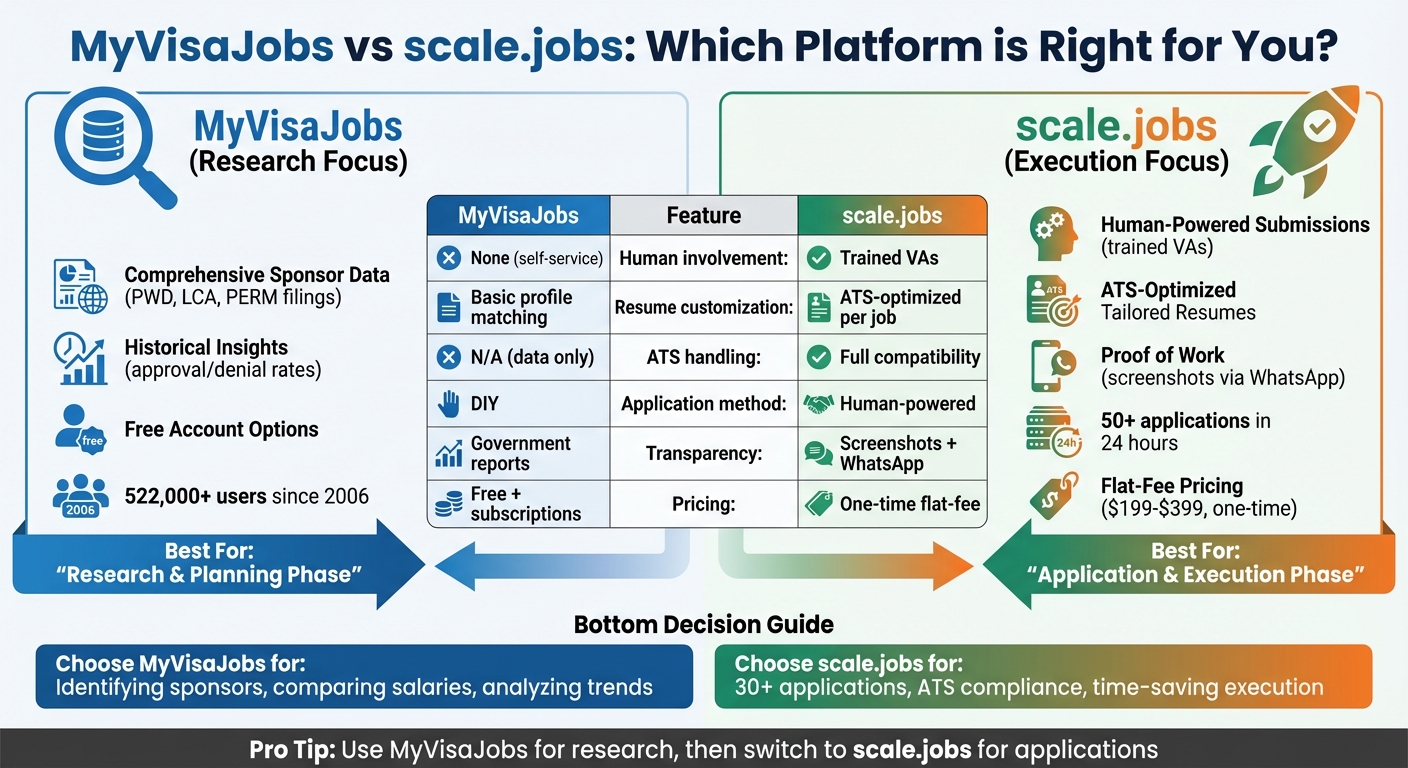
MyVisaJobs vs Scale.jobs: Feature Comparison for H1B Job Seekers
When it comes to navigating the H-1B job application process, both MyVisaJobs and scale.jobs offer distinct advantages. MyVisaJobs shines during the research phase, helping you identify potential sponsors, while scale.jobs steps in to streamline the application process. Let’s break down how these platforms complement each other and where they differ.
What MyVisaJobs Does Well
MyVisaJobs has been a go-to resource for H-1B job seekers since 2006, with over 522,000 users relying on its database. This platform takes government data and transforms it into actionable insights. Here’s what makes it stand out:
- Comprehensive Sponsor Data: MyVisaJobs compiles data from Prevailing Wage Determinations (PWD), Labor Condition Applications (LCA), and PERM filings. This allows users to track hiring trends and identify reliable sponsors.
- Historical Insights: You can verify employer approval and denial rates, compare average salaries for specific roles, and focus on companies that have sponsored workers in the last three years.
- Free Account Options: Basic profile creation and skill matching tools make it accessible for those just starting their H-1B job search.
While MyVisaJobs excels in providing data and insights, it leaves the actual application process up to you, which can be a time-consuming and complex task.
Why scale.jobs Wins: Execution Over Research
scale.jobs picks up where MyVisaJobs leaves off, focusing on the application process itself. Here’s how it simplifies and enhances your job search:
- Human-Powered Submissions: Trained virtual assistants (VAs) handle applications manually, ensuring compatibility with various Applicant Tracking Systems (ATS) like Workday, iCIMS, and Greenhouse. This reduces the risk of rejections caused by automated errors.
- Tailored Resumes for Each Job: Resumes are customized for specific job descriptions using a hybrid approach that combines AI tools and human expertise. This significantly improves interview chances.
- Proof of Work: Every application is documented with time-stamped screenshots shared via WhatsApp, giving you full visibility into the process.
- Flat-Fee Pricing: With one-time payment options ranging from $199 for 250 applications to $399 for 1,000 applications, there are no recurring charges. Unused credits are refundable.
- Time-Saving: scale.jobs can handle 50+ applications in 24 hours, saving you the 20+ hours it would take to manually navigate multiple portals.
Feature Comparison Table
| Feature | MyVisaJobs | scale.jobs |
|---|---|---|
| Human involvement | None (self-service research) | Trained VAs manage submissions |
| Resume customization depth | Basic profile matching | ATS-optimized, tailored per job |
| ATS handling | N/A (data only) | Full compatibility, manual entries |
| Application execution method | DIY pitching to employers | Human-powered across portals |
| Transparency and proof of work | Government filing reports | Screenshots, WhatsApp updates |
| Pricing model | Free account + subscriptions | One-time flat-fee bundles |
Who Should Use MyVisaJobs
MyVisaJobs is ideal for those in the research phase. If you need to verify an employer’s sponsorship history, compare salaries, or analyze hiring trends, this platform is a great tool. It’s particularly useful for identifying early hiring signals through PWD filings.
Who Should Choose scale.jobs
If you’ve done your research and are ready to apply to multiple sponsors, scale.jobs is the better choice. It’s perfect for candidates who lack the time or expertise to manage the application process manually. With its flat-fee pricing and proof-of-work transparency, scale.jobs ensures your applications are handled efficiently and effectively.
For those needing extra support, a virtual assistant for job seekers can further streamline the process.
Switch to scale.jobs If
- You already have a list of 30+ target sponsors but don’t have the time to manually submit applications.
- You’re worried about ATS filters rejecting your resume due to formatting issues.
- You want real-time updates on application progress rather than just a submission count.
- You prefer a one-time payment instead of recurring fees.
Decision Summary
Choose MyVisaJobs for research and planning, especially if you’re gathering data on potential H-1B sponsors. Opt for scale.jobs when you’re ready to act on that research and need a seamless, human-powered application process. Together, these platforms can make your H-1B job search more efficient and effective.
Conclusion: How to Track H1B Sponsors Efficiently
Keeping track of H-1B sponsors in 2026 requires a two-part approach: thorough research followed by focused execution. Start by using platforms like MyVisaJobs to monitor Prevailing Wage Determinations (PWD), which can signal early hiring trends. Pair this with H1BGrader to evaluate approval rates and salary benchmarks. These tools help you identify hiring companies and understand their pay structures, but they leave the application process in your hands.
Once you've built a solid list of target companies, it's time to focus on execution. With the wage-weighted lottery system, salary levels play a crucial role. For instance, roles offering Level II wages (34th percentile) receive two entries in the lottery, doubling your chances compared to lower wage levels. While research tools help uncover opportunities, human-driven services ensure your applications are tailored and stand out.
Unlike self-service platforms that require you to manage every step, scale.jobs offers a streamlined solution. Combining human expertise with ATS-optimized submissions, the platform simplifies the process. Their trained virtual assistants customize resumes, manually submit applications to bypass ATS filters, and provide real-time updates via WhatsApp. With flat-fee pricing starting at $199 for 250 applications, you avoid ongoing subscription costs while ensuring efficiency.
Maximize your strategy: Use MyVisaJobs and H1BGrader to create your target list, then rely on virtual assistants for job seekers or application services to handle submissions. With the FY 2027 lottery opening on March 4, 2026, early identification of sponsors through PWD filings gives you a head start before jobs hit the market.
Why Consider scale.jobs?
- You’ve identified 30+ target companies but lack time for manual applications.
- You want to bypass ATS rejections with tailored, human-optimized resumes.
- You prefer real-time updates, such as WhatsApp notifications, for transparency.
- Manual applications are time-consuming and yield limited results.
- You’re looking for a one-time payment model instead of recurring fees.
Decision Guide
Use MyVisaJobs and H1BGrader for in-depth research to find sponsors, analyze approval rates, and compare salaries. When you're ready to act, turn to scale.jobs for efficient, human-led application submissions that ensure ATS compliance and provide clear proof of work. Research tools help you identify opportunities, while human-powered services ensure your applications are delivered effectively.
FAQs
How can I estimate my odds in the 2026 wage-weighted H-1B lottery?
To understand your chances in the 2026 wage-weighted H-1B lottery, it’s crucial to consider factors like wage levels, employer sponsorship trends, and specific job roles. Higher salaries often improve your odds of selection. Platforms such as MyVisaJobs and H1BGrader can help you dive into sponsor data, salary distributions, and approval statistics. Focus on employers with a solid track record of sponsorship and compare your qualifications to typical salary benchmarks to assess how competitive you might be under the revised system.
What data points best predict if a company will sponsor this year?
Key information includes recent sponsorship activity, such as sponsorships within the last three years, historical approval trends, and current filing patterns for LCAs (Labor Condition Applications) and Labor Certifications. These details provide insight into current hiring practices and visa sponsorship trends.
How can I verify an employer’s H-1B approvals versus just LCA filings?
To check an employer’s H-1B approvals, the USCIS H-1B Employer Data Hub is a reliable resource. This tool offers detailed information on approved petitions from fiscal year 2009 through 2025, including their approval statuses. It provides a more precise method of verification compared to solely relying on LCA filings.
Related Blog Posts
- Is the H-1B $100,000 Fee the End of Tech’s Global Talent Flow? Myths, Fears, and Facts
- Beyond the Headlines: How the $100,000 H-1B Fee Upends Indian Tech Careers
- Navigating the New $100,000 H-1B Fee: Tips, Challenges, and Legal Insights for 2025
- How to Identify Companies That Truly Sponsor H1B (With Proof)