Small Business ATS vs. Enterprise ATS: Key Differences
Compare small-business and enterprise ATS: pricing, setup time, automation, compliance, and which system fits your hiring scale and goals.

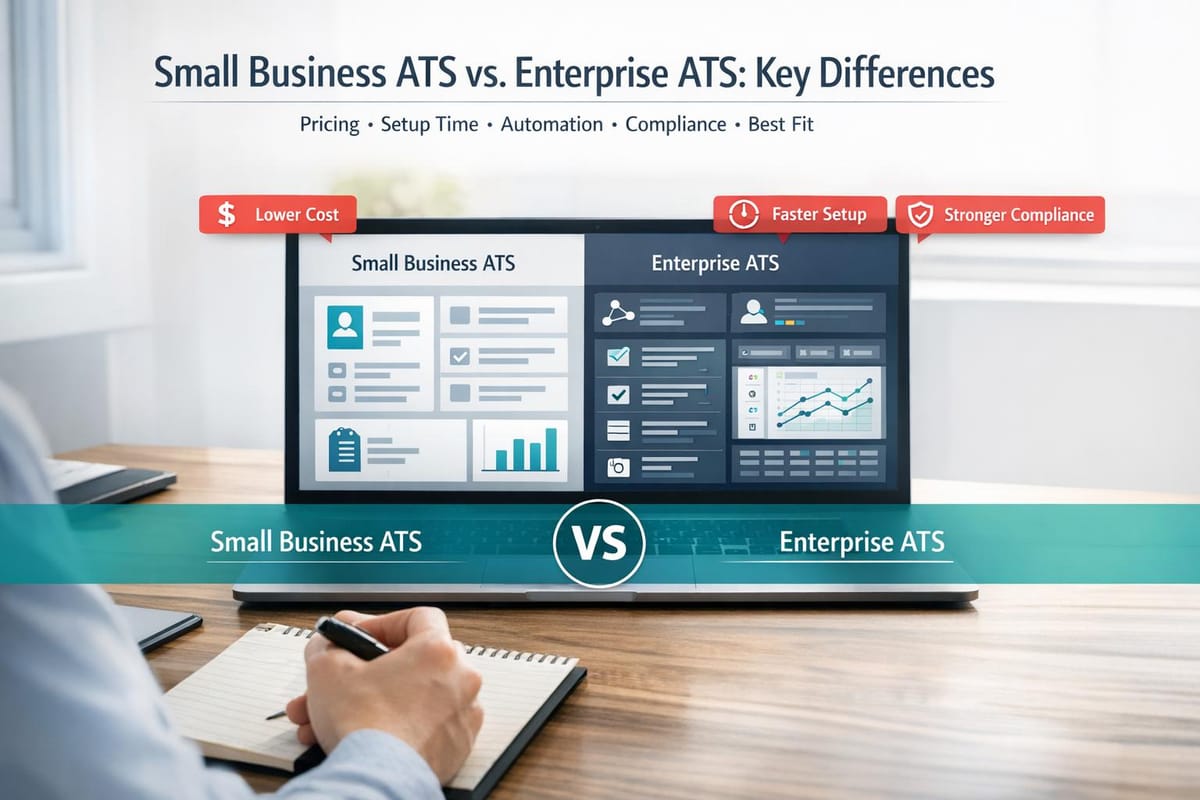
When choosing an Applicant Tracking System (ATS), it's important to understand how applicant tracking systems work and how small business and enterprise solutions differ. Small business ATS platforms prioritize ease of use, quick setup, and affordability, making them ideal for teams with limited resources. Enterprise ATS platforms, on the other hand, cater to large organizations with complex hiring needs, offering advanced features like AI-driven analytics, compliance tools, and high-volume processing.
Key Differences at a Glance:
- Small Business ATS: Focus on simplicity, with prices ranging from $19 to $300/month. Setup takes minutes, and features include basic automation, job board posting, and candidate tracking.
- Enterprise ATS: Designed for scale, with costs starting at $6,000/year and going up to $500,000. These systems offer custom workflows, deep integrations, and tools for compliance and analytics.
Quick Comparison Table:
| Feature | Small Business ATS | Enterprise ATS |
|---|---|---|
| Primary Goal | Speed, ease of use | Managing complexity, compliance |
| Pricing | $19–$300/month | $6,000–$500,000/year |
| Setup Time | 10 minutes–2 days | 1–3 months |
| Automation | Basic (resume parsing, scheduling) | Advanced (AI matching, analytics) |
| Compliance Tools | Minimal | Extensive (EEOC, GDPR, OFCCP) |
For small businesses, platforms like JazzHR or Zoho Recruit offer practical solutions without high costs. Enterprises often turn to systems like Greenhouse or Workday Recruiting to manage large-scale hiring needs. Whether you’re hiring for a small team or managing thousands of applications, selecting the right ATS ensures a smoother recruitment process tailored to your organization’s scale and goals.
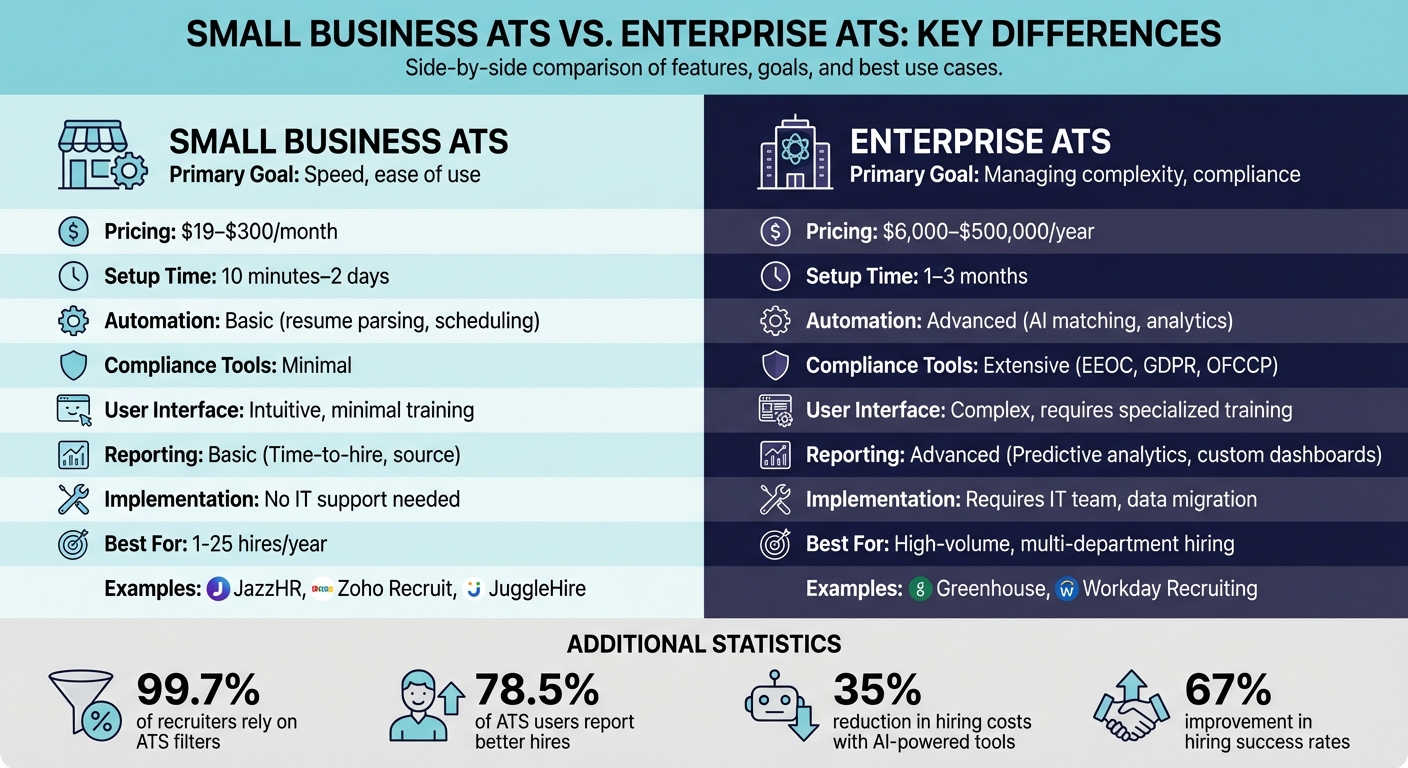
Small Business ATS vs Enterprise ATS: Key Differences Comparison Chart
Small Business ATS: Core Features
Simple Interface and Quick Setup
Small business ATS platforms are designed to be ready for action right out of the box. With a focus on user-friendly layouts, these systems make it easy for small business owners or HR teams to get started without needing advanced technical skills. For instance, JuggleHire boasts a setup time of just 10 minutes, a stark contrast to the months often required for enterprise-level systems.
The clean and straightforward interface helps users manage job postings, monitor candidate pipelines, and collaborate with their team - all from an intuitive dashboard. This simplicity is a game-changer for small business owners who are often managing multiple responsibilities. It also aligns with budget-friendly pricing models tailored for smaller operations.
Affordable Pricing Models
Small business ATS platforms keep costs transparent and manageable. Unlike enterprise systems that demand custom quotes and annual contracts starting at around $6,000, these solutions typically offer clear subscription plans ranging from $19 to $300 per month. Flat-fee pricing and the absence of hefty implementation fees make these platforms accessible.
What sets small business ATS apart is their plug-and-play functionality, which eliminates the need for expensive customizations. This means businesses can skip the implementation fees that range from $1,000 to $50,000 in enterprise systems. However, it’s worth noting that additional features - like texting, video interviews, or assessments - can sometimes increase the base plan costs, so it’s essential to review those details carefully.
Basic Automation Tools
These platforms are built to save time while staying easy to use and cost-effective. Essential automation features handle tasks like pulling candidate information, posting job ads to major job boards, and ranking applicants through keyword filters. This is a huge help for small teams, as over 99.7% of recruiters rely on ATS filters, focusing on skills (76.4%), education (59.7%), and job titles (55.3%).
Additional tools, like interview self-scheduling, integrate seamlessly with Google or Outlook calendars, simplifying the process of booking meetings. Pre-built communication templates also take care of routine messages, such as acknowledging applications, sending interview invitations, or delivering rejection letters.
"An ATS is like having an extra set of hands (or ten) to tackle hiring challenges head-on!"
These features highlight how small business ATS platforms stand apart from their enterprise counterparts, offering practical functionality without the hefty investment.
Enterprise ATS: Core Features
Custom Workflows and Integration
Enterprise ATS platforms are designed to handle the complexities of large organizations. They allow for tailored workflows, including multi-stage approval processes, and integrate seamlessly with other HR tools. Whether through native integrations, custom APIs, or middleware, these systems ensure data flows smoothly, cutting down on repetitive tasks. For instance, when PwC adopted Workday's recruiting solution, they automated manual hiring processes, saving approximately 9,000 labor hours annually. The integration between their ATS and HRIS allowed candidates to transition effortlessly from "applicant" to "employee", eliminating redundant data entry. Such flexibility not only simplifies operations but also sets the stage for leveraging advanced analytics.
Advanced Analytics and Reporting Tools
Modern enterprise ATS platforms go beyond simple tracking; they serve as strategic tools for talent acquisition. With real-time metrics and predictive analytics, these systems help organizations refine their hiring strategies. They measure everything from diversity metrics to the ROI of different sourcing channels, offering insights into where recruitment investments are most effective. Advanced analytics can highlight stages where candidates drop off, link interview scores to long-term performance, and even predict which applicants are likely to excel.
Ferring, a pharmaceutical company, utilized AI and machine learning within its ATS to match candidates to suitable roles. This approach allowed them to fill 90% of positions with top talent, speeding up the hiring process significantly.
Additionally, these platforms simplify compliance by automatically generating reports for regulations like EEO, OFCCP, and GDPR. This automation not only saves countless hours but also helps minimize hiring bias, with 32% of companies reporting that HR automation has made their recruitment processes fairer. For organizations managing large applicant volumes, these insights are indispensable.
High-Volume Hiring Capacity
Enterprise ATS platforms are built to handle the demands of large-scale hiring. They can process thousands of applications at once, using AI to screen and rank candidates based on their suitability. With the average number of applications per hire increasing by 46% between 2022 and 2024, automation has become essential. These systems offer features like automated drip campaigns to engage passive candidates, AI-driven tools for matching interviewers with candidates, and real-time solutions for managing scheduling conflicts. Advanced platforms are even incorporating identity verification and fraud detection to ensure candidate quality.
For larger organizations - those with over 2,000 employees - these capabilities are well worth the investment. Annual contracts for enterprise ATS platforms typically range from $150,000 to $500,000 or more, with implementation fees varying between $1,000 and $50,000. These tools not only streamline high-volume hiring but also ensure efficiency and quality throughout the process.
Best HR & Recruitment Software 2025: ATS Comparison
Small Business ATS vs. Enterprise ATS: Direct Comparison
Choosing the right Applicant Tracking System (ATS) depends on understanding the unique needs of your organization. Small businesses and enterprises face very different hiring challenges, and the ATS solutions they require reflect these differences.
Feature Differences
The primary distinction between small business and enterprise ATS systems lies in simplicity versus complexity. Small business ATS platforms focus on speed and ease of use, offering essential features like job board distribution, resume parsing, basic candidate tracking, and simple interview scheduling. These tools are tailored for hiring managers who need to post jobs and evaluate candidates quickly - sometimes within minutes.
Enterprise ATS platforms cater to high-volume hiring and compliance needs. They include advanced features like AI-driven candidate matching, detailed analytics, diversity tracking (EEOC/OFCCP compliance), and custom workflows that support multi-departmental approval processes. These systems integrate deeply with complex HRIS, payroll, and security systems (e.g., SSO/SAML), making them indispensable for organizations with large-scale hiring operations.
While small business ATS tools increasingly incorporate AI for sourcing candidates, enterprise systems focus on managing high application volumes efficiently. This reflects their distinct challenges: small businesses often struggle to attract enough candidates, while enterprises need to process thousands of applications effectively.
| Feature | Small Business ATS | Enterprise ATS |
|---|---|---|
| Primary Goal | Speed and simplicity | Compliance and process control |
| User Interface | Intuitive, minimal training | Complex, requires specialized training |
| Reporting | Basic (Time-to-hire, source) | Advanced (Predictive analytics, custom dashboards) |
| Sourcing | Built-in AI sourcing/outreach | Often requires separate CRM/Sourcing tools |
| Compliance | Basic | Robust (EEOC, GDPR, OFCCP, global support) |
| Setup Time | 10 minutes to 2 days | 1 to 3 months |
These differences make it clear why choosing an ATS tailored to your hiring needs is essential.
Cost Breakdown
Cost is another critical factor separating small business and enterprise ATS platforms. Small business systems typically charge $19 to $300 per month, with straightforward subscription pricing. For example, Workable offers plans starting at $149/month for teams of up to 50 employees, with no implementation fees and minimal training costs. This makes them accessible to smaller teams with limited budgets.
Enterprise ATS platforms operate on a much larger scale. Annual contracts start around $6,000 to $15,000 and can exceed $100,000 depending on the organization’s size and customization needs. Implementation fees range from $1,000 to $50,000, with additional training costs between $500 to $5,000. These additional expenses often surprise organizations that focus only on the base subscription price.
The financial priorities also differ. Small businesses focus on affordability and immediate value, often saving up to $10,000 annually by automating manual hiring tasks. Enterprises, on the other hand, prioritize ROI and long-term customization. For example, advanced analytics and compliance tools can significantly reduce time-to-hire while improving candidate quality - 78.5% of ATS users report better hires as a result.
Implementation Requirements
The implementation process varies dramatically between small business and enterprise ATS platforms. Small business systems can often be set up in 10 minutes to a day, requiring no IT support. A hiring manager can sign up, connect their email, and start posting jobs immediately. Training is typically self-guided, with video tutorials and help articles available on demand.
"Greenhouse seemed excellent on paper... but putting it together felt like building a little ERP." - Elena Cacean, People and Operations Manager, Index.dev
Enterprise ATS setups, by contrast, are far more involved, taking anywhere from two weeks to three months. The process includes gathering requirements, migrating data from legacy systems, integrating with existing HR technology, customizing workflows, and conducting formal training sessions. Data migration often requires extensive cleanup to ensure accurate reporting.
User adoption poses another challenge for enterprise systems. Large teams may resist shifting from familiar tools like spreadsheets or email-based workflows, making change management essential. For small businesses, the simplicity of modern cloud-based ATS platforms helps avoid these hurdles, ensuring a smoother transition.
How scale.jobs Helps Job Seekers Navigate ATS Systems
When you apply for a job - whether it's with a small business using JazzHR or a Fortune 500 company leveraging Greenhouse - your resume has to first pass through an Applicant Tracking System (ATS). These systems use automated filters to screen candidates, and with increased competition, getting past this stage is often the biggest hurdle.
scale.jobs (https://scale.jobs) simplifies this process by offering a comprehensive, three-part solution: free ATS-friendly tools, AI-powered customization, and human assistant services. With support for more than 500 ATS platforms, scale.jobs is designed to handle everything from basic small-business systems to the more intricate enterprise platforms.
ATS-Compliant Resume and Application Tools
One of the most frustrating parts of dealing with ATS platforms is how they often misinterpret formatted resumes, forcing job seekers to manually re-enter their information. scale.jobs eliminates this hassle with its free ATS-compliant resume builder, which generates machine-readable resumes that are seamlessly parsed by systems like Greenhouse and Workable.
For those looking to take their applications further, the platform’s AI Assistant Pro offers unlimited, AI-tailored resume customization at a launch price of $9/month (regularly $19/month). This tool adjusts keywords, skills, and job titles to align perfectly with specific job postings, ensuring your resume matches the criteria ATS platforms use to rank candidates. This level of customization is critical because both small and large ATS systems rely heavily on keyword filtering to identify top applicants.
Additionally, scale.jobs provides a free job application tracker to help you keep tabs on your submissions across various platforms, including corporate systems like iCIMS and niche job boards. This ensures no opportunities slip through the cracks.
Human Assistant Services for Job Applications
While AI can optimize resumes, it can't handle unique application processes or manually complete forms. That’s where scale.jobs’ human assistant services come in. Unlike competitors like LazyApply or Simplify, scale.jobs assigns real people to manage your applications, ensuring accuracy and avoiding red flags that can arise with automated tools.
For a flat fee starting at $199 for 250 applications (no recurring subscriptions), these human assistants handle everything from filling out forms to submitting applications. You’ll receive real-time updates via WhatsApp, time-stamped proof-of-work screenshots, and refunds for any unused credits, providing complete transparency. This hands-on service can save you over 20 hours a week - time better spent networking or preparing for interviews.
Because human assistants manually complete each application, they can adapt to any ATS interface, whether it’s a simple system for small businesses or a multi-step enterprise platform. This flexibility eliminates the compatibility issues that often plague automated tools.
Tools That Work with Any ATS Platform
ATS platforms are constantly evolving, but scale.jobs stays ahead by combining cutting-edge AI tools with human oversight. The platform’s free ATS resume checker ensures your document meets common parsing requirements, while its AI cover letter generator creates tailored cover letters to complement your optimized resume.
This dual approach - AI precision paired with human adaptability - ensures scale.jobs works seamlessly across all ATS systems. For example, enterprise platforms like Greenhouse, which integrate with over 450 third-party tools and use AI to rank applications, demand highly optimized materials. On the other hand, smaller systems like JuggleHire focus on basic keyword tracking and simple parsing. scale.jobs ensures your applications meet the requirements of both.
Beyond ATS optimization, scale.jobs offers additional free tools, including a salary predictor, interview questions predictor, and portfolio website generator. These resources help you prepare for the next steps in your job search, recognizing that passing the ATS is just one part of the journey.
Conclusion: Selecting the Right ATS for Your Organization
Deciding between a small business ATS and an enterprise-level solution ultimately depends on your hiring needs, available resources, and long-term growth plans. As we've outlined, these systems differ greatly in features and scale. For businesses hiring 1-25 employees per year without a dedicated IT team, platforms like JazzHR or Zoho Recruit provide straightforward functionality at a manageable cost, ranging from $19 to $300 per month. On the other hand, larger organizations handling thousands of applications across various departments or global offices require robust enterprise solutions like Greenhouse or Workday Recruiting. These platforms offer advanced tools, such as AI-driven candidate matching, diversity tracking, and seamless HRIS integrations, with annual contracts starting at $6,000 and climbing well into six figures.
After narrowing down your options, take a close look at your current hiring process to pinpoint specific challenges. Use free trial periods to test platforms by posting a real job and walking through the entire process from both the recruiter’s and candidate’s perspectives. Don’t forget to test the mobile experience - if the application process is cumbersome or requires manual data entry, you risk losing top candidates before they even apply.
Keep in mind the hidden costs, such as implementation and training fees, which can add to the base subscription price. While the initial investment may seem steep, AI-powered recruitment tools have been shown to cut hiring costs by 35% and improve hiring success rates by 67%, making them a smart choice for businesses with high-volume recruiting needs.
"The true challenge for small businesses is finding an Applicant Tracking System (ATS) that delivers enterprise-level power without enterprise-level complexity or price." - Loxo
Your ATS should grow with your organization. Small businesses need a system that can expand with additional users and job postings as they scale, while enterprises require platforms capable of managing large-scale recruiting efforts across multiple locations without faltering. Compare at least two options based on your expected headcount and growth trajectory. Selecting the right ATS will not only streamline your hiring process but also position your organization to attract and retain top talent as you grow.
FAQs
What should small businesses look for in an Applicant Tracking System (ATS)?
When selecting an ATS, small businesses need to focus on factors that cater specifically to their requirements. Budget considerations come first, as smaller companies often work with limited financial resources. Look for an ATS that offers the essential tools you need at a fair price, avoiding systems packed with features you won't use.
Another critical factor is ease of use. A straightforward, intuitive platform can save time and minimize the need for lengthy training sessions, allowing your team to hit the ground running.
Don't overlook integration capabilities - your ATS should work well with existing tools like best job boards, HR software, or communication platforms. This ensures a smooth workflow without added complexity. As your business grows, scalability becomes key. Opt for a system that can adapt to your expanding hiring needs without requiring a complete overhaul.
Customization is another feature to keep in mind. Being able to tailor application forms or screening questions allows you to align the system with your specific recruitment strategies.
Lastly, think about the return on investment (ROI). Features like automation, ATS-optimized resumes, and even services offering human assistance, such as those provided by Scale.jobs, can make hiring more efficient and free up your team’s time. By focusing on these aspects - budget, usability, integration, scalability, customization, and ROI - small businesses can choose an ATS that simplifies and enhances their hiring process.
How do enterprise and small business ATS platforms differ in handling compliance?
Enterprise ATS platforms come equipped with advanced features like diversity and inclusion tracking, customizable reporting, and detailed audit trails to address complex compliance requirements. These capabilities are essential for larger organizations that must meet stringent regulatory standards.
On the other hand, small business ATS platforms prioritize basic compliance needs. They offer straightforward solutions that are easier to set up and manage, making them a practical choice for smaller teams working with limited resources.
What unexpected costs should you consider when implementing an enterprise ATS?
Implementing an enterprise ATS often brings hidden costs that extend well beyond the initial purchase price. These can include upfront expenses like licensing fees, customization to fit your specific needs, and integrating the system with your current tools and platforms.
On top of that, there are ongoing costs to consider, such as regular maintenance, user training to ensure your team can fully utilize the system, and technical support for troubleshooting and updates.
If your business experiences growth, scalability can introduce additional expenses. You might need to upgrade your plan or pay for extra features to accommodate a larger workforce or expanded operations. Being aware of these potential costs during the planning phase can help you budget effectively and avoid unexpected financial surprises later.