
Skills You Should Learn in 2026 to Get Hired Faster
Top in-demand skills for 2026—AI, data analysis, cybersecurity, cloud, healthcare, marketing and advanced trades—plus how to present them to land jobs faster.


In 2026, the job market is prioritizing skills over degrees, with AI, data analysis, cybersecurity, cloud computing, and healthcare expertise leading hiring trends. Employers are seeking candidates who can work with AI resume builders, analyze data, secure digital environments, and adapt to tech-driven workflows. Platforms like Scale.jobs simplify job applications by combining ATS-optimized resumes, human assistance, and transparent updates, helping you stand out in a competitive market.
Key Takeaways:
- AI Skills: Expertise in Agentic AI, Model Context Protocol, and tools like LangChain is in demand.
- Data Analysis: Master SQL, Python, and Power BI for actionable insights.
- Cybersecurity: Focus on AI-driven threat detection and cloud security certifications.
- Cloud Computing: AWS, Azure, and tools like Docker are essential for tech roles.
- Healthcare: Combine patient care with AI literacy for modern healthcare jobs.
- Digital Marketing: Blend AI-powered content creation with SEO and data literacy.
- Project Management: Merge Agile methods with AI validation skills.
- Advanced Trades: Green energy and smart infrastructure skills are reshaping trade jobs.
Scale.jobs vs. Competitors: Unlike automated tools like LazyApply, Scale.jobs offers human-guided applications, ATS-friendly resumes, and real-time updates for a flat $199 fee, ensuring your skills and applications get noticed.
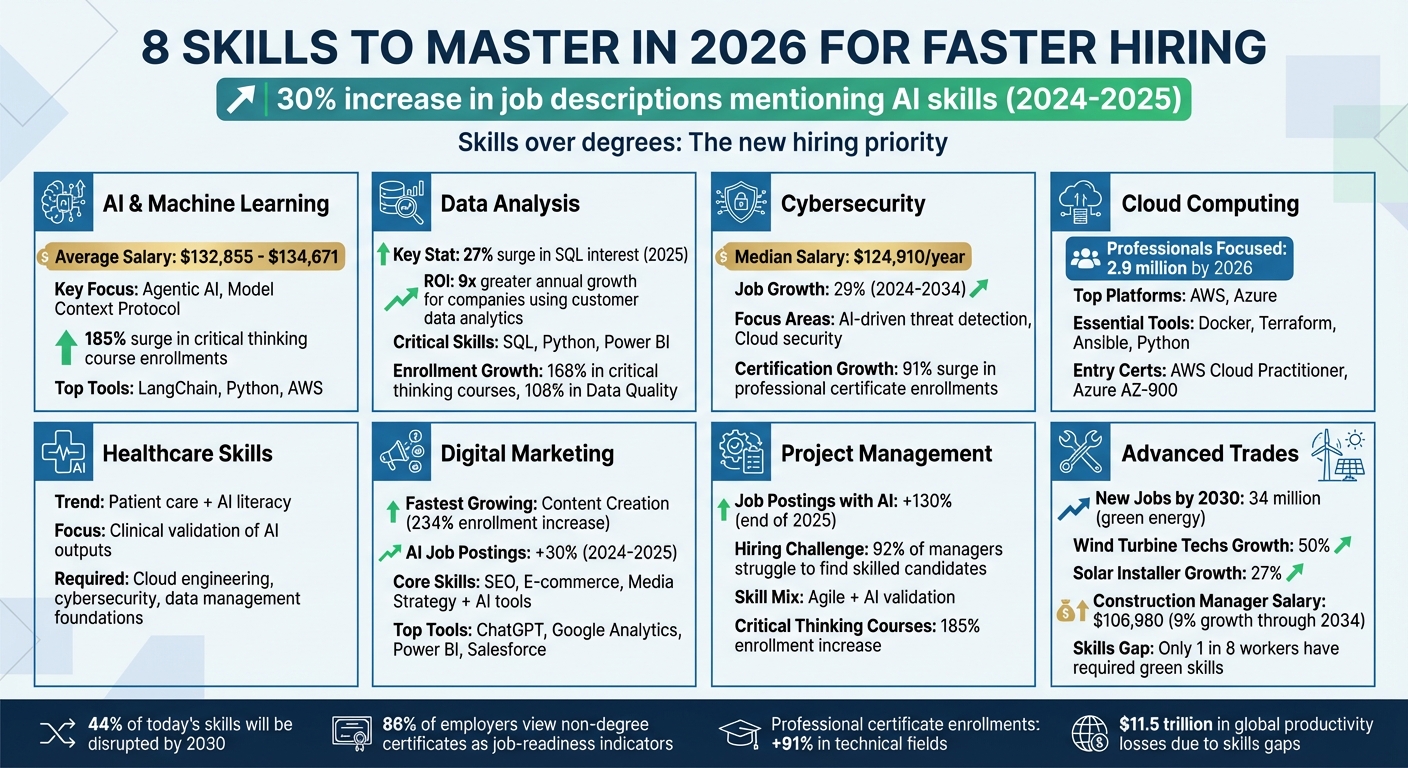
Top 8 In-Demand Skills for 2026 Job Market with Salary Data and Growth Statistics
1. AI and Machine Learning
Agentic AI & Model Context Protocol
In today's job market, AI expertise has shifted from being a bonus skill to an absolute requirement. Between 2024 and 2025, job descriptions mentioning AI skills saw a 30% increase. Employers are no longer content with candidates who can simply craft basic prompts; they’re looking for professionals skilled in developing Agentic AI - autonomous AI systems capable of handling complex, multi-step tasks with minimal human intervention. This shift demands moving beyond tools like ChatGPT to creating AI assistants that can independently research, draft, and schedule tasks.
One emerging trend shaping this landscape is the Model Context Protocol (MCP). MCP is becoming the go-to standard for enabling AI systems to seamlessly interact with external tools and databases. James Willett, an expert in AI and cloud architecture, highlights its importance:
"Tech leaders should closely watch Model Context Protocol (MCP) and the rise of AI SDKs that standardize how applications interact with AI systems. Together, they'll enable interoperable, agent-driven architectures."
By 2026, MCP is expected to be a core component of AI infrastructure, not just an optional add-on.
This growing reliance on AI has also transformed professional roles. Employers are increasingly valuing candidates with critical thinking abilities who can debug, question, and refine AI outputs. This is reflected in a 185% surge in enrollments for critical thinking courses among GenAI learners.
For those pursuing careers in AI, the financial rewards are compelling. AI engineers earn an average of $132,855 annually, while AI business strategists see salaries around $134,671. However, technical expertise alone isn’t enough. Employers are seeking candidates with strong foundations in programming languages like Python and cloud platforms such as AWS. Skills in Docker and Linux are also frequently mentioned alongside AI expertise.
To get started, explore tools like LangChain for building task-specific AI agents and pursue certifications such as IBM SkillsBuild: Artificial Intelligence Fundamentals and Google Cloud: Generative AI Learning Path. When crafting your resume, focus on measurable achievements - saying you "reduced research time by 40% using a custom GenAI summarizer" is far more impactful than simply listing AI proficiency. With platforms like Coursera seeing 14 GenAI course enrollments every minute, standing out in this competitive field requires both technical skills and the ability to demonstrate real-world results.
2. Data Analysis
SQL, Python & Power BI: The Critical Trio
As AI-driven roles continue to rise, the demand for strong data analysis skills has become equally pressing in 2026. Data analysis is no longer just about crunching numbers - it's about validating AI outputs and turning insights into actionable strategies. Interest in SQL surged by 27% in 2025, cementing its place as a must-have skill for those stepping into data roles. Mike McQuillan, Head of IT at Halls, underscores its importance:
"For people entering the industry, SQL is still essential, as well as a general understanding of database design principles, which can be applied to any paradigm."
This growing emphasis on data quality mirrors the trends in AI roles, where verifying and refining outputs is critical. Enrollment in courses focused on critical thinking for data professionals skyrocketed by 168%, while demand for Data Quality and Data Cleansing skills saw year-over-year increases of 108% and 103%, respectively. These skills directly contribute to measurable business growth.
Organizations leveraging customer data analytics platforms report over nine times greater annual growth, highlighting the importance of analytical thinking, which has become the top-ranked core skill globally. In fact, 72% of companies now prioritize analytical thinking over specific technical certifications when hiring for management roles. To excel, professionals should focus on mastering the "Big Three" tools:
- SQL for database querying and management.
- Python for advanced analytics, leveraging its powerful data science libraries.
- Microsoft Power BI or Tableau for creating impactful data visualizations.
These tools, when paired with AI expertise, form a well-rounded skill set that employers actively seek.
When crafting your resume, focus on the results you’ve achieved rather than simply listing tools. For example, instead of stating "proficient in SQL", demonstrate your impact by saying you "identified a 20% drop in checkout rates using SQL, leading to critical process improvements." Enhance your credibility by earning certifications like the Google Data Analytics Professional Certificate or the Microsoft Power BI Data Analyst Professional Certificate.
In 2026, the standout professionals are those who go beyond running analyses - they understand the narrative behind the numbers and use that knowledge to drive meaningful business decisions. This ability to connect data insights with actionable outcomes makes you a stronger candidate in today’s competitive job market.
3. Cybersecurity
AI-Powered Threats & Cloud Security: Your Entry Point to High-Paying Roles
Cybersecurity is consistently ranked as a top skill for the future, with tech practitioners and executives agreeing on its importance for growth. This alignment opens doors for job seekers who can showcase practical security expertise. Information security analysts, for instance, earn a median salary of $124,910 annually, with job growth expected to soar 29% between 2024 and 2034 - a rate significantly higher than most other professions.
The spotlight is now on AI-driven threat detection and cloud security. Christopher Rees, Principal AI Strategist at Unisys and a recognized cybersecurity expert, provides insight into the challenges ahead:
"Tech leaders face challenges from AI-powered attacks, stricter regulatory demands, and escalating supply-chain and identity risks. They must also manage talent shortages, education / upskilling, resource gaps, and the complexity of securing hybrid IT and OT environments."
This dynamic environment demands both certifications and hands-on experience.
To meet the rising demand for cybersecurity professionals, start by building a foundation with certifications like ISC2 Certified in Cybersecurity (CC) or CompTIA Security+. Once you've established the basics, focus on cloud platforms like AWS or Azure to enhance your credibility. The surge in enrollments for professional certificates - up 91% - reflects the growing employer preference for validated credentials. For example, the Google Cybersecurity Professional Certificate, rated 4.8/5 by over 52,000 learners, equips you with essential skills in Python, Linux, and SQL, all directly applicable to security roles.
As businesses rapidly shift to cloud environments, the demand for experts who can secure hybrid IT/OT systems and address risks associated with generative AI has never been higher. Hands-on practice in simulated labs, incident response training, and familiarity with tools like Splunk or frameworks like the OWASP Top 10 for Large Language Model Applications can set you apart in this competitive field.
When you're ready to enter the job market, scale.jobs provides a comprehensive edge over traditional job search tools. Unlike Jobscan, which focuses solely on resume scanning, or Resume Genius, which only offers document creation, scale.jobs goes further by combining ATS-optimized resume building with human-assisted application submissions. This personal touch avoids the pitfalls of automated systems and offers:
- 24-hour turnaround for tailored resumes and cover letters
- Real-time updates via WhatsApp, including proof-of-work screenshots
- Flat-fee pricing starting at $199 for 250 applications
- A free tier granting unlimited access to over 2 million monthly job postings and AI-powered resume customization
4. Cloud Computing
AWS & Azure: Building Blocks for Thriving Tech Careers
Cloud computing is projected to remain a top focus for 2.9 million tech professionals by 2026. Industry leaders and IT experts consistently identify it as a critical area for career development and skill enhancement.
Amazon Web Services (AWS) and Microsoft Azure lead the pack in cloud computing job opportunities. Jacob Lyman, Senior MLOps Engineer at Duke Energy Corporation, highlights the skills that matter most to employers:
"Cloud engineering skills are hugely important these days. Specific technologies I would highlight for entry-level practitioners would be AWS, Docker, Linux, Terraform, Ansible, Python, and Git."
For those starting out, certifications like AWS Certified Cloud Practitioner or Microsoft's AZ-900 are excellent entry points. These credentials not only lay the groundwork for understanding cloud environments but also provide hands-on practice through simulated scenarios. As you progress, pairing foundational knowledge with tools like Docker for containerization, Terraform for automating infrastructure, and Python for scripting can significantly boost your appeal in the job market.
The demand isn’t just for deploying cloud solutions - it’s about securing and optimizing them. Businesses are increasingly prioritizing stability and security, making expertise in networking, automation tools, and cloud security practices highly sought after. Gaining real-world experience in these areas will help you stand out during interviews and job applications.
When it comes to showcasing your skills and certifications, Scale.jobs offers an edge over competitors like TopResume and Resume.io. The platform combines ATS-friendly resumes with human-guided application submissions. Benefits include a 24-hour turnaround on personalized materials, real-time updates through WhatsApp (complete with proof-of-work screenshots), and a straightforward pricing model starting at $199 for 250 applications - no subscriptions required. By mastering cloud computing and presenting your qualifications effectively, you can position yourself as a top candidate in this competitive field.
5. Healthcare Skills
Patient Care and AI Literacy: The New Standard
Healthcare professionals aiming to secure jobs quickly in 2026 need a blend of clinical expertise and AI literacy. While patient care remains the cornerstone of healthcare resumes, employers now expect candidates to pair bedside skills with a solid understanding of AI and data analytics, reflecting the industry's shift toward digital tools.
Today's healthcare workers are evolving into expert validators, using their clinical judgment to verify AI-generated outputs. Automation is increasingly handling routine tasks like data entry and basic support, allowing professionals to focus on higher-level decision-making. To make your resume stand out, highlight measurable outcomes such as "reduced patient onboarding time by 35%" or "enhanced diagnostic accuracy through data visualization tools." These concrete examples show both clinical impact and technical proficiency.
Adding industry-recognized certifications from platforms like Google, IBM, or Microsoft can further strengthen your application. These micro-credentials in AI and data analytics not only boost your resume but also serve as verifiable proof of your capabilities. Including these on platforms like LinkedIn can make a strong impression on hiring managers.
Technical expertise is just as critical. Liz Bryson, Head of the Digital Learning Institute at Sanofi, underscores this point:
"While AI-specific skills are important, it's equally important to take a step back and make sure that our technical teams have solid foundations in domains like cloud engineering, cybersecurity, data management, and dev ops. These are the core skills that we need for AI transformation."
This foundational knowledge is essential for supporting next-generation healthcare systems and safeguarding connected medical devices from cybersecurity risks. Employers are actively seeking candidates who can bridge clinical expertise with technical know-how to protect hybrid IT systems.
If you're looking to stand out in the competitive healthcare job market, Scale.jobs offers tools that outperform competitors like Resume Genius and MyPerfectResume. Here's what makes Scale.jobs a better choice:
- ATS-optimized resumes that emphasize key healthcare terms like "patient care" and "clinical validation."
- Human-guided application support, including a dedicated assistant to tailor your job applications.
- Real-time updates via WhatsApp, complete with proof-of-work screenshots showing exactly where your applications are submitted.
- Transparent, one-time pricing of $199 for 250 applications, avoiding the recurring fees often charged by similar platforms.
6. Digital Marketing
AI-Powered Content Creation Meets SEO Fundamentals
By 2026, understanding AI tools is no longer optional for digital marketers - it's a must-have skill. While competitors like Resume Genius and Teal rely on automation, scale.jobs combines AI-driven solutions with human oversight to deliver better results. Interestingly, Content Creation has become the fastest-growing skill for those diving into Generative AI, with a 234% increase in course enrollments year-over-year. Yet, technical pillars like Search Engine Optimization (SEO), E-commerce, and Media Strategy remain just as crucial for cutting through today's competitive landscape. Success in this field demands a blend of creative AI tools and foundational technical knowledge.
Digital marketing now mirrors the dynamic nature of AI and data sciences, requiring professionals to balance creativity with technical expertise. The profession is evolving - marketers are increasingly delegating tasks to AI agents and focusing on refining and validating the results. This is especially true in analytics, where verifying AI-driven insights for accuracy and brand alignment is critical. Skills like multimodal prompting, which combines text, images, and data for innovative outputs, are becoming central. Between 2024 and 2025, job postings requiring AI proficiency rose by 30%, with employers seeking expertise in tools like ChatGPT, Google Gemini, Adobe Photoshop, Google Analytics, and Salesforce.
Data literacy has also become a cornerstone of modern marketing. Professionals are expected to use tools like Power BI, Tableau, or SQL to transform complex metrics into actionable insights. This doesn’t mean marketers need to become data scientists but rather that they need to leverage these tools to craft more effective campaigns. For instance, the Microsoft Power BI Data Analyst Professional Certificate boasts a 4.6/5 rating from over 8,000 reviews on Coursera, reflecting the growing demand for verified skill sets. Enrollments in such professional certificates have surged by 91%, highlighting the importance of demonstrating expertise in this area.
When it’s time to turn these digital marketing skills into job opportunities, scale.jobs stands out against competitors like Resume Genius or Teal. Here’s why:
- ATS-optimized resumes: Designed to showcase both AI expertise (like Content Creation and Multimodal Prompts) and technical skills (SEO, SEM, CRM), these resumes improve your chances of passing automated screening systems used by over 98% of Fortune 500 companies.
- Human-crafted applications: Experienced professionals tailor your applications to highlight your ability to merge creative and analytical strengths, addressing the unique challenges marketers face in proving their versatility.
- Real-time updates: Stay informed with WhatsApp notifications that include proof-of-work screenshots, giving you transparency throughout the process.
- One-time pricing: With packages starting at $199 for 250 applications, scale.jobs offers a cost-effective alternative to subscription models like Teal’s $9/week or Jobscan Premium’s $49.95/month, saving you money during extended job searches.
7. Project Management
Blending Agile with AI Validation in 2026
In 2026, project management is about much more than just keeping workflows on track or addressing bottlenecks - it's also about validating AI outputs and ensuring they align with business goals. With AI agents now handling entire technical tasks, hiring managers are looking for professionals who can bridge the gap between AI recommendations and actionable business outcomes. By the end of 2025, job postings mentioning AI or related terms surged by over 130%, as tracked by the Indeed AI Tracker, which hit a record high of 4.2% in December. Simultaneously, 92% of U.S. hiring managers reported struggles in finding skilled candidates, creating an opening for those who combine project management expertise with AI literacy.
Building on earlier discussions about technical upskilling, today's project managers are merging traditional Agile methods with AI-driven insights. While Agile methodology remains foundational in competitive roles, the real edge comes from combining it with critical thinking and analytical abilities. This shift is evident in the 185% year-over-year increase in enrollments for critical thinking courses focused on Generative AI. Anthony Salcito, General Manager for Enterprise at Coursera, highlights this evolving role:
"As workers increasingly offload entire tasks to AI agents rather than just iterating with them, the human role is shifting from collaborator to expert validator of the final output."
To thrive, project managers must master tools like Power BI for visualizing data, SQL for analyzing project metrics, and Kanban boards for tracking workflows. Equally important are soft skills like managing remote teams and resolving conflicts effectively.
Certifications such as PMP (Project Management Professional) and Agile are becoming essential in a market where 43% of businesses prioritize skills-based hiring. Professional certificate enrollments have risen by an average of 91% across key career areas, with programs like the Google Accelerate Your Job Search Specialization earning a 4.8/5 rating on Coursera. These credentials provide concrete evidence of skills mastery, which is crucial as professional skills become outdated more quickly. Elvi Caperonis, PMP and Career Strategist, underscores this shift:
"2026 won't reward titles. It will reward people who adapt early and show their work."
This trend reinforces the importance of combining classic expertise with emerging AI skills to stay competitive in the evolving job market.
Scale.jobs stands out as a top choice for job seekers, outperforming competitors like Simplify and Teal. Here's what sets it apart:
- ATS-optimized resumes: Emphasize your expertise in Agile methodology and AI validation to ensure your application passes automated screening systems.
- Human-crafted applications: Tailored submissions highlight your ability to balance trade-offs and connect project delivery with business outcomes.
- Real-time WhatsApp updates: Stay in the loop with live updates and proof-of-work screenshots throughout the process.
- One-time pricing: For $199, you get 250 applications, making it a more cost-effective option compared to Simplify's recurring fees or Teal's $9/week subscription.
These advantages ensure your project management skills shine in a sea of automated applications. While automation tools may flood hiring managers with generic submissions, Scale.jobs' human-driven approach helps your expertise stand out.
8. Advanced Trades
Green Energy and Smart Infrastructure Are Changing the Game
By 2026, advanced trades are no longer just about manual expertise - they now blend hands-on skills with a strong grasp of digital technologies. The global push for greener energy is expected to generate 34 million new jobs by 2030, with roles in renewable energy growing at twice the rate of worker availability. For instance, wind turbine technicians and solar photovoltaic installers are forecasted to grow by 50% and 27%, respectively. Yet, only 1 in 8 workers worldwide have the green skills employers need, creating a golden opportunity for those who invest in targeted upskilling. This shift is reshaping the landscape of traditional trades.
Jobs like electrical and HVAC work are evolving into specialized roles that require advanced technical knowledge. For example, AI facilities and data centers depend on experts skilled in building automation systems and IoT sensors. Advanced manufacturing is on the hunt for mechatronics technicians to manage robotics and automated systems, while healthcare facilities increasingly need HVAC-R specialists to maintain precise environmental conditions for medical equipment. Construction managers, who now earn a median annual salary of $106,980, are also seeing a 9% projected job growth through 2034.
As these roles evolve, the combination of in-depth technical expertise and digital literacy is becoming essential. Many industries now prioritize "T-shaped skills", which combine deep knowledge in areas like renewable energy with a broad understanding of digital tools. Certifications such as EPA Section 608 for HVAC or G-code proficiency for CNC machining can help bridge the skills gap. This is critical, especially in manufacturing, where up to 2.1 million jobs could go unfilled by 2030, and with the median age of construction workers hovering around 41 years old.
Just as AI and data skills are transforming other sectors, advanced trades are also embracing a digital shift. Scale.jobs is helping skilled tradespeople stand out in this competitive market. Here’s how it compares to services like ResumeGenius and TopResume:
- ATS-optimized resumes: Highlight certifications in areas like mechatronics or solar installation while emphasizing digital fluency to pass automated screening systems.
- Human-crafted applications: Applications are tailored by experts to showcase your unique mix of hands-on skills and technical knowledge, avoiding cookie-cutter templates.
- Real-time WhatsApp updates: Receive live updates, including screenshots, to track your green energy job applications.
- Transparent pricing: For $199, you get 250 applications with no recurring fees, unlike other services.
While many AI-based platforms submit generic applications, Scale.jobs takes a human-first approach, ensuring your specialized skills and certifications gain the attention they deserve in this rapidly growing field.
9. Job Application Tools: How Scale.jobs Outperforms LazyApply and Simplify
Mastering the Tools That Get You Past the Bots
Navigating the job application landscape in 2026 feels like tackling a technical puzzle. With nearly 40% of workers now leveraging AI - almost double the rate from 2023 - getting past automated ATS filters has become more challenging than ever. Recruiters, inundated with applications, increasingly rely on these systems to screen candidates, often leading to qualified applicants being overlooked. As Robert Hosking, Executive Director at Robert Half, explains:
"Great candidates may be immediately rejected because AI is determining their application doesn't look as good as one that was created by AI."
This reality calls for tools that combine the efficiency of AI with the precision of human insight.
The right job application tools can help you stand out by crafting tailored resumes with real-life examples, customizing cover letters, and ensuring ATS compliance - all while avoiding detection as spam. Features like AI-powered keyword matching, human oversight for quality assurance, and clear updates on submissions are essential. The most effective platforms integrate these elements seamlessly, offering a comprehensive solution for job seekers.
Among these tools, Scale.jobs sets itself apart by addressing the limitations of fully automated platforms like LazyApply and Simplify. While those competitors rely on automated submissions that often get flagged as spam, Scale.jobs uses trained human assistants to manually handle each application. Here’s why this approach makes a difference:
- No bot-detection issues: Human virtual assistants manually complete applications, mimicking natural behavior that automated systems can't replicate.
- ATS-friendly resumes: Resumes are reviewed and refined by humans to ensure they align with job descriptions while remaining appealing to recruiters.
- Transparent updates: Receive real-time WhatsApp notifications with time-stamped screenshots for every submission, offering peace of mind far beyond a generic log file.
- Flat-rate pricing: For $199, you get 250 applications submitted - a clear, upfront cost that avoids the recurring subscription fees charged by LazyApply and Simplify.
- Broad compatibility: Human assistants can navigate any ATS platform or niche job board, ensuring no opportunities are missed due to system limitations.
Anthony Salcito, General Manager for Enterprise at Coursera, highlights the growing importance of human involvement:
"The human role is shifting from collaborator to expert validator of the final output."
In a hiring environment that values precision over volume, your tools need to amplify genuine human expertise, not just AI-driven efficiency. Scale.jobs strikes this balance by combining AI's speed for initial preparation with human oversight for final submission, ensuring your applications are both polished and authentic. In 2026, mastering this hybrid approach is essential for standing out in the job market.
Most In-Demand Skills for 2026-2030 🔥Learn these NOW
Conclusion
Staying ahead in 2026 means keeping your skills sharp and relevant. With AI-related skills appearing in job descriptions 30% more frequently between 2024 and 2025, and predictions that 44% of today's skills will be disrupted by 2030, continuous learning is no longer optional. The most forward-thinking professionals regularly assess their skills against market demands and set quarterly learning goals to ensure they stay competitive. But keeping your skills updated is just one part of the equation - how you present them to recruiters is equally crucial.
The shift from traditional degrees to verified credentials is gaining momentum. Professional Certificate enrollments have surged by 91% in technical fields, and 86% of employers now view non-degree certificates as strong indicators of job readiness. As Anthony Salcito from Coursera puts it:
"I hope this report helps you navigate your path forward with clarity - so you can lead, adapt, and thrive in a world where skills are changing faster than ever."
While credentials become more important, the challenge of standing out in a crowded job market grows as well. It's not enough to acquire skills - you need to showcase them effectively, ensuring they pass applicant tracking systems (ATS) and reach hiring managers. This is particularly important when global productivity losses due to skills gaps amount to $11.5 trillion annually.
Scale.jobs addresses these challenges by ensuring your expertise is not only recognized but also presented in the best possible way. By combining AI tools with human attention to detail, Scale.jobs helps you focus on upskilling in areas like AI, data analysis, or cloud computing, while their team ensures your job applications reflect your strengths and are optimized for ATS systems.
Here’s why Scale.jobs stands out compared to tools like FindMyProfession, LazyApply, and Rezi.ai:
- Human-Powered Applications: Skilled virtual assistants personally handle each application, offering a tailored, human-first approach that automated services can't match.
- Transparent Workflow: Real-time updates via WhatsApp and proof-of-work screenshots ensure complete visibility and trust throughout the process.
- Cost-Effective Pricing: Flat rates start at $199 for 250 job applications, eliminating the need for recurring subscriptions.
- All-in-One Solution: Unlike platforms that focus on just one aspect, Scale.jobs integrates everything you need - job boards, resume optimization, and application management - into one seamless service.
In a world where adaptability shapes success, having the right tools to highlight your growth and skills is no longer optional - it’s a necessity. Scale.jobs ensures your efforts to stay competitive don’t go unnoticed.
FAQs
What are the top AI skills to focus on for 2026 to boost your career prospects?
To remain competitive in 2026, it’s important to focus on AI literacy, machine learning, and data analysis - skills that are becoming central as companies lean more on AI-powered solutions. Alongside these, having a solid grasp of cybersecurity, analytical thinking, and strong communication abilities will set you apart in a tech-driven job market.
Employers will be looking for individuals who can quickly adapt to emerging tools and technologies while working effectively within diverse teams. To boost your employability, invest time in gaining practical experience, earning certifications that align with industry demands, and demonstrating how you’ve applied these skills in real-world situations.
What’s the best way to highlight my skills so they pass ATS systems?
To make sure your resume stands out to ATS systems, align it closely with the job description by including keywords and phrases directly from the listing. Highlight a combination of technical skills, workplace expertise, and interpersonal abilities that are relevant to the position.
Stick to a clean, straightforward format, steer clear of intricate designs, and emphasize measurable accomplishments to ensure your resume is both ATS-compatible and attractive to hiring managers. Tailoring your resume for each job you apply for can greatly increase your chances of landing an interview.
Why is understanding data important for digital marketing professionals?
Understanding data plays a crucial role for digital marketing professionals. It enables them to analyze trends, evaluate campaign performance, and make informed decisions based on concrete insights. This approach helps refine strategies, reach the right audience, and achieve stronger outcomes.
Marketers with solid data literacy can interpret key metrics such as ROI, conversion rates, and customer behavior. This ensures their efforts are both efficient and effective. In a competitive landscape, the ability to work with data confidently has become an essential skill for maintaining an edge.