
100 Application on Simplify vs 50 on Scale.jobs: Why Scale.Jobs Won?
Compare Simplify.jobs' volume-based automation with Scale.jobs' human-assisted, ATS-optimized applications and learn why tailored apps get better callbacks.


When it comes to job applications, quality often beats quantity. While Simplify.jobs uses automation to submit a high volume of applications quickly, Scale.jobs focuses on fewer, tailored applications submitted manually by virtual assistants who streamline your search. The result? Higher callback rates and better outcomes for job seekers targeting competitive roles.
Here’s the key difference: Simplify.jobs is ideal for entry-level candidates needing speed and volume, while Scale.jobs caters to professionals requiring personalized, ATS-friendly applications. Scale.jobs achieves a 47% callback rate from 50 applications, compared to Simplify’s generic mass submissions that often fail to impress hiring managers.
Quick Overview:
- Simplify.jobs: Automated tool for fast, high-volume applications. Best for students or entry-level roles.
- Scale.jobs: Human-assisted service for tailored applications. Ideal for mid-to-senior roles or visa sponsorship needs.
For job seekers, the choice depends on your goals - volume vs. precision. Below, we’ll explore the numbers, workflows, and pricing in-depth to help you decide.
Simplify Jobs: What It Does Well and Where It Falls Short
What Simplify Does Well: Speed and Volume
Simplify.jobs stands out for its emphasis on speed. Its browser extension, Simplify Copilot, is designed to auto-fill application forms across more than 20,000 career pages and popular ATS platforms like Workday, Lever, and Greenhouse. Tasks that typically take 15–25 minutes per application are reduced to just 1–2 minutes. This efficiency allows users to apply to three to five times more positions with the same effort - a major advantage for those focusing on entry-level roles or internships, where standardized forms are common.
Beyond speed, Simplify offers centralized tracking, personalized alerts, and an AI resume builder, helping users manage their applications more effectively. These features are particularly appealing to students and entry-level job seekers. With a 4.9/5 rating on the Chrome Web Store and feedback from over 3,500 users, the platform has earned high marks for convenience. Its "Click to Fill" tool eliminates the repetitive and tedious task of manually entering the same information across multiple applications.
For passive job seekers or students juggling dozens of internship applications each week, Simplify’s focus on volume is a practical solution. It minimizes the effort required to maintain a steady flow of applications, making it easier to keep up with the demands of high-volume submissions. However, while this speed-oriented approach is effective for quantity, it often sacrifices the quality of applications.
Where Simplify Falls Short: Generic Applications
The convenience Simplify.jobs provides comes at a cost: lack of customization. This is where the platform falls short, especially compared to competitors like Scale.jobs. Simplify’s AI-driven autofill relies on template-based resumes that don’t adapt to the specific requirements of each role. Without role-specific keywords and tailored content, these generic submissions are more likely to be flagged by ATS systems and dismissed by hiring managers. In a competitive job market, where personalized applications often make the difference, a one-size-fits-all approach can be a significant disadvantage.
Simplify doesn’t share data on callback rates, but the absence of human oversight means errors - particularly on complex forms like those found on Workday - can slip through unnoticed. There’s also no confirmation that your application has been successfully submitted, leaving users in the dark. As Tommy Finzi, known as the "Lord of the Applications" at AutoApplier, aptly said:
"Simplify Jobs improves the application experience, but the underlying hiring mechanics remain unchanged. Reducing friction is not the same as increasing outcomes."
For those pursuing senior roles, transitioning careers, or requiring visa sponsorship, Simplify’s limitations become even more apparent. These situations demand tailored resumes, targeted cover letters, and careful navigation of non-standard application portals - tasks that require human judgment and a more thoughtful approach. If you’re sending out hundreds of applications but not seeing results, the problem likely isn’t the number of submissions - it’s the quality and relevance of your applications.
AI Job Application Bot: Automate 100 Applications in 10 Minutes
Scale.jobs: How It Works Differently
Scale.jobs takes a fresh approach to job applications by introducing a human-powered alternative to platforms like Simplify.jobs. Instead of relying solely on automation, Scale.jobs assigns trained virtual assistants to handle each application with precision, focusing on quality over sheer volume. The result? A portfolio of applications that are tailored to your goals and the specific roles you're targeting.
Human Assistants Ensure ATS-Friendly Applications
At Scale.jobs, virtual assistants handle every step of the application process manually. Each resume and cover letter is carefully customized to align with the job description. From pulling relevant keywords to fine-tuning your experience to match the role's requirements, these assistants ensure your documents are optimized to pass Applicant Tracking Systems (ATS). They also format everything to meet ATS standards, increasing the chances your application makes it to the hiring manager's desk.
For job portals like Workday or Taleo, which automated tools often struggle with, Scale.jobs' assistants fill out every field manually. They address nuanced questions - like "Are you authorized to work without sponsorship?" or "What is your expected salary range?" - that automation tools frequently miss. The goal isn't to bypass the system but to simplify the process for the ATS, ensuring your application is submitted correctly and professionally.
This hands-on approach not only ensures accuracy but also sets the stage for detailed, real-time feedback on each submission.
Real-Time Updates and Submission Proof
Scale.jobs emphasizes transparency by offering a dedicated WhatsApp line for direct communication with your virtual assistant team. After each application is submitted, you receive timestamped screenshots as proof. Additionally, a dashboard tracks all your applications, showing real-time updates, links to the job postings, the customized versions of your resume, and the status of each submission.
This level of organization is invaluable, especially when you're managing dozens of applications across multiple companies. There's no need to sift through email threads or wonder if an autofill tool completed the process correctly. Everything is laid out clearly, helping you stay on top of your job search.
Flat-Fee Pricing with No Subscriptions
Unlike platforms that charge recurring monthly fees, Scale.jobs offers a flat-fee pricing model. You can choose from packages like $199 for 250 applications, $299 for 500 applications, or $399 for 1,000 applications. There’s no ongoing subscription - just a one-time payment for the services you need. Plus, if you land a job before using all your credits, you can request a refund for the unused portion.
This pricing structure stands in contrast to Simplify.jobs' subscription model, where you continue paying even if you’re not actively applying. For those who want additional support, Scale.jobs also provides resume writing services, which include personalized strategy sessions to complement the human-assisted application process.
100 Simplify Applications vs. 50 Scale.jobs Applications: The Numbers
When it comes to job hunting, focusing on quality over sheer quantity can make all the difference. Scale.jobs' approach demonstrates this clearly through its impressive performance metrics.
Interview Callback Rates
Scale.jobs boasts a 47% callback rate for applications managed by its virtual assistants. This translates to roughly 23–24 interview requests from every 50 applications submitted. On the other hand, Simplify.jobs doesn’t share specific callback rates but claims a 25% improvement compared to unspecified "other platforms."
The takeaway? Quality trumps quantity. Virtual assistants at Scale.jobs carefully tailor resumes and cover letters to match each job description, ensuring applications resonate with hiring managers. In contrast, platforms like Simplify.jobs rely on automation to submit applications en masse, often using generic documents that can be overlooked by applicant tracking systems (ATS) or recruiters. Scale.jobs’ human-driven process contributes to its 93% placement rate within three months, a testament to its personalized approach.
This naturally leads to another critical factor: time efficiency.
Time Investment and Workflow Efficiency
Efficiency isn’t just about speed - it’s about saving time without sacrificing quality. Simplify.jobs uses automation to speed up submissions, but users often find themselves spending extra hours reviewing submissions, correcting errors on portals like Workday or Taleo, and tweaking documents to fit specific job requirements. For someone managing a high volume of applications, this can quickly add up to several hours a week.
Scale.jobs changes the game entirely. After an initial onboarding call, users can delegate the entire application process to trained virtual assistants. These assistants handle everything, from customizing resumes to navigating complex portals, all within 12 to 24 hours per application. Users are kept in the loop with WhatsApp updates and can track progress through a detailed dashboard, ultimately saving over 20 hours each week.
Why Scale.jobs Wins: 5 Key Differences
1. Human review eliminates ATS errors. Virtual assistants meticulously verify every detail on application portals, ensuring accuracy even on tricky platforms like Workday and Taleo, where automation often falls short.
2. Tailored documents for every job. Resumes and cover letters are customized to align with specific roles, incorporating relevant keywords and experiences to catch the attention of hiring managers.
3. Real-time updates and transparency. Users receive WhatsApp notifications and proof-of-work screenshots, offering clear visibility into each submission. Simplify.jobs, by comparison, provides a basic dashboard that focuses on volume, not quality.
4. One-time flat-fee pricing. Scale.jobs offers packages for 250, 500, or 1,000 applications with no recurring charges. This contrasts with Simplify.jobs' subscription model, which continues billing even during inactive periods.
5. Support for complex applications. Virtual assistants at Scale.jobs handle intricate details like salary expectations, work authorization, and relocation preferences, ensuring every application is complete and accurate. WhatsApp communication keeps users informed throughout.
For job seekers aiming to stand out, Scale.jobs' human-assisted approach, combined with professional resume writing services, ensures your application materials are not only tailored but also strategically optimized to make an impact.
Feature Comparison: Simplify vs Scale.jobs
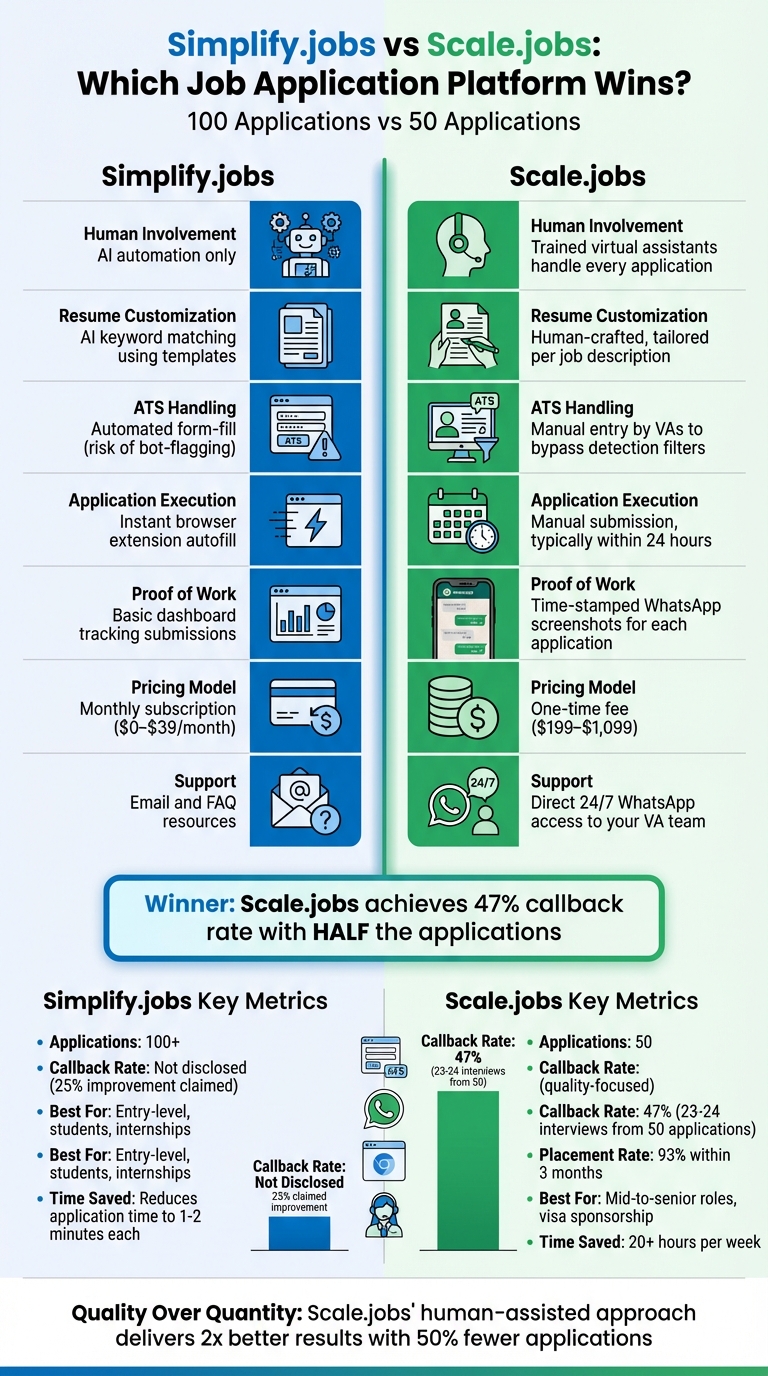
Simplify.jobs vs Scale.jobs: Feature Comparison and Success Metrics
What to Compare
Simplify and Scale.jobs take very different approaches to assisting with job applications. Below is a breakdown of how these platforms handle essential aspects of the job search process, from application submission to tracking progress and pricing.
| Feature | Simplify.jobs | Scale.jobs |
|---|---|---|
| Human Involvement | AI automation only | Trained virtual assistants handle every application |
| Resume Customization | AI keyword matching using templates | Human-crafted, tailored per job description |
| ATS Handling | Automated form-fill (risk of bot-flagging) | Manual entry by VAs to bypass detection filters |
| Application Execution | Instant browser extension autofill | Manual submission, typically within 24 hours |
| Proof of Work | Basic dashboard tracking submissions | Time-stamped WhatsApp screenshots for each application |
| Pricing Model | Monthly subscription ($0–$39/month) | One-time fee ($199–$1,099) |
| Support | Email and FAQ resources | Direct 24/7 WhatsApp access to your VA team |
| Success Metrics | Not publicly disclosed | 93% placement in 3 months |
The table highlights the core differences, but let’s dive deeper into why these distinctions matter when choosing the right platform for your job search.
Simplify emphasizes speed and volume, allowing users to autofill numerous applications in just minutes. While this might sound appealing, it comes with some trade-offs: resumes are often generic, the risk of being flagged by Applicant Tracking Systems (ATS) increases, and users have limited insight into the actual submission process.
In contrast, Scale.jobs prioritizes precision and a human touch. Every application is manually reviewed and submitted by trained virtual assistants, ensuring details like work authorization and salary expectations are accurately handled. This thorough approach leads to higher success rates, even with fewer applications submitted overall. Scale.jobs boasts a 93% placement rate within three months, a figure that reflects the platform’s focus on quality over quantity.
Simplify’s subscription model is ideal for students or early-career professionals who need to apply to a large number of entry-level positions quickly. Meanwhile, Scale.jobs, with its one-time fee, caters to experienced professionals or those targeting senior roles and visa-sponsored positions. If you’re considering a more personalized approach, Scale.jobs also offers resume writing services to ensure your application materials are tailored and effective from the outset.
Another key difference lies in transparency. Simplify provides basic confirmation that applications have been submitted. On the other hand, Scale.jobs offers detailed proof of work, including time-stamped WhatsApp screenshots showing that your virtual assistant manually entered your information into platforms like Workday and Taleo. This added transparency eliminates guesswork and ensures you have clear documentation for follow-ups, which can significantly improve interview callback rates and overall job placement success.
Who Should Use Simplify Jobs?
Simplify is a solid choice for those who value speed and efficiency over personalized applications, especially for entry-level positions. If you're applying to multiple roles with identical requirements, this browser extension can significantly cut down on time spent filling out applications.
Best for students and entry-level candidates. Simplify caters well to internships, graduate programs, and junior roles where applications often require standard details like your name, school, graduation date, and basic work history. For instance, Grace, an Associate Product Manager at Google, credited Simplify for notifying her the day Google's APM program opened, which played a key role in her success. Similarly, Winston, an Operations Intern at FYPM, found startup opportunities through the platform and secured an offer within a week of applying.
The tool is also useful for passive job seekers who want to explore opportunities without disrupting their day-to-day routine. Whether you're casually browsing or actively applying, Simplify offers a free tier and a premium plan priced at $39.99/month. Both options provide automation features, including a built-in tracker that logs submissions, eliminating the need for manual spreadsheets and reducing administrative effort.
Simplify shines when it comes to tech and startup roles on standardized platforms like Workday, Greenhouse, Lever, and iCIMS. The extension supports over 100 job boards and application portals, making it particularly effective for discovering niche opportunities at startups. However, it’s less ideal for senior-level positions, roles requiring visa sponsorship, or jobs that call for tailored resumes and cover letters. In these cases, the generic approach may reduce your chances of getting a callback.
For users on a budget who only need basic automation and tracking, Simplify’s subscription model is easy to navigate. That said, some users describe it as a "glorified autofill", noting that fixing AI errors can sometimes take more time than completing forms manually. If you need more personalized support, such as ATS-optimized documents or tailored applications, platforms like Scale.jobs may offer a better solution. Their human-powered services, including resume writing services, provide the oversight and customization that Simplify lacks.
If personalized assistance is what you’re after, check out who might benefit from choosing Scale.jobs.
Who Should Choose Scale.jobs?
Scale.jobs is an excellent choice for job seekers who need tailored applications rather than generic, mass submissions. If you're aiming for mid-to-senior level roles, dealing with visa sponsorship complexities, or competing in highly selective job markets, this platform's human-assisted approach offers a distinct edge over automated tools like Simplify. By focusing on personalized applications, Scale.jobs addresses the gaps often left by automated systems, which may overlook critical details.
Mid-to-senior professionals benefit from human expertise. Applicant Tracking Systems (ATS) like Workday and Greenhouse are designed to detect and block automated scripts. For experienced professionals applying to advanced roles, hiring managers expect resumes that highlight specific achievements and align closely with the job description - not generic templates. Scale.jobs provides trained virtual assistants who manually customize each application, ensuring that it meets the job's requirements and avoids the risks of automated submissions. This level of precision can make a real difference in competitive job markets.
Visa holders face unique challenges. If you're navigating visa requirements - whether it's H1B, F1, CPT, TN, O1, Canada PR, or the UK Global Talent Visa - you need applications that clearly address your sponsorship eligibility. Automated platforms often fail to account for these nuances, but Scale.jobs virtual assistants ensure every detail is handled accurately. This reduces the chances of triggering red flags during initial screenings and increases your likelihood of moving forward in the hiring process.
Career changers and niche role applicants need tailored positioning. Transitioning industries or targeting specialized roles requires resumes that effectively translate your experience into the language of your new field. Automated tools often lack the judgment needed for these adjustments. With Scale.jobs, you get direct WhatsApp access to your assigned virtual assistant, allowing you to make real-time changes to your application strategy based on feedback or shifting market demands.
Flat-fee pricing offers predictable costs. Instead of dealing with recurring subscription fees, Scale.jobs operates on a one-time payment model: $199 for 250 applications, $299 for 500, or $399 for 1,000. This includes time-stamped proof-of-work screenshots for every submission and refunds for unused credits, ensuring complete transparency. This pricing structure is ideal for those conducting a focused job search over a short period, rather than an extended, ongoing search.
Up next, we'll explore specific scenarios where Scale.jobs provides a clear competitive advantage.
Switch to Scale.jobs If...
Reassessing your job application strategy? Here are some scenarios where Scale.jobs might be the better fit for your needs:
You're submitting over 100 applications monthly but receiving fewer than five interview callbacks. If platforms like Simplify are helping you send out large volumes of applications but yielding poor results, the problem likely lies in generic submissions that fail ATS (Applicant Tracking System) filters. Scale.jobs tackles this by using trained virtual assistants who personalize every resume and cover letter to align with the job description, avoiding the pitfalls of automated systems.
You're targeting mid-to-senior roles that require personalized applications. Applying for senior positions often means showcasing specific achievements and tailoring your application to reflect strategic alignment with the role. For these jobs, Scale.jobs’ WhatsApp-connected virtual assistants deliver a level of customization that automated tools simply can't match.
You need clear proof that your applications were submitted successfully. Simplify may provide status updates, but it lacks definitive confirmation of submission. Scale.jobs, on the other hand, offers time-stamped screenshots for each application, giving you tangible evidence that your efforts are reaching their intended targets.
You're dealing with visa sponsorships or making a career shift. Whether you're navigating visa complexities like H1B, F1, or CPT, or transitioning to a new industry, these situations demand a nuanced approach. Automated platforms often miss these subtleties, while Scale.jobs’ virtual assistants handle the necessary documentation and strategically position your experience to avoid raising red flags during screenings.
You want a cost-effective, time-saving solution. Instead of paying for ongoing subscriptions, Scale.jobs offers flat-rate pricing: $199 for 250 applications, $299 for 500, and $399 for 1,000. Unused credits are refundable, making it a practical choice for job seekers who prefer to focus their time on networking and interview preparation rather than repetitive form-filling.
If these scenarios sound familiar, Scale.jobs might just be the tool you need to elevate your job search.
Decision Summary: When to Use Each Platform
Opt for Simplify if you're a recent graduate, current student, or someone early in your career applying for entry-level tech positions or internships. When speed and volume are your primary goals, Simplify's automation tool shines by quickly filling out standardized application forms. This makes it perfect for sending out multiple applications to startups and tech companies in a short amount of time. Plus, its monthly subscription pricing helps keep costs manageable during high-volume job searches.
Go with Scale.jobs if you're aiming for mid-to-senior level roles that require more tailored applications. Scale.jobs uses a human virtual assistant to craft ATS-friendly resumes, tackle complex application questions that automation might miss, and provide proof-of-work screenshots with timestamps. Its flat-fee pricing ($199 for 250 applications, $299 for 500, $399 for 1,000) is a smart choice if you're focused on quality submissions and increasing your chances of landing interviews, rather than just sending out large quantities of applications.
The main difference between these platforms boils down to effort versus results. Simplify requires more active involvement from you, while Scale.jobs takes care of the tedious parts, allowing you to focus on other priorities like networking, preparing for interviews, or handling your current job responsibilities.
For some, combining both platforms could be the most effective strategy. Use Simplify for roles where speed and volume matter, and Scale.jobs for positions that require a more personalized touch. The key is to match the tool to the importance of each opportunity, rather than relying on a single approach. This comparison highlights why Scale.jobs' human-driven, results-focused model often delivers better outcomes for competitive roles compared to volume-based tools like Simplify.
FAQs
How can I confirm my applications were submitted?
When ensuring your job applications are successfully submitted, it's helpful to use platforms that offer proof-of-work features. For example, Scale.jobs provides timestamped confirmation of submissions and real-time updates through WhatsApp, offering a straightforward way to track progress. Additionally, their human-assisted service allows you to directly check the status of your applications, adding a personal touch to the process. On the other hand, tools like Simplify.jobs or LazyApply often use dashboards or automated notifications, which might not always provide the same level of clarity. Opt for services that prioritize transparent and reliable submission confirmations to stay on top of your job search.
What information do I need to provide for tailored applications?
To craft tailored, ATS-friendly job applications, Scale.jobs' human virtual assistants need details about your profile, career aspirations, and the types of jobs you're targeting. This approach ensures your applications align with your goals and are optimized to improve your chances of success.
How should I balance automation and human assistance in my job search?
Automation can be a game-changer when applying for entry-level or less competitive roles, where speed and volume are key. For senior positions, highly competitive roles, or visa-sponsored opportunities, human-assisted services like Scale.jobs are better suited. These services provide personalized, ATS-optimized applications that can make a real difference. A hybrid strategy - using automation for broad outreach and human expertise for tailored applications - balances efficiency with quality, boosting your chances of success.