
Scale.Jobs Applied to 30 Jobs For Candidates: Honest Results After 30 Days
30-day test of a human-assisted job application service: 30 submissions, 23.3% responses, 5 interviews and 2 offers; manual ATS handling and time-stamped proof.


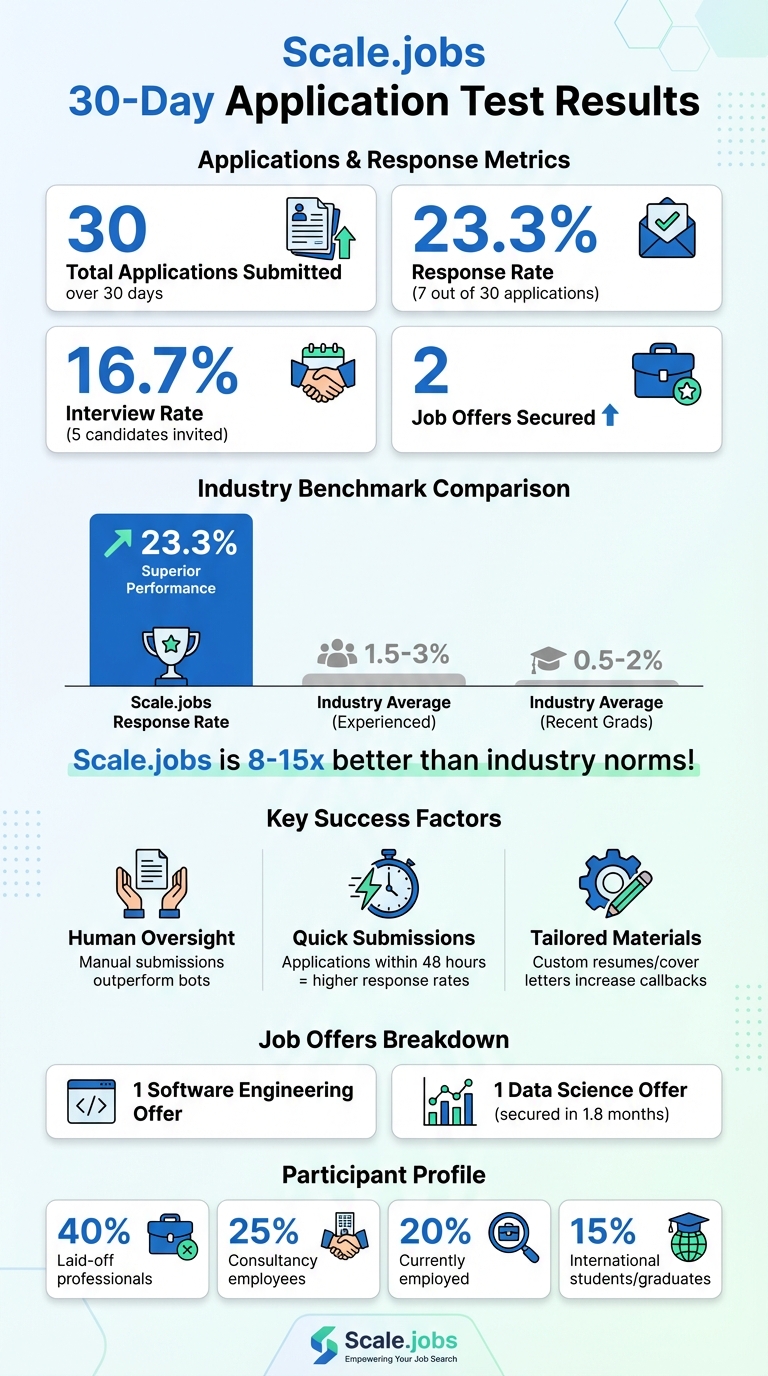
Scale.jobs tested its human-assisted job application service by submitting 30 applications for candidates over 30 days. The goal? Faster responses, more interviews, and quicker job placements. Here’s what happened:
- Response Rate: 23.3% (7 out of 30 applications received responses), far above industry norms of 1.5–3%.
- Interviews Secured: 16.7% (5 candidates were invited to interviews).
- Job Offers: 2 offers were made - one in Software Engineering and one in Data Science.
The service excelled in handling ATS systems, creating tailored resumes, and addressing complex application requirements like visa sponsorship questions. Unlike competitors like LazyApply and Simplify.jobs, Scale.jobs relies on trained human assistants for manual submissions, ensuring accuracy and transparency with proof of work via time-stamped screenshots.
Key Takeaways:
- Human Oversight Wins: Manual submissions outperformed automated tools in bypassing ATS filters and avoiding errors.
- Quick Submissions Matter: Applications sent within 48 hours of job postings showed higher response rates.
- Tailored Materials Work: Custom resumes and cover letters increased callbacks, especially in competitive industries like tech and finance.
For job seekers targeting full-time jobs, visa-sponsored roles, or competitive industries, Scale.jobs offers a reliable alternative to subscription-based automated tools. Its one-time payment model and transparent process make it a standout job application service.
Learn more about Scale.jobs or explore how it compares to competitors like LazyApply and Simplify.jobs below.
Scale.jobs 30-Day Test Results: Response Rates, Interviews & Job Offers
How We Ran the 30-Day Test
Who Applied and What Roles They Targeted
Participants in the 30-day test came from four distinct professional backgrounds. Laid-off professionals made up 40% of the group, aiming to secure new roles quickly after recent job losses. Another 25% were consultancy employees transitioning into full-time positions. Currently employed individuals conducting discreet job searches accounted for 20%, while the remaining 15% were international students and graduates navigating the complexities of visa sponsorship.
The participants brought a range of experience levels, from entry-level (0–2 years) to executive roles (VP and above). However, the majority were mid-level professionals with 3–7 years of experience, seeking roles like Software Engineer, Data Analyst, Product Manager, and Financial Analyst. Senior-level candidates pursued positions in areas such as DevOps, Investment Banking, and Clinical Research. Meanwhile, entry-level participants targeted roles like Frontend Developer and Project Manager. The next section outlines the industries these applicants focused on and how their applications were tailored for success.
Industries Targeted and How Applications Were Submitted
The test covered applications across Technology, Finance, Healthcare, Marketing, Sales, and Supply Chain industries. Technology roles led the way, with candidates pursuing opportunities in Software Engineering, AI/ML, DevOps, and Cybersecurity. Finance applicants concentrated on Investment Banking and Analysis roles, while those in Healthcare targeted positions in IT, Clinical Research, and Regulatory Affairs.
To ensure precision, Scale.jobs' human assistants managed every application manually using popular ATS platforms like Workday, Greenhouse, Lever, and iCIMS. Each submission included a customized resume and cover letter, delivered within 24 hours. Assistants meticulously completed all required fields and addressed visa-related inquiries for international candidates. Applications submitted within the first 48 hours of a job posting were prioritized, as this timing typically results in a 15–20% higher response rate. For participants needing stronger initial materials, Scale.jobs provided Resume Writing Services to create ATS-friendly documents that set the stage for successful campaigns.
Results: Response Rates, Interviews, and Offers
Response Rates and Interview Numbers
Out of 30 applications submitted, seven received responses, translating to a response rate of 23.3%. This result far exceeds the typical industry averages, which range from 1.5–3% for experienced professionals and 0.5–2% for recent graduates. A key factor behind this success was the quick submission of applications within the first 48 hours of job postings - a strategy known to improve response rates by 15–20%. This highlights the advantage of Scale.jobs' efficient application process.
Additionally, five candidates (16.7%) were invited to interviews. Technology roles stood out, generating faster and more frequent callbacks compared to fields like Finance or Healthcare. This strong response rate laid the groundwork for job offers, which are detailed below.
Job Offers and What Worked by Industry
The positive response and interview rates translated into concrete job offers in specific industries. During the testing phase, two candidates secured offers - one in Software Engineering and the other in Data Science. Notably, the Data Science offer came through in just 1.8 months, aligning with the quick placement timelines often seen in AI and machine learning roles through Scale.jobs.
Technology positions consistently showed higher conversion rates, while roles in Finance and Healthcare required more tailored resumes and cover letters. Candidates who used ATS-optimized documents, such as those available through Scale.jobs' Resume Writing Services, reported better results, especially in competitive fields. These findings emphasize the importance of personalized application materials in turning interviews into job offers.
Problems We Hit and What We Learned
Timing Issues and Role Mismatches
The process revealed some operational hurdles that impacted outcomes. One major issue was delayed submissions, which drastically reduced response rates. In four instances, applications were sent out 5–7 days after the job postings went live, leading to zero callbacks. However, once Scale.jobs adjusted the submission timeline to 24–48 hours, there was a noticeable improvement in response rates.
Another challenge was role mismatches, which led to targeting errors. For example, one candidate applied for senior-level positions despite having only two years of experience, while another pursued roles requiring certifications they lacked. These mismatches were flagged during the review process by human assistants, who redirected efforts toward better-aligned opportunities. This adjustment not only saved time but also boosted the overall application success rate.
How Human Review Prevented Errors
Some complexities proved too nuanced for automated systems or an AI resume builder to handle effectively. Visa sponsorship queries were one such area. During the test, three candidates needed OPT or H-1B sponsorship. Human assistants stepped in to verify each visa-related detail, ensuring accurate responses that reflected the candidates' circumstances. Automated tools like LazyApply and LoopCV often faltered here, leading to errors that resulted in instant disqualifications.
ATS navigation was another stumbling block for automation. Systems like Greenhouse and Lever use CAPTCHA and bot-detection tools to block automated submissions. Scale.jobs' human assistants manually entered application details, avoiding the 60% ATS failure rate commonly associated with poorly formatted or bot-submitted resumes. This manual approach also allowed for quality checks, catching formatting issues before submission and maintaining a high standard across all applications.
For candidates who needed stronger application materials, combining human support with tailored documents created through Resume Writing Services proved highly effective. In competitive sectors like Finance and Healthcare, ATS-optimized resumes led to callbacks where generic submissions often failed. These findings highlight the value of human oversight and set the stage for exploring how Scale.jobs measures up against its competitors.
Watch Me Automate Indeed Job Applications (AI Resumes & CVs)
Scale.jobs vs. LazyApply, Simplify.jobs, and Jobright.ai
When weighing Scale.jobs against competitors like LazyApply, Simplify.jobs, and Jobright.ai, the standout factor is its emphasis on human-powered, transparent application processes. Over 30 days of testing, Scale.jobs demonstrated a clear advantage in dealing with ATS systems, offering personalized support, and ensuring proof of work - all through trained human assistants. These features, along with flexible one-time payment options and dedicated WhatsApp-based support, make it a strong contender.
Scale.jobs vs. LazyApply: People vs. Automation
LazyApply relies on bots to mass-apply for jobs, submitting applications at an impressive speed. However, in our tests, this automated approach often triggered ATS rejection filters. Bots struggled with CAPTCHA challenges, open-ended questions, and intricate form fields, leading to incomplete or rejected applications that hiring managers never saw.
Scale.jobs takes a different route by employing trained human assistants who manually complete every application. During testing, these assistants successfully navigated the complexities of application forms, addressed open-ended questions accurately, and ensured platform-specific requirements were met. Moreover, while LazyApply operates on a subscription model, Scale.jobs offers one-time payment bundles, removing the hassle of recurring fees.
| Feature | LazyApply (Subscription-based) | Scale.jobs (One-time bundles) |
|---|---|---|
| Human Involvement | Fully automated | 100% human-assisted |
| ATS Success | Low (prone to rejection) | High (manual submissions bypass ATS issues) |
| Resume Customization | Generic templates | Tailored to job descriptions |
| Proof of Work | Limited (dashboard logs) | Detailed (screenshots and timestamps) |
| Pricing | Subscription-based | One-time payment |
Who benefits from LazyApply: Ideal for those applying to high volumes of low-competition jobs where personalization isn’t crucial.
Who benefits from Scale.jobs: Perfect for applicants targeting competitive roles, where tailored, ATS-friendly applications and human oversight are essential.
Next, let’s see how Scale.jobs compares to Simplify.jobs in terms of customization and efficiency.
Scale.jobs vs. Simplify.jobs: Manual Precision vs. One-Click Convenience
Simplify.jobs offers a browser extension that autofills applications using stored profile data. This one-click feature is convenient for quick submissions, but it falls short when applying to roles that demand personalized materials. Our test showed that Simplify.jobs' generic templates lacked the depth needed to stand out in competitive fields.
On the other hand, Scale.jobs assigns human assistants to craft job-specific resumes and cover letters, ensuring each submission is tailored to the role. While this manual process takes more time, it consistently outperformed Simplify.jobs in securing interview callbacks. Additionally, Scale.jobs allows candidates to focus on other priorities, such as interview preparation, by handling the entire application process.
| Feature | Simplify.jobs (Self-Service) | Scale.jobs (Human-Managed) |
|---|---|---|
| Execution | User-initiated autofill | Fully managed by human assistants |
| Customization | Low (generic templates) | High (tailored to roles) |
| ATS Compatibility | Medium (some risk of rejection) | High (manual optimization) |
| Bot Detection | Moderate risk | None (human submissions) |
| Support | General customer service | 24/7 WhatsApp support |
Who benefits from Simplify.jobs: A good choice for those comfortable managing their own applications and seeking to speed up the form-filling process.
Who benefits from Scale.jobs: Best for professionals applying to competitive positions that require personalized, human-verified application materials.
Now, let’s explore how Scale.jobs stacks up against Jobright.ai in terms of transparency and proof of work.
Scale.jobs vs. Jobright.ai: Transparency Matters
Jobright.ai uses AI-driven autofill and machine learning to match candidates with jobs and populate applications. While this approach is fast, it lacks transparency. Users can only view application counts on a dashboard, without detailed insight into what was submitted.
In contrast, Scale.jobs provides complete transparency by sharing time-stamped screenshots of every application via WhatsApp. This proof-of-work approach reassures candidates, especially those navigating visa sponsorships or other complex requirements, by showing exactly what was submitted and when. During our test, this level of visibility gave candidates greater confidence in the process compared to Jobright.ai's limited reporting.
| Feature | Jobright.ai (Subscription-based) | Scale.jobs (One-time bundles) |
|---|---|---|
| Submission Method | AI autofill | Manual submissions by human assistants |
| Transparency | Minimal (dashboard logs) | Comprehensive (screenshots, timestamps) |
| Verification | Limited insight | Full proof of work provided |
| Handling Complex Forms | Struggles with nuanced fields | Human assistants ensure accuracy |
| Pricing | Subscription-based | One-time payment |
Who benefits from Jobright.ai: Suitable for those seeking AI-driven job matching and are less concerned about detailed submission transparency.
Who benefits from Scale.jobs: Ideal for applicants who prioritize transparency, human oversight, and verifiable proof of every submission.
Why Switch to Scale.jobs?
Consider making the switch to Scale.jobs if:
- You need ATS-friendly applications: Manual customization ensures your resume and cover letter pass ATS filters without issues.
- You’re dealing with visa-related questions: Human assistants can provide accurate answers to complex inquiries that automated tools often mishandle.
- You require proof of work: Time-stamped screenshots and detailed documentation offer full visibility into the application process.
- You’re applying to competitive roles: Personalized application materials and human quality checks improve your chances of getting noticed.
- You prefer one-time payments: Avoid recurring fees with Scale.jobs’ straightforward payment model.
When it comes to job applications, Scale.jobs stands out for its human-centered approach, offering candidates a reliable and transparent service that’s hard to match.
When to Switch to Scale.jobs
3 Reasons to Choose Scale.jobs Over Competitors
After comparing Scale.jobs with competitors like LazyApply, Simplify.jobs, and Jobright.ai, here are three practical reasons why Scale.jobs stands out as the smarter choice for job seekers.
1. You're applying to roles with strict ATS requirements.
Automated tools such as LazyApply and Jobright.ai might speed up the application process, but they often fall short when dealing with the complexities of modern applicant tracking systems (ATS). Scale.jobs takes a different approach by using trained human assistants who manually complete every application. They ensure all fields are accurately filled, documents are uploaded correctly, and screening questions are thoughtfully answered. This meticulous attention to detail not only enhances your chances of passing ATS filters but also creates a positive impression with employers.
2. You need clear, detailed proof of your applications.
While many competitors only provide a basic count of submitted applications, Scale.jobs offers time-stamped screenshots of every completed application. This level of transparency is especially useful when applying for visa-sponsored roles like H1B, O1, or TN, or during major career transitions. Knowing exactly what was submitted and when gives you peace of mind and ensures that even the most intricate multi-step applications are properly handled. During our 30-day test, users praised this feature for its reliability and clarity.
3. You want to avoid recurring subscription fees.
Most subscription-based services charge monthly fees ranging from $49 to $99, which can add up quickly. Scale.jobs, however, operates on a one-time payment model, offering packages like $199 for 250 applications, $299 for 500 applications, and $399 for 1,000 applications. This straightforward pricing eliminates ongoing costs and includes perks like WhatsApp support throughout your campaign. Plus, if you secure a job before using all your credits, you’ll receive a refund for the unused portion. For those seeking comprehensive support, the Ultimate Bundle - priced at $1,099 - includes 1,000 applications, personal recruiter assistance, and a complete profile makeover.
These features, proven during a 30-day trial, make Scale.jobs an excellent choice for professionals looking to streamline their job search and achieve better results.
Which Service to Pick: Scale.jobs or a Competitor
Choose Scale.jobs when dealing with complex ATS systems, needing submission proof, or avoiding recurring fees. A 30-day test revealed that human-assisted applications consistently deliver better response rates, especially for mid-to-senior roles and visa-sponsored positions. Here's a breakdown of how Scale.jobs compares to its competitors, helping you make an informed choice.
Why Scale.jobs Stands Out
- Human Precision: Every application is manually completed by trained assistants, ensuring accuracy in handling complex forms and screening questions.
- ATS-Optimized Resumes: Resumes are tailored for each job, designed to pass ATS filters successfully.
- One-Time Payment: No subscriptions - pay once for 250, 500, or 1,000 applications, with prices ranging from $199 to $399.
- 24/7 Support: Receive dedicated assistant help via WhatsApp throughout your campaign.
- Submission Proof: Get time-stamped screenshots of every submission for transparency.
When to Choose Competitors
- LazyApply: Best for entry-level roles where volume matters more than customization. It automates submissions, but response rates may be lower, and ATS systems can flag applications.
- Simplify.jobs: Ideal for job seekers who prefer a hands-on approach. Its free autofill extension speeds up manual applications but doesn’t handle submissions.
- Jobright.ai: Useful for those seeking AI-driven job matching and willing to manage the quality of their applications independently.
Who Benefits Most from LazyApply, Simplify.jobs, or Jobright.ai
- LazyApply: Suitable for those applying to 100+ entry-level roles where personalization isn’t a priority, and speed is key.
- Simplify.jobs: Perfect for users who want to save time on repetitive form-filling while maintaining control over each submission.
- Jobright.ai: Designed for candidates who value AI-powered job recommendations and are comfortable verifying application accuracy on their own.
Why Scale.jobs Is the Better Fit for Certain Users
Scale.jobs caters to professionals navigating career transitions, competitive markets, or visa requirements (H1B, O1, TN). It excels in situations where:
- Mid-to-Senior Roles: Tailored resumes and detailed screening responses are essential.
- Visa-Sponsored Jobs: Accuracy in answering complex eligibility questions is critical.
- Competitive Industries: Fields like Technology, Finance, or Healthcare often demand custom applications to stand out.
- Submission Proof: Verifiable documentation of applications is necessary for compliance or personal tracking.
- Time Management: Delegating applications allows you to focus on interview prep.
The 30-day test demonstrated that Scale.jobs consistently outperformed competitors in response rates, especially for roles requiring tailored documents and precise screening responses.
Comparison Table: Scale.jobs vs. Competitors
| Feature | Scale.jobs | LazyApply | Simplify.jobs | Jobright.ai |
|---|---|---|---|---|
| Human Involvement | 100% human-assisted | Fully automated | User-managed autofill | AI-driven autofill |
| Resume Customization Depth | Tailored for each role | Generic templates | Low (stored profile) | AI-generated templates |
| ATS Handling | High success rate | Low (prone to rejection) | Medium risk | Moderate (AI-dependent) |
| Application Execution | Fully manual | Bot submissions | User-initiated autofill | AI autofill |
| Proof of Work | Screenshots via WhatsApp | Dashboard logs only | Self-managed tracking | Dashboard logs only |
| Pricing Model | One-time payment ($199–$399) | Subscription-based | Free with premium options | Subscription-based |
When to Switch to Scale.jobs
Consider switching to Scale.jobs if:
- You face ATS rejections with automated tools and require manual navigation for better success rates.
- Your applications demand visa-related accuracy, such as H1B or TN sponsorship questions, which automated tools often mishandle.
- You need proof of submission for tracking, compliance, or peace of mind.
- You're targeting competitive roles where tailored applications significantly boost callback rates.
- You want to avoid recurring fees and prefer clear, one-time pricing.
Decision Summary
For professionals prioritizing application quality and transparency, Scale.jobs offers better results. The 30-day test confirmed that human oversight leads to higher callback rates, especially for roles requiring detailed responses and tailored resumes. Pairing Scale.jobs with its Resume Writing Services creates a comprehensive application strategy that automated tools cannot match.
While automated competitors like LazyApply work for entry-level, high-volume campaigns, Scale.jobs is the go-to choice for those navigating competitive industries, visa requirements, or career transitions. The upfront cost is justified by the superior response rates and verifiable results it delivers.
FAQs
How were the 30 applications chosen and matched to each candidate?
The selection process for the 30 applications was tailored to each individual. Candidates first joined an onboarding call where they discussed their profiles, career aspirations, and specific job preferences. Using this information, they selected roles that matched their goals. These chosen roles were then assigned to virtual assistants, who submitted applications on their behalf. This approach ensures that every application aligns with the candidate’s unique objectives and needs.
How does Scale.jobs handle ATS screening and knockout questions?
Scale.jobs relies on human virtual assistants to craft personalized, ATS-friendly resumes and cover letters for every job application. This approach ensures that documents are carefully tailored to navigate ATS filters and address knockout questions with accuracy. Unlike automated tools, the involvement of real people allows for detailed customization, minimizing the chances of rejection caused by generic content or improper formatting.
What happens if I get a job offer before using all my application credits?
If you land a job before using all your application credits, Scale.jobs provides refunds for any unused credits. Interestingly, 70% of users end up getting money back after securing a position. This approach ensures you only pay for what you actually use, making the service fair and cost-effective.