Why Scale.jobs Users Get 3x More Callbacks Than Jobscan Users
Human-driven applications boost callback rates vs automated ATS tools by delivering tailored resumes, personalized cover letters, manual submissions, and proof.


Scale.jobs outperforms Jobscan by delivering up to three times more interview callbacks, thanks to its human-driven approach. While Jobscan relies on automated ATS keyword matching and requires users to handle resume customization and job submissions themselves, Scale.jobs assigns expert virtual assistants to manage the entire application process. This includes tailoring resumes, crafting personalized cover letters, and manually submitting applications - with proof of submission provided via WhatsApp.
Key differences:
- Callback Rates: Scale.jobs users report 15–47% callback rates compared to Jobscan’s 12–18%.
- Service Model: Scale.jobs offers flat-fee pricing starting at $199 for 250 applications, while Jobscan uses a subscription model at $49.95/month or $299.40/year.
- Transparency: Scale.jobs provides real-time updates and proof of work, unlike Jobscan’s automated summaries.
For busy professionals, career changers, or visa holders, Scale.jobs simplifies the job search with personalized execution and higher success rates. Jobscan is better suited for those who prefer a self-service tool to refine their resumes independently.
Finally… Here’s How to Beat the ATS Without a Perfect Resume
Why Scale.jobs Delivers 3x More Callbacks Than Jobscan
The difference in callback rates between Scale.jobs and Jobscan boils down to how each service handles the job application process. Jobscan analyzes your resume, gives it an ATS (Applicant Tracking System) compatibility score, and suggests keyword changes. However, the responsibility for rewriting, customizing, and submitting applications still falls on you. In contrast, Scale.jobs assigns a trained human assistant to handle everything - from tailoring your resume and cover letter for each role to filling out application forms and providing proof of submission via WhatsApp. This hands-on approach is what drives Scale.jobs' higher callback rates.
Jobscan's automated feedback is useful for identifying issues like missing keywords, formatting problems, or incomplete sections in your resume. But if you're applying to multiple positions weekly, you'll need to adjust each resume and cover letter manually while navigating various application portals. This often leads to shortcuts, such as using generic templates or copy-pasting content. ATS systems can flag these patterns, and hiring managers may notice the lack of effort or personalization.
Scale.jobs' human assistants, on the other hand, take a more personalized approach. They review job descriptions, fine-tune your resume to highlight relevant skills, and craft cover letters that reference specific company initiatives or values. They also handle detailed application questions, such as salary expectations or work authorization, ensuring no part of the application is incomplete. By addressing common reasons for rejection - like poor keyword alignment, incomplete forms, or generic messaging - Scale.jobs maximizes your chances of standing out.
The results speak for themselves. Users of Scale.jobs report a 15–47% callback rate, significantly higher than Jobscan's 12–18% range, where users still manage their own submissions. This demonstrates that personalized execution, rather than automated fixes, can make a substantial difference. If you're weighing options between professional resume writing services and job search automation tools, the data strongly supports the value of human involvement.
Another standout feature of Scale.jobs is its proof-of-work transparency. After submitting applications, they send time-stamped screenshots via WhatsApp, allowing you to track progress in real time. This not only keeps you informed but also helps you refine your job search strategy based on which roles generate responses.
Feature Comparison: Human Assistance vs. Automated Optimization
When it comes to refining job applications, Jobscan and Scale.jobs take very different approaches. Jobscan's strength lies in its instant ATS matching score. By uploading your resume and a job description, the platform quickly scans for keyword matches and formatting issues. It flags discrepancies, such as missing key terms that are heavily emphasized in the job posting, and provides suggestions to help you align your resume with the role. However, while Jobscan identifies what’s missing, the responsibility of rewriting and incorporating those changes falls entirely on you.
This self-service model works well for individuals who have the time, confidence, and writing skills to adjust their applications independently. You’ll need to manually tweak bullet points, reformat sections, and decide how best to integrate keywords into your resume and cover letter.
In contrast, Scale.jobs takes a human-centered approach, offering hands-on assistance for every application. A dedicated assistant reviews each job posting in detail and rewrites your resume using language tailored to the industry. For instance, if you're a marketing manager applying to a SaaS company, your resume might highlight achievements like lowering customer acquisition costs or boosting email campaign performance. They also create cover letters that go beyond generic templates, referencing specific details like recent company projects or funding announcements, adding a personal touch to each application.
What sets Scale.jobs apart is its real-time collaboration. Through WhatsApp, you can communicate directly with your assistant, request changes, and ensure your documents meet the unique requirements of each role. Additionally, the platform provides time-stamped screenshots as proof of submission, offering transparency throughout the process.
Key Advantages of Scale.jobs Over Jobscan
- Custom Resume Rewriting: Resumes are tailored to each application, emphasizing your achievements with industry-specific language.
- Personalized Cover Letters: Each cover letter is crafted to reflect company-specific details, such as recent milestones or initiatives.
- Real-Time Collaboration: Instant communication through WhatsApp ensures quick adjustments and alignment with job requirements.
- Transparent Tracking: Time-stamped submission proofs provide clarity and accountability.
For job seekers who prefer a DIY approach and are confident in their writing abilities, Jobscan’s automated tools can be a practical choice. However, if you’re juggling multiple applications or need help translating your experience into a compelling, tailored narrative, Scale.jobs provides a more hands-on, personalized solution. These differences make Scale.jobs an excellent option for those seeking precision and individualized support in their job search.
How Each Platform Works: Workflow and Transparency
Jobscan operates as a self-service tool, offering instant analysis of your resume. It generates a match rate based on the job description and flags missing keywords or formatting issues. For example, if a job posting lists specific skills that are absent from your resume, Jobscan identifies those gaps and suggests areas to improve. However, the platform stops at analysis. It's up to you to rewrite your resume, incorporate the recommended keywords naturally, and handle the application process. There’s no human involvement to verify or assist with submissions, making it a fully automated system.
In contrast, Scale.jobs takes a hands-on, human-driven approach from start to finish. Once you share a job posting - typically through WhatsApp - a dedicated assistant reviews the job requirements and customizes your resume with tailored, industry-specific language to emphasize your achievements. Within 24 hours, they manually complete your application to bypass bot-detection systems. Afterward, you receive a time-stamped screenshot confirming when and where your application was submitted, along with additional details for full transparency. This meticulous process ensures that your applications meet ATS standards and present your qualifications in the best possible light, which can lead to better callback rates.
The platforms also differ significantly in communication. Jobscan relies on automated email summaries, offering insights into your resume's match rate and keyword gaps. However, it lacks interactive support - there’s no way to ask questions or receive personalized advice. On the other hand, Scale.jobs provides real-time collaboration through WhatsApp, allowing you to directly communicate with your assistant. Whether you need to highlight a specific project, adjust how a skill is presented, or clarify job requirements, changes can be made quickly - often within hours. This direct interaction ensures your input is reflected throughout the process.
For those who prefer a DIY approach and have the time to implement feedback, Jobscan’s instant analysis can be a helpful starting point. But if you're juggling multiple applications, need expert assistance in crafting compelling resumes, or want assurance that your submissions are reaching the right hands, Scale.jobs offers a more transparent and accountable workflow. For even more tailored support, consider exploring professional resume writing services to create polished documents that align with your career goals.
Pricing Breakdown: Flat-Fee vs. Subscription
Jobscan operates on a subscription model, offering a free tier with 5 scans per month and paid plans costing $299.40 annually (about $24.95/month) or $89.95/month for Premium+. While the free tier provides limited functionality, most job seekers will likely need to upgrade to access features like unlimited scans and advanced formatting advice. However, this model requires continuous payments and focuses on providing tools for users to handle their own resume updates and application submissions. For those relying on AI-generated suggestions, there’s a risk of keyword stuffing, which can result in robotic-sounding resumes that may not appeal to human recruiters. This setup is best suited for users comfortable with managing the application process themselves.
On the other hand, Scale.jobs follows a flat-fee model, catering to applicants looking for a more hands-off approach. Pricing starts at a one-time fee of $199 for 250 applications, with packages scaling up to $1,099 for 1,000 applications. This fee covers a personalized, human-driven service, including resume customization, tailored cover letters, and manual application submissions, all completed within 24 hours. There are no recurring costs, and the process is designed to maximize callback rates by addressing both ATS requirements and the effective presentation of your experience.
For those who want to further refine their application materials before starting, combining Scale.jobs with professional resume writing services can provide a strong starting point. This ensures your resume and cover letters are polished and ready to make an impact.
Transparency is another key difference. Jobscan offers automated email summaries with match rates and keyword suggestions, but there’s no guarantee that these changes will lead to better outcomes. In contrast, Scale.jobs provides time-stamped screenshots of every submission and real-time updates via WhatsApp, so you always know what’s happening. Additionally, unused application credits are refundable, offering a level of flexibility that subscription models typically don’t provide.
Scale.jobs vs. Jobscan: Comparison Table
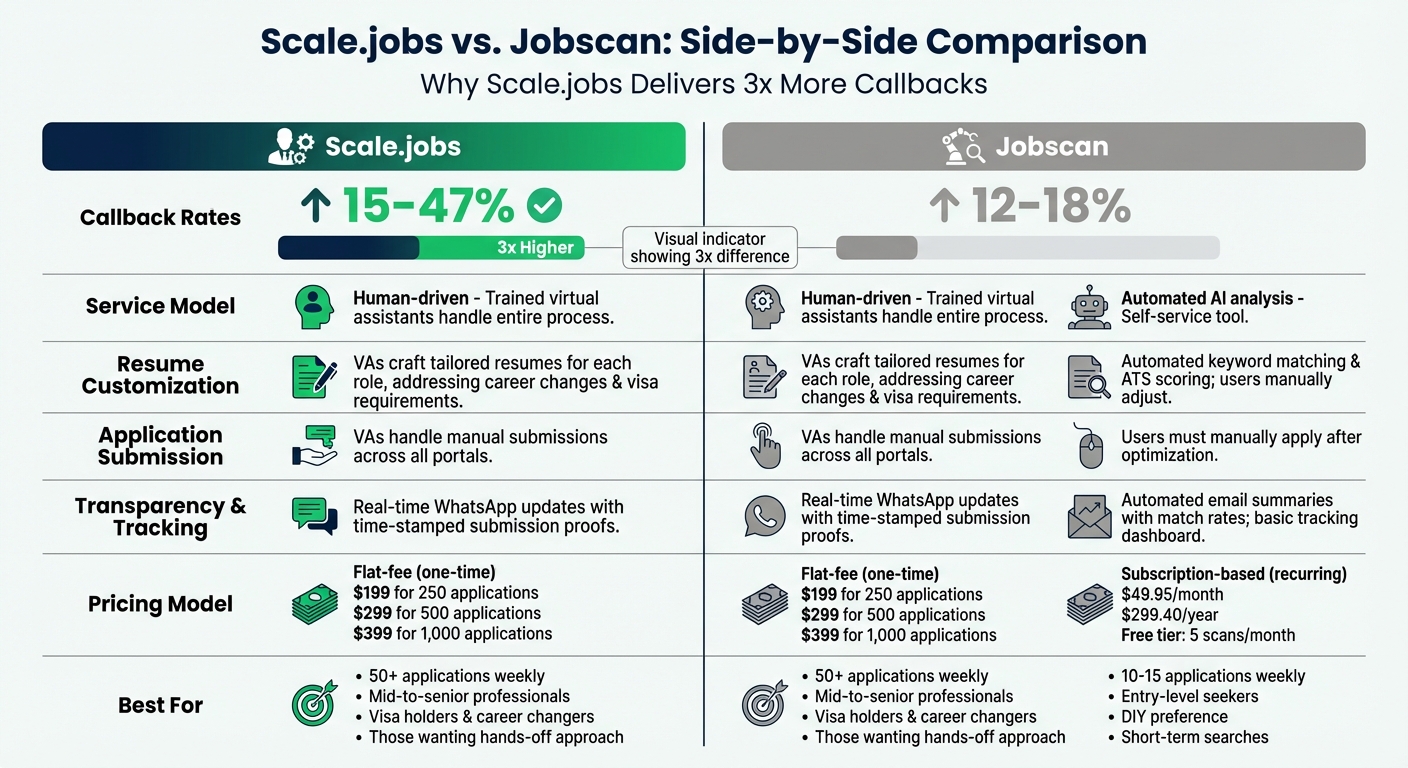
Scale.jobs vs Jobscan: Features, Pricing, and Callback Rates Comparison
This table lays out the key differences between Scale.jobs and Jobscan, helping you understand why Scale.jobs achieves a 3x higher callback rate. It’s a clear comparison for those deciding between expert-managed applications and DIY optimization tools.
| Feature | Scale.jobs | Jobscan |
|---|---|---|
| Human Involvement | Trained virtual assistants (VAs) personally handle applications, including form completion and document tailoring | Fully automated AI analysis; users manage their applications independently |
| Resume Customization Depth | VAs craft tailored resumes for each role, addressing career changes, visa requirements, and other complex needs | Focuses on automated keyword matching and ATS scoring; users manually adjust based on AI recommendations |
| ATS Handling | VAs optimize resumes for both ATS systems and human recruiters, ensuring compliance without sacrificing readability | Relies on keyword density and formatting for ATS parsing via Match Rate system |
| Submission Process | VAs handle manual submissions across all portals, including corporate ATS, niche boards, and company sites | Users must manually apply after optimizing their resume |
| Transparency & Proof of Work | Real-time updates sent via WhatsApp, complete with time-stamped submission proofs | Provides automated email summaries with match rates and keyword suggestions; includes a basic tracking dashboard |
| Pricing Model | One-time flat fee: $199 (250 applications), $299 (500 applications), $399 (1,000 applications) | Subscription-based: $49.95/month or $299.40/year; free tier allows 5 scans per month |
If you’re comfortable managing manual adjustments, Jobscan might work for you. However, Scale.jobs is ideal for those who want the entire process handled by experts. For the best results, consider pairing Scale.jobs with a job application service or professional resume writing services to ensure your documents are polished and ready for customization.
Scale.jobs' hands-on approach and personalized service translate to higher callback rates. Up next, we’ll explore which platform suits different types of job seekers.
Who Should Use Each Platform
Deciding between Jobscan and Scale.jobs depends on your job search needs, priorities, and the time you can dedicate to the process. Here’s a breakdown to help you decide:
Choose Jobscan if you prefer a hands-on approach to refining your resume and want to enhance its ATS (Applicant Tracking System) compatibility without spending much. This platform is ideal for entry-level job seekers applying to 10–15 positions a week and who have the time to tweak their resumes based on keyword suggestions. The $49.95/month subscription is a reasonable option for a short-term, focused job search.
Opt for Scale.jobs if you’re applying to 50+ positions weekly, managing visa requirements, or transitioning into a new career where generic keyword matching may fall short. Mid-to-senior-level professionals benefit the most, as Scale.jobs’ Virtual Assistants (VAs) handle the entire application process, allowing you to focus on networking and interview preparation. With a one-time payment model ($199–$399), you avoid the hassle of monthly fees, making it a practical choice for longer job searches.
- Key advantages of Scale.jobs:
- One-time payment saves money over extended searches
- Human assistants create tailored, ATS-optimized resumes
- Real-time WhatsApp updates provide transparency for every submission
This hands-on support contributes to Scale.jobs’ reputation for delivering up to 3x more callbacks compared to automated tools.
Budget Considerations: Jobscan’s recurring fees can add up over time, especially if your job search lasts several months. In contrast, Scale.jobs’ flat-fee model offers better value for extended searches. For highly competitive roles where callback rates are crucial, investing in human customization often shortens the job search process by weeks.
Special Cases: Visa holders and career changers often encounter challenges that automated tools fail to address. Scale.jobs’ VAs go beyond keyword matching by tailoring resumes to highlight work authorization status or reframe experience for a new industry. This personalized approach - especially when combined with professional resume writing services - can make a significant difference in standing out to employers.
The Core Difference: Control vs. Results
Jobscan appeals to DIY job seekers who want full control over their applications and the learning process. On the other hand, Scale.jobs focuses on delivering measurable outcomes, such as higher callback rates and time savings, making it ideal for busy professionals who need quick results.
Decision Summary:
- Use Jobscan if you want to refine your applications yourself and have the time to do so.
- Choose Scale.jobs if you need high-volume, human-tailored submissions with proven results - especially if time is of the essence or your job search involves complex requirements.
FAQs
How is the callback rate measured?
The callback rate refers to the percentage of job applications that lead to a response or an interview invitation from potential employers. This metric is often monitored using application management systems or gathered from user-reported feedback. It serves as a straightforward way to gauge how well job applications are capturing the attention of employers.
What info do I need to start?
To begin using Scale.jobs, head over to their website and sign up. During the onboarding process, you’ll be asked to share details about your professional background, the roles and industries you’re targeting, your key skills, and any specific preferences for how you’d like your applications to be handled. This information enables their team to create tailored, ATS-compatible resumes and cover letters, designed to make your applications more noticeable and increase your chances of getting callbacks.
Can I review applications before they’re sent?
Yes, with Scale.jobs, you have the option to review your applications before they are submitted. Skilled human virtual assistants craft and fine-tune applications that are tailored and optimized for ATS (Applicant Tracking Systems), giving you the opportunity to check their work and provide feedback if needed.