
Resume Tools vs Resume Experts: What Actually Improves Callbacks
Compare AI resume tools, human writers, and hybrid services to see which approach improves interview callbacks for different career needs.


When applying for jobs, your resume often determines whether you get an interview. With 97% of Fortune 500 companies using Applicant Tracking Systems (ATS), resumes must meet specific technical standards while also appealing to recruiters. You have two main options to improve your resume:
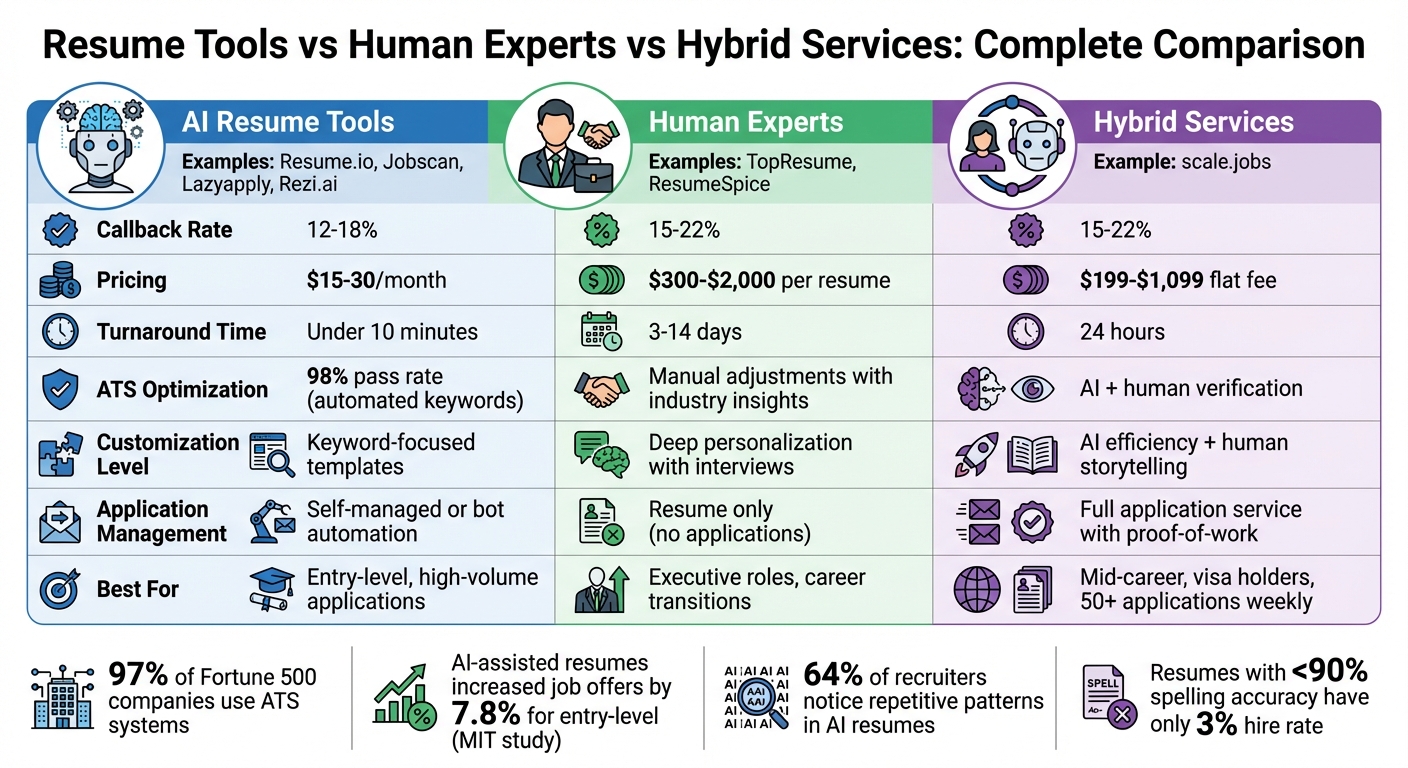
- AI-powered resume tools like Resume.io, Jobscan, and Lazyapply, which focus on ATS optimization and cost $15–$30/month. These tools achieve callback rates of 12–18%.
- Human resume experts, who charge $300–$2,000 to craft custom resumes. Callback rates for these services range from 15–22%.
AI tools are quick and affordable but often lack the storytelling needed for complex career transitions or senior roles. Human experts excel in creating tailored resumes but are slower and more expensive. Hybrid services like scale.jobs combine AI efficiency with human oversight, offering personalized resumes and job application management with callback rates of 15–22%.
Key Takeaways:
- Use AI tools for high-volume, entry-level applications where speed and ATS compliance matter most.
- Opt for human experts or hybrid solutions for career changes, executive roles, or addressing employment gaps.
- Hybrid services like scale.jobs balance cost, speed, and personalization, making them ideal for competitive roles or visa-related applications.
Below, we’ll break down the strengths and limitations of each option to help you decide what fits your job search needs.
Resume Tools: What They Offer and Where They Fall Short
What Resume Tools Do
AI-driven resume platforms like Resume.io, Jobscan, and Lazyapply aim to simplify the job application process by automating tedious tasks. Here's a closer look at their main features:
- Resume.io provides ATS-friendly templates designed to create polished resumes quickly.
- Jobscan compares your resume against job descriptions, assigns match scores (up to 95% accuracy), and suggests keywords to improve compatibility.
- Rezi.ai generates keyword-rich content, such as “project management” or “data analysis,” tailored for ATS needs.
- Lazyapply automates job application submissions on platforms like LinkedIn and Indeed, saving hours of manual effort.
- Resume Worded offers feedback on resume structure and language, flagging weak verbs or formatting issues.
These tools often operate on freemium or affordable subscription models (around $15/month), making them accessible to budget-conscious job seekers.
Where Resume Tools Work Well
Resume tools shine when speed and efficiency are essential. For entry-level roles in fields like administration, design, or customer service, these platforms can produce results quickly without requiring specialized input. A study by MIT revealed that AI-assisted resumes increased job offers by 7.8% for entry-level candidates, who also saw higher wages - $18.62/hour compared to $17.17/hour. With most tools, users can create tailored resumes in under 10 minutes.
For straightforward roles where ATS compliance is the key hurdle, platforms like Jobscan can be particularly helpful. They catch common mistakes - like typos, formatting issues, or missing keywords - that might otherwise hurt your chances. Research shows that resumes with less than 90% spelling accuracy have only a 3% hire rate, so these tools can make a noticeable difference. Fields such as software development or writing, where technical skills are easy to quantify, benefit from automated keyword matching, which handles much of the groundwork.
Where Resume Tools Fall Short
Despite their strengths, AI-generated resumes often fall short in areas requiring deeper personalization. The 12–18% callback rate for resumes created by these tools underscores their limitations. While they can insert the right keywords, they often produce generic, formulaic content. For instance, a mid-career professional transitioning from finance to tech might get a resume packed with buzzwords but lacking the narrative to explain how their analytical experience translates to product management.
Over-optimization can also backfire. Excessive keyword repetition can make content sound unnatural, potentially leading to ATS rejection or raising red flags for human reviewers. Tools like Lazyapply, which automate mass submissions, risk being flagged as bot-driven by systems that monitor application patterns. Without human oversight, these tools miss subtleties like soft skill framing, industry-specific language, or indicators of alignment with company culture.
For complex situations - such as senior-level roles, visa sponsorships, or niche industries requiring specialized expertise - AI tools fall short. They cannot conduct the in-depth conversations needed to uncover your unique strengths or craft executive summaries that effectively showcase your professional story. While these platforms excel at basic optimization and speed, they lack the ability to create the compelling narratives that human professionals can deliver.
For those navigating intricate job transitions or aiming for high-stakes roles, working with a job search coach or using a job application service may provide the tailored support needed to stand out.
Human Resume Experts: What They Offer and Where They Fall Short
How Human Resume Experts Operate
Human resume services like TopResume, ResumeSpice, and scale.jobs follow a structured, hands-on approach that AI platforms can't match. They start with in-depth intake calls or questionnaires to gather details about your career history, achievements, and goals. Certified writers - often accredited by the Professional Association of Résumé Writers & Career Coaches (PARWCC) - then craft resumes tailored to your unique story. Unlike AI-generated templates, these experts take 3–14 days to deliver drafts, allowing time for revisions and fine-tuning.
For instance, TopResume pairs clients with certified writers who conduct interviews to uncover the story behind your experience, turning vague phrases like "Managed team" into measurable achievements that highlight leadership and results. ResumeSpice offers high-end packages starting at $699, which include LinkedIn profile optimization alongside resume writing. Meanwhile, scale.jobs takes it a step further by combining expert resume writing with reverse recruiting services. Their virtual assistants not only refine your resume but also scout hidden job opportunities and handle application processes, including navigating tricky portals like Workday and Greenhouse. This added service ensures applications are customized and strategically aligned with job postings. Let’s explore what makes human experts stand out.
Where Human Experts Excel
Human resume writers shine in crafting personalized narratives and ensuring ATS (Applicant Tracking System) compatibility. While AI-generated resumes typically achieve callback rates of 12–18%, resumes written by professionals often reach 15–22%, striking a balance between technical requirements and engaging language that grabs attention during the crucial 7-second recruiter scan. A 2024–2025 survey revealed that 64% of recruiters noticed repetitive patterns in AI resumes, underscoring the advantage of human-crafted documents that avoid formulaic approaches.
Unlike AI tools that often rely on keyword repetition, human experts bring contextual understanding to the table. For example, if a job posting emphasizes "cross-functional collaboration", AI might simply repeat the phrase, while a professional writer from TopResume or scale.jobs would instead highlight specific examples of teamwork that demonstrate the skill in action. Human expertise becomes particularly valuable in complex situations like career changes, executive transitions, visa sponsorships, or addressing employment gaps. These professionals research companies, reference recent initiatives, and position your experience as a solution to specific challenges.
Services like scale.jobs go even further by providing proof-of-work, such as timestamped application screenshots, to show how resumes were tailored for each role. Features like 24/7 WhatsApp support and real-time updates build trust and ensure transparency - something automated platforms often lack. With manual checks for ATS compatibility and testing against Fortune 500 systems, these services can make the difference between moving forward in the hiring process or being filtered out. However, these strengths come with certain tradeoffs.
Where Human Experts Have Limits
The biggest drawbacks of human resume services are cost and speed. Pricing for TopResume ranges from $149 to $699 depending on career level, while ResumeSpice charges between $400 and $1,200 for standard resumes, with executive packages climbing to $2,500 when career coaching is included. scale.jobs offers premium packages priced between $500 and $1,500, which include reverse recruiting services. By comparison, AI tools are far more affordable, typically costing $15–$50 per month or offering free options, making human services significantly more expensive upfront.
Time is another factor. Human experts generally take 3–14 days to deliver initial drafts, with additional time needed for revisions. This slower process works well for targeted, strategic applications but can be a drawback for those applying to a high volume of jobs. For example, entry-level candidates who need to submit hundreds of applications in a short timeframe may find it impractical to wait days for each customized resume. In such cases, AI tools - despite their lower quality - offer the speed needed to handle large-scale applications efficiently.
While human experts excel in quality and personalization, their higher cost and slower turnaround times make them less suited for urgent or high-volume job searches. Balancing these factors is key to choosing the right solution for your needs.
Resume Tips: Using Help from AI (Career Coach Perspective) | Indeed
Resume Tools vs Human Experts: Side-by-Side Comparison
Resume Tools vs Human Experts vs Hybrid Services Comparison
Feature Comparison Table
The table below highlights the key differences between resume tools and human experts, helping you understand how each option can influence your job application success. These distinctions can determine whether your resume clears ATS filters and captures the attention of hiring managers.
| Feature | Resume Tools (AI Only) | Human Experts / Hybrid |
|---|---|---|
| Human Involvement | Minimal – relies on automated keyword insertion | High – involves trained professionals conducting interviews to create tailored narratives |
| Customization Level | Focused on keywords from job descriptions | Comprehensive storytelling that emphasizes transferable skills |
| ATS Optimization | Automated keyword integration; passes 98% of Fortune 500 ATS systems | Manual adjustments with industry-specific insights, leading to 15–22% callback rates |
| Application Method | Quick tailoring for multiple roles | One master resume with role-specific manual edits |
| Proof of Work | Basic analytics showing 12–18% callback rates | Verified credentials (e.g., PARWCC) and screenshots showing 15–22% callback rates |
| Pricing Structure | $15/month subscriptions or $10–$99 for bulk resumes | $300–$2,000 per resume; scale.jobs offers flat-fee bundles from $199–$1,099 |
| Transparency | Instant previews and ATS score estimates | Real-time updates via WhatsApp, proof-of-work screenshots, and refund options for unused credits |
These differences can guide you in choosing the right option based on your job search needs and career goals.
When to Use Each Option
Opt for resume tools if you're a recent graduate or someone applying to numerous entry-level positions weekly in fields like design or administrative support. Services like Jobscan or Rezi offer quick and efficient resume tailoring for around $15/month, making them suitable for high-volume applications where understanding ATS secrets is the primary goal for application success.
Turn to human experts if you're dealing with challenges like employment gaps or aiming for a career pivot. For example, transitioning from teaching to corporate training or addressing a six-month gap in your work history requires strategic storytelling. Services like TopResume, ResumeSpice, or scale.jobs specialize in crafting resumes that highlight transferable skills and address complex career paths. A sales executive in their mid-40s, for instance, might invest $500 in a professionally written resume to boost callback rates to 15–22%. Compared to tools like Jobscan, scale.jobs offers personalized WhatsApp support and proof-of-work documentation, ensuring tailored solutions for high-impact roles.
Consider a hybrid approach if you're balancing a tight budget with the need for strategic applications. Use AI tools for quick keyword adjustments when applying to many positions, then rely on human experts for resumes tailored to your top-priority roles. For instance, a marketing professional transitioning to software sales could use Rezi for volume applications while reserving scale.jobs for key opportunities requiring detailed narrative framing.
Why scale.jobs Delivers Better Results
What Makes scale.jobs Different
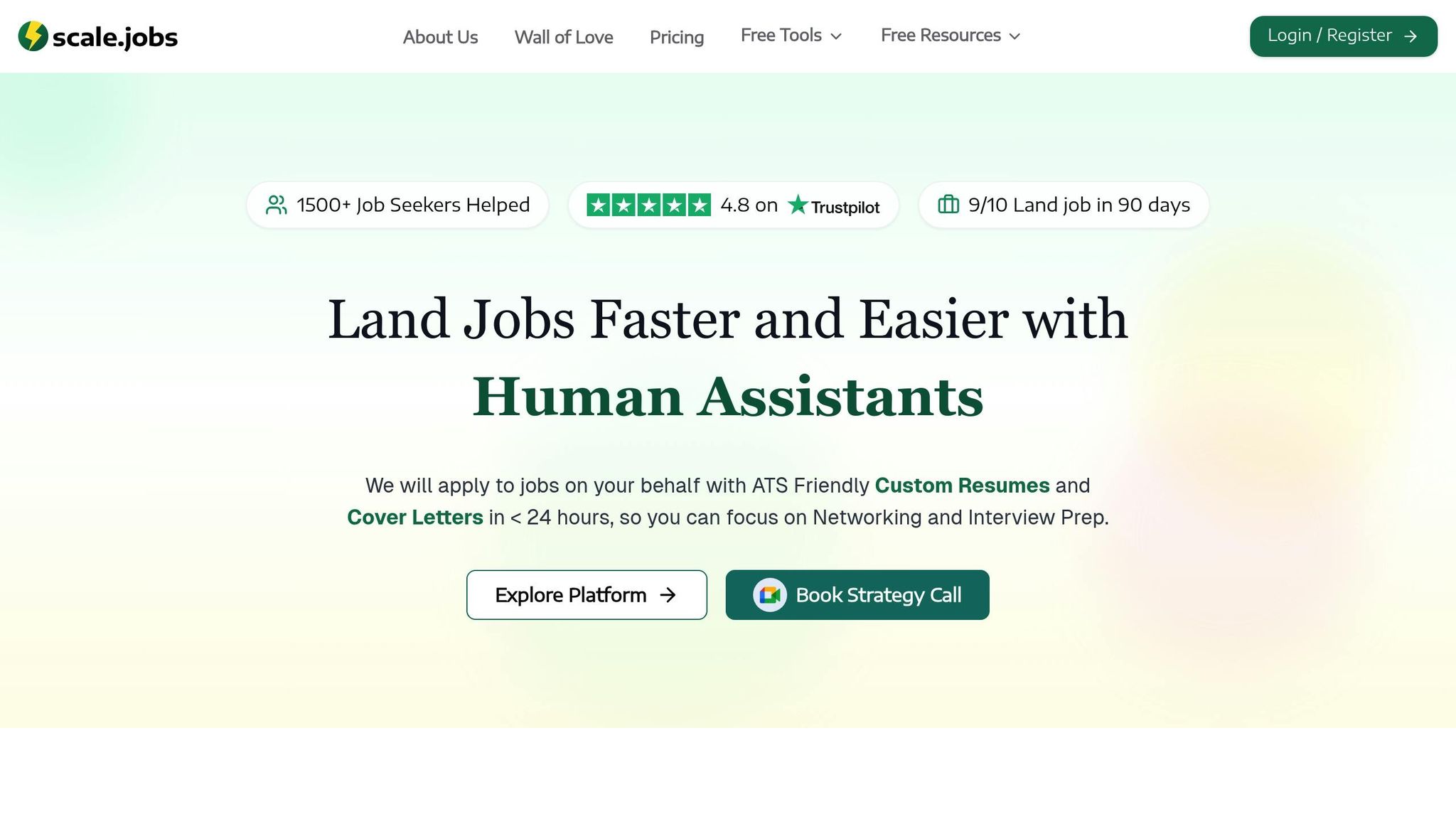
scale.jobs stands out by blending trained human virtual assistants with AI tools to manage your entire job application process - something competitors like Resume.io, Lazyapply, and Jobscan don't provide. Unlike subscription-based services such as Resume.io or Jobscan, scale.jobs offers flat-fee pricing starting at $199 for 250 applications, with no recurring costs. Your dedicated assistant manually submits applications across various platforms, tackles complex questions that can confuse automated systems, and sends time-stamped screenshots via WhatsApp to verify submissions. Plus, unused credits are refunded - a level of flexibility subscription services don't offer.
The human element is key. For instance, a software engineer using scale.jobs for 200 applications received a 12.5% callback rate (25 responses) thanks to resumes tailored for ATS and visa requirements. In comparison, Resume.io's automated templates yielded only 15 callbacks. Similarly, an administrative professional who tracked 50 submissions with screenshots secured interviews that Lazyapply's automated bulk submissions missed due to bot detection issues.
Now, let’s see how scale.jobs compares directly with its competitors.
scale.jobs vs Resume.io, Lazyapply, and Jobscan
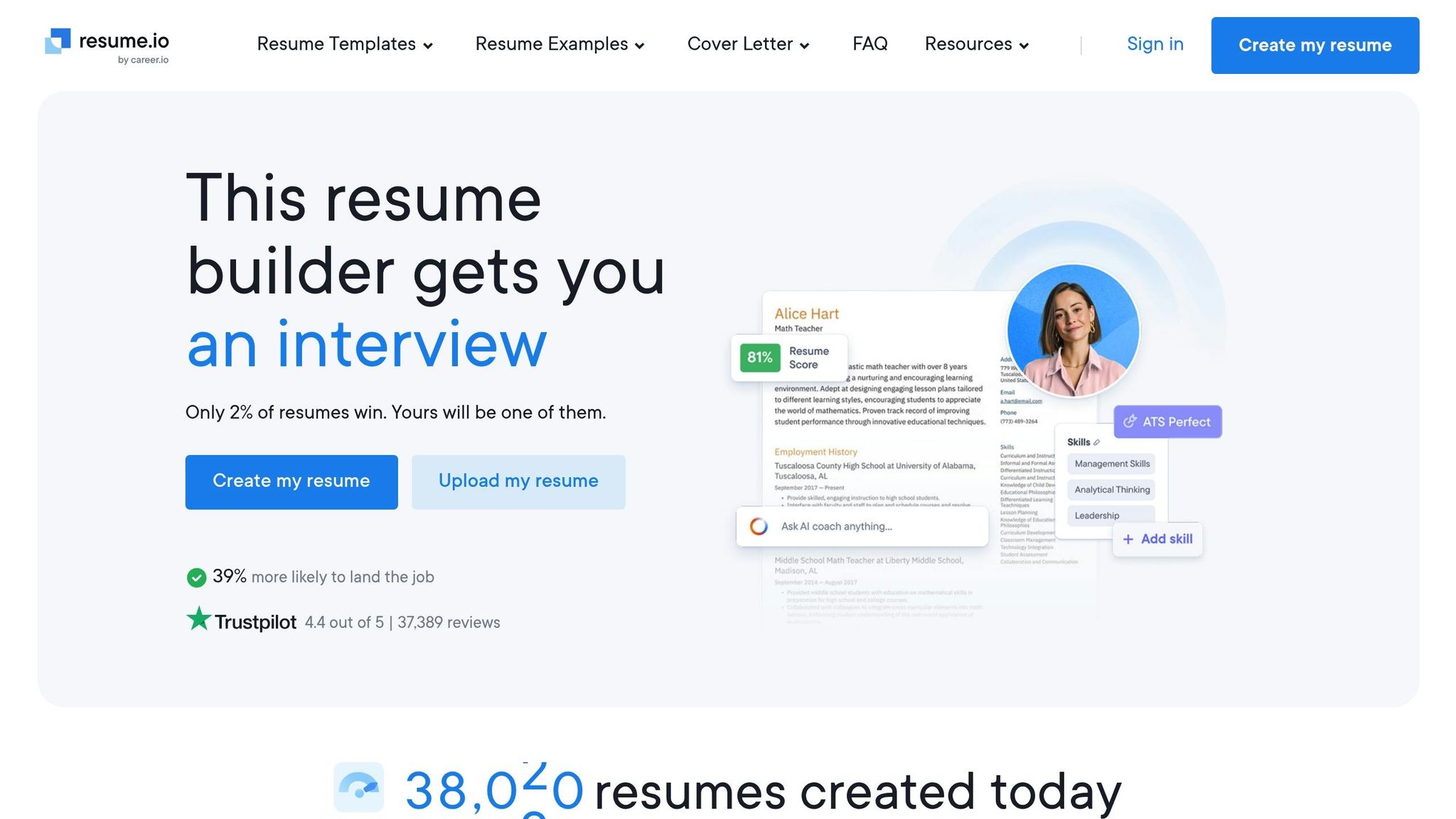
Resume.io offers polished templates and AI-driven keyword suggestions, with pricing ranging from $2.70 to $29.70 per month. While it’s helpful for formatting resumes quickly, it doesn’t handle applications or provide human review for addressing career gaps or visa-specific language.
Why scale.jobs wins:
- Manual submissions allow for nuanced responses that templates can’t achieve
- Flat-fee pricing avoids ongoing subscription costs
- Real-time WhatsApp updates ensure transparency with proof-of-work
- Human assistants customize resumes for each role instead of relying on static templates
- Refund guarantees for unused credits mean you only pay for what you use
Lazyapply automates bulk applications for a one-time fee of $99. However, bots often miss complex questions or trigger portal bans, leading to callback rates as low as 2%.
Why scale.jobs wins:
- Human execution avoids portal bans caused by bot detection
- Assistants handle multi-step forms that automation can’t complete
- Callback rates range from 15–22%, far exceeding Lazyapply’s sub-2% outcomes
- Time-stamped screenshots verify every submission
- Dedicated WhatsApp support provides real-time communication
Jobscan specializes in ATS keyword matching, with pricing between $49.95 and $99.95 per month. While it analyzes your resume, it doesn’t handle applications or offer customization for specific roles.
Why scale.jobs wins:
- Virtual assistants submit around 30 applications daily, tackling multi-step forms that automation struggles with
- Callback rates improve to 15–22%, compared to 12–18% with AI-only tools
- One-time payment model eliminates ongoing subscription fees
- Full application execution is included, not just resume analysis
- Proof-of-work documentation ensures accountability
Who Should Use Resume.io
Resume.io is ideal if you’re managing your own applications and need affordable templates for 5–15 roles per month. It’s best for entry-level candidates in straightforward fields like design or administration, where ATS formatting is the main priority.
Who Should Use Lazyapply
Lazyapply works for those applying to hundreds of basic positions, where volume matters more than callback quality. It’s suitable for early-career job seekers exploring broad market opportunities, though response rates may be low.
Who Should Use Jobscan
Jobscan is a good fit if you prefer optimizing your resume independently and analyzing keyword matches yourself. It’s ideal for tech-savvy professionals who have the time and skills to handle their own applications.
Who Should Choose scale.jobs
scale.jobs is the right choice if you’re applying to 50+ positions weekly, dealing with visa requirements, navigating career transitions, or targeting competitive roles. With callback rates of 15–22%, it’s a strong option for mid-career professionals, visa holders, or anyone needing documented proof-of-work and dedicated support.
Switch to scale.jobs If You Need...
- High-volume application management: When applying to 100+ positions weekly feels overwhelming, scale.jobs’ human assistants can handle the workload efficiently while maintaining quality.
- Visa sponsorship navigation: For roles requiring H-1B, F-1 CPT, or TN visas, human-powered customization ensures accurate handling of sponsorship questions and work authorization details.
- Documented proof-of-work: Time-stamped screenshots via WhatsApp provide transparency and compliance tracking, which competitors like Lazyapply or Resume.io lack.
- Competitive role targeting: If you’re pursuing roles where a 15–22% callback rate justifies the investment, scale.jobs’ mix of human oversight and AI efficiency delivers results.
For more information, explore our tailored job application assistance.
Decision Summary: Which Option Fits Your Job Search
Choose resume tools like Jobscan or Resume.io if you’re early in your career, applying to 10–20 entry-level roles monthly, and need quick ATS formatting for under $30 per month. These tools are ideal when speed and keyword compliance are your main goals.
Select human experts or scale.jobs if you’re navigating career changes, addressing employment gaps, managing visa complexities, or applying to 50+ positions weekly. With callback rates of 15–22%, scale.jobs justifies its flat-fee pricing of $199–$1,099. It’s a smart choice for mid-career professionals and visa holders in competitive U.S. job markets, offering virtual assistants, dedicated WhatsApp support, and refund guarantees for unused credits.
Decision Summary: Which Option Fits Your Job Search
After weighing the options, here's a straightforward guide to help you decide what works best for your job search needs.
Go with resume tools like Jobscan or Resume.io if your budget is tight (under $50/month), you're targeting entry-level roles, and you need quick fixes for Applicant Tracking System (ATS) keywords. These platforms are great for speed and volume, allowing you to handle numerous applications quickly. However, they often fall short when it comes to crafting compelling career stories for competitive or specialized positions.
Turn to human experts if you're aiming for executive roles, transitioning careers, or addressing employment gaps that require a thoughtful strategy. Human professionals charge between $300 and $2,000 per resume but offer callback rates of 15–22%, thanks to their ability to tailor industry-specific narratives through detailed interviews. This level of personalization is something automated tools simply can't match.
Consider scale.jobs for a blend of AI-driven efficiency and expert human oversight. With flat-fee packages ranging from $199 to $1,099, scale.jobs offers trained virtual assistants who manually submit applications - avoiding bot detection - while providing real-time updates via WhatsApp, complete with time-stamped screenshots. They can navigate complex systems like Workday with ease, making this option ideal for mid-career professionals, visa holders managing H-1B or F-1 processes, and anyone who values transparency and proof of work over fully automated tools.
If you're focusing on volume and working with a limited budget, resume tools are a practical choice. For roles requiring a compelling strategic narrative, investing in human expertise pays off. But if you need a solution that combines speed, precision, and tailored support - without recurring fees - scale.jobs offers the perfect middle ground with features like refundable unused credits and a 24-hour turnaround for custom resumes.
FAQs
How can I tell if my resume is too 'keyword-stuffed' for recruiters?
When writing your resume, avoid cramming in keywords unnaturally, as this can backfire. Both modern ATS (Applicant Tracking Systems) and recruiters are skilled at spotting excessive or forced repetition, which could harm your application. Instead, focus on aligning your resume with the job description. Use relevant terms thoughtfully and in context to highlight your actual skills and experience, ensuring your resume passes ATS filters while still appealing to human reviewers.
How many applications should I submit before judging my callback rate?
When it comes to measuring callback rates, submitting about 30 applications is often considered a solid benchmark. However, the outcome largely hinges on the quality and level of personalization in each application. Platforms like Scale.jobs demonstrate that concentrating on fewer, well-tailored applications can significantly boost callback rates - ranging between 25% and 47%. This approach far outperforms the less than 2% callback rate typically seen with generic or mass-submitted applications.
What’s the fastest way to tailor one resume for multiple roles without breaking ATS formatting?
To efficiently adjust your resume for different roles while maintaining compatibility with Applicant Tracking Systems (ATS), stick to a straightforward, single-column layout in either DOCX or an optimized PDF format. Use clear section headers to organize your information. Tailor the content by weaving in relevant keywords from each job description into your bullet points and summaries. Steer clear of intricate elements like tables or graphics, spell out months and years, and ensure the file size stays below 200 KB to guarantee smooth ATS processing.