How to List Multiple Jobs at Same Company: 5 Real Examples
You earned every title at that one company. Now make sure your resume proves it. These 5 examples show you exactly how to lay it out and get noticed.


When listing multiple roles at the same company on your resume, the format you choose can significantly impact your chances of landing an interview. The goal is to clearly showcase career progression, avoid redundancy, and ensure compatibility with Applicant Tracking Systems (ATS). Here’s what you need to know:
- Highlight Career Growth: Show how responsibilities expanded with each role using measurable results (e.g., team size, budgets managed).
- Avoid Repetition: Focus on what’s unique to each position instead of duplicating tasks.
- Optimize for ATS: Use clean, simple layouts with standard section headings to ensure your resume passes automated filters.
5 Effective Resume Formats:
- Stacked Titles: Combine related roles under one company entry to avoid redundancy.
- Separate Entries: Use distinct sections when promotions involved significantly different responsibilities.
- Overlapping Roles: Clearly outline concurrent responsibilities for dual roles.
- Leave-and-Return: List separate employment periods to highlight growth after returning.
- Project-Based Format: Ideal for consulting or agency roles to emphasize key projects.
Choosing the right format depends on your career path. For example, stacked titles work well for steady progression, while separate entries highlight distinct promotions. Tools like scale.jobs can simplify this process by blending ATS optimization with expert review, ensuring your resume is both clear and impactful.
How To Show Multiple Jobs At Same Company On Resume - Ways To List Multiple Positions At One Company
Basic Rules for Listing Multiple Roles at One Company
Before diving into formatting examples, let’s focus on three key principles that can make or break a resume. Whether you're showcasing promotions, lateral transitions, or overlapping roles, these guidelines will help you stand out.
Highlight Career Growth and Results
Your resume should tell a story of growth. Each role should reflect increased responsibilities and measurable achievements. Don’t just list job titles - show how you evolved from a Marketing Coordinator to a Senior Marketing Manager, for example.
Focus on quantifiable results to demonstrate this progression. Maybe you started by managing a team of two and eventually led a team of ten. Or perhaps your budget oversight grew from $50,000 to $500,000. These numbers make your growth clear to both hiring managers and ATS (Applicant Tracking Systems).
Be sure to trim unnecessary details while keeping the most important accomplishments front and center.
Avoid Repetition While Keeping Key Details
When you’ve held multiple roles at the same company, overlapping responsibilities are common. Resist the urge to copy and paste identical bullet points under each role. Instead, emphasize what was unique to each position and show how your duties evolved.
For example, if both roles involved managing social media, highlight how the scope expanded. In the first role, you might have overseen two platforms, while in the second, you managed six platforms with a $100,000 ad budget. This approach keeps your resume concise and engaging while showcasing genuine progression.
This method also ensures your resume is polished and easy for ATS systems to process.
Optimize Your Resume for ATS
Once you’ve crafted a clear narrative of your career growth and refined the details for each role, make sure to follow essential tips for ATS-friendly resumes. With 99% of Fortune 500 companies using ATS software, even small formatting issues can prevent your resume from being seen by a human recruiter.
Stick to standard section headings like "Experience", and avoid tables, columns, or graphics that might confuse ATS systems. A chronological or hybrid format works best for showcasing career progression within a single company.
"It helped me to get through the ATS system and get notified by recruiters" - Bala, IT systems operations manager
Keep in mind that less than 2% of applicants get interview callbacks. However, by optimizing your resume for ATS and achieving a 75% match rate with the job description, you can significantly boost your chances of moving forward in the hiring process.
5 Formatting Examples for Multiple Roles at the Same Company
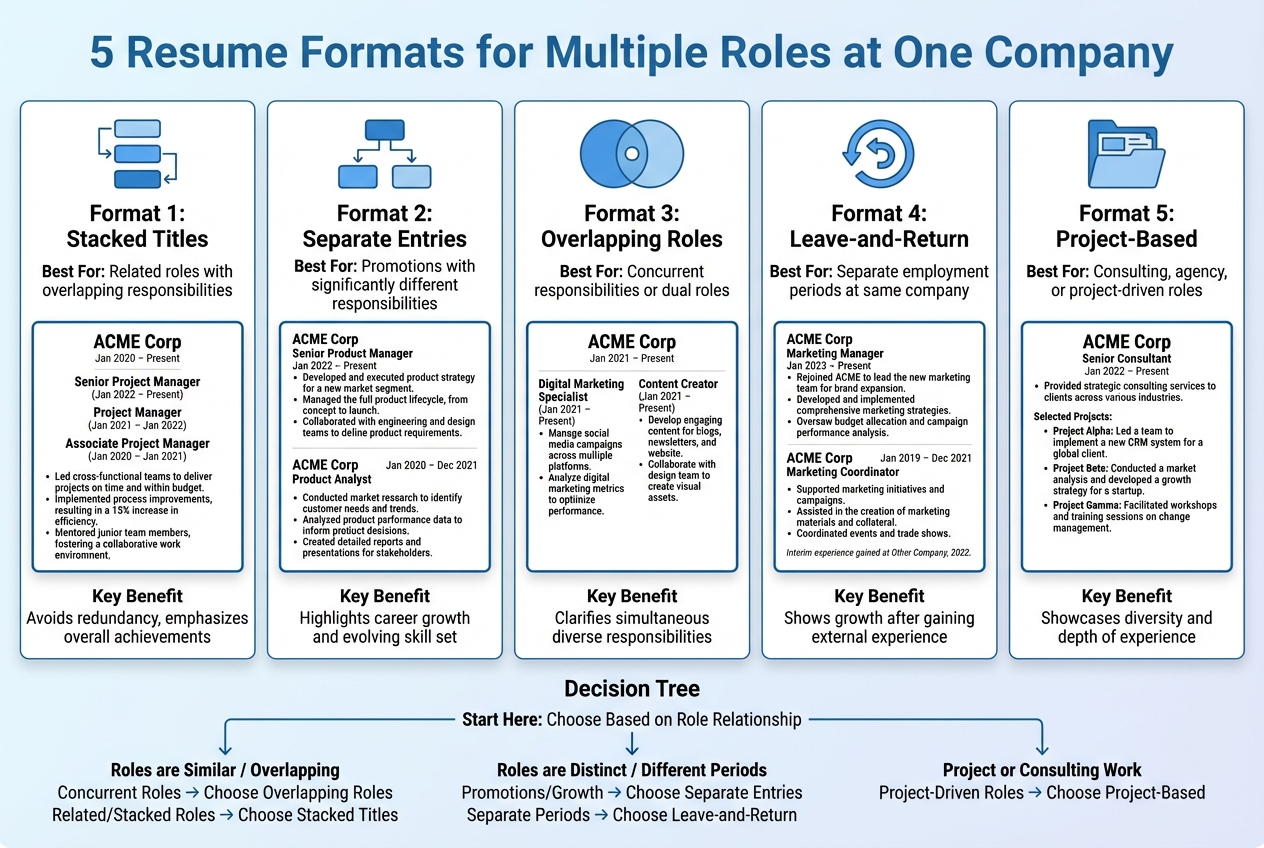
5 Resume Formats for Multiple Jobs at Same Company
Highlighting your career progression within the same company can be tricky, but choosing the right format can make a huge difference. Below are five examples to help you present your growth effectively, tailored to different career scenarios.
Example 1: Stacked Titles for Related Roles
Stacking titles is a great option when you've progressed through similar roles with overlapping responsibilities. It avoids redundancy while emphasizing your overall achievements.
ABC Marketing Agency, Chicago, IL
Marketing Manager (June 2022 – Present)
Marketing Coordinator (January 2020 – May 2022)
- Boosted client retention from 68% to 89% by introducing quarterly reviews
- Directed social media campaigns with annual budgets ranging from $25K to $150K
- Expanded team from 3 to 8 members while maintaining a 95% project delivery rate
- Created a content strategy that generated over 2,500 qualified leads in 18 months
This approach keeps your resume clean and focused on the impact you've made, rather than repeating similar duties for each role.
Example 2: Separate Entries for Promotions
If your responsibilities shifted significantly with a promotion, using separate entries can better showcase your career growth and evolving skill set.
TechVision Solutions, Austin, TX
Senior Software Engineer (March 2023 – Present)
- Designed a microservices architecture that supports 500,000+ daily active users
- Mentored six junior engineers, four of whom earned promotions within a year
- Cut system downtime by 73% by implementing automated monitoring tools
Software Engineer (July 2020 – February 2023)
- Contributed to 15+ new features for a mobile app rated 4.7 stars
- Partnered with the product team to reduce bug reports by 42% quarter-over-quarter
- Played a key role in code reviews and engineering best practices
This format clearly outlines your progression while giving each role the attention it deserves.
Example 3: Overlapping Roles at the Same Company
Sometimes you wear multiple hats simultaneously. Whether you're promoted while retaining previous duties or take on a special project, this format helps clarify overlapping responsibilities.
Global Retail Corp, Seattle, WA
Operations Manager & Interim HR Director (April 2023 – Present)
Operations Manager Duties:
- Supervised daily operations across 12 retail locations generating $8.5M annually
- Introduced an inventory system that cut waste by 31%
Interim HR Director Duties:
- Led recruitment efforts, hiring 45 employees across six departments in eight months
- Revamped onboarding, boosting new hire retention from 72% to 91%
This layout highlights your ability to manage diverse responsibilities effectively.
Example 4: Returning to the Same Company After Leaving
If you've left a company and later returned, list each period of employment separately with distinct date ranges to show your growth and evolving contributions.
DataStream Analytics, Boston, MA
Lead Data Analyst (September 2023 – Present)
- Rebuilt the analytics infrastructure, improving report accuracy by 28%
- Currently overseeing a $320,000 analytics platform migration
Data Analyst (March 2019 – June 2021)
- Automated reporting processes, saving 15 hours of manual work weekly
- Analyzed customer data for over 200 enterprise clients
This format highlights the value you brought back to the company after gaining additional experience elsewhere.
Example 5: Project-Based or Client-Focused Roles
For roles in consulting, agencies, or project-driven environments, a "Selected Projects" subsection can showcase the diversity and depth of your experience.
Creative Solutions Agency, Denver, CO
Senior Account Manager (January 2021 – Present)
Core Responsibilities:
- Managed 18 client accounts generating $2.3M annually
- Led cross-functional teams of 4–7 members per project
Selected Projects:
- Fortune 500 Retail Rebrand (Q2–Q4 2024): Delivered a six-month rebrand campaign for 300+ locations, finishing two weeks early and 8% under budget
- Tech Startup Product Launch (Q1 2023): Directed go-to-market strategy, achieving 12,000 sign-ups in the first month - 140% above the client’s goal
- Healthcare System Digital Transformation (Q3–Q4 2022): Spearheaded a website redesign that increased patient portal usage by 67%
This format is ideal for showcasing the variety and impact of your work when your title doesn’t fully convey your contributions.
How to Pick the Right Format for Your Resume
Stacked Titles vs. Separate Entries
Choosing between stacked titles and separate entries comes down to how your responsibilities have evolved over time. If your daily tasks stayed fairly consistent and you mainly received title upgrades - like moving from "Analyst" to "Senior Analyst" - stacking titles is a great way to keep your resume clean and avoid unnecessary repetition.
On the other hand, if your role changed significantly, such as transitioning from coding to leading a team, separate entries help emphasize the distinct skills and accomplishments tied to each role.
Keep in mind that ATS (Applicant Tracking Systems) favor resumes with standard section headings and straightforward layouts. A clean, simple format ensures your resume is both reader- and ATS-friendly.
Now, let’s look at situations where special formats might better highlight your career journey.
When to Use Special Formats
Sometimes, a nontraditional resume format can better reflect your unique career path. For instance, if you held two very different roles at the same time - like managing operations while temporarily handling HR duties - an overlapping roles format can effectively showcase your versatility. Similarly, if you left a company and later returned, a leave-and-return format allows you to highlight the new perspectives and skills you brought back with you.
For consulting, agency, or client-facing roles, a project-based format might be the best fit. Grouping related work under a "Selected Projects" section helps clearly present your expertise and achievements.
Lastly, resume optimization tools can be a game changer. They help fine-tune elements like spacing, font choices, and layout, ensuring your resume stays clear, ATS-friendly, and tailored to the keywords employers are searching for.
How Scale.jobs Makes Resume Formatting Easier for Multiple Roles
As mentioned earlier, getting your resume formatting right is essential. Scale.jobs simplifies this process by combining smart technology with a human touch. When you've held multiple positions at the same company, presenting your experience clearly can be tricky - for both recruiters and ATS systems. Scale.jobs bridges this gap by pairing ATS optimization with expert review, ensuring your resume not only gets noticed but also makes it through automated screenings. This blend of technology and human insight sets Scale.jobs apart.
Human Assistants for Tailored Formatting
One standout feature of Scale.jobs is its use of human assistants to handle resume formatting. Crafting resumes for multiple roles at the same company often requires nuanced decisions - should you stack titles, list them separately, or use a mix of both? These assistants carefully review your responsibilities and accomplishments for each role, then organize your resume using an ATS-friendly format for multiple positions that best highlights your career progression.
The process begins with an onboarding call where you share your background and career goals. This gives the assistant the context they need to make informed formatting choices. Within 12-24 hours, you’ll receive a resume tailored to your specific job applications. As Aubrey Smith, a Software Engineer, shared:
"Team did a great help in applying jobs and always available to talk. They followed my priority in applying jobs as well."
This personalized approach ensures that your multi-role experience is clearly presented, avoiding the cluttered or confusing layouts that can often bury key details.
ATS-Optimized Resume Builder
Scale.jobs prioritizes ATS compatibility from the start. Their system ensures resumes are created with clean layouts and standardized headings, allowing multi-role entries to be parsed correctly by ATS software. Whether your roles are similar and stacked together or listed separately to emphasize promotions, the human assistants optimize every detail, including strategic keyword placement and formatting.
The results speak volumes: with a 4.8 rating from over 1,500 job seekers and 93% of customers landing jobs within three months, Scale.jobs has proven its effectiveness. Plus, they provide proof-of-work screenshots for every application, so you can see exactly how your resume was submitted. This level of transparency eliminates the uncertainty often associated with automated tools that might misinterpret your carefully formatted resume.
Proof-of-Work Screenshots and Real-Time Support
To enhance the resume creation process, Scale.jobs offers real-time updates via WhatsApp and time-stamped screenshots of your resume in application portals. This is especially useful for multi-role formatting, as it lets you confirm that the ATS preserved your layout. If there’s an issue, your assistant will make adjustments before the next round of applications.
As verified user Hemil P. noted:
"The support is nice and turnaround is within 24 hours."
Scale.jobs offers one-time payment plans starting at $199 for 250 applications. With a 24-hour support turnaround and a refund policy for unused credits if you land a job early, the service is efficient and cost-effective without locking you into recurring fees.
Conclusion: Tell Your Career Story Clearly
The way you format your resume can make a huge difference in how recruiters perceive your career growth. Whether you use stacked titles to highlight steady progression, separate entries to emphasize distinct promotions, or specific layouts for overlapping or returning roles, the key is to ensure your professional journey is easy to follow at a glance.
Choosing the right approach depends on your career path. For roles that naturally build on each other, stacked titles can effectively show progression. On the other hand, if you’ve earned promotions that brought significantly different responsibilities, separate entries can better showcase those accomplishments. Whatever you choose, keep your resume clear and compatible with Applicant Tracking Systems (ATS) to ensure it makes it through automated screenings.
This is where scale.jobs steps in, offering a solution that combines human expertise with ATS optimization. Their assistants take the time to understand your unique career path, ensuring your resume is formatted to pass ATS filters while presenting your achievements in the best possible light.
Here’s how scale.jobs distinguishes itself from competitors like resume.io:
- Personalized Formatting by Experts: Instead of relying on automated templates, trained assistants craft resumes that highlight your career growth.
- ATS-Friendly Designs: Every resume is carefully formatted to navigate automated systems seamlessly.
- Transparent Process: With WhatsApp support and proof-of-work screenshots, you’ll know exactly how your resume appears in application portals.
- Simple, One-Time Payment: Starting at $199 for 250 applications, with refunds for unused credits - no subscription required.
Your career progression tells a story of dedication, growth, and adaptability. By formatting it thoughtfully and optimizing it for both recruiters and ATS, you can let your achievements shine through effortlessly.
FAQs
Should I list multiple roles at the same company as stacked titles or separate entries on my resume?
When deciding between stacked titles and separate entries, it all comes down to how you want to present your experience and career growth. Stacked titles are a great option when your roles within a company were closely connected or showed a clear progression. This approach keeps your resume concise while emphasizing your professional development over time.
On the flip side, separate entries work better if your roles were quite different, had distinct responsibilities, or if you want to spotlight specific achievements for each position.
Think about your audience and the job you're aiming for. Recruiters value resumes that are easy to read and relevant to the role, so pick the format that best showcases your skills and aligns with the position you’re pursuing.
What are the best ways to make your resume compatible with ATS systems?
To ensure your resume gets through an ATS (Applicant Tracking System), keep things simple and straightforward. Opt for a clean, professional layout - skip fancy designs, images, or graphics that could trip up the system. Stick to standard fonts like Arial or Times New Roman, and use clear, well-labeled section headers like Work Experience, Education, and Skills to make your resume easy to navigate.
Make sure to include keywords from the job description naturally throughout your resume. ATS software scans for specific terms, so aligning your skills and experiences with the language used in the job posting can boost your chances. At the same time, avoid clutter - keep your resume focused, concise, and relevant to the role.
Lastly, save your resume in a format the ATS can process, such as .docx or PDF (if specified in the job posting). This step ensures your formatting stays intact and your resume is readable by the system.
How can I effectively showcase overlapping roles at the same company on my resume?
When listing overlapping roles within the same company, it's important to keep things clear and well-organized. Start by grouping all roles under the company name and include the dates for each position to create a clear timeline. Use bullet points to highlight the key responsibilities and achievements for each role, but avoid repeating information - focus on what makes each position distinct and the skills or contributions unique to that role.
If the roles were very similar, you can consolidate them under a single title and break down the dates and responsibilities for each project or task. This method not only showcases your career growth but also keeps the layout neat and easy to follow. Be sure to align the details with the job you're applying for, prioritizing accomplishments that are most relevant to the role you're targeting.