
Resume Customization: Why One Resume No Longer Works for All Jobs
Tailor each resume to job descriptions and ATS: use contextual keywords, quantify achievements, adjust format, and favor human review over generic AI.


In today’s job market, a generic resume won’t cut it. Applicant Tracking Systems (ATS) and recruiters now demand tailored resumes that align with specific job requirements. ATS evaluates context, skills, and achievements, while recruiters spend just 6 seconds scanning resumes for relevance. This means your resume must highlight measurable results and real-life examples and directly address the role’s priorities.
Key takeaways:
- ATS Compatibility: Modern systems analyze context, not just keywords.
- Recruiter Focus: Top achievements must appear in the first third of your resume.
- Customization is Critical: Tailored resumes outperform generic ones in securing interviews.
Below, we’ll explore actionable steps to customize your resume, avoid common mistakes, and leverage tools or services like scale.jobs to streamline the process.
How to Customize Your Resume for Each Application
Finding and Using the Right Keywords
Start by carefully reviewing the job description to identify recurring terms, especially in the responsibilities and "must have" sections. These terms often indicate the skills and qualifications the employer prioritizes. Modern Applicant Tracking Systems (ATS) now evaluate keywords in context, so it’s essential to incorporate them naturally into your achievements and descriptions.
Break keywords into two categories: hard skills (like software, tools, or technical expertise) and soft skills (such as teamwork or communication). ATS systems tend to prioritize hard skills first, followed by education, job title relevance, and then soft skills. To optimize your resume:
- Include 3–5 high-priority keywords in your professional summary.
- List technical and soft skills in a clear, organized format within your skills section.
- Seamlessly integrate keywords into your work experience bullet points.
When using keywords, match the exact phrasing from the job posting. For instance, if the role highlights "safety compliance" and "throughput optimization", use those exact terms when describing your relevant achievements. Additionally, include both full names and abbreviations for certifications (e.g., "Certified Public Accountant (CPA)") to ensure the ATS captures them. Stick to standard section headings like "Work Experience", "Education", and "Skills" to help ATS software categorize your information correctly.
Once the keywords are in place, make sure your achievements directly reflect these terms.
Rewriting Your Achievements to Match the Job
After identifying the right keywords, focus on tailoring your achievements to align with the role’s priorities. Start by creating a master resume that includes all your roles, accomplishments, skills, and certifications. When applying for a specific job, pull only the most relevant content from this document. Organizing your master resume by skill category or job function, rather than chronologically, can make this process smoother.
Each achievement should highlight measurable results. For example, instead of saying, "Managed workflows", reframe it as, "Reduced processing time by 28% through workflow redesign." Use metrics that resonate with the industry. For example:
- Manufacturing roles: Reference metrics like cycle times or yield rates.
- Office roles: Highlight workflow efficiency or coordination improvements.
- Sales roles: Focus on client acquisition figures or revenue growth.
Always lead with results and impact rather than listing responsibilities. This approach proves you’ve delivered value in areas the employer cares about. Within each job entry, reorder bullet points to place the most relevant achievements first. Since recruiters often skim resumes, your strongest accomplishments should appear in the top three bullet points.
If customizing your resume feels overwhelming, consider using an AI resume builder to ensure your experience is presented effectively. Remember, the goal is to strategically emphasize your relevant experience - not to fabricate skills you don’t possess.
Adjusting Format and Section Order by Role
Once you’ve tailored your content, adjust your resume’s format to highlight the most relevant elements. Position your key achievements within the top third of the resume, as this is where recruiters focus their attention first. For instance, if a previous role from two years ago is more relevant to the target job than your current position, list it higher. Similarly, for IT roles, consider moving the technical skills section closer to the top.
To ensure ATS compatibility, stick to simple and consistent formatting. Use clean fonts, standard headings, and avoid complex designs like heavy visuals, columns, or tables that may confuse the system. Save your resume as a .docx or PDF file for maximum compatibility.
For different job types, adjust the focus of your sections rather than the overall design. For example:
- Licensed positions: Lead with certifications.
- IT roles: Highlight technical skills prominently.
- Client-focused roles: Emphasize achievements related to client interaction and satisfaction.
Use a straightforward date format, such as MM/YYYY to MM/YYYY, to help the ATS accurately calculate your experience. By prioritizing content over design, you’ll create a resume that’s both ATS-friendly and appealing to recruiters.
How to Tailor Your Resume to a Specific Job: Match Job Descriptions, Keywords, and ATS-Optimization
Resume Customization Tools: What Works and What Doesn't
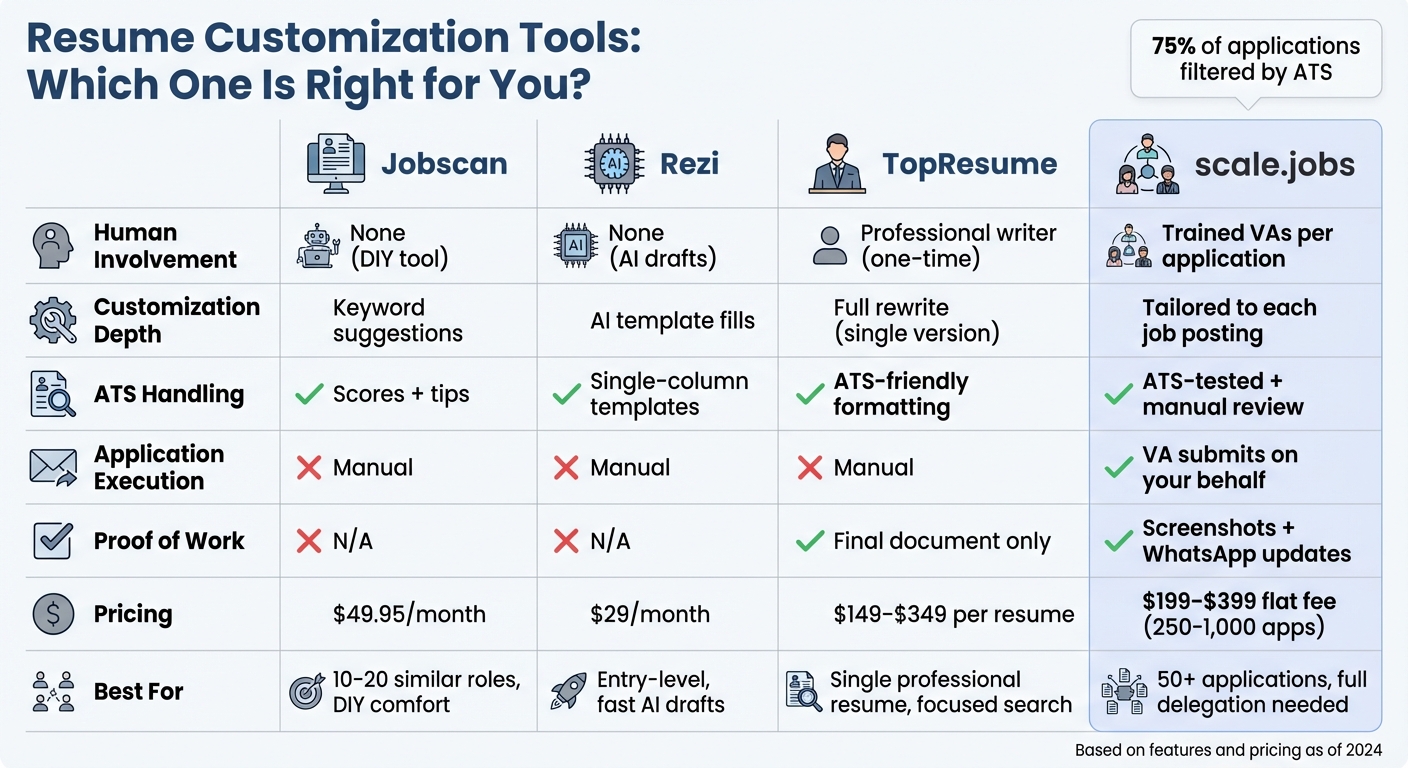
Resume Customization Tools Comparison: Features, Pricing, and Best Use Cases
AI Resume Tools: What They Do Well and Where They Fall Short
Platforms like Jobscan and Rezi are designed to improve your resume's compatibility with applicant tracking systems (ATS). These tools scan job descriptions, identify important keywords, and calculate match scores based on factors like keyword density and formatting. They provide quick assessments that highlight basic issues, helping users ensure that their resumes meet ATS requirements.
What AI tools excel at:
These platforms are great at catching formatting errors that could confuse ATS software. They recommend single-column layouts for better parsing and flag missing keywords that might affect your resume's ranking. Tools like Rezi's free plan and Jobscan's keyword scanner offer affordable solutions for checking ATS readability, making them a solid choice for basic resume audits.
Where they fall short:
AI-generated resumes often feel impersonal. Certified Professional Resume Writer Conor McMahon explains:
"AI-generated resumes often rely on standard templates with similar sentence constructions... The lack of variety can make the document feel robotic."
These tools tend to pull generic skills from a database without understanding the context of your achievements, which means they might miss the real impact of your contributions. While they optimize resumes for machines, they often fail to create documents that resonate with human recruiters, who typically spend just a few seconds reviewing each resume.
Why scale.jobs stands out:
- Human-assisted customization: Trained virtual assistants (VAs) tailor resumes to highlight your unique achievements, avoiding the generic feel of AI-generated documents.
- No subscriptions, just a flat fee: Pay once for 250–1,000 job applications, with real-time updates via WhatsApp.
- Proof of application: Receive screenshots confirming the correct submission of each application.
- Context-aware editing: Human reviewers adapt your career story to match job requirements and align with company expectations.
- Balanced optimization: Combines ATS-friendly formatting with strategic content adjustments that appeal to hiring managers.
While AI tools are effective for handling technical issues like formatting and keywords, their inability to capture nuanced achievements emphasizes the importance of human review.
Why Human Review Beats Automation for Customization
Tailoring your resume for each job requires more than automated keyword adjustments - it demands a human touch to craft a narrative that aligns with specific job requirements. Human assistants excel at understanding industry-specific nuances, identifying key achievements, and presenting them in a way that resonates with recruiters. For example, while an AI tool might ensure you include the phrase "safety compliance", a human reviewer can reframe your experience to show how you improved compliance rates and why that matters for the role.
What human reviewers offer that automation can't:
They address tone inconsistencies, rearrange achievements to emphasize relevant experience, and adjust language to match the company's values. They also catch hidden formatting issues - like extra spaces or characters - that might cause ATS parsing errors. Since ATS systems filter out roughly 75% of applications, these small details can make a big difference in whether your resume reaches a recruiter.
scale.jobs combines human expertise with ATS-friendly templates, offering a solution that bridges the gap between automated tools and traditional resume services. Their trained VAs handle everything from resume tailoring to application submissions, providing proof of work and addressing the limitations of AI tools, which can't adapt to the specific requirements of each job.
scale.jobs vs Jobscan vs Rezi vs TopResume
When evaluating resume customization tools, it's essential to consider factors like human involvement, ATS compatibility, and pricing. Here's how popular options compare:
| Feature | Jobscan | Rezi | TopResume | scale.jobs |
|---|---|---|---|---|
| Human involvement | None (DIY tool) | None (AI drafts) | Professional writer (one-time) | Trained VAs per application |
| Customization depth | Keyword suggestions | AI template fills | Full rewrite (single version) | Tailored to each job posting |
| ATS handling | Scores + tips | Single-column templates | ATS-friendly formatting | ATS-tested + manual review |
| Application execution | Manual | Manual | Manual | VA submits on your behalf |
| Proof of work | N/A | N/A | Final document only | Screenshots + WhatsApp updates |
| Pricing model | $49.95/month | $29/month | $149–$349 per resume | $199–$399 (flat fee, 250–1,000 apps) |
Who Should Choose Jobscan
- You need quick feedback on ATS compatibility for a few similar roles.
- You're comfortable rewriting your resume based on keyword suggestions.
- You're applying to 10–20 jobs with minimal customization requirements.
Who Should Choose Rezi
- You're looking for fast AI-generated drafts for entry-level roles.
- You're willing to manually edit the AI's phrasing to add a personal touch.
- You're targeting straightforward positions with simple requirements.
Who Should Choose TopResume
- You want a single, professionally written resume for a focused job search.
- You're comfortable managing the application process yourself after receiving the resume.
- You're applying to fewer than 20 roles and don't need ongoing customization.
Who Should Choose scale.jobs
- You're applying to 50+ jobs across various industries and need consistent customization.
- You've tried AI tools, but your applications still get filtered out by ATS.
- You need proof that applications were submitted correctly, with real-time updates.
- You're looking to avoid recurring subscriptions and want a one-time payment model.
- You're managing other responsibilities, like a current job or family, and need to delegate the application process.
For professionals seeking a virtual assistant for job applications, scale.jobs offers a comprehensive service that handles everything from resume customization to submission, all for a flat fee.
Decision Summary
Choose Jobscan or Rezi if:
- You need basic ATS audits for a limited number of similar roles.
- You're comfortable making manual edits based on technical suggestions.
- Your job search involves fewer than 20 applications with straightforward requirements.
Choose TopResume if:
- You want a single, professionally crafted resume for a targeted job search.
- You're fine managing applications yourself after receiving the document.
- You don't need ongoing customization or application support.
Choose scale.jobs if:
- You're applying to 50+ jobs across different industries and require personalized, human-reviewed applications.
- You want proof of application submissions with real-time updates.
- You're looking to eliminate recurring subscriptions and prefer a one-time fee.
- You need to delegate the entire process - from tailoring resumes to submitting applications - while ensuring quality and accuracy.
Switch to scale.jobs if:
- You're overwhelmed by the number of applications you need to complete.
- AI tools haven't worked, and your resumes keep getting filtered out by ATS.
- You need verifiable proof that applications are being submitted as promised.
- You want to focus on other priorities while leaving the application process to a trusted team.
What You Gain from Tailoring Every Resume
Customizing your resume for each job significantly increases your chances of securing interviews and shortens the overall job search process. Tailored resumes are designed to meet the dual expectations of ATS (Applicant Tracking Systems) and recruiters, ensuring your application stands out. Unlike generic resumes, customized ones are more likely to pass ATS filters and grab the recruiter’s attention, leading to faster responses and better opportunities.
For those applying to multiple roles, using resume writing services can save you from the overwhelming task of personalizing each application while maintaining high-quality standards. These services not only handle resume customization but also streamline the entire application process. Below, we explore real-world examples that highlight the advantages of tailored resumes.
Case Studies: Results from Customized Resumes
The impact of customized resumes is clear: they consistently improve interview rates compared to generic applications. While exact case studies with full data may vary, the trend is undeniable. Tailored resumes increase visibility with ATS systems and resonate better with human recruiters. However, the time commitment required for DIY customization - often up to five hours per application - makes this approach unfeasible for most job seekers, particularly those balancing work or personal responsibilities.
This is where services like scale.jobs step in, taking care of everything from resume personalization to application submission. They even provide updates through screenshots and WhatsApp messages, offering transparency and saving you valuable time. Instead of spending hours on logistics, you can focus on what really matters - preparing for interviews.
That said, even well-crafted resumes can fail if common mistakes are made during customization.
Mistakes That Ruin Customized Resumes
Even the best intentions can lead to poor results if your customization efforts include errors that confuse ATS systems or alienate recruiters. Avoiding these mistakes is crucial to ensuring your tailored resume reaches its intended audience.
- Overly complex formatting: ATS systems struggle with resumes that include tables, charts, text boxes, or multi-column layouts. These elements can cause the system to misread or skip important information. Stick to a single-column format and use standard fonts like Arial, Calibri, or Times New Roman. Additionally, some PDFs carry hidden formatting issues - known as "phantom text" - that can result in ATS rejection, even if the resume appears fine visually.
- Keyword stuffing: Overloading your resume with keywords can make it unreadable for recruiters. ATS systems prioritize relevant keywords, but excessive use of secondary terms can lower your overall score. Instead, focus on naturally incorporating exact phrases from the job description into your accomplishments.
- Unusual section headings: Creative headings like "My Journey" instead of standard titles like "Work Experience" or "Education" can confuse ATS software. Similarly, unconventional job titles like "Marketing Ninja" instead of "Marketing Manager" may prevent your resume from being categorized correctly. Recruiter Damulira Hakim points out that 88% of employers admit to losing qualified candidates due to ATS issues, which underscores the importance of using clear, standard formatting.
- Wrong file formats: Submitting resumes in formats like JPEG or non-text-based PDFs can lead to immediate rejection since ATS systems cannot parse the text. It's also worth noting that 74% of hiring managers claim they can identify resumes written entirely by AI, and 83% reject resumes that aren't tailored to the specific role. This highlights the importance of human oversight in the customization process.
Using services like scale.jobs ensures your resume avoids these pitfalls. Their trained virtual assistants tailor your resume to match job requirements while maintaining ATS compatibility, helping you present your career story effectively and professionally. By sidestepping these common errors, you can ensure your application has the best chance of success.
Decision Guide: When to Use scale.jobs for Resume Customization
Navigating today’s hiring landscape means dealing with Applicant Tracking Systems (ATS) that demand more than just a well-written resume. The choice between doing it yourself, using tools like Jobscan or Rezi, or opting for a service like scale.jobs boils down to how many applications you’re juggling, how much time you have, and how often you encounter ATS roadblocks. If you’re submitting dozens of applications weekly while managing other responsibilities, the DIY route can quickly become overwhelming.
scale.jobs stands out when you need speed and precision in your job applications. Unlike Jobscan’s keyword-matching suggestions or Rezi’s AI-based templates, scale.jobs takes a hybrid approach. It combines AI-driven optimization with human oversight to ensure your applications are tailored and authentic. Trained professionals handle submissions manually to avoid bot detection, refine your achievements for a more compelling narrative, and keep you updated in real time via WhatsApp with submission proof. This approach avoids the generic results often seen with fully automated systems.
Pricing is another factor to consider. While services like TopResume charge per resume or require monthly subscriptions, scale.jobs offers flat-fee packages with the flexibility of pro-rata refunds if you secure a job early. This structure is particularly cost-effective for those submitting 30 or more applications weekly, offering better value compared to DIY efforts.
Who Should Use Jobscan or Rezi vs. Who Should Choose scale.jobs
Choose Jobscan or Rezi if:
You’re applying to a smaller number of roles - around 10 to 20 - with clear requirements. These tools provide basic ATS feedback and are ideal if you have the time to implement keyword suggestions and handle submissions yourself. They’re a good fit for low-volume job searches where you’re comfortable managing the process independently.
Choose scale.jobs if:
You’re managing 50 or more applications across various industries and need consistent, human-reviewed customization for each role. scale.jobs is perfect for those who’ve tried AI tools but still face ATS rejections, require proof of submission, or want to delegate the entire process - from resume tailoring to application submission - while maintaining high quality and transparency.
Comparison Table
| Feature | Jobscan / Rezi | scale.jobs |
|---|---|---|
| Human involvement | None (DIY tool) | Trained VAs per application |
| Resume customization depth | Keyword suggestions / AI templates | Tailored to each job posting |
| ATS handling | Scores + tips / Single-column templates | ATS-tested + manual review |
| Application execution method | Manual | VA submits on your behalf |
| Transparency and proof of work | N/A | Screenshots + WhatsApp updates |
| Pricing model | $29–$49.95/month | $199–$399 (flat fee, 250–1,000 apps) |
Use the table above to evaluate which solution aligns best with your job search needs.
Switch to scale.jobs If You Need This
Consider making the switch to scale.jobs if any of the following apply to you:
- You’re submitting over 20 applications weekly and want to save time without compromising on quality. scale.jobs handles up to 30 applications daily with human-reviewed customization.
- You’re encountering ATS rejections despite optimizing keywords. Human assistants ensure clean formatting and natural integration to avoid common pitfalls of automated systems.
- You need proof that your applications were submitted. WhatsApp updates with screenshots provide real-time tracking and eliminate guesswork.
- You’re a mid-career professional or career changer with a complex work history that requires role-specific storytelling - something generic AI tools often struggle to deliver effectively.
- You’re dealing with intricate application processes, such as visa-related forms or detailed corporate portals, where manual submission reduces the risk of bot detection issues.
If you’re ready to move past the limitations of DIY methods or purely software-based solutions, explore the resume writing services that blend AI efficiency with human expertise for a smarter, more effective approach.
Final Takeaways
In today’s competitive job market, customizing your resume isn’t just a nice-to-have - it’s a necessity. While DIY methods may work for selective applications when time is on your side, tools like Jobscan or Rezi often leave the heavy lifting of execution and submission to you. scale.jobs bridges this gap by offering a done-for-you service that combines AI-driven optimization with human oversight. With transparent proof of work, a flexible pricing model, and the ability to handle high application volumes, scale.jobs is an excellent choice for job seekers facing ATS challenges, tight deadlines, or complex application requirements. For those looking to streamline their job search while improving results, this hybrid solution delivers a practical way forward.
FAQs
How many versions of my resume should I keep?
Customizing your resume for each job you apply to is a smart move. Tailored resumes significantly improve your chances of getting past ATS (Applicant Tracking System) filters and catching the attention of recruiters. Instead of sticking to a one-size-fits-all resume, focus on highlighting the skills and accomplishments that align closely with the specific job description. This approach shows employers that you’ve taken the time to understand their needs and that you’re a strong match for the role.
What’s the safest resume format for ATS parsing?
When it comes to creating a resume that works well with ATS (Applicant Tracking Systems), simplicity is key. Use a clean, standard layout with clearly labeled sections such as "Work Experience" and "Skills". Steer clear of tables, graphics, or fancy fonts, as these can confuse the system. Stick to commonly accepted file formats like .docx or plain text to ensure smooth processing. A straightforward design minimizes parsing errors, making it easier for ATS to accurately read and evaluate your resume.
How do I tailor achievements without exaggerating?
When highlighting your achievements, focus on being precise and grounded. Use specific numbers or data to quantify your impact - for example, saying, "boosted sales by 20% within six months" paints a clear picture of your contribution. To make your accomplishments more engaging, consider presenting them as stories: describe the challenge you faced, the actions you took, and the measurable results you achieved. Staying honest is key - avoid overstating or embellishing your achievements. Exaggeration not only risks damaging your credibility but can also create complications during the hiring process.