Resume Branding Statement That Grabs Recruiter Attention
A concise 15–20 word resume branding statement that states your role, showcases 2–3 skills, and proves impact with a measurable result.

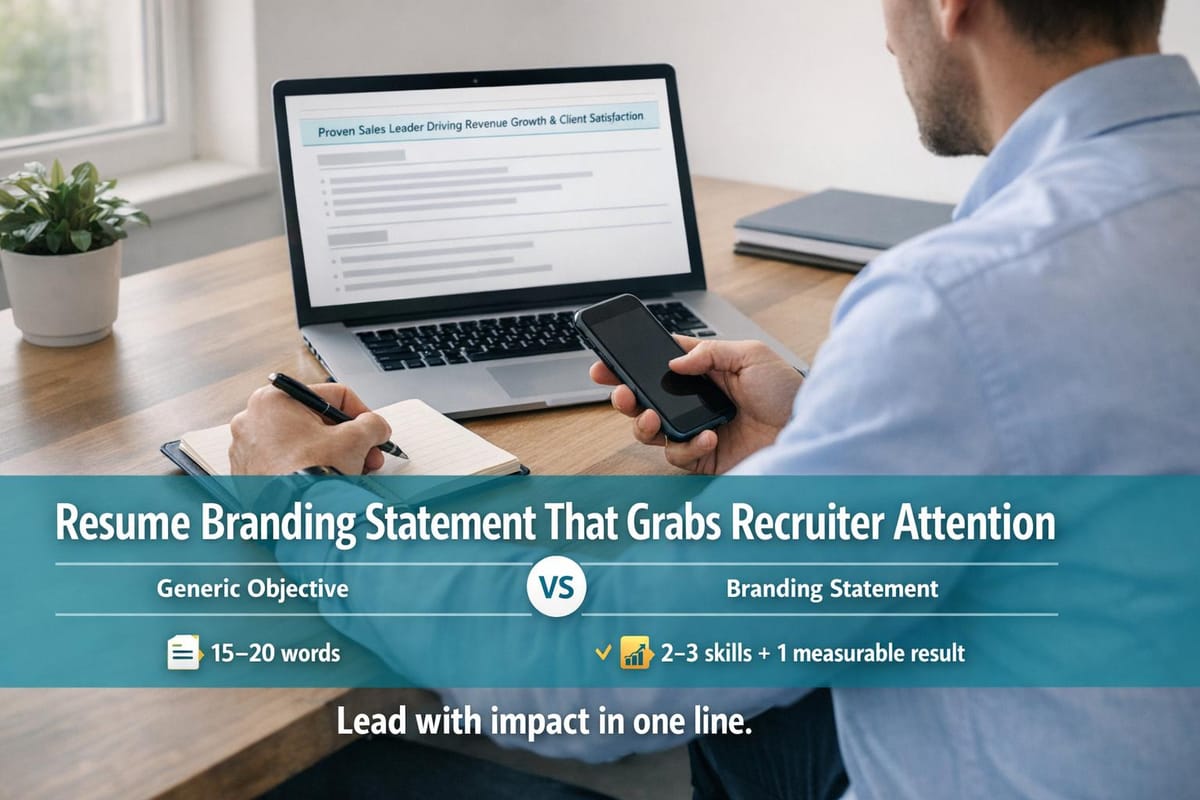
In today’s competitive job market, recruiters spend an average of only six seconds scanning a resume. Your branding statement, a concise 15–20 word pitch, is your chance to stand out immediately. Positioned at the top of your resume, it highlights your unique value, key skills, and measurable achievements. Unlike a traditional resume summary, a branding statement focuses on the employer’s needs, showcasing how you solve their challenges.
Here’s how to craft one:
- Who You Are: Clearly state your role or title, targeting the job you want.
- What Sets You Apart: Focus on 2–3 skills or strengths that align with the employer’s needs.
- Your Value: Include one quantifiable achievement to demonstrate your impact.
For example:
- “PMP-certified project manager with expertise in Agile, delivering 20+ projects on time and 12% under budget.”
- “Digital Marketing Manager who drove 300% revenue growth through data-driven campaigns.”
Avoid vague phrases like “results-driven” or “detail-oriented” and instead use specific, measurable outcomes. Tools like Jobscan, Resume Worded, or services like scale.jobs can help optimize your branding statement for ATS systems and tailor it to specific roles. By investing time in this step, you ensure your resume grabs attention and opens doors to full-time jobs, part-time jobs near me, or any role you’re targeting.
Your Personal Branding Statement: 4 Key Elements
To help you implement these elements, you can use our free job application tools to refine your resume.
What Is a Resume Branding Statement?
A resume branding statement is a brief, 1–2 sentence personal pitch that appears right at the top of your resume, just below your contact details. In about 15–20 words, it highlights your unique value, key strengths, and the impact you bring to the table.
This is different from a professional summary, which offers a more detailed look at your career history, or an objective statement, which focuses on your goals. Instead, a branding statement zeroes in on what you bring to the employer, addressing three key questions: Who are you? What do you offer? Why should they care?
"Think of your personal branding statement as your unique value proposition (UVP). What do you uniquely offer to a specific problem or goal, with what result(s)?" - Rebecca Joy Tromsness, Workforce Re-entry Educator
An effective branding statement typically includes your professional title, highlights 2–3 key skills, and showcases a quantifiable achievement that demonstrates your impact. For instance, instead of a generic line like "Experienced marketing professional seeking new opportunities", a compelling branding statement would read: "Digital Marketing Manager who drove 300% revenue growth through data-driven campaigns."
Placement is critical. By positioning your branding statement at the very top of your resume, you ensure it becomes the first impression for recruiters. This sets the tone for how they perceive the rest of your resume and immediately distinguishes you from candidates using outdated objectives or generic summaries. It’s a modern, results-focused way to grab attention and show your value right from the start.
You can also use an AI resume builder to help refine these elements. Next, we’ll explore the key ingredients that make a branding statement truly impactful.
Key Elements of a Strong Resume Branding Statement
Crafting a standout branding statement for your resume is all about capturing a recruiter's attention in those crucial first few seconds. To do this effectively, focus on three key components that clearly communicate your professional value.
Who You Are: Define Your Role and Title
Start with a clear and targeted title that reflects the role you're aiming for, not just your current job. Think of it as positioning yourself for the opportunity you want. Pair a descriptive adjective with your professional identity, such as "Data-Driven Product Manager" or "Innovative Software Engineer." This approach helps recruiters quickly understand your expertise and signals that you align with the job's requirements. Avoid vague labels like "professional" or "specialist" - specificity is key to making a strong impression.
What Sets You Apart: Highlight Your Skills and Strengths
Zero in on 2–3 skills that address the employer's top challenges. The goal is to showcase what you excel at and how it aligns with the company's needs. Rather than listing every skill, focus on the ones that truly differentiate you. For example, phrases like "expertise in scaling tech startups" or "specializing in Agile transformations" provide concrete evidence of your abilities. Replace overused terms like "hardworking" or "results-oriented" with specific, actionable strengths that demonstrate your unique problem-solving approach.
Value to Employers: Quantify Your Achievements and Impact
Numbers speak louder than adjectives, so include one measurable achievement that highlights your impact. Use metrics to tell a compelling story, such as "reduced operational costs by 22%" or "increased user retention by 32%." Tailor these metrics to the role you're applying for - sales positions might focus on revenue growth, marketing on engagement metrics, and operations on efficiency improvements. Research the company's challenges and align your achievements to show how you can address their specific needs, whether that's saving money, boosting efficiency, or driving growth.
Step-by-Step Guide to Writing Your Resume Branding Statement
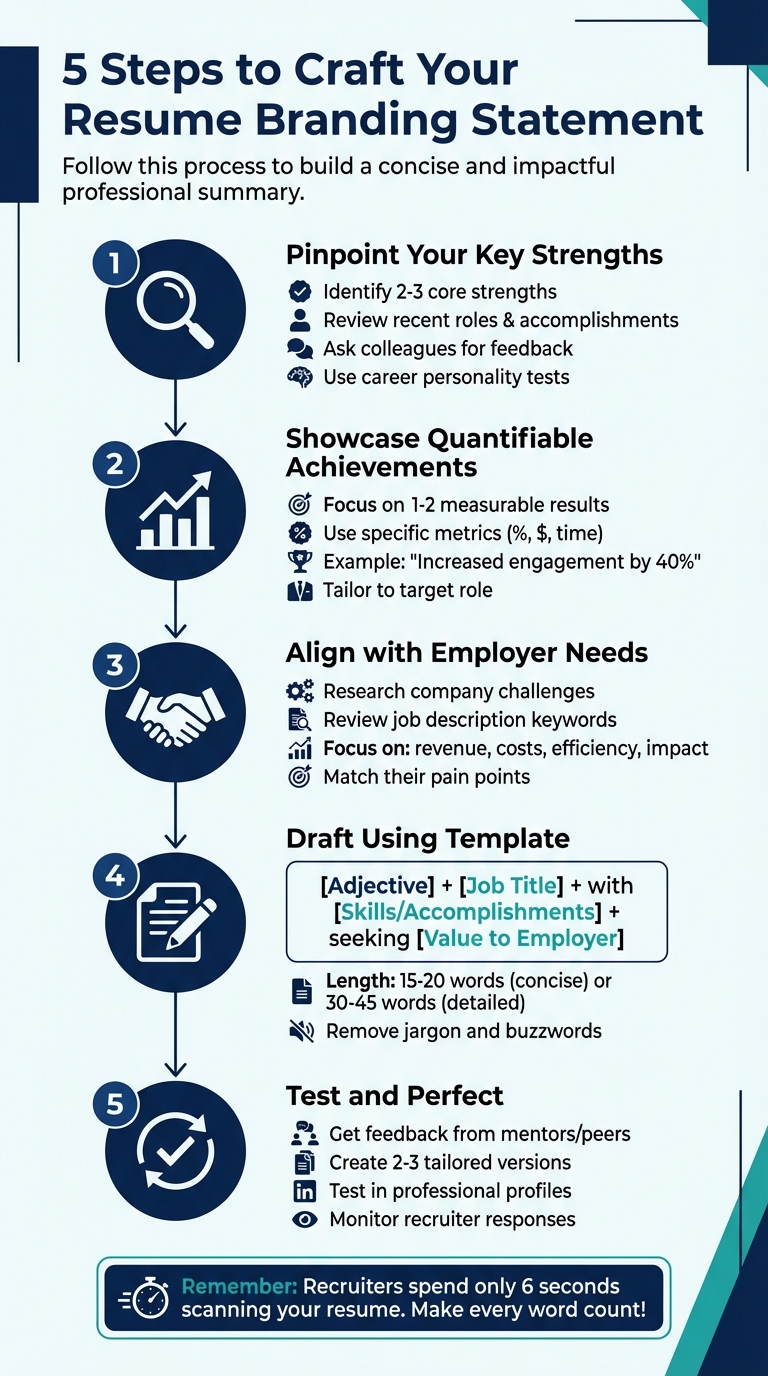
5-Step Process to Write a Compelling Resume Branding Statement
Step 1: Pinpoint Your Key Strengths and Value
Start by reflecting on your career journey - your recent roles, measurable accomplishments, and standout skills. Identify 2–3 strengths that have consistently contributed to your success. These could be traits like "strategic thinker", "cross-functional leader", or "data-driven problem solver." If you're unsure, ask former colleagues or mentors for feedback to confirm your strengths. Tools like career personality tests or self-reflection exercises can also uncover unique qualities that set you apart in your field.
Step 2: Showcase Quantifiable Achievements
Focus on 1–2 measurable results that align with the job you're targeting. These achievements should back up your claims with evidence. For example, instead of saying, "experienced in digital marketing", reframe it as "increased brand engagement by 40% using data-driven strategies." Similarly, replace "skilled in financial modeling" with "developed models that boosted profit margins by 12%." If you're transitioning careers, emphasize transferable accomplishments, like "saved $1M in operational costs", which demonstrate value across industries. Tailor your metrics to what matters most to the employer: highlight revenue growth for sales roles, engagement metrics for marketing positions, or efficiency improvements for operations jobs.
Step 3: Align Your Message with Employer Needs
Research the company you're targeting to understand their challenges and priorities. Most businesses focus on increasing revenue, reducing costs, improving efficiency, or expanding their impact. Review their website, mission statement, and job description to identify keywords and pain points. Incorporate these into your branding statement to show you're the solution they need. For example, if the job description emphasizes "Agile transformation experience", explicitly mention that qualification instead of using vague terms like "project management skills." This alignment demonstrates you’re attuned to their needs and ready to deliver results.
Step 4: Draft and Polish with a Proven Template
Use this formula to create your branding statement: [Adjective] + [Job Title] + with [Skills/Accomplishments] + seeking [Goal/Value to Employer]. Aim for 30–45 words, though a shorter, punchy version of 15–20 words can work well for a slogan-like impact. Once drafted, strip away jargon and overused buzzwords like "synergy" or "dynamic professional." Keep the tone natural and genuine. Position your statement prominently at the top of your resume, just below your contact details, so it stands out during a hiring manager’s initial review.
Step 5: Test, Adjust, and Perfect
After refining your statement, test its effectiveness by using it in professional profiles , such as optimizing your LinkedIn profile and gathering feedback from mentors or peers. Create 2–3 tailored versions for different roles and monitor how recruiters respond. This iterative process ensures your branding statement resonates with its intended audience before you finalize it across all your job application materials.
10 Resume Branding Statement Examples by Role
Here are 10 sharp and impactful resume branding statement examples tailored to specific roles. These examples highlight key achievements, measurable outcomes, and skills that align with employer expectations.
Marketing Manager: "Results-focused marketing manager with over 8 years of experience driving brand growth through data-driven campaigns, increasing customer engagement by 65% and generating $2.3M in new revenue for B2B SaaS companies."
Software Engineer: "Full-stack software engineer skilled in React and Node.js, optimized page load times by 40%, and delivered scalable applications serving over 500K daily fintech users."
Data Analyst: "Analytical data professional proficient in Python and SQL, transforming raw datasets into actionable insights that improved operational efficiency by 28% and reduced forecasting errors by 15% for Fortune 500 retailers."
Entry-Level Marketing Graduate: "Ambitious marketing graduate with hands-on internship experience, successfully managing social media campaigns that boosted follower engagement by 120% and generated 3,500+ qualified leads for mid-sized e-commerce brands."
Senior Financial Controller: "Experienced financial controller with 15+ years in audit compliance and financial planning, achieving $4.5M in cost savings through process improvements and risk management for publicly traded manufacturing firms."
Project Manager: "PMP-certified project manager with expertise in Agile methodologies, successfully delivering 20+ cross-functional projects on time and 12% under budget while leading teams of up to 35 members."
Human Resources Specialist: "Dedicated HR specialist with 5 years of experience designing talent acquisition strategies that reduced time-to-hire by 30% and improved employee retention by 22% for scaling tech startups."
Customer Success Manager: "Customer Success Manager with a proven track record of fostering strong client relationships, achieving 95% retention rates, and driving $1.8M in upsell revenue for SaaS companies."
Entry-Level Software Developer: "Recent computer science graduate proficient in Java and Python, with hands-on experience from a capstone project resulting in mobile app downloads exceeding 10K and internship contributions to enterprise-level codebases."
Executive Sales Director: "High-achieving sales director with 12+ years of experience building top-performing teams that consistently exceed quotas by 35%, securing $50M+ in annual contracts, and expanding market share across North America."
These examples demonstrate how to craft a compelling branding statement tailored to your role. Whether you're just starting or have years of experience, focus on specific achievements, measurable results, and industry-relevant expertise. Adjust these templates to reflect your unique skills and career highlights. Up next, we’ll explore common pitfalls to avoid in resume branding statements.
Common Mistakes to Avoid
To make your branding statement stand out, it’s essential to steer clear of common errors that can dilute its impact. These mistakes are often preventable but can significantly undermine how hiring managers perceive your value. Executive resume writer Colleen Paulson highlights the importance of getting it right, noting that recruiters typically scan a resume in just 6 seconds. Your branding statement needs to pack a punch and avoid meaningless fluff.
Avoid Generic or Vague Phrases
Using overused descriptors like "seasoned", "experienced", "results-driven", or "detail-oriented" can weaken your message. As Colleen Paulson explains:
"Words like 'seasoned' and 'experienced' make you sound older than you really are. 'Results-driven' and 'detail-oriented' are just cliche at this point. Choose adjectives carefully."
Instead, opt for action-driven verbs such as spearheaded, optimized, or championed. Pair these with measurable achievements to demonstrate your unique contributions in a concrete way.
Don’t Focus Only on Personal Goals
Your branding statement should reflect how you can solve the employer’s problems, not just your own career ambitions. Career coach Sharon Goldstein advises:
"Many people talk about what they can do. You can make a greater impact by addressing the employer's challenges."
For example, rather than saying, “seeking a challenging role to grow my skills,” focus on how your expertise can address specific business needs or challenges. This approach makes your statement more relevant and impactful.
Use Metrics and Stay Concise
Avoid vague claims like "effective" or "driven" unless you back them up with measurable results. Metrics - such as percentages, revenue figures, or timeframes - add credibility to your achievements. Talent acquisition specialist Vit Koval emphasizes:
"Keep it to 15–50 words. This brevity ensures hiring managers can quickly grasp your professional identity without sifting through unnecessary information."
A concise, data-backed statement ensures that you capture attention without overwhelming the reader.
| Weak Statement | Strong Statement |
|---|---|
| Experienced marketing professional seeking growth opportunities in a dynamic environment. | Marketing manager with 8 years driving brand growth through data-driven campaigns, increasing customer engagement by 65% and generating $2.3M in new revenue for B2B SaaS companies. |
| Detail-oriented software developer with strong problem-solving skills. | Full-stack software engineer skilled in React and Node.js, optimized page load times by 40%, and delivered scalable applications serving over 500K daily fintech users. |
| Results-driven sales leader looking for new challenges. | Sales director with 12+ years building top-performing teams that consistently exceed quotas by 35%, securing $50M+ in annual contracts across North America. |
Tools and Platforms to Build Your Resume Branding Statement
Crafting a standout branding statement can feel overwhelming, especially when juggling multiple job applications. Thankfully, there are tools designed to simplify the process by pinpointing impactful keywords, ensuring ATS (Applicant Tracking System) compatibility, and tailoring your resume to specific roles. Platforms like Jobscan and Resume Worded are popular choices for keyword optimization. Jobscan compares your resume to job descriptions, highlighting missing keywords, while Resume Worded offers a "Score My Resume" tool, used by over 1.2 million professionals, to flag generic phrases and weak language. However, both platforms are self-service, meaning you’ll need to make the edits yourself.
This is where scale.jobs takes a different route. By combining AI tools with human expertise, it doesn’t just identify issues - it actively solves them. Their team crafts and refines your branding statement using your career data, then applies to up to 30 jobs per day on your behalf. With a custom, ATS-optimized resume delivered in under 24 hours, you can skip the manual edits and focus on the bigger picture.
How scale.jobs Simplifies Resume Branding
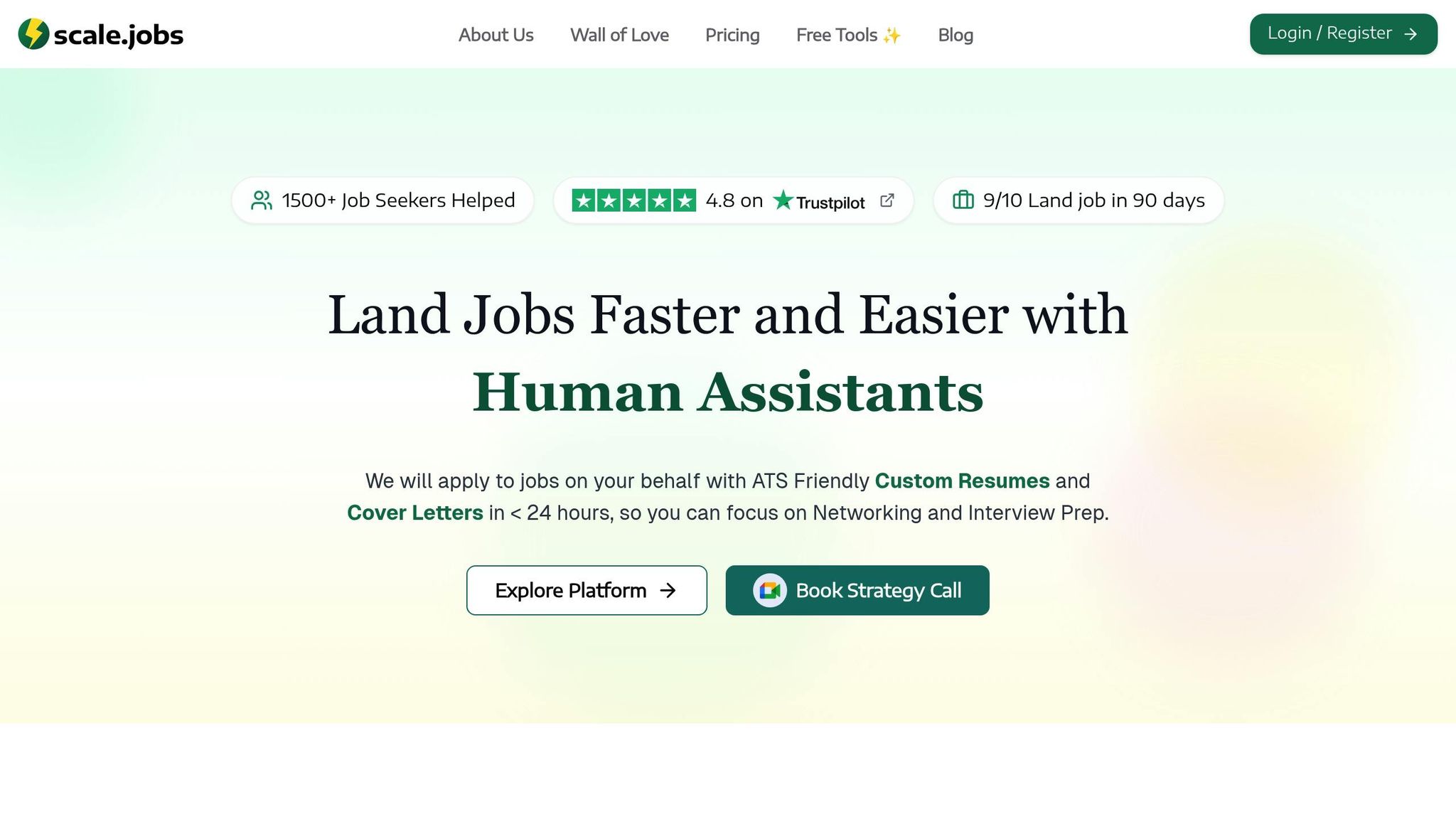
To address the challenges of resume branding, scale.jobs provides a comprehensive, streamlined solution with three tiers of service:
- Free tools: Includes an ATS-compliant resume builder and a job tracker.
- AI Assistant Pro: Offers unlimited AI-generated resumes and cover letters for $9/month (introductory price; typically $19/month).
- Human Assistant: Manages 250 custom job applications starting at $199.
The Human Assistant option sets scale.jobs apart. Here, virtual assistants handle each application manually, bypassing the pitfalls of automated screening and ensuring your branding statement is tailored to every role. As Rob Stevenson, Founder of BackupLABS, explains:
"A branding statement is a brief sentence that highlights your most valuable qualities and what sets you apart professionally. This is what a recruiter reads first, so it has to instantly convey why you're the right fit for the role."
Why scale.jobs Stands Out
Unlike traditional keyword-focused tools, scale.jobs offers a hands-off, end-to-end solution. While platforms like Jobscan and Resume Worded require you to make all the updates yourself, scale.jobs does the heavy lifting. You’ll receive real-time updates via WhatsApp, time-stamped screenshots of completed applications, and access to a dashboard showing exactly where your resume has been submitted. Their flat-fee pricing model ensures no surprise renewals, and unused credits are refunded.
This approach saves you over 20 hours per week, freeing up time for networking and interview preparation. Meanwhile, their experts transform your resume into a compelling document filled with quantifiable achievements - precisely the kind of details recruiters look for during those critical first 6 seconds of review.
Conclusion: Take Control of Your First Impression
Your resume branding statement serves as your opening act, drawing recruiters in and encouraging them to keep reading. With hiring managers spending an average of just six seconds scanning a resume, the right words can make the difference between landing in the "yes" pile or being overlooked. A strong statement should answer three key questions at a glance: Who are you? What do you offer? Why are you the ideal fit?
Creating this statement isn’t complicated, but it does require focus. Start by pinpointing your core strengths, back them up with measurable achievements, and tailor your message to align with the specific needs of the employer. Avoid overused buzzwords and instead, use active language and real-life examples to highlight your distinct contributions. As career coach Sharon Goldstein explains:
"Many people talk about what they can do from the perspective of skill set. You can get more impact if you present the problem you solve."
If fine-tuning every word feels overwhelming, scale.jobs can step in to simplify the process. Their Human Assistant service not only optimizes your branding statement but also creates custom, ATS-friendly resumes tailored to each job application. With flat-fee pricing starting at $199 for up to 250 applications, real-time updates, and proof-of-work documentation, they help you save over 20 hours a week - without the hassle of recurring subscriptions from DIY tools.
Your branding statement isn’t just a formality - it’s a strategic tool that gives your resume a competitive edge. Invest the effort to make it compelling, and you’ll position yourself as a standout candidate ready to seize the best opportunities.
FAQs
What makes a resume branding statement different from a traditional summary?
A resume branding statement is a short, impactful pitch that showcases your standout skills, the value you bring, and what makes you unique in your field. Placed prominently at the top of your resume, it’s crafted to grab a recruiter’s attention right away and align with your specific career aspirations.
Unlike a traditional summary, which often provides a broad overview of your experience, a branding statement hones in on your professional identity. Think of it as your career tagline - something that leaves a lasting impression and sets you apart from other applicants.
What mistakes should I avoid when creating a branding statement for my resume?
When creating a branding statement for your resume, steering clear of certain missteps can make a big difference in how effectively it captures attention. Here are some common mistakes to avoid:
- Being too vague or generic: A standout branding statement should clearly communicate what makes you unique. Avoid broad or overused phrases and instead focus on what sets you apart from other candidates.
- Including too much information: Keep it short and impactful - just one or two sentences. Highlight your core strengths rather than cramming in a long list of skills or achievements.
- Not tailoring it to the job: A generic statement won’t resonate as well. Adapt your branding statement to suit the specific role or industry you’re targeting so it feels relevant to recruiters.
- Placing it in the wrong location: To grab attention right away, position your branding statement prominently at the top of your resume.
- Skipping a thorough review: Errors or unpolished wording can hurt your credibility. Proofread carefully to ensure your statement is professional and error-free.
By sidestepping these common pitfalls, you can craft a branding statement that not only grabs attention but also aligns perfectly with your career aspirations.
How can I make sure my branding statement works well with ATS systems?
When crafting a branding statement for your resume, aim for clarity, relevance, and alignment with the job description. Keep it concise and include keywords that match the role to ensure it passes through ATS (Applicant Tracking System) filters effectively. Position it prominently at the top of your resume to grab attention right away.
Stick to straightforward, professional language, steering clear of unnecessary jargon or overly complex formatting that could confuse ATS software. Highlight what makes you stand out and ensure it aligns with your career objectives to boost your chances of making a strong impression.