
Resume Action Verbs That ATS Systems Rank Higher (Full List)
200+ high-impact resume action verbs by function with examples and formulas to boost ATS ranking and interview callbacks.


Your resume has just 7.4 seconds to grab attention. The first words of your bullet points are critical - weak phrases like "responsible for" or "helped with" can lead to instant dismissal by both recruiters and Applicant Tracking Systems (ATS). Strong action verbs not only highlight your achievements but also improve your chances of passing ATS filters and landing interviews.
This guide categorizes over 200 high-impact action verbs into six functional areas: Leadership, Technical, Analytical, Creative, Sales, and Operations. Each section provides examples, tips, and formulas to craft compelling resume statements. For instance, pairing action verbs with measurable outcomes, such as "Managed a cross-functional team of 12 engineers, achieving a 20% productivity boost", can increase interview callbacks by 140%.
Key Takeaways:
- Use Action Verb + Task/Project + Outcome/Metric for impactful bullet points.
- Replace passive phrases with dynamic verbs like "Led", "Optimized", or "Generated."
- Align your wording with the job description for better ATS rankings.
- Avoid overused terms by alternating with synonyms to maintain variety.
Whether you're applying for full-time jobs or exploring part-time jobs near me, this guide ensures your resume stands out. For tailored support, consider using a job application service or a job search virtual assistant to refine your resume further. Ready to elevate your job search? Let’s dive in.
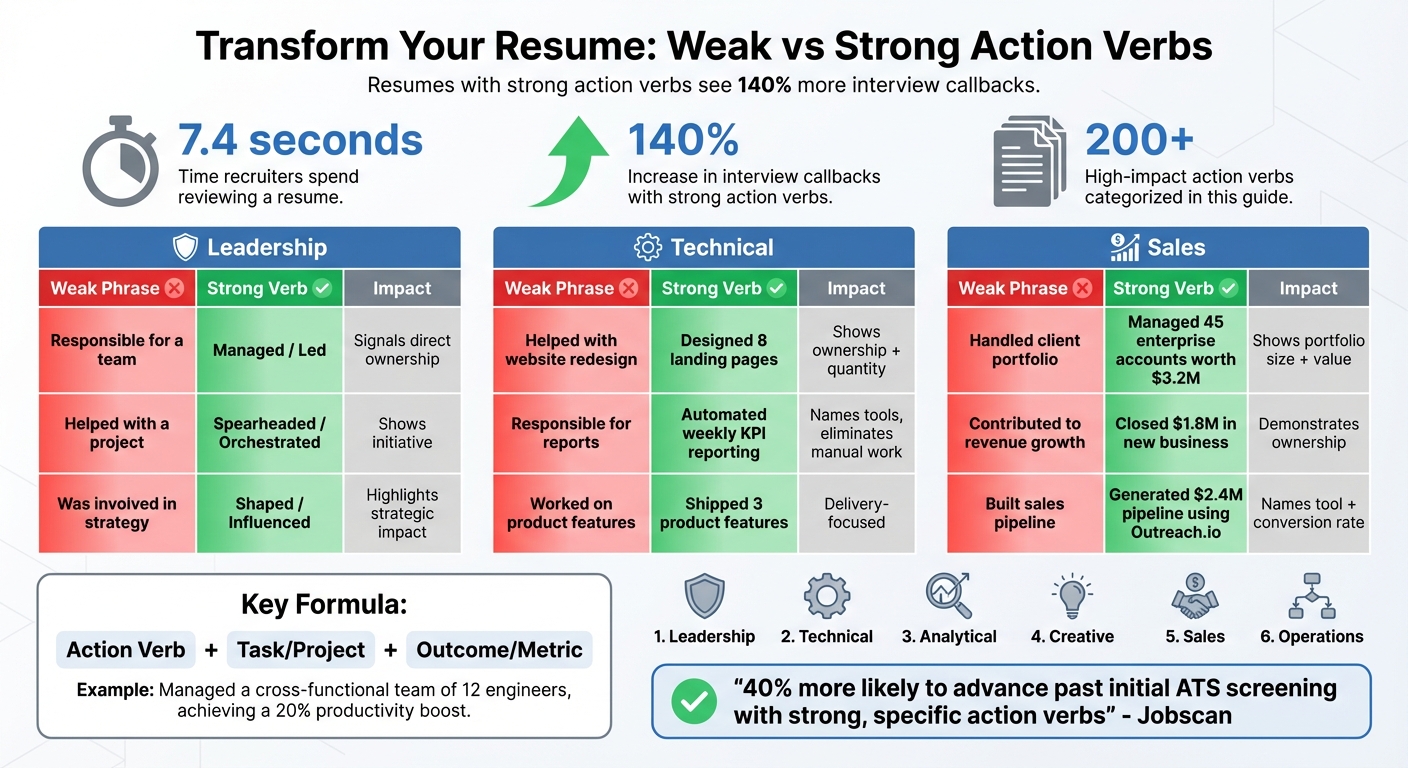
Weak vs Strong Resume Action Verbs: ATS Impact Comparison
How to Use Resume Action Verbs Step by Step
Following these steps ensures your resume passes ATS and reaches human recruiters for a final review.
1. Leadership
Leadership verbs play a crucial role in catching the attention of recruiters and applicant tracking systems (ATS). Using the right action words can highlight your ability to lead, innovate, and drive results. Here’s a breakdown of impactful leadership verbs and how to use them effectively:
Led is a standout verb for showcasing team leadership. Phrases like "led cross-functional teams" or "led product launches" are highly searchable by recruiters. Adding specifics, such as team size - e.g., "Led a team of 12 engineers" - can make your contributions more measurable and impactful.
Spearheaded communicates that you initiated a project or program from the ground up. It’s perfect for highlighting efforts like starting new departments, launching pilot programs, or introducing innovative initiatives.
Directed emphasizes authority and strategic oversight, especially over budgets, departments, or long-term operations. This is particularly relevant for VP or director-level roles.
Managed is a versatile and widely recognized ATS keyword for overseeing teams, accounts, or processes. To avoid overuse, alternate it with synonyms such as "Oversaw", "Supervised", or "Coordinated", all while staying aligned with ATS requirements.
Oversaw reflects high-level supervision, often involving multiple teams or regional operations, without necessarily being involved in daily tasks.
Supervised is ideal for describing direct oversight, such as conducting performance reviews, managing escalations, or approving timesheets.
Coordinated highlights organizational skills in managing complex, cross-functional projects. For instance, "Coordinated between engineering, design, and marketing teams" showcases collaboration and project management abilities.
Mentored demonstrates leadership through developing and supporting junior staff. Pair it with outcomes, such as "Mentored 5 associates, 3 of whom were promoted within 18 months", to underline your impact.
Delegated shows your ability to distribute tasks effectively, empowering team members to take ownership of projects and responsibilities.
Championed signals advocacy for new standards, making it particularly useful for roles focused on process improvement, organizational shifts, or adopting new technologies.
Mobilized conveys rallying resources or assembling teams to address critical challenges. It’s a strong choice for describing crisis management or high-pressure turnarounds.
Orchestrated suggests managing complex, multi-stage initiatives. For example, "Orchestrated a six-month product launch across four regions" illustrates your ability to handle dependencies and deliver results.
Scaled is used to describe significant growth, whether in team size, revenue, or system capabilities. For example, "Scaled headcount from 10 to 50" or "Increased annual recurring revenue from $2M to $10M" demonstrates measurable success.
Transformed highlights your role in leading large-scale changes, such as overhauling systems, restructuring departments, or shifting company culture.
Established works well for situations where you created something new, such as a department, framework, or protocol. For instance, "Established a customer success team that reduced churn by 22%" showcases both initiative and results.
Guided reflects providing strategic direction or leadership without direct authority. This is particularly useful for roles involving influence and collaboration.
Facilitated shows your ability to enable collaboration and lead structured workshops or planning sessions. It’s a great fit for roles requiring stakeholder alignment.
Aligned demonstrates your skill in bringing different groups or teams to consensus, making it a strong choice for roles focused on stakeholder management.
Shaped reflects strategic influence over roadmaps or company culture. Use it to highlight your contributions to direction-setting, even if you didn’t have full ownership.
Unified emphasizes bringing separate teams or workflows together, often under one cohesive system. This is particularly relevant for post-merger integration or standardization projects.
Stewarded conveys responsible management of resources, such as budgets or assets, and is ideal for roles focused on sustainability or financial oversight.
Recruited highlights leadership in team building and talent acquisition. Pair it with specifics, like "Recruited and onboarded 15 engineers in six months", to showcase measurable results.
Pioneered is perfect for describing first-of-their-kind projects or initiatives. For example, "Pioneered the company’s first remote-work policy" signals innovation and leadership.
Accelerated illustrates your ability to improve timelines or boost productivity. For instance, "Accelerated release cycles by 35%" demonstrates tangible efficiency gains.
Empowered reflects leadership through fostering autonomy and decision-making, a valuable trait in collaborative environments.
| Weak Passive Phrase | Strong Leadership Verb | ATS Impact |
|---|---|---|
| Responsible for a team | Managed / Led | Signals direct ownership |
| Helped with a project | Spearheaded / Orchestrated | Shows initiative and leadership |
| Was involved in strategy | Shaped / Influenced | Highlights strategic impact |
| Tasked with hiring | Recruited / Mentored | Demonstrates talent development |
Using these strong leadership verbs not only enhances your resume but also aligns with ATS algorithms, increasing its visibility and trust with recruiters. For personalized assistance, consider scale.jobs' professional writers for tailored, ATS-friendly resume optimization.
Ready to boost your ATS ranking? The next section dives into technical verbs that can further elevate your resume. Stay tuned!
2. Technical
Technical verbs are your secret weapon for making an impact on applicant tracking systems (ATS). When chosen carefully, they highlight your technical expertise and ownership of projects. Words like "Architected," "Deployed," and "Engineered" are great for senior-level roles, while "Implemented" and "Built" are ideal for mid-level positions. These verbs help paint a clear picture of your contributions and achievements.
Architected is a strong choice for showcasing design leadership. For example, "Architected a microservices platform handling 2M daily transactions" demonstrates both the scope of your work and its impact.
Deployed is perfect for emphasizing your ability to ship functional code. A statement like "Deployed containerized applications to AWS, reducing deployment time by 60%" speaks directly to DevOps and infrastructure roles.
Optimized highlights your ability to improve performance. Pair it with metrics for maximum effect, such as "Optimized database queries, cutting response time by 80%."
Automated is a go-to for efficiency improvements. For instance, "Automated regression testing using Selenium, reducing QA time from 8 hours to 45 minutes" shows how you’ve streamlined processes.
Debugged works well when paired with measurable outcomes. An example: "Debugged critical production issues, restoring service availability within 2 hours."
Refactored signals a focus on code quality. Use it to describe efforts like "Refactored legacy modules, reducing technical debt by 40%."
Integrated is excellent for API and third-party service work. For example, "Integrated Stripe payment processing, enabling $1.2M in monthly transactions" combines technical skill with business impact.
Engineered conveys complexity and innovation, making it stronger than "developed" for senior roles. Consider: "Engineered a real-time analytics pipeline processing 500GB daily."
Migrated is essential for cloud and data transition projects. A statement like "Migrated 200+ databases from on-premise to AWS RDS, achieving 99.9% uptime" shows both execution and reliability.
Configured demonstrates expertise in infrastructure and tooling. For example, "Configured Kubernetes clusters supporting 50+ microservices" highlights your technical know-how.
Programmed is straightforward but effective when tied to specific languages or tools. "Programmed data validation scripts in Python, reducing errors by 35%" is a clear example.
Containerized is a modern keyword in DevOps. "Containerized 15 legacy applications using Docker, standardizing deployment across environments" signals familiarity with current practices.
Instrumented is ideal for observability and monitoring roles. An example: "Instrumented application tracing with DataDog, reducing mean time to resolution by 50%."
Provisioned works well for resource management and infrastructure-as-code. For instance, "Provisioned cloud resources using Terraform, cutting infrastructure costs by $45,000 annually."
Hardened demonstrates security expertise. Use it like this: "Hardened API authentication protocols, eliminating 12 critical vulnerabilities."
Benchmarked is great for performance analysis. A statement like "Benchmarked application performance under load, identifying bottlenecks that improved throughput by 3x" shows data-driven decision-making.
Prototyped signals innovation and rapid development. For example, "Prototyped machine learning model in TensorFlow, achieving 92% accuracy in initial testing."
Scaled proves your ability to handle growth. "Scaled infrastructure to support 10x user growth, maintaining sub-200ms response times" is concise and impactful.
Streamlined highlights process improvements. Use it like this: "Streamlined build processes, reducing CI/CD pipeline execution from 45 to 12 minutes."
Resolved emphasizes problem-solving. For example, "Resolved 200+ customer-reported bugs across three product releases."
Developed remains a versatile and ATS-friendly choice. A statement like "Developed REST APIs serving 5M requests daily" is clear and effective.
Built is great for showcasing tangible results. For instance, "Built internal dashboard using React and Node.js, adopted by 80+ team members" highlights both creation and impact.
Implemented is solid for mid-level roles. "Implemented OAuth 2.0 authentication, securing 50,000+ user accounts" pairs technical action with measurable outcomes.
Troubleshot demonstrates diagnostic expertise. "Troubleshot network latency issues, reducing packet loss from 8% to 0.2%" is a strong example.
Secured emphasizes data protection and compliance. For example, "Secured customer data storage, achieving SOC 2 Type II compliance."
"Resumes that use strong, specific action verbs are 40% more likely to advance past initial screening, according to hiring data compiled by Jobscan."
| Weak Technical Start | Strong Technical Start | Why It Works |
|---|---|---|
| Helped with website redesign | Designed 8 landing pages for site redesign | Shows ownership and quantity |
| Responsible for reports | Automated weekly KPI reporting using SQL and Tableau | Names tools and eliminates manual work |
| Worked on product features | Shipped 3 product features in Agile sprints | Delivery-focused with framework context |
| Was involved in the launch | Led product launch generating $2.4M revenue | Leadership verb plus revenue impact |
Pair technical verbs with specific tools or technologies to stand out. For instance, instead of writing "Analyzed data", opt for "Analyzed customer behavior data using Python and SQL" to highlight both the action and your technical stack. If crafting these bullet points feels daunting, professional resume writers for software engineers can tailor your experience for ATS optimization, ensuring your technical achievements shine. Up next, we’ll dive into analytical verbs that connect technical skills to strategic impact.
3. Analytical
Analytical verbs play a crucial role in showcasing your ability to transform data into actionable business insights. These verbs not only highlight your analytical skills but also signal to Applicant Tracking Systems (ATS) that you're capable of driving measurable results. By pairing these verbs with specific tools and quantifiable outcomes, you ensure your resume stands out.
For example, verbs like "Forecasted," "Quantified," and "Modeled" convey strategic thinking, while "Analyzed" and "Measured" are versatile and applicable across industries.
Here’s a closer look at how to use these verbs effectively:
- Analyzed: A widely recognized term by ATS systems. For instance, "Analyzed churn data with Python to identify 3 key drivers, reducing attrition by 18%."
- Forecasted: Demonstrates predictive skills. Example: "Forecasted quarterly revenue within 2% accuracy using regression models in Excel."
- Modeled: Highlights advanced analytical expertise. Example: "Modeled pricing scenarios in R, enabling $3.2M revenue optimization across 12 product lines."
- Quantified: Emphasizes measurable outcomes. Example: "Quantified marketing ROI across 8 channels, reallocating $120,000 to high-performing campaigns."
- Identified: Ideal for problem-solving. Example: "Identified supply chain bottlenecks through process mapping, reducing fulfillment time from 6 to 3 days."
- Evaluated: Great for comparative analysis. Example: "Evaluated 5 CRM platforms against technical requirements, leading to a $45,000 cost-saving vendor switch."
- Benchmarked: Reflects competitive awareness. Example: "Benchmarked customer satisfaction scores against industry standards, revealing a 12-point gap and informing service improvements."
- Validated: Demonstrates accuracy and rigor. Example: "Validated data integrity across 3 systems, correcting 2,400+ discrepancies before quarterly reporting."
- Synthesized: Shows the ability to combine complex information. Example: "Synthesized insights from 15 market research reports, shaping product roadmap for Q3-Q4 2025."
- Investigated: Highlights in-depth analysis. Example: "Investigated root causes of 23% cart abandonment rate, implementing fixes that recovered $890,000 in annual revenue."
Other impactful verbs include Mapped, Surveyed, Reconciled, Mitigated, Allocated, Consolidated, Measured, Interpreted, Prioritized, Tracked, Tested, Calculated, Uncovered, Diagnosed, and Audited. Each verb, when paired with specific tools and outcomes, enhances your resume's ATS ranking.
Examples of Strong Analytical Verbs in Action
| Weak Analytical Start | Strong Analytical Start | Why It Works |
|---|---|---|
| Responsible for data analysis | Analyzed sales data using SQL, identifying $2.1M upsell opportunity | Names the tool and quantifies business impact |
| Helped with forecasting | Forecasted demand within 3% accuracy using time-series models | Shows precision and methodology |
| Worked on reports | Consolidated 8 regional dashboards in Power BI, saving 12 hours weekly | Demonstrates efficiency and specific tool |
| Involved in testing | Tested 15 pricing strategies via A/B experiments, increasing conversion 22% | Shows experimental rigor and results |
Pro Tip: Pair Verbs with Tools and Metrics
To maximize ATS relevance, always pair analytical verbs with industry-standard tools and measurable outcomes. For example, instead of saying "Examined customer data", opt for "Analyzed customer behavior using Google Analytics and SQL." This approach highlights not just the action but also your technical expertise.
If you're unsure how to translate your analytical achievements into impactful resume language, consider working with professional resume writers. They can help you optimize your experience for ATS systems while ensuring your strategic contributions are clearly communicated.
Next, we’ll dive into creative verbs that emphasize innovation and design thinking. Stay tuned for insights on how to showcase your ability to think outside the box.
4. Creative
When it comes to resumes, creative action verbs can make a huge difference. These words not only highlight your originality but also emphasize your ability to deliver measurable results. They help convey that you're not just completing tasks but driving strategies and outcomes - something both hiring managers and ATS systems look for.
For instance, verbs like "Conceptualized" demonstrate your ability to generate innovative ideas, while "Crafted" and "Designed" showcase hands-on execution. Words like "Launched" and "Revitalized" highlight your ability to bring ideas to life or breathe new energy into existing projects. Pairing these verbs with specific tools and measurable outcomes can make your achievements stand out. For example: "Designed 12 email templates in Figma, increasing click-through rates by 34%." This approach combines action, tools, and impact, creating a clear picture of your contributions.
Here’s a collection of 25 creative action verbs, arranged by their primary use case, to help elevate your resume:
- Conceptualized: Speaks to original ideas or programs. Example: "Conceptualized a loyalty program that drove 2,800 repeat purchases in Q1 2025."
- Crafted: Highlights precision in content creation. Example: "Crafted 15 email sequences with 42% open rates, exceeding industry averages by 18%."
- Designed: Focuses on visual or system creation. Example: "Designed checkout flows in Figma, reducing cart abandonment by 27%."
- Branded: Establishes identity. Example: "Branded conference booths for 4 events, generating 320 qualified leads."
- Rebranded: Indicates a complete refresh. Example: "Rebranded company identity across 200+ assets in just 6 weeks."
- Illustrated: Showcases visual storytelling. Example: "Illustrated 8 explainer videos, reducing support tickets by 23%."
- Storyboarded: Reflects narrative planning. Example: "Storyboarded 12 demo videos, increasing trial-to-paid conversions by 29%."
- Visualized: Simplifies complex data. Example: "Visualized KPIs in Tableau dashboards, saving executives 8 hours weekly."
- Curated: Organizes and selects content. Example: "Curated a resource library of 150+ templates, boosting self-service by 44%."
- Revitalized: Refreshes stale assets. Example: "Revitalized blog strategy, growing traffic from 12,000 to 38,000 monthly visits."
- Redesigned: Improves existing systems. Example: "Redesigned app navigation, reducing drop-off rates by 31%."
- Iterated: Reflects continuous improvement. Example: "Iterated landing pages through 18 A/B tests, doubling conversion rates."
- Personalized: Customizes for users. Example: "Personalized onboarding flows, improving activation rates by 26%."
- Amplified: Increases reach. Example: "Amplified launch efforts through influencer partnerships, reaching 480,000 viewers."
- Positioned: Strategically markets products. Example: "Positioned SaaS product as a Salesforce alternative, securing $1.2M ARR."
- Differentiated: Highlights unique value. Example: "Differentiated messaging, increasing demo requests by 53%."
- Launched: Introduces new campaigns. Example: "Launched brand refresh across 8 channels, generating 12,000 mentions in one week."
- Produced: Reflects high-volume output. Example: "Produced 48 blog posts in Q4, driving 22,000 organic visitors."
- Published: Shares authoritative content. Example: "Published an industry report with 3,200 downloads, leading to 180 inquiries."
- Edited: Refines content. Example: "Edited 200+ product descriptions, improving SEO for 85% of keywords."
- Developed: Builds frameworks. Example: "Developed a design system with 120+ components, cutting handoff time by 40%."
- Executed: Implements strategies. Example: "Executed a brand rollout across 6 markets, achieving 98% consistency."
- A/B Tested: Optimizes through comparisons. Example: "A/B tested 24 ad variations, reducing acquisition costs by 37%."
- Segmented: Targets specific audiences. Example: "Segmented email lists into cohorts, increasing campaign revenue by $84,000."
- Cultivated: Grows relationships or presence. Example: "Cultivated Instagram followers from 2,400 to 18,000 in 7 months."
Why This Matters for Your Resume
If you're unsure how to translate your creative work into language that resonates with both ATS systems and hiring managers, professional help can make a difference. Resume writing services can refine your achievements into statements that highlight both your creativity and measurable business impact.
Examples of Strong vs. Weak Creative Statements
| Weak Creative Start | Strong Creative Start | Why It Works |
|---|---|---|
| Responsible for design work | Designed 15 landing pages in Webflow, increasing lead capture by 58% | Names the tool, quantity, and measurable outcome |
| Helped with branding | Rebranded company identity across 200+ assets, improving brand recognition by 41% | Shows scope and quantified perception shift |
| Worked on content | Produced 36 video tutorials that reduced onboarding support tickets by 450 monthly | Demonstrates volume and specific business impact |
| Involved in campaigns | Launched email nurture campaign that converted 23% of dormant leads, recovering $340,000 in pipeline | Shows initiative ownership and revenue impact |
5. Sales
When it comes to sales resumes, the verbs you choose can make or break your chances of standing out. The best verbs not only highlight your ability to close deals but also satisfy Applicant Tracking System (ATS) filters by pairing with measurable outcomes. Words like "Closed" or "Exceeded" shine when paired with specific numbers, such as revenue figures, percentages, or deal counts. For example, "Closed $1.2M in new ARR" tells a much stronger story than a vague claim like "handled sales."
Unlike tools like Jobscan or LazyApply, Scale.jobs offers a unique advantage by combining human expertise with ATS-optimized documents. Their one-time payment model and dedicated WhatsApp support ensure your sales achievements are presented with precision and impact. This blend of human insight and ATS targeting elevates your resume to outperform automated tools.
Here’s a list of 25 sales action verbs, each paired with examples to demonstrate their effectiveness. These examples combine the action verb with a specific tool, method, or measurable result:
- Closed: Finalized contracts. Example: "Closed $1.2M in new ARR across 18 enterprise accounts in Q2 2025."
- Exceeded: Surpassed targets. Example: "Exceeded quarterly quota by 140%, ranking #2 out of 45 reps."
- Generated: Created pipeline. Example: "Generated $2M in new sales pipeline using LinkedIn Sales Navigator."
- Negotiated: Managed terms. Example: "Negotiated a 22% reduction in vendor costs, saving $340,000 annually."
- Prospected: Identified opportunities. Example: "Prospected 120 qualified leads monthly, converting 25% to discovery calls."
- Cultivated: Built relationships. Example: "Cultivated relationships with 8 Fortune 500 accounts, securing $980,000 in renewals."
- Acquired: Brought on clients. Example: "Acquired 32 new enterprise clients in 2024, expanding territory revenue by 58%."
- Retained: Prevented churn. Example: "Retained 95% of high-value accounts, reducing annual churn by $450,000."
- Upsold: Increased account value. Example: "Upsold 30% of existing client base to premium tier, adding $560,000 ARR."
- Surpassed: Beat benchmarks. Example: "Surpassed team average close rate by 34%, achieving 62% win rate."
- Captured: Gained market share. Example: "Captured 15% market share in SMB segment within 9 months of launch."
- Qualified: Vetted leads. Example: "Qualified 200+ inbound leads monthly using BANT framework in HubSpot."
- Forecasted: Predicted trends. Example: "Forecasted quarterly revenue within 3% accuracy for 8 consecutive quarters."
- Expanded: Increased reach. Example: "Expanded territory from 3 to 7 states, growing regional revenue by $1.8M."
- Launched: Introduced initiatives. Example: "Launched partner referral program that generated 45 qualified leads in first quarter."
- Pitched: Presented proposals. Example: "Pitched to C-suite at 12 Fortune 1000 companies, closing 6 contracts worth $2.4M."
- Converted: Turned prospects into customers. Example: "Converted 28% of cold outreach into booked demos - 2× the team average."
- Optimized: Improved processes. Example: "Optimized sales funnel in Salesforce, reducing sales cycle from 90 to 62 days."
- Secured: Obtained deals. Example: "Secured $2M in Series A funding by closing 4 anchor enterprise contracts."
- Influenced: Impacted decisions. Example: "Influenced purchasing decisions at 18 accounts by delivering ROI workshops."
- Leveraged: Used resources. Example: "Leveraged existing partnerships to drive $720,000 in co-selling revenue."
- Spearheaded: Led initiatives. Example: "Spearheaded new sales playbook adoption, increasing team quota attainment from 78% to 94%."
- Revitalized: Renewed accounts. Example: "Revitalized 14 dormant accounts, recovering $150,000 in annual revenue."
- Nurtured: Managed development. Example: "Nurtured 60-day email sequences that converted 19% of cold leads into meetings."
- Drove: Pushed growth. Example: "Drove 180% year-over-year revenue growth in mid-market segment."
Why This Matters for Sales Resumes
"Closed, Exceeded quota, and Generated pipeline are among the most searched phrases in sales job descriptions." - ResumeBold
If you’re finding it hard to articulate your sales achievements, Scale.jobs can help. Their experts craft ATS-friendly statements that highlight your results in a way that resonates with recruiters.
| Weak Sales Start | Strong Sales Start | Why It Works |
|---|---|---|
| Handled client portfolio | Managed 45 enterprise accounts worth $3.2M ARR, achieving 92% renewal rate | Shows portfolio size, value, and retention metric |
| Contributed to revenue growth | Closed $1.8M in new business across 22 accounts in 2025, exceeding quota by 135% | Demonstrates ownership, volume, and performance |
| Built sales pipeline | Generated $2.4M pipeline using Outreach.io, converting 31% to closed-won deals | Names the tool, shows pipeline creation and conversion rate |
Ready to take your resume to the next level? Learn how operations verbs can further enhance your professional story.
6. Operations
When crafting an operations resume, the choice of action verbs can make all the difference. Verbs like "Streamlined" or "Automated" convey ownership and measurable results, which resonate far better with hiring managers and ATS systems than vague phrases like "Responsible for process improvement." ATS algorithms are particularly tuned to phrases such as "standardized procurement processes" or "optimized supply chain logistics", so selecting precise language is crucial to boosting your ranking.
Unlike tools such as LazyApply, which rely entirely on automation, scale.jobs blends human expertise with ATS optimization. This ensures your operational achievements are presented with measurable impact and tailored for success.
"Just as strong verbs drive better ATS results, scale.jobs leverages human expertise to ensure your operations achievements are both quantifiable and compelling." - Blake Crosley, VP of Design, Resume Genius
Below is a list of 25 action verbs tailored for operations resumes, complete with examples of how to pair them with specific tools, methods, or measurable outcomes:
- Streamlined: Simplified workflows. Example: "Streamlined invoice processing, cutting cycle time by 67%."
- Optimized: Improved performance. Example: "Optimized warehouse layout, increasing picking efficiency by 38% and cutting fulfillment time by 2.1 hours."
- Automated: Replaced manual tasks. Example: "Automated inventory tracking with Fishbowl, eliminating 18 hours of weekly data entry."
- Standardized: Created uniform processes. Example: "Standardized onboarding across 4 regional offices, reducing training time from 6 weeks to 3.5 weeks."
- Consolidated: Merged resources. Example: "Consolidated 7 vendor contracts into 2, saving $127,000 annually in procurement costs."
- Orchestrated: Managed complex projects. Example: "Orchestrated office relocation for 240 employees with zero downtime across a 3-day transition."
- Implemented: Launched new systems. Example: "Implemented NetSuite ERP across 5 departments, completing migration 3 weeks ahead of schedule."
- Monitored: Oversaw performance. Example: "Monitored 12 operational KPIs using Tableau dashboards, identifying $89,000 in cost-saving opportunities."
LazyApply vs. scale.jobs: Which Is Right for Operations Professionals?
LazyApply is suited for those who prioritize speed and volume, making it a fit for entry-level candidates applying to a broad range of roles. Its automated system can handle hundreds of applications in a short time.
On the other hand, scale.jobs is designed for professionals aiming for roles that demand precision and measurable results. It focuses on:
- Human expertise: Skilled assistants craft ATS-friendly resumes that emphasize metrics and tools.
- One-time payment: Avoid recurring fees with a single upfront cost.
- Real-time support: Get instant assistance via WhatsApp for resume tweaks.
- Proof of work: Receive screenshots and reports for every application.
- Tailored documents: Highlight achievements with quantifiable results and specific tools like SAP, Jira, or NetSuite.
Comparison Table: LazyApply vs. scale.jobs
| Feature | LazyApply | scale.jobs |
|---|---|---|
| Human involvement | None - fully automated | Human assistants review and optimize every application |
| Resume customization depth | Generic templates | Tailored bullets emphasizing metrics and tools |
| ATS handling | Basic keyword matching | Advanced ATS optimization with NLP awareness |
| Application method | Bot-driven mass submissions | Human-executed applications with personalized cover letters |
| Transparency | Limited visibility | Screenshots and detailed reports for every application |
| Pricing model | Monthly subscription ($99–$249) | One-time payment ($299–$499) |
Why Choose scale.jobs?
Switch to scale.jobs if you:
- Need your operations achievements quantified with tools like SAP or NetSuite.
- Are targeting senior roles where generic applications won’t make the cut.
- Prefer human oversight to ensure your resume reflects business impact.
- Want a one-time payment model instead of monthly fees.
- Value transparency with proof that applications are tailored, not mass-submitted.
Looking to highlight your operational achievements? Scale.jobs ensures your metrics and improvements stand out.
| Weak Operations Start | Strong Operations Start | Why It Works |
|---|---|---|
| Responsible for logistics coordination | Automated logistics tracking with SAP, reducing delivery delays by 51% | Specifies tools used and quantifies impact |
| Helped with process improvement | Streamlined order fulfillment, cutting average delivery time from 7 to 4.2 days | Shows ownership and measurable results |
| Worked on vendor relationships | Consolidated 9 supplier contracts, saving $156,000 annually while maintaining quality standards | Demonstrates initiative, savings, and quality considerations |
Conclusion
Crafting a resume that stands out in today's competitive job market isn't just about listing your experience - it's about precision and strategy. Strong action verbs can make or break your chances of passing through ATS filters and catching a recruiter's eye. In fact, resumes that start bullet points with strong action verbs see up to 140% more interview callbacks, according to a study of over 100,000 resumes across industries.
To optimize your resume, apply the Action-Result Formula: begin with a strong verb, include the method or tool used, and conclude with a measurable result. For example, if a job description mentions "manage cross-functional teams", use "Managed" in your resume instead of a synonym like "Supervised." This direct match improves your ATS ranking. However, avoid overusing the same verbs - swap "Managed" with alternatives like "Directed", "Coordinated", or "Oversaw" to show variety while maintaining clarity.
Recruiters spend mere seconds scanning resumes, so eliminating weak phrases like "Worked on", "Assisted with", or "Tasked with" is crucial. Replace them with verbs that convey ownership, such as "Executed", "Developed", or "Built", and pair them with tools like Python, Salesforce, or NetSuite to make your skills stand out. Choosing precise, measurable verbs doesn’t just boost ATS performance - it grabs recruiters' attention quickly.
This focus on precision is where scale.jobs sets itself apart from competitors like LazyApply. While LazyApply relies solely on automation, scale.jobs combines ATS-optimized tools with human expertise, offering personalized resume improvements, one-time pricing, and transparent proof of work. Automated services may handle large volumes, but they lack the nuanced understanding needed to highlight achievements that truly resonate with recruiters.
Comparing LazyApply and scale.jobs: Which Is Right for You?
LazyApply may work for you if:
- You need to apply to a high volume of entry-level roles quickly.
- Speed and quantity are more important than customization.
- You’re on a tight budget and prefer the flexibility of monthly subscriptions.
scale.jobs is a better fit if:
- You’re aiming for senior roles where generic resumes won’t suffice.
- You need a human-reviewed resume that emphasizes measurable results.
- Transparency and proof of tailored applications matter to you.
- You prefer a one-time payment model over recurring fees.
When to Switch to scale.jobs
- Your resume needs to quantify achievements using tools like SAP, Salesforce, or NetSuite.
- You’ve applied to dozens of positions with automated tools but haven’t received callbacks.
- You want human oversight to ensure your resume highlights business impact, not just tasks.
- You value real-time support for resume adjustments via WhatsApp.
- You’re looking to avoid subscription fees and prefer a clear, one-time payment.
Tailor your action verbs to your career level. Words like "Spearheaded" or "Architected" convey senior-level authority, while "Assisted" or "Supported" are better suited for entry-level roles. Always use past tense for previous positions and present tense for your current role. Before submitting, run your resume through an ATS simulator to ensure key verbs from the job description are being recognized and scored correctly.
In a competitive market, small details can make a big difference. Choosing the right action verbs could be the key to transforming your resume from overlooked to outstanding. If you're serious about standing out, consider working with experts in ATS-optimized resumes. They’ll help you fine-tune every aspect of your resume - from action verbs to metrics - ensuring it’s designed to impress both ATS systems and recruiters, all without the hassle of recurring fees.
FAQs
How do I choose the best action verbs for a specific job posting?
To choose the most impactful action verbs for your resume, align them with the skills, responsibilities, and keywords found in the job description. Opt for strong, role-specific verbs such as "spearheaded" to highlight leadership capabilities or "streamlined" for operational improvements. Whenever possible, pair these verbs with quantifiable achievements, like "boosted revenue by 20%" or "reduced processing time by 15%". Swapping out generic phrases for precise, action-driven words not only makes your resume stand out but also improves its compatibility with Applicant Tracking Systems (ATS), effectively showcasing your contributions.
How many different action verbs should I use to avoid sounding repetitive?
Using 50 to 100 different action verbs can make your resume more dynamic and help you avoid repetitive phrasing. A diverse range of verbs not only keeps your content engaging but also increases its appeal to both hiring managers and Applicant Tracking Systems (ATS).
How can I add metrics if my work wasn’t measurable?
If you don’t have specific metrics to showcase, emphasize qualitative accomplishments and skills that reflect your impact. Highlight tasks, responsibilities, or contributions like streamlining processes, boosting efficiency, or driving team success. Use action-oriented verbs and descriptive phrasing to clearly demonstrate your value. For example, phrases like “Streamlined operational workflows” or “Directed a team to implement updated procedures” can make your resume stand out while remaining compatible with applicant tracking systems (ATS).