
Remote Work's Impact on Global Tech Hubs
Remote work decentralizes tech hubs, spurs new-city growth, and heightens global hiring competition while changing ATS-driven job search strategies.


Remote work has reshaped the global tech landscape. Here's what you need to know:
- Decentralization of tech hubs: Professionals no longer need to live in cities like San Francisco or Bangalore to work for top tech firms. Remote work has allowed them to move to more affordable or lifestyle-friendly locations like Austin, Denver, or Lisbon.
- Increased competition: Remote roles attract candidates globally, making the job market more competitive. Less than 2% of applicants receive interview callbacks, with companies relying heavily on Applicant Tracking Systems (ATS).
- Emerging hubs: Cities like Austin, Denver, and Toronto are thriving thanks to lower costs and local initiatives like co-working spaces and tech meetups. Globally, places like Lisbon and Berlin are becoming attractive due to their affordability and quality of life.
- Hybrid work models: Traditional hubs like Silicon Valley are adapting by offering flexible work policies to retain talent, but face challenges from newer hubs.
- Job search strategies: Tailored, ATS-optimized applications are critical for standing out in this competitive market. Tools like Scale.jobs can help streamline the application process.
Remote work has opened doors to new opportunities while intensifying the competition. Understanding these shifts is key for both job seekers and employers navigating the evolving tech landscape.
How Small Cities Are Luring Remote Workers Away From Tech Hubs | WSJ
From Centralized to Decentralized Tech Hubs
The way tech work gets done is undergoing a major transformation, as the focus shifts from traditional tech hubs to more decentralized locations. Remote work has paved the way for professionals to earn competitive salaries while relocating to more affordable areas. This shift is driving an exodus from established tech centers and sparking the growth of new, thriving tech communities.
Workers Leaving Traditional Tech Hubs
Cities like San Francisco and New York, once synonymous with tech innovation, are seeing their tech workforces shrink. The high salaries offered in these areas often fail to offset the soaring housing costs, leading many professionals to reassess what their compensation is actually worth. For those starting families, priorities are shifting toward more spacious homes, better schools, and strong community amenities - factors that don’t necessarily tie them to corporate headquarters. This migration is also heating up competition for remote jobs, which we’ll touch on further in the discussion.
New Tech Hubs Gaining Ground
Cities such as Austin are leading the charge in attracting tech talent, thanks to their lower taxes, affordable housing, and a bustling ecosystem of startups and venture capital. Denver is another hotspot, appealing to professionals who crave a dynamic career while enjoying an outdoor-focused lifestyle. Meanwhile, Toronto has carved out its place as a tech hub by offering streamlined immigration pathways and access to a diverse pool of talent, fueling local industry growth.
These emerging hubs are also building strong local networks by investing in co-working spaces, hosting tech meetups, and launching accelerator programs. These initiatives create opportunities for collaboration and networking that were once the hallmark of traditional tech centers. This shift in the U.S. reflects a larger global trend as international cities redefine their roles in the tech landscape.
International Cities Attracting Tech Talent
Globally, remote work has allowed cities to highlight their unique advantages to attract tech professionals. Lisbon, for instance, has drawn workers with its affordable cost of living, pleasant climate, and English-friendly business environment. Berlin, known for its creative energy and lower living expenses, has become a magnet for startups and satellite offices, especially in industries like fintech and enterprise software. In Bangalore, the story is one of tech professionals returning home while keeping remote roles with international companies, boosting its status as a global innovation hub. These shifts are laying the groundwork for new opportunities in the tech job market.
How Remote Work Affects Tech Job Opportunities
The shift from centralized office spaces to decentralized work environments has reshaped the tech job market. Remote work has opened up opportunities that are no longer tied to specific locations. Companies that once required employees to live in high-cost urban centers are now offering positions across the country - and even internationally. This means roles like software developers, data analysts, and project managers are now accessible to professionals living in more affordable regions, transforming the financial landscape of tech careers.
Surge in Remote-First Job Openings
The rise of remote-first positions has been dramatic. Companies like Shopify, Atlassian, and GitLab have fully embraced remote or remote-first work models, creating thousands of opportunities for candidates regardless of their physical location. Smaller startups and mid-sized businesses have also jumped on board, tapping into a broader pool of skilled workers. This trend is particularly strong in fields like software engineering, DevOps, cybersecurity, and data science, where modern collaboration tools make remote work seamless.
However, with more openings comes greater competition. Remote positions often draw applications from across the country, or even globally, meaning job seekers must work harder to stand out. Applicant Tracking Systems (ATS) are used to sift through hundreds of resumes, so crafting a tailored, keyword-rich application has become essential.
Remote Job Availability by U.S. State
While remote work removes many physical barriers, your location can still play a role in job availability. States with well-established tech hubs - like California, Texas, Washington, and New York - continue to generate a significant number of remote job postings. Even for fully remote roles, companies in these areas often prefer candidates in similar time zones. Additionally, some employers adjust salaries based on local cost-of-living differences, which can influence hiring decisions.
Emerging tech regions like Colorado, North Carolina, and Georgia are also seeing growth in remote opportunities. Local companies in these states are offering both in-state and out-of-state roles, making it crucial for job seekers to identify organizations that genuinely value geographic flexibility. Understanding these state-level trends can help candidates tailor their job search strategies in this competitive remote job market.
Strategies for Landing Remote Tech Roles
Securing a remote tech position requires a strategic approach. To pass ATS filters and grab the attention of recruiters, applications need to be customized and include relevant keywords.
This is where platforms like scale.jobs can make a big difference. Scale.jobs provides free tools for building ATS-compliant resumes and offers an AI Assistant Pro service for just $9/month. This feature generates tailored applications quickly, while an additional human assistant service ensures a hands-on approach with real-time WhatsApp updates and proof-of-work tracking.
One standout feature of scale.jobs is its Human Assistant option, where real people handle the entire application process for you. From crafting customized resumes to submitting applications, this service ensures your materials reach the right hiring managers. You’ll save time for networking and interview prep while keeping full visibility into your job search.
Next, we’ll explore how major tech hubs have adapted to this evolving remote work environment.
Comparing Major Tech Hubs Before and After Remote Work
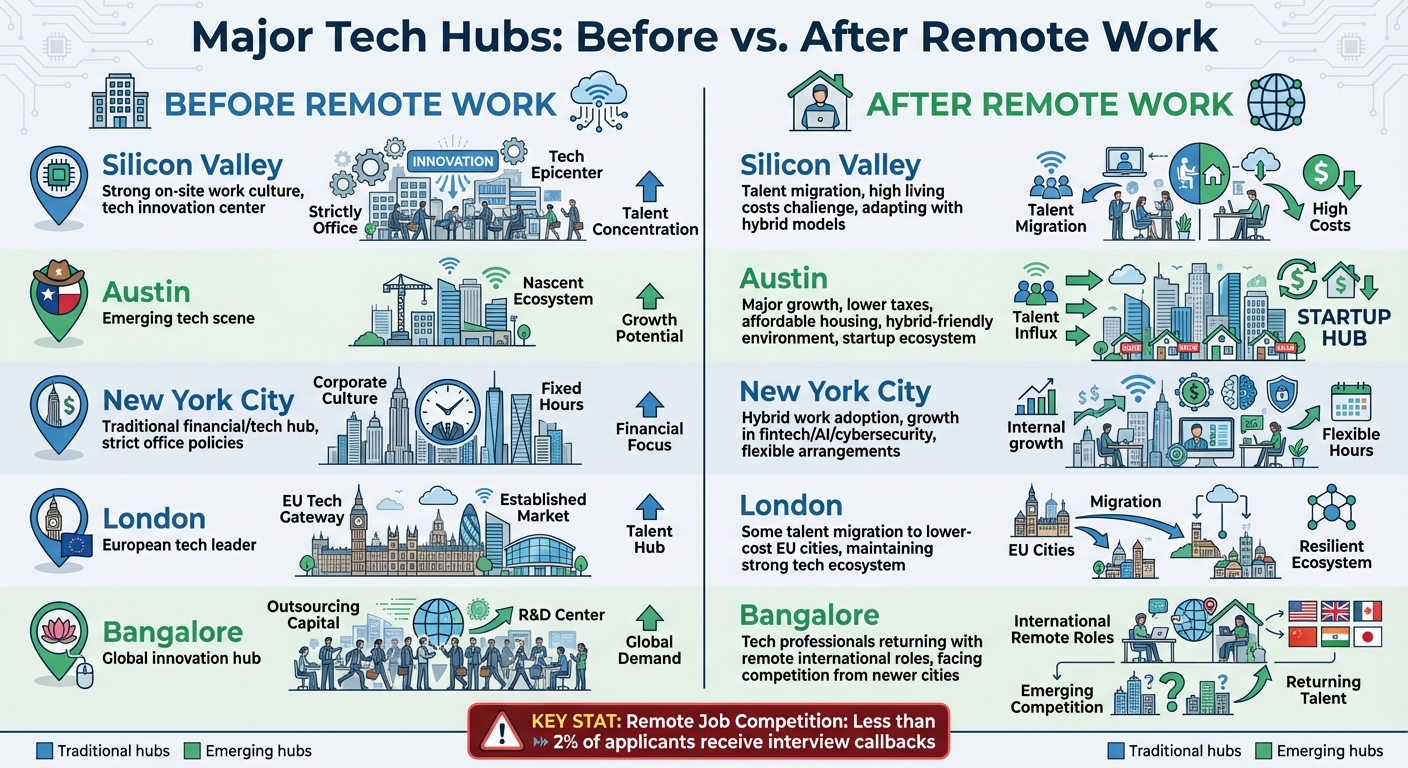
Major Tech Hubs Before and After Remote Work Transformation
The rise of remote work has shaken up traditional tech hubs like Silicon Valley, shifting the dynamics of where talent chooses to live and work. While some cities have seen an exodus of professionals due to high costs and rigid work policies, others are thriving by embracing flexibility. For job seekers, understanding these shifts can provide insight into where opportunities are growing and where old advantages might be losing their edge.
Before and After Remote Work: Key Changes
Silicon Valley, long celebrated for its on-site work culture, now faces challenges like talent migration and soaring living expenses. Meanwhile, cities like Austin have stepped into the spotlight, attracting tech companies and professionals with their hybrid-friendly environments and more affordable lifestyles.
New York City has managed to stay in the game by adopting hybrid work models, fueling growth in areas like fintech, AI, and cybersecurity. Internationally, the picture is evolving too. London, for instance, has seen some of its tech talent move to other European cities offering lower living costs but maintaining strong tech ecosystems. In India, Bangalore remains a leader among tech hubs, though it's feeling the heat from newer cities that offer competitive cost advantages.
How Hybrid Work Is Helping Traditional Hubs Stay Relevant
To stay competitive, traditional tech hubs are leaning into hybrid work models that blend in-person collaboration with remote options. Instead of focusing solely on remote opportunities, these cities are banking on their established strengths - like deep tech networks, ample venture capital, and a wealth of professional connections - to keep talent engaged.
Companies in these areas are rethinking their workplace policies, shifting from rigid, full-time office requirements to more flexible arrangements. In New York, for example, financial institutions have eased their strict return-to-office mandates, offering employees more adaptable work setups that align with modern expectations.
For job seekers, navigating this evolving landscape means knowing which companies genuinely embrace hybrid flexibility and which still lean heavily on in-office requirements. Platforms like scale.jobs can be a game-changer here. Their Human Assistant service helps candidates research company policies, tailor applications to highlight relevant hybrid or remote work experience, and streamline the process of applying across multiple cities - saving both time and effort.
The shift to hybrid work is reshaping the tech hub landscape. Cities that adapt quickly and strike a balance between flexibility and collaboration are better positioned to retain top talent. On the other hand, those clinging to outdated models risk falling behind. These changes are paving the way for the next chapter in the evolution of tech hubs.
Tech Hubs in 2025 and Beyond
What's Coming in the Next 10 Years
In the coming decade, Artificial Intelligence (AI) is set to redefine how tech hubs function and compete for talent. AI is already shaking up recruitment by simplifying tasks like resume optimization and candidate matching. As a result, tech hubs will need to focus on attracting remote-friendly companies and professionals who prioritize flexibility over being tied to a specific location.
Those hubs that prioritize strong remote work infrastructure and build thriving communities of distributed workers are likely to lead the charge. On the flip side, hubs that stick to outdated practices may find themselves falling behind. These advancements in technology are pushing both job seekers and employers to rethink their approaches.
What This Means for Job Seekers and Employers
Job seekers need to pivot quickly. The old method of targeting a single geographic tech hub is becoming less effective in today’s increasingly remote-first job market. Instead, focus on building skills that work across borders - like effective communication, self-management, and mastery of digital collaboration tools. Automating your job search is also key when applying for roles across multiple cities and time zones.
Employers are navigating their own hurdles in this competitive global talent market. Companies that offer flexible remote work policies and have strong digital infrastructures will be better positioned to attract top-tier talent. On the other hand, businesses that insist on rigid in-office requirements risk losing out to competitors who are more accommodating.
For job seekers trying to keep up with these changes, scale.jobs offers a practical solution. Their Human Assistant service takes the hassle out of high-volume job applications in a decentralized tech market. They handle ATS-optimized resumes and manage application submissions, saving over 20 hours a week - time you can use for networking and interview prep. Plus, you’ll get real-time WhatsApp updates and time-stamped proof-of-work screenshots, ensuring a level of transparency that AI-only tools can’t provide. Best of all, their flat-fee model eliminates recurring subscriptions, making it easier to compete across multiple tech hubs at once.
FAQs
How has remote work changed the competition for tech jobs?
Remote work has transformed the job market, especially in tech, by opening the doors to a global talent pool. Companies are no longer limited to hiring locally - they can recruit from anywhere in the world. This shift has intensified competition, with candidates from established tech hubs and emerging markets all vying for the same roles. U.S. tech hubs, in particular, have become even more competitive as international talent and remote-friendly policies flood the market with applicants.
In this crowded landscape, standing out can feel like an uphill battle. That’s where tools like scale.jobs come into play. Offering features such as ATS-optimized resumes, personalized support from real experts, and straightforward, one-time payment options, it’s designed to help job seekers tackle the challenges of remote-driven competition. Unlike many other services, scale.jobs blends advanced technology with human insight, giving candidates a meaningful advantage in their job search.
What are the best strategies for job seekers to stand out in the competitive remote job market?
To make a mark in the remote job market, it’s essential to tailor your applications. Start by weaving keywords from job descriptions into your resume and ensuring it’s formatted for Applicant Tracking Systems (ATS). Don’t forget to spotlight your remote work abilities - skills like self-management and effective communication should shine on both your resume and LinkedIn profile.
Tools like Scale.jobs can be a game-changer. They provide human-powered support to streamline your job hunt, offering ATS-friendly resumes, personalized cover letters, and even handling applications for you. Additionally, actively networking, building a solid online presence, and using AI tools to customize your applications can help you stand out and catch recruiters' attention.
What cities are becoming popular tech hubs due to the rise of remote work?
Remote work has transformed the tech world, giving rise to new hubs like Austin, TX, Denver, CO, Raleigh-Durham, NC, and Nashville, TN. These cities combine affordable living, buzzing tech communities, and an appealing lifestyle, offering a fresh alternative to traditional powerhouses like San Francisco and New York.
Thanks to the freedom remote work provides, tech professionals are flocking to these up-and-coming markets. Here, innovation thrives, and job opportunities are growing steadily. These cities have become magnets for both startups and established companies, creating dynamic environments that attract top tech talent.