
What Recruiters Really See When You Mass Apply to Jobs
Mass-applying lowers interview rates and flags resumes as generic to recruiters and ATS. Learn what they notice and how to make targeted applications.


Mass applying to jobs might feel productive, but it often works against you. Recruiters and Applicant Tracking Systems (ATS) can easily identify generic applications, automated submissions, and over-optimized resumes. This approach not only results in a low response rate (0.5%–1%) but can also harm your reputation with hiring teams. Instead, focusing on personalized applications and targeted strategies can significantly improve your chances of landing interviews. Services like Scale.jobs offer human-reviewed, ATS-optimized applications to help you stand out, saving you time and effort while increasing your success rate.
Key takeaways:
- Recruiters spend 6–8 seconds per resume and prioritize tailored applications.
- Mass applying often leads to formatting errors, irrelevant keywords, and ATS rejection.
- Referrals account for 30%–50% of hires, making networking a more effective strategy.
- Tools like Scale.jobs provide tailored, transparent job application services, avoiding pitfalls of automation.
Let’s explore why quality beats quantity in job applications and how to optimize your approach.
Tech Companies Cracking Down on Job Applications (Avoid these Mistakes)
What Recruiters Actually Notice in Mass Applications
Recruiters have an uncanny ability to spot mass applications after reviewing countless submissions. In the brief 6–8 seconds they spend on each resume, they’re looking for patterns that reveal whether you’ve put in genuine effort or just hit "submit" without a second thought.
Copy-Paste Resumes and Cover Letters
One of the biggest red flags is a lack of personalization. For instance, if your cover letter starts with, "I am writing to apply for a position at your company", instead of mentioning the actual role and company, it’s an immediate giveaway that you’ve used a generic template. Similarly, mismatched terminology - like referencing "Account Management" when the job posting highlights "Client Service" - signals that you haven’t tailored your application.
"Generic cover letters are like cold coffee - technically okay, but unappealing." - Lena R., Senior Recruiter
Recruiters also notice when applications focus solely on what you want instead of addressing what they need. Statements like "I’m seeking a challenging opportunity to grow my skills" don’t show how you can solve their problems. Tailored applications, on the other hand, naturally incorporate the job description’s language and demonstrate a clear understanding of the company’s goals.
Instead of relying on generic templates, Scale.jobs offers solutions like:
- Human assistants who tailor each application to the role
- ATS-optimized resumes that avoid keyword stuffing
- A transparent one-time payment model with proof-of-work oversight
- Real-time support through WhatsApp for any questions
If personalizing every application feels overwhelming, partnering with resume writing services can help you strike the right balance between efficiency and customization.
Bot-Submitted Applications
Automated tools like LazyApply are another red flag. These submissions often feature formatting errors, incomplete fields, or responses that don’t fully address application questions. When recruiters see dozens of applications with identical structures, they can immediately tell they were generated by bots.
The problem with these tools is that they rarely pass ATS (Applicant Tracking System) checks. Without proper customization, automated submissions fail to align with the specific requirements that ATS algorithms analyze.
Scale.jobs addresses these issues by:
- Providing human-reviewed applications for precision and customization
- Crafting natural language that satisfies both ATS systems and human reviewers
- Offering proof-of-work transparency to show exactly how applications are tailored
- Delivering ATS-optimized documents that maintain a polished, professional tone
Over-Optimized Resumes That Raise ATS Concerns
While ATS optimization is important, overdoing it can backfire. Some candidates stuff their resumes with every keyword from the job posting, creating awkward repetition that both ATS software and recruiters flag as unnatural. Others use tricks like hidden white text or excessive keyword density, which modern ATS systems are designed to detect and penalize.
When resumes that pass ATS checks finally reach recruiters, they’re scrutinized for authenticity. A resume overloaded with keywords but lacking substance is quickly dismissed. The key is to integrate keywords naturally while highlighting measurable achievements. For example, "Cut onboarding time by 30%" is far more effective than simply repeating "onboarding" multiple times.
Scale.jobs ensures a balanced approach by:
- Using natural keyword integration to avoid penalties
- Highlighting quantifiable achievements that showcase real experience
- Creating professional formatting that passes ATS checks without gimmicks
- Aligning resumes with job requirements through thoughtful customization
| Aspect | Generic Application | Tailored Application |
|---|---|---|
| Opening Line | "I’m applying for a job at your company." | "As a marketing strategist who admires [Company]..." |
| Keywords | Lacking or irrelevant stuffing | Mirrors job posting naturally |
| Company Knowledge | None | Demonstrates understanding of goals/mission |
| ATS Status | High risk of being flagged as "bot" | Optimized for both ATS and human review |
The Real Cost of Mass Applying
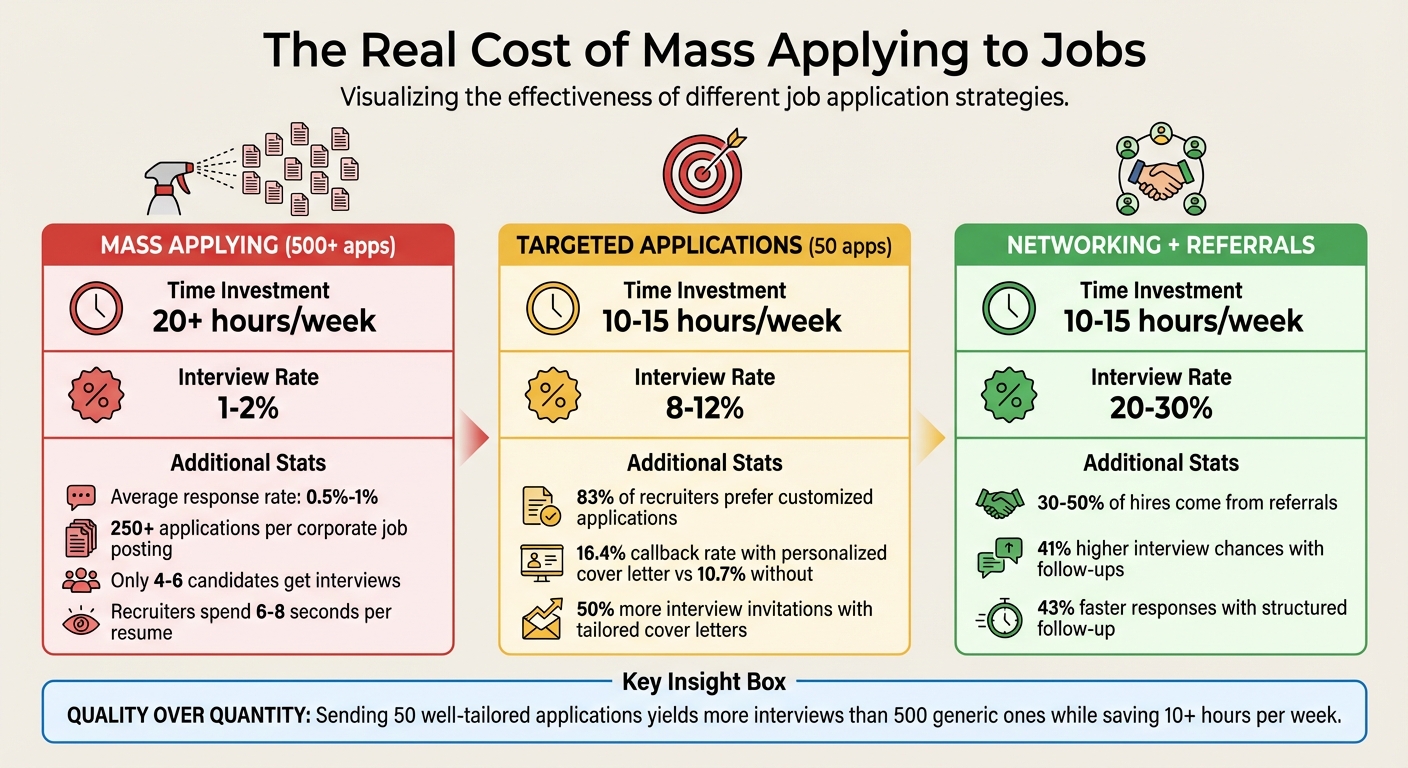
Mass Applying vs Targeted Job Applications: Success Rates and Time Investment Comparison
Mass applying for jobs might seem like a smart way to cast a wide net, but it often comes with hidden downsides that can hinder your job search efforts. While it might feel like you're being productive, the results tell a different story.
Lower Interview Rates
Did you know that the average corporate job posting attracts over 250 applications, but only 4–6 candidates actually get an interview? According to SHRM research, recruiters spend just 6–8 seconds scanning each resume. If your application is generic, it’s likely to blend in with the rest, making it easy to overlook.
Here’s the kicker: sending out 500 generic applications typically results in fewer interviews compared to sending just 50 well-tailored ones. Instead of spending 20+ hours on mass applying, consider dedicating 10–15 hours to crafting targeted applications. Services like AI resume builders can help you create resumes that align with specific roles, boosting your chances of standing out.
Reputation Damage with Recruiters
Recruiters notice patterns. If you apply for every job at a company - from entry-level roles to senior management positions - it signals a lack of focus. This scattershot approach can make you appear unsure of your skills or career goals, which might come across as desperation.
For example, applying to multiple departments or roles with varying seniority levels in a short period can raise red flags in modern ATS systems. These systems often flag such behavior, alerting recruiters that you might not fully understand your qualifications or the company’s needs. Over time, this can harm your credibility and make it harder to get noticed for the right roles.
Lost Time for Networking and Referrals
Mass applying doesn’t just hurt your reputation; it also eats up valuable time that could be better spent on more effective strategies like networking and securing referrals. While clicking “apply” repeatedly might feel productive, it rarely delivers the same results as building genuine connections.
Referrals, for instance, account for a significant percentage of successful hires. But they require time and effort - time that’s lost when you’re focused on submitting dozens of applications daily without researching companies or following up with recruiters. A relationship-driven approach consistently outperforms high-volume tactics in the long run.
| Strategy Comparison | Time Investment | Typical Interview Rate |
|---|---|---|
| Mass applying (500+ apps) | 20+ hours/week | 1–2% |
| Targeted applications (50 apps) | 10–15 hours/week | 8–12% |
| Networking + referrals | 10–15 hours/week | 20–30% |
Scale.jobs can help you reclaim this time by managing the application process for you. Their human assistants ensure applications are tailored to each role, avoiding generic submissions that might trigger bot flags. With ATS-optimized resumes and transparent updates shared via WhatsApp, you can focus on networking and building relationships while maintaining a strong application pipeline. Plus, their one-time payment model means you won’t be stuck with recurring fees, giving you peace of mind as you search for your next opportunity.
How to Make Your Applications Stand Out
To address the challenges discussed earlier, it’s crucial to take steps that make your applications shine. Recruiters can easily spot generic submissions, so fine-tuning your approach can significantly improve your chances of landing an interview.
Customize Each Resume and Cover Letter
Tailoring your resume and cover letter for each job is non-negotiable. Research shows that 83% of recruiters are more inclined to consider candidates who customize their applications. Plus, personalized submissions boast a 16.4% callback rate compared to only 10.7% for those without a cover letter.
Start by carefully reviewing the job description and identifying recurring keywords or phrases. For example, if "cross-functional collaboration" is mentioned multiple times, make sure to include it in your resume. Also, matching the exact job title in your resume summary can increase your chances of being noticed by Applicant Tracking Systems (ATS) and recruiters by 3.5 times.
Maintain a master resume that includes all your experiences and achievements. For each application, select the most relevant accomplishments and quantify your results. For instance, instead of saying "managed projects", opt for something like "reduced project delivery time by 18% across 12 teams." This level of detail not only aligns with the job but also demonstrates your impact.
When it comes to cover letters, focus on updating key sections like the summary, top three accomplishments, and skills to align with the role. A tailored cover letter can result in 50% more interview invitations, making the extra effort worthwhile.
While customization is essential, turning to expert services can further enhance your application strategy.
Use Human-Powered Services Like Scale.jobs
Job search automation tools may seem convenient, but they often come with drawbacks like outdated resumes or errors in application forms. Unlike platforms such as LazyApply or Simplify.jobs, which rely on automated submissions, Scale.jobs offers a more reliable, human-driven process.
Here’s what sets Scale.jobs apart: Their team of trained human assistants manually submits each application, ensuring accuracy even with complex portals or visa-related questions. Every resume is tailored to the job posting and optimized for ATS compatibility. You’ll receive real-time updates via WhatsApp, complete with time-stamped proof-of-work screenshots, giving you full transparency.
This personalized approach avoids the pitfalls of automation and leads to higher callback rates. Scale.jobs uses a one-time payment model starting at $199 for 250 applications, eliminating the need for recurring subscriptions. For those looking to fine-tune their resumes further, their resume writing services create documents specifically designed to match your target roles.
Once your applications are submitted, following up strategically is the next step to boost success.
Track Applications and Follow Up
Keeping track of your applications can make a big difference, yet 77% of job seekers overlook follow-up opportunities. Tracking your progress not only keeps you organized but also increases your chances of landing an interview by 41%.
Use a simple spreadsheet or a dedicated job search tracker to log key details such as the company name, job title, application date, version of your resume used, recruiter contact information, and follow-up dates. Include the job posting URL and reference number to have all the necessary information at your fingertips when reaching out.
Follow a structured timeline for follow-ups. Send a polite email 5–7 business days after applying, check in again 7–10 days later, and send a final note if you haven’t heard back after 14 business days. This disciplined approach can boost your interview chances by 37% and secure responses 43% faster than random follow-ups.
Additionally, monitor which resume versions and platforms yield the best results. If you’re using Scale.jobs, their service includes built-in application tracking, automatically logging submissions with screenshots. This feature allows you to focus your energy on networking and interview preparation instead of administrative tasks.
When High-Volume Applying Works (and When It Doesn't)
Recruiters can often spot mass applications, but their effectiveness depends on the type of role you're targeting. Factors like the industry, job level, and hiring processes of companies play a big role in determining whether this approach will help or hurt your chances.
Entry-Level and High-Turnover Roles
High-volume applications are most effective for entry-level, frontline, and operational roles, particularly in industries like retail, hospitality, logistics, and customer service. These sectors often rely on bulk hiring to meet constant staffing demands.
For example, 65% of companies across the U.S. engage in high-volume hiring, especially for roles that require minimal training. In the restaurant industry, where turnover exceeds 70%, positions like servers and cooks are perpetually in demand. Similarly, warehouses, call centers, and retail stores frequently hire for "evergreen" roles, especially during peak seasons like the holidays or back-to-school periods.
In these cases, speed and volume take precedence over personalized applications. Many companies use quick application processes, such as QR codes, SMS submissions, and AI-driven screening tools that can evaluate candidates in just a few minutes. Applying broadly increases your visibility in these fast-paced hiring environments.
How Scale.jobs compares to LazyApply and Simplify.jobs for high-volume roles:
While tools like LazyApply and Simplify.jobs can submit applications quickly, they often fall short in execution. For instance, LazyApply is prone to formatting errors and incomplete fields, which can make your application look unprofessional. Simplify.jobs does better with formatting but still struggles with complex application forms.
Why Scale.jobs stands out for entry-level high-volume applications:
- Human oversight ensures each application is manually submitted, avoiding errors common in automated systems.
- ATS-optimized resumes are designed to pass automated screening tools without being flagged as bot-generated.
- A one-time payment of $199 for 250 applications eliminates the need for recurring subscriptions.
- Proof-of-work transparency, including time-stamped screenshots, shows exactly how and when applications are submitted.
- Real-time WhatsApp support keeps you updated and answers questions during your job search.
Unlike automated tools, Scale.jobs combines speed with accuracy, ensuring your applications are professional and error-free, even in high-volume scenarios.
However, this approach doesn’t work for every type of job. Let's explore why it fails for specialized and senior roles.
Senior and Specialized Positions
For senior, executive, or specialized positions, high-volume applying is usually counterproductive. These roles require a more focused and personalized approach. Recruiters for these positions examine every detail, from your technical expertise to your ability to lead and fit within the company culture. Sending out generic applications en masse can make you appear unfocused or even desperate.
Specialized roles in fields like tech, finance, and law often involve multiple interview stages and in-depth evaluations. Recruiters expect tailored resumes that highlight specific achievements, technical skills, and a deep understanding of the company’s needs. Generic applications rarely survive the initial screening, and automated tools often fail to address the nuanced requirements of these roles.
When to use competitors versus Scale.jobs for specialized roles:
LazyApply or Simplify.jobs may work if:
- You're applying to entry-level or high-turnover positions where speed is more important than personalization.
- Your budget is tight, and you're willing to trade quality for cost.
- You’re okay with manually fixing errors and resubmitting applications flagged by recruiters.
Scale.jobs is better suited for:
- Professionals targeting mid-to-senior-level roles that require customized applications.
- Candidates who need ATS-friendly resumes tailored to specific job descriptions.
- Job seekers who value transparency, including proof of how their applications are submitted.
- Those who want consistent support throughout the application process via WhatsApp.
- People who prefer a one-time payment model instead of monthly subscriptions.
For specialized positions, the focus should shift from quantity to quality. Spend time researching companies, networking with key decision-makers, and tailoring your applications to match the role’s specific requirements. If you need help creating standout materials, Scale.jobs offers resume writing services to craft ATS-optimized documents that align with your career goals, ensuring your application makes an impact in competitive fields.
Conclusion: Switch to Quality-Focused Applications
Mass application strategies often lead to wasted effort and missed opportunities, as highlighted earlier. Recruiters spend up to 23 hours screening applications for a single role, with 90% deemed unqualified. This flood of generic submissions - often filled with copy-paste resumes and boilerplate cover letters - dilutes the chances of standing out. Unlike platforms like LazyApply and Simplify.jobs, which rely heavily on automation, Scale.jobs prioritizes human oversight to ensure every application is thoughtfully crafted.
Statistics show that 30-50% of job placements in the U.S. are made through referrals, not through mass applications. Thoughtfully tailored submissions that align with job requirements are far more likely to pass ATS filters and catch a recruiter’s attention. On the flip side, candidates who rely on mass applying often fail to recall the specifics of a job when contacted, which can immediately disqualify them.
Focusing on quality means taking the time to customize your resume and cover letter for each role, keeping track of applications in an organized way, and prioritizing networking over sheer volume. If time is a constraint, services like professional resume writing services can help create ATS-friendly, role-specific documents that make an impact.
Scale.jobs bridges the gap between efficiency and personalization with a service model designed to streamline your job search:
- Human-reviewed submissions ensure accuracy and avoid ATS rejection
- Custom, ATS-optimized materials tailored to each job
- Transparent one-time payment ($199 for 250 applications) with no hidden fees
- Real-time WhatsApp support for updates and proof-of-work
- Time-stamped screenshots to confirm precise application submissions
This approach allows you to maintain the speed needed for a competitive job search while ensuring every application is meaningful. It also helps avoid the fatigue and frustration that often come with high-volume, low-quality approaches.
To maximize your chances, focus on roles that align with your skills, track your applications carefully, and follow up promptly. The goal isn’t to apply to every job - it’s to secure interviews for positions where you can truly excel.
Final Recommendation: Platforms like LazyApply might work for entry-level roles with high turnover where budget constraints are a concern. However, for tailored, human-reviewed applications that enhance your chances of landing interviews and protect your professional reputation, Scale.jobs is the smarter choice.
FAQs
Can recruiters tell I mass applied?
Recruiters often pick up on signs of mass applications. Generic resumes, boilerplate cover letters, or errors in the application can raise red flags. Both ATS systems (Applicant Tracking Systems) and hiring managers are adept at spotting these patterns. To stand out, take the time to customize your resume and cover letter for each position. Highlight relevant skills, align your experience with the job description, and double-check for accuracy. Personalization shows genuine interest and increases your chances of moving forward in the hiring process.
How do I tailor my resume fast?
To efficiently update your resume, concentrate on making specific adjustments instead of rewriting it entirely. Start by identifying the core skills and keywords mentioned in the job description. Use these to refine your summary and work experience sections, ensuring they align with the role. Emphasize accomplishments that are directly relevant and include measurable outcomes, while removing outdated or irrelevant details. Platforms like Scale.jobs integrate AI with human review to simplify this process, keeping your resume optimized for ATS systems and saving you valuable time.
When does high-volume applying work?
High-volume job applications often fall short because generic, automated submissions rarely lead to success - fewer than 3% result in callbacks. Recruiters and ATS (Applicant Tracking Systems) are adept at identifying these cookie-cutter applications, and they tend to prioritize candidates who invest time in crafting personalized, well-tailored applications. A thoughtful approach not only improves your chances but also helps your application stand out in a crowded field.