
What Recruiters Really See When You Mass Apply to Jobs
Mass applying with generic resumes triggers ATS filters and recruiter rejections—focus on tailored, ATS-friendly applications and human-assisted tools.


When you mass apply to jobs using generic resumes, recruiters and Applicant Tracking Systems (ATS) quickly spot red flags like formatting errors, mismatched skills, and lack of personalization. This approach often leads to rejections, with 94% of applications filtered out by ATS before reaching human eyes. Even if your resume gets through, recruiters can identify low-effort submissions, such as inconsistent fonts or irrelevant skills, signaling a lack of genuine interest in the role.
Instead of prioritizing quantity, focus on crafting tailored applications that align with specific job descriptions. Tools like scale.jobs combine human oversight and ATS-friendly templates to ensure your applications stand out. By investing time in quality over volume, you can improve your chances of landing interviews and avoid job search burnout.
Key Takeaways:
- Mass applying hurts your chances: Recruiters dismiss generic resumes, and ATS systems reject poorly formatted or irrelevant submissions.
- Personalization is critical: Tailored resumes and cover letters, aligned with job descriptions, increase success rates.
- Better tools can help: Services like scale.jobs provide tailored applications, real-time updates, and ATS optimization to improve outcomes.
This article explores why mass applying fails, the red flags recruiters notice, and how to create targeted applications that get results. Learn how to save time and energy while improving your job search effectiveness.
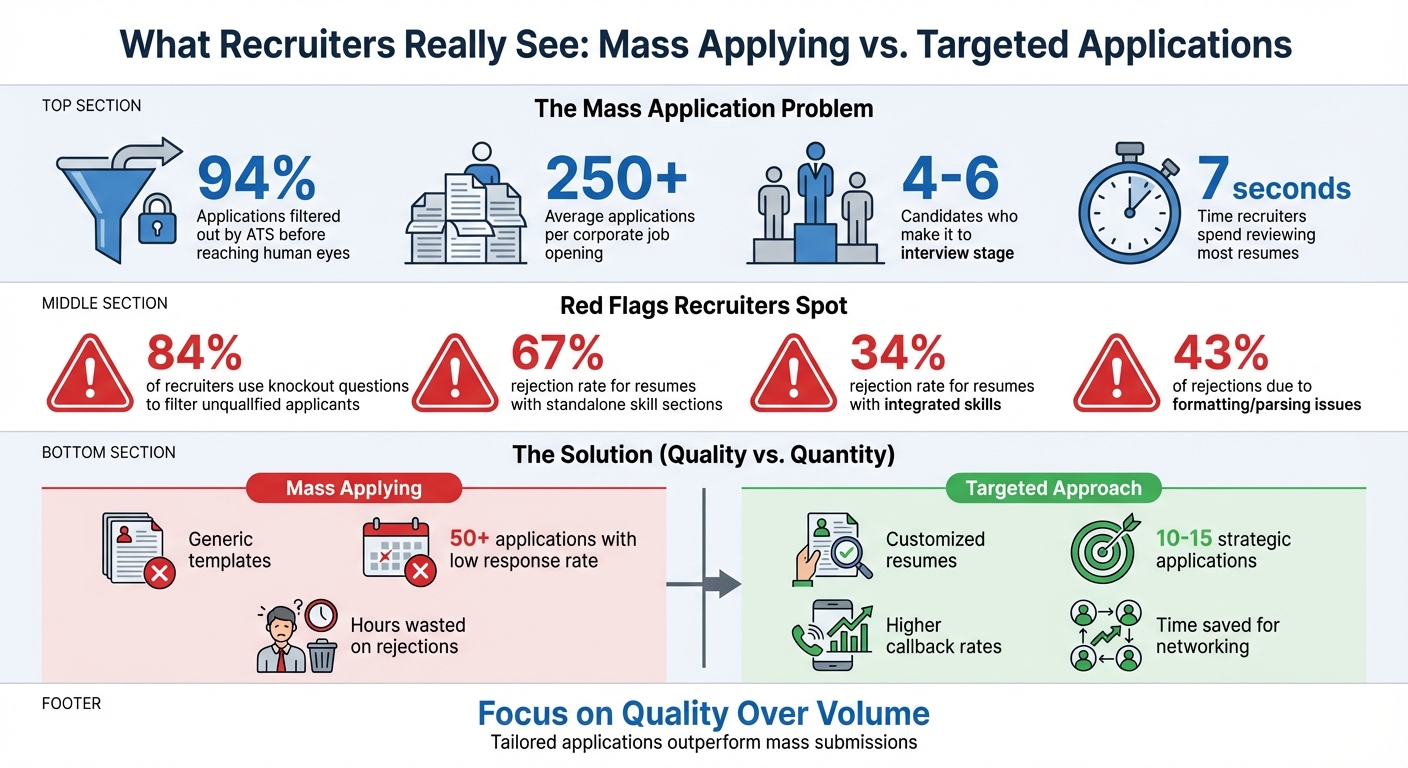
Mass Applying vs Targeted Job Applications: Key Statistics and Red Flags
Why Mass Applying Is Killing Your Job Search
While it's tempting to use job search automation to increase your volume, doing so without a strategy often leads to these common pitfalls.
Red Flags Recruiters Spot in Mass Applications
Recruiters can quickly identify resumes that lack personalization, often leading to an immediate rejection. Mass applications, especially those that appear generic, signal a lack of effort and genuine interest in the role.
Generic Resumes That Don't Match the Role
Resumes that look like templates are a dead giveaway for recruiters. When candidates use generic structures without tailoring their experience to match the job requirements, it becomes clear they’re sending out mass applications.
Attention to detail is crucial. Senior Recruiter Kristin Palumbo puts it plainly:
"Make sure that you're tailoring it to the position you're applying for because I get a lot of people that you can tell are just kind of mass applying to places - and sometimes they even forget to change the position's name. Somebody like that is definitely going to get rejected from me because it shows they don't have the attention to detail."
Mistakes like leaving the wrong company or position name in a cover letter show a lack of genuine interest and are often deal-breakers for hiring managers.
Formatting issues can also hurt your chances. For example, listing jobs in the wrong order - starting with the oldest instead of the most recent - is a common mistake. Pair this with overly graphic-heavy resumes, and you risk making it harder for both recruiters and Applicant Tracking Systems (ATS) to scan your application. Beyond formatting, recruiters will also scrutinize how well your skills align with the role.
Skills That Don't Match Job Requirements
To streamline the hiring process, recruiters often use knockout questions to filter out candidates who don’t meet basic qualifications like work authorization, certifications, or specific licenses. In fact, 84% of recruiters rely on these automated filters to weed out unqualified applicants before a human even reviews the resume.
Another common issue is the "skills trap." Simply listing a long, separate section of 20+ skills without integrating them into your work experience can backfire. ATS systems are designed to prioritize resumes where skills are naturally woven into job descriptions. Data shows that resumes with standalone skill sections face a 67% rejection rate, compared to just 34% for those that integrate skills into relevant experience.
Formatting errors can also trip you up. A staggering 43% of resume rejections are due to formatting or parsing issues rather than a lack of qualifications. With ATS systems making decisions within the first 10 seconds of parsing, poorly formatted resumes or those with mismatched skills create a significant barrier to success.
Signs of Low Effort and No Real Interest
A generic, hastily prepared application sends a clear message: the candidate isn’t fully invested in the role. When your application lacks polish, it gives the impression that you might not bring the necessary commitment to the job.
To stand out, candidates should focus on creating resumes that shine with tailored, well-prepared applications. Tools like scale.jobs' professional resume writing service can help remove these red flags by ensuring your resume is customized, polished, and free from the common pitfalls that lead to rejection.
Why Mass Applying Damages Your Job Search
Mass applying can derail your job search by creating a cycle of inefficiency and diminishing returns.
Lower Response Rates and Wasted Effort
On average, corporate job openings receive over 250 applications, but only 4–6 candidates make it to the interview stage. When you rely on generic applications, they often fail to pass through Applicant Tracking Systems (ATS), significantly reducing your chances of standing out. Many Fortune 500 companies use ATS filters to weed out irrelevant applications, and generic submissions are frequently the first to be eliminated.
Recruiters, who may spend hours reviewing up to 500 resumes for a single position, often dismiss most resumes within just seven seconds. This means the time you spend submitting 50 generic applications could be better spent crafting 5–10 personalized ones that align closely with the role and showcase your unique qualifications. A targeted approach not only increases your chances of getting noticed but also ensures your time is used effectively.
Relying on mass applications not only lowers your chances of landing interviews but can also drain your energy and enthusiasm over time.
Job Search Burnout and Frustration
The repetitive process of submitting generic applications often leads to mounting frustration and burnout. Hours spent applying for mismatched roles frequently result in rejection or, worse, no response at all. This lack of progress can create a demoralizing cycle where effort feels wasted.
The cost of this approach is more than just emotional - it’s also a missed opportunity. Instead of focusing on quantity, your time could be better spent building connections with recruiters, leveraging your network to uncover hidden opportunities, or working with tailored job application assistance to craft standout materials. A more intentional strategy, such as tailoring each application to specific roles and tracking your progress, not only improves your results but also helps maintain your motivation throughout the process. Platforms that encourage mass applying may seem convenient, but a focused, deliberate approach will protect your energy and lead to better outcomes in the long run.
How to Get Recruiter Attention: Better Alternatives
Focusing on targeted applications over mass submissions can make a strong impression on recruiters, showcasing your genuine fit for a role.
Customize Each Application for the Specific Job
Recruiters often spot a generic resume within seconds, so tailoring your application is crucial. Start by mirroring the language used in the job posting in both your resume and cover letter. For instance, if the job description highlights "stakeholder management", incorporate that term instead of a broader phrase like "client communication." This isn't about tricking the system - it's about aligning your application with the recruiter's priorities and demonstrating you understand their needs.
To further enhance your resume, use the STAR method (Situation, Task, Action, Result) to convert vague bullet points into clear, results-driven statements. For example, instead of saying "Managed social media accounts", write something like, "Boosted LinkedIn engagement by 47% in Q3 2025 through a data-driven content calendar." Including specific metrics and timeframes provides tangible proof of your achievements. Additionally, ensure your resume is formatted with clear section headers and professional fonts like Arial or Calibri to improve readability.
Use Tools and Human Help for Better Applications
Customizing every application can be time-consuming, especially if you're applying to multiple roles weekly. Combining technology with human expertise can make the process more efficient. While automated bots may speed up submissions, they often raise red flags in Applicant Tracking Systems (ATS).
For a more balanced approach, consider services that combine human oversight with ATS-friendly tools. For example, scale.jobs employs trained virtual assistants who manually customize applications to align with specific job postings. These assistants use ATS-optimized templates and provide updates via WhatsApp, including proof-of-work screenshots. With flat-fee packages starting at $199 for 250 applications, this service allows you to save over 20 hours weekly for networking and interview preparation. If you prefer a more hands-on approach, professional resume writing services can help you create a strong foundational resume that’s easier to adapt for different roles.
Apply Strategically and Build Connections
Submitting more applications doesn’t necessarily increase your chances. Instead, focus on 10–15 roles that closely match your skills and experience. Research each company’s recent projects, leadership changes, or product launches, and reference these details in your cover letter to show genuine interest.
Networking can also open doors that traditional applications might not. For example, Jennifer Dulski of Rising Team shared how, among 800 applicants for a Chief of Staff role in 2024, the ones who included tailored materials like a 30-60-90 day plan or a video presentation stood out immediately (Source: Fast Company, 2024). All three candidates who took this approach were invited to interviews because their applications reflected deep research and a clear understanding of the company.
Explore hidden opportunities by joining professional Slack communities, LinkedIn industry groups, and employee referral programs. After submitting your application, follow up with the recruiter within 1–2 weeks to show initiative. Additionally, optimize your LinkedIn profile with AI by including specific keywords in your headline. For example, use "Global Recruiter" instead of just "Recruiter" to increase your visibility in searches conducted by hiring managers.
scale.jobs vs LazyApply, LoopCV, and JobScan: Why Human-Powered Wins
The demand for tailored job applications has led to a rise in automated tools, but how does scale.jobs stack up against popular options like LazyApply, LoopCV, and JobScan? Let’s dive into the details.
How scale.jobs Stands Out Against Automated Tools
Automated tools like LazyApply and LoopCV often fall into predictable patterns that recruiters can easily spot. Identical submission timestamps, generic formatting, and incomplete fields are red flags that automated tools can’t always avoid. In contrast, scale.jobs employs dedicated human assistants who manually handle every aspect of the application process. From filling out text boxes to uploading files, every detail is carefully managed to ensure accuracy and personalization.
When it comes to Applicant Tracking System (ATS) optimization, scale.jobs goes beyond keyword matching. While tools like JobScan analyze resumes for keywords, they don’t handle submissions or ensure documents pass complex ATS filters. Human assistants at scale.jobs craft resumes tailored to each job posting, using ATS-friendly templates to maximize success. They also manually submit applications across various platforms, including Workday, Greenhouse, and niche industry job boards.
Pricing is another area where scale.jobs shines. With flat-fee plans - $199 for 250 applications, $299 for 500, and $399 for 1,000 - you avoid the recurring subscriptions that can strain your budget over time.
Transparency is key, and scale.jobs delivers with real-time updates via WhatsApp. Each update includes time-stamped screenshots as proof of submission, offering clarity and peace of mind. While LazyApply and LoopCV provide basic logs, they lack the detailed, verifiable updates that scale.jobs offers.
Why scale.jobs outperforms automated tools:
- Human oversight ensures tailored applications that avoid bot-like patterns.
- Manual ATS optimization increases the chances of passing screening filters.
- Real-time updates with proof-of-work screenshots build trust and accountability.
- Flat-fee pricing eliminates the unpredictability of recurring costs.
- Handles submissions across a wide range of platforms, from corporate ATS systems to niche boards.
Need help crafting a strong resume before starting the application process? Check out how to craft your future with an AI resume builder to build a solid foundation.
Feature Comparison: scale.jobs vs LazyApply vs LoopCV vs JobScan
| Feature | scale.jobs | LazyApply | LoopCV | JobScan |
|---|---|---|---|---|
| Human Involvement | Full human assistants | AI automation | Browser extension | Keyword scanner |
| Resume Customization | Per-job deep tailoring | Basic templates | Auto-fill | ATS keyword match |
| ATS Handling | Manual optimization | Automated parsing | Simulated inputs | Analysis only |
| Submission Method | Strategic manual | Mass one-click | Auto-loop | N/A (tool) |
| Transparency | WhatsApp + screenshots | Logs | Basic reports | Scans |
| Pricing | Flat-fee, no recurring | Subscription | Per-app fees | One-time/sub |
This table highlights the distinct advantages of scale.jobs in comparison to its competitors.
Who Benefits Most from Each Option?
Choose scale.jobs if you're a mid-career professional in a competitive field, dealing with frequent rejections, or aiming for senior roles that demand detailed, customized applications. It's perfect for those who understand that 50 well-crafted applications can be more effective than 500 generic ones, especially for roles with high recruiter scrutiny.
Opt for LazyApply or LoopCV if budget is your primary concern and you're comfortable with lower response rates. These tools are better suited for early-career job seekers who are willing to manage a large volume of applications and rejections. Use JobScan if you only need keyword analysis for your resume and plan to handle applications on your own.
When to Switch to scale.jobs
- If you've sent out 100+ applications with little to no response and suspect ATS filters are the issue.
- When targeting senior or specialized positions where attention to detail is critical.
- If you want verifiable proof of every submission for peace of mind.
- To save over 20 hours a week that you can redirect toward networking and interview prep.
- If you prefer a one-time payment over recurring monthly fees that can quickly add up.
Decision Summary
scale.jobs is the ideal choice when quality, transparency, and human oversight are your priorities for landing competitive roles. LazyApply and LoopCV are budget-friendly but come with lower response rates, making them better suited for entry-level seekers. JobScan is useful for keyword optimization but leaves the application process entirely in your hands. For those who value precision, accountability, and time savings, scale.jobs delivers unmatched results.
Conclusion: Focus on Quality, Not Volume
As outlined earlier, mass applications often raise red flags for recruiters. Generic resumes, mismatched skills, and identical timestamps suggest minimal effort, leading to swift rejections. The data is clear: applications tailored to match your skills with a job's specific needs yield better results - not just in callback rates but also in long-term job satisfaction. This shift from quantity to quality can make all the difference in your job search.
Prioritizing quality means taking a more thoughtful approach - customizing each resume and cover letter for the role you’re applying to. While this requires additional effort, the payoff is undeniable. If balancing personalization with a broader outreach feels overwhelming, leveraging tools like professional resume writing services can help create a strong foundation for your applications.
scale.jobs offers a solution that bridges the gap between quality and scale. Their human-assisted approach ensures each application is carefully managed, using ATS-optimized, customized resumes to avoid patterns that trigger automatic rejections. With real-time updates via WhatsApp and proof-of-work screenshots, you can trust that every submission reflects a high level of effort. Let’s explore why scale.jobs stands out compared to other tools.
When to Choose scale.jobs vs Other Options
scale.jobs is the right choice when you need precision and quality, particularly for mid-career or senior roles where recruiters pay close attention to detail. If you’re struggling with low response rates or suspect ATS filters are holding you back, this service can provide a much-needed edge.
Why scale.jobs stands out:
- Human-assisted applications ensure every submission avoids bot-like patterns that ATS systems flag.
- Custom ATS-optimized resumes and cover letters tailored to each job increase your chances of passing initial screenings.
- Flat-fee pricing ($199 for 250 applications, $299 for 500, $399 for 1,000) eliminates the hassle of recurring subscriptions.
- Real-time WhatsApp support keeps you informed with time-stamped proof-of-work screenshots.
- Full transparency guarantees accountability, with verifiable submissions across platforms.
This service is ideal if you’ve already sent over 100 applications with little to no response, suspect your applications are being filtered out, or simply want to save time for networking and interview preparation.
For those on a tighter budget or in the early stages of their careers, LazyApply or LoopCV may be more appropriate, though higher rejection rates are a common trade-off. If your focus is solely on optimizing keywords and you prefer to handle applications yourself, JobScan might be a better fit.
Decision Summary
Here’s how scale.jobs compares to its competitors based on different needs:
- If you need personalized, manually submitted applications with clear proof-of-work and straightforward pricing, scale.jobs is the top choice.
- If budget constraints are your main concern and you’re early in your career, tools like LazyApply or LoopCV might work better.
- If you’re focused on keyword optimization but want to manage applications independently, JobScan could be a suitable option.
FAQs
How can I tell if an ATS is rejecting my resume?
Spotting whether an ATS (Applicant Tracking System) is rejecting your resume often comes down to recognizing certain patterns. Issues like improper formatting, missing essential keywords, or receiving low match scores can be red flags. To improve your chances, consider using ATS checkers. These tools can help ensure your resume is properly formatted and parsed by the system. Many ATS platforms automatically reject resumes that fail to meet specific formatting or keyword criteria, so tailoring your resume to these requirements can make a big difference.
What’s the fastest way to tailor a resume for one job?
The fastest way to adjust your resume for a particular job is by carefully reviewing the job description, pinpointing essential skills and keywords, and revising your resume to emphasize relevant accomplishments and duties. Pay special attention to sections like your professional summary, work experience, and skills, tailoring them to reflect the requirements of the role. This approach not only ensures your resume matches the job but also boosts its compatibility with applicant tracking systems (ATS) and catches the eye of recruiters.
How many targeted applications should I submit each week?
Submitting approximately 30 targeted applications each week is a solid goal. However, prioritize quality and personalization over sheer numbers. Applications that are carefully tailored and thoughtfully written often lead to better outcomes compared to generic submissions. Taking the time to craft each application with a personal touch can make all the difference in standing out to potential employers.