Why Recruiters Reject AI-Generated Applications
Recruiters reject many AI-written applications for generic phrasing, missing role details, and ATS-breaking errors; combine AI with human edits and personalization.

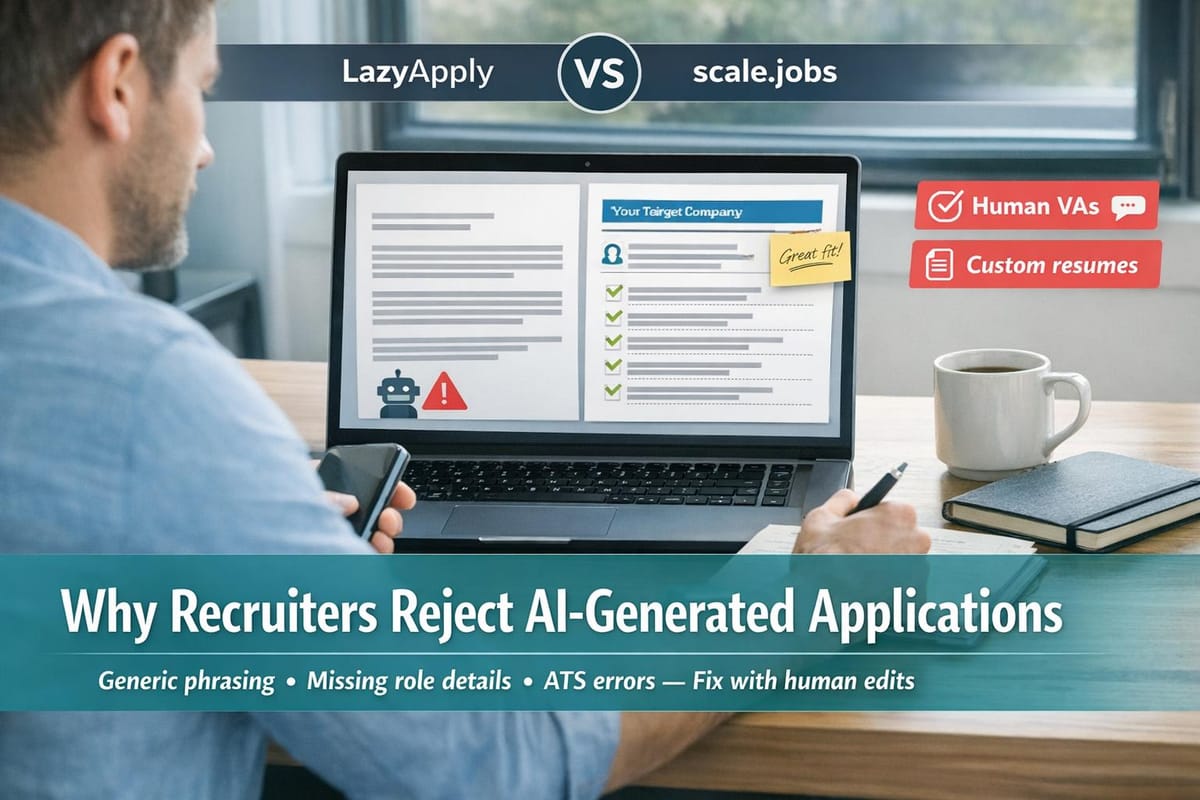
Recruiters are increasingly rejecting AI-generated applications due to their lack of personalization, generic content, and technical errors. While tools like ChatGPT and AI resume builders can streamline the job application process, over-reliance on them often results in applications that fail to stand out. Key issues include repetitive phrasing, missing role-specific details, and errors like placeholders or formatting problems that confuse Applicant Tracking Systems (ATS).
Employers value authenticity and effort, with 62% more likely to dismiss resumes lacking personalization. Customization - adding specific achievements, metrics, and tailored content - is critical to avoid rejection. Services like scale.jobs combine AI efficiency with human expertise, ensuring tailored, ATS-optimized applications without the pitfalls of generic automation. By balancing AI tools with personal input, job seekers can improve their chances of landing interviews.
Key Takeaways:
- AI-generated applications often fail due to lack of personalization and accuracy.
- Recruiters detect AI use through generic phrasing, buzzwords, and technical errors.
- Human-assisted services like scale.jobs help create tailored, ATS-friendly resumes.
- Focus on quality over quantity: Personalized applications outperform generic submissions.
To succeed, use AI as a tool, not a replacement, and ensure your application reflects genuine effort and your unique qualifications.
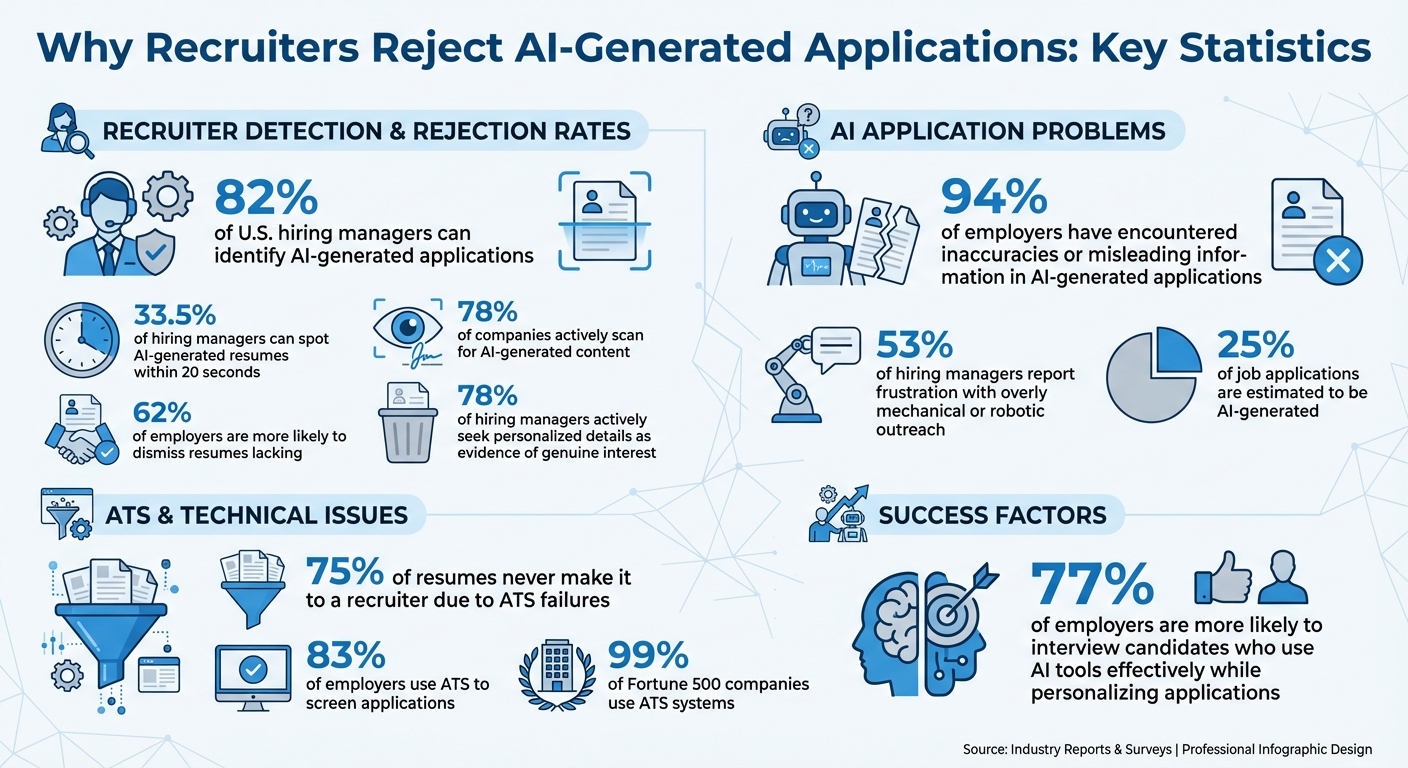
Key Statistics: Why Recruiters Reject AI-Generated Job Applications
AI Is GARBAGE For Resumes, Do This Instead | Recruiter Reviews Resume
Why Recruiters Reject AI-Generated Applications
Recruiters often reject AI-generated applications due to issues with personalization and accuracy. A survey reveals that 62% of employers are more likely to dismiss resumes lacking personalization, while 78% of hiring managers actively seek personalized details as evidence of genuine interest. The problem lies not in the use of AI itself but in how candidates apply it carelessly. Recruiters now scrutinize applications more closely, looking for authenticity and effort. Below, we explore the key pitfalls that lead to these rejections.
Generic Content and Lack of Personalization
One of the biggest red flags for recruiters is when multiple applicants submit nearly identical content. AI tools often pull from the same data sources, resulting in repeated phrasing, structures, and examples. For instance, Bonnie Dilber, a recruiting manager at Zapier, noted that many candidates responding to a product use case prompt all cited the same "flower shop" example. This repetition made it clear that candidates were relying on unmodified AI outputs.
Such lack of personalization can hurt your chances significantly. AI cannot automatically highlight your unique achievements with real-life examples - like the percentage increase in sales you drove or specific improvements you made to a project - unless you take the time to add those details manually. Beyond the generic phrasing, these applications often miss the nuances that align with specific roles, further diminishing their impact.
Missing Role-Specific Details and Keywords
AI-generated applications frequently fail to address the specific requirements of a role. While they may include some relevant keywords, they often neglect to integrate these terms into meaningful, tailored content. This results in applications that sound surface-level, mentioning buzzwords but lacking the depth or evidence recruiters want.
James Hudson, an HR Executive, explains, "You're eroding your competitive advantage when you don't manually include those details." Additionally, 94% of employers have encountered inaccuracies or misleading information in AI-generated applications. These errors often stem from AI "hallucinations", where the tool fabricates skills or achievements that don’t exist. Such inaccuracies trigger skepticism among recruiters, leading to immediate rejection.
Overuse of Buzzwords and Robotic Language
Recruiters are becoming skilled at identifying AI-generated content, especially when it relies on overused buzzwords. Gabrielle Woody, a university recruiter at Intuit, shared:
"I almost always see words like 'adept,' 'tech-savvy,' and 'cutting-edge' repeatedly now on resumes for tech roles... many of the early-career candidates I reviewed were not using those terms in their applications before ChatGPT."
This robotic tone can make applications feel impersonal and untrustworthy. In fact, 53% of hiring managers report frustration with outreach that comes across as overly mechanical or detached. Worse still, some applicants fail to proofread AI-generated content, leaving placeholders like "[insert mission statement]" or "add numbers here" in their resumes. Tejal Wagadia, a tech recruiter, frequently rejects applications with such errors, as they indicate a lack of effort and attention to detail. For recruiters, these mistakes suggest dishonesty and an attempt to game the system rather than provide genuine value. This is often a side effect of using misleading AI auto-apply services that prioritize volume over quality.
Common Mistakes in AI-Generated Applications
AI-generated applications often stumble on technical errors that can cost you an interview. These mistakes not only confuse Applicant Tracking Systems (ATS) but also strip away the personal touch that recruiters value. Let’s break down the most common errors that can hurt your chances.
Formatting Issues and Grammar Errors
Applicant Tracking Systems often struggle with certain design elements introduced by AI tools. Features like text boxes, headers, footers, or graphics can disrupt how information is read, leading to missing or garbled data. For example, if you use graphical logos or badges to showcase certifications instead of plain text, the ATS might not recognize your qualifications, wrongly marking you as unqualified.
Amanda Augustine, a career expert at TopResume, highlights the importance of presentation:
"Format really matters."
AI-generated resumes sometimes include non-standard design choices like colored backgrounds or custom symbols, which ATS software often fails to process. Even embedded hyperlinks can get stripped, leaving behind incomplete or confusing text.
Tejal Wagadia, a tech recruiter, points out:
"If you're missing that level of detail, it shows the employer that you're not detail-oriented. Yeah, you use technology, but not well."
Beyond formatting, ignoring specific instructions in job applications is another common pitfall.
Ignoring Application Instructions
AI tools are great at following initial commands but often fail to address nuanced or later instructions in job postings. For example, if the job description specifies file naming conventions, document formats, or required details, AI-generated applications might overlook these critical points.
Christina Hallman, Head of Demand Generation at Outpost24, explains:
"It's not the use of AI that's the problem, it's the lack of customization that is coupled with it. If you're going to use AI, I think you need to use it really intentionally."
With an estimated 25% of job applications being AI-generated, recruiters are taking extra measures to identify them. Some even include hidden instructions in job postings - designed as "chatbot traps" - to weed out candidates relying solely on automation. Ignoring these details, combined with poor formatting, can severely hurt your chances.
Poor ATS Optimization
Did you know that about 75% of resumes never make it to a recruiter because they fail ATS checks? Inconsistent formatting can confuse ATS algorithms, causing even highly qualified candidates to be overlooked. Considering that 83% of employers - 99% of Fortune 500 companies included - use ATS to screen applications, these errors can lead to automatic rejection.
Keyword matching is another major issue. Basic AI tools struggle with context, so if your resume doesn’t use the exact terms from the job description, the system might disqualify you even if you’re a perfect fit. Amit Bhatia, Cofounder of Datapeople, advises:
"Sometimes being explicit about your skills and your responsibilities is helpful in case the algorithm isn't as smart on the other end to make the connection as the human mind would."
| Formatting Error | Impact on Recruiter/ATS Decision |
|---|---|
| Graphics/Logos for Certifications | ATS cannot recognize the qualification; candidate marked as unqualified |
| Text Boxes & Headers | Data parsing errors; information appears missing or corrupted |
| Identical Phrasing/Prompts | Recruiters may see the applicant as dishonest or lacking originality |
| Misnamed Companies | Immediate rejection due to perceived carelessness |
With 78% of companies actively scanning for AI-generated content and 33.5% of hiring managers claiming they can spot AI-generated resumes within 20 seconds, these technical missteps are more than minor inconveniences - they can be career roadblocks.
How to Improve Your Job Applications
You can use AI tools to streamline your job application process while ensuring your personal touch shines through for authenticity.
Combine AI Tools with Human Review
Think of AI as your assistant, not your replacement. Tools like ChatGPT can help you break down job descriptions, highlight key skills, and draft a structured resume with real-life examples. However, it's up to you to infuse it with your accomplishments - like exceeding sales goals or increasing website traffic.
James Hudson, an HR Executive, puts it best:
"Use AI as a tool in your toolbox... the final product should still be edited and amended by you because only you know your career."
This approach helps avoid overused buzzwords that automated systems might flag and ensures your resume reflects your genuine experience. Plus, it prevents the "resume illusion" - when your application looks great on paper but leaves you unprepared to discuss it in detail during interviews.
Before submitting, read your application out loud to catch awkward phrasing or mistakes. Double-check that all metrics are accurate and the formatting is polished. Once your draft feels solid, customize it for each specific job.
Customize for Each Job Posting
Personalization is your secret weapon. Research the company’s LinkedIn profile or social media accounts to understand its values, and use the STAR method (Situation, Task, Action, Result) to highlight examples that align with the job requirements.
Amy Gallo, Author and Editor at Harvard Business Review, offers this insight:
"The cover letter shouldn't be focused so much on the past. That's the resume's job. The cover letter is really about the future. So how are you going to take what's in that resume, your past, and apply it to where you're going."
Avoid generic greetings like "To Whom It May Concern." Instead, find the hiring manager's name on LinkedIn for a more personal touch. Mention the company’s challenges or recent achievements, and explain how your skills can address their needs. If you’re shifting careers, show how your transferable skills fit the role. A thoughtful approach like this can make a big difference - 77% of employers are more likely to interview candidates who use AI tools effectively while still personalizing their applications.
For those who want to ensure error-free submissions, human-assisted application services can be a game-changer. Working with a virtual assistant for your job search can help manage the heavy lifting of sifting through listings and tailoring documents.
Use Human-Assisted Application Services
To boost your chances of landing interviews, consider platforms that merge AI efficiency with human expertise. In a comparison - LazyApply vs. scale.jobs: Why you should switch to human-powered apply - scale.jobs stands out for its manual, personalized approach, unlike LazyApply, which often produces generic, bot-detectable submissions.
Here’s why scale.jobs outperforms LazyApply, Simplify, and LoopCV:
- Zero Bot Detection: Human assistants manually complete applications, bypassing automated filters.
- ATS-Optimized Documents: Resumes and cover letters are tailored with verified achievements and metrics.
- Transparent Proof-of-Work: Receive updates via WhatsApp and time-stamped screenshots for every application.
- One-Time Flat Fee: Pay a single fee that covers all applications, with a refund for unused credits.
- 24-Hour Turnaround: Job-specific documents are delivered within a day.
Bonnie Dilber, Recruiting Manager at Zapier, sums it up perfectly:
"If the company was simply looking for AI-generated work, they'd use an AI tool. They are trying to hire a human for the unique things only humans can offer."
Since 62% of hiring managers reject AI-generated resumes that lack personalization, services like these can save you over 20 hours weekly - time better spent networking and preparing for interviews.
| Application Element | AI's Role (Efficiency) | Human's Role (Quality) |
|---|---|---|
| Resume Bullets | Identifying keywords and structure | Adding specific metrics and verified accomplishments |
| Cover Letter | Drafting a basic outline | Adding personal stories and explaining your motivation |
| Skills List | Matching skills to job requirements | Backing up skills with evidence and relevance |
| Formatting | Structuring layout and sections | Ensuring consistency and fixing formatting errors |
Conclusion
Recruiters can identify AI-generated applications almost instantly - 82% of U.S. hiring managers report being able to tell when AI has been used. The giveaways? Overused buzzwords, a mechanical tone, and a lack of personal touches. As automated applications become more common, standing out takes more than just getting through an applicant tracking system.
Instead of relying on AI to do the entire job, use it as a tool to refine your application. AI can help you structure your ideas and pinpoint missing keywords, but the real magic happens when you add your own accomplishments, specific metrics, and personal voice. Christina Hallman, Head of Demand Generation at Outpost24, explains it well:
"It's not the use of AI that's the problem, it's the lack of customization that is coupled with it."
A human touch is essential. AI often invents achievements or suggests vague claims that fall apart under scrutiny during interviews. Submitting an application that appears polished but doesn’t align with your actual experience creates what recruiters call the "resume illusion." This disconnect can instantly damage your credibility. To avoid this, your application needs to be both genuine and well-crafted.
Focus on quality over quantity. Crafting five personalized applications will always outperform sending out 100 generic ones. Every word in your application should emphasize your unique value. Andrew Hilger, former president of Allegis Group, puts it succinctly:
"If you're looking for a job, run a different race altogether. Remember, it's a contact sport. It's a HUMAN contact sport."
The key is to combine advanced tools with your own insights. Platforms like scale.jobs demonstrate this balance, offering human-assisted services and ATS-optimized resumes to ensure your application stands out. By blending technology with authenticity, verifying your claims, and letting your true self shine through, you’ll not only pass the bots but also win over the decision-makers who matter most.
FAQs
How can I make my AI-generated resume stand out to recruiters?
To make your AI-generated resume stand out to recruiters, focus on customization and job relevance. Begin by tailoring your professional summary and career objectives to match the role you're targeting. Use keywords specific to the position and emphasize accomplishments that showcase your unique abilities and experience.
It's also crucial to ensure your resume is ATS-compatible. Use a clean, straightforward format and incorporate keywords directly from the job posting to increase the likelihood of passing through applicant tracking systems and catching the attention of recruiters. By applying these techniques, you can craft a resume that feels genuine and connects with hiring managers effectively.
What are the biggest mistakes in AI-generated job applications?
AI-generated job applications often face challenges that can reduce their effectiveness with recruiters. Among the most common issues are a lack of personalization, the use of overly generic language, and a failure to address the specific needs of the role. These elements can make your application appear rushed or insincere - something recruiters are quick to notice.
Another concern is that some AI-generated applications might be flagged as machine-written. This not only harms your credibility but could also result in rejection or even being blacklisted by certain employers. To make a strong impression, focus on crafting resumes and cover letters that are thoughtfully tailored to the job you're targeting. Blending AI tools with a human touch can help ensure your application feels authentic and demonstrates genuine effort.
Why is it important to include human input in job applications?
Human involvement plays a critical role in job applications, ensuring that your materials are personalized, relevant, and reflective of your unique qualifications. While AI tools like an AI resume builder or AI cover letter builder can be helpful for structuring your documents, they often produce content that feels generic or overly polished. This can make it difficult for recruiters to see your individuality or genuine enthusiasm for the role. In fact, many hiring managers can spot AI-generated content due to awkward phrasing or vague details, which might hurt your chances of moving forward.
Adding a human touch to your application allows you to tailor it specifically to the job, emphasizing your unique experiences and aligning your skills with the employer’s needs. This not only helps your application resonate with recruiters but also improves its chances of passing through applicant tracking systems (ATS). In today’s competitive job market, showing genuine motivation and authenticity can set you apart from other candidates.