
The Real Reason Recruiters Ignore Most Online Applications
Most online applications are filtered by ATS, lost in high volume, or rejected for generic content and bad formatting; practical fixes can improve your chances.


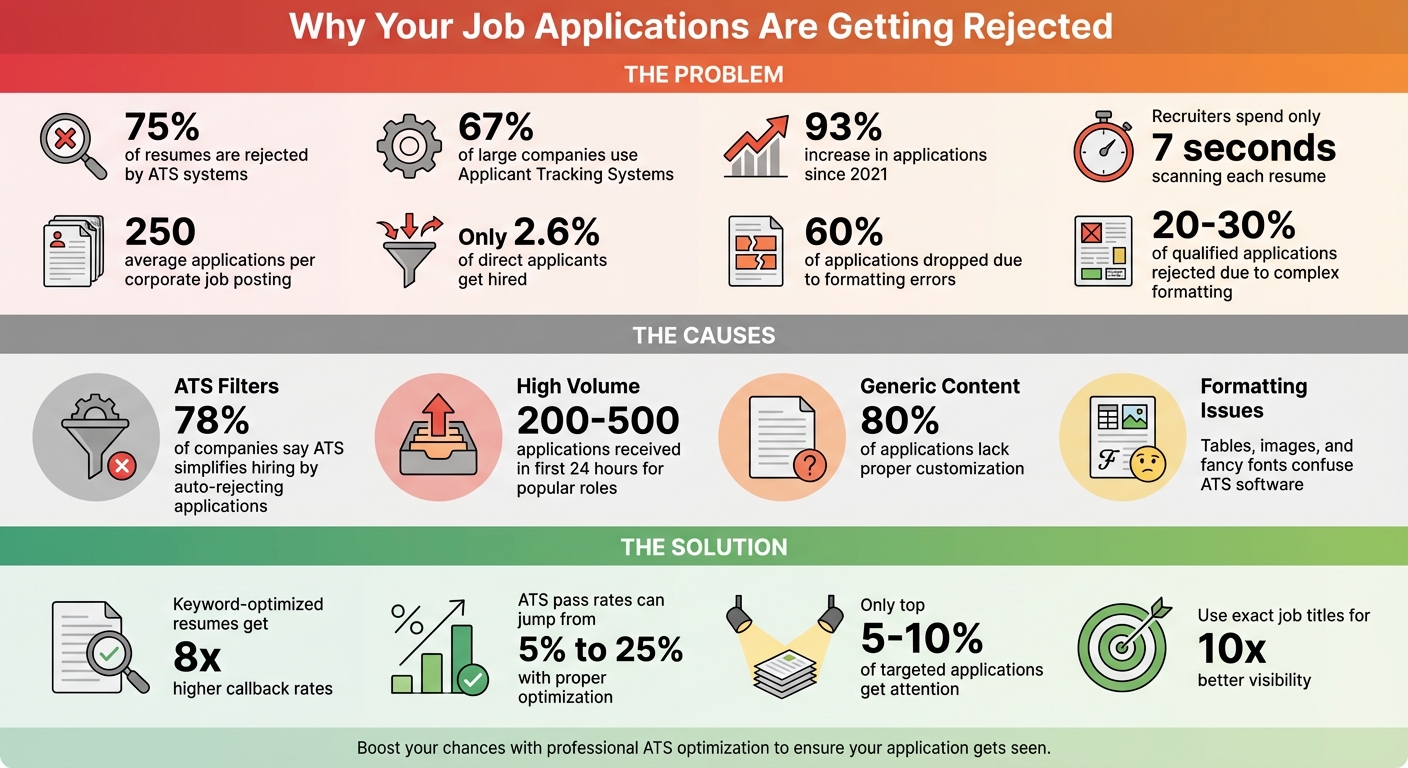
If you’ve been applying to jobs online and hearing nothing back, you’re not alone. Up to 75% of applications never make it past automated systems. Here’s why:
- ATS Filters: Most companies use Applicant Tracking Systems (ATS) to screen resumes for specific keywords. If your resume lacks these terms or uses slightly different phrasing, it may never reach a recruiter.
- High Volume: Recruiters often receive hundreds of applications per job. With limited time, they rely on quick scans or automation to filter candidates.
- Generic Submissions: Resumes and cover letters that don’t align with the job description fail to stand out.
- Formatting Issues: Overly complex designs or incomplete applications can confuse ATS software, leading to rejection.
How to Improve Your Chances
- Use Keywords from Job Descriptions: Tailor your resume with exact terms listed in the job posting.
- Keep Formatting Simple: Avoid tables, images, or fancy fonts. Stick to a clean, single-column layout.
- Highlight Measurable Results: Focus on achievements with numbers, such as “increased sales by 20%.”
- Consider Professional Help: Tools like Scale.jobs offer tailored, human-crafted applications that are ATS-friendly.
Why Scale.jobs Stands Out
Unlike automated tools, Scale.jobs combines human expertise with ATS optimization. This ensures your applications are personalized, properly formatted, and submitted with proof of work. It’s a cost-effective way to manage high-volume job searches without sacrificing quality.
If you’re tired of the “application black hole,” refining your approach and leveraging the right tools can make all the difference.
Why 75% of Job Applications Get Rejected: ATS Statistics and Solutions
Your Resume Is Getting REJECTED by ATS (Here’s How to FIX IT) + FREE TEMPLATE INSIDE!
Why Recruiters Ignore Your Online Applications
Understanding why your applications may go unnoticed can help you refine your approach and improve your chances of success.
1. ATS Filters Block Applications Without the Right Keywords
Did you know that about 67% of large companies use Applicant Tracking Systems (ATS) to filter resumes? These systems are designed to scan for specific keywords that match the job description, such as job titles, technical skills, and industry-specific terms. If your resume doesn’t include these exact keywords, it might get filtered out before a recruiter even sees it.
Statistics highlight the challenge: nearly 75% of resumes are rejected by ATS due to poor keyword alignment. For example, if you're applying for a data analyst role, a generic phrase like "project management experience" may not make the cut. On the other hand, a tailored description like "SQL querying and data visualization for 50+ projects" directly matches the job's requirements, increasing your chances of passing the initial filter. In fact, keyword-optimized resumes can lead to up to eight times higher callback rates compared to generic submissions.
The ATS process is highly technical. If a job posting specifies "Python programming" and your resume uses "Python coding", the system might not recognize it as a match. This automated filtering is why 78% of companies say ATS tools simplify hiring - they eliminate a large number of applications without requiring manual review.
On top of ATS filtering, recruiters face an overwhelming number of applications, which adds another layer of difficulty.
2. Recruiters Receive Hundreds of Applications Per Job
Recruiters are dealing with a sharp increase in applications - 93% more than in 2021 - but with 14% smaller teams. For popular roles like software engineering, it’s not uncommon for recruiters to receive 200–500 applications within the first 24 hours of a job posting. Unfortunately, about 80% of these are generic and lack proper customization.
With such high volumes, recruiters spend an average of just seven seconds scanning each resume. Only the top 5–10% of highly targeted applications stand a chance of grabbing their attention. To put it in perspective, corporate job postings typically attract around 250 applications, yet only 2.6% of direct applicants are hired, compared to 11% of candidates sourced through other methods.
Given this level of competition, your resume needs to immediately demonstrate that you’re a strong match for the role.
3. Generic Resumes and Cover Letters Fail to Show Fit
While keyword optimization is critical, personalization is just as important. A one-size-fits-all resume doesn’t clearly show how your skills align with a specific job. Recruiters - 78% of whom value clear role fit - are looking for evidence that you understand the job and can deliver results. A generic resume often fails to convey this and gets lost in the shuffle.
A tailored resume, on the other hand, mirrors the job description and highlights relevant accomplishments. For instance, if a job posting emphasizes leadership in managing teams, your resume should showcase specific examples of how you’ve led successful projects. This targeted approach helps your application stand out among the competition.
4. Formatting Problems and Incomplete Applications Get Rejected
ATS systems aren’t designed to handle overly complex resume formats. Fancy templates, tables, images, or unconventional fonts can confuse the system, potentially disqualifying 20–30% of otherwise qualified applications before they’re even reviewed by a human.
Incomplete applications are another common issue. For instance, failing to fill in required ATS fields or omitting contact information can lead to automatic rejection. Surprisingly, 60% of applications are dropped due to such errors, which can include typos or formatting issues like embedding contact details in a header.
Even small mistakes, such as using a two-column layout, can cause your resume to be overlooked. Keeping things simple and adhering to ATS-friendly formatting can make a big difference.
| Common Rejection Reason | Technical Impact | Mechanism |
|---|---|---|
| Missing keywords | Filtered out before human review | Resume uses terminology different from the job description |
| Poor formatting | System can't parse resume data | Use of tables, images, or incompatible fonts disrupt parsing |
| Generic content | Appears irrelevant in a high-volume pool | One-size-fits-all resume doesn't align with role specifics |
| Incomplete fields | Flagged as an unfinished application | Required ATS fields left blank or contact info is unreadable |
How to Get Your Applications Past Recruiters
Now that the reasons for application rejections are clear, let’s focus on actionable steps to improve your chances of landing interviews. This method, similar to Scale.jobs' personalized system, blends technical accuracy with tailored strategies for success.
1. Add Job-Specific Keywords to Your Resume
Start by pulling keywords directly from the job listing. Pay attention to hard skills (like Python, SEO optimization, or data analysis), soft skills (such as cross-functional leadership or stakeholder communication), and action-oriented verbs (e.g., orchestrated, optimized, implemented). Strategically place these keywords in key sections of your resume - such as the headline, professional summary, a skills section with 8–12 items, and the bullet points under your work experience.
Always include the exact job title from the job listing prominently in your resume. For instance, if the role is "Senior Data Analyst", use that exact phrase instead of a generic title like "Data Professional." Doing this can increase your chances of getting noticed by over 10 times. However, remember to weave these terms into your accomplishments naturally. For example, replace a vague phrase like "managed projects" with something more specific, such as "led 15+ Agile projects."
Once you've optimized keywords, ensure your resume’s formatting is ATS-friendly to avoid technical issues during the screening process.
2. Use Clean, ATS-Compatible Formatting
Formatting plays a huge role in how well an ATS (Applicant Tracking System) can parse your resume. Stick to simple fonts like Arial, Calibri, or Helvetica, and avoid using multi-column layouts, tables, text boxes, or graphics. These elements often confuse ATS software and could disqualify your application, even if your content is strong. A single-column layout with clear section headers like "Work Experience" and "Education" works best.
Be consistent with formatting details, such as listing dates in full (e.g., "January 2021" instead of "Jan '21"). Keep your contact information within the main body of the document, as ATS systems may overlook details placed in headers or footers. To ensure your resume meets ATS requirements, tools like Scale.jobs' free Resume ATS Checker can help identify and fix formatting issues.
3. Include Measurable Achievements
Once your resume is optimized for keywords and formatted correctly, focus on showcasing measurable results. Quantifiable achievements make a stronger impression than vague responsibilities. For example, instead of saying "responsible for marketing campaigns", write "Generated $2M in new revenue through a targeted LinkedIn campaign."
If you’re in tech, link to your GitHub profile and highlight engagement metrics for open-source contributions. Designers can share portfolio links and emphasize specific results, such as "improved user retention by 15% through UI redesign." For project managers, briefly outline key projects delivered ahead of schedule or under budget. Sales professionals should quantify metrics like revenue generated, deals closed, or client retention rates.
When applying to multiple positions, tailoring your resume to emphasize relevant achievements can feel overwhelming. In such cases, professional resume services can help customize your applications, ensuring they align with job-specific requirements while maintaining authenticity.
scale.jobs vs Competitors: Which Tool Should You Use?
Deciding on the right application tool depends on your priorities - whether that's speed, human oversight, or cost efficiency. Below, we break down how scale.jobs compares to three popular alternatives - LazyApply, Simplify.jobs, and FindMyProfession - to help you determine which option aligns best with your job search approach.
1. LazyApply vs scale.jobs: Automation vs. Human Precision
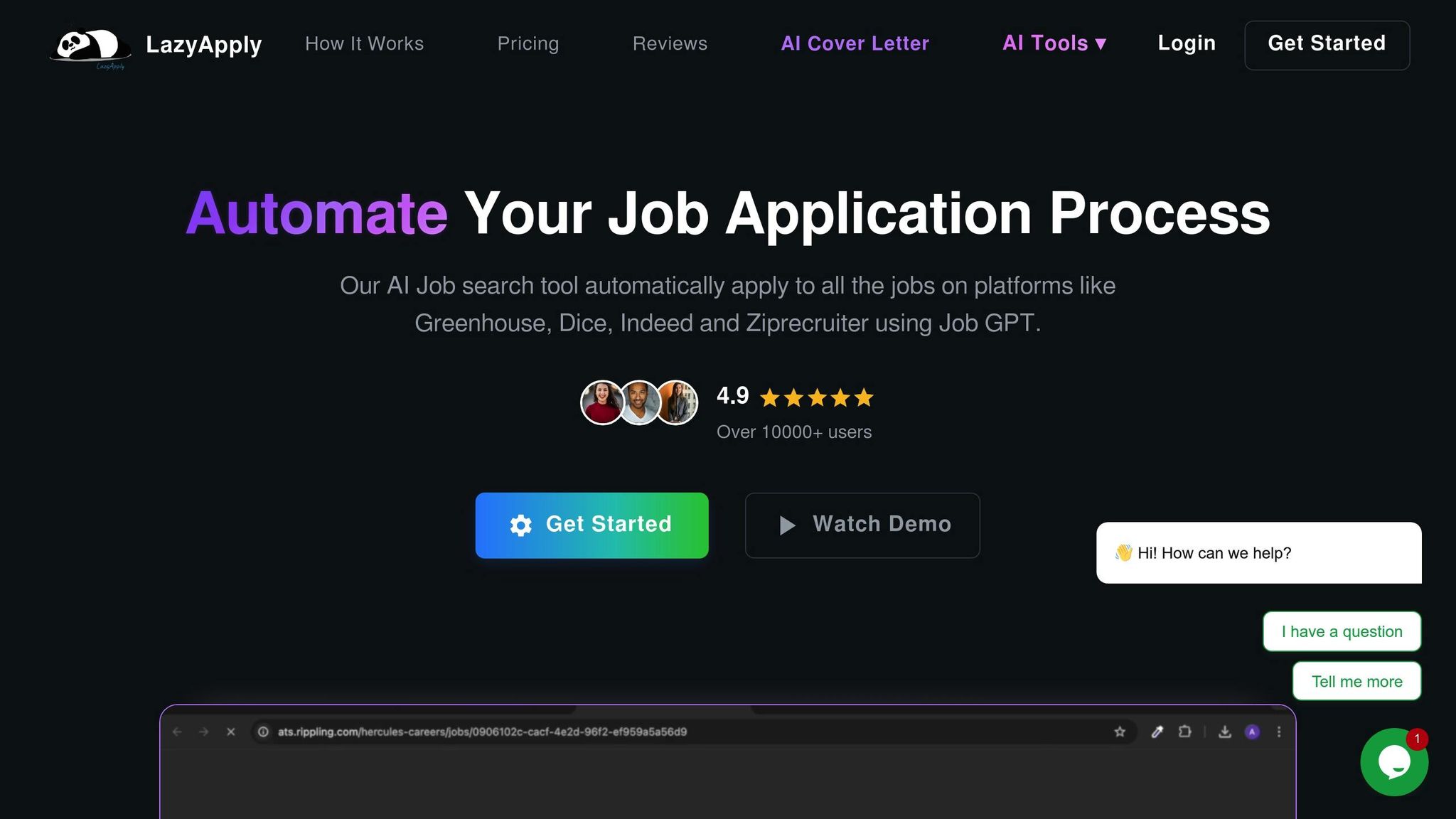
LazyApply is known for its ability to automate bulk job applications quickly. If your main goal is to send out as many applications as possible in a short time, LazyApply delivers. However, this speed often comes at the cost of personalization and effectiveness.
Why scale.jobs stands out:
- Human involvement in every application ensures tailored, ATS-optimized documents that align with specific job postings.
- Time-stamped proof of submission gives you visibility into the application process, unlike LazyApply's limited transparency.
- Dedicated WhatsApp support connects you directly with your assistant for real-time updates.
- One-time payment system eliminates ongoing subscription fees, making it cost-effective for high-volume applications (250+).
- Advanced ATS compliance ensures applications are crafted to bypass automated filters, increasing your chances of success.
LazyApply's fully automated process can sometimes make applications appear generic or bot-generated, which may hurt your chances compared to scale.jobs' personalized, human-driven approach.
| Feature | LazyApply | scale.jobs |
|---|---|---|
| Human Involvement | None (fully automated) | Human assistants manage every step |
| Resume Customization | Uses generic templates | Tailored to specific job postings |
| ATS Handling | Basic keyword matching | Expert human optimization |
| Application Method | Automated bot submissions | Manual submissions by trained staff |
| Proof of Work | Limited visibility | Time-stamped screenshots and updates |
| Pricing Model | Monthly subscription | One-time flat fee ($199–$1,099) |
Who should use LazyApply: Those looking for a quick, automated solution to send a high volume of applications and are okay with less personalization.
Who should choose scale.jobs: Job seekers applying to hundreds of positions who need ATS-optimized, manually submitted applications with full transparency and a one-time payment.
2. Simplify.jobs vs scale.jobs: AI Convenience vs. Human Expertise
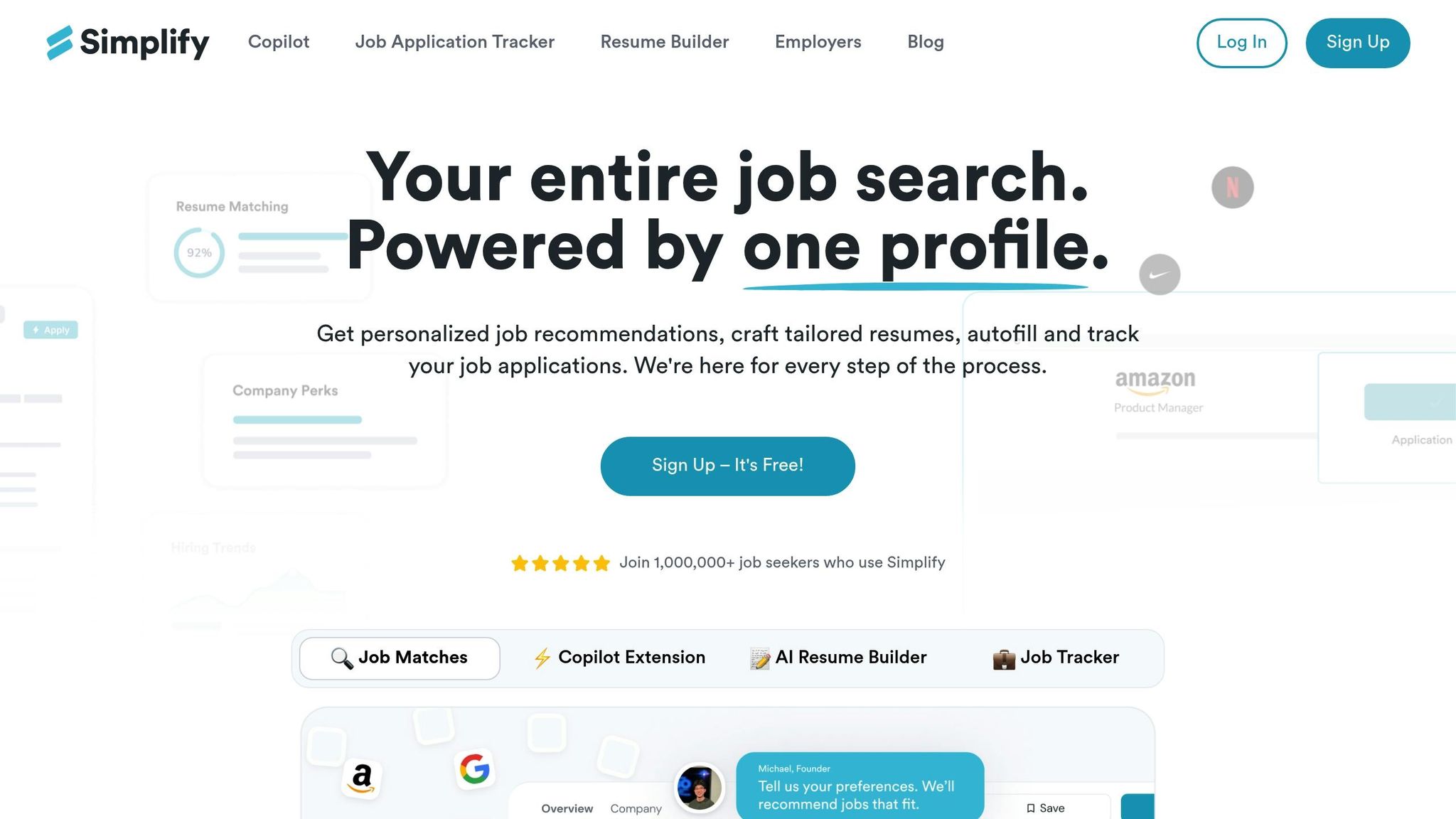
Simplify.jobs offers a sleek, AI-driven platform that matches users with jobs through a browser extension. While this self-service tool is convenient, it relies heavily on automated keyword matching, which may lack the nuance recruiters look for.
Why scale.jobs is better:
- Human reverse recruiters craft personalized resumes and cover letters, ensuring your unique voice comes through.
- Quick turnaround time - customized documents are ready within 24 hours, tailored to each job's requirements.
- Compatibility with all platforms, from corporate ATS systems to niche job boards, ensures broad reach.
- Transparent process includes WhatsApp updates, proof-of-work screenshots, and a dashboard for easy tracking.
- Flat-fee pricing avoids the recurring costs associated with Simplify.jobs' subscription model, making it ideal for high-volume applications.
Simplify.jobs' reliance on AI can result in generic applications that lack the personal touch recruiters value, whereas scale.jobs ensures each submission is thoughtfully crafted.
| Feature | Simplify.jobs | scale.jobs |
|---|---|---|
| Primary Method | AI-powered browser extension | Human reverse recruiters and assistants |
| ATS Optimization | Automated keyword matching | Human-crafted, ATS-compliant content |
| Proof of Work | Limited visibility | Screenshots, WhatsApp updates, dashboard |
| Content Quality | AI-generated (generic) | Personalized, human-written documents |
| Support | Self-service | Dedicated WhatsApp access |
| Pricing | Monthly subscription | One-time flat fee |
Who should use Simplify.jobs: Those who prefer a self-service tool and are comfortable with AI-driven, less customized applications.
Who should choose scale.jobs: Candidates who value human-crafted applications, transparency, and cost-effective pricing for high-volume job searches.
3. FindMyProfession vs scale.jobs: Premium Career Services vs. Affordable Scalability
FindMyProfession provides high-end career services, including professional resume writing and career coaching. While these services are highly personalized, the premium pricing may limit the number of applications you can afford to submit.
Why scale.jobs excels:
- Higher application volume - scale.jobs handles between 250 and 1,000 applications for a one-time fee, ranging from $199 to $1,099.
- Wider platform compatibility, ensuring applications are submitted across various job boards and ATS systems.
- Full transparency through WhatsApp updates and time-stamped screenshots, so you know exactly where your applications stand.
- Faster turnaround - customized resumes and cover letters are prepared within 24 hours for each job.
- Flexible pricing tiers allow you to scale your application efforts based on your goals and budget.
While FindMyProfession is ideal for those seeking in-depth career guidance, scale.jobs offers a scalable, cost-effective solution for candidates who need to apply to a large number of positions.
| Feature | FindMyProfession | scale.jobs |
|---|---|---|
| Method | Professional career services | Human virtual assistants |
| Customization | Focused on strategic impact | Tailored for high-volume applications |
| Transparency | Limited visibility | Screenshots, WhatsApp updates, dashboard |
| Application Volume | Limited by high pricing | 250–1,000 applications per package |
| Pricing | Premium fees (over $1,000) | One-time fee ($199–$1,099) |
Who should use FindMyProfession: Professionals looking for comprehensive career transformation services and willing to invest in premium offerings.
Who should choose scale.jobs: Job seekers aiming for high-volume, ATS-optimized applications with verified submissions at a budget-friendly, one-time cost.
Switch to scale.jobs If...
Here’s when making the move to scale.jobs could be the right choice for you:
1. You Need to Apply to 250+ Jobs
Applying to hundreds of positions on your own can lead to rushed and low-quality submissions. With scale.jobs, human assistants handle 250–1,000 personalized applications. For instance, a software engineer applied to 350 roles across the U.S. in just two weeks. By tailoring each application with keywords like "Python" and "AWS", the engineer achieved a 13% response rate, far surpassing the typical 2–5%. This approach resulted in five interviews and a $120,000 job offer in San Francisco.
The flat-fee pricing - ranging from $199 to $1,099 depending on application volume - eliminates the need for monthly subscriptions. Plus, if you land a job before all applications are submitted, you’ll receive a refund for unused credits, providing added flexibility.
2. Your Applications Keep Getting Rejected by ATS
Applicant Tracking Systems (ATS) are often the gatekeepers to your dream job, and optimization is essential. scale.jobs employs human experts to analyze job descriptions and tailor resumes with precise keywords, ATS-friendly formatting, and clear headers. This is critical since 67% of large companies use ATS systems that automatically reject applications lacking proper formatting.
Users have seen their ATS pass rates jump from under 5% to 25% after switching to scale.jobs. For example, one job seeker secured three interviews out of 100 applications after their resume was reformatted to meet ATS requirements.
3. You Want Proof of Every Application Submitted
Transparency matters. scale.jobs provides real-time WhatsApp updates with time-stamped screenshots of each submitted application. Additionally, a dashboard tracks submission dates, statuses, and links to the applications. This proof-of-work system addresses the frustration many candidates feel when waiting endlessly for feedback - 34% of applicants report not hearing back within 60 days.
One user who applied to 500 jobs through scale.jobs received photo evidence for every submission, ensuring that each application was customized and sent to platforms like LinkedIn, Indeed, and individual company websites.
4. You Want to Avoid Monthly Subscription Fees
Subscription services like LazyApply and Simplify.jobs charge $20–$50 per month, which can add up to over $300 annually if your job search spans several months. scale.jobs offers a one-time payment model, avoiding the pitfalls of recurring fees. You pay upfront for a specific batch of applications, and that’s it.
This structure is especially cost-effective for large-scale job applications. For example, one user applied to 400 jobs with scale.jobs for $299, while a subscription service would have cost over $150 for just three months of similar activity. If you’re also considering services like professional resume writing, scale.jobs combines document creation and job applications into a single, flat-fee package, making it a more streamlined option.
Decision Summary: When to Choose Each Option
Choosing the right tool depends on your specific job search needs. If you're an entry-level candidate comfortable with generic applications and can handle higher bot-detection risks, LazyApply might be a good fit. For those who value speed and prefer a DIY approach supported by AI, Simplify.jobs offers a streamlined option. On the other hand, FindMyProfession caters to executives or career changers who need in-depth coaching, though it comes with a higher price tag.
For those requiring a more personalized and precise solution, scale.jobs stands out. With human virtual assistants crafting each application, ATS-optimized resumes, and job-specific keywords, this service ensures applications are tailored to each opportunity. Proof of work is shared via WhatsApp screenshots, offering a level of transparency not often found elsewhere. Additionally, the one-time payment model removes the hassle of recurring subscription fees, making it a practical choice.
Here’s a quick comparison of the key differences:
| Feature | scale.jobs | LazyApply | Simplify.jobs | FindMyProfession |
|---|---|---|---|---|
| Method | Human Virtual Assistants | Automated Bots | AI "Copilot" | Career Coaches |
| Customization | High (Tailored per job) | Low (Generic templates) | Medium (AI-generated) | High (Expert-led) |
| Transparency | WhatsApp + Screenshots | Basic Dashboard | Basic Tracking | Email/Calls |
| Pricing Model | One-time Flat Fee | Lifetime/Subscription | Monthly Subscription | High Monthly Fee |
| Best For | High-stakes/Visa/Senior | Entry-level/Volume | DIY/Speed | Executive/Coaching |
When to Choose scale.jobs
Scale.jobs is a strong choice if you're pursuing senior-level positions, require visa sponsorship, or have faced challenges with ATS rejections. The human-driven approach ensures applications are tailored and optimized for success. The flat-fee pricing structure, along with transparent updates and a refund policy for unused applications, makes it a cost-effective option compared to subscription-based services.
For those who want to go beyond application submissions, pairing scale.jobs with professional resume writing services can provide a winning combination. This approach offers precise, tailored applications alongside expert career guidance - without the ongoing costs associated with full-service coaching.
FAQs
How can I find the exact ATS keywords for a job?
When reviewing a job description, pay close attention to the specific keywords that highlight the desired skills, qualifications, and industry-specific terms. Look for phrases that are repeated or particularly emphasized, as applicant tracking systems (ATS) are designed to prioritize resumes that closely match these terms. By aligning your resume with the language used in the job posting, you improve your chances of passing ATS scans and moving forward in the hiring process.
What resume format is safest for ATS parsing?
When it comes to creating a resume that works seamlessly with Applicant Tracking Systems (ATS), simplicity is key. Stick to a single-column layout and use standard fonts such as Arial or Calibri for readability. Clearly label each section with straightforward headers, and avoid adding graphics, tables, or multi-column designs. These elements can confuse ATS software, potentially causing your resume to be misread or skipped altogether.
How can I prove my applications were submitted?
You can confirm that your applications have been submitted by utilizing platforms like Scale.jobs. They provide proof-of-work tracking through tools such as screenshots and real-time updates, giving you clarity and assurance for each application.