The Real Problem with Automated Job Applications
ATS and bot tools often reject qualified candidates over formatting, keywords, or bias; a hybrid human-plus-AI approach preserves context and accuracy.

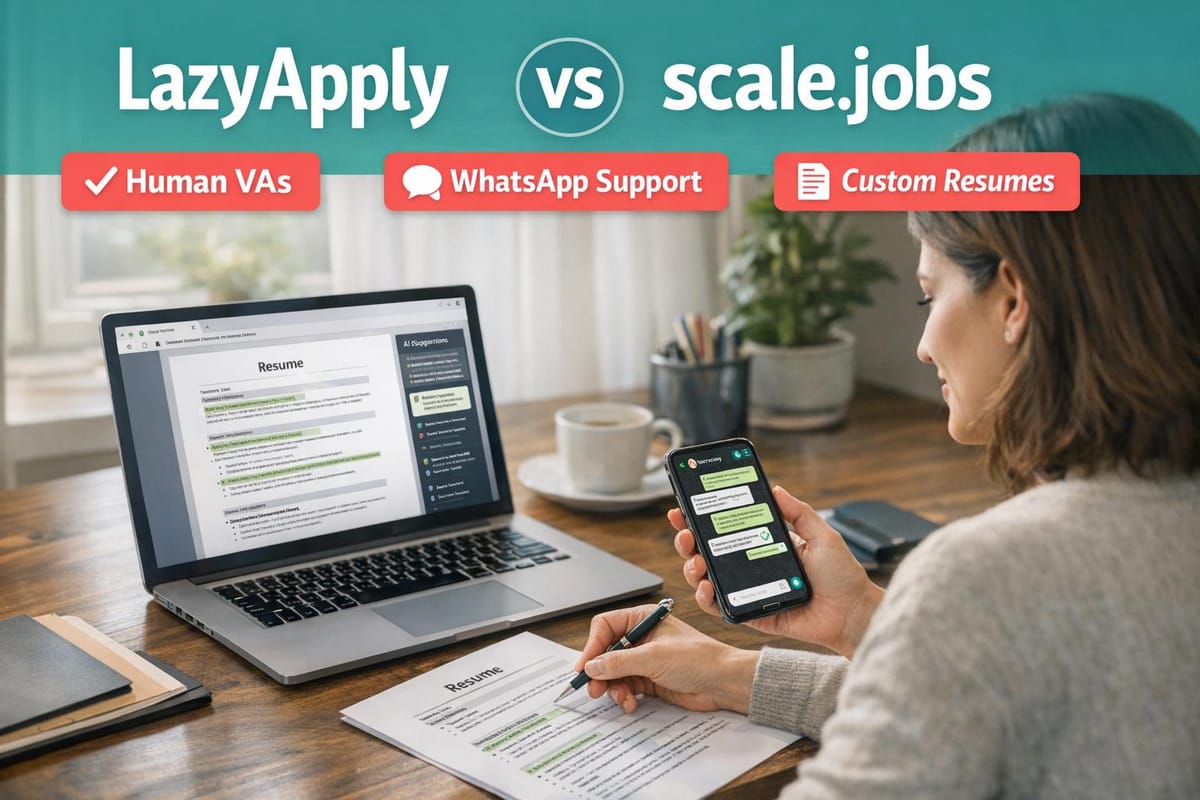
Finding a job today often feels like battling against invisible barriers. Automated systems like Applicant Tracking Systems (ATS) dominate hiring processes, used by nearly 99% of Fortune 500 companies. While these tools help companies manage overwhelming applications - some postings get 1,000 in just 10 minutes - they also reject 75-90% of resumes, often disqualifying qualified candidates due to formatting issues or keyword mismatches.
On the flip side, job seekers are turning to automation tools like LazyApply and Simplify.jobs to keep up, but these bot-driven solutions often introduce errors, harm reputations, and fail to address personal details or career context. This creates a frustrating cycle where both employers and candidates rely on flawed systems, leaving potential matches overlooked.
Human-powered services like scale.jobs offer a better solution. By combining ATS-friendly strategies with manual application processes, they ensure accuracy, personalization, and transparency - factors critical for job seekers aiming to stand out. This article breaks down why automation often fails and how a hybrid approach can improve your job search success.
Allowing AI Agents to Apply for Jobs Is a Mistake
Problems with Automated Job Application Systems
Automated job application systems might seem like a time-saver, but for job seekers, they often feel more like a roadblock. The main issue? Most Applicant Tracking Systems (ATS) are just basic sorting tools, not advanced AI. These systems rely on rigid algorithms to categorize your information, which often leads to oversights that can undermine your chances of standing out.
ATS Keyword Filters Reject Qualified Candidates
One of the biggest flaws with ATS software is its reliance on exact keyword matches. This means even highly qualified candidates can be excluded if their resumes don’t align perfectly with the job description. For example, if a job posting mentions "Adobe Creative Suite" and your resume only lists "Photoshop", the system might reject your application - even though Photoshop is part of that suite. Similarly, variations in job titles can trip up the system: "online marketing specialist" and "digital marketing professional" might describe the same role, but unless both phrases are in your resume, the ATS won’t connect the dots.
Formatting issues also create hurdles. Resumes with columns, tables, or graphics often confuse ATS software. If your contact details are in the header or footer, the system might not even see them, making it impossible for recruiters to reach out. Hyperlinks and uncommon acronyms like "LSW" (for Licensed Social Worker) can also lead to misinterpretation or outright rejection.
The irony? Employers are well aware that their ATS systems often screen out strong candidates simply because their resumes don’t meet these rigid technical standards. Tailored resumes - ones customized for specific job descriptions - can boost your chances of landing an interview. On average, tailored resumes result in six interview opportunities per 100 applications, compared to fewer than three for generic submissions. But that’s only if the ATS doesn’t reject your application first.
"88% of employers believe ATS systems can screen out high-quality candidates because many candidates don't submit ATS-friendly résumés." - J.R. Johnivan, HR Tech Journalist
Automation Misses Personal Details and Career Context
Beyond keyword mismatches, ATS systems struggle to capture the full picture of your career. While they can identify the presence of a skill, they can’t assess its scope or impact. For instance, an ATS might flag "project management" on your resume, but it won’t know whether you managed a $50,000 project or a $5 million one. It also can’t interpret the reasons behind a career pivot or the significance of a gap for caregiving or freelance work. The story behind your achievements - the "how" and "why" - is entirely lost.
This is especially problematic for people with non-linear career paths. Automated systems are designed to reward traditional, straightforward progressions, leaving those with unconventional backgrounds at a disadvantage. Tools like Jobscan.co and Rezi.ai attempt to optimize resumes for ATS software by improving keyword density, but they strip away the personal context that makes your experience memorable. The result is what recruiters call "cookie-cutter resumes" - perfectly formatted but utterly forgettable. This lack of depth is why human-driven solutions like scale.jobs are becoming increasingly important.
"AI doesn't understand context. It doesn't know how you got results or what made your impact unique. Without that, your resume might check all the boxes for keyword searches, but it won't connect with a human reader." - Adam Karpiak, Co-founder, Karpiak Consulting
AI Tools Carry Built-In Bias
Another troubling issue with automated systems is their tendency to replicate biases. Since AI models learn from historical hiring data, they often reinforce existing patterns, which can disadvantage diverse candidates. For example, if a company has historically hired mostly men for engineering roles, the AI may unconsciously favor male applicants. While this isn’t deliberate discrimination, the effect is the same: qualified candidates from underrepresented groups are filtered out before anyone even sees their applications.
These systems also develop what experts call "proxy" biases. For instance, an algorithm might penalize candidates who list "softball" as a hobby while favoring those who list "baseball" - a subtle form of gender bias. Similarly, filtering by graduation dates can lead to age discrimination. The scale of this problem is massive, with over 10 million workers in the U.S. classified as "hidden workers" - qualified individuals overlooked due to career gaps or unconventional education. In fact, 75% of job applications never reach a human because they’re filtered out by ATS software.
"One biased human hiring manager can harm a lot of people in a year... But an algorithm that is maybe used in all incoming applications at a large company… that could harm hundreds of thousands of applicants." - Hilke Schellmann, Author and Assistant Professor at NYU
The risks increase when automation interacts with other automated tools. For instance, "bot" applications from platforms like LazyApply and LoopCV.pro have been caught making errors, such as misreporting skills or demographics. These inaccuracies can tarnish your reputation with potential employers. When automation takes over too much of the process, mistakes multiply - and it’s the job seekers who bear the consequences. This highlights the need for human oversight, as offered by services like scale.jobs, to ensure fairness and accuracy in the hiring process.
LazyApply vs scale.jobs vs Jobscan.co vs Simplify.jobs: Why Automation Fails
Automated vs Human-Powered Job Application Services Comparison
After discussing the inherent challenges of automated systems, let’s dive into how specific tools like LazyApply, Simplify.jobs, LoopCV.pro, and Jobscan.co compare to human-driven alternatives like scale.jobs. By examining these platforms, it becomes clear why automation alone often falls short in addressing the complexities of job applications. This breakdown highlights the importance of human expertise, as exemplified by scale.jobs.
LazyApply vs scale.jobs: Why Manual Effort Wins Over Bots
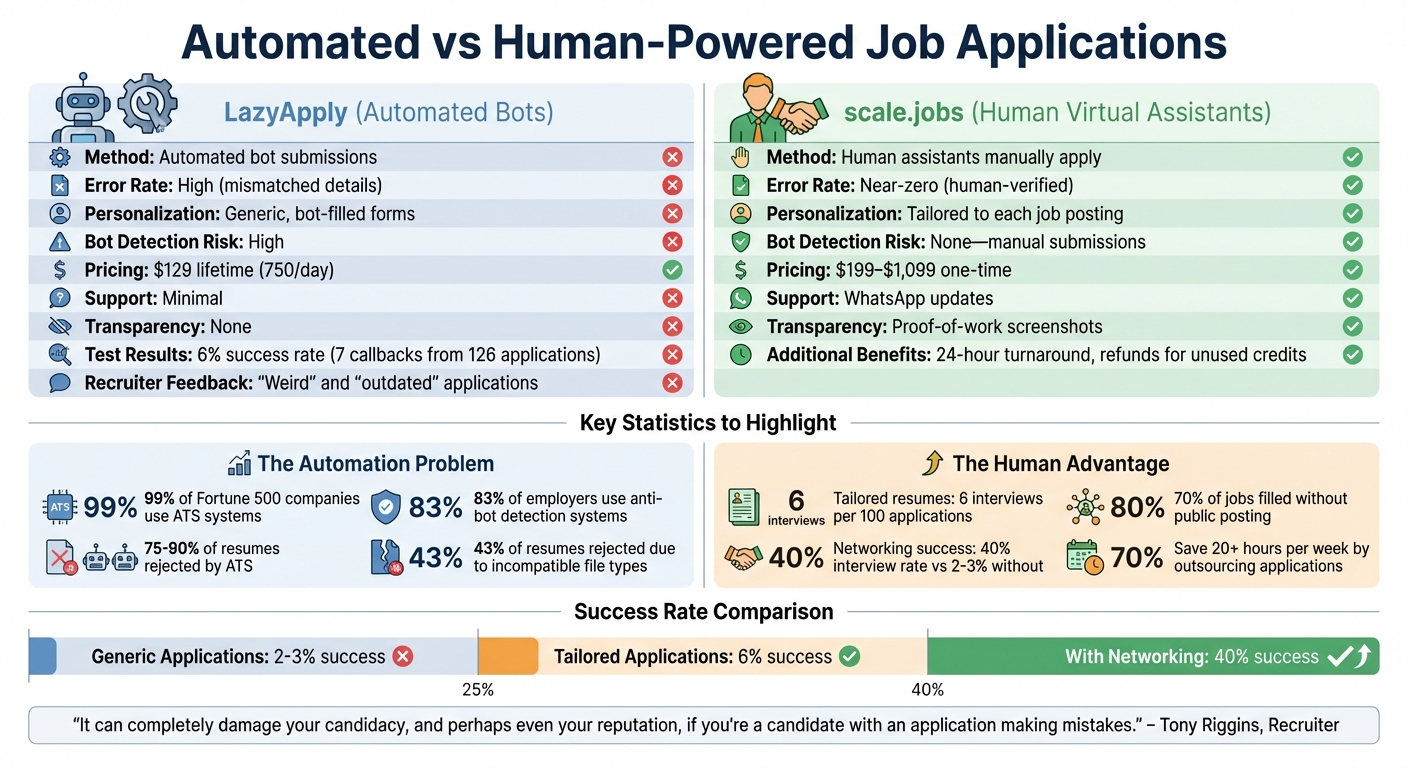
Unlike LazyApply, which relies on bots for mass submissions, scale.jobs emphasizes human oversight to ensure precision and personalization. LazyApply offers to submit up to 750 applications daily for a one-time fee of $129. While this might sound appealing, real-world tests reveal serious shortcomings. For instance, in March 2024, Business Insider’s Aki Ito tested LazyApply by submitting 126 applications. The results? The bot frequently introduced errors, such as outdated and mismatched details. Although she received 7 callbacks - a 6% success rate - recruiters described the applications as "weird" and "outdated."
Beyond errors, bot-driven submissions can harm your professional image. As recruiter Tony Riggins cautions:
"It can completely damage your candidacy, and perhaps even your reputation, if you're a candidate with an application making mistakes."
Marc Cenedella, founder of Ladders, also weighed in on automation’s limitations:
"What we're interested in is quality, accuracy, and speed. So far, we haven't found any [bots] that have met those bars for us."
scale.jobs offers a starkly different experience. Instead of automation, trained virtual assistants handle every application manually. They customize resumes and cover letters for each job and provide proof-of-work screenshots via WhatsApp. This human-centered process eliminates errors, avoids bot detection, and ensures up-to-date documents. Pricing ranges from $199 (250 applications) to $1,099 (1,000 applications), with unused credits refunded and full support included.
| Feature | LazyApply (Bots) | scale.jobs (Human VA) |
|---|---|---|
| Method | Automated bot submissions | Human assistants manually apply |
| Error Rate | High (mismatched details) | Near-zero (human-verified) |
| Personalization | Generic, bot-filled forms | Tailored to each job posting |
| Bot Detection Risk | High | None - manual submissions |
| Pricing | $129 lifetime (750/day) | $199–$1,099 one-time |
| Support | Minimal | WhatsApp updates |
| Transparency | None | Proof-of-work screenshots |
Jobscan.co vs scale.jobs: Keywords vs Context
Jobscan.co and scale.jobs take fundamentally different approaches. Jobscan.co is a self-service tool that focuses on keyword optimization. Users upload their resume and a job description, and the platform identifies keywords to improve ATS (Applicant Tracking System) scores. Monthly plans range from $29.95 to $89.95. While helpful for identifying missing keywords, Jobscan leaves the actual rewriting and formatting to the user.
The downside? Keyword scanning alone doesn’t account for the context or storytelling needed to grab a recruiter’s attention. As Ian Siegel, ZipRecruiter’s CEO, notes:
"Conventional wisdom will kill you in your search for a job. You want the simplest, most boring résumé template you can find."
scale.jobs bridges this gap by combining AI optimization with human expertise. Their virtual assistants craft ATS-friendly resumes and cover letters that reflect your unique career story. With a 24-hour turnaround, they handle every aspect of the application process, from writing to submission - even on niche job boards that automated tools can’t access. This approach ensures your application stands out for all the right reasons.
Simplify.jobs and LoopCV.pro vs scale.jobs: The Human Edge
Platforms like Simplify.jobs and LoopCV.pro promise to simplify job searches with automation. They auto-fill application forms and track submissions, but like LazyApply, they rely heavily on bots. These systems often falter when forms require detailed personal information or when employers use anti-bot detection systems. With 83% of employers utilizing such filters, mass-submitted applications are frequently flagged and rejected before they’re even reviewed by a human.
scale.jobs avoids these pitfalls by relying on a human-powered approach. Virtual assistants handle complex requirements, such as visa-related questions and portfolio uploads, with meticulous accuracy. Every form is filled manually, eliminating the risk of bot detection. Additionally, users receive WhatsApp updates and proof-of-work screenshots, ensuring transparency. This level of care is especially critical for job seekers navigating visa challenges, such as H1B, F1, CPT, TN, O1, EB1A, Canada PR, or UK Global Talent Visa applications.
How to Beat Automated Job Application Systems
Now that you know why relying solely on automation often falls short, let’s explore how to strike the right balance - using technology to save time while keeping the human touch for accuracy and personalization.
Use AI for Speed, Humans for Precision
Speed is where AI shines, but accuracy and personalization require a human touch. With scale.jobs, you get a hybrid approach that combines both. AI quickly generates tailored resumes and cover letters, pulling relevant keywords and formatting them in seconds based on job descriptions. Afterward, human experts step in to review, finalize, and manually submit each application. This two-step process avoids the common pitfalls of fully automated systems.
As Adam Karpiak, Co-founder of Karpiak Consulting, puts it:
"The smartest way to use AI is as an editor, not a ghostwriter. Let it help you tighten your language... but make sure the content... comes from your own experience."
With scale.jobs, you get real-time, human-reviewed applications. Packages start at $199 for 250 applications, and any unused credits are refunded. This blend of technology and human insight also ensures your resume uses the right keywords without losing its personal touch.
Optimize Keywords Without Sacrificing Personality
Passing ATS filters is all about using keywords strategically, but it’s not just about loading your resume with industry buzzwords. Instead, weave keywords naturally into achievement-based bullet points. For example, instead of listing "Project Management" as a standalone skill, write: "Led cross-functional project management for a 12-person team, delivering a product launch 3 weeks ahead of schedule."
Match the language from job descriptions exactly. If a job posting says "Search Engine Optimization (SEO)", use that exact phrasing. Spell out acronyms at least once, and always quantify your achievements to provide context. Stick to clean, standard resume formats with headings like "Work Experience" and "Education." Use a single-column layout and submit your resume in .docx format to avoid issues - 43% of resumes are rejected due to incompatible file types. Avoid tables, graphics, and text boxes, as they often don’t translate well when parsed by ATS systems.
Reclaim Time for Networking and Interview Prep
Did you know that networking accounts for 80% of job placements? Yet many job seekers spend over 20 hours a week on repetitive application forms instead of focusing on building connections. Referrals can increase your chances of landing an interview from 2–3% to an impressive 40%.
By outsourcing your applications, you free up time for activities that truly matter - like reaching out to hiring managers on LinkedIn, conducting informational interviews, and preparing for actual interviews. Since 70% of jobs are filled without ever being publicly posted, these personal connections can often bypass the traditional application process altogether.
Tailored applications can yield about 6 interview opportunities per 100 submissions, compared to fewer than 3 with generic resumes. By combining accurate, human-reviewed applications with the time saved for networking, you tackle your job search from two critical angles - getting through ATS filters and building meaningful relationships that can open doors.
Conclusion: Why Human-Powered Job Applications Work Better
Relying solely on automated systems often leads to generic, impersonal applications. This pushes employers to tighten ATS filters, resulting in 75% of resumes being rejected before they even reach a human. With 93% of job seekers using the same AI tools, it’s no wonder applications often blend into a "sea of sameness." Worse, these bots can make costly errors that damage your professional image. Clearly, the need for a more accurate and personalized approach is undeniable.
That’s where scale.jobs steps in, combining AI’s speed with the precision of human expertise. Our trained virtual assistants handle every application manually, eliminating errors and avoiding bot detection. You’ll receive ATS-optimized resumes tailored to each job description, along with real-time updates via WhatsApp, complete with proof-of-work screenshots. Plus, with a simple one-time payment starting at $199 for 250 applications - and refunds for unused credits - you avoid subscription hassles.
This method doesn’t just sidestep the pitfalls of automation; it also frees up your time for what matters most: networking. Tailored applications lead to about 6 interviews per 100 submissions, compared to fewer than 3 for generic resumes. By outsourcing the tedious work to professionals who get it right the first time, you save over 20 hours a week - time you can dedicate to networking, which can boost your interview chances from 2–3% to an impressive 40%. This approach treats job searching as a human challenge, not just a data problem.
When technology supports your skills without overshadowing your individuality, it can transform your job search. By having experts review your achievements, optimize keywords in context, and submit applications manually, you bypass the filters and connect directly with hiring managers - turning your efforts into real opportunities. That’s the difference human-powered applications can make.
FAQs
How can I optimize my resume for ATS while keeping it personal and engaging?
To ensure your resume gets through ATS (Applicant Tracking System) filters without losing its personal appeal, stick to a straightforward, single-column format with standard headings. Avoid fancy designs or elaborate layouts that might trip up automated systems.
Make sure to weave relevant keywords naturally into your resume, matching the job description while keeping the content genuine and engaging. Balance showcasing your technical expertise with soft skills that highlight what sets you apart. This approach not only improves your chances with ATS but also makes your resume stand out to human recruiters.
Steer clear of using images, charts, or non-traditional fonts, as these elements can create issues for automated systems trying to read your resume. Keep it simple, clear, and professional.
What are the downsides of using automation tools like LazyApply for job applications?
Using automation tools like LazyApply might seem like a shortcut in your job search, but it can actually work against you. These tools often send out generic, bulk applications that employers are quick to flag and reject. In fact, some companies may go as far as blacklisting candidates who use automated submissions, potentially harming your future chances with them.
Another major downside is that automated applications typically lack the personalization needed to match specific roles. This makes it harder to pass ATS (Applicant Tracking System) filters or catch the attention of recruiters. By contrast, applications crafted by hand are tailored, thoughtful, and far more likely to lead to interviews. Relying too heavily on automation can waste valuable time and significantly lower your chances of landing the job you’re aiming for.
Why is human oversight better than automated systems in job applications?
Human involvement brings a crucial layer of improvement to the job application process, addressing the common shortcomings of automated systems like ATS (Applicant Tracking System) filters. These automated tools often misread or misjudge a candidate’s qualifications, leading to many skilled applicants being unfairly filtered out. In fact, research highlights that more than 75% of resumes never even make it to a hiring manager’s desk.
When humans step in, applications become more personalized and aligned with the expectations of potential employers. This approach not only helps applicants navigate ATS filters more effectively but also ensures resumes are crafted with the right keywords, formats, and contextual relevance. Unlike purely automated methods, human-assisted processes bring a sense of transparency, accountability, and care that technology alone simply can’t replicate. By blending human expertise with technological tools, job seekers can produce applications that truly stand out in today’s competitive job market.