Public-Private Workforce Equity: Challenges and Solutions
Public-private workforce equity needs investment in training, data-driven accountability, skills-based hiring, paid internships, and retention for quality jobs.

Public-private workforce equity programs aim to address systemic barriers by using human assistants for hiring, pay, and career advancement - factors like race, gender, and ethnicity that still influence outcomes. Despite progress, challenges persist, including funding gaps, weak accountability, and poor collaboration between sectors. Here’s what you need to know:
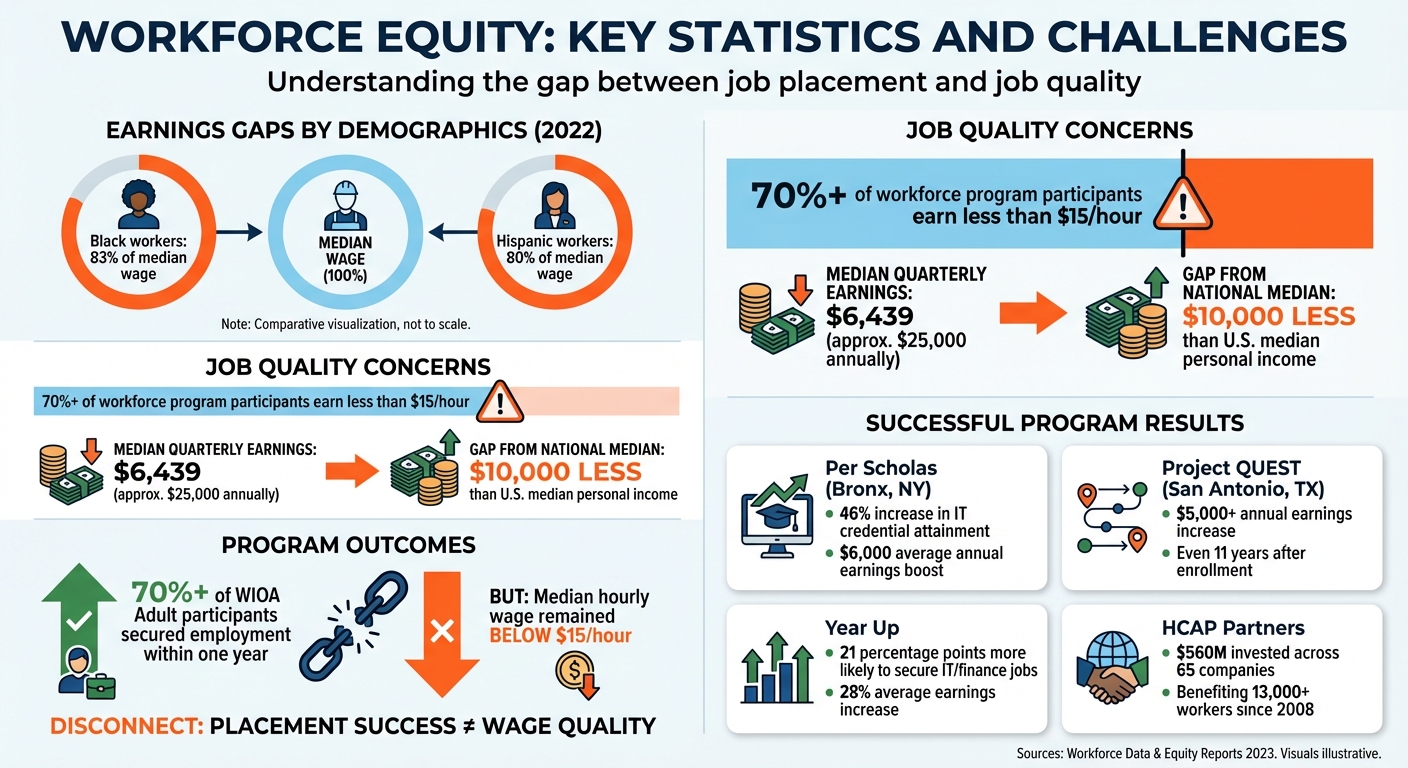
- Earnings Gaps: Black workers earned 83% of the median wage in 2022, while Hispanic workers earned 80%. Women and minorities remain underrepresented in higher-paying fields.
- Job Quality Matters: Many workforce programs secure jobs, but over 70% of participants earn less than $15/hour - far below a living wage.
- Key Challenges: Insufficient funding for training, fragmented data systems, and misaligned priorities between public and private sectors hinder progress.
- Effective Solutions:
- Targeted Outreach: Programs like Blackstone’s Career Pathways focus on underrepresented groups, including veterans and individuals without college degrees.
- Skills-Based Hiring: Nonprofits like Per Scholas train workers for high-paying fields, boosting annual earnings by thousands.
- Paid Internships: Programs like Year Up combine training with paid opportunities, making career pathways accessible for low-income individuals.
- Retention Strategies: Clear promotion criteria, better pay practices, and ongoing career development reduce turnover and improve equity.
Quick Overview of Recommendations:
- Invest in training that leads to high-wage careers.
- Align public and private goals for better collaboration.
- Use data to track equity outcomes and adjust strategies.
- Support workers with childcare, transportation, and other essential services.
The ultimate goal? Not just jobs, but quality jobs that provide fair pay, benefits, and growth opportunities. Workforce equity requires a shift in focus from placement numbers to meaningful, measurable progress.
Workforce Equity Statistics: Wage Gaps, Earnings, and Job Quality Metrics
Advancing Workforce Equity in BIL
Main Challenges in Public-Private Workforce Equity Programs
Workforce equity programs often stumble over structural hurdles that arise from the differing priorities, metrics, and operational styles of the public and private sectors. These obstacles - ranging from funding issues to data challenges and collaboration gaps - undermine efforts to create equitable opportunities. Let’s break them down.
Insufficient Investment in Training and Career Development
The current reimbursement models place a heavy burden on smaller community organizations, requiring them to cover costs upfront before receiving payment. This practice forces many into "survival mode", making long-term planning nearly impossible.
"The funding is very, very, very helpful because very little funding helps you build your infrastructure... this funding continues to allow us to have those conversations." - Amber Roth, Executive Director, Worker and Education Resource Center
Funding restrictions further complicate matters. Essential activities like focus groups, participant stipends, transportation, and meals are often excluded from funding eligibility. This lack of support disproportionately impacts underrepresented groups. At the same time, private businesses are scaling back their investments in workforce training, shifting the financial burden of retraining onto workers - many of whom are already struggling to make ends meet. These funding gaps lead directly to accountability issues, which we’ll explore next.
Missing Data and Weak Accountability
While over 70% of WIOA Adult participants secured employment within a year of exiting their programs, the median hourly wage for these individuals remained below $15 per hour. In fact, median earnings for participants were reported at $6,439 for the fiscal quarter following program completion - equating to roughly $25,000 annually. That’s $10,000 less than the median personal income for workers nationwide.
The emphasis on quantity over quality in reporting requirements exacerbates the problem. Organizations are incentivized to focus on the number of participants trained rather than the actual impact on their lives. This can lead to practices like "creaming", where programs prioritize individuals who are already more likely to succeed, sidelining those who need extra support to thrive.
Fragmented data systems only add to the chaos. Information is often siloed across various public and private agencies, making it difficult for job seekers to navigate resources or for policymakers to assess long-term outcomes. For example, a 2019 study across 24 states revealed that none had strong alignment between the credentials earned by high school students and the actual job market demand for those credentials. Without cohesive data, collaboration becomes even harder.
Barriers to Collaboration
The public and private sectors often operate with conflicting goals. Public systems are focused on compliance metrics, while private partners prioritize return on investment (ROI). This disconnect discourages the kind of long-term commitments needed to achieve equity goals, which often take years to bear fruit.
"CBOs should be at the table from the beginning of any crucial conversation, not brought in after substantial decision-making has taken place." - Doug Mollett, Economic Mobility Program Manager, NCRC
Community-based organizations (CBOs) are particularly sidelined. Too often, they’re treated as mere service providers rather than equal partners, brought into initiatives only after major decisions have already been made. This exclusion wastes the invaluable local knowledge these organizations bring to the table. Smaller businesses face their own hurdles, lacking the HR capacity and data infrastructure needed to effectively track equity outcomes. Bridging these gaps is essential to creating workforce programs that deliver real, lasting change.
Better Strategies for Recruitment and Hiring
Public-private partnerships need to rethink recruitment strategies to attract a broader range of qualified candidates. Unlike FindMyProfession, scale.jobs combines human expertise with ATS-friendly tools to deliver faster and more transparent results. Effective recruitment practices can be measured by their impact, and several organizations have already shown how to successfully engage diverse talent pools.
Targeted Outreach Programs
The best outreach programs don’t just aim to reach more people - they actively collaborate with communities that have historically been excluded from access to quality jobs. Take Blackstone’s "Career Pathways" program, launched in spring 2025 across more than 70 portfolio companies. Under the leadership of Marcus Felder, the initiative focuses on hiring veterans, people with disabilities, and individuals without four-year college degrees. To ensure progress, Blackstone introduced an "Impact Measurement Framework" in fall 2024, which helps companies set clear goals and track the ROI of skills-based hiring.
"The Career Pathways program aims to broaden the high-quality talent networks from which the portfolio companies recruit, develop, and advance talent from communities that are historically untapped in quality jobs, including people without a four-year college degree, people with disabilities, and veterans." – Marcus Felder, Managing Partner and Head of Career Pathways, Blackstone
Regional collaborations have also made a difference. Between 2024 and 2025, organizations like the National Fund for Workforce Solutions and PolicyLink led working groups in cities such as San Francisco, Dallas, Chicago, and Boston. These groups used detailed data to uncover racial employment gaps and created action plans tailored to each region. These efforts are vital for breaking down systemic barriers and creating direct pathways to quality jobs.
Focusing on outreach is a great start, but shifting attention to skills-based hiring takes recruitment to the next level.
Skill-Based Hiring Methods
Skill-based hiring prioritizes what candidates can actually do instead of focusing on their educational background.
For example, Per Scholas, a nonprofit IT training organization operating in over 20 cities, has seen great results with its 15-week training program in the Bronx, New York. Participants saw a 46% increase in IT credential attainment, and graduates reported an average $6,000 annual earnings boost. Similarly, Project QUEST in San Antonio, Texas, targets high-paying healthcare careers like nursing and medical technology. Participants in this program experienced annual earnings increases of over $5,000, even 11 years after starting.
This shift from degrees to competencies also helps reduce unconscious bias. Standardized skill assessments and structured interviews create objective ways to evaluate candidates, minimizing subjective judgments that often disadvantage minority applicants. These skill-focused strategies pave the way for training models that promote workforce equity.
Paid Internships and Training Programs
Unpaid training programs are simply not an option for many low-income workers. If someone is living paycheck to paycheck, they can’t afford to spend months in an unpaid role, no matter how promising the career prospects.
HCAP Partners tackled this issue with its "Gainful Jobs Approach." Since 2008, the firm has invested over $560 million across 65 companies, directly benefiting more than 13,000 workers. At the end of each investment, HCAP collaborates with companies to develop a "Strategic Road Map" that sets annual goals for better wages, career advancement, and employee benefits like 401(k) matches and assistance funds. This approach has delivered real results, including higher wages and improved financial security for frontline workers.
Another standout program is Year Up, which combines training with paid internships. Participants receive six months of skills training followed by a six-month paid internship, making the program accessible to low-income individuals while giving employers a chance to assess talent in real-world settings. Graduates of Year Up are 21 percentage points more likely to secure jobs in IT or finance and see an average earnings increase of 28%.
For job seekers navigating these new skills-based opportunities, tools like scale.jobs can be a game-changer. With its ATS-compliant resume builder and AI-powered customization tools, scale.jobs helps candidates translate their new skills into polished application materials that pass automated screening systems - a critical step in today’s hiring landscape.
What sets scale.jobs apart:
- Tailored applications supported by human assistants, unlike fully automated competitors
- An ATS-compliant resume builder that outperforms tools like LazyApply
- Transparent support via WhatsApp and proof-of-work features not found elsewhere
Better Training, Development, and Retention
Getting people hired is just the beginning. The real challenge lies in keeping employees engaged, helping them grow, and reducing turnover. Public-private partnerships that focus on long-term development tend to achieve much better results than those that stop at initial placement. By connecting recruitment strategies with ongoing training and career advancement, these partnerships create a more sustainable workforce.
Industry Partnerships and Clear Career Paths
The most impactful training programs are not created in isolation - they thrive on collaboration between employers, community organizations, and training providers. A great example of this is Project QUEST in San Antonio, Texas. As reported by MDRC in July 2023, this program focused on healthcare careers like nursing and medical technology. The results? Participants earned over $5,000 more annually nine years after enrolling compared to a control group. This success was driven by targeted advising and financial support that helped participants complete their training.
"CBOs should be at the table from the beginning of any crucial conversation, not brought in after substantial decision-making has taken place." – Doug Mollett, Economic Mobility Program Manager, NCRC
What sets these partnerships apart is their emphasis on outcomes-oriented contracting. Instead of simply tracking how many people finish training, these programs focus on long-term metrics like wage growth and job retention. Data-sharing agreements between public agencies and private employers ensure that everyone is aligned toward meaningful economic progress, rather than just meeting basic benchmarks. The CHIPS and Science Act of 2022 now encourages these sectoral partnerships for federal funding applicants, signaling a shift toward this collaborative approach.
Another key component is alumni advancement coaching. Employees need guidance beyond their first job - whether it’s skills assessments, career planning, or advice on moving up the ladder within their industry. This ongoing support helps sustain growth. Automated messaging systems can further democratize access to learning opportunities, bypassing potential biases from managers who might limit advancement opportunities.
Platforms like Scale.jobs offer a unique edge over tools like Jobscan or ResumeWorded. While those platforms focus primarily on resume optimization, scale.jobs provides end-to-end support, including human assistants who understand the nuances of career transitions. Whether you’re stepping into your first role or aiming for a promotion, their dedicated WhatsApp support and proof-of-work transparency ensure you’re always informed about your progress.
Why scale.jobs stands out:
- Human-powered career guidance that goes beyond automated keyword tools
- Real-time WhatsApp updates with proof-of-work screenshots
- Flat-fee model that eliminates recurring subscriptions and saves time
- ATS-optimized resumes and cover letters crafted by trained assistants
- Comprehensive job search management, far surpassing basic resume scanning
Culturally Adapted Training Programs
For workforce development to be effective, training programs must address the cultural and linguistic needs of participants. Generic programs often miss the mark, especially for diverse populations. The Integrated Basic Education and Skills Training (I-BEST) model is a great example of how to do this right. By pairing professional-technical instructors with ESL or adult basic education instructors, the program helps participants build both language and vocational skills simultaneously, rather than making them complete one before starting the other.
"The old adage 'one size fits all' has never been less true in workforce development." – Center for American Progress
Tailoring training programs goes beyond simple translation. For example, programs serving justice-involved individuals must teach specific skills like how to discuss gaps in employment or incarceration history during interviews - something generic training often ignores.
This is where data-driven customization becomes critical. By analyzing data disaggregated by race, ethnicity, gender, and disability, programs can pinpoint opportunity gaps and adjust their strategies. The challenges faced by immigrant communities differ from those faced by Black populations in densely populated areas, and effective training programs recognize these distinctions.
Wraparound support is also essential. Programs must integrate services like childcare, transportation, and housing assistance to ensure participants can complete their training. Bridge programs offering tutoring and foundational skills in math and reading can help those with educational gaps qualify for advanced sector training.
Clear Promotion and Pay Practices
Even with strong training and career path strategies, retention hinges on transparent promotion and pay practices. Clear criteria for promotions and equitable pay structures are essential. Without these, even the best-trained employees may leave for employers offering more straightforward advancement opportunities.
"Instead of closing skill gaps, assessing job quality would be a structural means to combat labor market inequalities and foster equity across the education, workforce, and employment ecosystem." – Center for American Progress
Objective promotion criteria can help counter biases where employers rely on assumptions about race or background to gauge productivity. Dashboards and tools that track disaggregated pay and promotion data can help organizations quickly spot and address inequities.
Retention isn’t just an ethical priority - it’s also cost-effective. In 2021, the average cost to hire a new employee was $4,683. Offering wealth-building opportunities like profit-sharing and retirement savings plans gives employees a stake in the company’s success. This is especially important as nearly half of the fastest-growing occupations pay less than $30,000 annually. Equity efforts should define a "living wage" based on the industry’s median wage as a baseline.
Finally, formalizing data-sharing agreements between public and private agencies creates systems that can track wage and earnings data while protecting individual privacy. These structures ensure that progress toward fair pay and retention is measurable and sustainable.
Measuring and Maintaining Workforce Equity Progress
Tracking workforce equity progress means looking beyond job placement numbers to assess job quality - fair wages, benefits, and opportunities for growth. While placement rates might be high, earnings often fall far below national averages. This highlights the need to shift focus from sheer numbers to the quality of jobs people are landing. Let’s explore how setting clear equity goals, using robust data analysis, and fostering ongoing collaboration can lead to meaningful improvements.
Equity Plans with Specific Goals
Setting clear, measurable goals is essential for accountability. For example, in 2020, the San Diego Workforce Partnership allocated $10 million to address equity gaps, targeting populations with high disconnection rates, such as Black youth. This funding was guided by local research and public input. Programs should aim for both short- and long-term milestones, like narrowing the gap between the lowest wages and the local living wage or boosting annual earnings for specific groups.
In Travis County, Texas, the "Better Builder Certification" sets job quality standards for public construction projects. These standards - covering safety and wages - are shaped with input from workers and their families. This approach shows how giving workers a voice can lead to measurable outcomes. Equity plans should monitor more than just employment rates; metrics like earnings equity, job stability, workplace safety, and benefits access provide a fuller picture of progress. Once goals are defined, data analysis becomes critical to track and refine efforts.
Data-Based Evaluation
Breaking down data by race, gender, age, and other factors can uncover hidden disparities. For instance, in 2020, Providence, Rhode Island, issued an executive order to create a framework for analyzing inequities in the community. This data-driven strategy helped the city better allocate resources for workforce investments.
"A skillfully designed dashboard of indicators can provide objective, measurable ways for schools, districts, and states to identify challenges and solutions to close opportunity gaps." – Linda Darling-Hammond, Education Scholar
Tools like Colorado's "My Colorado Journey" offer real-time insights and outcome predictions. Launched during the 2020–2021 "Data for the American Dream" initiative, the platform consolidated data from state agencies and private vendors to provide personalized career pathways. It also tracked the market value of credentials, offering job seekers and policymakers a clearer understanding of workforce outcomes. Programs can further enhance transparency by hosting "data walks", where community members review outcome data and provide input on why certain groups may be underserved.
| Metric Category | Key Metrics |
|---|---|
| Earnings Equity | Ratio of lowest wage to living wage; Median pay compared to the U.S. median; Year-over-year pay growth |
| Job Stability | Job retention rates; Hours utilization; Likelihood and duration of job loss |
| Workplace Safety | Recordable incident rates; Absenteeism rates |
| Benefits Access | Eligibility for health insurance, parental leave, and retirement plans |
| Stakeholder Input | Percentage of budgets or RFPs influenced by those with lived experience |
Regular Stakeholder Engagement
Achieving workforce equity requires ongoing collaboration among public agencies, private employers, and workers themselves. HCAP Partners, through its "Gainful Jobs Approach", works with portfolio companies to create Strategic Road Maps. These maps set annual job quality goals, focusing on areas like sustainable livelihoods and workplace belonging. Progress is reviewed quarterly, ensuring equity remains a priority.
"The Career Pathways program aims to broaden the high-quality talent networks from which the portfolio companies recruit, develop, and advance talent from communities that are historically untapped in quality jobs." – Marcus Felder, Managing Partner and Head of Career Pathways, Blackstone
Feedback from workers is also critical. Tools like Blackstone's "Impact Measurement Framework" and Future of Work Partners' "Good Job Score" incorporate direct input to align key performance indicators (KPIs) with what workers value most. Programs should allocate funds to compensate community organizations and job seekers for their time and insights, ensuring their voices are heard.
For job seekers navigating these evolving systems, platforms like scale.jobs offer a unique edge over tools like Jobscan or ResumeWorded. Unlike traditional resume optimization tools, scale.jobs provides personalized, human-powered assistance to help candidates secure high-quality jobs - not just any job.
Why scale.jobs stands out:
- Human-guided support tailored to workforce equity programs and job quality standards
- Real-time WhatsApp updates with detailed progress screenshots for transparency
- Flat-fee pricing that avoids recurring subscriptions and saves significant time
- ATS-optimized resumes and cover letters crafted by trained assistants, not automated tools
- End-to-end job search management offering more than simple resume scanning
Platforms like scale.jobs make navigating workforce equity programs more accessible, helping job seekers focus on securing meaningful, quality employment opportunities.
Conclusion: Moving Workforce Equity Forward
Reaching true workforce equity isn’t just about helping people find jobs - it’s about ensuring those jobs provide fair pay, solid benefits, and real chances for growth. However, there are hurdles to overcome: inadequate investment in training, weak accountability measures, and a lack of effective collaboration between the public and private sectors. To tackle these challenges, strategies like targeted outreach, skills-based hiring, partnerships with industries, and using data to measure what matters most to workers are key.
Collaboration plays a central role in making meaningful progress. When intermediaries, community leaders, policymakers, and employers work together, they can create systems that serve everyone. A great example is Apis & Heritage Capital Partners, which introduced ESOP conversions aimed at supporting diverse workforces.
Organizations need to shift their focus from simply achieving high placement numbers to prioritizing job quality metrics like fair wages and comprehensive benefits. HCAP Partners, for instance, uses its "Gainful Jobs Approach" to set annual goals across six key areas, including Sustainable Livelihood and Wellness.
But it’s not just about tracking progress - creating clear pathways for workers is crucial for lasting change. This means embedding equity metrics into systems and ensuring workers have a say in shaping solutions. By combining efforts like targeted outreach, skills-based hiring, and data-driven accountability, we can create a framework that integrates equity into every hiring decision, training opportunity, and promotion pathway.
For job seekers navigating these changes, using a virtual assistant for your job search through platforms like scale.jobs stands out compared to alternatives like Teal HQ or ResumeGenius. Scale.jobs offers unique advantages, including:
- Personalized, human-powered support: Real people guide you through the process instead of relying on automated templates.
- Real-time WhatsApp updates: Stay informed at every stage of your job search.
- ATS-optimized documents: Ensure your resume and cover letters meet industry standards.
- Flat-fee pricing: Save over 20 hours a week with transparent, affordable pricing.
FAQs
What are the biggest challenges to achieving workforce equity in public-private programs?
Achieving fairness in workforce opportunities within public-private programs is no easy feat, mainly because of systemic obstacles and scattered approaches. Racial and economic disparities often block access to good jobs and career growth, leaving the workforce unevenly represented across pay scales and skill levels. On top of that, many job seekers encounter structural hurdles, like limited access to education and training programs, which hold them back from qualifying for available roles.
One major challenge is the slow adoption of equity-centered practices by private-sector employers. Despite private equity influencing millions of jobs, efforts to improve job quality often take a backseat. This lack of priority fosters mistrust and discourages meaningful investment in equity initiatives. On the public side, agencies frequently operate without clear accountability standards, making it tough to measure progress or unite stakeholders around shared equity goals. The COVID-19 pandemic only made things worse, amplifying these inequities and hitting groups like young workers, women, part-time employees, and racial minorities the hardest - issues that programs now need to tackle head-on.
How can organizations use data to improve accountability in workforce equity programs?
Data-driven approaches play a crucial role in helping organizations turn broad workforce equity goals into actionable, measurable outcomes. By gathering and analyzing data on key areas like hiring practices, promotions, pay disparities, and employee retention, companies can establish a clear starting point, set specific equity goals, and monitor progress over time. Tools like dashboards and scorecards keep leadership focused on these objectives and allow for timely adjustments when gaps are identified.
To strengthen accountability, it’s essential to prioritize strong data governance and cultivate a culture where data literacy thrives. Assigning clear responsibility for data, conducting regular quality checks, and ensuring alignment with equity goals help build trust and prevent errors. A balanced approach that combines hard numbers - such as demographic representation and wage comparisons - with softer insights, like employee feedback, offers a comprehensive view of progress. This ensures not only equitable results but also fairness in the processes used to achieve them.
How do community-based organizations contribute to workforce equity?
Community-based organizations are key players in advancing workforce equity. They bring deep local knowledge, foster trusted relationships, and directly address the needs of their communities. By identifying challenges like racial and socioeconomic barriers, they help bridge gaps that often block workers from accessing meaningful opportunities. These groups also work closely with employers to create practical, data-informed solutions tailored to the unique needs of their communities.
On top of that, they offer critical support services such as job training, credentialing programs, transportation assistance, and childcare. These resources help individuals secure stable, better-paying jobs. Beyond direct services, these organizations take on an advocacy role, pushing for workforce policies that are inclusive and shaped by the perspectives of workers themselves. By tackling systemic barriers and amplifying workers' voices, they pave the way for fairer employment opportunities and stronger, more resilient communities.