
PGWP Rejected? Here's Exactly What to Do Next in 2026
If your PGWP was refused, follow clear steps: read the IRCC letter, restore status if needed, reapply correctly or pursue alternatives.


When your Post-Graduation Work Permit (PGWP) application is rejected, it’s critical to act quickly to protect your legal status in Canada. Start by carefully reviewing the IRCC rejection letter to understand the reason for denial, whether it’s missing documents, ineligible programs, or missed deadlines. Depending on the issue, you may be able to reapply, request reconsideration, or explore alternative work permits. If your status has expired, restoration is your immediate priority. Additionally, begin a focused job search to strengthen your position for future applications or alternative pathways. Tools like Scale.jobs can help streamline your job search with tailored, ATS-optimized applications and proof of effort documentation.
Key Steps:
- Review the Rejection Letter: Identify the reason for denial and ensure you address it in any reapplication.
- Restore or Maintain Status: Apply for restoration of status if your permit has expired.
- Reapply with Corrected Documents: Address issues like missing transcripts or incorrect forms.
- Explore Alternatives: Consider options like employer-specific work permits or pathways to permanent residence.
- Start Job Applications: Use platforms like Scale.jobs for optimized resumes and detailed job application tracking.
Act promptly to avoid legal or employment gaps while ensuring your documents and applications are error-free.
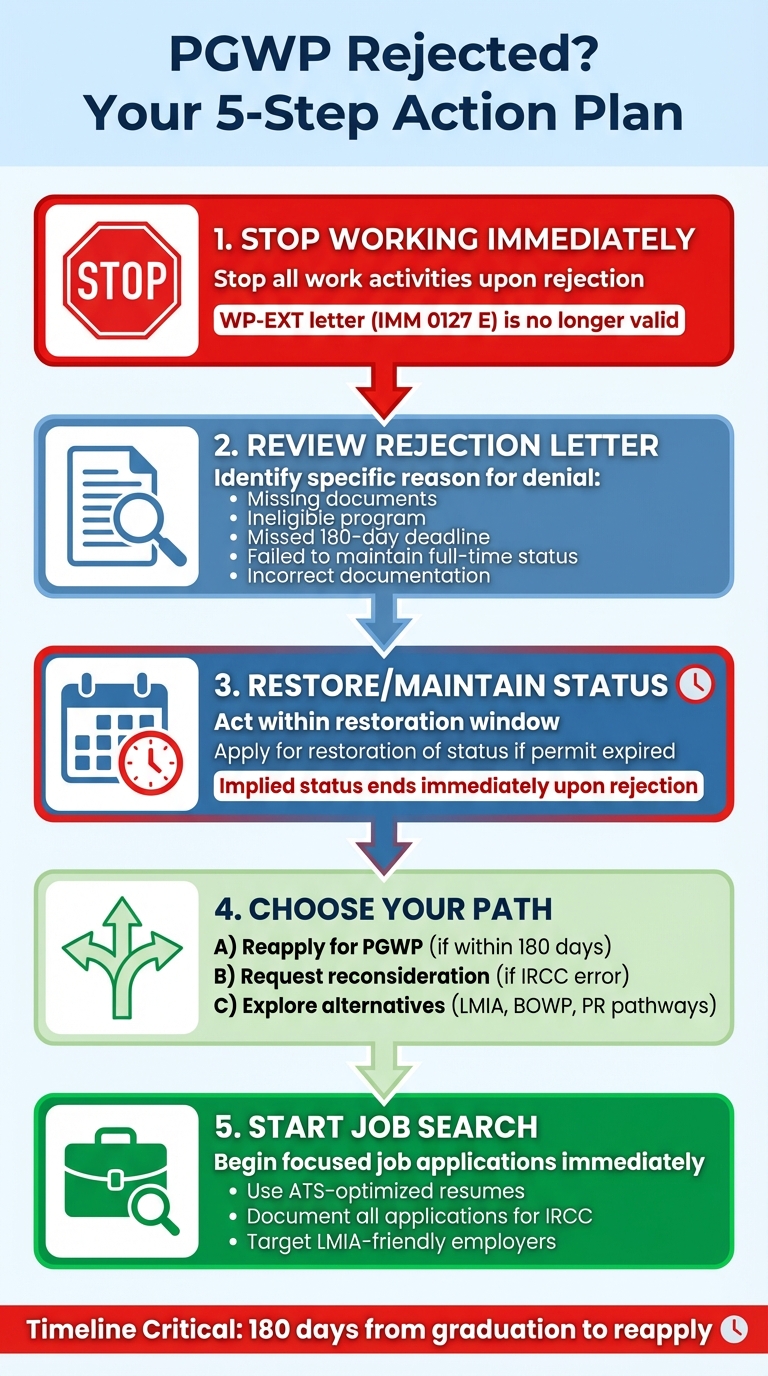
PGWP Rejection Response Flowchart: 5 Critical Steps to Take Immediately
Why Your PGWP Was Rejected
Read Your IRCC Rejection Letter Carefully
The rejection letter from the IRCC is your roadmap to understanding why your Post-Graduation Work Permit (PGWP) application was denied. It outlines specific reasons, such as missing documents, ineligible programs, application mistakes, or missed deadlines. Each issue requires a tailored approach to address it, so take the time to read the letter thoroughly.
For instance, if the letter cites "missing or improperly placed documents", ensure that all required items - like your language test scores and proof of field of study - are included and properly organized. If it mentions "failure to maintain full-time student status", this could mean there were unauthorized enrollment gaps during your studies. On the other hand, if the rejection is due to applying "after the deadline", it means you missed the strict 180-day window after receiving your final marks and official transcript, a rule that doesn’t allow for exceptions.
The letter will also clarify whether you can reapply or need to consider alternative options. Errors like document placement can often be corrected, provided you’re still within the eligibility period. However, issues such as studying in an ineligible program or missing the 180-day deadline may require exploring other pathways, such as applying for restoration of status or investigating alternative work permits.
Once you’ve reviewed your rejection letter, it’s essential to identify the specific issue and learn from common pitfalls that have led to rejections in recent years.
Most Common Rejection Reasons in 2026
Several recurring issues have been identified as the leading causes of PGWP rejections:
- Missing or improperly placed documents: A significant number of applicants have faced rejection due to incomplete submissions, particularly missing language test scores or proof of field of study. The PGWP e-application portal, as of December 2025, does not have designated slots for these documents, leading many applicants to mistakenly believe they were optional.
- Applying after the 180-day deadline: The 180-day window starts from the day you receive your final marks and official transcript. Missing this strict deadline results in automatic rejection, no matter how strong your other qualifications are.
- Studying at non-eligible institutions: Not all designated learning institutions (DLIs) offer programs that qualify for a PGWP. Applicants must confirm that both their institution and program meet the eligibility criteria before enrolling.
- Failure to maintain full-time student status: Unauthorized breaks in enrollment, dropping to part-time status without valid reasons, or taking unapproved leaves of absence can disqualify you. Maintaining full-time status throughout your studies is a critical requirement.
- Incomplete or incorrect documentation: Errors such as missing official transcripts, not including a completion letter, incorrect passport validity dates, or mismatched dates across documents are common reasons for rejection. These mistakes can often be avoided with a careful pre-submission review.
To address the issue of missing upload slots in the e-application portal, IRCC now requires applicants to submit a single PDF labeled "Letter of Explanation - Mandatory Documents." This document should consolidate all essential items, including language test scores, proof of field of study, your official transcript, and completion letter. Attach this PDF under the optional documents section to avoid rejection due to missing files.
PGWP Refused for Missing Language Test? Reconsideration Is Getting Approved (2026 Update)
What to Do Right After Rejection
Start by carefully reviewing your PGWP rejection letter. This will help you understand the reasons for the decision and determine your next steps, including reapplication options and deadlines. Acting quickly is essential to protect your legal status or address any errors in the decision.
Apply for Implied Status or Restoration Status
If your study permit expired while you were waiting for your PGWP decision, a rejection means you lose implied status immediately. In this case, you’ll need to apply for restoration of status without delay. Follow the IRCC’s guidelines closely, submit the necessary fees, and provide any updated documents required.
If you submitted your PGWP application before your study permit expired, you were under implied status during the processing period. However, a rejection ends that status right away. To restore it, you must file for restoration status promptly.
Request a Reconsideration if You Qualify
If you believe an error was made in your application review, you can request IRCC to reconsider their decision. To do this, provide clear evidence of the mistake along with a detailed explanation. Be sure to include your application number and any supporting documents that address the reasons for rejection. This step can be crucial if you feel the decision was unjustified.
How to Reapply for a PGWP
If your Post-Graduation Work Permit (PGWP) application was rejected, it's essential to address the issues that led to the denial. Carefully collect and verify all required documents based on the updated 2026 guidelines. Remember, you have 180 days from your graduation date to submit a new application, so ensure every detail is accurate before reapplying.
Verify Your Program Eligibility and Documents
Start by confirming your program's 6-digit CIP code is included in the IRCC's 2026 list of eligible fields of study. You can find this information through your Designated Learning Institution (DLI) or its website. If you applied for your study permit on or after November 1, 2024, and graduated from a college or non-university program, this step is mandatory.
Check that your language test results meet the required standards. For university graduates, the minimum is CLB 7, while college graduates need CLB 5. Accepted tests include IELTS, CELPIP, and PTE Core for English, or TEF and TCF for French. Ensure your test results are less than two years old. If you encounter issues uploading them in the standard fields, use the "Client Information" section to manually upload the results.
Your passport must also be valid for the entire duration of the permit. IRCC will not issue a PGWP that extends beyond your passport's expiration date. Scan and upload every page of your passport that contains stamps, visas, or markings from any country - don’t limit it to just the bio-data page.
Once your documents meet all eligibility requirements, focus on correcting the specific issues that caused your initial application to be rejected.
Fix the Problems from Your First Application
Carefully review the reasons outlined in your rejection letter and address them thoroughly. For example, if your Letter of Completion was rejected, request a new one from your school that explicitly confirms your program completion. Avoid any conditional language such as "expected to complete" or references to pending final grades, as these will likely lead to another refusal.
Submit official transcripts that include all final grades and the "Explanation of student academic record" page, often found on the back of the transcript. If your rejection was due to part-time study, verify your transcripts to ensure you maintained full-time status throughout your program, except for your final semester. If you took an authorized leave of up to 150 days, include a letter from your DLI confirming the leave was approved.
Prepare a concise Letter of Explanation that addresses the reasons for the initial rejection and outlines the corrections you’ve made. This document is a critical part of your reapplication. Additionally, pay the required fees: the $255 PGWP fee (which includes the $155 work permit fee and $100 open work permit holder fee), and the restoration fee if applicable. Be sure to attach all payment receipts to your online application.
Other Work Permits and Immigration Options
If reapplying for a Post-Graduation Work Permit (PGWP) isn’t an option, it’s critical to explore alternative ways to maintain your legal status in Canada. Time is of the essence, especially if your previous permit has expired. Depending on your current immigration status, work experience, and goals, there are several pathways to consider. At the same time, leveraging advanced tools for job applications can help streamline the process, ensuring you stay on track.
Apply for a Bridging or Employer-Specific Work Permit
A Bridging Open Work Permit (BOWP) can allow you to continue working in Canada while preparing your permanent residence (PR) application. To qualify, you’ll generally need an active PR application and must address any issues that contributed to your previous PGWP refusal.
Alternatively, if a Canadian employer is willing to hire you, consider applying for an employer-specific work permit supported by a Labor Market Impact Assessment (LMIA). Your potential employer must demonstrate that no Canadian citizen or permanent resident can fill the position, which is a key requirement for securing this type of permit.
Explore Permanent Residence Pathways
Your Canadian work experience can open doors to more stable, long-term immigration options. Programs like the Canadian Experience Class (CEC) and various Provincial Nominee Programs (PNPs) are designed for individuals who have worked in Canada. Each program has specific eligibility requirements and application steps, so it’s essential to review these thoroughly to determine which aligns best with your circumstances.
While navigating these pathways, securing employment plays a vital role in meeting permit or residency requirements. Platforms like scale.jobs can be invaluable here, offering services like ATS-friendly resumes, human-reviewed applications, and detailed documentation to support your job search efforts - especially when working within tight visa deadlines.
Is LazyApply Worth It? Reviews & Alternatives for PGWP Job Seekers
For PGWP applicants facing immigration uncertainty, tools like LazyApply can help automate job applications. LazyApply allows users to apply to hundreds of jobs quickly, saving time. However, automation-first platforms often fall short when it comes to customization and optimization for Applicant Tracking Systems (ATS) - a critical factor when applying for roles that may sponsor work permits.
Here’s how scale.jobs compares to LazyApply for PGWP job seekers:
- Human involvement: scale.jobs assigns dedicated assistants to review and tailor every application. In contrast, LazyApply relies on automated scripts, which can lead to generic submissions that often fail ATS filters.
- Resume customization: scale.jobs creates resumes tailored to specific roles and industries, ensuring they are ATS-optimized. LazyApply uses a single resume template for all applications, reducing the likelihood of standing out.
- Proof of work: scale.jobs provides detailed logs, screenshots, and tracking documentation - essential for demonstrating job search efforts to Immigration, Refugees, and Citizenship Canada (IRCC). LazyApply offers only basic submission counts.
- Pricing model: scale.jobs operates on a one-time payment basis with clear pricing, while LazyApply charges recurring monthly fees, which can add up over time.
- Support: scale.jobs includes real-time WhatsApp support for immediate assistance, whereas LazyApply offers standard email support with slower response times.
Comparison Table: LazyApply vs scale.jobs
| Feature | LazyApply | scale.jobs |
|---|---|---|
| Human involvement | Minimal; automated scripts | Dedicated human assistants |
| Resume customization | Single template | Tailored, ATS-optimized resumes |
| ATS handling | Basic keyword matching | Advanced optimization with human review |
| Application execution | Automated bulk submissions | Human-powered, tailored applications |
| Transparency & proof | Basic submission counts | Detailed logs and tracking |
| Pricing model | Monthly subscription | One-time payment |
| Support | Email support | Real-time WhatsApp assistance |
Who Should Use LazyApply
LazyApply is a good fit for job seekers who prioritize speed and volume over customization. It works best for straightforward applications that don’t require tailored documents and for roles that involve minimal ATS complexity.
Who Should Choose scale.jobs
scale.jobs is ideal for PGWP applicants who need ATS-optimized resumes, require proof-of-work documentation for immigration purposes, or want applications reviewed and tailored by humans. It’s also a better choice for those who prefer transparent, one-time pricing over monthly subscriptions.
Switch to scale.jobs if:
- Your automated applications aren’t resulting in interviews despite high submission volumes.
- You need proof of your job search efforts for IRCC or status restoration applications.
- You’re targeting competitive roles that demand customized resumes and cover letters.
- You want hands-on support to navigate ATS systems and meet employer-specific requirements.
- You prefer a one-time fee over ongoing subscription costs.
Decision Summary
LazyApply works well for those who need to apply to a large number of jobs quickly and don’t require much customization. On the other hand, scale.jobs is better suited for PGWP applicants managing permit rejections, needing ATS-friendly documents, or requiring detailed proof of job search efforts. If you’re looking for human assistance and tailored applications to increase your chances of success, scale.jobs offers the tools and support you need to stay competitive.
How to Find Work While Fixing Your PGWP Status
Facing a rejected PGWP (Post-Graduation Work Permit) can feel overwhelming. You’re not just dealing with immigration hurdles - you also need to secure employment that could help you stay in Canada. The reality is, you can’t afford to delay your job search while sorting out your permit issues. Many work permits and pathways to permanent residency require proof of active job searching or a valid job offer. Choosing the right tools to assist with your applications becomes crucial. For instance, while LazyApply relies on automation, Scale.jobs combines human expertise with ATS-optimized documents, giving you an edge in securing employment.
Start your job search immediately, even as you work through your permit situation. Platforms like LinkedIn can connect you with recruiters who are familiar with immigration challenges. Additionally, your university’s career services office can be a valuable resource, offering access to alumni networks. Immigration-focused employment agencies are another great option to ensure your profile stays visible during this critical time.
Why Your Resume Matters More Than Ever
When applying for Canadian jobs, your resume must pass through ATS (Applicant Tracking System) filters before it even reaches a recruiter. Generic resumes or automated templates often fail these filters, which can be a dealbreaker if you’re competing for roles that might sponsor a work permit. This is where Scale.jobs stands out compared to tools like LazyApply:
- Tailored Applications with Human Review: Instead of relying on automated scripts, Scale.jobs uses human-assisted reviews to customize each application.
- ATS-Optimized Documents: Resumes are specifically designed to meet Canadian employer standards, ensuring they pass ATS filters.
- Proof of Effort: Scale.jobs provides detailed logs, screenshots, and tracking for your applications - essential if the IRCC (Immigration, Refugees, and Citizenship Canada) asks for proof of job search efforts.
LazyApply vs Scale.jobs: A Feature Comparison

| Feature | LazyApply | Scale.jobs |
|---|---|---|
| Human involvement | Minimal; automated scripts | Dedicated human assistants |
| Resume customization depth | Single template for all | Tailored, role-specific |
| ATS handling | Basic keyword matching | Advanced, human-reviewed |
| Application method | Automated bulk submissions | Customized, human-powered |
| Transparency and proof | Basic submission counts | Detailed logs, screenshots |
| Pricing model | Monthly subscription | One-time payment |
Leverage Networking to Your Advantage
Networking remains one of the most effective strategies during this period. Many Canadian employers prefer hiring through referrals, particularly when immigration sponsorship is a factor. Reach out to your network, attend virtual job fairs, and don’t hesitate to ask for introductions. These connections can significantly improve your chances of landing an offer.
Why Scale.jobs Can Be a Game-Changer
If you’re juggling tight deadlines to restore your status, every application counts. Scale.jobs provides structured support, ensuring your resume is ATS-optimized and tailored to each role. This personalized approach can save you time and increase your chances of success. Additionally, documenting your job search efforts is crucial - IRCC may request proof of your applications if you’re applying for status restoration or alternative permits.
Time is of the essence. Each week without submitting applications reduces your chances of securing the job offer or work experience needed for immigration pathways. Treat your job search with the same urgency as your permit applications. With tools like Scale.jobs, you can stay on track and maximize your opportunities while addressing your PGWP status.
Next Steps After PGWP Rejection
Read your IRCC decision letter as soon as you receive it. This document outlines whether you're allowed to reapply and provides a specific timeframe for taking action. If your previous work permit or study status has already expired, your legal status in Canada is at risk. In such cases, the window for restoration is very short, so it's crucial to act without delay.
Stop working immediately upon receiving the rejection notice. Continuing to work after a refusal can jeopardize your chances of obtaining future permits or even lead to removal from Canada. Remember, the WP-EXT letter (IMM 0127 E) only permits you to work while your application is under review - not after a decision has been made.
In most cases, you can reapply unless the decision letter explicitly states otherwise. However, ensure you address the reasons for the initial refusal with updated documentation before submitting a new application.
Start a focused job search right away. Look for employers familiar with LMIA-based permits or those open to international sponsorship. Keep detailed records of every application you send out, as IRCC may ask for proof of your job search efforts if you're applying for status restoration or alternative permits. Professional tools, like an AI resume builder, can help you create tailored, ATS-friendly applications while maintaining a clear tracking system.
If reapplication or restoration isn't an option, explore other potential pathways immediately. Options may include LMIA-based work permits, spousal open work permits (if your partner is a Canadian citizen or permanent resident), or bridging open work permits if you have a pending permanent residence application. Each of these routes has specific requirements, so research them carefully to determine your eligibility.
FAQs
How long do I have to restore my status after a PGWP refusal?
If your Post-Graduation Work Permit (PGWP) application is refused, you generally have up to 180 days after graduation to reapply. If your study permit has expired before you submit your application, you may restore your status within 90 days of its expiration. However, even if more than 90 days have passed since your permit expired, it might still be possible to restore your status. It's always a good idea to double-check the specific deadlines and requirements that apply to your circumstances.
Can I stay in Canada while I reapply or request reconsideration?
Yes, it is possible to remain in Canada while reapplying or requesting a reconsideration of your Post-Graduation Work Permit (PGWP) rejection, provided specific conditions are met. You may submit a new application if you have additional information or significant changes to your circumstances that could impact the decision. Alternatively, if you believe the rejection was unfair or unreasonable, you can pursue a judicial review through the Federal Court. However, your ability to stay in Canada will depend on the terms of your existing visa or permit.
What proof should I keep from my job search for IRCC?
It's a good idea to maintain detailed records of your job search activities. This can include items like email exchanges with potential employers, records of job applications submitted, invitations to interviews, job offers received, or any other communications with employers. Keeping these documents organized can be helpful if you're required to show evidence of your job search efforts to the IRCC or if you're exploring alternative immigration options.