Personal Branding for Thought Leadership in 2025
Guide to building a cohesive personal brand in 2025: define your voice, create authority with content, grow networks, and track metrics for real career impact.


In 2025, standing out in a crowded digital world is all about building a strong personal brand. With AI generating massive amounts of content daily, people trust thought leaders who bring clarity and expertise. Your personal brand is your professional reputation online, influencing how employers, clients, and collaborators perceive you. Here’s what matters most:
- Clarity and Consistency: Your brand should align with your skills, experiences, and career goals across platforms like LinkedIn and personal websites.
- Audience Engagement: Share knowledge through content like blogs, short videos, or podcasts. Focus 80% on expertise and 20% on personal stories.
- Actionable Goals: Set measurable targets, like growing your LinkedIn audience by 30% in 90 days or securing speaking invitations.
- Networking Smartly: Build genuine connections by collaborating with peers and engaging in industry communities.
Your personal brand is the key to unlocking professional growth in 2025. Start by defining what sets you apart and sharing it authentically with the world.
How to Build a Strong Personal Brand and Become a Thought Leader - @iankafleerackers
Finding Your Personal Brand Through Self-Assessment
To build a personal brand that truly connects with others, you first need to understand what sets you apart. It’s about uncovering your voice, strengths, and experiences without mimicking others.
Brand strategist Ashley Kedra describes a process called "tone unbraiding" - separating your genuine voice from the communication habits you’ve picked up from bosses, mentors, or corporate environments. Often, professionals adopt styles that act as a shield, but your real brand lies beneath those layers.
Identify What Makes You Stand Out
Start by getting feedback from others. Ask five to ten colleagues, clients, or peers to share three words they associate with you. This simple exercise can highlight any disconnects between how you view yourself and how others perceive your work.
Next, take stock of your skills and experiences. Write down key achievements, challenges you’ve faced, and pivotal moments in your life. These stories form what Kedra calls the "Proof Pyramid." At the base is your lived experience, in the middle is your expertise, and at the top is your vision for the future.
Think about how past criticisms might now be strengths. For instance, being labeled "too curious" as a child could mean you’re great at spotting untapped opportunities. Or being called "overly analytical" might now translate into strong decision-making based on data.
Look for market gaps where your unique skills meet an unmet need. For example, if you’re a software engineer with a knack for user psychology, you could position yourself as a bridge between technical teams and product design - an area often overlooked.
Use these insights to align your brand with your future goals.
Align Your Brand With Your Career Aspirations
Once you’ve identified what makes you unique, it’s important to tie those qualities to your career goals. Your personal brand isn’t just about where you are now - it’s about where you want to go. Aligning your brand with your long-term vision helps avoid inconsistent messaging and burnout.
Set clear, measurable goals to track your progress. For instance, aim to generate 10 consulting leads in three months or grow your LinkedIn audience by 32% in 90 days. These specific targets give your efforts direction and purpose.
Picture yourself five years from now. What habits, skills, and routines define that version of you? If you want to be a sought-after speaker, start creating a library of your talks. If your goal is executive leadership, focus on sharing strategic insights instead of just tactical advice.
Craft a Personal Brand Statement using this structure: "I am [Name], a [Role] who [Problem you solve]. I stand out because [Unique perspective]. I am the perfect person to [Market gap you fill]." This statement becomes your guiding light, helping you pursue opportunities that align with your vision and decline those that don’t.
The secret to success is congruence - ensuring that your values align with the image you project. When there’s a mismatch, trust erodes. In today’s world, authenticity matters more than ever, with 86% of consumers saying it’s a key factor in deciding which leaders to support.
A clear personal brand doesn’t just shape your professional image - it also streamlines your job search and career strategy. Tools like Scale.jobs can help by managing applications with human-assisted services, saving you over 20 hours a week. Their reverse recruiters handle everything from ATS-friendly resumes to tailored applications, so you can focus on building your brand and pursuing high-value opportunities.
Creating a Content Plan to Establish Authority
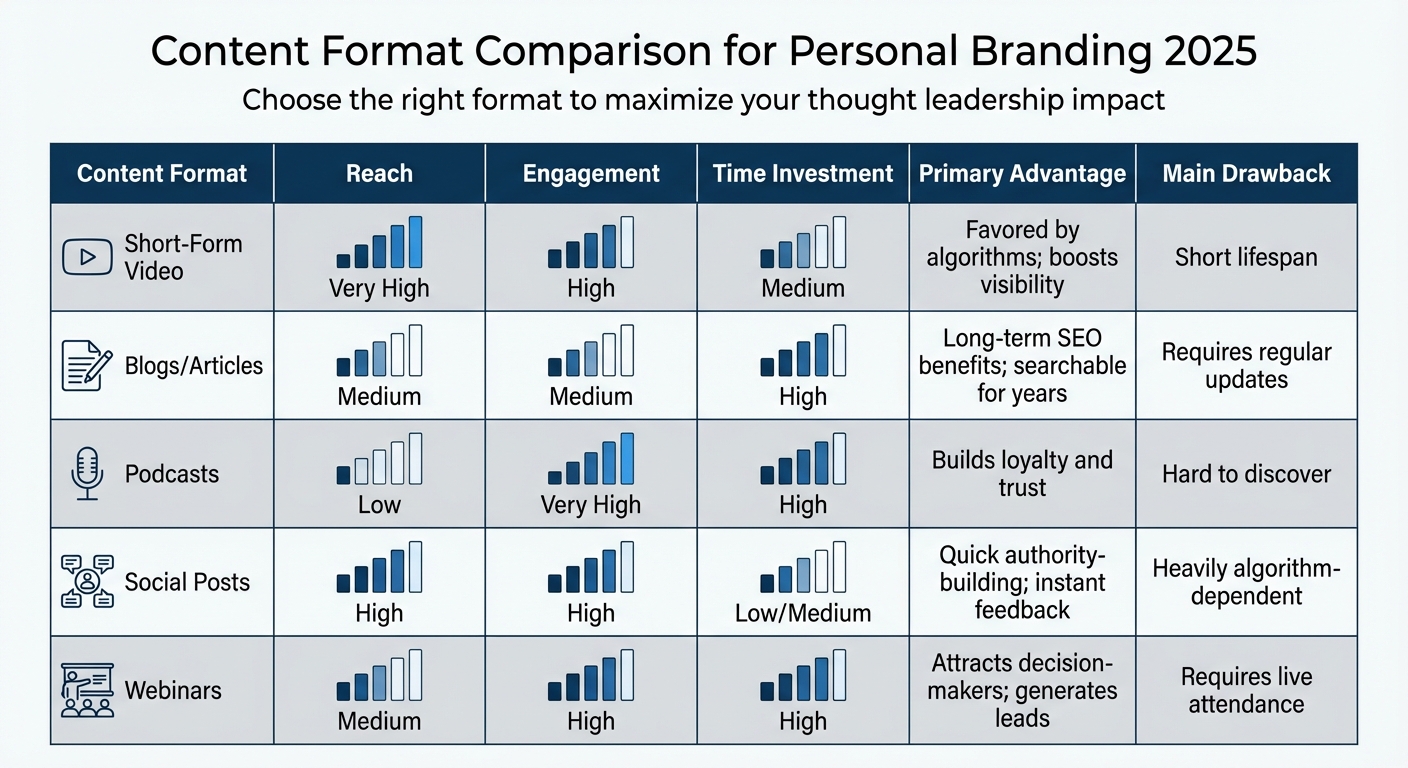
Content Format Comparison for Personal Branding 2025
Sharing your expertise effectively starts with a solid content plan. It’s not enough to post sporadically - true thought leadership requires a clear strategy that highlights your knowledge and positions you as a trusted expert in your field. Once you’ve identified what sets you apart and your long-term goals, your next step is to create content that reflects your authority.
Consistency and quality are non-negotiable. Focus on the platforms where your audience spends their time. For B2B professionals, LinkedIn is often the best choice. For visual brands, Instagram or YouTube might be more effective. Wherever you choose to post, do it regularly and share insights that add real value.
A good rule of thumb is the 80/20 principle: dedicate 80% of your content to your area of expertise and 20% to personal stories or interests that make you relatable. For example, a cybersecurity consultant might primarily share tips on data protection but occasionally post about lessons learned from past challenges or their approach to problem-solving. This balance keeps your content informative while building a personal connection with your audience.
Set specific, measurable goals to guide your efforts. For instance, aim to generate 10 consulting leads in three months or grow your LinkedIn following by 32% in 90 days.
Pick the Best Content Formats for Your Goals
Choosing the right content formats depends on your audience, your time, and how you want to establish your authority. In 2025, short-form video reigns supreme - clips under 15 seconds get 70% more visibility thanks to platform algorithms. But don’t overlook long-form content, which still plays a vital role.
- Blogs and articles are excellent for showcasing deep expertise and boosting SEO. A well-researched blog can rank on Google for years, driving consistent traffic. Aim for at least 1,900 words for competitive topics and use long-tail keywords like "content marketing for SaaS startups" to attract a focused audience.
- Video content is perfect for building trust quickly. Platforms like LinkedIn Video, YouTube Shorts, and Instagram Reels let you showcase your knowledge while adding a personal touch. While video production takes time, the engagement payoff is worth it.
- Podcasts create a strong bond with listeners, though they’re harder to discover through search. They work best if you already have an engaged audience or can appear as a guest on established shows.
Here’s a quick comparison of content formats:
| Content Format | Reach | Engagement | Time Investment | Primary Advantage | Main Drawback |
|---|---|---|---|---|---|
| Short-Form Video | Very High | High | Medium | Favored by algorithms; boosts visibility | Short lifespan |
| Blogs/Articles | Medium | Medium | High | Long-term SEO benefits; searchable for years | Requires regular updates |
| Podcasts | Low | Very High | High | Builds loyalty and trust | Hard to discover |
| Social Posts | High | High | Low/Medium | Quick authority-building; instant feedback | Heavily algorithm-dependent |
| Webinars | Medium | High | High | Attracts decision-makers; generates leads | Requires live attendance |
To maximize your efforts, repurpose your content. For example, turn a webinar into a blog post, extract short clips for social media, and create an infographic summarizing the key points. This approach ensures you get the most mileage out of your work.
Use SEO and Social Algorithms to Your Advantage
Understanding how search engines and social platforms distribute content gives you a leg up in building authority.
For SEO, aim to create content that’s significantly better than what’s already out there. Add original insights, case studies, and visuals like infographics. Focus on long-tail keywords with lower competition but high intent, such as "internet marketing for freelance graphic designers." This strategy attracts an audience actively seeking your expertise.
On LinkedIn, the algorithm rewards posts that encourage genuine conversation. The first two lines of your post are critical - they need to grab attention immediately. Structure your posts with a hook, explain why the topic matters, offer a practical solution, and close with a clear call to action. Posts that combine professional insights with personal anecdotes tend to perform best.
Engagement is just as important as posting. Respond to comments on your content and interact thoughtfully with others’ posts. Platforms reward active participation, and it helps keep your name top-of-mind in your industry.
For YouTube, tools like VidIQ can help you identify popular tags in your niche. Use your main keyword at the start of your video title and mention it early in the video itself - this helps YouTube’s algorithm categorize your content. Creating playlists around specific topics can also improve discoverability and encourage longer watch times.
The rise of "edutainment" - content that blends education with entertainment - is a major trend in 2025. People prefer learning through engaging, story-driven formats rather than dry presentations. Research shows that stories are 22 times more memorable than standalone facts, so use narratives to illustrate your expertise in action.
Building authority through content takes time, but it’s an investment that pays off in the long run. While you focus on creating and sharing content, tools like Scale.jobs can handle the time-consuming parts of your job search. Their human-assisted services take care of applications, ATS-optimized resumes, and tailored cover letters, saving you over 20 hours a week. With real-time updates and proof-of-work screenshots, you can focus on high-value activities like networking and interviews. Their flat-fee model ensures you only pay for results, not recurring subscriptions.
These strategies set the stage for a strong online presence, preparing you to expand your digital footprint across platforms.
Building Your Online Presence Across Platforms
Your online profiles are like your digital storefront, offering the first impression to anyone who comes across them. As we move into 2025, platforms like LinkedIn have become essential tools for professional vetting. To stand out, your profile needs to tell a cohesive story that highlights your expertise and makes you memorable. The secret? Consistency. When someone searches for you or stumbles upon your content, every platform should reinforce the same message about your skills and the value you bring.
Think of your online presence as an interconnected ecosystem. A hiring manager might find you on LinkedIn, glance at your Twitter for recent insights, and visit your personal website to see your work. If these platforms tell conflicting stories - or worse, contradict each other - you risk losing credibility before you even have a chance to engage. On the other hand, when your visuals and messaging align across platforms, people recognize and trust you more quickly. This unified presence lays the groundwork for platform-specific strategies, starting with LinkedIn.
Improve Your LinkedIn Profile
LinkedIn remains a powerhouse for professional networking and thought leadership. Start with a professional headshot - ideally, your face should take up about 60% of the frame. Profiles with professional photos get 21 times more views than those without. Pair this with an engaging banner that visually communicates your value.
Your headline is prime real estate. Instead of a generic title like "Marketing Manager at ABC Corp.", craft a headline that showcases your value. Use a formula like this: "I help [target audience] achieve [specific result] using [your skill or method]." For example, "I help SaaS startups boost organic traffic by 200% with data-driven content strategies." This approach immediately tells people why they should care about what you do.
The summary section is your chance to tell your story in a way that resonates. Write in the first person to create a personal connection. Start with a hook - something surprising, bold, or thought-provoking. Then, outline your unique value proposition using keywords relevant to your industry (this helps with searchability). Wrap it up with a clear call to action, like, "Let’s connect if you’re looking to scale your team’s productivity."
When filling out the experience section, focus on measurable results rather than vague descriptions. Instead of saying, "Managed a team", try, "Increased team productivity by 40% through agile workflows and weekly coaching sessions." Numbers make your achievements stand out. Use the "Featured" section to showcase your best work - whether it’s case studies, articles, videos, or presentations. Treat this section as your portfolio.
Finally, customize your LinkedIn URL to make it more search-friendly, and list key skills with endorsements to enhance your profile’s credibility. These small details contribute to a polished, professional image that attracts the right opportunities.
Keep Your Message Consistent Everywhere
Once your LinkedIn profile is optimized, carry that same message across all your platforms. Consistency builds trust and recognition. Use the same professional headshot on LinkedIn, Twitter, your personal website, and even your email signature. This creates a cohesive visual identity that makes you instantly recognizable.
Your tone and messaging should also align. If you present yourself as a data-driven strategist on LinkedIn, don’t shift to a completely different persona on Twitter. Define a few "voice principles" - for example, "analytical, approachable, and action-oriented" - and stick to them. Create a simple "do's and don'ts" list to guide your content. For instance: "Do ask thought-provoking questions. Don’t overuse jargon or overly apologize." This consistency helps you adapt to different platforms without losing your core identity.
Visual design matters too. Use a consistent color palette, fonts, and design elements across your website, social media banners, and any resources you share. While everything doesn’t need to look identical, there should be a clear design language tying your brand together. Tools like Canva can help you maintain a polished look, even if you’re not a designer.
Keep your bio consistent as well, adjusting only for character limits. For instance, on Twitter, you might write: "Data-driven content strategist helping SaaS startups grow organic traffic. Sharing tips on SEO, storytelling, and growth." On your personal website, this could expand into a full "About" page, but the core message should remain the same.
According to a study, 86% of consumers say authenticity influences their decisions about which brands to support. This applies to personal brands, too. Consistency doesn’t mean being overly rigid - it means letting your audience know what to expect from you. When people trust your expertise and feel they understand your values, they’re more likely to become loyal followers, clients, or collaborators.
As you refine your online presence, tools like Scale.jobs can simplify your job application process. They offer ATS-optimized resumes and real-time WhatsApp updates, all through a straightforward flat-fee model.
Networking and Partnerships to Grow Your Influence
Your network and partnerships are powerful tools for boosting your brand and credibility. In 2025, networking isn’t just about swapping business cards at events. It’s about building mutual value with professionals who share your interests and can help amplify your reach.
The most effective networkers focus on giving first. Instead of immediately asking for favors or introductions, they start by sharing someone’s content, offering helpful advice, or featuring them in a blog post. This creates genuine connections before any requests are made. For example, collaborating with experts - like inviting them to a webinar or co-authoring an article - often leads them to share that content with their audience. This mutual effort not only expands your reach but also strengthens your E-E-A-T (Experience, Expertise, Authoritativeness, and Trustworthiness).
Being strategic is key. Focus on building relationships with individuals whose values and audiences align with yours. This ensures that your partnerships feel natural and impactful. Research backs this up: 85% of hiring managers prioritize candidates with strong personal brands, and 77% of consumers trust individuals over brands. These numbers highlight the importance of strong relationships and social proof in establishing yourself as a thought leader. One way to deepen this influence is by actively engaging in industry communities.
Participate in Industry Communities
Industry communities are where leaders are shaped. Whether it’s a LinkedIn group in your niche or a Facebook group for peers, these spaces provide a low-pressure environment to showcase your expertise. The key is consistency. Share insights, answer questions, and engage thoughtfully with others’ content. Over time, people will start to recognize your name and associate it with knowledge and authority.
Consider Russell Brunson, the founder of ClickFunnels. He built a loyal following through the "Funnel Hacker Movement", creating a shared identity for his audience with the "Funnel Hacker Manifesto." Similarly, Lia Haberman, known for her work in the creator economy, established herself as a go-to expert through her "ICYMI" newsletter. By consistently sharing updates on social media and tech, she became an essential resource for creators.
When engaging in these communities, use the 48-hour rule: follow up with new connections within 48 hours of meeting them. Reference specific points from your conversation to strengthen the connection. Tools like LinkedIn Sales Navigator (often available as a free trial) can help you identify and connect with key decision-makers in your field. The goal isn’t to gather as many contacts as possible - it’s about building meaningful relationships with the right people. This approach complements your online presence and reinforces your expertise. But beyond networking, showcasing tangible proof of your skills is equally important.
Showcase Your Expertise
Your credibility grows when others vouch for you. Testimonials, endorsements, and case studies serve as social proof that highlights your expertise. Instead of relying on vague praise like "Great to work with", guide recommenders to focus on measurable results. For instance, they might say, "Increased our productivity by 40% through agile workflows" or "Helped secure $500,000 in funding with a data-driven pitch deck."
Display these testimonials, endorsements, and recognizable media mentions on your LinkedIn profile, website, or even in your email signature to establish instant credibility. Take Chima Mmeje, Senior Content Marketing Manager at Moz, as an example. She hosted the "Practical Marketer Webinar" series, which became one of the company’s most viewed content pieces in 2024 by making the sessions actionable and featuring experts.
Another way to refine your brand is through 360-degree feedback. Conduct anonymous audits with peers, clients, and team members to uncover gaps between how you perceive yourself and how others experience your leadership. This feedback can help you address any blind spots and strengthen your reputation. As Jeff Bezos, the founder of Amazon, famously said:
"Your brand is what people say about you when you're not in the room."
If you’re in the middle of a career transition or job hunt, platforms like Scale.jobs can save you time by managing ATS-optimized resumes and tailored cover letters, cutting down your workload by over 20 hours per week.
Track and Improve Your Personal Brand Over Time
Building a personal brand isn't something you can check off a to-do list - it’s an ongoing effort that thrives on consistent, data-driven tweaks. In 2025, the game has shifted: grabbing attention matters more than racking up followers, and trust always outweighs sheer visibility.
Instead of obsessing over likes or follower counts, focus on metrics that actually open doors, like inbound inquiries, branded search volume, and referral traffic. For example, tools like Google Trends or Search Console can help you track branded search volume, showing how often people are actively searching for your name. If those numbers are climbing, it’s a strong sign that your influence is growing. Similarly, keep an eye on referral traffic to your website or LinkedIn profile. Did a guest blog post or podcast appearance drive a 30% spike in traffic? That’s a clear indicator that platform deserves more of your time and energy.
Shift your attention from surface-level likes to deeper engagement metrics like Video Completion Rate (VCR) or In-view time - essentially, how long your content holds someone’s attention. These numbers reveal whether your audience is truly engaged or just scrolling past. On LinkedIn, use built-in analytics to track profile views, search appearances, and the ratio of comments to reach on your posts. If you’re posting regularly but engagement feels flat, it might be time to rethink your content strategy or refine your niche.
Track These Key Performance Indicators
To measure your progress, focus on metrics across four key areas: Awareness, Consideration, Authority, and Conversion.
| KPI Category | Specific Metrics | Purpose |
|---|---|---|
| Awareness | Impressions, Reach, Branded Search Volume | Tracks how people discover you |
| Consideration | Video Completion Rate, In-view time, Engagement Rate | Measures how interested your audience is |
| Authority | Branding Linkage, Media Mentions, Testimonials | Indicates trust and expertise |
| Conversion | Inbound DMs, Sales, Speaking Invitations | Reflects tangible career growth |
Set clear goals to keep yourself on track, like increasing profile views by 32% within 90 days or landing three speaking gigs by mid-2026. Tools like LinkedIn Sales Navigator can help you monitor interactions with decision-makers in your field, while Google Analytics can show which pieces of content drive the most valuable traffic to your site.
Use these metrics as a foundation to continually refine your personal brand, ensuring it evolves alongside your career.
Review and Update Your Brand Regularly
Regularly analyzing your metrics helps you make timely updates to your brand. Schedule quarterly brand audits to review where your name shows up online, assess how your content is performing, and tweak your messaging based on audience feedback. These audits build on earlier self-assessments and content strategies, keeping your brand aligned with your growing expertise.
Dive deeper during these audits by gathering 360-degree feedback to identify any gaps between how you see yourself and how others perceive you. Ask colleagues, clients, or team members to describe you in three words, then compare their responses to your own. Research shows a striking disconnect: while 80% of executives think their communication is effective, only 30% of their teams agree. This kind of "perception gap" can harm your credibility if left unchecked. Anonymous surveys can be a helpful way to uncover blind spots and adjust your messaging.
Above all, ensure your brand stays true to your core values. Consistency and authenticity are non-negotiable - after all, 86% of consumers say authenticity is a key factor in choosing which brands to support.
Lastly, don’t tie your brand too tightly to a specific job title or company. Your brand should reflect who you are, not just what you do. This flexibility allows your brand to adapt during career shifts or industry changes. For example, if you’re navigating a job transition, tools like Scale.jobs can simplify the application process, giving you more time to focus on refining your personal brand.
Conclusion: Start Building Your Thought Leadership Today
Becoming a thought leader doesn’t happen overnight - it’s a process of consistently sharing a clear and genuine message. The most trusted voices in 2025 won’t necessarily be the loudest; they’ll be the ones who communicate with clarity and consistency. Start by identifying what makes you stand out - your unique mix of experiences and perspectives that no one else can replicate. From there, take small but impactful steps, like updating your LinkedIn profile with ChatGPT for a polished headshot and an engaging elevator pitch. These foundational moves set the stage for everything else.
When it comes to building your personal brand, remember: quality beats quantity. In 2025, decision-makers are spending over an hour each week engaging with thought leadership content, and 73% trust it more than traditional marketing. This means one insightful post each week can deliver far more impact than daily posts that don’t offer value. While AI tools can help streamline tasks like research and content distribution, your unique perspective and emotional connection should always come from you - especially since over 75% of consumers express concerns about businesses relying on AI for communication.
Consistency is key. Trust isn’t built through a single viral moment; it develops over 90 to 180 days of steady, meaningful contributions. When people repeatedly encounter your name alongside valuable insights, they’ll begin to associate you with expertise in your field. This kind of authority grows not through burnout, but through sustainable, focused effort.
If you’re in the middle of a career shift, consider using Scale.jobs. Their human-assisted, ATS-optimized services can save you over 20 hours a week, freeing up time to focus on creating content and building your reputation as a trusted voice in your industry.
Take the first step today: write your brand statement, reach out to three potential collaborators, or publish a post that addresses a specific challenge. Thought leadership starts with action - and that first step is yours to take.
FAQs
How can I discover my unique voice to build a strong personal brand?
Finding your voice is essential when it comes to shaping a personal brand that feels genuine and resonates with others. While the term “tone unbraiding” might not be something you’ve come across often, the process of discovering your voice boils down to staying true to yourself, being consistent, and communicating clearly. Think about what sets you apart - your values, life experiences, and unique perspectives - and make sure those elements shine through in everything you create and share.
If you need a little extra help refining your personal brand, tools like Scale.jobs can be incredibly useful. They offer features like AI-powered resume customization and networking tools to help you align your professional voice with the career path you’re aiming for.
How can I align my personal brand with my career goals for the future?
To align your personal brand with your career ambitions, start by defining what you want to achieve - whether that's stepping into a leadership role, transitioning to a new industry, or becoming a well-known expert in your field. Once you're clear on your goals, craft a value proposition that emphasizes your unique strengths and how you can contribute to the roles or industries you’re targeting.
From there, work on creating a consistent and professional brand presence. Use a polished, professional photo and maintain a cohesive tone across platforms like LinkedIn or your personal website. Share content that highlights your expertise in the areas most relevant to your goals. To build connections, engage with key decision-makers and industry leaders by participating in LinkedIn groups or niche forums where they’re active. Tailor your communication to fit the platform and audience.
Lastly, keep an eye on your progress by monitoring metrics like profile views, engagement on your posts, or content shares. Use these insights to refine your approach and ensure your personal brand stays aligned with your career objectives. A well-managed personal brand can open doors to exciting opportunities as you move forward in your career.
How can I use industry communities to build my personal brand and establish thought leadership?
Engaging with industry communities is one of the best ways to position yourself as a respected voice in your field. Start by joining spaces where your audience already spends time - think LinkedIn groups, professional forums, or industry-focused Slack channels. Once there, share your perspectives on current trends, offer practical solutions to common challenges, and provide fresh insights. This not only helps others but also establishes you as a go-to resource.
Don't stop there - interact meaningfully with others' content. Leave thoughtful comments, ask questions that spark discussion, and recognize the contributions of your peers. These genuine interactions build trust and show that you're there to contribute, not just to promote yourself.
To make the most of your efforts, choose platforms where your target audience is most active, create content that solves real-world problems, and look for opportunities to collaborate - whether that's through co-written articles or live discussions. By consistently showing up and adding value, you'll not only strengthen your personal brand but also cement your place as a trusted thought leader.