
Why Paying Less for AI Job Applications Often Means Getting Less
Cheap AI job-apply tools favor volume over fit, causing ATS rejections, generic resumes, and low interview rates; human-assisted services improve accuracy and transparency.


When it comes to AI-powered job application tools, opting for cheaper options like LazyApply or Sonara.ai might seem like a cost-effective way to send out hundreds of applications. However, these platforms often prioritize quantity over quality, leading to lower success rates. Generic templates, poor ATS compatibility, and a lack of transparency are common issues that result in missed opportunities and wasted time.
In contrast, services like Scale.jobs combine AI efficiency with human oversight, tailoring applications to specific roles and ensuring ATS compliance. While these services come with a higher upfront cost, they deliver better results by doubling interview rates and offering real-time updates and proof of submission. For job seekers targeting competitive or specialized positions, investing in quality over volume can significantly shorten the job search process and improve outcomes.
Key Takeaways:
- Budget AI tools work for entry-level, high-volume applications but often fail for specialized or senior roles.
- Generic resumes and poor ATS handling can lead to automatic rejections.
- Human-assisted services like Scale.jobs focus on tailored applications, improving interview rates and transparency.
- Spending more upfront on quality applications can save time and reduce job search frustration.
For those seeking full time jobs, part time jobs near me, or roles requiring precision, a job application assistance like Scale.jobs offers a more effective alternative to budget tools.
What You Lose with Budget AI Application Services
Generic Templates That Miss the Mark
Budget AI tools, such as LazyApply, often rely on a one-size-fits-all template for hundreds of applications. This cookie-cutter method overlooks the importance of tailoring applications to specific roles. For example, a senior marketing position emphasizing data analytics requires a resume that reflects those skills - not generic, entry-level phrasing. Such mismatches can make your application irrelevant at first glance.
The consequences are clear: tailored applications can increase interview invites by up to 120%. In contrast, generic submissions often fail to make an impression, especially for specialized or senior-level roles. Services like professional resume writing services ensure applications are customized to match job descriptions and pass ATS filters, something budget tools struggle to achieve.
ATS Issues That Stop You Before You Start
Applicant Tracking Systems (ATS) are designed to filter resumes, and budget tools often fail to navigate these systems effectively. Problems like poor keyword placement, incompatible formatting, and unnecessary graphics can lead to automatic rejections. Tools like LazyApply might resort to keyword stuffing or completely miss critical sections, such as certifications. For instance, if an ATS can't parse a resume due to non-standard fonts or tables, your application might never reach a human recruiter.
The difference is stark: human-assisted platforms can double your chances of landing an interview compared to budget tools. By understanding ATS requirements, professional services ensure resumes are both machine-readable and engaging for human reviewers.
Lack of Transparency and Application Tracking
Beyond content and ATS issues, budget platforms often fall short in providing transparency. After paying a subscription fee, you’re left in the dark about your applications. Did the tool apply to 50 positions or 500? Were all fields completed correctly? Without clear updates, you’re left guessing.
Human-assisted services close this gap by offering proof-of-work screenshots, real-time updates through platforms like WhatsApp, and detailed dashboards to track your applications. This level of transparency not only builds trust but also allows you to follow up strategically. Services like scale.jobs provide this clarity, ensuring you’re always informed about your job search progress and outcomes.
watch me apply to 1000+ jobs in minutes with AI
Scale.jobs vs. Low-Cost AI Tools: Feature Comparison
Scale.jobs vs Budget AI Job Application Tools Feature Comparison
Why Scale.jobs Delivers Better Results
Scale.jobs sets itself apart by relying on trained virtual assistants (VAs) who manually handle each job application. This human-driven approach ensures compatibility with applicant tracking systems (ATS) and avoids the risks associated with automated bot detection. Every submission is accompanied by real-time WhatsApp updates, complete with timestamped screenshots, so you can track exactly what was submitted and when. Unlike platforms that rely on automated keyword stuffing, Scale.jobs customizes resumes for each job posting through human oversight. Additionally, Scale.jobs offers a straightforward one-time fee model (ranging from $199 to $1,099), with refunds for unused credits, eliminating the recurring costs of subscription-based services.
How Scale.jobs Outshines LazyApply and Sonara.ai:
- Human-assisted submissions ensure ATS compliance and bypass bot-detection filters.
- Resumes are customized to match specific job postings, avoiding generic templates.
- Real-time WhatsApp updates provide proof of submission with timestamped screenshots.
- Offers a one-time payment model with refund options for unused credits, compared to recurring subscription fees.
- Manual form completion on any job portal avoids automated rejection risks.
In contrast, low-cost tools like LazyApply and Sonara.ai prioritize speed over precision. LazyApply, for example, uses a Chrome extension to automate hundreds of applications daily, but this often triggers ATS filters due to its automated nature. Similarly, Sonara.ai relies entirely on AI automation, which focuses on basic keyword insertion without human review. Neither of these platforms offers proof-of-work screenshots or direct communication channels; instead, they provide only application counts or dashboard summaries.
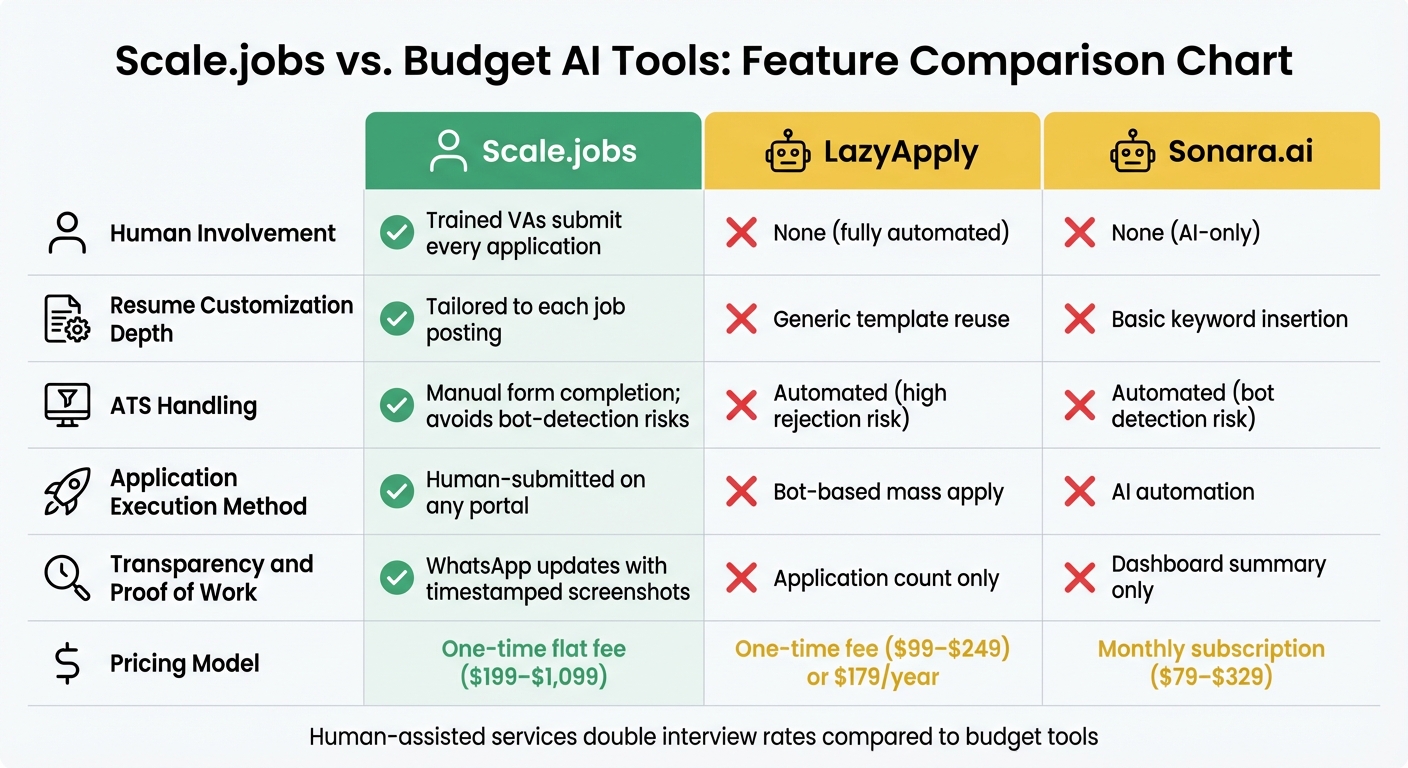
The comparison table below highlights how Scale.jobs delivers better results compared to its budget-friendly competitors.
Side-by-Side Feature Breakdown
| Feature | Scale.jobs | LazyApply | Sonara.ai |
|---|---|---|---|
| Human Involvement | Trained VAs submit every application | None (fully automated) | None (AI-only) |
| Resume Customization Depth | Tailored to each job posting | Generic template reuse | Basic keyword insertion |
| ATS Handling | Manual form completion; avoids bot-detection risks | Automated (high rejection risk) | Automated (bot detection risk) |
| Application Execution Method | Human-submitted on any portal | Bot-based mass apply | AI automation |
| Transparency and Proof of Work | WhatsApp updates with timestamped screenshots | Application count only | Dashboard summary only |
| Pricing Model | One-time flat fee ($199–$1,099) | One-time fee ($99–$249) or $179/year | Monthly subscription ($79–$329) |
Where Budget Tools Work (And Where They Don't)
Budget tools like LazyApply and Sonara.ai are designed for speed, making them suitable for high-volume applications to entry-level or remote positions. If your goal is to cast a wide net quickly and cost-effectively, these tools can deliver volume efficiently. However, they sacrifice precision and personalization in the process.
For roles requiring careful ATS navigation or tailored applications, these tools often fall short. Automated systems can trigger bot detection or introduce formatting errors, which can prevent your application from even reaching a recruiter. Additionally, the lack of transparency means you won’t know if every field was completed correctly or if your resume was effectively submitted.
For specialized or senior-level positions where quality matters more than quantity, Scale.jobs provides a better solution. By combining professional resume customization with human-submitted applications, Scale.jobs ensures that your application stands out for relevance and attention to detail. This approach not only improves your chances of passing ATS filters but also enhances your professional credibility - something that mass automation tools simply cannot match. For those serious about securing interviews, Scale.jobs proves to be a more reliable and effective option.
Who Should Use Each Option
When Budget AI Tools Might Be Enough
Budget AI tools like LazyApply and Sonara.ai work best for job seekers aiming to apply to a large number of entry-level roles, even if it means facing a higher rejection rate. For instance, recent graduates sending out over 100 applications weekly can benefit from these tools' ability to generate standard resumes quickly, enabling a broad application strategy without requiring much upfront cost. However, these tools often lead to more rejections and demand manual follow-ups.
They are also a good fit for exploratory job searches. For example, freelancers looking into gig economy roles or career changers with time to improve their skills might use these tools to apply broadly and analyze rejection patterns to identify skill gaps. That said, this approach requires reapplying manually after Applicant Tracking System (ATS) failures and lacks the precision needed for highly competitive or specialized positions. In short, budget tools prioritize speed over personalization, which can be a drawback when first impressions count.
If your goal is a tailored, high-quality application, a human-assisted service is a better choice.
When Scale.jobs Is the Right Choice
Scale.jobs stands apart by incorporating human expertise to deliver tailored job applications. It’s an excellent option for job seekers targeting 10–20 specialized positions monthly, such as roles at FAANG companies or senior-level opportunities. By ensuring ATS-compliant applications, Scale.jobs helps avoid the pitfalls of automated rejections and improves interview rates.
One of the standout features is its transparency. Job seekers receive real-time WhatsApp updates, complete with timestamped screenshots, so there’s no ambiguity about the application process. This service is particularly valuable for individuals with over five years of experience who need customized narratives for each application or for those who’ve faced repeated ATS rejections despite having strong qualifications. If you’re already considering professional resume writing services, Scale.jobs offers the added benefit of executing applications too, saving you upwards of 20 hours per week while maintaining a high standard of quality.
This service is especially beneficial for applicants with visa requirements or those pursuing roles in fields like design, marketing, or executive leadership. The human touch ensures applications reflect soft skills and align with workplace expectations. With a one-time flat fee ranging from $199 to $1,099 and a refund policy for unused credits, Scale.jobs provides a cost-effective alternative to subscription-based tools, particularly in competitive job markets.
This clear distinction reinforces the importance of quality applications for maximizing interview opportunities. For those seeking roles where precision and customization are critical, Scale.jobs offers an efficient and transparent solution.
Apply for jobs or explore how a job search virtual assistant can streamline your efforts.
Switch to Scale.jobs If You're Experiencing These Problems
Your Applications Get Rejected by ATS Before Human Review
If you've sent out 100+ applications and received zero callbacks, there's a high chance your resume isn't getting past ATS (Applicant Tracking System) filters. Many budget AI tools, like LazyApply, rely on generic formatting and excessive keyword stuffing, which can trigger automatic rejections. If you're repeatedly getting rejection emails stating "did not meet qualifications", it might not be your skills at fault - it’s likely an ATS compatibility issue.
Scale.jobs tackles this problem through manual keyword optimization, ensuring your resume uses natural, professional language rather than robotic keyword stuffing. Human assistants carefully review each resume to ensure it meets ATS standards while still appealing to hiring managers. This approach ensures your application makes it to a human reviewer instead of being filtered out by automated systems. And ATS compliance is just the tip of the iceberg when it comes to application challenges.
You Have No Idea What Was Actually Submitted
Not knowing what was submitted - whether it's the version of your resume, the answers to application questions, or even if the submission went through - can leave you feeling completely in the dark. Tools like LazyApply often fail to provide this clarity, making it hard to track your applications or follow up effectively.
Scale.jobs solves this with real-time WhatsApp updates. You’ll receive timestamped screenshots showing exactly what was submitted, when it was sent, and which version of your resume was used. This transparency removes the guesswork and gives you full control over your job search. But beyond technical clarity, there's another issue that could be holding you back: the inefficiency of focusing on quantity over quality.
You're Wasting Time on Volume Instead of Quality
If you're submitting 500+ generic applications each month and seeing less than a 1% response rate, you're likely wasting over 20 hours a week on ineffective strategies. Platforms like BulkApply prioritize sheer volume - sometimes up to 150 applications per day - but this approach often results in mass rejections rather than meaningful opportunities.
With Scale.jobs, you can reclaim those wasted hours and focus on what truly matters: networking and preparing for interviews. While you concentrate on building connections, human assistants handle targeted, high-quality applications on your behalf. By shifting from mass submissions to personalized, well-crafted applications, you’ll see better results and avoid the burnout of low-response cycles. Scale.jobs offers a tailored, transparent, and efficient solution, eliminating the need for recurring monthly subscriptions that deliver little value.
Decision Summary: When Paying More Gets You Better Results
Budget-friendly AI tools like LazyApply might be a good fit if you're focused on entry-level roles with less competition or testing the waters in a new industry. These tools are designed for high-volume applications, so if you're applying to 20–30 similar jobs every week and can work with a 1–2% response rate, a $15–$30/month plan could meet your needs. They’re most effective when you're not aiming for competitive companies and can afford a 5–6 month timeline for results.
On the other hand, Scale.jobs proves more effective for those seeking mid-to-senior positions, aiming at Fortune 500 companies, or requiring visa sponsorships, where generic AI submissions often get flagged. If you’ve already sent 100+ applications without a single callback, the issue likely lies in poor ATS alignment and a lack of tailored content. Scale.jobs addresses these challenges by offering customized, ATS-ready applications, saving both time and effort. Spending $199–$399 for human-assisted applications can be a smart investment when it reduces your job search duration from 5 months to just 1–3 months, potentially saving you thousands in lost income while avoiding the risks of spamming top-tier employers.
Here’s the math: Spending $174 over six months on a budget tool that yields no interviews is far less effective than a one-time $299 investment that results in 3–5 interviews within six weeks. A lower upfront cost doesn’t translate to better value when it leads to application burnout, missed networking and referral opportunities, and lost hiring windows. With approximately 50% of job seekers now using AI for resumes, recruiters increasingly report seeing repetitive content, making human oversight the key to standing out and avoiding rejection. This cost-versus-value comparison highlights why focusing on quality over quantity can save both time and money.
If you're currently dedicating 20+ hours weekly to job applications with no results, it’s time to pivot from a volume-based approach to a quality-driven one. Scale.jobs allows you to reclaim valuable time for networking and interview preparation while human assistants handle targeted applications, complete with time-stamped proof of work. For professionals who can’t afford to waste months on ineffective methods, investing in human-supported resume writing services ensures every application has a purpose.
When weighing your options, keep the key differences in mind: human assistants who understand ATS criteria, personalized optimization for each submission, and a one-time fee structure that avoids recurring costs. Opt for budget AI tools if you're early in your career, have flexible timelines, and are applying for lower-stakes roles. Choose Scale.jobs if you're competing for high-value positions where missing even one opportunity could cost you more than the service itself.
FAQs
How do I know if ATS is rejecting my applications?
When you get an immediate rejection after submitting your application, it could be a sign that an Applicant Tracking System (ATS) has filtered you out. This often happens because of reasons like missing important keywords, qualifications that don’t align with the job description, or formatting issues in your resume. Automated filtering is designed to quickly screen applications, so rejections shortly after applying are a common result of this process.
When is paying for human-assisted applications worth it?
Investing in human-assisted job applications can be a smart move when targeting competitive, senior, or specialized positions that require a high level of personalization, ATS-friendly formatting, and a better chance of getting callbacks. This approach works well for individuals aiming to craft customized, standout applications that grab the attention of recruiters and hiring managers.
What proof can I get that each application was submitted correctly?
Scale.jobs prioritizes transparency by offering users clear proof of their application submissions. After each application is sent, users receive screenshots as verification, ensuring they can confirm that every submission was handled correctly and aligned with their expectations.