
OPT to H1B: The Exact Timeline Every International Student Must Know in 2026
Complete OPT→H1B timeline for 2026: registration (Mar 4–19), filing (Apr 1–Jun 30), cap-gap, STEM OPT rules, travel risks, and key dates.

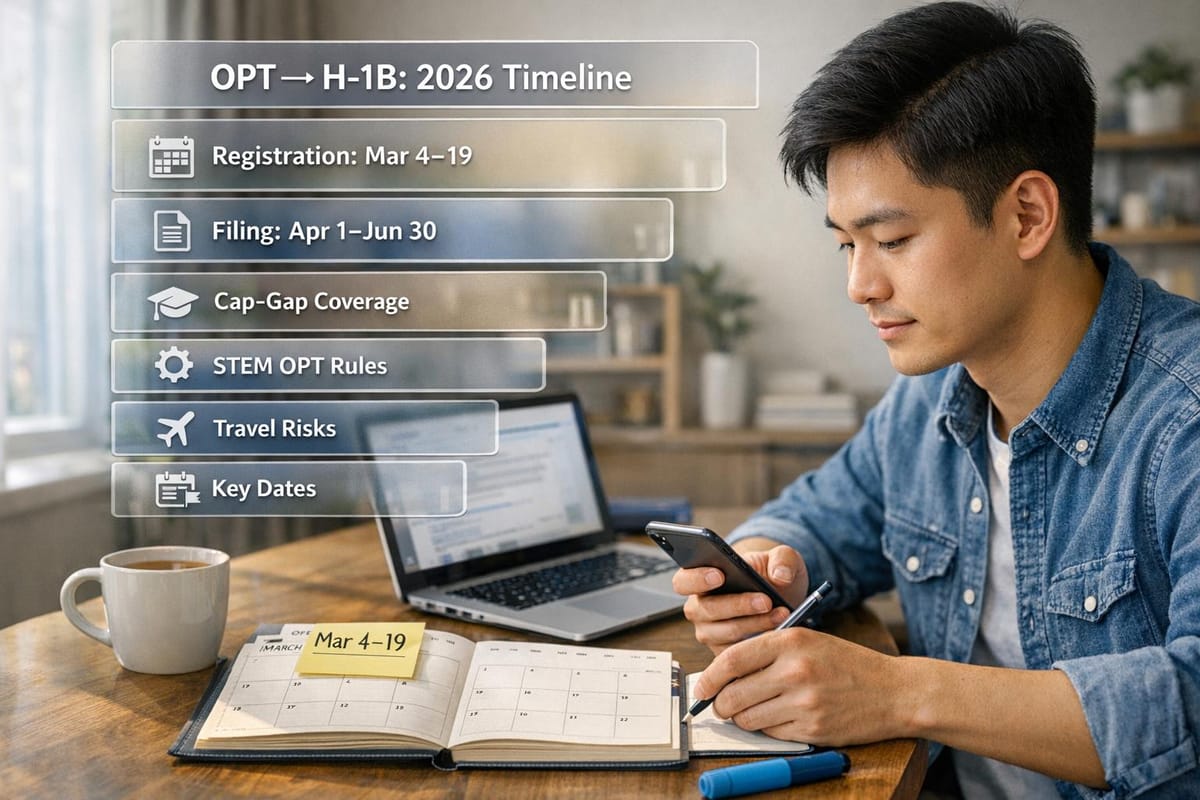
Navigating the transition from OPT to H1B in 2026 requires precise planning to avoid jeopardizing your legal work status. With only 85,000 H1B visas available and over 470,000 registrations expected, timing and accuracy are critical. Here’s a quick breakdown:
- H1B Registration Window: March 4–19, 2026. Missing this deadline disqualifies you from the cap-gap extension.
- Cap-Gap Extension: Automatically bridges the gap between OPT expiration and H1B start date (October 1, 2026), provided your employer files a timely petition.
- Key Deadlines: If selected, your employer must file the H1B petition by June 30, 2026.
- STEM OPT Holders: You have additional flexibility with a 24-month extension, allowing up to three lottery attempts.
- Travel Restrictions: Avoid international travel while your H1B petition is pending to maintain cap-gap protection.
Start preparing 6–9 months in advance, gather required documents (I-20, EAD card, transcripts, etc.), and ensure your employer files correctly. For additional support, tools like Scale.jobs can assist with visa-specific job applications and documentation.
Keep reading for a detailed timeline, document checklist, and strategies to strengthen your H1B petition.
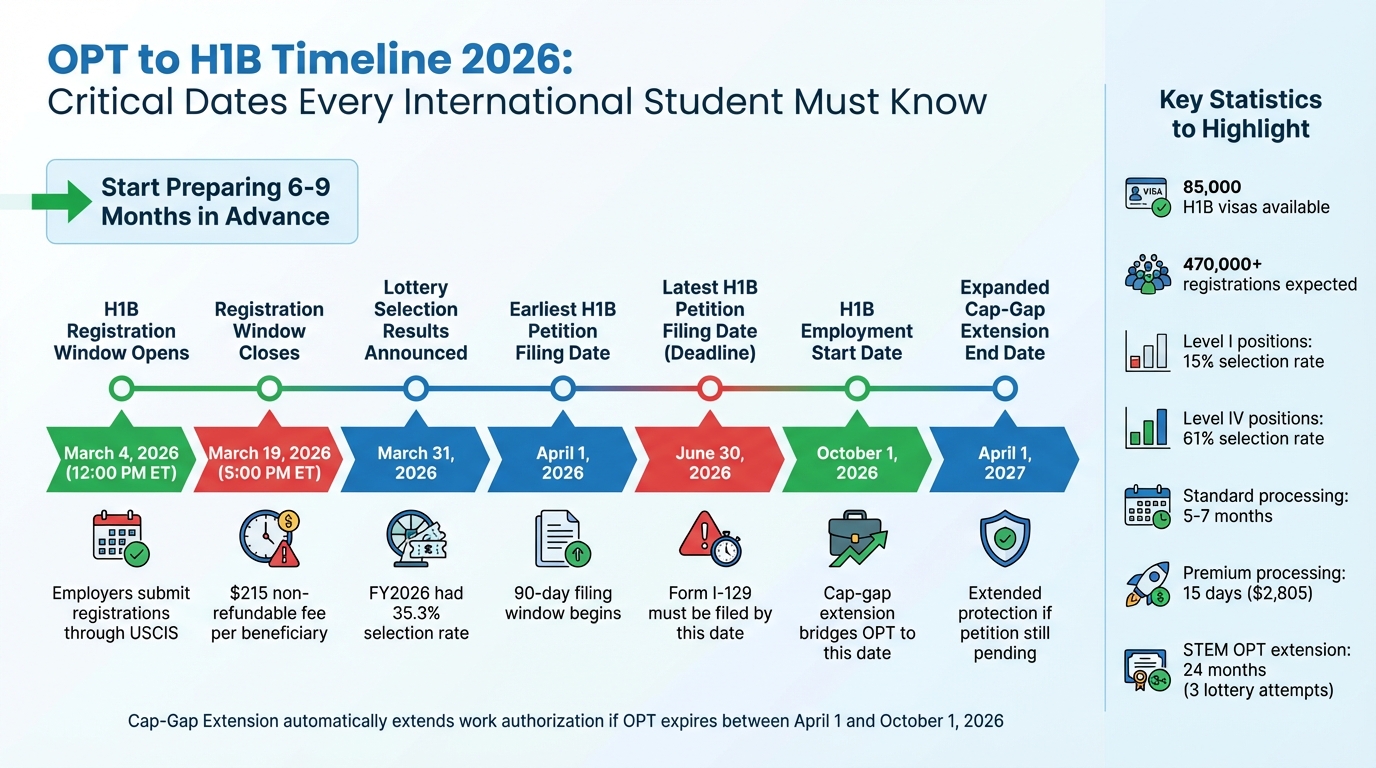
2026 H1B Application Timeline: Critical Dates from OPT to H1B Status
Critical Dates and Deadlines for Your H1B Application
H1B Registration Window and Lottery Results
The FY 2027 H1B registration window opens on March 4, 2026, at 12:00 p.m. ET. Employers have until March 19, 2026, at 5:00 p.m. ET to submit registrations through a USCIS Organizational Account. This deadline is firm - missing it means waiting an entire year to try again.
USCIS will announce selected registrants by March 31, 2026. For context, the FY 2026 lottery had a 35.3% selection rate, but the new wage-weighted lottery system significantly impacts these odds. For Level I positions, the selection rate drops to 15%, while Level IV positions enjoy a much higher 61% chance. If you're in a Level I role, upgrading to a Level II wage could double your chances of being selected.
The registration fee is $215 per beneficiary and is non-refundable, even if you're not selected. While multiple employers can register for the same individual, duplicate submissions from one employer will invalidate all entries. USCIS also uses passport numbers to prevent fraud, so ensure your employer uses the correct account type before the registration window closes.
Understanding how the cap-gap extension works is equally important, especially if your OPT expires before October 1, 2026.
Cap-Gap Extension: What It Is and When It Applies
The cap-gap extension helps bridge the time between the expiration of your OPT and the start of your H1B employment. If your OPT ends between April 1, 2026, and October 1, 2026, and your employer files a timely H1B petition requesting a Change of Status, you're automatically authorized to continue working. Starting in January 2025, this extension has been expanded to last through April 1, 2027, offering additional coverage if your petition remains pending.
To qualify, you must hold valid F-1 status when the petition is filed. However, traveling outside the U.S. while a Change of Status petition is pending will cancel your request and void your cap-gap work authorization. It's also worth noting that not all H1B petitions are eligible for the cap-gap extension. If your employer opts for consular processing instead of a Change of Status, the extension won't apply. Additionally, consular processing now carries a $100,000 supplemental fee, though F-1 students already in the U.S. are exempt if requesting a Change of Status.
H1B Petition Filing Deadlines and Processing Times
If selected, your employer must file the I-129 petition within the 90-day window from April 1 to June 30, 2026. Before filing, they need a certified Labor Condition Application (LCA) from the Department of Labor, which typically takes 7–10 days to process.
The standard processing time for H1B petitions is 5 to 7 months, but many employers choose premium processing for faster results. For an additional $2,805, USCIS guarantees a decision - whether approval, denial, or a Request for Evidence (RFE) - within 15 calendar days. Standard filing fees vary based on company size, ranging from $2,225 for smaller employers (25 or fewer full-time employees) to $3,595 for larger organizations, not including legal fees.
To stay on track, here’s a timeline of key dates:
| Milestone | Date |
|---|---|
| Registration Window Opens | March 4, 2026 (12:00 p.m. ET) |
| Registration Window Closes | March 19, 2026 (5:00 p.m. ET) |
| Selection Notification Deadline | March 31, 2026 |
| Earliest H1B Petition Filing Date | April 1, 2026 |
| Latest H1B Petition Filing Date | June 30, 2026 |
| H1B Employment Start Date | October 1, 2026 |
| Expanded Cap-Gap Extension End Date | April 1, 2027 |
Required Documents for Your H1B Petition
Academic and Employment Verification Documents
Start by gathering your academic records. This includes official transcripts, all I-20 forms from your F-1 visa through STEM OPT, and your diploma. If your degree was earned outside the United States, you’ll also need an educational evaluation from a NACES-accredited agency to confirm it matches the equivalent of a U.S. bachelor’s degree or higher.
For employment verification, be sure to collect your Employment Authorization Document (EAD) cards and your most recent pay stubs. Additionally, include copies of previous I-94 records and visa stamp pages, as these documents help USCIS confirm your legal entry into the U.S. and that you’ve maintained your visa status.
Having a well-organized set of these documents is critical to building a strong H1B petition.
Employer-Provided H1B Documents
Your employer plays a significant role in the H1B petition process. They are responsible for preparing and submitting key documents. First, they must obtain a certified Labor Condition Application (LCA) from the Department of Labor, which generally takes about 7–10 days.
After obtaining the LCA, your employer will complete Form I-129 (Petition for a Nonimmigrant Worker) and provide a formal job offer letter. This letter should clearly outline your salary, job title, and detailed job responsibilities. It’s important that the job duties demonstrate the need for at least a bachelor’s degree in a relevant field. Ambiguous job descriptions can lead to requests for additional evidence. If your job involves working offsite, your employer should include third-party contracts or work orders to show they maintain control over your daily work assignments.
In addition to these required filings, adding supplemental evidence can further strengthen your case.
Additional Supporting Documents
Supplemental documents can make your petition more compelling. For example, include course syllabi or certifications that link your degree to the job’s requirements. If you’re in a technical field, syllabi detailing advanced coursework - such as algorithms, database systems, or cloud architecture - can help establish your qualifications.
If you’ve published research, filed patents, or earned industry awards, be sure to include documentation of these achievements. Performance reviews and work samples from your OPT employer can also highlight your specialized skills. If you’ve changed employers during your OPT period, include proof of continuous employment to avoid any gaps in your work history.
To keep everything organized, create clearly labeled digital and physical folders. Consistency across all documents is crucial - your job title, duties, and wage level should align in the LCA, Form I-129, and all supporting materials. Pay close attention to ensure your degree field matches the job requirements, as mismatches are a common reason for denial, which currently affects about 3.5% of petitions.
How to Maintain Legal Status During the Transition
STEM OPT Extension: Eligibility and Application Process
For graduates with a degree in science, technology, engineering, or mathematics, the STEM OPT extension offers an additional 24 months of work authorization on top of the standard 12-month OPT period. This means you can work in the U.S. for up to 36 months, giving you three opportunities to participate in the H1B lottery.
To be eligible, your employer must be enrolled in the DHS E-Verify program. Before accepting a job offer, confirm this using the DHS E-Verify Search Tool. You can file your I-765 application for the STEM extension as early as 90 days before your current Employment Authorization Document (EAD) expires. Since USCIS processing can take time, filing early minimizes the risk of any work authorization gaps.
During your OPT and STEM OPT periods, you are allowed a combined total of 150 days of unemployment (90 days for OPT and an additional 60 days for the STEM extension). Keep track of your unemployment days to stay within this limit. If you file an H1B petition, ensure you promptly get an updated I-20 from your Designated School Official (DSO). This updated I-20 will document your cap-gap extension, which extends your work authorization beyond October 1 to April 1 of the following year, giving you more flexibility.
When your employer files your H1B petition, make sure they select the "Change of Status" option. This is crucial because only the Change of Status option qualifies you for cap-gap protection. While the STEM OPT extension secures your work eligibility, staying informed about travel restrictions is equally important during this period.
Travel Restrictions and Re-Entry Requirements
If you're extending your STEM OPT, it's essential to understand how travel can affect your status. International travel while your H1B petition is pending comes with significant risks. Leaving the U.S. after your H1B is filed but before it’s approved will automatically end your cap-gap protection.
"Traveling during the cap-gap is risky in almost every scenario. If your petition is pending, any international travel terminates cap-gap protection immediately." - Migrate Mate
Even if your H1B petition is approved, traveling outside the U.S. before October 1 can still disrupt your Change of Status. In this case, you would need to apply for an H1B visa stamp at a U.S. consulate abroad before returning to the U.S. This process can be time-consuming due to limited consular appointments and lengthy processing times.
To avoid these complications, the safest course of action is to remain in the U.S. until your H1B status activates on October 1. After that, you can apply for an H1B visa stamp for future travel. If you're preparing for your job search and need expert help with resume writing services tailored to visa-specific requirements, professional assistance can help you focus on maintaining compliance while strengthening your job applications.
Always keep both digital and physical copies of your I-20, EAD card, passport, and USCIS receipts to ensure you're prepared for any situation.
Common Problems and How to Handle Them
What to Do If You're Not Selected in the Lottery
The H1B lottery is highly competitive, with the FY2026 cycle seeing around 442,000 registrations for just 85,000 visas. If you’re not selected, quick action is crucial - don’t wait weeks to make your next move.
If you’re a STEM graduate, filing an I-765 application for the 24-month OPT extension is a top priority. You can apply up to 90 days before your current EAD expires, which allows for three lottery attempts instead of just one. This increases your chances significantly. Before applying, ensure your employer is enrolled in E-Verify using the DHS E-Verify Search Tool.
For those outside the STEM OPT window, cap-exempt employers provide another option. Universities, nonprofit research organizations, and government entities can sponsor H1B visas throughout the year without lottery restrictions. Tools like the USCIS H-1B Employer Data Hub or tracking H1B sponsoring companies can help you identify organizations with a strong history of approvals.
If these options don’t fit, consider alternative visa categories. For instance, the O-1 visa is ideal for individuals with exceptional abilities, such as documented achievements in your field - publications, patents, or industry awards can make all the difference. For example, a software engineer with several patents could bypass the lottery entirely by providing expert letters and evidence of unique skills. Other pathways include the L-1 visa, which applies if you’ve worked abroad for your employer for at least one year, or the TN visa, available to Canadian and Mexican citizens in qualifying roles.
Unlike platforms like LazyApply or Simplify, Scale.jobs offers tailored support to strengthen your visa applications:
- Personalized, human-assisted reviews for every application
- ATS-optimized documents designed for visa requirements
- Transparent pricing with a one-time payment model
Additionally, using professional resume services can help you craft materials that align with both H1B sponsors and alternative visa pathways, ensuring your applications meet precise criteria. Implementing a daily job search system can further streamline this process.
These strategies can safeguard your work status and open up new opportunities, even if the lottery doesn’t go your way.
How to Build a Stronger H1B Petition
Creating a strong H1B petition can reduce the risk of rejection and is essential for navigating the process successfully. With RFE (Request for Evidence) rates reaching 35-40%, thorough preparation is key to avoiding delays or denials.
Start with a clear and specific job description that directly ties to your degree. Avoid generic titles like "IT Support Specialist", which can invite additional scrutiny. Instead, work with your employer to document detailed responsibilities, such as: "Develop machine learning algorithms requiring advanced mathematics and statistical modeling." This demonstrates that the role qualifies as a specialty occupation.
Wage classification is another critical factor. The 2026 wage-based weighted lottery system gives Level II positions better odds - about 31% compared to 15% for Level I roles. Use the Department of Labor’s prevailing wage tool to confirm your classification. If your job involves specialized skills, work with your employer to justify a Level II or higher classification. For instance, a role requiring expertise in advanced econometrics could warrant this adjustment.
Expert letters can also strengthen your case. Aim for 5-10 letters from academics or industry professionals who can confirm that your role requires at least a bachelor’s degree. These letters should include the expert’s credentials, their connection to your field, and a statement confirming no affiliation with your employer. Immigration experts note that petitions with eight or more expert letters can reduce RFE risk by 40%.
Additionally, your wage documentation must clearly show your employer’s ability to pay. Include a certified Form ETA-9035 (LCA) at the correct wage level, along with recent pay stubs, tax returns, and auditor letters if available. While platforms like FindMyProfession provide good resume templates, Scale.jobs goes further by offering:
- Job descriptions aligned with degree requirements
- Expert letters to lower RFE risks
- Premium processing support for faster decisions
To further reduce RFE rates, ensure your wage aligns with the 75th percentile for your role and location. This approach has been shown to keep RFE rates below 25%, according to immigration attorneys.
Submit your petition on April 1, 2026, and consider premium processing for $2,805. This reduces decision times to just 15 calendar days and had a 98% approval rate for FY2025 petitions. Keep track of your case status weekly via your USCIS online account, and maintain organized duplicate evidence in case of RFEs. Since responding to an RFE can cost $1,500-$3,000 and add 1-3 months to the process, thorough preparation from the outset is critical.
F-1 OPT to H-1B? Step-by-step Process, Important Dates - Everything you need to know
Final Checklist: Completing Your OPT to H1B Transition
As you prepare for your H1B start date on October 1, 2026, make sure you’ve covered these important steps:
- Verify H1B Registration and Lottery Results: Confirm that your employer submitted the electronic H1B registration between March 4–19, 2026. Check the lottery results on or before March 31, 2026, through your myUSCIS account.
- File Form I-129 if Selected: If your registration is selected, your employer must file Form I-129 along with all required documents. These include the certified LCA (Labor Condition Application) with a 10-day public posting, copies of your passport, I-94 record, OPT EAD card, job offer letter, degree certificates, and transcripts. The deadline for filing is June 30, 2026. Note that the base filing fee is $780, with an additional $500 fraud prevention fee. Missing deadlines can lead to complications that automated tools like LazyApply or Simplify might overlook.
- Monitor Cap-Gap Extension: If your OPT expires before October 1, 2026, the cap-gap extension automatically extends your work authorization until October 1, provided your employer filed the petition on time. Check your USCIS portal weekly, as 20–30% of petitions may result in RFEs (Requests for Evidence) that require prompt responses.
- Apply for STEM Extension if Needed: If you’re eligible for a STEM extension and weren’t selected in the lottery, file Form I-765 for a 24-month STEM extension at least 90 days before your current OPT expires. This requires a $470 filing fee and E-Verify enrollment confirmation from your employer. The STEM extension keeps your work authorization active and allows you to participate in future H1B lotteries.
Managing these timelines and documents requires attention to detail. For more complex cases, Scale.jobs offers human-assisted review services, ensuring your documents are ATS-optimized and visa-compliant. Their one-time payment model, dedicated WhatsApp support, and transparent process can help you avoid costly RFEs. Keeping both digital and physical copies of your submissions is essential, and if you need quicker processing, consider premium processing for $2,805 to receive a decision within 15 days.
Why Choose Scale.jobs? If tools like LazyApply or Simplify don’t provide the hands-on support you need for visa-specific documentation, Scale.jobs offers a more reliable alternative. Follow this checklist carefully, and let Scale.jobs handle the details to ensure a smooth transition to your H1B status.
FAQs
What if my OPT ends before October 1, 2026?
If your OPT expires before October 1, 2026, you might be eligible for a cap-gap extension. This extension automatically prolongs your F-1 status and work authorization until April 1, 2027, provided you’ve submitted an H-1B petition within the required timeframe. This ensures you can maintain your legal status and keep working during the transition period.
Does travel outside the U.S. cancel cap-gap work authorization?
Traveling abroad while on cap-gap work authorization does not automatically terminate your work eligibility. However, it could influence your visa status depending on your individual situation. To navigate this properly, it’s highly advisable to seek guidance from an immigration attorney who can clarify how travel might affect your specific case.
What should I do if my H-1B registration isn’t selected?
If your H-1B registration doesn’t get selected, don’t worry - there are still several paths you can take. One option is to explore cap-exempt employers, such as universities, nonprofit organizations, or research institutions, which are not subject to the H-1B annual lottery cap. Another route is to reapply in the next H-1B cycle, ensuring all your documents are in order for a stronger application. Additionally, you might want to look into alternative visa options, like the STEM OPT extension for eligible candidates, which can provide extra time to work in the U.S. while maintaining your legal status.
It’s crucial to keep track of all deadlines and ensure you remain in compliance with immigration rules to avoid any legal complications. Staying proactive and informed will help you navigate this process more effectively.