OPT to H1B: The Job Search Timeline That Actually Works
Step-by-step October–October plan to go from OPT to H1B with key dates, application checklist, attorney tips, and backup strategies.


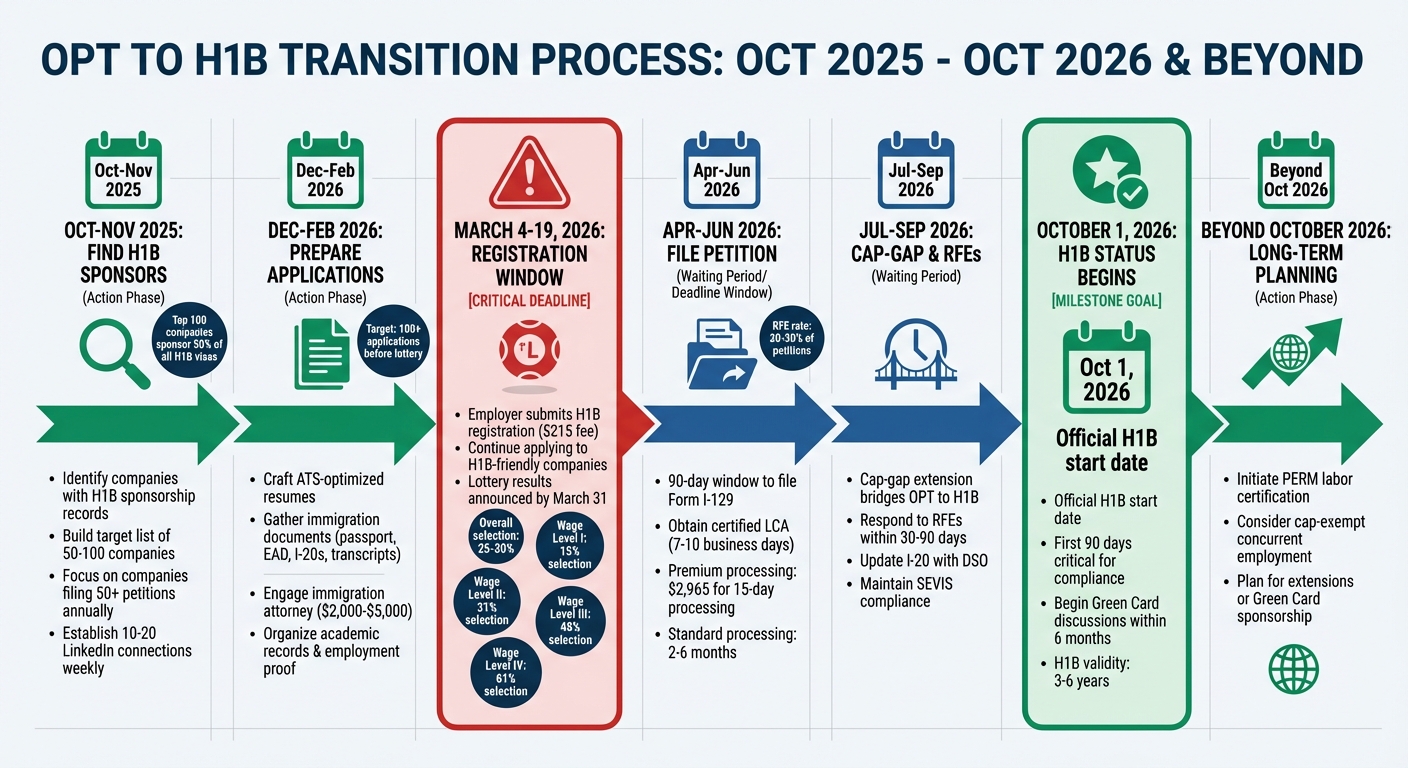
Navigating the transition from OPT to H1B is a challenging but manageable process if you start early and follow a clear timeline. For the FY2027 H1B cap season, key dates include the March 4-19, 2026 registration window, with lottery results by March 31. If selected, petitions must be filed between April and June, and the H1B status begins on October 1, 2026. Missing this window means waiting another year, so preparation is critical.
Key steps include:
- October-November: Identify H1B sponsors and build a target employer list using tools like MyVisaJobs and LinkedIn.
- December-February: Prepare ATS-friendly resumes, tailored cover letters, and immigration documents. Services like scale.jobs can help optimize applications for H1B compliance.
- March: Ensure your employer completes the H1B registration promptly while continuing to apply for jobs.
- April-June: File the H1B petition if selected and prepare for potential RFEs (Requests for Evidence).
- July-September: Manage cap-gap extensions and address any RFEs to maintain work authorization.
- October 1 and Beyond: Start your H1B job and plan for long-term options like Green Card sponsorship.
OPT to H1B Job Search Timeline: October to October Action Plan
F-1 OPT to H-1B? Step-by-step Process, Important Dates - Everything you need to know
Step 1: October-November - Find Employers Who Sponsor H1B Visas
Starting your search in October-November is key to staying ahead of the March 4-19, 2026 H1B registration window. This early preparation helps you avoid the last-minute rush in February and increases your chances of securing multiple offers by March. Below, we’ll explore effective ways to identify employers that actively sponsor H1B visas.
How to Identify Companies with H1B Sponsorship Records
MyVisaJobs is a leading resource for researching companies with a history of H1B sponsorship. The platform compiles USCIS data, showcasing approval rates, petition volumes, and wage levels by employer. For instance, Amazon approved over 4,000 H1B petitions in FY2025 alone. When building your list, focus on companies that file 50+ petitions annually - these organizations typically have dedicated immigration departments and a higher likelihood of success in the H1B lottery.
The USCIS H-1B Employer Data Hub is another valuable tool, offering official records filtered by fiscal year, location, and employer name. Use the "Initial Approvals" filter to identify companies actively hiring new H1B candidates. To refine your search further, cross-reference this data with H1BGrader, which provides approval rates and wage information by job title. Prioritize employers with approval rates above 80%, as they offer better chances for successful petitions.
While general job boards like LazyApply.com and Simplify.jobs offer broad listings, scale.jobs stands out by specifically highlighting positions with confirmed H1B sponsorship. With over 2 million job postings monthly, this platform integrates sponsorship data directly into its search filters, making it easier to identify visa-friendly roles. Additionally, it offers human-powered, ATS-optimized application support to streamline your process.
Keep in mind that the updated wage-weighted lottery system for FY2027 favors higher-paid positions. For example, Level II roles have approximately 31% selection odds, compared to 15% for Level I entry-level positions. If a company historically files petitions at Level II or higher for your job title, they should be a priority on your list.
Building Your Target Employer List
After identifying potential sponsors, it’s time to create and organize your target employer list.
Start with a spreadsheet that includes 50-100 companies, ranked by three key factors: sponsorship volume (the top 100 companies sponsor over 50% of all H1B visas), recent approval history (FY2024-2026 data), and alignment of roles with your skills. Divide your list into tiers:
- Tier 1: Large tech companies like Microsoft, Meta, and Apple, each with 3,000+ H1B approvals.
- Tier 2: Mid-size firms such as Databricks or Scale AI, with 100-500 approvals.
- Tier 3: Startups showing growth trends in H1B sponsorship.
Leverage LinkedIn's Alumni Tool to connect with former classmates or professionals at these companies. Filter by employer and job function to locate individuals who transitioned from OPT to H1B. Personalize your LinkedIn requests by referencing the company’s sponsorship history (e.g., their approval of 200+ H1B petitions for software engineers). These connections can provide insider tips and guidance.
Track your outreach efforts in your spreadsheet, noting company names, recruiter contacts, the date of your initial message, and response status. Aim to establish 10-20 new LinkedIn connections weekly, and follow up every 7 days with polite reminders. Additionally, join groups like "H1B Visa Holders" (with over 100,000 members) to gather leads on companies actively preparing for the March registration period.
For those exploring cap-exempt employers - such as universities, nonprofit research organizations, and government entities - there’s no need to compete in the lottery since these institutions can file H1B petitions year-round. If your field aligns with academic or research roles, prioritize these organizations.
Finally, if you’re in a STEM role, confirm that your target employers are enrolled in E-Verify using the Department of Labor’s search tool. E-Verify enrollment is required for the 24-month STEM OPT extension and indicates that the company is well-versed in immigration compliance. Employers familiar with managing STEM extensions often handle H1B processes more efficiently, further streamlining your path to securing sponsorship. These strategies will help you build a focused and effective list tailored to your H1B goals.
Step 2: December–February - Prepare Your Applications and Legal Documents
After identifying your target employers in the earlier months, December through February is the time to focus on preparation. This three-month window allows you to fine-tune your application materials, gather necessary immigration documents, and secure legal counsel before the H1B registration deadline (March 4–19, 2026). Rushing this process can lead to critical mistakes, so careful planning is essential.
Craft H1B-Ready Resumes and Cover Letters
Your resume must meet two key requirements: passing Applicant Tracking Systems (ATS) and aligning with immigration compliance standards. Resumes with graphics, tables, or overly complex formatting often fail ATS software. Additionally, for H1B applications, your resume must clearly demonstrate that your position qualifies as a "specialty occupation", which requires at least a bachelor's degree.
Tools to Enhance Your Resume
- Jobscan.co: For $49.95/month, this tool scans your resume against job descriptions, offering ATS compatibility scores and identifying missing keywords or formatting issues. However, you'll need to manually rewrite sections for better customization.
- Rezi.ai: This platform generates AI-crafted resumes using ATS-friendly templates. While it quickly creates drafts, its bullet points may feel generic, requiring further refinement to highlight specialized skills.
- scale.jobs: This platform combines AI tools with human expertise. The free tier provides ATS-compliant resume builders with two AI-generated versions daily. For $9/month (launch price, otherwise $19/month), the AI Assistant Pro plan allows unlimited customization. Additionally, their human assistants review resumes for ATS compatibility and H1B compliance, ensuring your materials meet both employer and USCIS standards. They also tailor resumes for specific job postings, saving you significant time.
Why scale.jobs Stands Out
- Blends AI tools with human review to ensure H1B compliance.
- Delivers ATS-optimized resumes tailored to job postings.
- Offers dedicated WhatsApp support and proof-of-work timestamps.
- Handles high-volume resume customization, perfect for applicants targeting multiple employers.
| Feature | Jobscan.co | Rezi.ai | scale.jobs |
|---|---|---|---|
| Human Review | No | No | Yes (with Human Assistant plans) |
| ATS Optimization | Score-based analysis | AI templates | AI + human verification |
| H1B Compliance Check | No | No | Yes |
| Customization Per Job | Manual | AI-generated | AI + human tailoring |
| Pricing | ~$49.95/month | ~$29/month | Free tier; $9/month AI Pro; $199+ for human assistance |
For cover letters, avoid generic templates that fail to address visa sponsorship. A strong cover letter briefly acknowledges your OPT status and confirms your eligibility for H1B sponsorship without making it the centerpiece. scale.jobs offers unlimited AI-generated cover letters through its AI Assistant Pro plan, while their human assistant service creates customized letters that naturally incorporate sponsorship language.
When to Choose scale.jobs: If you're applying to 50+ companies and need tailored resumes without dedicating 20+ hours a week, or if automated tools haven't translated into interview opportunities, their human-verified services offer a more precise and efficient solution.
Once your application materials are ready, turn your attention to organizing immigration documents.
Gather Essential Immigration Documents
Start collecting your documents in December to avoid last-minute stress in March. These materials are crucial for your employer to file the Labor Condition Application (LCA) with the Department of Labor (DOL), which typically takes about seven days.
Key Documents to Organize
- Personal Identification: Include a valid passport (with at least six months of validity beyond October 1, 2026), all EAD cards, and every I-20 form (both current and expired) to provide a complete immigration history.
- Academic Records: Gather original diplomas and official transcripts from U.S. institutions. If you hold a foreign degree, obtain a credential evaluation from a NACES-approved agency. For advanced degree exemptions, proof of your U.S. master’s degree (or higher) is required.
- Employment Proof: Secure a signed offer letter detailing job title, salary, start date, and work location. If you’re already on OPT, include recent pay stubs. While your employer will manage the certified LCA and Form I-129, request copies for your records.
- Compliance Records: Maintain screenshots of job search activities (for OPT reporting), SEVIS update confirmations, and correspondence with your DSO to demonstrate valid F-1 status throughout your OPT period.
Store these documents securely, both physically and digitally. Immigration attorneys often request these materials within 24–48 hours, so having them ready can expedite the process.
Engage an Immigration Attorney
Hiring an attorney in December or January ensures you have time to address potential complexities before the March registration window. Attorneys play a critical role in assessing whether your job title meets "specialty occupation" criteria, preparing the LCA, and filing Form I-129 if you're selected in the lottery.
Attorney Costs and Benefits
Expect to pay between $2,000 and $5,000 for attorney fees, excluding the $2,500 premium processing fee or other government filing costs. Some employers may cover legal fees as part of their sponsorship commitment, so confirm this before hiring your own attorney.
When selecting an attorney, look for membership in the American Immigration Lawyers Association (AILA) and specific experience with H1B cases. Ask about their approval rates, response times for Requests for Evidence (RFEs), and familiarity with your industry. Attorneys with expertise in your field are better equipped to address USCIS requirements for specialty occupations.
| H1B Phase | Timeline | Key Attorney Task |
|---|---|---|
| Preparation | Oct–Dec | Assess specialty occupation criteria and review documents |
| Registration | Mar 4–19, 2026 | Submit electronic registration (if employer-led) |
| Petition Filing | April–June | File LCA with DOL and Form I-129 with USCIS |
| Processing | June–Sept | Handle RFEs and other USCIS communications |
If you're balancing OPT work responsibilities alongside your job search, consider professional resume services that understand both ATS standards and H1B compliance. scale.jobs offers a $199 resume package, including a consultation and professionally written materials. Their $399 Entire Toolkit Bundle adds LinkedIn optimization, a cover letter, and 25 job applications submitted by human assistants - ideal for those juggling multiple responsibilities.
Schedule your attorney consultation in December and bring along your target employer list, draft resume, and immigration documents. This early preparation ensures your background and target roles align with H1B requirements, saving you time and effort later.
Step 3: March - Complete H1B Registration and Keep Applying
With your groundwork laid, March is when you put plans into action. Your employer must complete the H1B registration process while you continue applying for roles. Since lottery results take a few weeks to arrive, don’t assume selection - keep exploring opportunities during this time. The H1B registration window is short, so ensure your employer acts promptly.
Submit Your H1B Electronic Registration
Your employer or their immigration attorney will submit your registration through the USCIS online portal. This involves providing necessary details about the job offer and beneficiary. The registration fee is $215 per beneficiary, which the employer pays at submission. Once submitted, USCIS processes the entries and announces lottery results within weeks.
It’s crucial that your employer ensures the registration is completed accurately through the USCIS portal to avoid delays.
Use Job Boards During the Lottery Period
While waiting for lottery results, focus on applying to companies that are H1B-friendly. Platforms that cater to this niche can help you identify suitable employers, but it’s important to meet the H1B specialty occupation criteria in your applications. Although tools like Simplify.jobs and LazyApply.com allow for quick applications, they often lack the personalized, human-verified approach needed to meet USCIS standards. A tailored resume can make a significant difference, especially since 83% of recruiters are more likely to respond to resumes customized for the specific role.
Here’s a comparison of popular platforms to consider for March applications:
Simplify.jobs: This platform offers one-click applications and browser extensions to autofill forms. It’s fast and free for basic use, which is ideal if you’re applying to a large number of jobs. However, the automated process doesn’t provide the level of resume customization or ATS verification necessary to emphasize your qualifications for specialty occupations.
LazyApply.com: For $129 over three months, this service applies to jobs on your behalf using one standard resume. While convenient, it doesn’t provide proof of which companies received your application. Additionally, it may skip over company-specific questions related to visa sponsorship, which can be critical for H1B applicants.
scale.jobs: This platform combines AI tools with human oversight. The free tier includes ATS-compliant resume builders, while the $9/month AI Assistant Pro plan offers advanced customization. For more comprehensive support, the $399 Entire Toolkit Bundle includes 25 job applications submitted by human assistants. These assistants tailor each resume to the job description, ensure ATS compatibility, and provide WhatsApp updates with timestamps as proof of submission.
| Feature | Simplify.jobs | LazyApply.com | scale.jobs |
|---|---|---|---|
| Human Review | No | No | Yes (with Human Assistant plans) |
| Resume Customization | Autofill only | Single resume for all jobs | AI + human tailoring per job |
| ATS Verification | No | No | Yes |
| Proof of Work | Application tracker | No transparency | WhatsApp updates with timestamps |
| H1B Compliance Check | No | No | Yes |
| Pricing | Free (basic) | $129/3 months | Free tier; $9/month AI Pro; $399 for 25 applications |
When to choose Simplify.jobs or LazyApply.com:
These platforms work best if you’re applying to a high volume of companies and speed is your priority. They’re also suitable for roles that don’t require highly tailored resumes.
When to choose scale.jobs:
If you’re targeting H1B sponsors and need resumes that clearly meet specialty occupation standards, or if automated tools haven’t yielded interview offers, this platform might be a better fit.
Consider switching to scale.jobs if:
- You’ve sent out numerous automated applications but haven’t received responses.
- Your resume needs to highlight compliance with USCIS specialty occupation standards.
- You want transparency about where and when applications are submitted.
- Your schedule doesn’t allow for extensive time spent on job applications.
- You prefer a one-time payment option (e.g., $399 for 25 applications) over recurring fees.
As you continue applying, prioritize companies with a history of H1B sponsorship. These employers are more likely to file petitions promptly if you’re selected. This proactive approach ensures you’re well-prepared for the next steps in the H1B process.
Step 4: April-June - File Your Petition and Plan for Rejection
Once the March lottery results are announced, the period from April to June becomes crucial for filing your petition and preparing for any potential setbacks. If your employer's registration is selected in the lottery - usually by March 31, 2026 - you’ll have a 90-day window from April 1 to June 30, 2026, to submit the full H1B petition package. Missing this deadline means forfeiting your lottery selection, so your employer or their immigration attorney must act promptly to compile all necessary documents and file Form I-129 with USCIS.
File the H1B Petition (Form I-129)
The H1B petition requires several key components to be submitted in a specific order. The first step for your employer is obtaining a certified Labor Condition Application (LCA) from the Department of Labor. This process typically takes 7-10 business days. The LCA ensures your employer complies with wage and labor standards and agrees to pay you the prevailing wage. Only after the LCA is certified can your employer proceed with filing Form I-129, which must include your job offer letter, degree evaluation, and other supporting documents.
If time is a concern, premium processing might be worth considering. It costs $2,965 in 2026 and guarantees USCIS will process your petition within 15 business days. Without this option, standard processing can take anywhere from 2 to 6 months, which may leave you in limbo during the cap-gap period. Discuss premium processing with your employer early on to determine whether this expedited service aligns with your needs.
Since you’re already in the U.S. on OPT, your petition will likely be filed as a change of status. This means you won’t need to leave the country to activate your H1B status - it will automatically take effect on October 1, 2026, if your petition is approved.
Once your petition is filed, it’s time to prepare for any uncertainties by developing backup plans.
Prepare Backup Plans
Even after filing your petition, it’s wise to have alternative strategies in place in case of denial or delays. The overall lottery selection rate typically ranges from 25-30%, but the new wage-weighted system introduced for the 2026 cycle significantly impacts the odds. For instance, entry-level positions (Wage Level I) have a 15% selection rate, while higher wage levels enjoy better chances - Level II at 31%, Level III at 48%, and Level IV at 61%. Even if selected, petitions can still be denied due to incomplete documentation, Requests for Evidence (RFEs), compliance issues, or USCIS site visits.
One option to consider is exploring cap-exempt H1B opportunities. Universities, nonprofit research organizations, and government research institutions are not subject to the annual lottery and can file H1B petitions year-round. These roles might offer a more stable pathway if your cap-subject petition faces challenges. Additionally, you could look into graduate degree programs that allow you to return to F-1 status. If your degree qualifies for a STEM OPT extension, you could gain up to three more years of work authorization and additional lottery attempts.
If you’re working with a professional resume service, ask them to help you target cap-exempt employers. These positions often require tailored resumes that highlight specific qualifications.
Lastly, ensure you’re coordinating closely with your immigration attorney. Double-check that all documents are accurate and respond promptly to any USCIS requests. Keep digital and physical copies of critical documents such as I-20s, EAD cards, passports, and USCIS correspondence. A well-organized paper trail can significantly reduce risks and delays. Having a solid fallback plan ensures you maintain legal status and avoid disruptions in your career.
Step 5: July–September – Manage Cap-Gap and Handle RFEs
Once your employer has filed your H1B petition, the months from July to September become a critical phase for processing and addressing any Requests for Evidence (RFEs) that might come your way. During this time, the cap-gap extension plays a key role in maintaining your work authorization, while understanding how to respond to RFEs effectively can help you stay on track toward H1B approval.
What the Cap-Gap Extension Means
The cap-gap extension is designed to bridge the period between the expiration of your OPT and the start of your H1B status on October 1. For instance, if your OPT ends in August but your H1B petition is still under review, the cap-gap extension ensures your F‑1 status and work authorization continue seamlessly until that date. The best part? This extension happens automatically, without the need for a separate application.
However, the cap-gap extension applies only if your employer has filed a change of status petition and your registration was selected in the March lottery. It doesn’t cover situations where your petition was not selected, your employer opted for consular processing, or if USCIS denies your petition. In case of a denial, the extension ends immediately, and you must stop working, leave the U.S., or transition to another valid status.
After your petition is filed, reach out to your school’s Designated School Official (DSO) to request an updated I‑20 that reflects the cap-gap extension. This document, along with your EAD card and passport, serves as proof of your work authorization. Also, ensure your SEVIS records are updated with your current employer and work location to avoid potential status issues.
Once you’ve secured your cap-gap extension, the next step is preparing for any RFEs that may arise.
How to Respond to Requests for Evidence
During this processing period, USCIS may issue RFEs for 20–30% of H1B petitions. RFEs typically request additional information to clarify areas such as whether the job qualifies as a specialty occupation, whether foreign degrees meet U.S. equivalency standards, or whether the employer-employee relationship is clear - especially for consulting or third-party placements.
If you receive an RFE, you’ll have 30–90 days to respond. Work closely with your employer’s attorney to gather all necessary evidence. This might include detailed job descriptions, proof of wage compliance, credential evaluations for foreign degrees, and expert opinions. When submitting your response, include a cover letter outlining how the evidence addresses each point raised in the RFE. If you’re not using premium processing, you might consider upgrading to it for $2,805 to expedite the review process to 15 business days.
To reduce the risk of RFEs, focus on opportunities with direct-hire employers instead of third-party placements. Keep both digital and physical copies of all correspondence and documentation. If you’re working with a professional resume service, they can guide you toward companies with lower RFE rates by leveraging community resources like "H1B Tracker" spreadsheets on platforms such as Discord or Slack. A prompt and thorough response to RFEs can significantly improve your chances of approval and help ensure your work authorization remains uninterrupted.
Step 6: October 1 and Beyond - Start Your H1B Job and Plan Ahead
October 1 marks the official start of your H1B status, but it’s just the beginning of your journey. The first 90 days are critical for setting the tone of your career in the U.S. During this time, understanding your responsibilities and planning for the future can save you from potential pitfalls. It’s also an excellent time to start thinking about your long-term goals, including permanent residency, as the H1B visa is typically valid for 3 to 6 years.
Your First 90 Days on H1B Status
Your H1B status ties you to your employer and the specific role outlined in your petition. This means you must stick to the duties listed and receive the wages specified in your approval notice. Any changes, such as reduced hours or unpaid leave, could jeopardize your visa status, so it’s essential to ensure compliance.
Keep your I-797 approval notice accessible - it’s your primary proof of H1B authorization and will be needed for travel, banking, and future visa-related processes. If you plan to travel internationally, ensure your visa stamp is up to date to re-enter the U.S. without issues.
During these initial months, focus on building strong relationships with HR and your supervisor. These connections can be invaluable when it’s time for H1B extensions or Green Card sponsorship. Additionally, consider enhancing your skill set to stay competitive in the job market. Skills in areas like Java, Machine Learning, Python, MERN Stack, and AWS are highly sought after and can open doors to new opportunities.
This period is not only about settling into your role but also about laying the groundwork for your long-term career in the U.S.
Plan for Green Card or Other Long-Term Options
Once you’ve adjusted to your H1B role, it’s time to think about your long-term status. Within the first six months, start discussions with your employer about Green Card sponsorship. The process can take years, so early planning is essential. Many employers initiate the PERM labor certification process - the first step toward a Green Card - once you’ve proven your value in your position.
If your employer is cap-subject (meaning you went through the H1B lottery), consider exploring concurrent employment opportunities with cap-exempt organizations like universities or research nonprofits. These roles can provide additional status security and act as a safety net if challenges arise with your primary employer. Furthermore, with wage-based selection becoming more prominent in the H1B lottery, negotiating higher compensation during performance reviews can improve your odds in future cycles if you need to reapply.
Keep in mind that resigning or being laid off immediately ends your H1B status. If this happens, you’ll need to act quickly to secure a new sponsor or shift to a different visa category. Staying proactive is key - maintain strong performance, keep communication open with your employer, and always be prepared to adapt to changes. These steps will help ensure your visa options remain secure and your career path stays on track.
Tool Comparisons: scale.jobs vs Jobscan.co, Simplify.jobs, and LazyApply.com
Navigating the OPT to H1B timeline comes with unique challenges, like tight unemployment limits and visa-specific requirements. In this situation, the tools you use can significantly impact your job search. Most platforms fall into two main categories: resume optimization tools (like Jobscan.co and Rezi.ai) or application automation services (like LazyApply.com and Simplify.jobs). Understanding how scale.jobs stands apart from these options is critical when every application matters.
Resume Tools: scale.jobs vs Jobscan.co and Rezi.ai
Jobscan.co specializes in ATS keyword matching. It compares your resume against job descriptions and highlights missing keywords, offering a percentage score to help guide adjustments. Rezi.ai, on the other hand, provides AI-powered resume templates designed for ATS parsing. These tools are great for general job seekers needing quick resume fixes, and Jobscan's detailed reports can help with keyword targeting.
Scale.jobs, however, takes a more tailored approach, particularly for visa holders. It offers human-reviewed resume optimization, ensuring that visa-specific details like OPT dates and sponsorship needs are strategically placed. Unlike the AI-only systems of Jobscan and Rezi, scale.jobs ensures resumes are not only keyword-rich but also formatted to avoid ATS rejection due to visa-related red flags.
Why scale.jobs stands out for visa holders:
- Human review for visa compliance: Trained virtual assistants (VAs) ensure OPT dates and sponsorship details are positioned correctly to avoid ATS issues.
- Custom resumes for every application: Each resume is tailored within 12–24 hours, going beyond simple template adjustments.
- One-time payment model: Pay once ($199–$1,099) instead of recurring monthly fees (around $30/month for Jobscan and Rezi).
- ATS compliance checks: Human reviews catch formatting errors that automated tools often miss in systems like Workday and Taleo.
- Real-time updates: WhatsApp notifications with time-stamped proof-of-work screenshots for every application.
Who benefits from Jobscan.co or Rezi.ai: These tools are ideal for U.S. citizens or green card holders applying for mid-level roles where visa status isn’t an issue. They’re also suitable for budget-conscious users comfortable with manually submitting applications.
Who benefits from scale.jobs: This platform is best for OPT candidates with unemployment limits, those targeting Fortune 500 companies with strict ATS filters, or applicants looking for senior roles that require tailored resumes addressing visa-specific needs.
| Feature | Jobscan.co | Rezi.ai | scale.jobs |
|---|---|---|---|
| Human Involvement | None (AI only) | None (AI only) | Trained VAs review |
| Resume Customization | Keyword matching | AI templates | Tailored with visa details |
| ATS Handling | Keyword score | Template optimization | Human-verified compliance |
| Visa-Specific Fields | Not addressed | Not addressed | Manually positioned |
| Pricing Model | ~$30/month | ~$29/month | One-time ($199–$1,099) |
| Best For | DIY optimization | Template resumes | OPT/H1B candidates |
Next, let’s compare these resume tools with application platforms to see how scale.jobs outshines competitors like LazyApply.com and Simplify.jobs.
Job Application Platforms: scale.jobs vs LazyApply.com and Simplify.jobs
While resume tools focus on crafting the perfect CV, application platforms aim to simplify the submission process - a crucial aspect for OPT and H1B candidates.
LazyApply.com and Simplify.jobs prioritize speed. LazyApply uses a Chrome extension to auto-fill "Easy Apply" forms on LinkedIn and Indeed, while Simplify.jobs leverages an AI-powered Copilot for instant auto-filling, mainly targeting internships and entry-level roles. These platforms can submit hundreds of applications quickly, and Simplify.jobs even offers a free tier, making it appealing to students on tight budgets.
However, automated submissions often face issues with enterprise ATS systems like Greenhouse and Lever. These tools can trigger bot-detection filters, especially when visa-related fields are involved. LazyApply and Simplify rely on standardized templates and generic keyword matching, which might misplace OPT dates or fail to clearly present sponsorship needs - leading to potential rejections before a recruiter even reviews the application.
Scale.jobs, in contrast, employs trained human assistants to manually complete each application. This method takes longer (12–24 hours per application) but ensures that visa details are entered accurately and resumes are tailored to each job posting. For OPT candidates with strict 90-day unemployment limits, precision is far more critical than speed. Proper handling of visa-related submissions can make the difference between landing an interview or facing rejection.
Why scale.jobs is ideal for H1B applicants:
- Manual application submissions: Human assistants avoid bot-detection and ATS flags common with automated tools.
- Real-time proof of work: WhatsApp updates with time-stamped screenshots of each submission ensure transparency.
- Compatibility with all portals: Works across corporate ATS systems like Workday, Taleo, and Greenhouse - not just "Easy Apply" buttons.
- Custom cover letters: Every application includes a tailored cover letter addressing sponsorship requirements.
- Flat-fee pricing: Pay once ($199–$1,099) with refunds for unused credits, compared to monthly fees ($49–$99 for LazyApply and ~$30/month for Simplify).
Who benefits from LazyApply.com or Simplify.jobs: These platforms are suitable for U.S. citizens or entry-level applicants who need to quickly apply to hundreds of internships without visa constraints. They’re best for users prioritizing volume over customization.
Who benefits from scale.jobs: This service is perfect for OPT candidates with tight unemployment limits, mid-to-senior-level applicants targeting companies with rigorous ATS systems, and those needing tailored submissions for H1B sponsorship opportunities.
| Feature | LazyApply.com | Simplify.jobs | scale.jobs |
|---|---|---|---|
| Execution Method | Automated (Extension) | AI Auto-fill | Manual (Human Assistants) |
| Primary Goal | High Volume/Speed | Speed/Entry-level Volume | Quality & ATS Compliance |
| Proof of Work | Basic Dashboard | Basic Dashboard | WhatsApp Screenshots |
| ATS Handling | Standardized formatting | AI keyword matching | Human-verified compliance |
| Visa Field Accuracy | Risk of errors | Risk of errors | Manually verified |
| Pricing Model | Monthly ($49–$99) | Free or ~$30/month | One-time ($199–$1,099) |
| Best For | Entry-level/Broad search | Internships/Students | Mid-to-senior & Visa (H1B/OPT) |
When to switch to scale.jobs:
- You’ve submitted 50+ automated applications with no responses and suspect ATS rejection.
- Your OPT unemployment clock is running out, and you can’t afford wasted applications.
- You’re targeting Fortune 500 companies or tech firms with advanced ATS systems that automated tools can’t navigate.
- You need visa-specific customization for resumes and cover letters to address H1B sponsorship requirements.
- You want clear proof that your applications were submitted accurately, not just logged in a dashboard.
Summary: Use Jobscan or Rezi for quick keyword optimization if you’re submitting applications yourself. Choose LazyApply or Simplify if you’re a student applying to hundreds of internships where speed matters more than precision. Opt for scale.jobs if you’re on OPT with unemployment limits, targeting H1B sponsorship roles, and need human-verified ATS compliance with transparent proof of work. For those requiring expert resume positioning and verified applications, utilizing a job search virtual assistant like scale.jobs can be a game-changer in achieving H1B success.
Conclusion: Follow This Timeline to Land Your H1B Job
The six-step timeline spanning October to the following October is designed to align with USCIS deadlines, giving you the best chance of securing H1B sponsorship while protecting your work authorization. Starting employer outreach in October or November provides a solid three to four months to find sponsorship before the critical March 4–19, 2026 registration window. Missing this window means waiting an entire year to reapply, and with lottery selection rates around 25–30%, every opportunity counts.
If your OPT is nearing its end, cap-gap extensions can fill the gap between your OPT expiration and October 1, 2026, or until your petition decision. To qualify, your employer must file the I-129 petition within 90 days of lottery selection (typically between April 1 and June 30). This ensures your work authorization remains intact, even during potential delays or if USCIS issues a Request for Evidence (RFE), keeping you covered through the July–September period.
When choosing a platform to streamline your job search, Scale.jobs offers a clear edge over competitors like LazyApply and Simplify.jobs. Scale.jobs employs human virtual assistants to handle 250 to 1,000 job applications over three months, with each resume manually tailored to meet sponsorship requirements. Their timestamped proof-of-work screenshots also meet DSO documentation standards, which is critical if you face an audit during the 90-day unemployment period on OPT.
Automated tools like LazyApply or Simplify.jobs often encounter issues with enterprise ATS systems, as automated submissions can trigger bot-detection filters used by major employers. Scale.jobs avoids this problem with its manual submission approach, ensuring your applications are seen by recruiters. Plus, their one-time pricing model eliminates recurring monthly fees, which can be a financial strain during a prolonged job search. For added support, consider using their professional resume writing services to strengthen your visa-specific application strategy.
This makes Scale.jobs an ideal choice for OPT candidates navigating strict timelines and visa requirements.
Switch to Scale.jobs if:
- You need manually customized, ATS-optimized applications
- Proof-of-work and regular WhatsApp updates are critical for DSO compliance
- A one-time payment model fits your budget better than monthly fees
- You’ve experienced rejection after 50+ automated applications and suspect ATS filters are the issue
- Your OPT unemployment period is running out, and you need results quickly
Quick Checklist:
- Mark your calendar for the H1B registration window
- Consult an immigration attorney early in the process
- Aim for at least 100 applications before the lottery
- Ensure your applications bypass ATS filters and reach recruiters
FAQs
What if I don’t have an H1B-sponsoring offer by early March?
If you haven’t secured an H1B-sponsoring job offer by early March, shift your focus to employers known for being H1B-friendly. Pay special attention to cap-exempt organizations, such as universities and nonprofits, as they can hire without going through the lottery process. Strengthen your networking efforts, explore visa-specific job boards, and make sure your applications are optimized for applicant tracking systems (ATS). Act swiftly to align with the H1B registration window, which runs from March 4–19, 2026. Missing this window could mean waiting an entire year for another chance.
How can I keep working if my OPT ends before October 1?
To keep working after your OPT period ends, it's crucial to secure a job offer from an employer willing to sponsor your visa. Tools like Scale.jobs can simplify this process by helping you apply to visa-sponsoring employers with ATS-friendly resumes tailored to their needs. Prioritize companies experienced with OPT and H1B visa procedures, ensuring they understand the requirements. Additionally, stay organized - track your applications, deadlines, and documentation meticulously to maintain your legal status and ensure a seamless transition.
What should I do if my H1B isn’t selected or I receive an RFE?
If your H1B application isn’t selected or you receive a Request for Evidence (RFE), it’s crucial to act promptly and carefully. For an RFE, provide a detailed response with all necessary evidence and documentation within the deadline set by USCIS, which is usually up to 12 weeks. Address each concern raised in the RFE clearly and thoroughly to strengthen your case.
If your application wasn’t selected, consider alternatives such as seeking employment with cap-exempt organizations like universities or nonprofit research institutions. Additionally, start preparing for the next H1B lottery by refining your approach. Focus on crafting targeted applications and using ATS-optimized resumes to improve your chances of being noticed by employers. These steps can help you stay proactive and better positioned for future opportunities.