LinkedIn vs. Twitter: Best for Job Networking?
Compare LinkedIn's recruiter-focused tools and long-form presence with Twitter's real-time conversations to use both effectively for job networking.

When it comes to job networking strategies, LinkedIn and Twitter (X) offer distinct advantages. LinkedIn is a structured platform tailored for professional branding, job applications, and recruiter connections. Twitter, on the other hand, facilitates real-time industry conversations and informal networking. Both platforms can play a critical role in your job search, depending on your goals.
Key Highlights:
- LinkedIn: Ideal for creating a polished professional profile, connecting with recruiters, and applying for jobs through features like "Open to Work" and "Easy Apply."
- Twitter: Best for engaging with industry leaders, tracking trends, and discovering job leads shared informally before they hit job boards.
- Combined Use: Start casual conversations on Twitter, then transition to LinkedIn for formal connections. Tools like Scale.jobs can streamline your efforts across both platforms.
Quick Comparison:
| Feature | Twitter (X) | |
|---|---|---|
| Audience | Corporate professionals, recruiters | Tech, media, and industry influencers |
| Networking Style | Formal, structured | Informal, fast-paced |
| Response Time | Slower (18–25% DM response rate) | Faster (instant replies, open DMs) |
| Content Longevity | Long (posts stay visible for weeks) | Short (requires frequent updates) |
| Best For | Job applications, recruiter outreach | Trend tracking, early job leads |
By understanding these differences, you can strategically combine both platforms to maximize your reach and results. Whether you're applying for full-time jobs, exploring part-time jobs near you, or engaging with a job search coach, leveraging LinkedIn and Twitter effectively can streamline your job search process.
Building Your Professional Network with LinkedIn and Twitter: Part 2
Why LinkedIn Works for Job Networking
LinkedIn functions as a vibrant, ever-evolving resume (which you can optimize using AI resume builders) that recruiters actively search for specific skills, industries, and experience levels. Mike Falahee, President of Marygrove, emphasizes this point: "I have scaled and grown multiple companies, and for hiring, I've always used LinkedIn as a starting point." Let’s dive into how LinkedIn’s detailed profiles, job tools, and group interactions create a powerful networking ecosystem.
Professional Profiles and Skill Endorsements
LinkedIn profiles are designed to highlight your expertise and experience, offering a 120-character headline, a summary section, and detailed listings of your career and volunteer work. This matters because 42% of hiring managers view volunteer experience as equivalent to formal job experience.
Skill endorsements add credibility to your profile. Users with at least five skills listed attract up to 17 times more profile views and are 33 times more likely to receive messages from recruiters. LinkedIn even provides skill assessment quizzes, and passing one with a top 30% score earns you a verified badge - something recruiters trust when reviewing candidates.
"Skills are among the most common queries performed by recruiters and hiring managers." - LinkedIn
Profiles with summaries over 40 words rank higher in employer searches. Crafting a strategic headline is key. Instead of a generic job title, focus on a specific skill and industry. Dan Schawbel, a branding strategist, explains: "The idea is that you're branding yourself as someone who focuses on a specific skill in a specific industry." For instance, "Paid Content Advertising Expert in the Entertainment Industry" is more effective than "Marketing Manager" in search results.
Built-In Job Board and Direct Recruiter Access
LinkedIn’s job tools simplify the application process and enhance recruiter connections. Features like "Easy Apply" let you submit applications quickly, while the "Open to Work" badge signals your availability to recruiters discreetly. The "Who's viewed your profile" feature provides insights into recruiter interest, allowing you to take proactive steps.
Direct messaging makes LinkedIn more than just a static resume. Lucas Botzen, CEO of Rivermate, advises against "treating LinkedIn like a resume dump, rather than the interactive medium it was intended to be." By sending tailored messages to hiring managers, attaching your resume, and referencing specific job roles, you can stand out in ways few other platforms allow. This blend of job listings and direct communication tools makes LinkedIn a valuable resource for job seekers.
Industry Groups and Article Publishing
LinkedIn industry groups allow you to connect with professionals beyond your immediate network. You can join up to 100 groups, gaining access to insider knowledge about hiring trends and company culture that you won’t find in public job postings.
Publishing articles and engaging in conversations establishes your expertise. LinkedIn’s Pulse feature lets you share long-form content, showcasing your knowledge to peers and recruiters alike. Even simple actions like liking, commenting, or sharing posts within your industry groups can boost your visibility. The alumni tool is another powerful feature, helping you filter connections by university and build relationships based on shared educational backgrounds.
Brian Uzzi, Professor at the Kellogg School of Management, highlights the importance of weak ties in networking: "The strength of weak ties is really a cornerstone of social science... actually strangers might be the best contacts for you." LinkedIn’s "People You May Know" algorithm leverages these weak ties, connecting you to acquaintances who can open doors to new professional circles and opportunities. By combining group participation, content sharing, and strategic outreach, you can significantly expand your professional reach and make LinkedIn an essential part of your job search strategy.
Why Twitter Works for Job Networking
Think of Twitter as a "professional cocktail hour", where informal, real-time interactions can lead to meaningful professional connections. Mallory Woodrow, a Social Marketing Strategist, describes it perfectly:
"Social media was once described as a professional cocktail hour - a way to connect, share, and interact with others beyond the confines of your cubicle."
Twitter’s fast-paced environment allows users to hop into conversations, share insights, and build relationships through casual exchanges. These quick interactions make it a unique platform for fostering real connections, especially within professional circles.
Instant Replies and Direct Mentions
Twitter thrives on immediacy, making it a powerful tool for networking. The @mention system and reply features enable instant communication with industry professionals and company representatives. Whether you’re sharing insights or asking questions, these quick replies let you showcase your expertise without the formality of LinkedIn messaging. Woodrow suggests:
"Giving a compliment with some added insight on the topic goes a long way."
By using keyword searches like "social media marketing" or "Twitter marketing", you can cut through the platform's noise and find relevant conversations. This positions you as an engaged participant, not just a passive observer, in your industry.
Custom Lists for Companies and Influencers
Twitter lists are a game-changer for staying organized and focused in your job search. By creating lists of target companies, recruiters, and industry influencers, you can build curated feeds that highlight job leads and industry insights. Instead of wading through a cluttered timeline, these lists let you zero in on updates from key players. For example, you can create a list of recruiters from your top 20–30 target companies to ensure you never miss their posts or informal job announcements.
Lists are also handy for tracking content creators from industry publications. Follow them, add them to your lists, and engage with their posts. Building rapport this way can make reaching out for networking feel more natural. This targeted approach turns Twitter into a streamlined tool for professional growth, complementing the more structured networking you might do on LinkedIn.
Informal Tone and Industry News
Twitter’s casual tone and real-time updates give active users a competitive edge. Many companies and recruiters share job openings on Twitter 24–48 hours before listing them on traditional job boards. By following your target companies and enabling notifications, you can catch these opportunities early. This spontaneous news feed supports a proactive job search strategy, working hand-in-hand with more formal tools.
However, as Woodrow points out:
"Twitter can be a great source of information, but it can also be one of the 'noisiest' places on the web."
The trick is to use keyword searches and curated lists to filter out the noise and focus on the conversations and updates that matter most to your career goals.
LinkedIn vs. Twitter: Side-by-Side Comparison
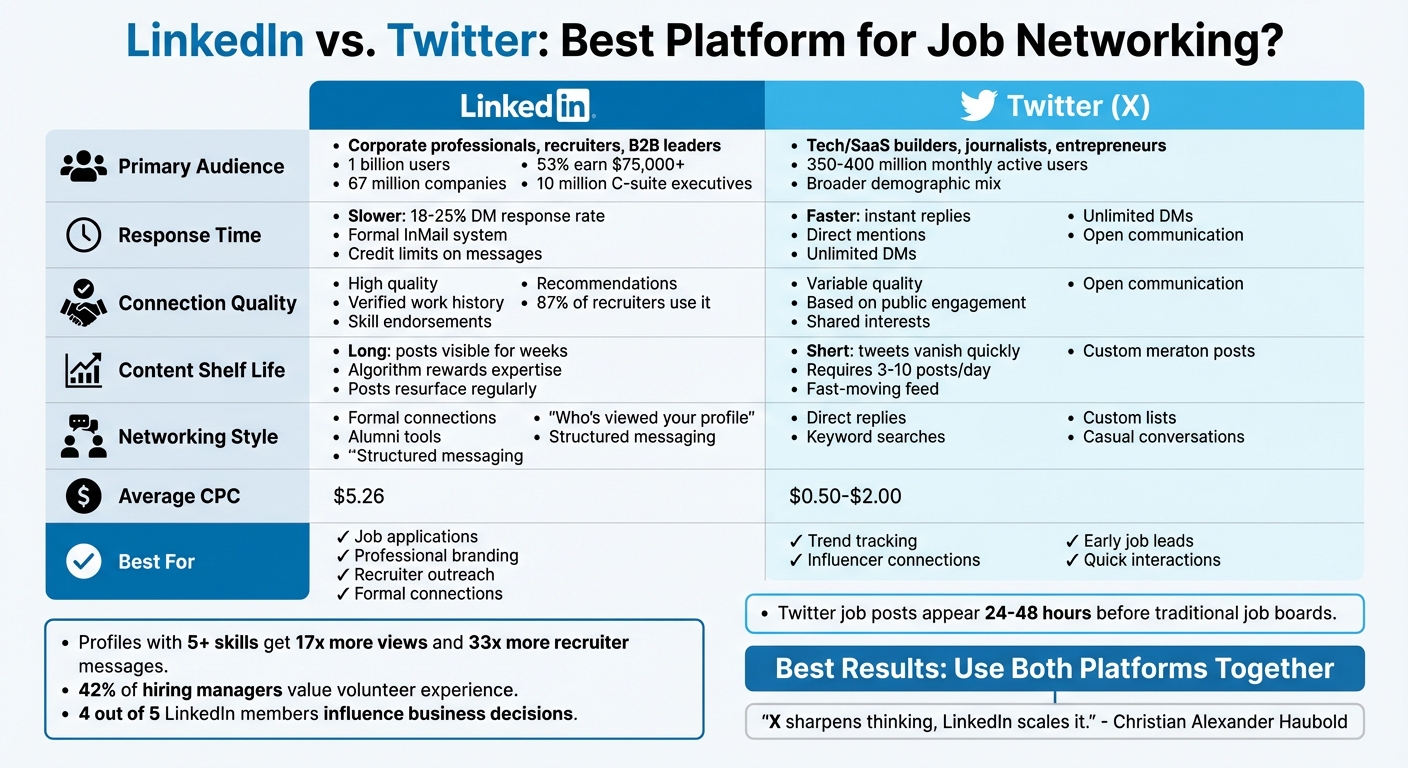
LinkedIn vs Twitter Job Networking Comparison Chart
Deciding between LinkedIn and Twitter comes down to your networking strategies and job search goals. Think of LinkedIn as a professional meeting room - structured, polished, and geared toward building lasting connections. On the other hand, Twitter feels more like a bustling town square - informal, fast-paced, and conversational. Knowing how these platforms differ in key areas can help you focus your efforts where they’ll yield the best results.
Key metrics like response times and content visibility highlight the platforms' strengths. LinkedIn is ideal for meaningful, professional connections, though its response times can be slower. With over 87% of recruiters using LinkedIn to find talent and access to 10 million C-suite executives, it’s a hub for serious professionals. Direct messages (DMs) on LinkedIn have an 18–25% response rate, but the platform’s formal messaging system and InMail credit limits can slow down conversations. Twitter, by contrast, offers quick access to industry professionals with fewer restrictions. Its instant messaging and open communication style allow for more fluid interaction, though the response rate averages a lower 3–5%.
Content longevity is another key difference: LinkedIn posts have staying power, while tweets demand frequent updates. LinkedIn’s algorithm rewards content that demonstrates expertise, with posts, articles, and "Featured" media often resurfacing for weeks. Profiles with detailed summaries (40+ words) and "All-Star" status rank higher in employer searches. On Twitter, the fast-moving feed means tweets quickly vanish unless you post consistently - 3–10 times daily. As Christian Alexander Haubold aptly puts it:
"X sharpens thinking, LinkedIn scales it."
Feature Comparison Table
| Feature | Twitter (X) | |
|---|---|---|
| Primary Audience | Corporate professionals, recruiters, B2B leaders (1 billion users, 67 million companies) | Tech/SaaS builders, journalists, entrepreneurs (350–400 million monthly active users) |
| Response Time | Slower (18–25% DM response rate, formal InMail system) | Faster (direct mentions and unlimited DMs) |
| Connection Quality | High (verified work history, endorsements, recommendations) | Variable (based on public engagement and shared interests) |
| Content Shelf Life | Long (posts and articles resurface for weeks) | Short (requires 3–10 posts/day for visibility) |
| Networking Style | Formal connections, alumni tools, "Who's viewed your profile" | Direct replies, keyword searches, custom lists |
| Average CPC | $5.26 | $0.50–$2.00 |
| Best For | Job applications, professional branding, recruiter outreach | Trend tracking, influencer connections, early job leads |
The platforms also appeal to distinct user demographics. LinkedIn attracts higher-income professionals, with 53% of U.S. users earning $75,000 or more annually. Additionally, 4 out of 5 LinkedIn members influence business decisions, making it a go-to for professional networking. Its fastest-growing audience includes students and recent grads. Twitter, on the other hand, draws a broader audience, including tech enthusiasts, media professionals, and industry influencers.
Understanding these differences can help you strategically combine both platforms for maximum impact.
How to Use LinkedIn and Twitter Together
LinkedIn and Twitter can complement each other to supercharge your job search. By leveraging the unique strengths of both platforms, you can expand your network, engage with industry professionals, and land new opportunities. The secret lies in knowing how to use each platform effectively and transitioning conversations between them.
Share Updates Across Both Platforms
Tailoring your updates for LinkedIn and Twitter helps you reach a broader audience. LinkedIn’s professional tone is ideal for sharing career milestones, industry insights, and published articles. On the other hand, Twitter’s casual style allows for quick, conversational updates. For example, if you’ve written a blog post or achieved a professional milestone, craft a formal version for LinkedIn and a more relaxed, engaging version for Twitter. This way, you connect with different types of audiences while maintaining your professional image.
Optimize your LinkedIn profile to stand out. A precise, skill-focused headline can make a big difference. For instance, instead of a generic title like "Software Engineer", try something more specific: "Software Engineer | Python & Cloud Architecture | Fintech." Meanwhile, on Twitter, use keyword searches to find relevant conversations and engage thoughtfully. As Catherine Fisher, Senior Director of Corporate Communications at LinkedIn, points out:
"You can't sit back and wait for it to happen."
Find Contacts on Twitter, Build Relationships on LinkedIn
Start conversations on Twitter and solidify connections on LinkedIn. Twitter is a great place to discover industry leaders and influencers. Use keyword searches to find relevant discussions, follow key figures, and contribute thoughtful replies. Mallory Woodrow, a Social Marketing Strategist, highlights the value of this approach:
"Giving a compliment with some added insight on the topic goes a long way."
Once you’ve established a connection on Twitter, take the next step by reaching out on LinkedIn. Send a personalized connection request referencing the specific tweet or topic that sparked your interest. Alexandra Levit, Co-founder of the Career Advisory Board, advises:
"A lot of people don't know what to do with a generic message from someone they don't know, so customise it, give it a frame of reference."
Additionally, LinkedIn's alumni tool can help you find professionals from your university. Shared connections and experiences often lead to higher acceptance rates. This shift from casual Twitter interactions to professional LinkedIn connections sets the stage for more meaningful networking.
Track Your Networking Results with Scale.jobs
Tracking your efforts is essential for success. Without a system to monitor your outreach, it’s easy to lose track of who you’ve contacted or how effective your strategy is. Scale.jobs offers tools to streamline this process:
- Free job applications tracker to log every connection request, message, and follow-up across platforms
- Human-verified tracking with proof-of-work screenshots
- Real-time WhatsApp notifications to stay updated on your outreach
- AI Assistant Pro ($9/month launch offer, usually $19/month) for unlimited tailored resumes and cover letters, designed for contacts you meet through networking
- Human Assistant service ($199 for 250 applications) to manage your applications, saving you over 20 hours per week, with refunds for unused credits
Set aside 30 minutes each Friday to review your dashboard metrics. If response rates dip below 2%, tweak your messaging or adjust your resume with real-life examples. If you notice networking referrals are leading to more interviews than direct applications, allocate more time to LinkedIn and Twitter outreach. Set clear weekly goals, like sending five new connection requests and following up with three contacts, and use Scale.jobs to stay consistent and organized.
Which Platform Should You Use?
Choosing the right platform for your job search depends on your specific needs. LinkedIn is the go-to for formal applications and connecting with recruiters, while Twitter shines in real-time networking and staying updated on industry trends. Many job seekers find success by using both platforms strategically. Let’s explore why LinkedIn is ideal for structured job searches and how Twitter can complement it with quick, informal interactions.
Use LinkedIn for Formal Job Searches
LinkedIn is unmatched when it comes to formal job applications. Features like "Open to Work" make it easy to signal your availability to recruiters, who often rely on tools like "LinkedIn Recruiter" to scout talent. A polished LinkedIn profile is your best asset here. As Sarah Jackson, Careers Reporter at Business Insider, puts it:
"The best time to look for work is when you already have a job."
This underscores the importance of maintaining an active and professional LinkedIn presence, even if you're not actively job hunting.
Use Twitter for Quick Connections and Trend Monitoring
Twitter, on the other hand, is all about immediacy. It’s a powerful tool for staying on top of industry trends and making quick connections. By searching for keywords like "social media marketing", you can find and join relevant conversations. Thoughtful engagement in these discussions can help you build relationships that complement the more formal networking you do on LinkedIn.
Best Results: Use Both Platforms with Scale.jobs
Balancing LinkedIn and Twitter can significantly expand your job search reach, but managing both effectively can be overwhelming. That’s where Scale.jobs steps in, streamlining your efforts and keeping everything organized. Here’s how it helps:
- Free Job Applications Tracker: Keeps a log of all your connection requests and follow-ups, ensuring nothing slips through the cracks.
- AI Assistant Pro: For $9/month (introductory offer; later $19/month), you’ll get unlimited, customized resumes tailored to each job application. Using an AI resume builder ensures your documents stand out to hiring managers.
- Human Assistant Service: At $199 for 250 applications, this service handles the entire application process for you, complete with real-time WhatsApp updates and proof-of-work screenshots. It can save you over 20 hours a week, giving you more time to focus on networking and interviews.
FAQs
How can I use LinkedIn and Twitter together for job networking?
To get the most out of your job networking efforts, it’s smart to use LinkedIn and Twitter in ways that play to their individual strengths. On LinkedIn, focus on crafting a polished professional profile that highlights your skills and achievements. Use the platform to connect with industry professionals, engage with posts that align with your field, and join groups where meaningful conversations happen. It’s the perfect space to showcase your expertise and build long-term professional relationships.
Twitter, in contrast, is all about immediacy and staying in the loop with industry trends. Follow thought leaders, jump into relevant discussions, and share your take on trending topics. This approach not only keeps you informed but also increases your visibility in real-time.
By combining these platforms, you can use LinkedIn for cultivating deeper connections and Twitter for making quick, impactful impressions. Together, they can help you expand your network and stand out in the competitive U.S. job market. Remember to stay genuine, consistent, and focused on building meaningful relationships to make the most of these tools.
How do LinkedIn and Twitter differ when it comes to job networking?
LinkedIn and Twitter cater to different aspects of job networking, each offering unique advantages based on their audiences and interaction styles. LinkedIn is designed with professionals, recruiters, and industry leaders in mind. It’s the go-to platform for building meaningful, long-term connections, showcasing your expertise, and participating in career-oriented discussions. Think of your LinkedIn profile as your online resume and portfolio - networking here often involves personalized messages and sharing insightful content to establish your professional credibility. Plus, posts on LinkedIn tend to have a longer shelf life, allowing for deeper and more sustained engagement.
Twitter, by contrast, operates at a much faster pace and leans toward an informal vibe. Its audience includes tech enthusiasts, media professionals, and a broader public. Twitter is perfect for real-time interactions, joining trending conversations, and building your personal brand through quick posts, retweets, and hashtags. While LinkedIn is better suited for intentional, relationship-driven networking, Twitter helps you stay visible and active in ongoing industry discussions.
For job seekers, using both platforms strategically can make a big difference. Leverage LinkedIn for structured, professional networking while turning to Twitter to amplify your voice and keep up with the latest trends in your field. Together, they can help you cover all your bases in the job search landscape.
How does Scale.jobs help with job networking on LinkedIn and Twitter?
Scale.jobs takes the hassle out of job applications on LinkedIn and Twitter by automating repetitive tasks like crafting ATS-friendly resumes and customized cover letters. With human assistants managing your applications in just 12-24 hours, you’re free to focus on what really matters - connecting with professionals, sharing insightful content, and engaging meaningfully on these platforms.
What sets Scale.jobs apart is its personalized approach. Unlike services that rely heavily on automation or lock you into subscriptions, Scale.jobs offers direct support via WhatsApp, complete transparency with proof-of-work, and a simple one-time payment model. This not only saves you valuable time but also boosts your chances of getting responses, turning your social media presence into a powerful tool for career advancement.