Why Letting AI Apply to Jobs Is Costing You Real Interviews
Mass AI-applying creates generic, error-prone resumes that ATS and recruiters flag. Use human editing with AI to create tailored applications that get more interviews.

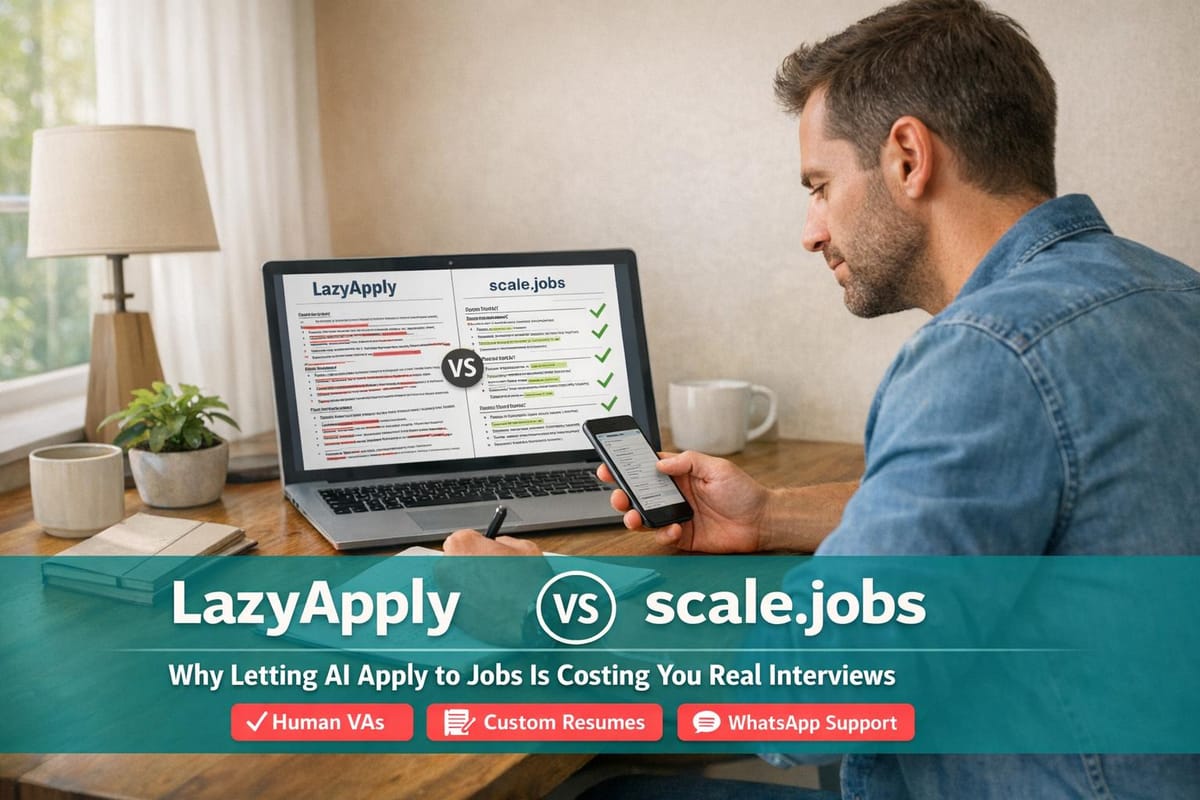
AI-powered tools for job applications, such as LazyApply, Sonara.ai, and Simplify.jobs, promise speed and convenience by automating the process of sending resumes to hundreds of companies. However, these tools often harm your chances of landing interviews. Here's why:
- Generic Applications: AI-generated resumes lack personalization and context, making them blend into a sea of sameness. Recruiters are quick to spot these overly polished, buzzword-heavy submissions.
- Errors and Mismatches: Automated tools frequently include factual mistakes, outdated cover letters, or incorrect details, which can make you appear careless or unprofessional.
- ATS Challenges: Applicant Tracking Systems (ATS) can flag AI-written resumes for keyword over-optimization or "eerie perfection", leading to rejections before a human even reviews them.
- Privacy Risks: Sharing personal information with AI platforms may expose you to data breaches or misrepresentation of your details.
Human-assisted services, like scale.jobs, offer a better alternative by combining human expertise with ATS optimization. These services craft tailored resumes and cover letters, provide proof-of-work, and ensure accuracy, doubling your chances of landing interviews compared to generic AI-generated submissions. In a competitive market, balancing automation with a human touch is essential for standing out. This approach is even more effective when paired with proven networking strategies.
The AI Resume Mistakes Costing You Interviews
What's Wrong with AI-Powered Job Applications
AI tools for job applications might seem like a time-saver, but they could be doing more harm than good. Issues like generic content, mismatched keywords, and privacy concerns can seriously hurt your chances of landing an interview. Let’s dive into how these problems - generic resumes, ATS challenges, and data risks - can derail your job search.
AI Creates Generic Applications That Don't Stand Out
Using AI to craft your resume often results in cookie-cutter applications. Why? Because many candidates rely on the same prompts, producing resumes filled with overused buzzwords like "dynamic", "innovative", and "cross-functional." Instead of standing out, these resumes blend into a sea of sameness.
But it’s not just the wording that’s the problem. AI tools lack the ability to understand the context of your achievements. They can’t highlight how you exceeded sales targets or what made your approach different. As Adam Karpiak, co-founder of Karpiak Consulting, explains:
"AI doesn't understand context. It doesn't know how you got results or what made your impact unique. Without that, your resume might check all the boxes for keyword searches, but it won't connect with a human reader."
This lack of depth means your application misses the chance to include metrics, unique accomplishments, and personal stories - details that make a resume memorable.
On top of that, AI-generated applications often contain errors, like outdated cover letters or incorrect details, which can come across as careless. Recruiters are increasingly spotting these patterns; some estimate that around half of the resumes they review each week show clear signs of AI authorship. These generic submissions not only fail to impress but also create more problems when it comes to ATS filters and privacy concerns.
ATS Systems Reject AI-Generated Applications
The same lack of personalization that makes AI-generated resumes generic also makes them vulnerable to rejection by Applicant Tracking Systems (ATS). Both ATS and human recruiters have become skilled at spotting AI-written content. They look for what recruiter Steve Levy describes as "eerie perfection" - flawless grammar and formatting but no personality.
One major issue is keyword over-optimization. When AI tools overly mimic job descriptions, they can trigger ATS red flags. A safer range is an 80% to 90% keyword match, but copying the job description verbatim into an AI prompt often leads to automatic rejection.
AI's language patterns can also raise suspicions. Phrases like "exceeding stakeholder expectations" or "accelerated time-to-market", combined with overly polished formatting, often signal machine-generated content. Sofia Mishina, Talent Acquisition Director at AI Digital, notes:
"I see resumes that are perfectly formatted and perfectly forgettable - the same buzzwords, same tone, no proof of work."
Even if these resumes make it past ATS filters, they often fall short during human review. Recruiters frequently cross-check resumes with LinkedIn profiles, and any discrepancies in dates, skills, or achievements can lead to immediate rejection. AI's tendency to fabricate - or "hallucinate" - details can create conflicts that make you appear untrustworthy or careless.
Data Privacy Risks and Built-In Bias Problems
Using AI tools to apply for jobs involves sharing personal information with automated platforms, which can expose you to privacy risks. Beyond that, these systems sometimes misrepresent your details, leading to errors that could harm your professional reputation - or even have legal consequences.
AI-driven hiring tools also have a history of amplifying biases. Studies show that these systems may favor male candidates or penalize those with names perceived as "Black-sounding." Some tools even attempt to assess job suitability based on facial expressions or tone of voice during video interviews - methods that lack scientific validity. For example, a journalist speaking only German for an English-language role was rated 73% qualified by an AI video assessment, highlighting the flaws in such evaluations.
The lack of transparency in these systems - often referred to as a "black box" - makes the situation worse. As Hilke Schellmann, author of The Algorithm, explains:
"To a job seeker and a recruiter, the AI is a little bit of a black box. What exactly are the criteria of why people are suggested to a recruiter? We don't know."
This opacity leaves candidates with little recourse if errors occur. Worse, some bots may scrape outdated documents from linked accounts and submit them without your approval. Imagine a 2020 cover letter being sent for a 2024 job opening - an error that could damage your reputation. Recruiter Tony Riggins warns:
"It can completely damage your candidacy, and perhaps even your reputation, if you're a candidate with an application making mistakes."
AI Job Tools vs. Human-Powered Services: A Direct Comparison
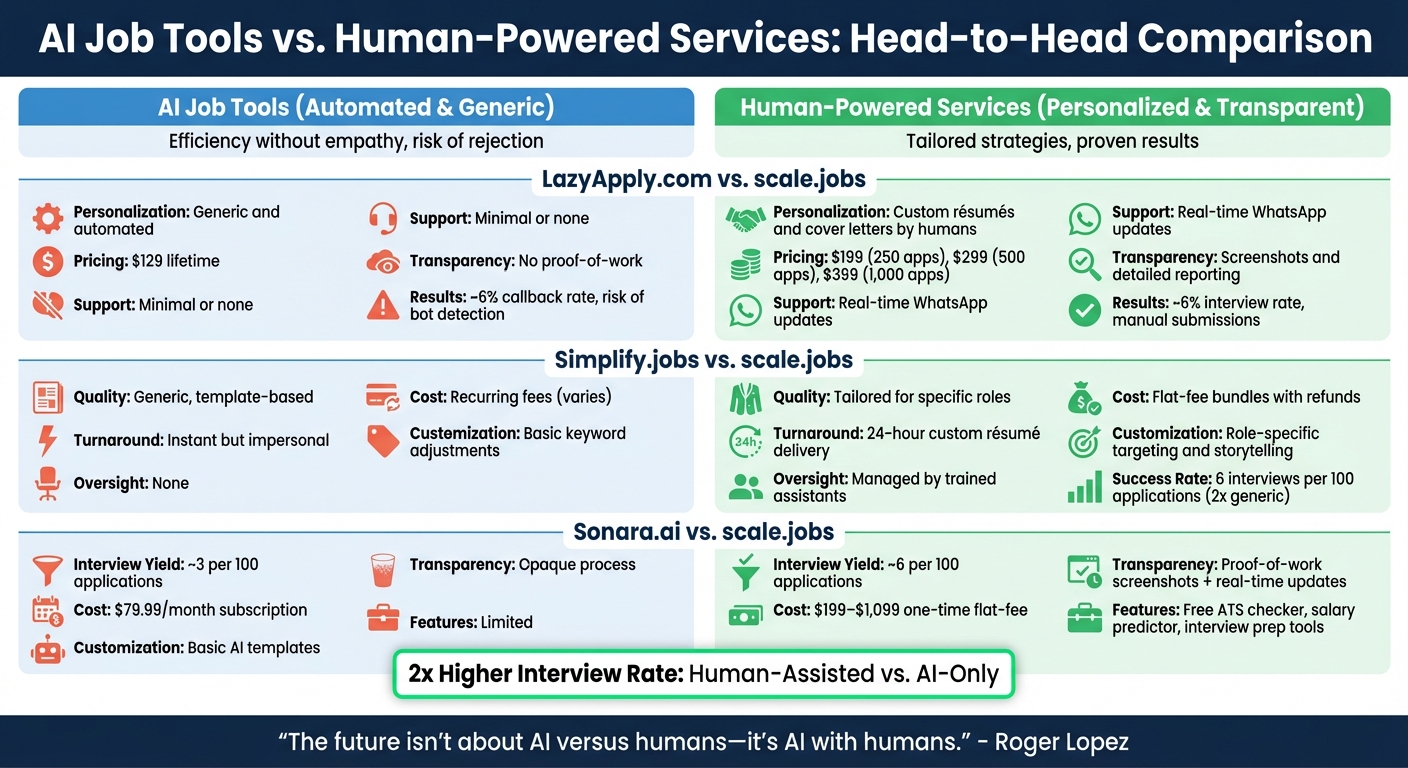
AI Job Application Tools vs Human-Powered Services Comparison
When deciding between AI-driven job application tools and human-powered services, it’s not just about speed - it’s about results. Do you prioritize quantity or quality? And are you willing to risk your professional reputation with automated submissions that recruiters can easily spot? Let’s break down how AI tools like Lazyapply.com, Simplify.jobs, and Sonara.ai compare to scale.jobs' human-assisted approach.
Lazyapply.com vs. scale.jobs: Why Human Assistance Delivers Better Results
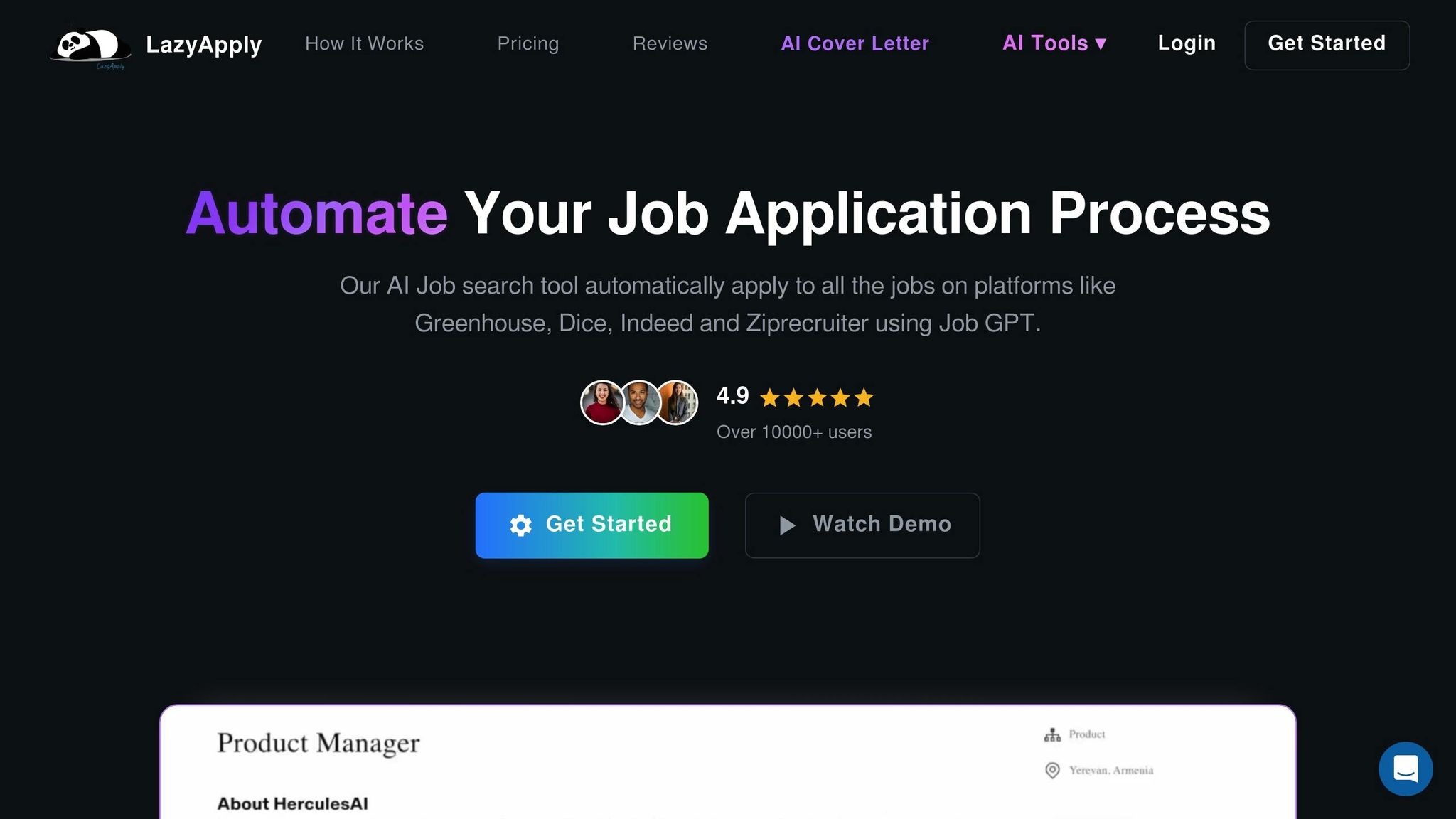
LazyApply claims to send up to 750 applications daily for a one-time fee of $129. However, when Business Insider’s Aki Ito tested the service in March 2024, the results were far from ideal. The tool misrepresented her ethnicity, falsely claimed she spoke Spanish, and sent 27 applications using a 2020 cover letter addressed to "Dear Mr. Carlson" - at the wrong company. Such automated errors can damage your credibility.
Here’s how the two services stack up:
| Feature | Lazyapply.com | scale.jobs |
|---|---|---|
| Personalization | Generic and automated | Custom résumés and cover letters tailored by humans |
| Pricing Model | $129 lifetime | Flat-fee bundles: $199 (250 apps), $299 (500 apps), $399 (1,000 apps) |
| Support | Minimal or none | Real-time updates via WhatsApp |
| Transparency | No proof-of-work | Screenshots and detailed reporting on submissions |
| Results | Risk of bot detection; ~6% callback rate | Manual submissions avoid bot flags; ~6% interview rate |
Why scale.jobs comes out ahead:
- Custom résumés eliminate errors and ensure accuracy, unlike generic automation.
- Real-time updates and proof-of-work screenshots provide transparency and accountability.
- Manual reviews ensure reliable results without risking your professional reputation.
Simplify.jobs vs. scale.jobs: Automation vs. Tailored Precision
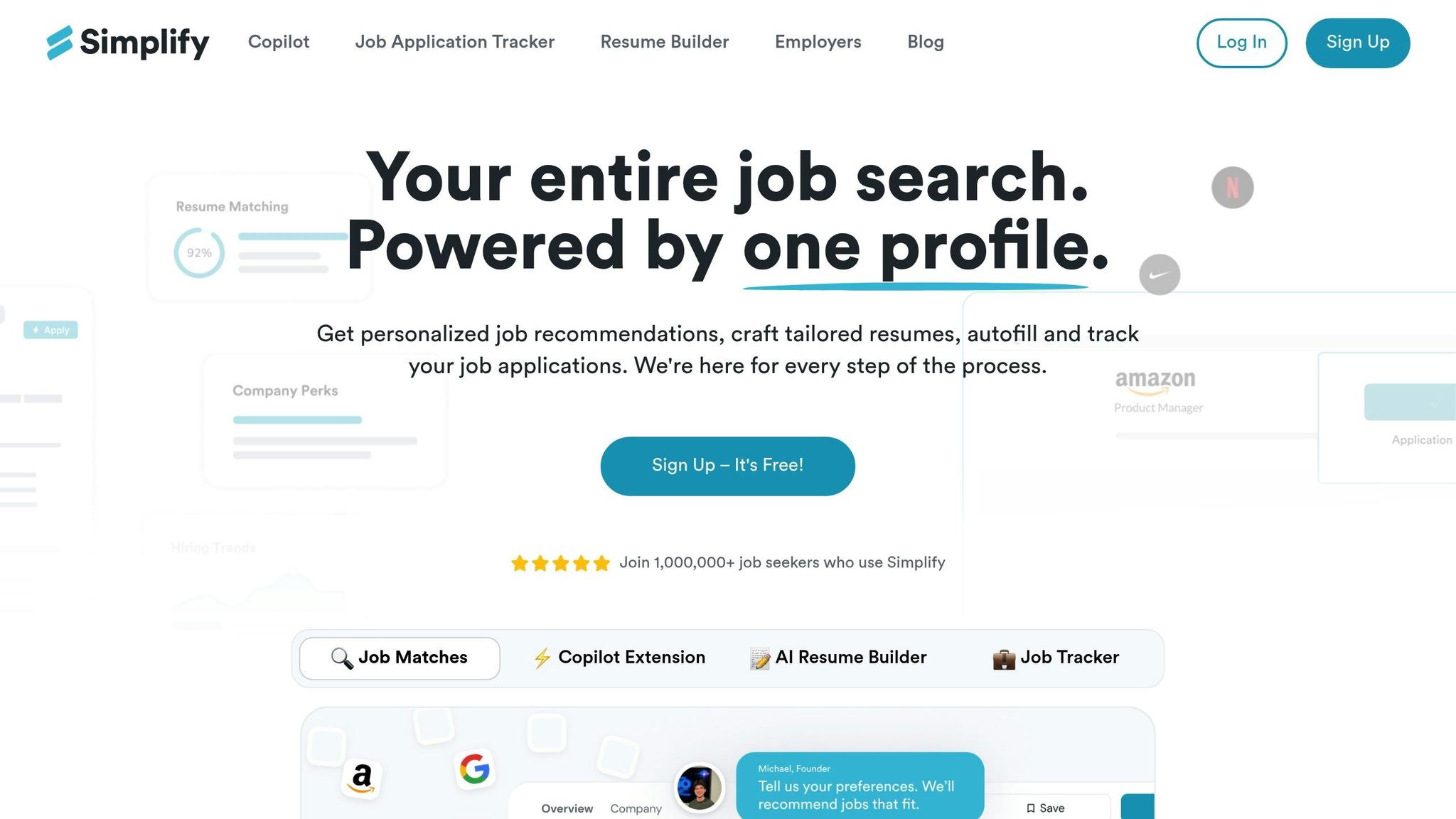
Simplify.jobs offers a Chrome extension that allows for one-click applications. While convenient, the applications remain generic and lack the tailored storytelling that resonates with hiring managers.
Comparison at a glance:
| Feature | Simplify.jobs | scale.jobs |
|---|---|---|
| Application Quality | Generic, template-based | Tailored for specific roles |
| Turnaround Time | Instant but impersonal | 24-hour custom résumé delivery |
| Human Oversight | None | Managed by trained assistants |
| Cost | Recurring fees (varies) | Flat-fee bundles with refunds for unused credits |
| Customization | Basic keyword adjustments | Role-specific targeting and storytelling |
Why scale.jobs leads the way:
- Tailored résumés result in about 6 interviews per 100 applications - double the success rate of generic submissions.
- Specific customization highlights your unique achievements, making your application stand out.
- Flat-fee pricing with refunds for unused credits avoids the ongoing expense of subscriptions.
Sonara.ai vs. scale.jobs: The Value of Human Input
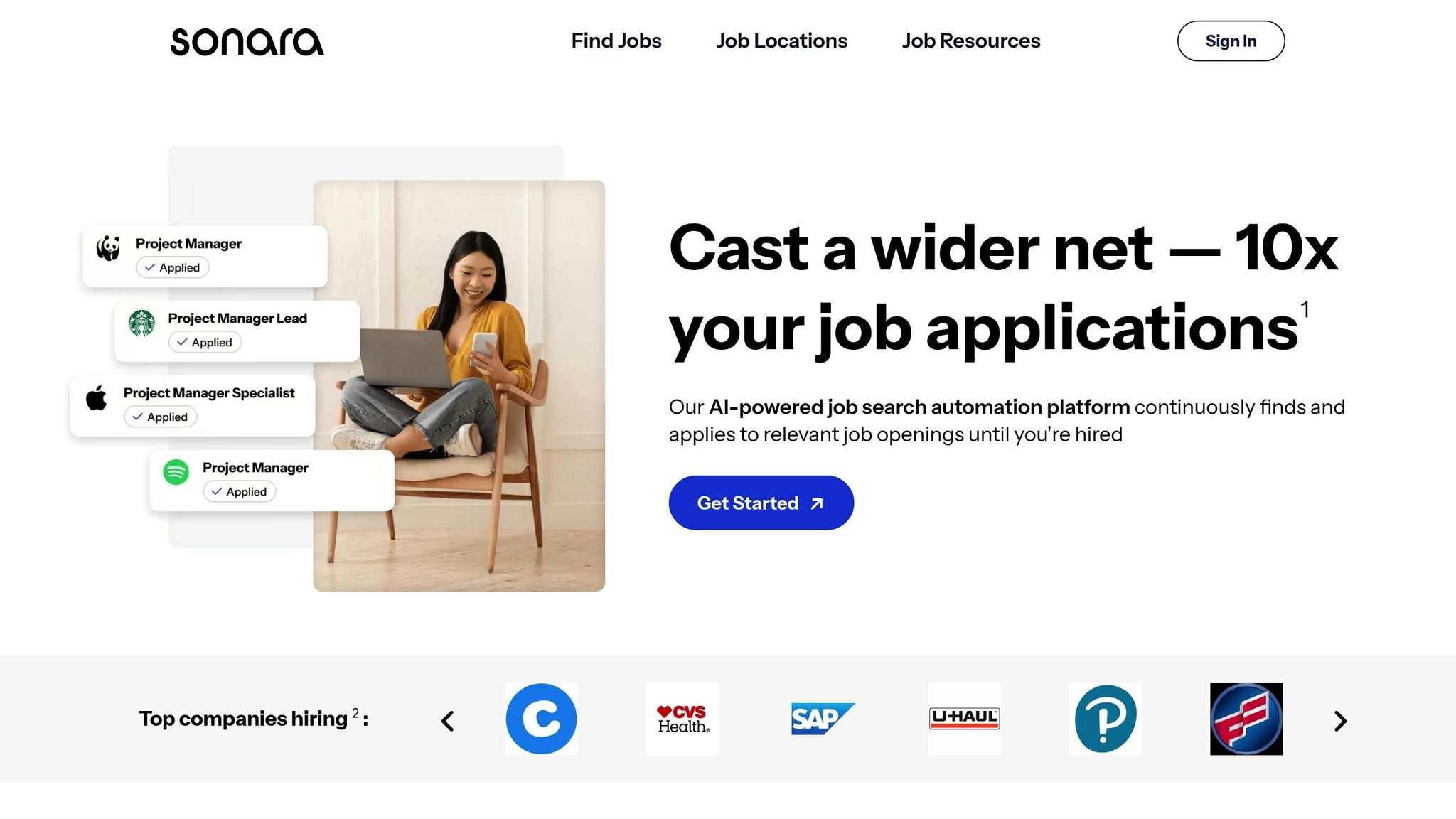
Sonara.ai charges $79.99 per month for its "amplitude" plan, offering up to 420 applications. However, early 2024 saw users reporting service issues and a limited pool of job options. The AI-driven system lacks transparency, making it hard to confirm whether applications are submitted effectively.
Here’s the comparison:
| Feature | Sonara.ai | scale.jobs |
|---|---|---|
| Interview Yield | Low (~3 per 100 applications) | Higher (~6 per 100 applications) |
| Cost | $79.99/month subscription | One-time flat-fee ($199–$1,099 based on volume) |
| Customization | Basic AI templates | Collaboration between humans and AI for depth |
| Transparency | Opaque process | Proof-of-work screenshots and real-time updates |
| Additional Features | Limited | Free ATS checker, salary predictor, and interview prep tools |
Why scale.jobs excels:
- Achieves double the interview rate through human-assisted, targeted customization.
- One-time payment eliminates the need for recurring monthly fees.
- Offers complete transparency with proof-of-work and real-time updates.
The trend toward human-assisted services reflects a broader shift in hiring. As Roger Lopez of National Search Group puts it:
"The future isn't about AI versus humans - it's AI with humans."
Companies relying solely on automated hiring processes face 68% higher turnover rates compared to those using a hybrid human-AI approach. This underscores the importance of the human element in both applying for and filling jobs effectively.
How to Get More Interviews with Human-Centered Strategies
If you're looking to boost your chances of landing interviews, shifting your focus to human-centered strategies is key. By blending thoughtful personalization with intentional outreach, you can stand out in a sea of applications.
Create ATS-Friendly Resumes and Cover Letters
Did you know that over 90% of large employers rely on Applicant Tracking Systems (ATS) to filter resumes? This means your resume has to impress both the algorithm and the human recruiter. Start by keeping your resume clean and easy to read. Stick to a single-column format, use standard fonts, and avoid fancy designs that could confuse the system.
Make sure your language aligns with the job description, aiming for an 80–90% keyword match without directly copying phrases. Be specific about your achievements - saying you “reduced processing time by 30%” is far more effective than a vague “improved efficiency.” Also, include your contact details in the main body of the document rather than in headers or footers, as some ATS tools might overlook these sections.
What really sets your application apart? Personalized, human-driven content. As Adam Karpiak, co-founder of Karpiak Consulting, advises:
"The smartest way to use AI is as an editor, not a ghostwriter. Let it help you tighten your language... but make sure the content, the how and why behind your achievements, comes from your own experience."
Leverage AI tools to refine your wording, but ensure your unique experiences and accomplishments remain front and center. Tailored resumes are nearly twice as likely to land interviews compared to generic ones, generating about 6 interview opportunities per 100 applications.
Start by refining your resume to meet both ATS requirements and human expectations.
Use Proof-of-Work and Real-Time Updates
In a world saturated with AI-generated resumes, proof-of-work can make all the difference. Showcasing tangible examples of your skills - like a product analysis, a portfolio of relevant projects, or a proposal addressing a company’s challenges - can demonstrate your value far better than words alone.
Keep a “brag book” of your accomplishments. Document specific metrics, such as dollar savings, team sizes, and percentage improvements, along with your role in achieving them. This habit not only helps you customize applications quickly but also ensures your submissions are packed with authentic, memorable details that AI can’t replicate.
Additionally, real-time updates on your proof-of-work can reinforce your credibility. For example, our service offers transparent, real-time updates to showcase your work, eliminating the mystery often associated with automated tools.
Once your resume is polished, it’s time to amplify its impact through networking.
Combine Applications with Targeted Networking
Cold applications often feel like tossing your resume into a black hole. In contrast, having a referral can increase your chances of success by 40%. In fact, around 80% of job seekers find positions through networking or personal connections.
After submitting a tailored application through the company’s website (since recruiters often prioritize internal systems), take the extra step to map out the team. Platforms like LinkedIn make it easier to find and connect with team members or hiring managers. Reach out for a quick informational chat or mention your application during your message - this human touch can help your application rise above the rest.
As Kimberly Brown, founder of Brown Leadership, puts it:
"AI can open the door, but relationships get you in the room."
The formula is simple: submit applications backed by research, build meaningful connections, and follow up. A polished resume alone might not be enough to get noticed, but when paired with a warm introduction from someone within the company, it could be the key to landing that interview.
Conclusion: Balance Speed with Personalization in Your Job Search
In today’s fast-paced job market, finding the right balance between speed and personalization can make all the difference. With Americans now experiencing an average unemployment duration of 24.5 weeks - up from 21 weeks the previous year - job seekers are often compelled to send out hundreds of applications. In fact, 63% of applicants submit over 337 applications just to secure a single offer, resulting in a discouraging 2% success rate.
While tools like LazyApply and Sonara.ai promise volume by automating hundreds of applications weekly, they often fall short by generating generic, error-prone submissions that recruiters dismiss. However, abandoning technology isn’t the answer. Instead, platforms like scale.jobs show how to use AI as a supportive tool rather than a one-size-fits-all solution. What sets scale.jobs apart is its focus on combining automation with human expertise, ensuring every application is tailored to highlight your unique achievements. Their trained virtual assistants carefully craft each submission to be ATS-compatible and customized for the role, bridging the gap between efficiency and personalization.
Adding networking and referrals to this strategy can significantly boost your chances. While the average application has a mere 2–3% chance of leading to an interview, targeted and personalized efforts increase that likelihood to 40%. It’s clear that tailored applications consistently outperform generic ones.
Scale.jobs also stands out with its transparent, user-friendly process. You’ll receive real-time updates via WhatsApp, proof-of-work screenshots, and flat-fee pricing starting at $199 for 250 applications - without hidden fees or surprise renewals. Their virtual assistants handle the repetitive, time-consuming task of filling out forms across various platforms, freeing you up to focus on researching companies, networking, and preparing for interviews.
In a competitive landscape, combining the speed of smart automation with the precision of human input is the winning formula for landing more interviews and advancing your career.
FAQs
How can I make my resume stand out when using AI-driven job tools?
To create a resume that grabs attention, leverage AI-powered tools alongside a personalized touch. Focus on customizing your resume to match the specific role you're applying for, rather than depending entirely on generic templates or fully automated systems. These systems often overlook the subtle details that hiring managers appreciate.
Make sure your resume is ATS-compatible by using simple formatting, incorporating relevant keywords, and highlighting measurable accomplishments. For a more polished result, explore services that blend AI technology with human insight, such as those offering personalized reviews and tailored advice. This ensures your resume not only meets technical requirements but also feels genuine and well-suited to the job.
What privacy risks should I be aware of when using AI tools for job applications?
AI-powered job application tools bring privacy concerns to the forefront due to how they manage personal data. These tools often gather sensitive details, such as resumes, social media profiles, and even recorded interviews. Without adequate security measures, this information could be at risk of data breaches or unauthorized access, potentially exposing candidates and companies to significant vulnerabilities.
Moreover, some AI tools may process personal data without obtaining clear consent, raising potential conflicts with privacy laws like GDPR or CCPA. This lack of transparency can lead to legal challenges and erode trust in the hiring process. To safeguard your information, it’s crucial to ensure that any tool you use adheres to strict data protection standards and complies with applicable privacy regulations. Striking the right balance between speed and security is essential for a safe and trustworthy job search experience.
How do human-assisted job application services increase your chances of getting interviews?
Human-assisted job application services give you a better shot at landing interviews by offering tailored, strategic support that goes beyond what AI tools can achieve. While AI is great at handling large numbers of applications quickly, it often falls short when it comes to capturing the personal story, role-specific details, and emotional appeal that resonate with hiring managers. Human experts step in to create resumes and cover letters that are not only customized but also highlight your standout achievements, making sure your application aligns seamlessly with the job’s requirements.
These services also offer real-time feedback and one-on-one coaching, helping you sharpen your approach and make a stronger impression in today’s competitive job market. On top of that, they can guide you through targeted networking strategies, an essential step for building connections and securing interviews. By blending human expertise with efficiency, these services help you present yourself in a way that feels both genuine and strategic, giving you a clear advantage over generic, AI-generated applications.