Jobscan Didn’t Get You Interviews? Why Some People Switch to Scale.jobs
Compare Jobscan's ATS resume scoring with Scale.jobs' human-led submissions, real-time proof, and flat-fee application support.


If you’ve optimized your resume with Jobscan, achieved a high ATS match score, and still aren’t landing interviews, you’re not alone. Many users face challenges beyond keyword optimization, such as navigating high application volumes and limited recruiter engagement. This is where Scale.jobs steps in, offering a human-driven approach to job applications.
Key Takeaways:
- Jobscan focuses on helping you optimize resumes for ATS but leaves application submissions and recruiter outreach to you.
- Scale.jobs provides trained assistants who handle everything from tailoring your resume to submitting applications and tracking progress in real-time.
- Scale.jobs offers a one-time fee starting at $199 for 250 applications, compared to Jobscan’s recurring subscription costs.
For job seekers juggling high volumes of applications or needing personalized support, Scale.jobs offers a more hands-on solution, saving time and increasing transparency. Below, we’ll break down how these platforms compare and which might work best for your job search.
What Jobscan Does Well and Where It Falls Short
Where Jobscan Works
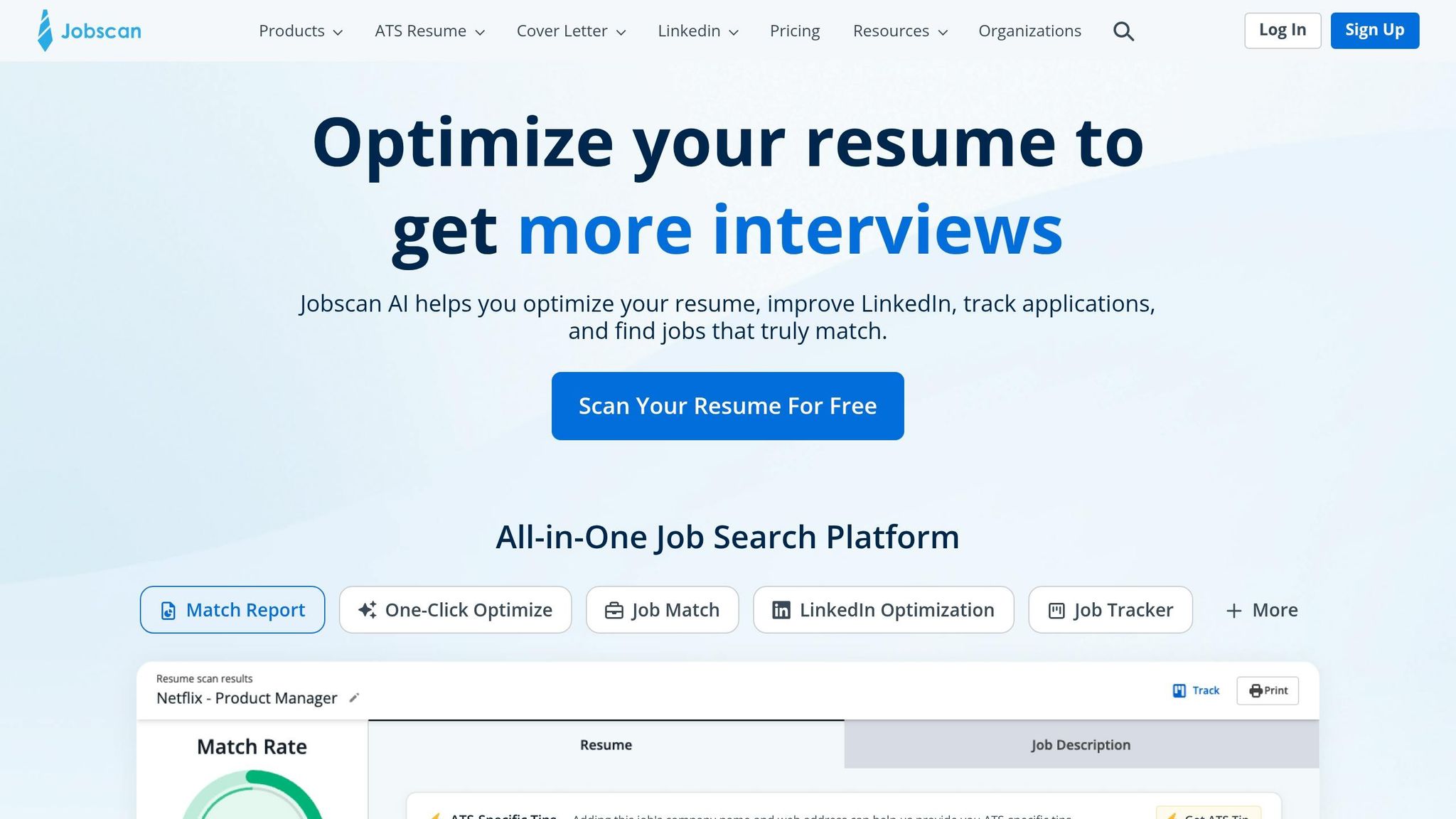
Jobscan is particularly strong when it comes to evaluating ATS (Applicant Tracking System) compatibility. Its real-time scoring feature compares your resume with specific job descriptions, pinpointing missing keywords and formatting issues that could lead to rejection. The platform provides detailed feedback, offering suggestions on which skills and terms to add. It even includes industry-specific templates tailored to meet common ATS standards.
For job seekers who prefer a DIY approach, the keyword optimization tool is a standout. It helps identify technical gaps, such as missing certifications or software proficiencies, that might otherwise go unnoticed. This makes Jobscan especially appealing for those targeting technical roles. The platform is also user-friendly, making it accessible for a wide range of users. However, its functionality doesn’t extend beyond resume optimization, leaving the rest of the application process up to you.
Where Jobscan Doesn't Deliver
While Jobscan excels at resume optimization, it doesn’t provide support for managing the actual job application process. Unlike Scale.jobs, which offers human-assisted vs. automated job applications, Jobscan stops at keyword optimization. It doesn’t handle application submissions or provide personalized, human-led guidance. This means users are left to track and manage their applications independently.
Another limitation is its focus on automated matching. While a high ATS score might seem promising, it doesn’t guarantee that your resume will resonate with recruiters. Research shows that 80% of recruiters value authenticity, which can be difficult to achieve through automation alone. This is a key area where Jobscan falls short, especially for those who need a more tailored, human touch.
Lastly, Jobscan operates on a subscription model, which might not suit everyone. If your job search is intermittent or spans a long period, the recurring fees can add up. For individuals looking for a more hands-on, comprehensive approach, relying solely on automated tools like Jobscan may not provide the best value.
Next, we’ll take a closer look at how Scale.jobs addresses these shortcomings by offering human support throughout the entire job application process.
sbb-itb-564272e
Scale.jobs: Human Assistants Handle Your Applications
Trained Assistants Create and Submit ATS-Optimized Resumes
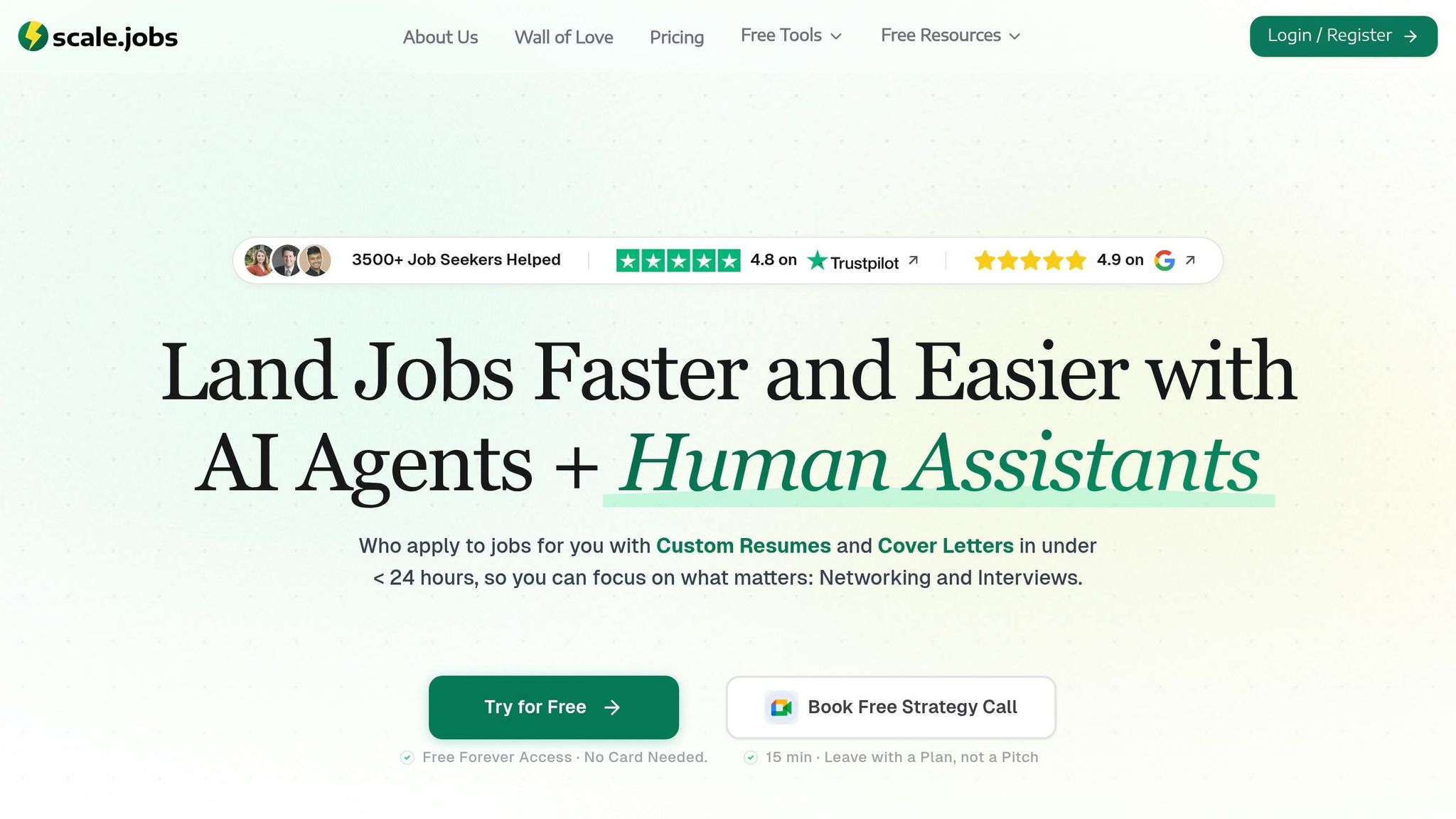
At Scale.jobs, your entire application process is managed by trained human assistants. From customizing your resume to submitting it directly through job portals, they handle it all. Unlike Jobscan, which provides automated keyword suggestions that you need to implement yourself, Scale.jobs takes a hands-on approach. Their team reviews each job description and adjusts your resume to include key terms, such as Python, AWS, or Docker, ensuring it aligns with what applicant tracking systems (ATS) require.
These assistants use ATS-friendly templates, sticking to standard fonts and avoiding elements like graphics or tables that could confuse the system. Dates are formatted in the MM/DD/YYYY style commonly used in the U.S., making your application even more ATS-compatible. If you’re considering professional resume writing services, this comprehensive approach ensures every detail is covered, making your application process seamless and efficient.
Real-Time Updates and Proof of Work
One of the standout features of Scale.jobs is the transparency they offer. For every application submitted, you receive a time-stamped WhatsApp screenshot (e.g., 2:00 PM from Google Careers) showing confirmation details and links to the portals. This level of accountability eliminates the uncertainty many job seekers face when using automated tools.
WhatsApp also becomes your space for real-time collaboration. Assistants share resume edits for your approval, answer any questions you might have about job postings, and provide daily updates on submission progress. A shared dashboard tracks everything - from application statuses to interview requests and follow-ups - giving you a clear view of where you stand. This human-driven attention to detail ensures nothing slips through the cracks, setting Scale.jobs apart from Jobscan's more do-it-yourself approach.
One-Time Payment Instead of Monthly Subscriptions
Scale.jobs uses a straightforward pricing model, charging a one-time fee starting at $199 for 250 applications or $299 for 500 applications. In comparison, Jobscan operates on a subscription basis, with monthly fees of $49.95 for Premium or $89.95 for Ultra. With Scale.jobs, you avoid auto-renewals and unpredictable costs, making budgeting easier.
Even better, if you land a job before using all your applications, you’re eligible for a pro-rata refund on any unused credits. This one-time payment approach is not only cost-effective but also aligns with the platform's commitment to transparency and comprehensive support, making it an excellent option for job seekers who want to avoid subscription fatigue while receiving top-notch assistance.
Who Should Use Jobscan vs Scale.jobs
Let's break down who benefits most from each platform based on your job search needs and circumstances.
When Jobscan Makes Sense
Jobscan is a great fit for independent job seekers and career changers who are comfortable navigating applicant tracking systems (ATS). It's particularly useful for tech-savvy professionals in fields like engineering, IT, or data science. If you're applying to major corporations like Amazon, Google, or JPMorgan Chase and submitting around 5–10 applications per month, Jobscan's keyword-matching capabilities can help you tailor your resume effectively.
This platform works well for those who can dedicate 10+ hours a week to refining their applications. Over the course of a long job search, the subscription model can prove to be a cost-efficient tool for fine-tuning your resume and cover letters.
When Scale.jobs Is the Better Choice
On the other hand, Scale.jobs is a better choice for those who have limited time or need documented proof of their job search efforts. If you're sending out 50+ applications and working full-time, with only about 5 hours a week to spare for job hunting, Scale.jobs can be a lifesaver. Their team handles resume optimization and application submissions, allowing you to focus on networking and interview preparation.
Scale.jobs is particularly beneficial for visa-sponsored candidates who must provide detailed proof of their job search to meet immigration requirements. Their real-time WhatsApp-based updates include screenshots with timestamps, company names, and submission dates - offering a level of documentation that automated tools like Jobscan don't provide.
If you've been using Jobscan but aren't landing interviews, Scale.jobs might offer a fresh approach. Their human review process can identify resume issues or strategic gaps that automated tools might overlook. Additionally, their one-time payment model, ranging from $199 to $399, avoids recurring subscription costs. Plus, if you secure a job before using all your purchased applications, they offer a pro-rata refund. For those seeking end-to-end support, Scale.jobs also provides professional resume writing services.
Up next, explore our feature comparison to see how these platforms stack up against each other.
Jobscan vs Scale.jobs: Feature Comparison
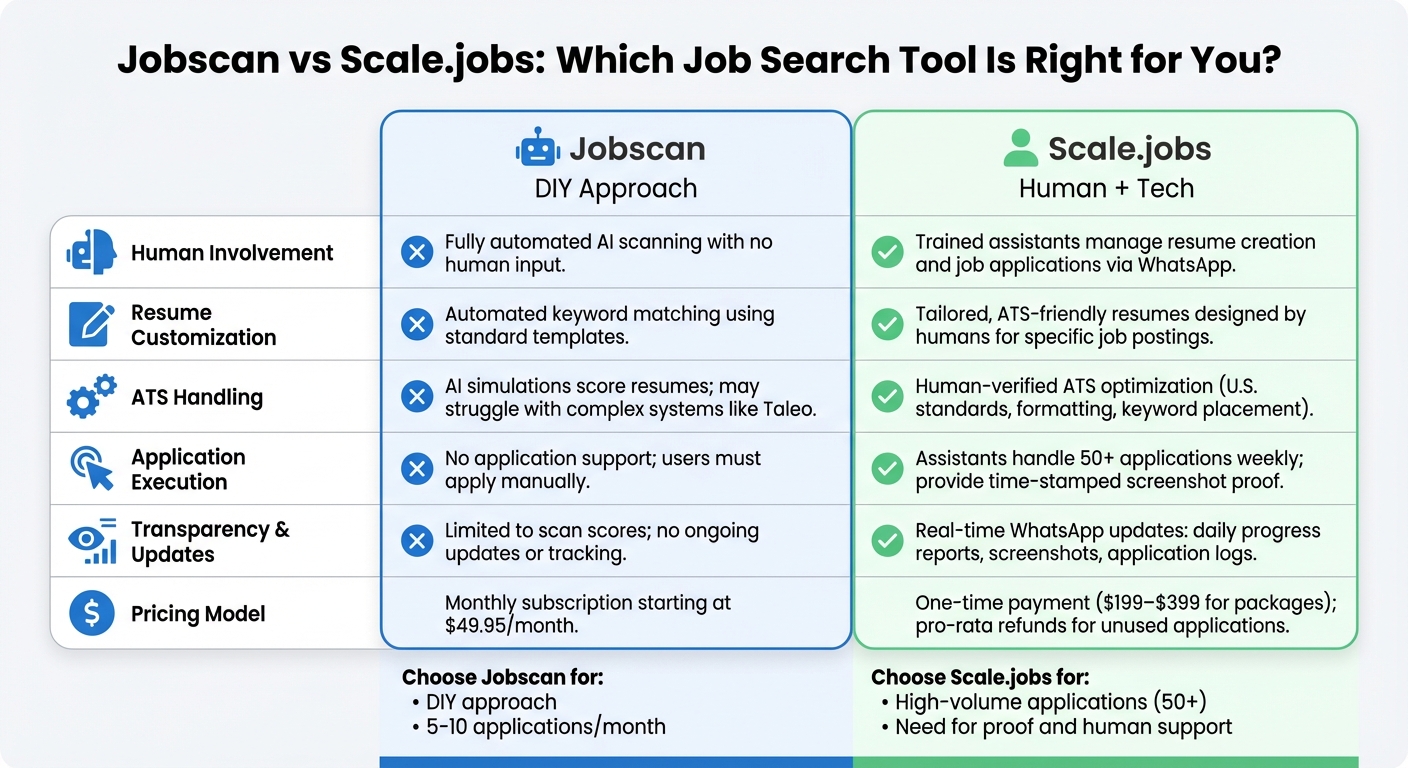
Jobscan vs Scale.jobs Feature Comparison for Job Seekers
When it comes to boosting your chances of landing interviews, the right tools and services can make all the difference. Below is a detailed comparison of Jobscan and Scale.jobs, focusing on the features that directly impact your job search success.
| Feature | Jobscan | Scale.jobs |
|---|---|---|
| Human Involvement | Fully automated AI scanning with no human input | Trained assistants manage resume creation and job applications via WhatsApp |
| Resume Customization | Automated keyword matching using standard templates | Tailored, ATS-friendly resumes designed by humans for specific job postings |
| ATS Handling | AI simulations score resumes but may not navigate complex systems like Taleo effectively | Human-verified ATS optimization, including formatting to U.S. standards (e.g., MM/YYYY dates, natural keyword placement) |
| Application Execution | No application support; users must apply manually | Assistants handle 50+ applications weekly, providing time-stamped screenshots for proof |
| Transparency & Updates | Limited to scan scores; no ongoing updates or tracking | Real-time updates via WhatsApp, including daily progress reports, screenshots, and application logs |
| Pricing Model | Monthly subscription starting at $49.95/month | One-time payment ($199–$399 for packages), with pro-rata refunds for unused applications |
Jobscan offers tools to optimize your resume through automated keyword analysis, leaving the application process entirely in your hands. In contrast, Scale.jobs provides a comprehensive, hands-on service that covers everything from creating tailored resumes to submitting applications while keeping you informed every step of the way.
For job seekers, this distinction is crucial. Automated tools like Jobscan may improve your resume's keyword match score, but they can't replicate the precision and strategic adjustments that human experts bring to the table. This often explains why even a high-scoring resume may fail to result in callbacks.
Moreover, Scale.jobs stands out for its proof-based tracking system, a feature particularly useful for those needing documentation for visa applications or unemployment claims. While Jobscan's score reports offer some insights, they can't match the accountability provided by Scale.jobs' screenshot-based updates.
When your job search demands personalized attention and documented results, Scale.jobs offers a level of service that automated tools simply can't achieve.
Switch to Scale.jobs If...
Here are some clear reasons why switching from Jobscan to Scale.jobs might be the right move for you:
You Need to Submit Many Applications with Proof
If your job search involves applying to hundreds of roles, Scale.jobs is designed to handle high-volume applications while keeping you informed every step of the way. The platform supports up to 1,000 applications per campaign, with trained assistants managing each submission and providing real-time, time-stamped proof via WhatsApp. For instance, a software engineer reported a 15% interview success rate after submitting 300 applications - out of over 500 - thanks to personalized ATS adjustments and detailed tracking. This approach ensures transparency and avoids the "black hole" rejections often associated with Jobscan's automated, untracked process.
You Prefer Predictable Costs Over Monthly Fees
Scale.jobs offers a straightforward pricing model: a one-time fee of $497 for up to 1,000 fully supported applications. This eliminates the uncertainty of recurring charges, making it an appealing option for those undertaking a focused two-month job search. Most campaigns on Scale.jobs are completed within eight weeks, making the flat fee more economical compared to Jobscan's subscription-based model.
Automated Tools Haven't Led to Interviews
If you've achieved high ATS scores using tools like Jobscan but still aren't landing interviews, the problem may lie in overlooked formatting and customization details. Automated scanners often miss subtle issues, such as incorrect date formats, keyword overuse, or missing contextual information. Human review can identify about 40% more ATS-related problems than automated tools. Scale.jobs addresses these gaps through a collaborative, iterative process. For example, a marketing professional who switched after using Jobscan for months secured five interviews following 100 applications with Scale.jobs, crediting the WhatsApp-based feedback loop for catching nuances that automated systems missed. If you're also exploring professional resume writing services, Scale.jobs goes beyond document creation by combining human expertise with full application execution.
Which Tool Should You Choose?
Deciding between Jobscan and Scale.jobs depends on your job search style and needs. Jobscan is ideal for those who prefer a hands-on, DIY approach, while Scale.jobs caters to those looking for a mix of automation and human oversight to manage high-volume applications.
Stick with Jobscan If...
Jobscan works best if you're someone who likes having complete control over tweaking your resume and handling applications yourself. It's a great choice for targeting a smaller number of highly specific roles - think 10 to 20 carefully chosen positions. The platform’s subscription model is particularly useful if your job hunt spans several months, as it provides detailed feedback and real-time scoring to fine-tune your applications. This process is driven by understanding ATS scoring algorithms to ensure your resume ranks highly. For instance, IT professionals have praised Jobscan, giving it 5/5 stars for its keyword optimization capabilities. If you're confident in reading and acting on ATS feedback and prefer to manage the process on your own, Jobscan is a solid choice.
On the other hand, if the idea of manually managing dozens - or even hundreds - of applications feels overwhelming, Scale.jobs might be a better fit.
Go with Scale.jobs If...
Scale.jobs is tailored for job seekers facing high application volumes but unwilling to compromise on quality. It’s designed for those who want human support to handle submission tasks while ensuring ATS-friendly resumes. Unlike Jobscan’s subscription model, Scale.jobs offers a flat-fee structure, which removes the guesswork from budgeting - especially helpful if automated tools haven’t been enough to land interviews. With reports suggesting that 80% of hiring managers dismiss AI-only applications, Scale.jobs bridges the gap by combining automation with human review.
The platform stands out with features like real-time updates via WhatsApp and proof-of-work screenshots, offering transparency that Jobscan may lack. Additionally, it integrates services like professional resume writing services vs AI tools, so you don’t need to juggle multiple vendors. If you’re looking for a blend of hands-off convenience and hands-on attention to detail, Scale.jobs delivers the support you need for a more streamlined and effective job search.
FAQs
How do assistants access my job accounts safely?
Assistants handle your job applications with care, using processes led by real people to ensure everything is done securely. They keep you in the loop with real-time updates through WhatsApp and provide proof of submission for complete transparency. Throughout it all, they prioritize the security and privacy of your account, giving you peace of mind.
What jobs should I exclude from my application list?
When searching for opportunities, it’s important to filter out roles that don’t match your qualifications, career aspirations, or those that rely heavily on generic, high-volume applications. Instead, prioritize positions where a tailored, thoughtful application can make a real impact - such as competitive roles or those requiring specialized expertise. Steer clear of jobs with vague descriptions, low growth potential, or outside your skill set. This approach not only saves time but also boosts your chances of landing a role that truly aligns with your goals.
How do you prevent ATS issues across different portals?
To avoid problems with Applicant Tracking Systems (ATS), make sure your resume is ATS-friendly by sticking to a single-column format, using standard fonts such as Arial or Calibri, and organizing content under straightforward headings like "Work Experience" and "Education." Incorporate keywords from the job description to match the role's requirements and submit your resume in widely accepted formats like .docx or PDF. Stay away from using graphics or tables, as they can confuse ATS software. Platforms like Scale.jobs integrate these best practices with expert insights to create resumes tailored for specific job portals, minimizing rejection risks and ensuring better system compatibility.